Health-Related Quality of Life (HRQoL) refers to the fraction of quality of life that is related to health and care.Reference Martinez-Martin1 In this present study, we mainly stated the HRQoL from the physical and mental health dimensions. Since the coronavirus disease 2019 (COVID-19) pandemic broke out, it has greatly affected people’s physical and mental health, as well as many aspects of the global, public, and private property.Reference Xiong, Lipsitz and Nasri2–Reference Alkhamees, Alrashed and Alzunaydi4 COVID-19 pandemic has caused a large number of infections and deaths around the world without effective treatment.Reference Palacios Cruz, Santos and Velázquez Cervantes5 The uncertainties and fears associated with the COVID-19 outbreak, along with mass lockdowns and economic recession were predicted to lead to increased anxiety, depression, post-traumatic stress disorder, and psychological distress.Reference Xiong, Lipsitz and Nasri2, Reference Tee, Tee and Anlacan6 These psychiatric symptoms were also reported after SARSReference Maunder7 and H1N1 epidemicReference Douglas, Douglas and Harrigan8 and study has indicated 24 months after exposure to the Wenchuan earthquake, sleep disorders and depression still existed in adolescents,Reference Fan, Zhou and Liu9 which showed that the psychological effects of disaster may persist for a long time.
Many researchers have realized that developing an effective COVID-19 vaccine is crucial to control the spread of the pandemic.Reference Sharma, Sultan and Ding10–Reference Dai, Zheng and Xu12 As of April 9, 2021, the number of COVID-19 vaccines in pre-clinical development was 186 and the number of vaccines in the clinical phases of testing was 87.13 During the time of our investigation (November 22-November 28, 2020), Chinese-made COVID-19 vaccines were on-going phase-3 clinical trials, and starting December 15, some high-risk groups (those who engaged in handling imported cold-chain products, customs officers, medical workers and people working in public transport and fresh markets) were vaccinated against COVID-19. After that, China would vaccinate the population as widely as possible and gradually build an immune barrier in the whole population to control the epidemic.14 To prevent the virus infection effectively, it’s important that enough people are vaccinated.Reference Kreps, Prasad and Brownstein15 As of April 10, 2021, 164.47 million doses of COVID-19 vaccines have been administered among 1.4 billion Chinese people.16 Based on the principle of voluntary vaccination, most general people were uncertain about whether to receive the COVID-19 vaccine.Reference Detoc, Bruel and Frappe17–Reference Lin, Hu and Zhao19 Vaccine hesitancy as a potential threat to the achievements of vaccination challenges the establishment of the immune barrier in the whole population.
Most of the studies on the factors affecting vaccination intentions focus on people’s beliefs about side effects, safety, and effectiveness of the vaccine, etc.Reference Pogue, Jensen and Stancil20, Reference Prematunge, Corace and McCarthy21 However, few studies have concentrated on investigating the relationship between HRQoL and the willingness of COVID-19 vaccination. Previous studiesReference Graffigna, Palamenghi and Boccia22, Reference Barello, Guida and Leone23 suggested that patients’ health engagement can improve the level of HRQoL and citizens’ health engagement was positively related to the intention to vaccinate. So, is there a correlation between HRQoL and the willingness of COVID-19 vaccination? Furthermore, studiesReference Dattalo, Giovannetti and Scharfstein24, Reference de Jong, Munneke and Jansen25 indicated that people who were in better physical health were more likely to engage in health promotion. They may promote health through vaccination. Based on these, we conducted this study to explore the association between HRQoL and the willingness of COVID-19 vaccination. Our study may extend the knowledge about the HRQoL and the willingness of vaccination and provide supporting information for government and health policymakers in developing programs and delivering services to promote the COVID-19 vaccine uptake.
Materials and Methods
Study Design and Participants
Due to pandemic restrictions, a stratified random sampling method was difficult to implement in the present study. Thus, we used online self-administered questionnaire with a convenience sampling method for data collection. Criteria for recruitment were all adults who were able to understand and read Chinese. Based on an online survey, the study collected data from 1569 participants. Then, data cleansing was carried out by 2 investigators, and data from 1461 participants were selected after eliminating invalid and incomplete questionnaires. Participants could not advance to complete this study questionnaire without completing the online informed consent, and the study was approved by the research ethics committee of Henan University.
Data collection
The questionnaire was built using the web-based survey tool named wenjuanxing (a widely used website for conducting surveys and creating a link in China), and the link of the questionnaire was distributed by our team members via WeChat, QQ, and Sina (popular social platforms in China). The questions were first pre-survey and were revised and finalized based on suggestions from pre-respondents. All participants completed the questionnaire which was developed in Chinese by clicking on the link (https://www.wjx.cn/jq/104679159.aspx) from November 22-November 28, 2020, and the respondents were advised to share this link with their friends and families via WeChat, QQ, and Sina to find more participants. In this way, the survey almost encompassed all provincial-level administrative regions in mainland China. To control the validity of the questionnaire, we set that participants can only answer once through the same device (mobile phone, computer, or tablet). In addition, several supervisors verified the authenticity of the data.
Questionnaire
At first, the participants were asked to report their socio-demographics characteristics, health-related characteristics, and vaccine-related items. Then, they completed the SF-12 questionnaire regarding their own HRQoL.
Socio-demographics characteristics and health-related characteristics were obtained from the respondents directly. Socio-demographics characteristics included gender, age, marital status, ethnicity, education, workplace, and residence. The item whether the residence belongs to a medium-risk and high-risk district or not was also included (considering COVID-19 onset time and pandemic situation, the Chinese government takes the county, district, township, community as the basic units to classify the disease areas; with the change of the pandemic situation, dynamic risk level adjustment is carried out based on analysis and judgement). Health-related characteristics included the conditions of chronic diseases, respiratory diseases, and having contact with someone positive for COVID-19 (Table 1).
Association between the willingness of COVID-19 vaccination and each of subgroups (n = 1461)

Due to rounding, not all percentages of the categorical variables add up to 100%;
Data presented are n(%) or Mean (SD);SD: standard deviation;
Single: unmarried, divorced, or widowed;
*Fisher’s exact probability method;
PCS: physical component summary; MCS: mental component summary;
Immediate vaccination: people who were willingness to receive the COVID-19 vaccine immediately;
Hesitant vaccination: people who hesitated to receive the COVID-19 vaccine;
Reluctant vaccination: people who refused to receive the COVID-19 vaccine.
Vaccine-related variables included if participants receive the influenza vaccine during the COVID-19 pandemic and have confidence in Chinese-made COVID-19 vaccine or not. The roll-out extent of Chinese-made COVID-19 vaccine that participants conceived and the willingness of COVID-19 vaccination were also included. These items that we chose were based on previous population-based studies,Reference Larson, de Figueiredo and Xiahong26, Reference Dror, Eisenbach and Taiber27 representing their cognition and attitude toward the vaccine.
In our study, the participants were asked to evaluate their HRQoL using the Chinese version of the 12-item Short Form Survey (SF-12), which was translated from the standard English version of SF-12. SF-12 was a simplified version of SF-36,Reference Ware, Kosinski and Keller28 and was widely used because of its small number of items and short testing time. The answers to this 12-item scale allowed calculation of Physical Component Summary (PCS) and Mental Component Summary (MCS) scores. Scores ranged from 0 (worst)-100 (best), with higher scores indicating better HRQoL. The PCS and MCS scores were calculated according to the report of Ware et al.Reference Ware JE and Keller29 The standard SF-12 was valid and equivalent to SF-36 for the Chinese.Reference Lam, Tse and Gandek30, Reference Shou, Ren and Wang31
Statistical analysis
All data analyses were conducted in SPSS version 26.0 (SPSS Inc, Chicago, IL) software. Frequency and percentage were used for socio-demographics characteristics, health-related characteristics, and vaccine-related items, while means and standard deviation (SD) were presented for SF-12. Chi-square tests were used to compare the relationship between categorical variables and vaccination intention (the willingness of COVID-19 vaccination) and one-way ANOVA was used to assess the association between HRQoL and the willingness of COVID-19 vaccination. Multivariate logistic regression was used to assess the relationship between socio-demographics characteristics, health-related characteristics, vaccine-related items, HRQoL, and the willingness of COVID-19 vaccination. The willingness of COVID-19 vaccination was assigned as a dependent variable, whereas the socio-demographic characteristics (Table 1), health-related characteristics (Table 1), vaccine-related items (Table 1), and the scores of SF-12 were independent variables. The scores of SF-12 were converted into Z scores (Z-score standardization) for multivariate logistic regression models. We also calculated adjusted Odds ratios (ORs) for the scores of SF-12, with adjustments for potential confounders, such as gender, age, marital status, ethnicity, education, workplace, and residence. ORs with 95% confidence intervals (CIs) were calculated. The statistical significance level was set at α=0.05.
Results
Characteristics of Participants
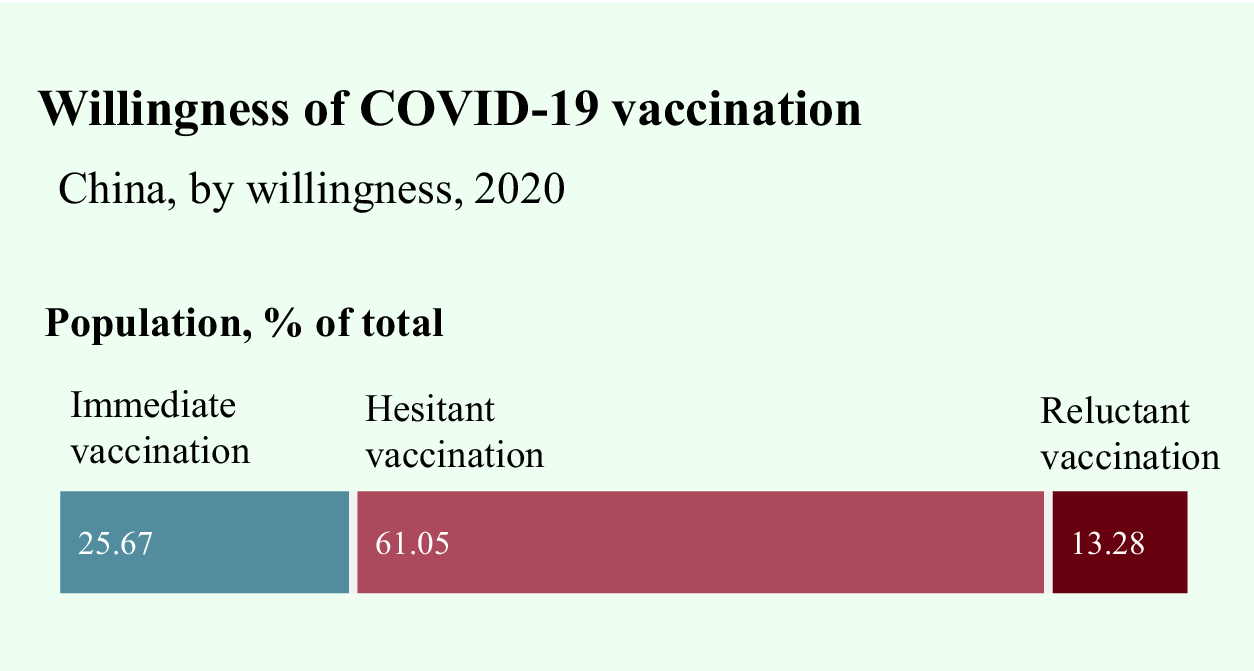
In this study, 1461 respondents were included, with their ages ranging from 18-70 years (mean age ± SD of 26.5 ± 9.4 years). 448 (30.7%) were males and 1013(69.3%) were females. Among them, 325 (22.2%) were married and 1136 (77.8%) were single, including those who never married, got divorced, and were widowed. Overall, only 123 participants (8.4%) have received junior high school education or below and 447(30.6%) had a high risk of COVID-19 infection in their workplaces (those who engaged in handling imported cold-chain products, customs officers, medical workers and people working in public transport and fresh markets.). A total of 468 (32.0%) lived in rural areas and 993 (68.0%) lived in urban areas. Regarding the COVID-19 vaccine, up to 96.2% of the participants had confidence in the COVID-19 vaccine developed by China and 43.6% of respondents thought that Chinese vaccines can be popularized all over the world. Only 25.67% of respondents intended to be vaccinated immediately, most people (61.05%) were uncertain about whether to be vaccinated, and 13.28% of respondents refused to take the COVID-19 vaccine if available, as illustrated in Figure 1. More details on the participants’ characteristics are shown in Table 1.
Percentage of people’s willingness to be vaccinated against COVID-19.

HRQoL in the physical and mental dimensions
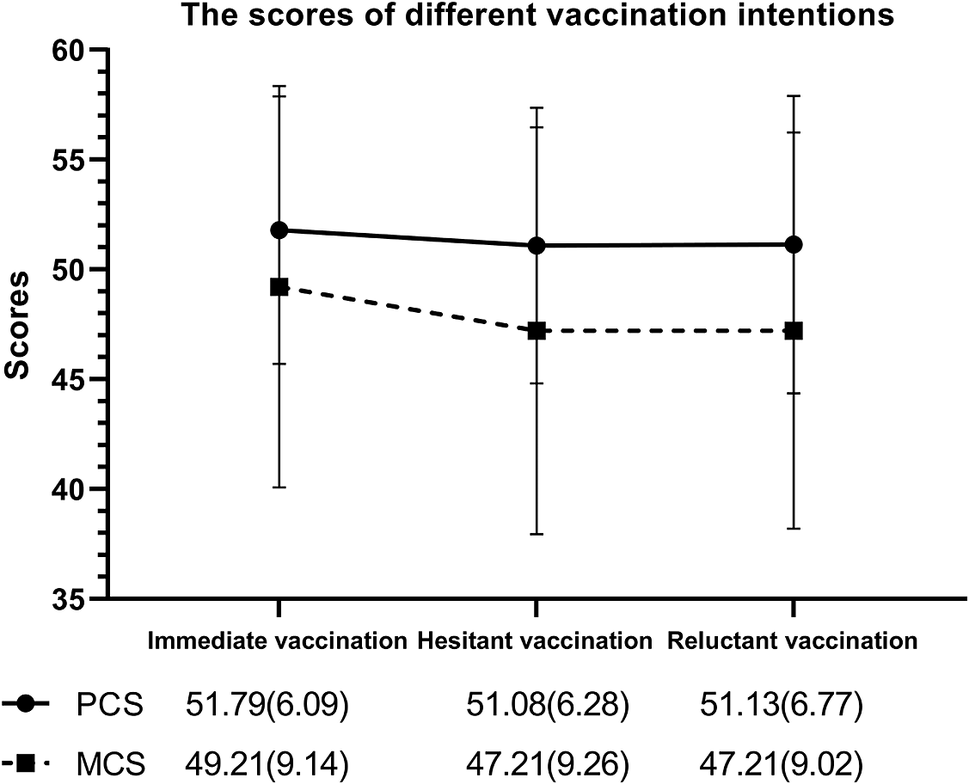
The SF-12 physical and mental component summary scores were shown in Table 1. Among 1461 individuals, the mean score of PCS was 51.27 ± 6.30, and the mean score of MCS was 47.72 ± 9.26, indicating that the COVID-19 pandemic had an impact on people’s mental health (US norm [50 ± 10] and Hong Kong norm [48.4 ± 8.8]). Higher scores indicated better HRQoL. The scores of different vaccination intentions were shown in Figure 2.
Mean SF-12 scores (SD) of different vaccination intentions.

Multivariate logistic regression models
Multivariate logistic regression analyses were performed to explore the influence of social-demographic characteristics (Table 1), vaccine-related items (Table 1), and HRQoL on the willingness of COVID-19 vaccination, shown in Table 2 (there were no significant health-related characteristic variables in Table 1, so they were not included in multivariate logistic regression). Regarding the multivariate logistic regression model in Table 3, potential confounders such as gender, age, marital status, ethnicity, education, workplace, and residence were adjusted. Based on Z-score standardization, for 1 SD increase in PCS, the OR was 0.854 (95% confidence interval [CI]: 0.753-0.969) in individuals who hesitated to be vaccinated compared with those who were willing to be vaccinated immediately. For 1 SD increase in MCS, the OR was 0.810 (95% CI: 0.677-0.970) in individuals who refused to be vaccinated compared with those who were willing to be vaccinated immediately, and the OR was 0.808 (95% CI: 0.710-0.919) in individuals who hesitated to be vaccinated compared with those who were willing to be vaccinated immediately. The results indicated that people with higher PCS and MCS scores preferred to receive the COVID-19 vaccine immediately (Table 3, Figure 3).
Multivariate logistic regression analysis model explaining variables related to willingness of COVID-19 vaccination (n = 1461)

*P<0.05, ** P<0.01, *** P<0.001; PCS: physical component summary; MCS: mental component summary; OR = odds ratio; CI = confidence interval.
The PCS and MCS scores are converted to Z scores in the multivariate logistic regression model.
Multivariate logistic regression analysis of SF-12 for willingness of COVID-19 vaccination (n = 1461)

*P<0.05, ** P<0.01, PCS: physical component summary; MCS: mental component summary. OR = odds ratio; CI = confidence interval.
Adjusted OR: Adjusting for gender, age, marital status, ethnicity, education, workplace, and residence.
The PCS and MCS scores are converted to Z scores in the multivariate logistic regression model.
The association between HRQoL and the willingness of COVID-19 vaccination after adjusting for confounding variables.

Discussion
The main objective of the research was to investigate the HRQoL of Chinese citizens during the COVID-19 pandemic and their willingness of COVID-19 vaccination. The results were obtained at the end of 2020 and represented the pandemic situation at that time. Although the outbreak of COVID-19 was under control in this study period, small-scale epidemics occurred continuously. Thus, the general population was still restricted by a series of policies (e.g., lockdown, social restriction measures and border control, et al.), and had little knowledge with COVID-19 vaccines in development. We believe that these findings are still of importance because they reflected the HRQoL of the general population and its attitude toward COVID-19 vaccines in development at that time. Our findings may provide information for health care providers and policymakers in improving vaccination coverage in similar situations.
In this study, the results indicated that although public sentiment toward the Chinese-made COVID-19 vaccine was positive, the rate of immediate vaccination was not high once the vaccine was available. Furthermore, the COVID-19 pandemic had an impact on HRQoL, especially on the mental health domain. In addition, the HRQoL independently contributed to willingness to consider vaccination.
With the samples drawn in the current study, 96.2% of the participants had confidence in the Chinese-made COVID-19 vaccine; most participants expressed positive attitudes towards the COVID-19 vaccine. But only 25.67% of the participants denoted a willingness to receive the vaccine immediately. This result was consistent with 1 study conducted among the Chinese general population.Reference Lin, Hu and Zhao19 Their study suggested that only about 28.7% reported a definite intention. That may be due to concerns about the safety, effectiveness, and side effects of vaccines.Reference Dror, Eisenbach and Taiber27 Citizens’ trust in biomedical science was acknowledged as another relevant factor that might affect people’s attitudes toward vaccination.Reference Palamenghi, Barello and Boccia18 In addition, some pregnant women would delay vaccination due to fear of potential side effects for the baby.Reference Dudley, Limaye and Salmon32
In our study, high-risk groups were more willing to be vaccinated immediately. It has been recognized that some industries and occupations have higher risks for COVID-19, especially those engaged in medical work and other necessary industries.Reference Ran, Chen and Wang33 The above-mentioned findings corresponded with an earlier study, which showed that vaccination rate increased for individuals with multiple risk factors.Reference Annunziata, Rak and Del Buono34 In addition, education levels were associated with vaccine decision-making. People who had a bachelor’s degree or above were less likely to get vaccinated compared with people whose education level was high school or lower. But the result of an American studyReference Malik, McFadden and Elharake35 showed that college and/or graduate degree holders compared to people with less than a college degree were more likely to accept the vaccine. One of the reasons for the dissimilarity of the results of this study with ours might be because highly educated people were more speculative and had their own judgment on new things.Reference Tian, Li and Tian36 Furthermore, people who were vaccinated against influenza during the COVID-19 pandemic had a strong tendency to receive the COVID-19 vaccine. Similar to the results of our study, Dror et al.Reference Dror, Eisenbach and Taiber27 found that the most significant positive predictor of COVID-19 vaccination was influenza vaccination. The most frequent reasons for vaccination uptake are self-protection and the belief in the effectiveness of the vaccine.Reference Petek and Kamnik-Jug37 They have a risk perception toward viruses and pandemics. Perhaps driven by this motivation, people who were vaccinated against influenza were willing to accept COVID-19 vaccines. Research suggested that lower cardiovascular incidence rates and mortality in patients with COVID-19 were related to higher influenza vaccination rates.Reference Marín-Hernández, Schwartz and Nixon38, Reference Behrouzi, Araujo Campoverde and Liang39 If the participants taking influenza vaccines were trying to prevent COVID-19, they would accept the COVID-19 vaccine. In addition, vaccine hesitancy is a common social phenomenon, and studies have shown that lack of confidence in vaccines is one of the most important reasons for hesitant vaccination.Reference Larson, de Figueiredo and Xiahong26, Reference Brown, Sperandio and Turssi40 Similar to the findings in our study, having confidence in the COVID-19 vaccine can motivate people to be vaccinated; 43.6% of participants believed that the Chinese-made COVID-19 vaccine could be popularized all over the world.
In our study, PCS scores (51.27 ± 6.30) of the participants were slightly higher than the US norm (50 ± 10) and Hong Kong norm (50.2 ± 7.0) while MCS scores (47.72 ± 9.26) were lower than the US norm (50 ± 10) and Hong Kong norm (48.4 ± 8.8).Reference Ware JE and Keller29, Reference Lam, Tse and Gandek30 About the better physical condition presented in our study, maybe it’s because Chinese people have been used to wearing masks, which is an effective measure to block the epidemics of COVID-19 and many other respiratory infectious diseases.Reference Williams, Rasmussen and Kleczkowski41 Moreover, the participants in our survey were mostly young people. Considering the pandemic situation during the survey period, our survey was conducted on the Internet based on the smart device (mobile phone, computer, or tablet). Thus, most of the participants in this study were young adults and there were fewer elderly people. Under the government roll-out plan, adults aged 18-59 were the main population in the early stages of COVID-19 vaccination, and elderly people aged over 60 years old and teenagers were later included in the target population for vaccination.42, 43 Thus, the participants in our study were in accordance with the set targets of the national vaccination plan at the time of the study. The lower MCS scores revealed that the COVID-19 pandemic had a negative effect on people’s mental health. These experiences might include sleep disorders, anger, depression, increase of drinking and smoking rate, post-traumatic stress disorder, and anxiety disorders, etc.Reference Shigemura, Ursano and Morganstein44 Unfamiliar public health measures and large economic losses contributed to widespread emotional distress and increased risk for mental illness associated with COVID-19.Reference Pfefferbaum and North45 Stay-at-home orders, domestic violence, long-term school lockdown, lack of emotional support and interaction, and excessive use of the Internet and social media also affected people’s mental health.Reference Guessoum, Lachal and Radjack46, Reference Elmer, Mepham and Stadtfeld47
Our findings suggested that some degree of correlation was observed between HRQoL and willingness of COVID-19 vaccination. The result showed that the scores of PCS were associated with the willingness to be vaccinated after adjusting for gender, age, marital status, ethnicity, education, workplace, and residence. People who were in better physical health were more likely to be vaccinated immediately than those who hesitated to be vaccinated. Furthermore, studiesReference Dattalo, Giovannetti and Scharfstein24, Reference de Jong, Munneke and Jansen25 indicated that people who were in better physical health were more likely to engage in health promotion. Vaccination is used to prevent disease and promote health;Reference Okeibunor, Mihigo and Anya48 in our study, people with higher PCS were more likely to be willing to get vaccinated immediately. Although scientists from all over the world made efforts in developing vaccines against COVID-19, there were still a lot of people who had no determination to be vaccinated right away.Reference Dror, Eisenbach and Taiber27, Reference Corey, Mascola and Fauci49 Thus, health-seeking behaviors are encouraged to improve physical health and vaccination rates.
Our results also indicated that people with higher MCS scores were more inclined to be vaccinated immediately. Related researchReference Hey, Calderon and Carroll50 represented that spiritual health was the center of one’s inner strength, which has been accepted widely. Human behavior is the result of psychological activities. Besides, scholars have shown that when in a good mood, our judgements tend to be more positive than when in a bad mood, and the mood-congruent effect affects behavioral intention.Reference Fiedler, Nickel and Asbeck51, Reference Razran52 Moreover, Sela’s Study has shown that people in a positive mood are more likely to be persuaded and to adopt recommended behavior.Reference Sar and Rodriguez53 In our study, participants with higher MCS scores (or those with relatively good mental health and positive attitudes) were more likely to take a beneficial, government recommended approach against the COVID-19 pandemic, so they would be willing to receive a COVID-19 vaccine immediately. In addition, good social function is an important part of mental health,Reference Tough, Siegrist and Fekete54 and social connectedness is a significant predictor of quality of life.Reference Lardone, Sorrentino and Giancamilli55 In our research, the MCS score was lower than the US norm and Hong Kong norm, probably due to the restriction of social activities since the COVID-19 outbreak.Reference Ammar, Brach and Trabelsi56, Reference Ammar, Chtourou and Boukhris57 Students were not allowed to leave school and there were strict restrictions on leisure activities and physical contact with friends and peers.Reference Singh, Roy and Sinha58 Under these circumstances, the people with relatively better mental health maybe showed that they would want to normalize social relationships and restore social contacts. As such a pandemic may continue or repeat, vaccination can increase people’s confidence to effectively prevent COVID-19 infections, and, in this way, helps maintain relationships. Thus, finding ways to improve the condition of mental health may help people make better decisions to promote their health.
As we mentioned above, the COVID-19 pandemic had an impact on HRQoL, especially mental health. HRQoL, especially the mental domain, might be closely related to the willingness of COVID-19 vaccination. To promote the willingness of COVID-19 vaccination and establishment of herd immunity, in-depth research on the HRQoL should be included in the following study to provide more accurate and detailed information.
Limitations
This study has several limitations that should be noted. First, our survey was conducted on the Internet and adopted the method of convenience sampling, which was lack of randomization and had definite limitations when extrapolated to other countries. Second, the data in our analyses were based on self-reports, which could lead to biases or inaccuracies. Finally, this was a cross-sectional study. Further in-depth studies with longitudinal follow-up data are warranted to examine the cause-effect relationship.
Conclusion
In conclusion, this is the first population-based study concerning HRQoL and the willingness of COVID-19 vaccination. To some degree, we found HRQoL, especially the mental domain, was associated with the willingness of COVID-19 vaccination independently and differentially. These findings emphasize the importance of paying attention to people’s HRQoL. Thus, timely assessment and effective intervention measures are needed to improve the physical and mental health conditions to promote the establishment of herd immunity. Our study may remind governments, policymakers, and the public of the importance of paying attention to HRQoL, especially mental health, after pandemics.
Data availability statement
The study data are available from the corresponding author (Dr. Pei-Xi Wang, Email: peixi001@163.com) upon reasonable request.
Acknowledgments
We would like to express our gratitude to the cooperators (Sha-Sha Li, Yan Liu, Ya Meng, etc.) who collected data and the respondents who participated in this survey. We could not have finished the paper without the encouragement and suggestions of our professors. We sincerely appreciate all the people who helped us during this study.
Author contribution
Jingrui Wang and Ruihan Xi contributed equally to this work as cosenior authors.
All authors contributed to study conception and design. Jing-Rui Wang, Jing Xia, Qian-Wen Pan, and Li-Na Shi performed data collection. Rui-Han Xi, Wan-Min Su, and Bo-Li conducted data analyses. Jing-Rui Wang, Rui-Han Xi, and Bo Li drafted the manuscript. Zhen-Zhen Su, Yi-Jin Feng, Yu-Jun Fan, and Pei-Xi Wang revised the paper. Jing-Rui Wang, Rui-Han Xi, and Pei-Xi Wang finalized the manuscript, and all authors commented on previous versions of the manuscript. All authors read and approved the final manuscript.
Funding statement
No funding was received.
Competing interests
The authors declare that they have no conflict of interest.
Ethical standard
All procedures performed in studies involving human participants were in accordance with the ethical standards. The study was approved by the research ethics committee of Henan University. This research did not utilize animals.