1. Introduction
Reducing carbon emissions is a critical strategy for addressing climate change, a global issue of significant concern. China has committed to reaching peak carbon emissions by 2030 and achieving carbon neutrality by 2060. Similarly, the European Union enacted the European Green Deal and the European Climate Act in 2020, setting a legislative goal of achieving carbon neutrality by 2050. In China, the ‘dual carbon objective,’ introduced in 2020, reaffirms the targets of peaking carbon emissions by 2030 and reaching carbon neutrality by 2060. Consequently, the global imperative to reduce carbon emissions, coupled with China's focus on sustainable economic growth, has driven the country to implement robust measures to accelerate corporate carbon emission reductions.
To advance environmental protection and pollution prevention, the Chinese government has undertaken sustained efforts to strengthen its legal and institutional frameworks. Since the enactment of the Environmental Protection Law of the People's Republic of China in 1979, a multilayered legal system has gradually taken shape, encompassing national legislation, administrative regulations, judicial interpretations and local rules. Notably, local environmental legislation – typically enacted by provincial and municipal people's congresses – is increasingly tailored to reflect regional environmental conditions, industrial structure and governance capacity. For instance, coastal cities such as Shenzhen and Shanghai have respectively introduced regulations specifically targeting marine ecological protection and carbon emission disclosures (such as the Shanghai Marine Ecological Protection and Restoration Action Plan), while resource-dependent cities like Ordos have prioritised pollution prevention in the mining sector (such as the Ordos Green Mine Construction Management Regulations). Such localised legislative efforts are intended to refine and complement the often general and principle-based provisions of central environmental laws, enhancing their practical applicability (Zhou et al., Reference Zhou, Yu and Chen2023). However, these regional laws are frequently criticised for prioritising economic development over environmental integrity, leading to selective enforcement and regulatory capture (Bao et al., Reference Bao, Shao and Yang2021). Therefore, achieving substantive solutions to local environmental challenges requires not only legislation but also robust supervision and stringent law enforcement.
In parallel, since 2007, China has launched nationwide reforms to specialise environmental justice through the establishment of environmental courts and tribunals (Qi et al., Reference Qi, Wu, Xu and Shan2023). These institutions are empowered to adjudicate disputes related to environmental degradation, resource exploitation and climate mitigation, often with the support of professional judges and technical experts. Environmental courts aim not only to enforce environmental laws more rigorously but also to resolve administrative inaction and local protectionism by providing an independent legal venue. According to the white paper on China Environmental Resources Trials, 2021 Footnote 1 released by the Supreme People's Court, by 2021, China had established 2149 environmental resources trial bodies, which had handled over 297,000 cases of first instance. In high-profile cases such as the Changzhou School Land Pollution Incident, environmental courts played a decisive role in assigning legal liability and compelling polluters to compensate for ecological damage, thereby demonstrating their potential in curbing corporate environmental violations. However, existing studies often examine environmental legislation and environmental court establishment in isolation, overlooking the institutional complementarities between them. In practice, neither legislation nor enforcement alone is sufficient to constrain corporate environmental behaviour due to fragmented regulatory authority and weak legal deterrence. Therefore, understanding how these two mechanisms interact to generate an interactive effect is critical. This study contributes to the literature by empirically identifying and explaining this synergy, emphasising that robust legal enforcement through environmental courts significantly enhances the effectiveness of local legislation.
How effective is the establishment of environmental courts in conjunction with local environmental legislation? Can this combination drive down corporate carbon emissions, thereby fostering coordinated ecological and economic development? If corporate carbon emissions are indeed influenced, what mechanisms underpin this impact? Existing scholarly research primarily examines the effects of either environmental legislation or environmental court establishment on environmental governance from a singular perspective (Qi et al., Reference Qi, Wu, Xu and Shan2023; Zhou et al., Reference Zhou, Yu and Chen2023; Zhao et al., Reference Zhao, Chen, Si and Jiang2024). However, there is a noticeable gap in the literature regarding the interaction of local environmental legislation and environmental court establishment on corporate carbon emissions.
This study offers several marginal contributions. First, regarding research methodology, the paper employs an interactive effect model, integrating local environmental legislation and court establishment within a unified framework to empirically assess their combined impact on corporate carbon emissions. Second, concerning the selection of indicators, while most existing studies on environmental legislation rely on natural experiments based on the 2015 revision of the Environmental Protection Law or the initial environmental regulations issued by cities (Zhang et al., Reference Zhang, Yu and Sun2022; Zhao et al., Reference Zhao, Chen, Si and Jiang2024), this paper takes a more granular approach. It manually compiles the number of environmental regulations issued by prefecture-level cities to gauge the intensity of environmental legislation, providing a more nuanced reflection of the development of environmental legislation in China in recent years. Third, although some studies have shown that the establishment of environmental courts can reduce urban carbon intensity (Zhao et al., Reference Zhao, Zheng and Zhu2022), they have not yet explored the impact of these courts on the carbon emissions of micro-enterprises from a city-level perspective. This study addresses this gap by bridging the macro and micro perspectives, offering new insights into the factors and mechanisms affecting corporate carbon emissions, particularly from the viewpoint of government environmental concern and the implementation of pollution charges or environmental taxes. The findings of this study provide theoretical support for achieving the dual carbon objective and fostering harmonious coexistence between humans and nature.
This paper innovatively incorporates local environmental legislation and environmental court establishment into a unified framework. Based on the carbon emission data of China's A-share listed companies from 2004 to 2021 and the number of local environmental laws enacted, this paper tests the impact of the intensity of environmental legislation and the establishment of environmental courts on the carbon emissions of enterprises and further considers the interactive effect of environmental legislation and court establishment. We found that local environmental legislation and court establishment alone cannot play a positive role in reducing corporate carbon emissions. However, the interactive effect of the two can significantly inhibit corporate carbon emissions. Second, we went through five methods to test the robustness of the conclusions, including replacement measurement of variables, back-door causation analysis, omitted variable analysis and excluding interference from the epidemic and other policies. Third, we found that the intensity of local environmental justice and corporate pollution charges or environmental protection taxes are essential mechanisms for environmental legislation and court establishment to reduce corporate carbon emissions. Finally, heterogeneity analysis shows that the interaction of environmental legislation and court establishment on corporate carbon emissions is most significant in areas where the government pays less attention to the environment, state-owned enterprises, enterprises in the eastern region and in highly polluted cities.
The rest of the paper is arranged as follows: Section 2 is the literature review and research hypothesis. Section 3 presents the data and model, which describes the data sources, variables and methodology. Section 4 reports the empirical results. Section 5 provides further analysis, including the mechanism and heterogeneity analysis. Section 6 provides the conclusion and implications.
2. Literature review and research hypothesis
2.1. Local environmental legislation and corporate carbon emissions
In China, the governance structure is characterised by ‘political centralisation and administrative decentralisation’, where the central government formulates environmental policies, and local governments implement them. While central legislation at the provincial level typically addresses broader, macro-level issues, local legislation at the municipal level can either concretise higher-level regulations or refine and expand central regulations to align with local customs and specific conditions (Ji et al., Reference Ji, Wu, Su, Luo and Long2022). This structure results in significant regional variations in local environmental legislation. To enhance environmental governance and promote sustainable development, the Chinese government has implemented a series of environmental regulations to reduce pollutant emissions (Zhao et al., Reference Zhao, Zhao, Zeng and Zhang2015), such as the government's environmental subsidy (Ren et al., Reference Ren, He, Zhang and Chen2019), the carbon-emission trading scheme (Yang et al., Reference Yang, Li and Liu2021) and environmental tax reform (Liu et al., Reference Liu, Yang, Zhang and Zhang2022). However, in the process of implementation of local environmental laws and regulations, there are widespread cases of incomplete implementation. Yang et al. (Reference Yang, Lin, Wang and Peng2024) found that due to insufficient regulation and inadequate incentive measures, there is a widespread lack of enforcement of local environmental regulations. However, the use of technology-assisted monitoring systems can significantly enhance the level of air pollution control within the regulatory area. One major issue is that environmental performance is more challenging to quantify than economic performance, which weakens the effect of central vertical supervision over local governments (Konisky and Teodoro, Reference Konisky and Teodoro2016). Additionally, the connection between environmental governance and local officials’ performance evaluations is insufficiently robust, leading to a lack of motivation among local officials to prioritise environmental governance. Previous studies have found that when officials face competing pressures, they tend to focus on short-term gains and lack incentives to address long-term environmental issues (Zheng et al., Reference Zheng, Kahn, Sun and Luo2014). According to a report by the Xinhua News Agency, in 2019, the average PM2.5 concentration in Hebei Province decreased by 5.8 per cent year-on-year, indicating a significant improvement in air quality. To continue advancing the ‘Blue Sky Protection Campaign’, Hebei implemented several measures, including deep industrial pollution control, capacity reduction and relocation of urban industries, coal usage rectification and clean energy substitution, vehicle pollution prevention and comprehensive dust pollution management. However, some cities still lag in air pollution control efforts. In June 2019, the Ministry of Ecology and Environment summoned the governments of Baoding and Langfang, among others, pointing out that these cities experienced significant deterioration in air quality, failed to complete key tasks, saw repeated measures and faced rebounding issues, indicating delays in air pollution control work (Xinhua New Agency, 2019). This highlights that the effectiveness of local environmental legislation and enforcement largely depends on the attention and execution strength of local governments. In certain regions, despite the formulation of relevant environmental regulations, insufficient emphasis and weak enforcement by local authorities have led to poor implementation of laws and unsatisfactory environmental governance outcomes. In addition, from the perspective of enterprises, Chinese companies often possess significant negotiating power in their interactions with local environmental law enforcement agencies, leading to ineffective implementation of environmental legislation (Wang and Wheeler, Reference Wang and Wheeler2003). Research indicates that command-and-control legislation alone does not significantly influence enterprises to adopt proactive environmental management practices. However, when environmental regulation is driven by voluntary norms, it can significantly encourage such practices (Lopez-Gamero et al., Reference Lopez-Gamero, Molina-Azorin and Claver-Cortes2010). Ding et al. (Reference Ding, Chen and Wang2020) further suggest that carbon taxes and take-back legislation may not necessarily motivate firms to enhance their carbon emission reduction efforts. Moreover, Omri and Boubaker (Reference Omri and Boubaker2024) found that democratic clean energy policies and climate change legislation have a relatively small effect on reducing carbon emissions.
Therefore, environmental legislation alone is insufficient to achieve the goals of environmental governance. It is imperative to ensure the effective implementation of local environmental laws and regulations through strong judicial oversight and enforcement mechanisms.
2.2. Local environmental court establishment and corporate carbon emissions
Environmental courts have increasingly become a pivotal mechanism for enhancing the efficiency of environmental justice and mitigating environmental pollution, including carbon emissions (Walters and Westerhuis, Reference Walters and Westerhuis2013; Zhao et al., Reference Zhao, Zheng and Zhu2022). Unlike administrative legislation, which often lacks stringent enforcement, environmental courts are specifically tasked with hearing and enforcing cases related to environmental violations and pollution (Zhang et al., Reference Zhang, Yu and Kong2019). However, companies with high carbon emissions might resort to bribing local government officials to evade strict environmental regulations and pollution penalties (Biswas et al., Reference Biswas, Farzanegan and Thum2012; Li and Wu, Reference Li and Wu2017). In such scenarios, even when environmental regulations are in place, corruption among local government officials can result in the deliberate lax enforcement of these regulations, thereby permitting polluters to continue emitting excessive carbon emissions (Lisciandra and Migliardo, Reference Lisciandra and Migliardo2017). Consequently, the establishment of environmental courts plays a crucial role in monitoring and curbing the corrupt practices of local governments that contribute to unchecked corporate carbon emissions. These courts significantly enhance the efficiency of environmental pollution case trials, effectively deter corporate environmental violations (Edwards, Reference Edwards2013) and bolster the enforcement of environmental laws and regulations (Zhang et al., Reference Zhang, Yu and Kong2019).
A review of the existing literature reveals a notable gap in research on the impact of China's environmental courts on carbon emissions, particularly in the context of corporate carbon emissions. Furthermore, studies on the influence of local environmental legislation on environmental governance yield varied conclusions, with little focus on its effectiveness in carbon emission control. There is also a lack of exploration into whether local environmental legislation and environmental court establishment have an interactive effect on reducing corporate carbon emissions. This underscores the necessity of investigating the combined impact of local environmental legislation and environmental court establishment on corporate carbon emission governance, which is essential for advancing China's goals of carbon peaking and carbon neutrality.
The rule of law is the fundamental guarantee of effective environmental pollution control, which relies not only on the establishment of laws and regulations but also on the enhancement of judicial capacity (Zhao et al., Reference Zhao, Chen, Si and Jiang2024). The extent to which environmental legislation achieves its intended legal effects largely depends on the effective implementation of these laws. Environmental legislation alone has a limited impact on curbing corporate carbon emissions; only through the interactive effect of environmental court establishment can the full potential of legislation and court establishment in reducing carbon emissions be realised. Based on this understanding, we propose the following hypothesis.
Hypothesis 1: Local environmental legislation and environmental court establishment can have an interactive effect on curbing the carbon emissions of enterprises.
3. Data and model
3.1. Data sources
We select A-share enterprises listed on the Shanghai and Shenzhen Stock Exchanges from 2004 to 2021 as samples. The data on environmental legislation and court establishment are manually sorted according to the Legal Information Center of Peking University and the websites of the local Municipal Intermediate People’s Court. We obtain the carbon emissions of pollutants from various industries and the control variables data of A-share listed enterprises from the China Stock Market & Accounting Research Database (CSMAR) database and the China City Statistical Yearbook. The sample is filtered based on the following criteria: (1) considering the particularity of the financial industry in supervision and financial indicators, the samples of the financial industry are excluded; (2) exclusion of companies designated as specially treated by the stock exchange (ST, ST*)Footnote 2; and (3) companies with financially unusual data, such as missing variables. Our final sample includes 2220 companies in 70 Industries with 21,544 panel data points from 2004 to 2021. All variables were winsorised at the top and bottom 1 per cent to get rid of the influence of extreme values.
3.2. Variable selection
3.2.1. Explained variable: corporate carbon emissions (CE)
As China does not currently mandate firms to disclose their carbon emissions, direct emission data at the firm level are generally unavailable. Therefore, we estimate carbon emissions indirectly using an approach consistent with the IPCC National Greenhouse Gas Guidelines. Building on the methodologies established by Ding et al. (Reference Ding, Ren, Tan and Wu2023) and Wang et al. (Reference Wang, Fu and Ren2023) for measuring carbon emissions, we approximate corporate carbon dioxide emissions by linking industry-level carbon dioxide emissions to individual enterprises based on their operating costs. First, we sourced industry energy consumption data from the CSMAR database. Specifically, our carbon emission estimates are based on industry-level energy consumption data provided by the CSMAR database, covering eight major energy types: coal, coke, crude oil, gasoline, kerosene, diesel, fuel oil and natural gas. Next, carbon emissions were calculated using the volume of energy consumed and the corresponding carbon emission coefficients. Finally, corporate carbon emissions were estimated by applying the ratio of an enterprise’s operating cost to the total operating cost of the industry. The resulting carbon dioxide emissions were logarithmically transformed for measurement purposes. The formula for calculating corporate carbon emissions is
 \begin{equation}C{O_2}{\text{ }}Emissions = \frac{{Operating{\text{ }}Cost{\text{ }}of{\text{ }}the{\text{ }}Enterprise}}{{Operating{\text{ }}Cost{\text{ }}of{\text{ }}the{\text{ }}Industry}} \times Industrial{\text{ }}C{O_2}Emissions\end{equation}
In addition, since the corporate carbon emission data in this study are estimated based on industry-level emissions and firm operating costs, some degree of measurement error is likely. To address this concern, and following the approach adopted in prior research (Lu et al., Reference Lu, Li and Yang2024), CE2 is based on firm-level information obtained from sustainability reports, environmental reports and social responsibility reports, complemented by emissions calculated from disclosed energy consumption. Specifically, if a firm directly reports carbon emissions, indirect emissions, or total emissions, we use the reported data. Otherwise, if fossil fuel consumption, electricity usage or heat usage is disclosed, we convert energy consumption into carbon emissions using the standard coal conversion factors from the China Energy Statistical Yearbook and apply carbon emission coefficients (energy calorific values multiplied by carbon oxidation factors). We sum the two to obtain the total carbon emissions of a firm and take ln(1 + total carbon emissions) as the dependent variable CE2.
3.2.2. Explanatory variable: environmental legislation and court establishment
Local environmental legislation (Policy): Local environmental legislation refers to the normative legal documents issued by cities at or above the prefecture level within the framework of central environmental legislation. These documents encompass a range of topics such as water pollution control, air pollution prevention and watershed management within their respective administrative areas. Unlike central legislation, local environmental legislation is tailored to specific regional conditions, allowing local governments to exercise greater initiative and enthusiasm in addressing environmental challenges. The primary forms of local environmental legislation include local environmental laws and administrative rules. To more accurately capture the strength of local environmental legislation, this study measures it by summing the cumulative number of environmental laws and regulations issued annually by each region.
Local environmental court establishment (Justice): On 20 November 2007, the Guiyang Intermediate People’s Court established the Environmental Protection Tribunal, along with the Qingzhen Municipal People’s Court Environmental Protection Tribunal, marking the first publicly established intermediate people’s court in China focused on environmental protection. Following this, environmental courts were gradually piloted across the country, offering a unique opportunity to study the impact of enhanced legal frameworks on China's carbon emission governance. According to public records and relevant legal documents in China, most environmental courts are established within intermediate people’s courts and typically exercise jurisdiction over multiple counties or districts within their administrative area, not just the immediate city in which the court is physically located. In certain cases, provincial-level coordination mechanisms also permit the handling of cases involving facilities located outside the environmental court's locality. Building on the research of Fan and Zhao (Reference Fan and Zhao2019), this paper identifies the specific years in which environmental courts were first established in prefecture-level cities, using data from the websites of intermediate people’s courts across these cities. The environmental court establishment variable is constructed as a 0–1 dummy variable, which includes environmental resources tribunals, panels and circuit tribunals of primary and intermediate courts. If a prefecture-level city had established an environmental court in a given year, the variable is assigned a value of 1; otherwise, it is assigned a value of 0.
3.2.3. Control variables
Referring to the existing literature (Ding et al., Reference Ding, Ren, Tan and Wu2023; Wang et al., Reference Wang, Fu and Ren2023; Li and Xu, Reference Li and Xu2024), we select some control variables that may have a potential impact on CE. The variable definitions are listed in Table A1 in the online appendix.
3.3. Model
This study investigates the interaction of environmental court establishment and environmental legislation on corporate carbon emissions with the following equation:
 \begin{align}C{E_{it}} &= {\alpha _0} + {\alpha _1}Justic{e_{ct}}*Polic{y_{ct}} + {\alpha _2}Justic{e_{ct}} + {\alpha _3}Polic{y_{ct}} + {\alpha _4}Control{s_{ict}} \nonumber \\
& + Year + Ind + \varepsilon \end{align}
where CEit is the firm’s carbon emissions and the subscripts i, c and t represent firm, city and year, respectively. Justice*Policyct is the core explanatory variable, which indicates the interaction of environmental court establishment and legislation; Controlsict represents a set of control variables. Year is the year-fixed effect, Ind is the industry-fixed effect and ε is the random error. Standard errors are clustered at the firm level in all regressions.
In this model,  ${\alpha _0}$ is the constant term, and is the coefficient of primary interest, capturing the estimated interactive effect. We hypothesise that
 ${\alpha _1}$ should be less than 0 and statistically significant, thereby supporting Hypothesis 1.
 ${\alpha _2}$ and
 ${\alpha _3}$ represent the regression coefficients for Justice and Policy, respectively. Since the individual effects of Justice and Policy have not yet been fully examined, the signs and significance levels of
 ${\alpha _2}$ and
 ${\alpha _3}$ are subject to further empirical testing.
 ${\alpha _4}$ denotes the vector of coefficients for a series of control variables.
4. Analysis of empirical results
4.1. Descriptive statistics
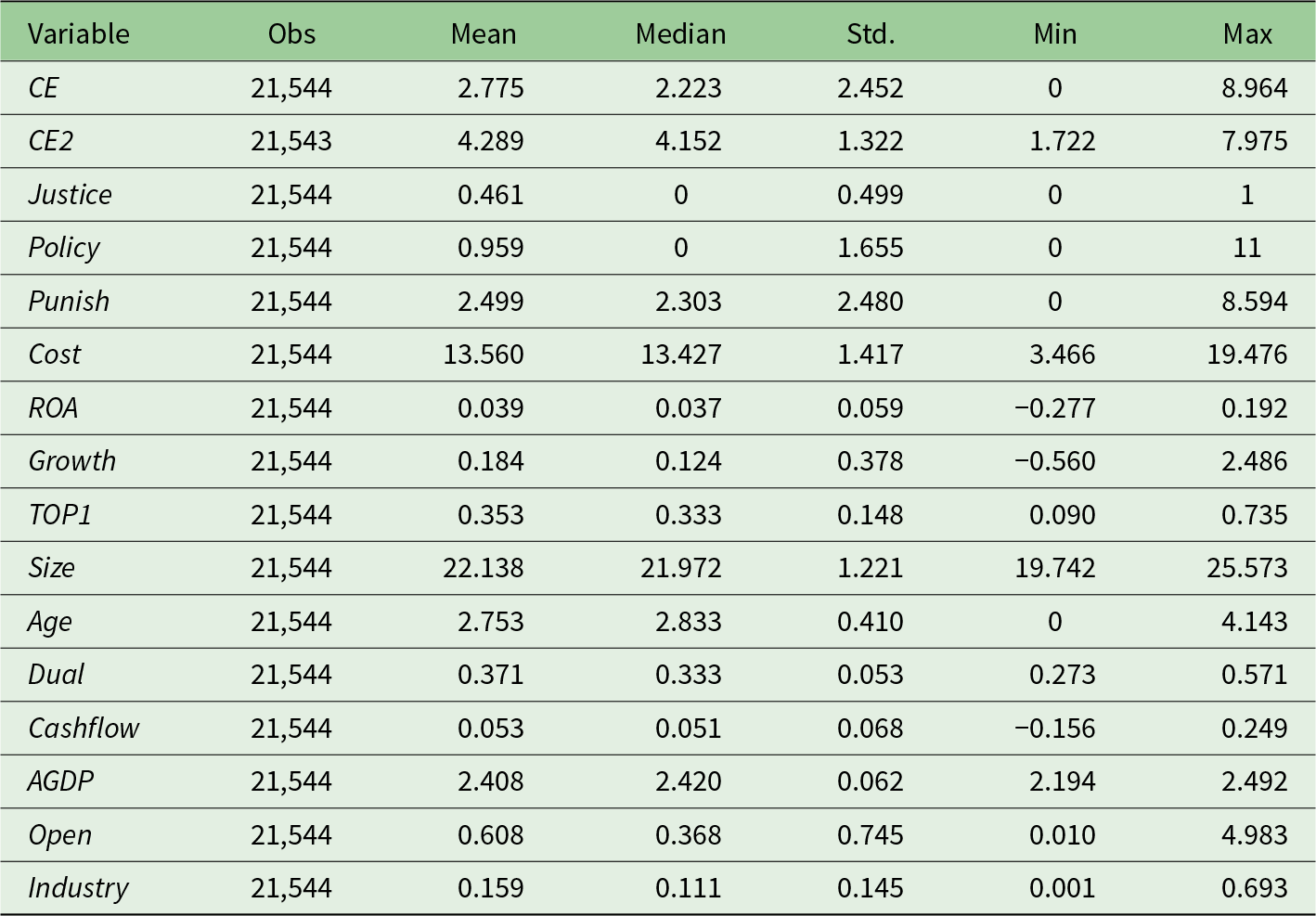
Table 1 presents the descriptive statistics for the main variables. The CE variable shows a maximum value of 8.964 and a minimum of 0, with a standard deviation of 2.452, indicating significant variation in carbon emissions among the firms in our sample. The standard deviations for Justice and Policy are 0.499 and 1.655, respectively, highlighting considerable differences in the levels of local environmental court establishment and legislation across the sampled cities. The average value of Justice is 0.461, with a median of 0, while the average value of Policy is 0.959, also with a median of 0. These statistics suggest that more than half of the cities exhibit low levels of local environmental court establishment and legislation. The minimum and maximum values of CE2 are 1.722 and 7.975, respectively, with a standard deviation of 1.322. The overall distribution pattern of CE2 is broadly consistent with CE, suggesting that the two measures capture similar emission characteristics. However, both the mean (4.289) and median (4.152) of CE2 are slightly higher than those of CE (mean = 2.775, median = 2.223). We believe this difference arises from the distinct calculation methods: CE is derived from industry-level estimates, while CE2 is based on firm-level voluntary disclosures, which tend to yield somewhat higher reported values. The remaining variables fall within expected and reasonable ranges.
Descriptive statistics of main variables

Table A2 (online appendix) presents the establishment of local environmental courts in China from 2004 to 2021 at both the national and regional levels. As shown, the establishment of environmental courts began to expand gradually at the local level starting in 2004, reaching its peak in 2016 with the highest number of local courts established nationwide. Additionally, the number of environmental courts is relatively comparable across the eastern, central and western regions, with the eastern region having a slightly higher count.
Table A3 in the online appendix presents the descriptive statistics on the industry distribution of the sample firms. To provide a clear overview, the classification follows the one-digit industry codes based on the 2012 China Securities Regulatory Commission industry classification standard. The table also separately reports the number of firms in heavily polluting industries and those with carbon emissions above the annual sample median. As shown, the manufacturing sector (C) is the primary contributor to both pollution and carbon emissions.
Table A4 (online appendix) presents the cumulative number of cities that had established environmental courts from 2004 to 2021, along with the corresponding aggregate GDP of these cities and their share in national GDP. The data reveal a clear upward trend in both the number of cities with environmental courts and their economic weight. Specifically, while only 2 cities had such courts in 2004, contributing merely 2.36 per cent to national GDP, by 2021 the number had risen to 198, covering cities that collectively accounted for 67.46 per cent of China's total GDP. This progression suggests that the implementation of environmental courts has gradually expanded to economically significant regions, including many industrial hubs and high-emission areas. Therefore, the policy not only gained broader geographic coverage over time but also achieved substantial economic representativeness, strengthening the relevance and generalizability of our empirical findings.
4.2. Multiple regression analysis
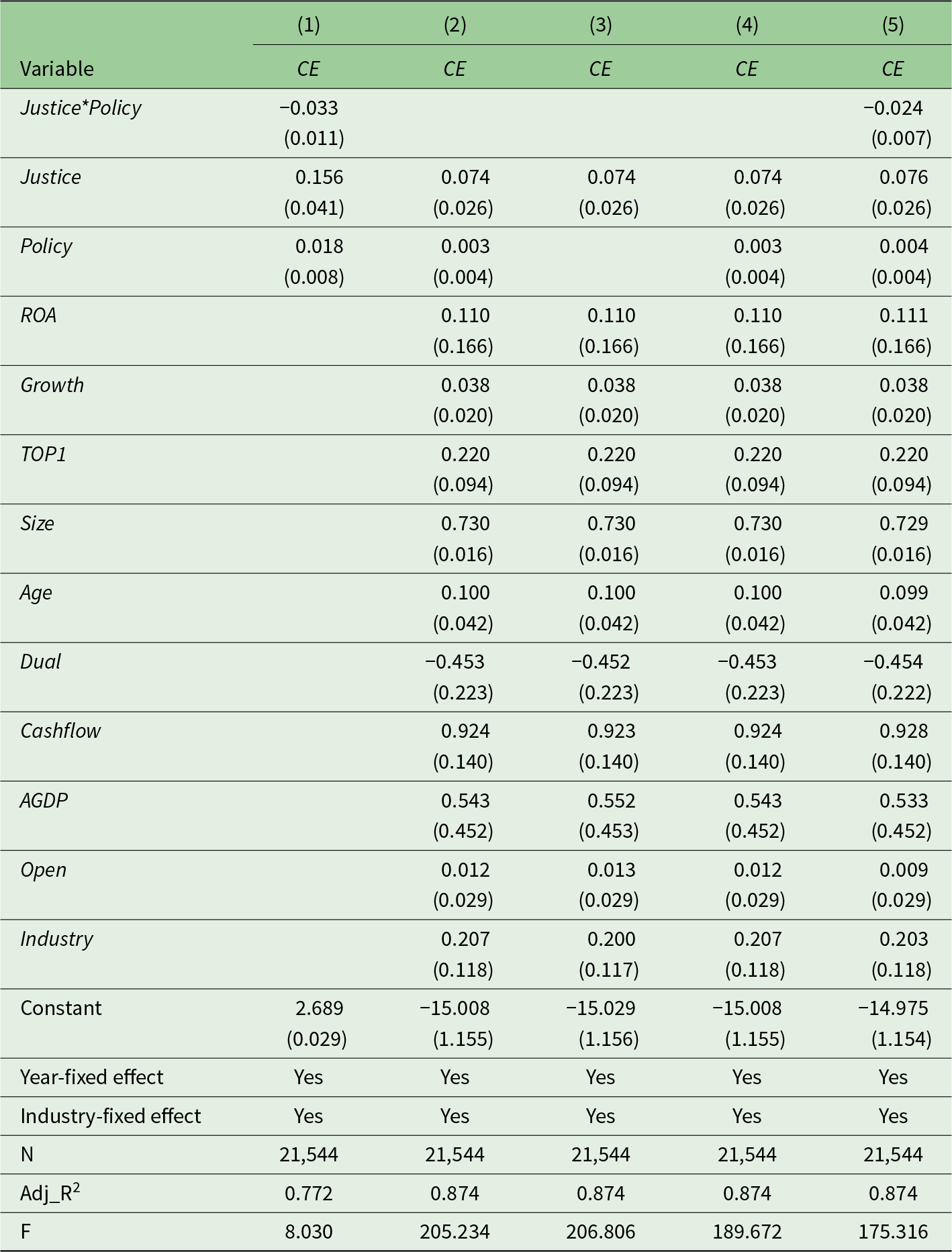
Table 2 presents the main regression results, employing a fixed effects model to estimate Equation (2). In column (1), where no control variables are included, the interaction term Justice*Policy is significantly negatively associated with CE at the 1 per cent level. Columns (2) and (3) report the individual effects of Justice and Policy, respectively, and indicate that neither environmental court establishment nor environmental legislation alone effectively reduces carbon emissions. Column (4) estimates a model that includes both Policy and Justice to show their direct effects on corporate carbon emissions. It can be observed that neither Policy nor Justice has a significant inhibitory effect on carbon emissions. Column (5) incorporates all control variables and continues to show a significantly negative interaction effect between Justice and Policy at the 1 per cent level, supporting Hypothesis 1. Economically, the coefficient of Justice*Policy is −0.024, suggesting that for each one-unit increase in the interactive intensity of judicial and legislative efforts, corporate carbon emissions decrease by approximately 2.4 per cent, given the log-linear form of the dependent variable.
Effect of Justice and Policy on CE
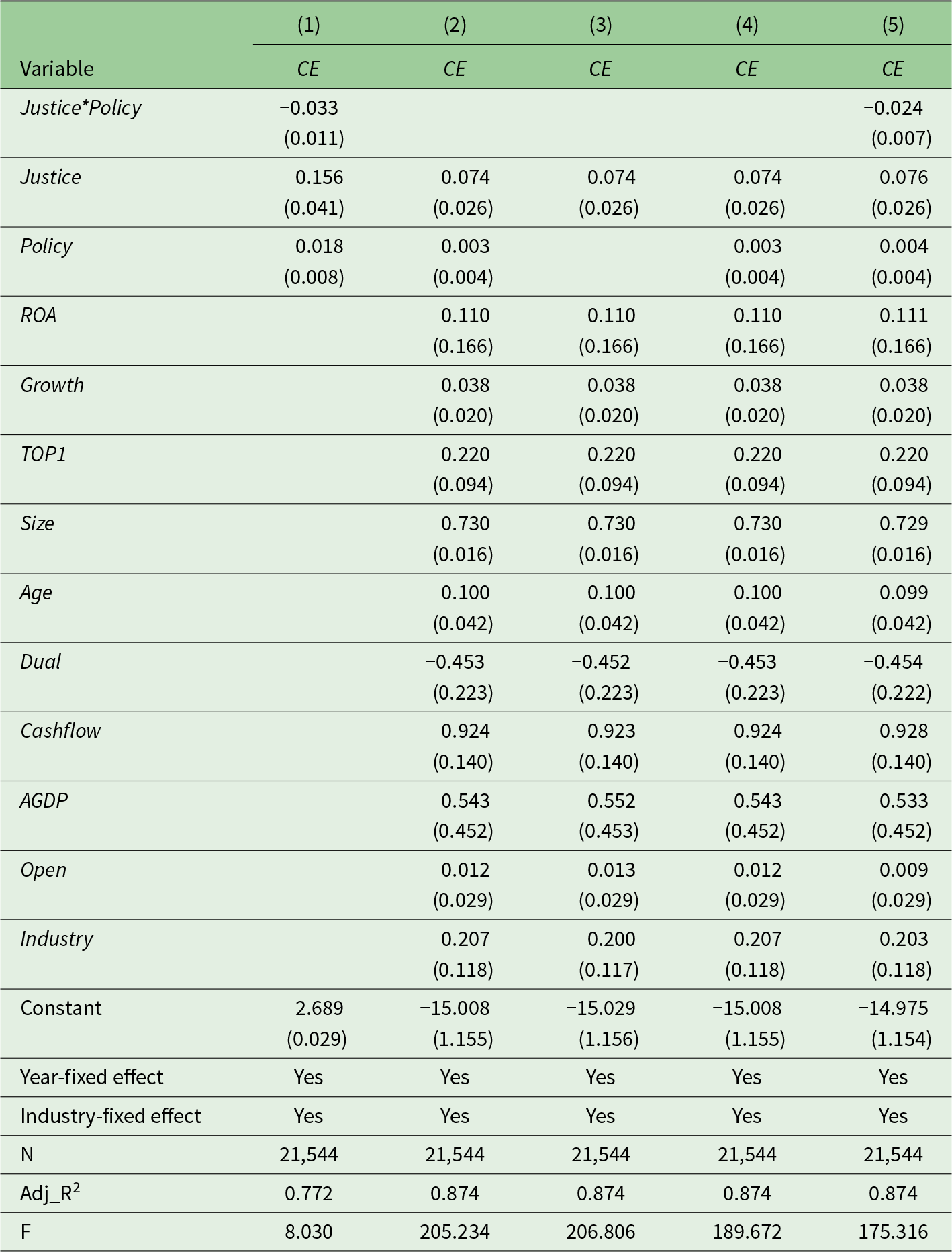
Notes: Standard errors in parentheses. Standard errors clustered at the firm level.
To better interpret the interaction term, we calculate the marginal effects implied by the model. Based on column (5), the marginal effect of Justice is
 \begin{equation}\frac{{\partial CE}}{{\partial Justice}} = 0.076 + \left( { - 0.024} \right) \times Policy\end{equation}
and the marginal effect of policy is
 \begin{equation}\frac{{\partial CE}}{{\partial Policy}} = 0.004 + \left( { - 0.024} \right) \times Justice\end{equation}
Using sample means of Policy (mean = 0.959) and Justice (mean = 0.461), the average marginal effect of Justice is  $0.076 - 0.024 \times 0.959 \approx 0.053$, and the average marginal effect of Policy is
 $0.004 - 0.024 \times 0.461 \approx - 0.007$.
These results imply that although Justice still tends to be positively associated with CE on average, the policy context moderates this effect. In contrast, Policy shows a negative average marginal effect on CE when judicial protection is stronger.
Furthermore, we compute the threshold values at which the marginal effects change sign. For Justice, its effect becomes negative when  $Policy \gt 0.076/0.024 \approx 3.17$, and for Policy, its effect turns negative when
 $Justice \gt 0.004/0.024 \approx 0.167$.
In addition, we calculated the proportion of observations for which the marginal effect of Justice is negative (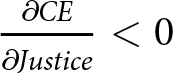 $\frac{{\partial CE}}{{\partial Justice}} \lt 0$), i.e., where
 $0.076 - 0.024 \times Policy\left\langle {0 \Rightarrow Policy} \right\rangle 3.17$. Based on the distribution of Policy values in the sample, there are 1415 observations where Policy exceeds 3.17, accounting for 6.568 per cent of the total sample. This indicates that only approximately 6.568 per cent of the observations exhibit a negative marginal effect of Justice on carbon emissions – i.e., a reduction effect. Similarly, we calculated the proportion of observations where the marginal effect of Policy is negative (
 $\partial CE/\partial Policy \lt 0$), i.e., where
 $0.004 - 0.024 \times Justice\left\langle {0 \Rightarrow Justice} \right\rangle 0.167$. According to the sample data, 9935 observations – accounting for 46.115 per cent of the sample – meet this condition. This suggests that in 46.115 per cent of the observations, Policy exerts a negative marginal effect on carbon emissions, indicating a mitigation effect.
The results show that neither local environmental legislation nor environmental court establishment alone significantly reduces corporate carbon emissions, while their interaction term is both statistically and economically significant. This result reflects the institutional fragmentation in China's environmental governance, where regulatory mandates and enforcement capacity are often decoupled. Local environmental legislation, though increasingly detailed, often lacks binding force due to limited administrative capacity, economic growth priorities and the absence of credible enforcement mechanisms. Environmental protection departments typically face challenges in imposing penalties or compelling compliance, especially when local governments prioritise industrial output or tax revenues. On the other hand, environmental courts specialise in adjudicating environmental disputes but rely on a clear legal framework to operate effectively. In the absence of supporting regulations, courts may be limited in their ability to impose material consequences. Their enforcement power becomes substantially more effective only when backed by specific and localised environmental rules. The synergy between legislation and judicial enforcement thus reflects institutional complementarity: legislation sets the formal environmental obligations, while courts translate them into enforceable outcomes. It also manifests through fiscal penalties such as pollution charges or environmental protection taxes, which are more likely to be implemented stringently in jurisdictions with active environmental courts. Our mediation results confirm that these financial sanctions become more credible and impactful when litigation risk is real and enforceable. Therefore, the observed synergy stems from the mutual reinforcement between regulatory intent (via legislation) and enforcement credibility (via judicial action), which jointly raise the expected cost of environmental violations for firms and drive actual reductions in emissions.
4.3 Robustness tests
To verify the robustness of the baseline regression results, we conducted a series of robustness checks, including: (1) replacing the measures of both the independent and dependent variables, (2) addressing potential reverse causality using instrumental variable estimation and lagged independent variables, (3) employing alternative fixed-effects specifications and (4) excluding the potential interference from COVID-19, the low-carbon city pilot policy and the carbon emissions trading scheme. All of these results consistently support the robustness of our main conclusions. Due to space limitations, the detailed results are provided in Tables A5–A8 in Section A1 (Robustness tests) of the online appendix.
5. Further analysis
5.1. How do justice and policy affect carbon emissions?
We examined how local environmental legislation and judicial actions affect corporate carbon emissions, focusing on two key aspects: the impact of environmental courts on judicial intensity and the impact of legislation on corporate pollution control.
First, the primary mechanism by which environmental courts and regulations influence pollution control is through enhancing regional environmental justice intensity (Huang et al., Reference Huang, Liu, Zhang and Zhao2022). The establishment of environmental courts contributes directly to this by training and appointing judges with specialised expertise to handle environmental cases, thereby improving the intensity of judicial proceedings in environmental matters (Huang et al., Reference Huang, Liu, Zhang and Zhao2022). Additionally, environmental legislation provides a legal foundation for these courts, granting them centralised jurisdiction over environmental protection cases and enabling them to adopt flexible judicial practices within the legal framework to resolve environmental disputes (Edwards, Reference Edwards2013). Based on this, we hypothesise that the intensity of adjudicating environmental administrative cases could mediate the relationship between environmental court establishment and legislation and corporate carbon emissions. To measure the intensity of regional environmental justice (Punish), we used the annual number of environmental administrative punishment cases in prefecture-level cities, assuming that a higher number of cases reflects greater judicial intensity. Following the method of Huang et al. (Reference Huang, Liu, Zhang and Zhao2022), we use ln(1 + the number of environmental administrative punishment cases) to measure the intensity of environmental enforcement at the prefecture level, in order to mitigate issues such as heteroscedasticity. Data on local environmental judicial cases were manually collected from the Legal Information Centre of Peking University.
Second, we considered pollutant discharge fees and environmental protection taxes (Cost) as critical factors related to corporate pollution control and carbon emissions (Du et al., Reference Du, Li, Shi and Wang2024). To explore the role of corporate environmental expenditure in the relationship between environmental justice and legislation and corporate carbon emission control, we measured corporate environmental pollution expenditure using the natural logarithm of the actual pollutant discharge fees and environmental protection taxes paid by enterprises. The data on enterprise pollution charges and environmental protection taxes were sourced from the CSMAR database.
In order to explore the mediating effect, this paper constructs the following model:
 \begin{align}{M_{ict}} &= {\beta _0} + {\beta _1}Justic{e_{ct}}*Polic{y_{ct}} + {\beta _2}Justic{e_{ct}} + {\beta _3}Polic{y_{ct}} \nonumber \\
&+ {\beta _4}Control{s_{ict}} + Year + Ind + \varepsilon, \end{align}
 \begin{align}C{E_{it}} &= {\gamma _0} + {\gamma _1}{M_{ict}} + {\gamma _2}Justic{e_{ct}}*Polic{y_{ct}} + {\gamma _3}Justic{e_{ct}} + {\gamma _4}Polic{y_{ct}} \nonumber \\
&+ {\gamma _5}Control{s_{ict}} + Year + Ind + \varepsilon \end{align}
where  ${M_{ict}}$ represents the mechanism variables, and other variables remain the same as previously.
Table A9 in the online appendix reports the mediation analysis results based on Equations (5) and (6). Columns (1) and (2) explore the mediating role of Punish in the interaction of environmental court establishment and legislation on carbon emissions. In column (1), the coefficient on Justice*Policy is significantly positive (0.021, p < 0.05), indicating that stronger judicial-legislative coordination is associated with increased intensity of local environmental penalties. Column (2) shows that Justice*Policy is significantly negatively associated with carbon emissions (−0.024, p < 0.01), while Punish also shows a significant negative effect (−0.016, p < 0.01). This supports the presence of a mediation effect – the interaction between court establishment and legislation reduces corporate emissions partly by enhancing the enforcement intensity of local environmental punishment cases. From a quantitative perspective, the coefficient of −0.024 for Justice*Policy in column (2) implies that a one-unit increase in the judicial-legislative synergy reduces carbon emissions by approximately 2.4 per cent, after accounting for enforcement intensity. Meanwhile, the coefficient of −0.016 for Punish suggests that a one-unit increase in environmental enforcement intensity is associated with a 1.6 per cent decrease in emissions, highlighting its economic significance as a transmission channel.
Columns (3) and (4) examine Cost as a second mechanism. In column (3), Justice*Policy is significantly negatively associated with Cost (−0.011, p < 0.1), indicating that improved synergy reduces the financial burden of environmental pollution expenditures, likely due to greater compliance and reduced violations. In column (4), Justice*Policy remains significantly negatively associated with emissions (−0.019, p < 0.01), while Cost has a significantly positive coefficient (0.458, p < 0.01), implying that firms with higher pollution costs tend to emit more, further confirming the mediating role of environmental cost. From an economic standpoint, a one-unit increase in the court-legislation synergy reduces emissions by 1.9 per cent, even after controlling for pollution-related costs. At the same time, a one-unit increase in pollution expenditures is associated with a 45.8 per cent increase in carbon emissions, emphasising the financial dimension of environmental performance and its importance as a mediating channel.
Overall, these results offer clear evidence that judicial-legislative synergy reduces emissions through two main channels: (1) by strengthening the enforcement intensity of local environmental punishment cases, and (2) by decreasing corporate pollution costs and taxes.
5.2. Heterogeneity analysis
5.2.1. Heterogeneity analysis of government environmental concern
Environmental performance is becoming an increasingly critical priority for the Chinese government, even surpassing the emphasis on economic growth (Bao and Liu, Reference Bao and Liu2022). Drawing from existing literature (Liu et al., Reference Liu, Cifuentes-Faura, Zhao and Wang2023), we gathered data on government environmental concerns from local government work reports using word frequency analysis. Theoretically, when the government prioritises environmental issues, enterprises are compelled to reduce carbon emissions due to heightened administrative regulation. Conversely, when the government places less emphasis on environmental concerns, enterprises may become lax in their carbon emission governance. In such cases, environmental court establishment and legislation play a crucial role in compensating for the government's lack of attention and reinforcing legal oversight of corporate carbon emissions. We hypothesised that in regions where the government is less focused on environmental issues, the inhibitory effect of environmental court establishment and legislation on corporate carbon emissions would be more pronounced. To test this, we categorised the data based on the median frequency of environmental protection-related terms in annual government work reports, allowing us to examine the heterogeneous impact of environmental legislation and court establishment on corporate carbon emissions. The regression results are shown in columns (1) and (2) of Table A10 (online appendix). Specifically, in regions with low environmental attention, the coefficient of Justice*Policy is − 0.023 (t = − 2.613), whereas in high-attention regions, the coefficient is − 0.023 as well (t = − 1.876). While the magnitude of the coefficients appears similar, the statistical significance is notably higher in low-attention regions, suggesting that environmental court establishment and legislation play a more critical complementary role where administrative oversight is weak. This supports our hypothesis that legal and judicial tools can effectively compensate for insufficient government prioritisation of environmental issues.
5.2.2. Property right heterogeneity
Previous studies have consistently demonstrated that state-owned enterprises (SOEs) exhibit superior environmental initiatives compared to their non-state-owned counterparts (Calza et al., Reference Calza, Profumo and Tutore2016). SOEs typically display a heightened sense of social responsibility and a stronger inclination to adhere strictly to government environmental regulations, leading to relatively lower carbon emission intensity. To explore the asymmetric impact of ownership on environmental outcomes, we conducted a heterogeneity test based on the nature of property rights. As shown in Table A10, columns (3) and (4), the interaction coefficient Justice*Policy for state-owned is −0.042 (t = −2.784), which is significant at the 1 per cent level, while for non-state-owned, the coefficient is −0.008 (t = −1.108), which is not statistically significant. The much larger and significant coefficient in state-owned indicates that environmental court establishment and legislation have a markedly stronger inhibitory effect on carbon emissions in state-owned firms. This reflects the higher institutional pressure and greater policy responsiveness of SOEs, compared to non-SOEs, which may lack similar incentives or enforcement intensity.
5.2.3. Regional heterogeneity
This study categorises China into eastern, central and western regions based on variations in geographic location and economic development levels. The results in Table A10, columns (5)–(7), reveal that the Justice*Policy is significantly negative in the eastern region (−0.015, t = −2.192), while it is negative but insignificant in the central (−0.023, t = −0.627) and western (−0.031, t = −0.514) regions. The findings suggest that environmental court establishment and legislation are more effective in the eastern region, where legal and institutional frameworks are more developed and enforcement is more rigorous. In contrast, the lack of statistical significance in the central and western regions implies that weaker institutional environments may hinder the effective implementation of environmental policy and judicial mechanisms.
In addition, Table A11 (online appendix) reports the distribution of sample firms and cities under different levels of heterogeneity. It can be observed that the number of firms and cities is higher in the subsample with high government environmental concern, as well as in the subsamples of non-state-owned enterprises and eastern regions. Moreover, the distribution shows a relatively stable upward trend over time.
5.2.4. Heterogeneity analysis based on urban pollution levels
The level of environmental pollution in a city is an important factor influencing the implementation and effectiveness of environmental legislation and judicial enforcement. Therefore, we further investigate the heterogeneity of the effects of Policy and Justice under different levels of urban environmental pollution. Given that people are more frequently exposed to atmospheric environments and that air pollution is more readily perceived by the public, air quality is considered a primary indicator of regional environmental pollution (Qu and Yan, Reference Qu and Yan2015). Among various air pollutants, sulphur dioxide (SO2) emissions from industrial activities are a major contributor to air pollution. Accordingly, following previous studies (Qu and Yan, Reference Qu and Yan2015), we measure environmental pollution using the annual industrial SO2 emissions of cities. To ensure robustness, we additionally employ the annual average PM2.5 concentration as an alternative indicator. Data on SO2 emissions are obtained from the China City Statistical Yearbook, while PM2.5 data are sourced from the Atmospheric Composition Analysis Group at Dalhousie University.
Table A12 in the online appendix reports the results of the heterogeneity test. Columns (1) and (2) show the results of subsample regressions based on the median split of annual SO2 emissions. Compared to cities with lower levels of pollution, the interaction term Justice*Policy exhibits a more significant negative effect on carbon emissions in more polluted cities, indicating a stronger suppressive effect. Columns (3) and (4) present the results based on the median split of PM2.5 concentrations. Although the interaction terms are significantly negative in both groups, the marginal effect is larger in cities with higher PM2.5 levels. These findings suggest that the interaction of environmental legislation and court establishment is more pronounced in regions facing more severe environmental pollution, highlighting the importance of coordinated environmental governance in highly polluted areas.
6. Conclusion and policy implications
This paper presents an innovative approach by integrating local environmental legislation and environmental court establishment into a unified framework. Utilising carbon emission data from China’s A-share listed companies between 2004 and 2021 and the number of local environmental laws enacted, the study examines the impact of the intensity of environmental legislation and the establishment of environmental courts on corporate carbon emissions, with a particular focus on the interaction of these two factors. The findings indicate that while local environmental legislation and court establishment individually do not effectively reduce corporate carbon emissions, their combined effect significantly curtails emissions. To ensure the robustness of these conclusions, the study employed five different methods, including variable replacement, back-door causality analysis, omitted variable analysis and the exclusion of interference from events such as the pandemic and other policies. Moreover, the study identifies that the intensity of local environmental court establishment, as well as corporate pollution charges or environmental protection taxes, serve as critical mechanisms through which environmental legislation and court establishment mitigate corporate carbon emissions. Lastly, heterogeneity analysis reveals that the interaction of environmental legislation and court establishment is most pronounced in regions where government attention to environmental issues is minimal, among state-owned enterprises, in firms located in the eastern region and in heavily polluted regions of China.
Based on the conclusions drawn from this study, the following policy recommendations are proposed to further enhance local environmental legislation, improve judicial effectiveness and reduce corporate carbon emissions.
First, strengthen coordination between the legislation and judiciary. The government should focus on enhancing the interaction between environmental legislation and the judiciary. Ensuring that environmental laws are effectively enforced and supported by judicial mechanisms is crucial for promoting environmental protection and encouraging enterprises to reduce emissions. Second, improve enforcement mechanisms. It is imperative to refine the enforcement mechanisms of environmental laws. This includes bolstering the enforcement capacity, improving the intensity of law enforcement and establishing a robust environmental judicial system. Additionally, linking government officials’ evaluations with their performance in carbon governance can help eliminate potential collusion between the government and enterprises. Third, encourage proactive corporate environmental management. Enterprises should be encouraged to strengthen their environmental management practices. This can be achieved by improving energy efficiency, adopting cleaner production technologies and enhancing waste treatment processes. By doing so, companies can proactively reduce their carbon emissions. Fourth, enhance supervision and penalties for non-compliance. The government should intensify its supervision of enterprises and establish stringent penalties for violations of environmental laws. Severe consequences for non-compliance will incentivise companies to adhere to environmental regulations and contribute to emission reduction efforts. Finally, tailor environmental strategies to regional and ownership differences. The government should pay closer attention to environmental protection to address any shortcomings in current legislation and court establishment. For enterprises with different ownership structures and those located in various regions, local governments should adjust their environmental legislation and judicial efforts according to specific local conditions. For instance, strengthening supervision in the central and western regions could promote more balanced regional environmental development.
By implementing these recommendations, the government can better align environmental legislation with judicial practices, thereby fostering a more sustainable balance between economic development and environmental protection.
However, according to the Regulations on the Administration of Company Registration, the Regulations on the Registration of Legal Entities and the official reply issued by the State Administration for Industry and Commerce titled ‘On Whether Enterprises Must Register for Additional Business Premises’, it is explicitly stipulated that firms are not permitted to operate in a location different from their registered address without prior registration. In practice, there is currently no official or large-scale dataset disclosing discrepancies between firms registered and their actual operating locations. As such, most empirical studies rely on the registered location as a consistent and legally grounded proxy. We recognise this as a potential limitation of our study and have explicitly noted it in the revised manuscript to invite future research on this issue.
Moreover, one important limitation of this study concerns the measurement of firm-level carbon emissions. Due to the lack of publicly disclosed and standardised emissions data for most Chinese listed firms over the sample period, we follow existing literature by estimating firm-level emissions based on industry-level carbon emission intensity and the firm's operating cost. While this method enables broad coverage and comparability across firms and years, it introduces several limitations. This proxy measure differs from directly reported or verified carbon emission data, which has become increasingly available in recent research. However, such data remains limited in scope and consistency in the Chinese context, particularly for longitudinal analysis. Future studies could benefit from incorporating actual reported carbon emissions data when it becomes more widely available to further improve the accuracy and credibility of empirical research in this area.
Supplementary material
The supplementary material for this article can be found at https://doi.org/10.1017/S1355770X2510034X.
Data availability
Data will be made available on request.
Funding
This work was supported by National key research projects of accounting (2023KJA3-12); Science Foundation of China University of Petroleum, Beijing (2462025YJRC028).
Competing interests
The authors declare none.