

Grammatical morphology is an area of language that constitutes a significant obstacle for many children with specific language impairment (SLI; Bishop & Leonard, Reference Bishop and Leonard2000; Leonard, Reference Leonard1998). Trouble in marking finiteness (tense and agreement inflections on verbs) has been widely documented in children with SLI speaking English and other languages (Leonard, Reference Leonard1998). For instance, English-speaking children with SLI have been found to be less accurate than their mean length of utterance (MLU)-matched typically developing peers in using a range of grammatical morphemes such as copula be forms, present tense third person singular -s inflection, and regular past -ed verb forms (Leonard, Eyer, Bedore, & Grela, Reference Leonard, Eyer, Bedore and Grela1997; Redmond, Reference Redmond2003; Rice, Wexler, & Cleave, Reference Rice, Wexler and Cleave1995). The explanations for why certain elements of grammatical morphology pose problems for children with SLI have been controversial. Broadly speaking, two competing theoretical frameworks have been posited. There are theories that propose an underlying deficit in linguistic representation versus those that suggest the source of the difficulty stems from general limitation in processing (for a review, see Leonard, Reference Leonard1998). Despite the fact that most work in SLI has focused on English, in the last decade investigations have been expanded to include other languages with the aim of distinguishing language-specific manifestations from universal aspects of SLI. In this manner, cross-linguistic research on SLI has shed light on issues pertaining to the following: (a) the nature of the grammatical deficit, (b) the relationship of SLI to typical language development, and (c) the nature of the errors reflected in these children's use of language.
Studies have made it clear that children with SLI do not display uniform grammatical profiles across all languages. Leonard and colleagues have conducted systematic comparisons of grammatical morphology in SLI in several language families including Germanic, Romance, and Semitic languages (Leonard, Reference Leonard, Bishop and Leonard2000). The general consensus that has emerged from this body of research indicates that grammatical morphology poses a special challenge for the children with SLI acquiring languages such as German (Roberts & Leonard, Reference Roberts and Leonard1997), Swedish (Hansson, Nettelbladt, & Leonard, Reference Leonard, Bishop and Leonard2000), Italian (Bortolini, Caselli, & Leonard, Reference Bortolini, Caselli and Leonard1997), Spanish (Bedore & Leonard, Reference Bedore and Leonard2001), and Hebrew (Dromi, Leonard, Adam, & Zadunaisky-Erhlich, Reference Dromi, Leonard, Adam and Zadunaisky-Ehrlich1999). It is interesting that, out of the 45 grammatical morphemes analyzed in these languages, 24 showed significant differences in proficiency between the children with SLI and their typically developing peers matched for MLU (Leonard, Reference Leonard, Bishop and Leonard2000). The structural characteristics of the target languages influence the types of linguistic forms that pose problems for the children with SLI (Leonard, Reference Leonard, Bishop and Leonard2000; Paradis & Crago, Reference Paradis and Crago2001). In English, such children have difficulties with verb inflections that mark agreement and tense (Bedore & Leonard, Reference Bedore and Leonard1998; Redmond, Reference Redmond2003; Rice et al., Reference Rice, Wexler and Cleave1995; Rice & Wexler, Reference Rice and Wexler1996). Of interest, accuracy scores for such inflections in data from German and Swedish (Hansson et al., Reference Hansson, Nettelbladt and Leonard2000; Roberts & Leonard, Reference Roberts and Leonard1997) surpassed that of the English-speaking children with SLI. For example, in German, children with SLI used present tense third person singular verb inflections with lower accuracy in obligatory contexts than a group of MLU-matched controls (Rice, Noll, & Grimm, Reference Rice, Noll and Grimm1997). In contrast, these same children's percentages of accurate responses were higher than those reported for the corresponding morpheme (third person singular -s) in English-speaking children with SLI (Leonard, Reference Leonard, Bishop and Leonard2000). In certain studies of richly inflected languages such as Italian, Spanish, and Hebrew, children with SLI did not have the same degree of problems in marking tense and agreement (Bortolini et al., Reference Bortolini, Caselli and Leonard1997; Dromi et al., Reference Dromi, Leonard, Adam and Zadunaisky-Ehrlich1999; Dromi, Leonard, & Shteiman, Reference Dromi, Leonard and Shteiman1993; Leonard, Reference Leonard, Bishop and Leonard2000; Leonard et al., Reference Leonard, Eyer, Bedore and Grela1997). For instance, difficulties observed in Italian-speaking children with SLI were primarily restricted to function words (direct object clitic pronouns and articles; Leonard & Bortolini, 1998; Leonard, Bortolini, Caselli, McGregor, & Sabbadini, Reference Leonard, Bortolini, Caselli, McGregor and Sabbadini1992).
In Hebrew, finiteness marking was not the major problem for children with SLI. However, problems were detected for past tense agreement but not for present tense. This was attributed to variations between the two inflectional types (Dromi et al., Reference Dromi, Leonard, Adam and Zadunaisky-Ehrlich1999). Hebrew present tense forms are less complex than past tense verb inflections because the former have only number and gender distinctions whereas the latter involve distinctions in number, gender, and person. Because the children were not required to use tense, it was difficult to tease apart whether their problems were actually with tense or with agreement. Thus, to address this issue, Leonard, Dromi, Adam, and Zadunaisky-Ehrlich (Reference Leonard, Dromi, Adam and Zadunaisky-Ehrlich2000) conducted a further study that focused on tense. No significant differences in present and past tense between the SLI and the control groups emerged. In contrast, although Inuktitut is a richly inflected language like Italian, Spanish, and Hebrew, an Inuit child with SLI studied by Crago and Allen (Reference Crago and Allen2001) exhibited difficulties in marking finiteness, often omitting inflections and using overt subject pronouns. In general, across a number of languages, many children with SLI have more difficulty with verb morphology than do younger MLU-matched comparison groups. The specific linguistic configuration of the difficulty differs across languages.
Moreover, researchers have investigated the pattern of errors displayed by children with SLI as well as whether the target and error forms are used optionally or whether they are consistently omitted. Many cross-linguistic studies have shown that problematic grammatical morphemes are nevertheless produced in appropriate contexts and that most errors by children with SLI resemble those of younger typically developing children acquiring the same language (Leonard, Reference Leonard, Bishop and Leonard2000; Rice, Wexler, & Hershberger, Reference Rice, Wexler and Hershberger1998). Following an extensive survey of the developmental literature, Paradis and Crago (Reference Paradis and Crago2001) drew the following conclusions in terms of the possible error patterns. First, errors of substitution were a frequent pattern. Usually this resulted in replacing the target forms with root infinitives (e.g., in English a bare stem go may be used as a substitute for the target third person singular form goes in the utterance “Car go there.”), but in other cases it resulted in finite default forms (de Jong, Reference de Jong1999; Meyer Bjerkan, Reference Meyer Bjerkan1999; Rice et al., Reference Rice, Noll and Grimm1997). Second, in the majority of the languages surveyed, a default inflected form that carried morphological and distributional characteristics for finiteness often served as the substitution form. For example, in Greek, the present tense, which has no overt tense, and aspectual marking was used as the principal substitution form by both typical and impaired language users (Clahsen & Dalalakis, Reference Clahsen, Dalalakis, Jakubowicz, Nash and Wexler1999; Varlokosta, Vainikka, & Rohrbacher, Reference Varlokosta, Vainikka and Rohrbacher1998). Third, in certain languages, both finite forms and nonfinite root infinitives appeared simultaneously as errors in the SLI data. For instance, children acquiring Dutch, Norwegian, and French were found to use the present tense as substitutes for the past tense, although the use of infinitives as substitution forms also appeared (de Jong, Reference de Jong1999; Meyer Bjerkan, Reference Meyer Bjerkan1999; Paradis & Crago, Reference Paradis and Crago2001). Such an error pattern across languages suggests that language learners may, in fact, be selecting a default form (nonfinite or underspecified inflected form) rather than an infinitival form per se (Poeppel, Reference Poeppel and Rice1996). Thus, Paradis and Crago (Reference Paradis and Crago2001) proposed that “root default” may be a more apt way of characterizing the error form found in children with SLI.
Finally, researchers have debated whether the pattern of acquisition found in children with SLI represents a delayed or deviant pattern. To address this issue there is a well-established design of comparing children with SLI to two groups of typically developing children: those who are chronologically age matched and those who are matched by MLU. Using this model, some investigators propose a delay model (Rice, Reference Rice, Bishop and Leonard2000; Rice et al., Reference Rice, Wexler and Cleave1995) for the acquisition pattern of English learners, both those with SLI and those who are typically developing. Rice and colleagues discovered three different degrees of tense marking in the three groups of language learners that they investigated. The 5-year-old group with SLI had the most errors, followed by the 3-year-old typically developing MLU controls. The performance of both of these groups contrasted with the near ceiling achievement of the 5-year-old age-matched children, that is, SLI < MLU < age. In other languages, either no differences between the group with SLI and controls in marking finiteness (i.e., SLI = MLU = age) were found as in Hebrew (Leonard et al., Reference Leonard, Dromi, Adam and Zadunaisky-Ehrlich2000) or children with SLI performed worse than the age-matched peers but not the MLU-matched peers (i.e., SLI = MLU < age) as in Inuktitut (Crago & Allen, Reference Crago and Allen2001). Crago and Paradis (Reference Crago, Paradis, Schaeffer and Levy2003) questioned the validity of considering the pattern of SLI < MLU < age as a mere delay whereas, even for English, Rice and colleagues (Reference Rice, Wexler and Cleave1995) demonstrated that this stage is severely protracted or possibly never resolved. Accordingly, Crago and Paradis (Reference Crago, Paradis, Schaeffer and Levy2003) suggested using the term “deviant” to encompass both atypical and protracted patterns of language acquisition.
In summary, cross-linguistic study of SLI has been valuable in narrowing the number of potential factors that might be assumed to negatively affect the use of grammatical morphology by children with SLI. The examination of the nature of the grammatical deficit in children with SLI, error profiles, and their relationship with typical language learners has demonstrated that some of the potentially operative factors are universal whereas others are language specific. The lack of current consensus in studies, however, warrants further empirical investigations of the features of SLI in an even wider range of languages. This study attempts to contribute to this line of research by providing insights into SLI in Arabic through the analysis of verb morphology from language learners varying in age and proficiency. Such groundwork will pave the way for determining core clinical markers of Arabic SLI and for developing more effective methods of assessment and treatment. The Arabic data are also valuable from a theoretical perspective given the special characteristics of Arabic such as its rich bound morphology, intricate verb system, null subject properties, and lack of an infinitival form. Such features make it particularly valuable in addressing the delay-deviant dichotomy and how children with SLI in such a language develop their use of verb inflections.
There is a dearth of research on language impairment in Arabic even though the language is spoken extensively in the Middle East and parts of Africa. Evidence from research on bilingual Swedish–Arabic speaking children has shown that some details of grammar appear to pose difficulties for Arabic-speaking children with language impairment (Salameh, Hakansson, & Nettelbladt, Reference Salameh, Hakansson and Nettelbladt2004). For instance, Hakansson, Salameh, and Nettelbladt (Reference Hakansson, Salameh and Nettelbladt2003) measured grammatical acquisition in 10 Arabic–Swedish preschool children with language impairment and 10 age-matched Arabic–Swedish children with normal language development. The study revealed that both languages were affected in the children with language impairment, although grammatical structures were found to develop in the same orderly manner in both groups of language learners. In comparison with the typical language learners, the bilingual children with language impairment developed at a slower rate than the typically developing children of the same age in both Arabic and Swedish, often displaying difficulties with more complex grammatical structures. More recently, Morsi (Reference Morsi2006) found less accurate use of verb inflections and a tendency to substitute imperatives for correct inflected forms in a 6-year-old, Egyptian–Arabic speaking child with SLI. Before turning to the present study, highlights of verb morphology in Arabic are provided.
A BRIEF SUMMARY OF VERB MORPHOLOGY IN URBAN HIJAZI ARABIC (UHA)
The participants in this study speak a dialect of Arabic known as UHA, which is spoken mainly in the western part of Saudi Arabia (Sieny, Reference Sieny1978). Like other Semitic languages, Arabic has rich inflectional morphology and is often described as exhibiting “nonconcatenative morphology” (McCarthy & Prince, Reference McCarthy, Prince, Eid and McCarthy1988; O'Grady & Debrovolsky, Reference O'Grady and Dobrovolsky1996; Ratcliffe, Reference Ratcliffe1998). Lexical meaning is usually represented by three radicals. Morphological meaning is expressed through “internal” modifications of the lexical item. For example, some derivatives of the radicals k-t-b, which represent the meaning of “writing,” include kataba (he wrote), kitaab (book), kuttab (writers), and maktaba (library). UHA has a basic subject–verb–object (see Example 1b) and verb–subject–object (VSO) word order (see Example 1a). Traditional Arabic grammarians have considered the basic order to be VSO and any other order comes from preposing or extraposing (Mohammad, Reference Mohammad2000). A gerundive form (nounlike) exists, but the language has no clear verbal infinitive forms.
UHA is a “null-subject or pro-drop” language; that is, the subject may not be overt if the referent can be inferred from the morphological inflections. As shown in Examples 1a and 1b, verbs are morphologically marked for aspect tense and mood and they agree with the subject in person (first, second, third), number (singular, plural), and gender (feminine, masculine; Bakalla, Reference Bakalla1979). The general consensus is that the verbal system of spoken Arabic combines time reference (relative temporal meaning) and aspect (Brustad, Reference Brustad2000; Comrie, Reference Comrie1976). The perfective aspect describes a completed action and contrasts with the imperfective, which denotes a noncomplete action, that is, present, progressive, or habitual. This is the view adhered to in this study, and the perfective will be referred to roughly as the “past tense” and imperfective forms that have a present meaning will be referred to as the “present tense.”
- 1.
a.

b.

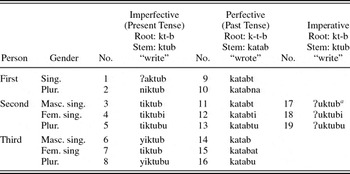
Table 1 contrasts the imperfective (present time reference) and the perfective (past time reference). Typically, the verbal paradigm consists of four main elements: a root; a derivational element; a vocalic pattern that designates the aspectual-tense role; and one or more affixes that carry inflectional elements for person, gender, and number (Bakalla, Reference Bakalla1979).
Verb paradigm for k-t-b root

Note: Sing., singular; Plur., plural; Masc., masculine; Fem., feminine.
aAccording to native informants, this form can also appear as ʔaktub.
The imperfective (present tense) and perfective (past tense) have eight items, which can be divided into three major groups on the basis of person. There are two types of affixes that attach to the verb stems. The first, associated with the perfective stems, are suffixational. The second type consists of suffixes and prefixes that appear with the imperfective stems (Bakalla, Reference Bakalla1979; Sieny, Reference Sieny1978). Compare Examples 8 and 15 in Table 1. Example 8 has a prefix [yi-] and a suffix [-u] but Example 15 has only a suffix [-at]. The imperfective stem is distinct from the perfective (past tense) form. As is evident in Table 1 (Examples 9–16), the past tense consists of the root pattern k-t-b that together with the inserted vowels /a/ forms the past tense stem katab. Affixes can be added to this stem to indicate the subject of the verb. Unlike agglutinative languages, such as Turkish, where each agreement inflection is represented by a distinct form attached to the verb stem, in Arabic, one unanalyzable unit simultaneously represents several linguistic categories (e.g., person, number, and gender). For instance, the suffix at (Example 15 in Table 1) denotes agreement for feminine, singular, and third person.
In Arabic the imperative has three different forms reflecting differences in gender and number. Table 1 (Examples 17–19) shows that the imperative also has a stem pattern similar to the present kt-b (uktub). There is overlap between some forms for the first person singular present and the singular masculine imperative in spoken context. For example, according to native informants of UHA, both ʔuktub and ʔaktub can represent the second person singular imperative form “write.” Note that when ʔaktub is used it is homophonous with the first person singular present form, which denotes “I write.” Because the singular masculine imperative is less marked than the feminine singular and plural imperatives, it might be considered to be the closest to the stem form.
Imperatives in UHA, as in Arabic in general, are tenseless (Zanuttini, Reference Zanuttini1997). Arabic linguists have also noted that the imperative represents mood, which is usually identified by an imperative stem (Brustad, Reference Brustad2000). Given these facts, one might assign a special role for imperatives in UHA child language development. In other words, in the absence of a distinct infinitival form and considering the fact that roots in this language cannot stand alone, a logical prediction is that children acquiring Arabic would select the imperative form as the default in place of fully inflected forms (see Poeppel, Reference Poeppel and Rice1996, for how language-specific parameters determine the nature of the error form).
The present study examines the ability of Arabic-speaking children with SLI to produce finite verb inflections and compares their productions with those of typically developing children. The study also explores error patterns in the children's use of verbs in finite verb contexts. As noted earlier, the form of the error in Arabic is intriguing given the fact that children learning Arabic must express several aspects of grammar simultaneously (e.g., gender, number, person, and tense). Language-specific characteristics of Arabic appear to dictate an inflected default form other than the infinitive form or bare stem that are commonly reported for other languages.
METHODS
Participants and procedures
A total of 30 monolingual UHA-speaking children were recruited through the Jeddah Institute for Speech and Hearing (JISH), Jeddah, Saudi Arabia. The children formed three groups of 10 each; a group of children with SLI and two groups of typically developing children who served as MLU-equivalent (2TD) and age-matched (5TD) controls.
The 10 children with SLI (6 boys, 4 girls) ranged in age from 4;0 to 5;3 (mean age = 57.3 months) and had an average MLU in words of 1.9 (range = 1.5–2.47) based on 100-utterance samples. They were diagnosed as having SLI by native Arabic-speaking speech–language pathologists who were certified by the American Speech, Language and Hearing Association. According to diagnostic records, each child had passed both a hearing screening (20 dB at 500, 1000, 2000, and 4000 Hz) and an oral–motor examination. Parental report indicated no history of chronic otitis media, but for a majority of the participants a positive family history of language impairment was mentioned. At present, no standardized tests for language exist in Saudi Arabia. Therefore, diagnosis of language difficulties was arrived at by the certified speech–language pathologists' clinical judgment using various speech and language diagnostic measures such as (a) a battery of language tests adapted for Arabic, derived from the Test of Auditory Comprehension of Language Revised and the Preschool Language Scale; (b) an informal articulation test to assess various Arabic phonemes in three word positions using picture stimuli of familiar items; (c) cognitive screening tasks (association, matching, categorization, and problem solving); and (d) analysis of a spontaneous language sample to examine the types and variety of grammatical structures used (morphology, utterance length) as well as conversational discourse/pragmatics and lexical diversity. Criteria for inclusion in the group of children with SLI consisted of receptive and expressive language performance that was markedly below the developmental milestones expected for typically developing children. In terms of cognitive functioning, all children considered to have SLI had records from pediatric developmental specialists and psychologists that reported the children's nonverbal IQ to be “within normal limits” and that none of the children presented with frank neurological deficits or socioemotional disturbances.
The 20 remaining participants consisted of typically developing monolingual UHA-speaking comparison groups. Ten children (4 boys, 6 girls) ranging in age from 4;0 to 5;2 (mean age = 56.7 months) with an average MLU in words of 3.2 (range = 2.63–3.74) served as age controls (5TD group). For the present investigation, MLU in words was selected rather than MLU in morphemes in order to circumvent a confound that might result because the dependent variable of interest represents the production of verb inflectional features. The age of each participant in the 5TD group was within 2 months of a child in the group of children with SLI. The ages of the 5TD group were not significantly different from those of children with SLI, t (18) = 0.250, p = .806. The second group of typically developing children (2TD) consisted of 10 children (4 boys, 6 girls) ranging in age from 2;0 to 3;0 (mean age = 28.7 months) who had an average MLU in words of 1.86 (range = 1.42–2.42). They were at an equivalent level of MLU to the group with SLI whose average MLU in words was 1.9. Each participant in the 2TD group was within 0.1 MLU (words) of at least 1 child in the SLI group (Rice et al., Reference Rice, Wexler and Cleave1995). The SLI and the 2TD groups were equivalent in their MLUs, t (18) = 0.368, p = .792. Results obtained from parental reports and preliminary speech–language pathologists' screenings indicated that the normally developing children's (5TD and 2TD) birth and medical histories were uneventful and they had achieved developmental milestones as expected. No hearing, neurological, or intellectual impairments were documented in parental and clinician reports.
The data were drawn from an existing patient and normal language videotape database gathered at JISH. All of the videotapes of the 30 participants consisted of spontaneous samples elicited by a native Arabic-speaking JISH staff member (clinician or trained research assistant) during play, picture description, and spontaneous conversation with the child. The sessions were held in a videocircuited JISH therapy room and were recorded using a Panasonic AG-7350 VHS recorder, a WV-CU254 system controller, and a WJ-MX12 digital AV mixer. Data from the children with SLI consisted of individual therapy sessions between the child and a therapist. Sessions that had over 100 spontaneous samples were selected. The topics of conversation in these samples were elicited in conjunction with the therapy using pictorial material (e.g., picture posters with absurd depictions) and following the child's lead during structured play with toys (e.g., house and cooking set). None of the sessions targeted morphemes investigated in this study. The data collection procedures for the typically developing participants were similar to those described for the SLI group in terms of context, interaction partner, and spontaneous sample elicitation strategies. An application specifying the research project, design, and consent forms was reviewed and approved by the McGill University, Faculty of Medicine Institutional Review Board, Montreal. Parents or guardians of the participants provided informed consent for the use of their children's language samples for research and educational purposes.
The participants' language production was transcribed according to the conventions of the CHAT system (MacWhinney, Reference MacWhinney1991). Data transcription was conducted by the first investigator who has an excellent receptive command of UHA and two native-speaking Urban Hijazi research assistants. To maintain consistency across samples, transcription was initiated after the child had produced 10 consecutive, complete, nonstereotypical utterances such as yes–no responses, greetings, and routines. Because one participant produced only 105 utterances, 105 utterances was adopted as the length for all transcripts, excluding any stereotypical productions.
Coding and analyses
The transcripts were coded for correct use in marking verb inflections. The coding conventions created for the present research were compiled into an Arabic Coding and Transcription Manual using the guidelines of the CHAT and CLAN systems of the CHILDES Program. It is worth noting that in coding subject–verb agreement, analysis was begun with the verb and then the features were checked against the type of subject following Poeppel and Wexler's (Reference Poeppel and Wexler1993) strategy. In the procedure adopted here, nontensed forms used as substitutes (imperatives) were considered as incorrect default forms. Agreement errors on the imperatives were treated in a separate analysis.
Agreement in UHA is fusional (see Table 1). This makes it difficult to isolate the exact agreement inflectional error, for example, whether it is an error of person, number, or only gender. All substitution error forms were coded for any relevant features, such as the substitution of the third person feminine singular for second person masculine plural. The accuracy of use of the morphosyntactic elements investigated in this study was determined by matching the form produced by the child with the target form as determined by the structural (i.e., correspondence of verb agreement features with subject type) or discourse context (i.e., past events). Overall, any production that did not conform to the adult spoken version of the local dialect was coded as incorrect.
Ten percent of each child's record was selected randomly for transcription and coding reliability checks. Two native UHA-speaking linguists were used for these checks on the selected samples. Average interjudge reliability rates were 92.1% for transcription and 94.9% for coding. The breakdown of reliability for the transcription was 89.9% for SLI, 97.6% for 5TD, and 88.3% for 2TD whereas for the coding it was 92.6% for SLI, 98.5% for 5TD, and 93.6% for 2TD. Consensus in cases of disputed coding was reached through discussion.
For each grammatical morpheme that was coded, the percentages of correct use in obligatory context were computed for each participant and compared across the three groups. Percentages were used because the spontaneous production data varied in the number of contexts for particular morphemes across the participants. Tabulations were computed using the CLAN system of CHILDES.
RESULTS
Arabic-speaking children with SLI were compared to the two groups of typically developing children, MLU-matched (2TD) and chronological age-matched (5TD) controls, on the percentage of correct use of verb inflections marking tense and agreement. The group comparisons (SLI, 2TD, and 5TD) were conducted utilizing one-way and Kruskal–Wallis analyses of variance (ANOVAs). Morpheme error comparisons across the groups were limited to descriptive statistical analysis because of smaller sample sizes and lower frequency of occurrences. Descriptive data including cell size, number and range of contexts, group mean, range of scores, and standard deviations for each investigated morpheme can be found in Appendix A. Only data that met a predetermined cutoff criterion of at least three obligatory contexts per child were included in the analysis. A minimum of 5 out of 10 children had to be in each group for a nonparametric statistical analysis to be conducted.
Tense
Analysis of tense was restricted to the present and past tense obligatory forms because the future forms rarely emerged in the transcript records of the children's spontaneous productions. Recall that for the computation of the percentages of tense marking, agreement form choice errors were ignored. Outcomes for agreement choice errors are presented separately in the following section. Overall, the group with SLI exhibited significantly lower scores in marking tense (68.2%) when compared to the two control groups (95% for 2TD, 100% for 5TD). Analyses of tense types were conducted to determine whether the groups were comparable on marking present versus past. Results are given followed by error profiles for tense.
Correct tense types
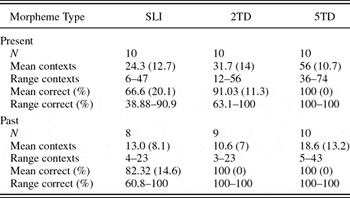
The mean of correct percentages for present tense for the SLI, 2TD, and 5TD groups were 66.6, 91, and 100%, respectively. A univariate ANOVA yielded significant group effects for present tense accuracy scores, F (2, 27) = 16.64, p < .0001, η2 = 0.55. As is evident from the relatively large eta-squared value, approximately half of the observed variances can be attributed to group differences. A pairwise Fisher least significant difference (LSD) t test (p < .01) revealed that the group with SLI had significantly lower scores than either of the control groups. No significant differences were found between the 2TD and 5TD groups. For the past tense the group with SLI averaged 82.3%, whereas both the control groups (2TD and 5TD) scored at ceiling (100%). A Kruskal–Wallis analysis for past tense revealed significant group differences, χ2 (0.01, 2) = 17.2, p = .0001. A Mann–Whitney U test indicated that the group with SLI was significantly lower in marking the past tense than the 2TD and 5TD groups (p < .01).
The scores for the present tense were lower than the past tense for the 2TD and SLI groups. However, the difference between the two tenses (66.6 and 82.3%) for the SLI group was not significant using dependent t tests, t (7) = −1.96, p = .09. Typical utterances produced with correct tense forms are provided in Examples 2a–2c.
- 2.
a.
b.
c.
Tense error analysis
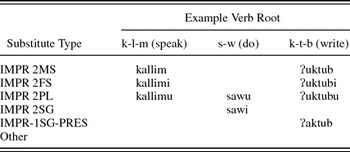
All tense errors were coded for type of substitution. These fell into the following categories: (a) imperative, (b) imperative forms homophonous with first person singular present forms, and (c) other tensed form (e.g., present for past; see Table 2 for examples of each type). Certain verbs (e.g., “sawi”) could not be coded for gender type (masculine vs. feminine) because they end with /i/, a phoneme that is identical to the second person feminine imperative marker.
Types and examples of imperative forms used as substitutes for tensed forms

Note: IMPR, imperative; MS, masculine singular; FS, feminine singular; SG, singular; PL, plural; IMPR-1SG-PRES, imperative homophonous with first person masculine singular present; Other, incorrect tensed form.
Two types of error analyses were carried out for tense. The first addresses the types and frequency of occurrence for each substitute type. The second compares the use of imperatives (excluding homophonous forms) by the SLI and 2TD groups.
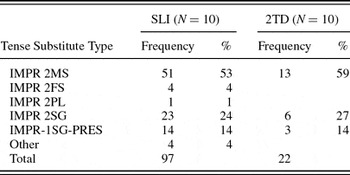
The frequency and percentage of tense error types for the SLI and 2TD groups appear in Table 3. There were too few past tense contexts to allow a separate analysis of error forms for each tense (present, past). Overall, the two groups exhibited a similar pattern of errors except that the children with SLI produced approximately five times as many errors as the 2TD children. Nontensed forms (imperatives) predominated as an error form for tensed target forms, which is evident from Table 3. In contrast, only four instances of substitution with an incorrect tensed form occurred for the SLI group and none for the 2TD group. The percentage of imperative substitutions (excluding homophonous forms) was almost the same for the SLI (85.6%) and 2TD (86.4%) groups. A closer inspection of Table 3 reveals second person masculine imperative unmarked for agreement as the most common substitution for tensed forms (53% for SLI, 59% for 2TD). Next in frequency was the second person singular form (2SG; 24% for SL, 27% for 2TD). Examples of utterances with error patterns are presented in Examples 3 and 4. Note that the utterances in Examples 3a and 4a are what the children said and the corresponding utterances in Examples 3b and 4b represent the target sentence as determined from the context.
Frequency of tense error types for SLI and 2TD groups

Note: IMPR, imperative; MS, masculine singular; FS, feminine singular; SG, singular; PL, plural; IMPR-1SG-PRES, imperative homophonous with first person masculine singular present; Other, incorrect tensed form.
- 3.
a.
b.
- 4.
a.
b.
Subject–verb agreement
Accuracy of subject–verb agreement collapsed for person, number, and gender was contrasted across the three learner groups (SLI, 2TD, and 5TD). Means for the groups were 77.7% for SLI, 93.7% for 2TD, and 99.8% for 5TD. A univariate ANOVA followed by Fisher LSD post hoc tests revealed a significant group effect, F (2, 27) = 15.21, p < .0001, η2 = 0.52, with significant differences occurring between the group with SLI and each of the control groups (p < .01). Typical utterances produced with correct subject–verb agreement marking are given in Examples 5a and 5b.
- 5.
a.
b.
To gain further insights into group profiles for agreement marking, two types of analyses were conducted. First, all correct scores on agreement for each group were separated into contexts where present versus past tense was produced. The groups were then compared on present versus past agreement inflectional marking. Second, separate analyses of agreement forms for gender and person were carried out to determine whether the groups differed in marking these forms. Results for each type of analysis are presented in the following section.
Correct present and past tense agreement marking
Subject–verb agreement used in present tense contexts was relatively high for the group with SLI (SLI = 88.3%, 2TD = 94%, and 5TD = 99.8% correct). A Kruskal–Wallis ANOVA for this context revealed a nonsignificant group effect, χ2 (0.01, 2) = 1.92, p = .383. Agreement in past tense contexts (SLI = 79.5%, 2TD = 96.4%, and 5TD = 100%) also yielded a marginally nonsignificant main effect for group, χ2 (0.01, 2) = 8.21, p < .016. A comparison between the accuracy in agreement on past versus present tense contexts for the SLI group also failed to reach significance (Wilcoxon matched test, p > .05).
Correct person agreement
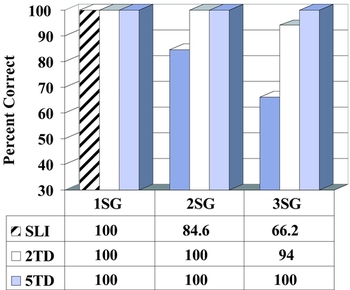
The children's spontaneous samples generated sufficient contexts to conduct an analysis of agreement forms for gender and person but not for number. Figure 1 contrasts the performance of the three groups on the accuracy (medians) of three types of person agreement (first, second, and third person singular). It was interesting that an examination of agreement for each of the person contexts (first, second, and third) using a series of Kruskal–Wallis analyses yielded a significant main effect for third person singular, χ2 (0.01, 2) = 11.18, p = .004, but not for the first person singular, χ2 (0.01, 2) = 3.93, p = .140. Findings for second person singular barely failed to reach significance, χ2 (0.01, 2) = 8.61, p = .013. A Mann–Whitney U test showed that the children with SLI scored significantly lower than the 5TD group on the third person inflectional marking (p = .005). First person singular was significantly different from second person for the group with SLI (Wilcoxon matched test, p < .01). However, differences in the percentages correct for first and third person for the SLI and 2TD groups did not reach significance at the alpha level selected for this study (.01).
The median percentage of correct person agreement marking. 1SG, first person singular; 2SG, second person singular; 3SG, third person singular. [A color version of this figure can be viewed online at www.journals.cambridge.org]

In summary, the children with SLI were more proficient in using the first person but less capable with the third person singular forms than their aged matched peers.
Correct gender agreement
Because of the small number of tokens used by members of the SLI group, the analysis for gender agreement is only exploratory and conclusions are at best tentative. A series of Kruskal–Wallis analyses for each type of gender agreement inflection (masculine vs. feminine) revealed significant group differences for masculine, χ2 (0.01, 2) = 9.35, p = .009, and feminine, χ2 (0.01, 2) = 19.13, p = .001. Mann–Whitney U tests indicated that the group with SLI was significantly lower in using the masculine forms (80.8%) than the 5TD group (99.4%) only (p < .01). For feminine inflections, significant differences (p < .01) were found among all three groups (SLI [33.5%] < 2TD [91.1%] < 5TD [100%]). The picture that emerges is one in which the percentage of correct agreement combined for all persons (second and third) shows approximately ceiling performance for feminine by the two control groups and much lower accuracy rates by the children with SLI. However, a comparison between feminine agreement and masculine agreement for the group with SLI failed to reach our α = .01 level of significance (Wilcoxon matched test, p = .04).
To further explore the question of gender distinctions, the agreement forms for third person singular (masculine vs. feminine) were singled out for analysis. Ideally it would have been best to examine contexts in which only one feature varied (e.g., comparing third person feminine present forms with third person masculine present forms); however, because of the small number of occurrences of certain forms, the third person forms were collapsed across tense (present, past). A Kruskal–Wallis ANOVA revealed a significant group difference for the third person feminine singular, χ2 (0.01, 2) = 13.5, p < .001. In contrast, third person masculine forms failed to reach significance, χ2 (0.01, 2) = 3.59, p = .165.
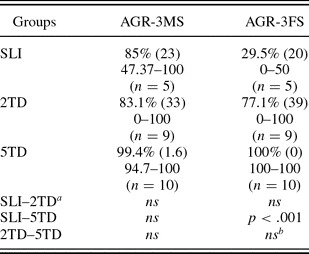
The percentage of correct agreement according to the two gender types appears in Table 4. Significance values based on Mann–Whitney U tests are also indicated in the table. The group with SLI was significantly different from the 5TD children in the use of feminine agreement in the third person (p < .001). No statistical difference emerged between the 2TD children and the group with SLI for third person feminine singular inflections. Despite the lack of statistical significance, it should be noted that the scores for third person feminine singular were numerically lower for the children with SLI than for the 2TD children.
Mean percentages correct for third person masculine and feminine singular agreement forms (standard deviations), range, and number of participants in each group for each measure

Note: AGR, agreement; 3MS, third person masculine singular; 3FS, third person feminine singular.
aMann–Whitney U test (two-tailed) group comparisons (p > .05).
bSignificance at .05; below α = .01.
Agreement error analysis
IMPERATIVE AGREEMENT ERRORS
Imperatives in UHA are nontensed, second person forms that are marked for gender and number agreement. Generally, the frequency of substituting a masculine imperative in contexts requiring a tensed feminine form was high (58% for SLI, 47% for 2TD). The use of feminine imperatives in tensed masculine contexts was less frequent (12% for SLI, 0% for 2TD). Furthermore, the group with SLI often used singular imperative forms to substitute for tensed plural forms (30%).
PERSON, NUMBER, AND GENDER AGREEMENT ERRORS
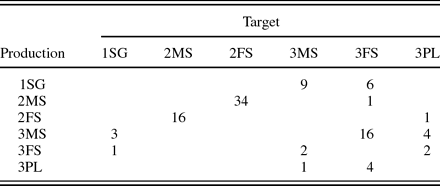
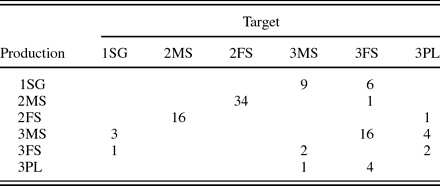
For this analysis, all contexts in which a tensed agreement form was replaced by an incorrect tensed agreement form were considered. These data are presented descriptively; the small number of errors of each type per child precludes statistical analysis. These errors are summarized in Table 5. On the left are the actual productions used in place of the target forms that appear in the top row. For instance, there were nine first person singular (1SG) forms used in contexts requiring third person masculine singular (3MS) forms.
Errors in the use of tensed agreement inflections by the group with SLI
Note: MS, masculine singular; FS, feminine singular; SG, singular; PL, plural; 1, first person; 2, second person; 3, third person.
From an inspection of Table 5, the following generalizations can be noted. First, most errors of agreement differ by only one feature (gender, number, or person). Errors involving more than one feature (e.g., second person masculine singular for third person feminine singular) were rare. For one-feature errors, there were 15 first person singular substitutions for the third person singular, 34 second person masculine singular for second person feminine singular, 16 second person feminine singular for second person masculine singular, and so forth. Second, errors were slightly more in the direction of singular for plural (7 errors) than plural for singular (5 errors). Third, more masculine forms were substituted for feminine forms (51 errors) than feminine for masculine (18 errors). Fourth and finally, more substitutions were first person for third person (15 instances) than third person for first person (4 instances). Examples of substitution patterns for subject–verb agreement can be found in Examples 6 and 7.
- 6.
a.
b.
- 7.
a.
b.
DISCUSSION
The purpose of this study was to explore and compare verb morphology in the spontaneous productions of Arabic-speaking children with SLI to the performance of typical language learners who were age and MLU matched. The general profile that emerged from our data from Arabic-speaking children with SLI demonstrates that their grammatical morphology is indeed an area that is vulnerable, much as it is for children with SLI who speak a variety of other languages (Bedore & Leonard, Reference Bedore and Leonard1998; Crago & Allen, Reference Crago and Allen2001; de Jong, Reference de Jong1999; Fletcher, Leonard, Stokes, & Wong, Reference Fletcher, Leonard, Stokes and Wong2005; Hansson et al., Reference Hansson, Nettelbladt and Leonard2000; Leonard, Reference Leonard, Bishop and Leonard2000; Leonard, Camarata, Brown, & Camarata, Reference Leonard, Camarata, Brown and Camarata2004; Paradis & Crago, Reference Paradis and Crago2001; Rice et al., Reference Rice, Wexler and Cleave1995, Reference Rice, Noll and Grimm1997; Tager-Flusberg & Cooper, Reference Tager-Flusberg and Cooper1999). We now turn to a discussion of the nature of the morphological deficit in Arabic SLI, the error forms used in lieu of correct finite forms, and the relationship of SLI to typical language development.
Verb morphology in Arabic SLI
As a group, the Arabic children with SLI in this study used a significantly lower proportion of correct finite marking on verbs than either of the two control groups (MLU matched and age matched). The SLI data examined in this study appear to be compatible with predictions of the sparse morphology hypothesis, an account often applied to languages with rich morphology (Leonard, Reference Leonard, Bishop and Leonard2000). The expected pattern under the sparse morphology hypothesis is that children acquiring richly inflected morphology such as Hebrew and Italian will fare better than their counterparts in learning languages in which inflectional morphology is sparse, for example, English and Cantonese. Indeed, the use of verb morphology was more extensive in the Arabic-speaking children with SLI than is often cited for English-speaking children with SLI. For example, the English-speaking children with SLI in Rice and Wexler's (Reference Rice and Wexler1996) study had only 22% (standard deviation = 34) of their past tense forms correct whereas Arabic-speaking children with SLI in this study had 82% (standard deviation = 14) of their past tense forms correct.
The accuracy of subject–verb agreement collapsed across the features of person, number, and gender was contrasted across the three learner groups (SLI, 2TD, and 5TD). The Arabic-speaking participants with SLI displayed lower scores in marking subject–verb agreement (77.7% accuracy in comparison with the near ceiling performance of the two control groups). Their difficulty with this aspect of morphology is not surprising given the relatively complex nature of agreement marking in Arabic. As described earlier, Arabic verbs are morphologically complex and have to agree with the subject according to person, number, and gender. In addition, more than one feature (e.g., person, gender, tense) is often marked by a single surface form. It may be assumed that the fusional property of the grammatical inflections and the number of distinctions simultaneously expressed are jointly responsible for the observed agreement problems (Dromi et al., Reference Dromi, Leonard, Adam and Zadunaisky-Ehrlich1999; Slobin, Reference Slobin, Ferguson and Slobin1973). Further analyses of the subject–verb agreement data revealed that not all forms posed equal challenges for the Arabic children with SLI. For instance, scores for third person agreement (56.9%) were lower than for first person agreement (97.4%) in the group with SLI. Given that third person forms involve gender distinctions as well as distinctions according to person and number, whereas first person forms involve distinctions according to person and number only, this substitution pattern may well have been influenced by the number of features required for the third person forms. One observation consistent with this interpretation is that in most languages the third person forms are usually the most accurately used by children.
It could be the case that the children with SLI face special challenges with agreement features because of associated limitations in computational processing. As Leonard (Reference Leonard1998) points out, the learner must consider the relationships between the two constituents of a sentence in order to correctly mark agreement. This requirement may necessitate substantial processing capacity. In addition, the complexity of Arabic inflectional morphology may represent a case in which the processing requirements are greater than the resources available to the children with SLI. Although a processing account may have merit in explaining the SLI difficulties in the finiteness marking observed in this study, it is not easy to determine what form “processing demands” would take for a specific grammatical element, apart from the number of features reflected in the fusional morphemes. Instead the inflectional morphology may be affected by reasons related to a morphosyntactic representation deficit in children with SLI, as has been suggested by Rice and Wexler (Reference Rice and Wexler1996), rather than the processing demands of inflection use. Future theoretically based acquisitional studies of Urban Hijazi dialect are certainly needed to shed further light on this issue.
Clahsen and colleagues (Clahsen, Reference Clahsen1989; Clahsen, Bartke, & Göllner, Reference Clahsen, Bartke and Göllner1997) proposed that children with SLI have particular deficiencies in marking agreement relations in their grammars. The overall finding that subject–verb agreement is troublesome for Arabic-speaking children with SLI is concordant with this claim. According to Clahsen (Reference Clahsen1989), correct use of agreement results from rote learning. However, a closer examination of the data showed that accuracy of agreement was not uniform across the agreement inflections. For example, the children with SLI were more accurate with first person singular than with third person singular. It is difficult to see how mere rote learning can explain this kind of finding.
Why did the children with SLI appear to have more problems with third person singular agreement? We noted earlier that third person forms involve gender as well as person and number. In addition, longitudinal data from Kuwaiti Arabic revealed that the first person category developed earlier than third person agreement (Aljenaie, Reference Aljenaie2001). This developmental trend may explain why the third person lags behind first person marking in the SLI data examined in this study. In other words, the children with SLI may still be in the process of mastering the more abstract feature for marking third person agreement.
In contrast to the first person form, gender marking in Arabic is distinguished for the third person. To further explore the question of gender distinctions, agreement forms for the third person singular (masculine vs. feminine) were singled out for analysis. Although the exploration of gender distinction was tentative for methodological reasons, the emerging picture was revealing. The masculine form for all persons was used with greater accuracy than the feminine form in the spontaneous productions of the group with SLI. Difficulty with third person feminine forms was quite striking in the group with SLI (SLI [33.5%] < 2TD [91.1%] < 5TD [100%]). One could speculate from these data that gender marking may be a particular locus of agreement difficulty for Arabic-speaking children with SLI. In fact, Anderson (Reference Anderson2001) found difficulties in learning gender inflections in Spanish-speaking children with SLI. Other studies of Arabic language acquisition have confirmed that the masculine verb form emerges before the feminine counterpart (Aljenaie, Reference Aljenaie2001). This discrepancy between the gender forms could be linked to the possibility that masculine forms are more “neutral” or “less marked.” Aljenaie (Reference Aljenaie2001) provides a syntactic argument for how gender agreement in Arabic verbs and nouns is controlled by masculine nouns. According to Aljenaie, evidence from cross-linguistic acquisition also attests to a preference for the masculine gender over the more strongly and consistently marked feminine counterpart. Additional data on proficiency of agreement in Arabic is warranted before firm conclusions can be drawn regarding gender marking.
Subject–verb agreement did not constitute the entirety of the verb morphology problems experienced by this group of Arabic-speaking children with SLI. Indeed, the scores of the group with SLI were significantly lower for marking present and past tense. The fact that the MLU-matched controls (2TD) were more proficient in marking tense is confirmed by Aljenaie's (Reference Aljenaie2001) work in which the tense contrast emerged early in 2-year-old typical language learners of Kuwaiti Arabic. A comparison between the two types of tense in the group with SLI in this study revealed that their difficulty appears to be tied to tense in general and not to present or past tense in particular. This finding is rather surprising because several cross-linguistic studies have found children with SLI to have greater difficulty with past tense. Swedish represents a good example because finite inflections in this language mark tense only, without making any distinctions according to person or number. Swedish-speaking children with SLI displayed lower percentages of correct past tense forms than typically developing language controls (Hansson et al., Reference Hansson, Nettelbladt and Leonard2000). However, present tense forms were used much more accurately.
Nature of errors
The error analysis for tense and agreement revealed an interesting pattern that emphasizes the value of examining language-specific structures before drawing conclusions about the nature of morphosyntactic deficits in SLI. In Arabic, the root that is composed of triradicals cannot stand alone and there is no infinitival form. Therefore, the pattern of using a bare stem or an infinitive seen in children with SLI who are acquiring languages such as Dutch, Swedish, English, and German (de Jong, Reference de Jong1999; Hansson et al., Reference Hansson, Nettelbladt and Leonard2000; Rice et al., Reference Rice, Wexler and Cleave1995, Reference Rice, Noll and Grimm1997) is not possible for Arabic SLI. In addition to the use of infinitives, studies of some languages such as Dutch, Norwegian, and French found the use of present tense forms as default forms (de Jong, Reference de Jong2002; Meyer Bjerkan, Reference Meyer Bjerkan1999; Paradis & Crago, Reference Paradis and Crago2001). The third person singular present forms were used as substitute forms in Spanish (Bedore & Leonard, Reference Bedore and Leonard2001) and in certain other languages (for a comprehensive cross-linguistic review of root defaults, see Paradis & Crago, Reference Paradis and Crago2001). Inuktitut presents an interesting contrast. Crago and Allen (Reference Crago and Allen2001) found that an Inuk child with SLI used bare roots, which unlike the default forms found in the languages described above is not permissible in Inuktitut. These possible error patterns could be summarized as follows: (a) the error resembles permissible nonfinite forms in the language (bare stem or infinitive); (b) the error pattern consists of forms that are not permissible in the target language; and (c) the error pattern consists of forms that are permissible finite defaults, for example, the present tense form. Given this set of findings, some permissible form (Type c) was predicted to emerge as a default when errors in tense and agreement occurred in the language of the Arabic-speaking children with SLI because Types a and b were not possible in Arabic. Paradis and Crago (Reference Paradis and Crago2001) propose the term “default” to represent optional use of finite and nonfinite forms observed in typical and impaired developmental language. The empirical evidence in the current study supports their use of this term because children with SLI tended to substitute the imperative, particularly the second person masculine imperative, as default for tensed forms. An analogous pattern emerged in the typically developing MLU-matched controls, although tense errors committed by them were relatively rare. Likewise, in her analysis of spontaneous production data of Kuwaiti Arabic children, Aljenaie (Reference Aljenaie2001) discovered that the first person singular or imperative forms served as substitutes in contexts where other inflections were required.
Leonard and colleagues' observation that errors in children acquiring Spanish and Hebrew constituted “near-misses” is also supported by the SLI data of this study (Bedore & Leonard, Reference Bedore and Leonard2001; Dromi et al., Reference Dromi, Leonard, Adam and Zadunaisky-Ehrlich1999; Leonard, Reference Leonard2002). Near misses comprised errant productions that differed from the correct target form by a single feature, such as person or tense only. In line with this prediction, many errors in verb agreement marking in the present study differed in only one feature from their targets. For example, a common directional bias was to substitute first person singular for third person singular and second person masculine singular for second person feminine singular forms. It was rare to find errors that differed by more than one feature (person and gender). For example, Arabic participants with SLI only infrequently produced a second person masculine form to replace the third person feminine similar form.
Relationship with typical language development
The performance of the group with SLI in relation to the two comparison groups was revelatory. Profiles of differences and similarities between children with SLI and typically developing language learners have not been found to be consistent across various languages (Leonard, Reference Leonard, Bishop and Leonard2000). As illustrated in the Results section, the Arabic-speaking children with SLI were significantly different in their use of tense and agreement forms than the MLU- and age-matched comparison groups. On the one hand, the performance of the MLU-matched group resembled that of the 5-year-old normally developing children in their use of tense. This is actually consistent with predictions of Wexler's (Reference Wexler1998) optional infinitive hypothesis in which he predicts that typically developing children learning a null subject language like Arabic will demonstrate either no optional infinitive stage or an early resolution of it. Patterns such as that of the Arabic-speaking children (SLI < 2TD = 5TD) for some grammatical forms have been found in other languages such as Inuktitut (Crago & Allen, Reference Crago and Allen2001). Children with SLI are often characterized as “delayed” when they score at the same level or lower than age-matched controls. For example, Rice and Wexler (Reference Rice and Wexler1996) refer to English SLI as an extension of the optional infinitive stage of language development typically seen in young children. On the other hand, the Arabic-speaking children demonstrated a deviant rather than delayed pattern of grammatical development. However, at the same time, the children with SLI in the present study were very similar to the younger MLU controls in certain other respects, such as using imperatives in contexts requiring tensed agreement forms.
The fact that the Arabic-speaking children performed significantly less well than the comparison groups runs counter to some of the findings on children with SLI who speak richly inflected and typologically similar languages such as Hebrew. As with the Arabic results, children in the studies by Dromi and colleagues had higher overall accuracy scores on tense and agreement than demonstrated by English-speaking children with SLI of the same age (Leonard et al., Reference Leonard, Eyer, Bedore and Grela1997; Rice & Wexler, Reference Rice and Wexler1996). Moreover, a closer examination of the findings for the present tense (Dromi et al., Reference Dromi, Leonard and Shteiman1993) and for the past tense (Leonard et al., Reference Leonard, Dromi, Adam and Zadunaisky-Ehrlich2000) resembled the pattern for Arabic (SLI < MLU controls). The fact that some agreement forms are more difficult than others was confirmed in both Hebrew- and Arabic-speaking children with SLI (Dromi et al., Reference Dromi, Leonard, Adam and Zadunaisky-Ehrlich1999). For instance, first person and masculine forms were found to be easier than third person and feminine forms in both languages. In addition, children with SLI in both languages displayed similarities in the agreement error pattern. Most errors committed by the children with SLI in both studies differed from the target form by a single feature. Despite convergence in these aspects, other findings from Hebrew are conflicting. Methodological as well as language-specific differences may have contributed to some of the observed discrepancies. Superficially, Hebrew and Arabic share similar structures; however, there are differences in linguistic features that could have accounted for the discrepancy in some of the findings. Unlike Arabic, Hebrew has infinitives and the past tense varies in person, number, and gender, a property that distinguishes it from the present tense where only number and gender vary. Therefore, the fact that differences between present and past tense were found in Hebrew and not in Arabic might be related to this difference (Dromi et al., Reference Dromi, Leonard, Adam and Zadunaisky-Ehrlich1999).
CONCLUSION
In summary, verb morphology presents special difficulties for children with language impairment who are acquiring UHA. This study confirms the importance of examining language-specific features when investigating SLI. In particular, the use of imperatives as default substitutes for tensed forms appears to be a pattern dictated by specific typological features of UHA, given the absence of bare roots and infinitives. Future research using controlled elicitation with greater opportunities for third person and plural forms will help to refine our understanding of Arabic-speaking children with SLI. Replicating the analyses of tense and agreement using more extensive spontaneous language samples and probe data with Arabic-speaking children with SLI who have varying severity levels would help in determining the applicability of the findings of this study to a wider range of Arabic speakers with SLI. Moreover, as more theoretically based linguistic studies of the UHA dialect are undertaken, important light may be shed on the analysis of the data in the present study. At present there are only descriptive characterizations of the language on which to base our research.
However, this study does begin to provide information on normal and impaired acquisition that can be helpful in the clinical management of Arabic-speaking children with SLI. It is important to note that tense, third person, and feminine agreement inflections appear to be particularly difficult for Arabic-speaking children with SLI. These forms may prove to have particular diagnostic utility. Experimental and clinical observations using larger samples will assist in confirming the generalizability of the results to other Arabic speakers with SLI. The use of the imperative as an apparent default form is worth considering in assessment and therapy.
In conclusion, much has been learned from this first exploration of SLI in Arabic. Further research will be important in order to gain a more refined understanding of the universal characteristics of SLI as well as those that are unique to Arabic. Nevertheless, given the grammatical characteristics of Arabic and the intricate morphological system it possesses, some of the theoretical and clinical ramifications that have emerged from this study have added another piece to the puzzle of understanding SLI.
APPENDIX A
Data for correct tense marking

Note: Tense: sample size (N) and mean number of contexts and percentage of correct use (standard deviations).
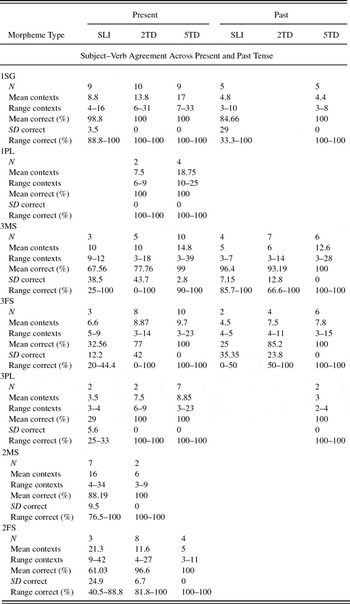
Data for correct subject–verb agreement

aThe spontaneous productions for 2MS and 2FS (nonimperatives) were too few to warrant analysis and hence do not appear in Appendix A.
ACKNOWLEDGMENT
This article was based on a doctoral dissertation completed by the first author in the School of Communication Sciences and Disorders at McGill University. The study was partly supported by a doctoral scholarship to Fauzia Abdalla from JISH, for which we are grateful. We acknowledge the important contributions made by Elin Thordardottir, Lydia White, Diane Pesco, and Laurence Leonard in all aspects of this study and thank Areej Aseeri and Fawzia Osman for their help with data collection and transcription. We extend our appreciation to the children who participated in this research, to their parents for granting the permission for them to do so, and to their clinicians who assisted us in selecting candidates for the project.