The structure will start with background information about the conversation participants, followed by an initial conversation between Vogel and Erdede. Out of this, the final section will be the 3-way conversation, which picks up on and elaborates further on points made in the earlier conversation.
There is no conclusion, other than a recognition that the conversations must continue and involve others, to effect real change in art libraries.
As this involves conversation and the transcription of speech, the first person is used often throughout, in order to preserve a more natural text. The conversations were both transcribed by Erica Foden-Lenahan, in consultation with the participants. The abstract, biographical sketches, introductory and transition excerpts were compiled and/or written by Foden-Lenahan, also in consultation with the participants.
Nistiman Erdede (NE) (born in Diyarbakir, Turkey and, since 2008, lives and works in Zurich) reveals a personal recollection of individual experience of collective memories, historical facts and practices of doing memory and its political art and institutional conditions. The material for this work is based on personal and interpersonal memories, diaries, from different moments of time, which arises from war reports in the war zone before and after forced migration. He questions the relations between history, memory and emancipatory action in forced immigration. His Zurich and Amed/Diyarbakir based practices can be read as a collective memory in its endeavour to come to terms with his own personal memory. Also, the works should be considered as an inquiry into the possibility of overcoming the experiences of war and refugee through the medium of writing and decolonial Art Practice.
Being a person of a minority in Turkey can best be understood as an integral part of Turkey's nation-building project. Following the fall of the Ottoman Empire, the founder of the new Turkish Republic, Mustafa Kemal Atatürk, established a regime which was particularly concerned with ‘reaching the contemporary level of civilisation’… They were inspired by Western statehood and deemed that only a homogenous and secular nation-state would be successful … The Kemalist regime sought to maintain territorial integrity and create social cohesion by imposing a secularized and westernized ‘national identity based on Turkish language and culture.’ They launched an authoritarian homogenizing project with the aim of eliminating ethnic differences through ethnic domination and forced assimilation … The regime sought to eradicate any mention of a Kurdish presence and removing any references from maps and official documents to a territory called ‘Kurdistan’, which had been widely acknowledged during the Ottoman era … Ever since, the Kurdish provinces have been ruled ‘in a colonial way’ where forced population resettlements, state-terror and ethnic persecution have become the everyday experience for the Kurds in Turkey.Footnote 3
In 2013 he began studying for a BA in Art and Media (Vertiefung Theorie) at the Zürcher Hochschule der Künste, graduating in 2016. Since then he is a decolonial artist, curator and works currently as a freelance radio journalist and copywriter.
Regina Vogel (RV) credits her annual vacations to southern and eastern Europe as a child for forming her ‘interest and openness for people from other regions of the world.’Footnote 4 While still in school, Vogel became interested in feminism and, later, Marxism. She worked in various part- and full-time jobs after graduating from high school, did an apprenticeship as a bookseller and organized the director's archive at Kunstmuseum Luzern, before studying art history, European popular literature and cultural anthropology at Zurich University, where she became interested in feminist art and non-European art. After obtaining her Masters degree, she catalogued the DADA collection at Kunsthaus Zurich. In the late 1990s, she began to learn Arabic and to spend time in Syria.
In 2003, she began to work as the librarian at the Daros Latinamerica collection. Although that role changed over time and she eventually was made redundant when their priorities shifted to Brazil, Vogel was able to spend considerable time in Latin America, particularly Brazil, when Casa Daros in Rio de Janeiro was developed. Casa Daros is now closed and part of the library was brought to Zurich and Vogel finds herself working with the collection again on a part-time basis. She combines this with several projects and with a part-time position as librarian at the Kunsthalle Basel.
It was while Vogel was on a Daros trip to London that she and I became acquainted. I was working as an acquisitions librarian at Tate, further building the book collection for contemporary Latin-American art. Vogel organized a panel about this subject for the SALALM (Seminar for Latin-American Library Materials) conference in Albuquerque in 2007. She says ‘We were, in the end, European and North America-based art librarians, with one Puerto Rican working in the US (Taina Caragol) and one Argentinian working in Canada (Norma Palomino). Librarians from Latin America could not afford to participate. I represented these missing librarians in the introduction of the panel. This was of course also a key experience of colonial legacy…’Footnote 5
Erica Foden-Lenahan (EFL) is a Canadian transplanted to Germany via many years in London. She has worked in museum libraries, as special collections librarian at the Courtauld Institute of Art and spent a year leading the collection care team of The London Library. In 2016 she began working as the librarian at an art college, the Staatliche Akademie der Bildenden Künste Karlsruhe.
Although many kilometres and years away from Canada, she has retained an interest in the country's attempts to reconcile its colonial legacies. Erdede's description of Turkey's nation-building policies are echoed in the practices of residential schools in Canada, where Indigenous children were far from their families and culture, and brutally prevented from speaking their languages. That had been British colonial practice.
It is these many experiences that brought us together to discuss decolonization in the context of libraries in general, but specifically art libraries. Vogel and Erdede met at an event in December 2019, where Erdede was discussing decolonial art. Their ensuing conversation led to a visit to the Kunsthalle Basel and an invitation for him to join us in a conversation about decolonizing art libraries. They met in MarchFootnote 6 for a discussion after I had sent them some preliminary questions. Below is some of the text of that conversation. For my benefit, as transcriber, they spoke in English. I have tried to retain the energy of their conversation.
Conversation 1
NE: Memory is, for me, very connected with the writing, with my diary. I have 3 phases of that diary: Secondary school age, where I try to find who I am, the universal question, it brings me to my identity as ‘Other’, as Kurdish. This opens the new phase of my life, my activism. At the end of the first stage, after 10 years, I was very involved in the struggle for my cultural rights…My language, my mother tongue is linguistic, political point, but I don't want to talk about that because I am not a linguist, not a political scientist. But my activism brings me to prison and after prison, 6 months, it was no longer possible to stay in Turkey; This starts the second chapter of this diary, that of a refugee. For me it was the brutal face of the racism, the discrimination, in 2008, this Ausschaffungsinitiative (by the Swiss Peoples’ Party – SVP - which called for the expulsion of people who were in Switzerland legally, but who had committed a serious crime such as benefits fraud, drug trafficking and break-ins). I was very confused because in the vote in 2010 this initiative was approved by a majority of Swiss citizens (52,9%).Footnote 7 I thought ‘Wow’, I crashed [into] a wall in a metaphoric way. Who is this majority of the society? That motivated me, offering conditions that pushed me to express my opinion. I don't want to use that word victim because I am not victim … I was the other and this very brutal, very harsh way of the precarity and, …you have nothing, just a kind of official [document], it's very blue and its your ID and must be renewed every 6 months, its so political, so I don't want to go there… I have to tell my witnesses to the people directly, how can I do it? Those were the first years in Switzerland. And what surprised me also was [the attitude] ‘You are an immigrant, you are a stereotype, you are exotic, you are authentic.’ You have a role [projected on you by] the white, privileged, eurocentric, dominant society members, citizens; they define your cultural capital (according to Bourdieu).Footnote 8 I was just a small coin of the capital, as a refugee, and I couldn't accept that because I was involved in political activism, human rights activism for 17 years of my life. It doesn't make sense if I am an immigrant or a citizen or not; I have knowledge, I have consciousness, awareness of my rights, my fundamental human rights and how to struggle for these rights.
RV: I am thinking that there could be a danger that we, or I reduce you to this role, of you collaborating with me in this library decolonization project. What could we do to avoid this danger? Do you see it as a danger?
NE: What kind of danger do you mean?
RV: I mean as me, the privileged, Swiss, white person with the paid job in this library, and I feel this danger, that unconsciously in a way I put you in this role that you have explained now, of being the Other.
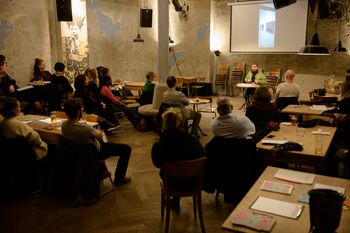
NE: No, it is the start with decolonizing, with your request or with our talk. It is not that as your profession you look for some immigrant. After my presentation at Cabaret Voltaire Figure 1, it was the basis to bring us together and that was just my contemporary art position. I see it in that case, it is good for me. In this case I would like to mention the definition by Gayatri Spivak, of ‘unlearning’. For me, it was also another topic with my activism, for me it was very hard to talk about this with my very best friends, to talk and discuss with them. What is the unlearning? How do they start that? How do they have courage to start that unlearning? They become very emotional, they take it very personally, they cry, they break our friendships. And that for me is the characteristic of the white, eurocentric, dominant, privileged society.
Cabaret Voltaire presentation. Photograph ©Olaf Brachem. Courtesy of Cabaret Voltaire.
Now I think for me this question about danger is not a question because we are at the same level, sitting around a table, it's not that you are the specialist, of course you are.
RV: We escape the stereotypical setting. It is clear to us that our positions are equal.
NE: Yes, that for me is the first point.
RV: I contacted you because it was so important what you presented in this lecture in Cabaret Voltaire, I was thinking a lot about what I could do to decolonize the library. And it is always very connected to this unlearning process. I think I always considered libraries as kind of neutral spaces, just spaces having books, giving access to books and only recently I started to think more deeply about the collections we have in this art library. How it was formed? What does it represent? What is in and what is not in the library? It was such an amazing experience to me when you visited the library. You showed me things, I didn't have any expectations let's say, but it was so surprising to me what came out. For example this book about Mesopotamia.
NE: This Ararat, you mean.
RV: Yes, Der Ararat magazine too, but also the big book on the art of Mesopotamia, where you explained to me that it is the Kurdish region and no one talks about this Kurdish history.
NE: I think it is a very important point to acknowledge here: what you tell about this book. I cannot contextualize it as a Kurdish region. It is a territory, a geography and Mesopotamia is the base of this civilization, the birthplace of this civilization. Art historians maybe can talk about the prehistoric Asians first, the skills of the humans, how they start to draw on the walls of the caves, how they make soil-baked tablets and how they use the roots. Really Mesopotamia is the mother of the civilization, one of the mothers, when we think about Asia, Latin America, Mesopotamia also. For me it is much more, the library has this direct connotation to Karl May [German writer of adventure stories and travel books set in Asia, the US and Mexico] Durchs wilde Kurdistan (1892). As Edward W. Said writes in 1978 in his milestone work Orientalism:
On a visit to Beirut during the terrible civil war of 1975–1976 a French journalist wrote regretfully of the gutted downtown area that ‘it had once seemed to belong to … the Orient of Chateubriand and Nerval’. He was right about the place, of course, especially so far as a European was concerned. The Orient was almost a European invention, and had been since antiquity a place of romance, exotic beings, haunting memories and landscapes, remarkable experiences.Footnote 9
My decolonial artistic position is mainly based on Edward Said's Orientalism.
I shall be calling Orientalism, a way of coming to terms with the Orient that is based on the Orient's spatial place in European Western experience. The Orient is not only adjacent to Europe; it is also the place of Europe's greatest and richest and oldest colonies, the source of its civilizations and languages, it is cultural contestant, and one of its deepest and most recurring images of the Other. In addition, the Orient has helped to define Europe (or the West) as its contrasting image, idea, personality, experience. Yet none of this Orient is merely imaginative. The Orient is an integral part of European material civilization and culture. Orientalism expresses and represents that part culturally and even ideologically as a mode of discourse with supporting institutions, vocabulary, scholarship, imagery, doctrines, even colonial bureaucracies and colonial styles.Footnote 10
Libraries are reproducing and supporting these clichés, through their ordered structures. Why is this book on Mesopotamia in the library? Where is this book about the artworks, the history, the heritage of humanity: why is it on the hidden parts of the shelves of the library?
As an immigrant and decolonial artist, I perceive that the books chosen for library collections only represent the clichés because the librarians selecting material come from a different background and context under which these artists are working. There is institutional censorship through their collecting policies and what they choose to display. What is the criteria for the selection of books in art libraries? And who has access to these books? How many immigrants work in art libraries? Are they able to influence the selection of publications? Do we need only well-known artists in art libraries, those well-connected to the global market? I am really interested to know what qualifies an artist to be represented in a library collection and what qualifies a person to be able to select books for a library?
RV: Ah your expectations were…
NE: No, no, it is not expectation. It has changed my view, developed my perspective.
RV: That also Kurdish Turkish artists can be included?
NE: I don't want to categorize that, for me it was Othering, the art of the Others, which they don't want to show to people, as I briefly explained above. They are really hidden; you have to work hard to find [them]. The library is like a road and you have to have your map to find the right address of the shelf you look for.
RV: In this case, when you have to check the online catalogue to find the books and look afterwards on the shelves. It can also be a restriction through the keywords given to these books, for instance Kurdish is not a keyword, Kurdistan is not a keyword, so it is more difficult…
NE: Kurdistan was erased from world maps after World War I, when victorious powers carved up the Middle East and denied the Kurds a nation-state. Throughout modern times, the culture, language and identity of the Kurds has been threatened and destroyed by the regimes of the countries they inhabit. Kurdish art and culture is made invisible in western art discourse for a couple of reasons:
1. Politically constructed invisibility - Kurdistan is not only a forbidden keyword according to the policies of the Turkish state, all connected keywords are contaminated….and therefore excluded from the discourse of contemporary art….And Turkish authorities apply pressure on foreign governments and their institutions not to use those keywords.
2. Exclusive or discriminatory western art market - The contemporary art market also has its own interests and they dominate how and under what conditions they display artworks. Artists cannot challenge these policies or they will not get shown. The selection of the artworks is guided by the imagionary war reality in the way Susan Sontag writes that the ‘western world’ is increasingly inclined to view the war itself as a spectacle.Footnote 11
Contemporary Kurdish artists have to be presented in the context of their current situation. That is conflict, massacres and violence and life under a hostile government. They are not living under equal conditions with European artists. The defense of reality has become a spectacle and universalizes the viewing habits of a small, educated group of people who live in the rich part of the world where news has been turned into entertainment, ‘Consumers droop.’Footnote 12
Sontag writes that when it comes to looking at the suffering of others, one should not take ‘we’ for granted. She also writes that there are millions of television viewers who are by no means indifferent to what is shown on the screen. ‘They cannot afford the luxury of a consumer attitude towards reality.’ With regard to the reality of war, Sontag writes that the members of the educated class are not monsters, they are not mentally up to this reality. ‘Our imagination and compassion have failed.’Footnote 13
When there is a war, no matter how it is shown and how much, people are threatened in their existence, as well as their entire environment. I think it is impossible to understand this feeling if you are not concerned yourself, but it is necessary to deal with it and develop an understanding and at best react to it.
It was the structure of the nation-state, which started from the West. If the art institutions, like Tate Modern and MoMA, are now interested in the Kurdish context, in contemporary Kurdish artists, it is not easy to show them. It is not easy for them to show my works, for example. I challenge their stereotypes of the Oriental as authentic or exotic. My goal as a decolonial artist/curator is interventions that change this understanding of hegemonical institutions about the region I was forced to leave. I produce something if there is a kind of natural necessity.
The questions start for me from the entrance, to go inside the building, in a library, for me it was like the immigrant curator, you don't carry your credentials around your neck. It happens to me in Europe, mostly in Germany. I like to go to museums when I go to a city, art exhibitions, anthropological museums and because I also work as a radio journalist, it gives me the freedom, the opportunity with the press pass and accreditation for the exhibitions. When I went to one of the museums in Berlin, they did not believe that I was the owner of that ID, they didn't take me seriously. When I asked them if they had my press dossier, the way she reacted was as if I had asked if they had hard cheese! It was sad the way she reacted, ‘No, we don't have.’ Why in a museum or a library? How can the communication from reception start like that? It is a barrier; it makes you feel uncomfortable.
And that, for me, is the picture. In the context of the library, I am thankful to you for a good experience, this visit. I learned many things and it was a new step in my understanding, to think about the libraries.
RV: That is, of course, very nice for me to hear. But what you said is quite significant, your experience of the museum with the press dossier, because it shows the kind of public that museums and libraries are used to having and if they judge you as not the typical visitor, it shows that these places are for white, middle-class visitors.
NE: I can give the name of the museum, it was the Pergamon in Berlin. This is a colonial museum, this is the challenge of the nation-states. They are not transparent to the public; it is their secret. That case awakened me to decolonize the mind, decolonize the institutions, decolonize the museums. It is the aim of my activism or aim of my purpose as a curator: how can we decolonize the minds, the bookshelves of the libraries, decolonize the reception service at the entrance of the libraries?
RV: It was important to be at your lecture because it was the point where I realized I cannot do this decolonization of the library by myself. I can only do it by collaborating with other people and before it was like my thinking was very typical: theoretical concepts, looking for texts about decolonization without ever thinking about talking to people I know from other countries living in Switzerland, if that makes sense.
NE: That is a good point. For me also it is important question. How did I decide to investigate decolonial theories, because we live in a post-modern society, post-modern age and there are the post-colonial theories also. For me, no; history has not worked in this kind of forgiving; the apologies are not there. How can we just leave it there and just look forward to the future? No, we need the theoretical inputs.
I realized that with decoloniality, we can make philosophy and theory about it; but for me, my reality, as Nistiman - as a refugee, as an immigrant, as an artist, as a curator - I come from practice to the theory, to the philosophy. Decoloniality and my thinking, it was like a process, not like a book: point a to b. It is your will, your struggle, what you believe, the conditions and precarity that I come from. I am not privileged, but I studied at art school and now have a privileged situation, with my position as a decolonial artist. In Switzerland I studied fine arts; it is my qualification and I make interventions to change that thinking with my praxis. The 1923 Lausanne Peace Treaty Table as an object is a starting point for altering research and reflection through decolonial art. The need to ‘decolonize’ a table is as a result of this history. Decolonizing the Table addresses the politics of display in the time of decolonization. It merges decolonial art and activism through focusing on the complex political situation facing the minorities in eastern Turkey, as well as those of immigrants from the Middle East scattered throughout Europe, by reflecting on this as a symbol of injury.
Conversation 2
Listening to and transcribing the conversation between Erdede and Vogel led to further questions. By late March we were all in lockdown, so we had a virtual conversation. There is some repetition of ideas, however, we have tried to highlight and discuss more deeply in the later conversation, points that were mentioned in the initial discussion.
NE: Shall I start with the Table as your question?
EFL: Yes, could you tell us about the Table because Decolonization of the Lausanne Peace Treaty Table was the basis of your talk at Cabaret Voltaire, wasn't it?
NE: For sure. It is the right question to start to link to decolonial theory and decolonial art because that is how my interest in decolonial theory started. I will comment first on the background of my ideas. Actually, it is my reality: the repression of the colony, of the territory, which all started on that Table in 1923. And that happened in Switzerland.
I think about the history and context of 80 years ago, some people had no visual idea about the geography of Kurdistan, about how the territory was constructed, represented and perceived. They have maps and very nice chic historical salons, in Lausanne, that building, the Palais de Rumine, and they shared with the rulers, the rivers, the railway from Berlin to Bagdad. The railway, it becomes the border between Syria and Turkey. That was decided in Lausanne. Syria was a colony of France, they left Syria and they needed a border. And the other side, the Iraqi side, there are inhabitants, they have villages on both sides of the mountain, they have relatives, family, and from one day to the next, there is a 400 km long border. The border had landmines, now there is a wall, as well. That is the context, the main reason for my seeking refuge.
Here I started my project Decolonizing the table Figure 2 and to work on nation-building and related objects and events.
Fortunately, I was in Switzerland in 2008, when the President of the Federal Council of Switzerland Pascal Couchepin was in Turkey to meet his counterpart, and he brought the Table, as a gesture of goodwill; makes a present of it to the Turkish colleague.Footnote 14 They are proud of that Table because the republic was established on that Table. That republic led to the massacre of non-Muslim minorities, massacre of the Kurdish minority. Ismet Inonu, the first prime minister of Turkey, said in 1925, ‘Nationalism is our only factor of cohesion…. In the face of a Turkish majority other elements have no kind of influence. We must Turkify the inhabitants of our land at any price and we will annihilate those who oppose the Turks or ‘le Turquism.’Footnote 15 This was the extension of a process first tried in 1909 when the Committee of Unity and Progress attempted to impose Turkish as the language used in schools in Albania, while still part of the Ottoman empire. In the context of Benedict Anderson's idea of building a nation, it starts with language and name of the country.Footnote 16
Atatürk was insipired by this western nation state model to establish the Turkish Republic. And this means the Table is more than a functional object; it is an exhibit in a Turkish national museum and I ask myself, what means the Table for the states? What means the Table for me? It was one of the collective memories, as an interned person, about the trauma, the fight, the mourning of 500,000 murders. That made me think if we need a roof for this Table, if we need a place to exhibit this Table at all. Which place can be the right place, an address, for that Table? It can be a symbol of pride or a symbol of shame. These multiple questions challenged me to initiate an ongoing work on decolonization processes.
I started Decolonize the Table in 2010 in an artistic manner and it was not easy to be heard. In 2015 I had the chance to attend the Stolen Memories: Museums, Slavery and (De) Coloniality summer school in Middelburg in The Netherlands.Footnote 17 I was there to learn about the archives and decolonial theory, the slave trade and its brutality. And at the end each participant had to make a presentation. ‘Letter to a Friend/(De)Colonize the 1923 Lausanne Peace Treaty Table’ reveals a personal recollection of individual experience, collective memories, historical facts and explicit spaces in-between. This letter is a promising starting point for further research and action.
My personal experience as a Kurd from Turkey inspired the need to (de)colonialize and confront the particular history of this object to reflect on its significance for today. The 1923 Lausanne Peace Treaty Table as an object is a starting point for altering research and reflection through decolonial art. The need to “decolonize” a Table is as a result of this history.
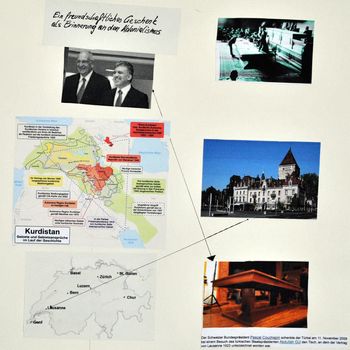
Ein freundschaftliches Geschenk als Erinnerung an den Kolonialismus. Courtesy of the artist.

Ein freundschaftliches Geschenk (detail): Table placed at Landesmuseum Zürich. Courtesy of the artist.

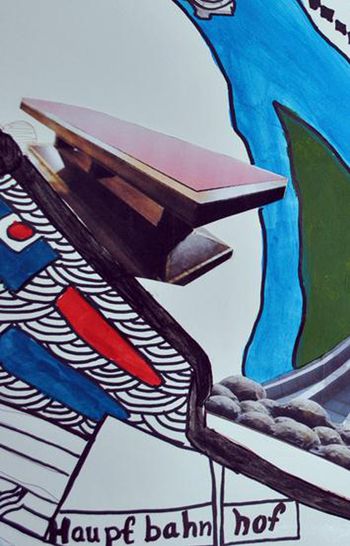
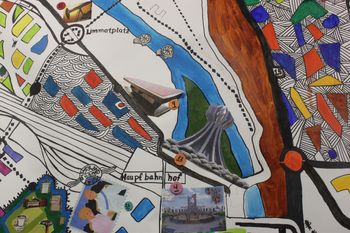
I analyzed my connection to the Table with a refugee political art group called the AntiKultiAtelier.Footnote 18 The project Stadtkarte Kartografien: die Welt in Zürich was centered on the question: What are the connections between the cities we come from and where we live? The title of my work was ‘A Present as Reminder of Colonial Friendship’ Figures 3 and 4. I placed the Table on the city map where the Landesmuseum Zürich is located. The gifting of this Table happened at the same time as I arrived in Switzerland as an asylum seeker. The collage served as the first step of this decolonizing process.
Ein freundschaftliches Geschenk (detail): Stadtkarte. Courtesy of the artist.

Decolonizing the Table addresses the politics of display in times of decolonization. It merges art and activism through focusing on the complex political situation facing the Kurdish population in Eastern Turkey, as well as those of immigrants from the Middle East scattered throughout Europe, by reflecting on this Table as a symbol of injury. The 1923 Lausanne Peace Treaty Table as an object is a starting point for altering research and reflection through decolonial art practice.
EFL: I find it quite interesting and should probably talk to you about it separately, but I was listening to the other conversation, just between the two of you on the idea of building a nation. How many other countries have done something similar, not always with brutality? In your case you have the Swiss perspective, the Kurdish, and the Turkish perspective. We lived for a year in northern Greece and 1923 is an equally important year for them because that was the exchange of populations between Greece and Turkey. And Greece imposed the idea on the population that everybody is Greek, there are no minorities and that is still the position and I thought it is just another side of the same coin. That Table represents so much more than just one aspect of that story.
NE: It is an indescribable context; it is beyond imagination. It is what I experienced also; I tried to explain to people, but if people don't experience that reality, it is very hard to bring them to the borders of their imagination. That is why decolonial theory of art helps me again; helps me to make imagination about, and within aesthetics, for sure.
EFL: Maybe you two could talk together about when you came across the book about Mesopotamia in the library: what did that represent to you and from a librarian's perspective, Regina, how it changed your view?
RV: Yes, this book is on a shelf below the books about prehistoric art, Egyptian art, in a section called the Near East. At the beginning of art histories in the eurocentric way and in 4 years of working in the Kunsthalle Basel library, I have to admit, I have never looked at this section. Then when we had a Kurdish-Turkish intern, he took out books from this section. That was when I first realized there was such a section, and there were also books on Syria, in which I am very interested. Then Nistiman came to visit and this shelf was even hidden by a pile of other things and it was really hard to get to, that is also why it gave you even more the impression of being a hidden shelf. And then I got this huge book on early art of Asia and Mesopotamia and Nistiman began to explain about this.
NE: Can I just make one point, Regina? It's because I think it is very important and I don't want to forget it. When I saw the book, the reality hit me in the face because, in the index of the pictures, images from this prehistoric time were included which are now underwater in Turkey. They built a hydro-electric dam. And it covers the heritage of humanity; it is not only people they massacred, it is the crime against the heritage of humanity. When I turned a page and saw the old city, Diyarbakir, and now the walls don't exist anymore, churches don't exist. Five years ago, five months after the decision of Unesco World Heritage, the Turkish government destroyed it with aircraft bombs; a world heritage site! The same day Unesco had a world heritage conference in Istanbul during the destruction of the old city.Footnote 19 It is only a book on the shelf of a library, but for me it makes me much more nervous and much more engaged in many ways. How can I decolonize art libraries? Actually, I can say that is my motto because I feel myself responsible to humanity, not only to Kurds, I don't want to be classified only as Kurdish. But as a citizen of the world, of the planet, I feel myself responsible to bring that heritage, to transform that heritage for coming generations. Also, it's the same with the Table, the process of decolonization of the Table: I don't want to judge, but I want to remind the young Swiss that they are very disconnected from their identity and their neutrality, which is the humanitarian basis of the country. But this is also the fault of your country. Don't do it again, please!
EFL: Maybe that should be the title of the article, ‘Don't do it again, please!’
RV: To me this story is so impressive because it showed how a book considered as old history is our real present and it is so important because there are photos of objects in it that are destroyed. And I also learned from Nistiman that objects are not just objects, like in a museum, but this ancient art was in their daily life, embedded. And so, these objects have a life given to them by the people living with these objects.
EFL: And yet these objects get put in a separate category, the art of daily life we call it in German, the Volkskunst or folk art, that people are creating and living with every day. And it somehow has a different status in museums in comparison with art that is considered to be created as a separate activity, as in ‘I am an artist creating this, as opposed to something I use every day.’
RV: That reminds me about the story from Daros when the director of the collection went for a trip to Paraguay: he met a curator who brought him to Indigenous communities because this curator has a concept that their folk art is as contemporary as the art we call contemporary art. And then the director came back to Zurich and said we needed to start a part of the collection with this other contemporary art without being in the classical schema; to put it as separate as folk art, but to consider it contemporary on the same level.
NE: Another question – what is the contemporary? What is the modernity? It is a repetition of the history? For me, the Lausanne Table can be in history, but now new tables are being discussed. Art can make an intervention on the contemporary. It depends on the background, the experience, of the person making the artwork. If I am white, privileged, eurocentristic, masculine thinking, then for sure it's another reality. But if you are oppressed, a direct victim of brutality, then for sure the emotions, the context, the understanding is othered. I don't want to go to the British Museum; at the same time, I do want to go, I dream to go. I would have to motivate myself to enter that museum because I know what waits for me: I can see pieces from my city, from my old region and territory. Within museums, we see the institutional perspective, but we create our own thinking. It is like Gramsci's hegemonically brain-washing, the mechanism and how it works.
EFL: What is your position on repatriation, to give back those objects in the British Museum?
NE: I think it is much more than to give them back, it is important to acknowledge that because it is a danger, there is no safe place for these objects in Palmyra, Syria, that is demolished. Or in Afghanistan, in the war. They cannot protect themselves because they are not alive - the heritage objects - they are as unsafe as the plants and animals. Humans are very selfish, they take, but they don't think about the life of the animals, ecology, the heritage of humanity. They need the humans to protect them because they can't talk. To me it would be more important to present the knowledge of the topic, with decoloniality, I don't know.
RV: Maybe another thing that is very difficult with restitution is that it is giving objects back to national states and not the communities who are the real owners.
EFL: It shows that it is a much more complicated thing than just to say we'll give them back.
NE: It is much more important to fill the libraries and archives with materials supporting the critical thinking and to make them accessible to the people who are interested and that will be the same for decoloniality also; to have access to many more perspectives, ideas, opinions, and to give access to the people. That is the idea, I think.
EFL: Some say that about the statue of Cecil Rhodes in Oxford. You can destroy that statue, melt it down or whatever, but then nobody learns anything from it. Why not have it there but have context with it, so the statue is there with an explanation of the whole issue?
NE: For me it is very important to have opposing positions in libraries. For example the fictional novel by Karl May, Journey to Wild Kurdistan: Instead of talking about Mesopotamia from a geographical or theoretical perspective, we should talk about what significance Mesopotamian civilization entails. Many portray a fictional image of Mesopotamia, our western societies are not aware of the history of Mesopotamia, which leads them to bring in their ideology - modernity, contemporaneity - with ease, and to declare that Kurdistan lacks civilization; that it is not at the forefront of civilization. The message is: We are the West, we are the shiny part of civilization. I refuse to believe that. The West has borrowed civilization from the Orient and now, by chance it starts to fall apart. In our times, we are witnessing a rebirth of civilization in the Middle East, in the Kurdish confederalism proposed by Abdullah Öcalan, which supports my philosophy, as in his framework Öcalan integrates ecological and democratic confederalism. It therefore goes beyond politics, where not only people but also animals and all living beings have their right to life, and also to cultural heritage.
EFL: So, it is conservation in its biggest sense: conserving nature as well as man-made heritage.
NE: Yes. It would be a very interesting experiment to bring people into the library and let them search the art books, as a kind of interest group – people like me, from my city, from the region. What would be their reactions? And other groups – the experts, the specialists on this issue, without comment, just have 2 perspectives … That would be a step of honouring the kind of consciousness that makes us aware. A visit to the library with 2 different interest groups.
EFL: I would like to do that with the Akademie's Korean, Japanese and Chinese students, who are some of the most frequent users of the library. We have this whole section classified as ‘Outside Europe’ art and it would be interesting to ask them about that section, to find out their perspectives on what is problematic about it. It is on the list of things to do.
NE: I am very glad that the three of us are discussing about this, it is amazing to think deeper about it. But it is important to mention my first impression of libraries in my life. It was in Zurich in 2010 and I was in the 6 year asylum seeker process. I was trying to learn the language and my conditions were uncomfortable. I didn't have anything and I started to visit the library to use the German language learning books. One time it was just at closing time and I took a book to the lady at the desk and asked to borrow it with my asylum seeker ID to study at home. She said ‘No, you are not allowed; your ID is not acceptable. We are not sure you won't be deported and how will we get the material back?’ And it was the library of the university and the central library of Zurich, the heart of the Enlightenment and science; this intellectual feeling just demolished all my hopes and expectations with tons of dynamite. That is my description: very deep injury. Thank you for reminding me of that deep injury and epistemic, unforgettable moment because I am never going to forget it for the rest of my life. This injury shapes my hammer to demolish that rules-based understanding, not the people; we'll decolonize the libraries and this discrimination, racial profiling, racistic basis - these institutions with their rules. How can I decolonize libraries, specifically that understanding of library?
EFL: I am not going to defend that at all, but I have a question about rules because libraries like rules, especially a university library, a big library open to the public. How do you make rules that don't injure?
NE: Of course I totally respect the rules applied for conservation reasons when consulting rare books. Yes, I have an answer: to ask not only one person in the library and ask the group most affected by certain rules. Perhaps identify these books for language learning on the bookplate or with a colour on the spine of the book, to indicate to the staff member that they have some discretion in loaning the book out in certain situations. An asylum seeker doesn't have enough financial resources to access the book and they want to learn the language, they want to integrate. They are vulnerable and it can de-integrate that person. If the person on the desk can have some flexibility to ask ‘Do you promise to bring that back?’
RV: I remember I was really very shocked when I came to know that asylum seekers weren't allowed to borrow books in the libraries. I wrote some emails to colleagues, but then I didn't go on to question it further. But to me it was like librarians are not inventive enough, they just stick to their rules, and the most important thing to them is getting the books back that they lend. They don't think about this vulnerable group and how the rules could affect them. The library could have found a way to loan the books. I don't know if the situation is better now, I don't think so; I guess asylum seekers are still not allowed to borrow books.
NE: For me, it is much more than just asylum seekers; it can also be undocumented persons. It is a fundamental human right to have access to institutional public spaces. If there is an exception it cannot be formulated in an ignorant way. And it is manner of the communication, also. ‘No, you are not allowed to get that book! We don't trust your ID; we are not sure if you will bring the borrowed material back (German Language book) or whether you will be deported.’ It is a reminder that you are in a temporary situation here. Always reminding me of that. Maybe we can decolonize the minds of the library workers – to share with them that experience because they don't imagine that.
RV: It will be the responsibility of the institution to talk internally about these questions and not just impose these kinds of rules in the hierarchy of the institution. In this way, it would also question the internal hierarchies, and bring in a more horizontal, democratic way of deciding things.
NE: Be aware of human beings; forget all the positions, the hierarchies. We are all human beings and sometimes we get, conscious or unconscious, far away from the soul of human beings. It doesn't matter which profession; but in the case of the library, how can we engage the people about the exceptions and make them aware of the situation and the need for access to language learning books?
EFL: You have made me think about some of my own reactions, my rules, that is good. That is what this is about, this kind of dialogue.
NE: May I ask a question, Erica and Regina, with all your experience of different institutions, after this talk, what is your feeling, the hope, that libraries will become much more transparent places one day?
EFL: I do, I think it is happening already, perhaps not so much here in Germany, but I watch in North America and the UK, there are a lot of things happening in libraries that are encouraging.
I remember when I first worked at the Tate, my first museum library, fairly early on I asked why they had no books about contemporary Indigenous North American art? And I thought there is something wrong with this and in almost every place I have worked I have found something difficult about the collecting policy. But when you live in London, it is the centre of the universe. Everything we do is designed to promote our superiority as art destination. Just moving to another country and, also, living in a small city like Karlsruhe, which has an active art scene and a small art college, gives a different perspective. I think it will change, but it is going to be slow.
NE: Regina, could you answer from the Swiss context, which doesn't have any official, direct colonial connection, but has a very, very dirty colonial heritage? What do you think? Because I think it is a very specific - not in Germany, England or France, it is another context - almost an island context with strong taboos and no-gos. We are humanitarian, we are neutral.
RV: Yes, I mean it started 20 years ago. One of the important protagonists is Hans Fässler, he is a teacher and wrote a book about Switzerland and slavery called Reise in Schwarz-Weiss, in which he wrote about places that represent Switzerland's relationship with colonialism. That was also the first book I read about this topic, not so long ago, I must admit. And just a couple of weeks ago Nistiman and I were at a discussion in Zurich at the Brazilian film festival, and Hans Fässler was present. It was a good thing because it was a discussion between people from Brazil and Fässler, as a specialist on Swiss colonialism. He said that in the early days he could easily follow all the research done about the Swiss relationship with colonialism, but nowadays there is so much research published in the universities that he cannot follow everything, and that gives me a bit of hope.
And of course, it is in this academic elitist field, but many of them go out to public discussions, but it is really hard because we have a right-wing majority in Switzerland considering these topics. And I was asking around a little bit from library colleagues in Germany, in Switzerland, about decolonization of the library and it is not a topic.
EFL: I know. I was at a conference last year in Italy and on one day the topic was, predominantly, decolonization and most of the presentations were by British librarians and there were no questions from the floor after the presentations. It did not seem to be a topic for the local librarians. In Germany, we don't think of ourselves as an immigrant country or as a colonial nation, certainly not a colonial power. I think some Germans do not know about Germany's colonies.
I am of two minds on this because I think part of it is what librarians have to deal with on a day-to-day basis. And on one hand, you are not having to address these issues, for most librarians it is not a priority, they have a lot of other things to do. In our countries, they don't see that…Switzerland is different because it thinks of itself as a place that has given refuge to people over the years. I don't know, I don't think you can push people, they will come around; but pushing, through encounters like this with Nistiman, are the types of pushing we need to have because they broaden our minds. I don't think directives coming from management that say ‘you have to do this, this, this and this’ will result in anything positive. When our users question, it is up to us to respond, but those questions forcing changes are going to come from our users, not our managers.
RV: My idea is to just spread stories about what we are doing now and then more storytelling might make the librarians I meet maybe…
NE: Might I ask how can it be harder for you specialists to make changes? Harder than it is for a user of an art library, who, as a refugee, was once rejected from the shelter of the library and is now sitting here discussing with two specialists? I am thinking if something doesn't make me uncomfortable, make me feel something, to be indignant; without feeling it's difficult to change.
But it is very hard to find my voice. I have had many requests as a refugee to participate in art projects. ‘We give a voice to refugees’ is often heard from European artists. But white privileged people cannot give me a voice, I have my voice, as a refugee. That is the first point. You can be privileged, with your diploma, with your specialism, your hierarchies and job levels, but they don't make any sense. We are 2 human beings. I don't care about your hierarchies, your specialties; I respect them, but your labels, your classification doesn't make sense for me. If you are ready to discuss with me, I am ready, but it is impossible if they try to stand 10 metres over me and I stand 10 metres under them and they look down on me from above. And they have this magic stick because they are privileged, they belong to their society. It is their conditions, they have their habits; I understand totally, it is the ‘Other’ context. If you look at it from the perspective of an immigrant, it requires many more privileged immigrants to talk, to bring their practice to these topics and it is very hard work. Well, it is not hard work; there are many thousands of immigrants, they are motivated and ready to go into that process, but the doors are closed, they are very, very definitely closed. And how can we bring that critical thinking, so immigrants can also work in the art libraries? It is very difficult; as an immigrant, every field, vocation, to find a job, then a place to live…it is very hard. We have to struggle but I don't lose hope as an unprivileged person, we have to struggle to get that privilege because we don't have this reality from where we were born.
I understand what you mean, Regina, about the reactions from your colleagues. From their context, their reality, they are right, but the point is how to decolonize their minds so we can discuss together?
Epilogue
Editing of this article took place during the protests in the US and around the world, after the murder of George Floyd, an unarmed Black man, by a member of the Minneapolis police force while 3 other officers stood by. My words about how change in libraries will be slow and it cannot be forced on libraries haunted me. Libraries, archives, museums need to change, this must be prioritized. EFL