INTRODUCTION
Psychiatric intensive care units admit patients who are acutely mentally unwell and have behaved, or are at risk of behaving, in a way that places themselves and/or others at risk (Department of Health, 2002). Often such behaviour is agitated or aggressive in nature and immediate management has traditionally been through medication, seclusion and physical interventions such as control and restraint. Although much emphasis is placed upon proactive management of disturbed behaviour through de-escalation techniques, the fact that PICUs care for the most disturbed and unwell of patients implies that physical intervention and/or seclusion will inevitably be used at times. Practice and rates of different containment strategies vary between countries (Bowers et al., Reference Bowers, van der Werf, Vokkolainen, Muir-Cochrane, Allan and Alexander2007a) and within the UK, a survey of PICUs and Low Secure Units found that 53% of units used seclusion and 95% used control and restraint as core interventions to manage disturbed behaviour (Pereira et al., Reference Pereira, Dawson and Sarsam2006). Individual units have reported varying rates of use (Tunde-Ayinmode & Little, Reference Tunde-Ayinmode and Little2004; Wynn, Reference Wynn2002; Hafner et al., Reference Hafner, Lammersma, Ferris and Cameron1989; El-Badri & Mellsop, Reference El-Badri and Mellsop2002; Cohen et al., Reference Cohen, Akhtar, Siddiqui, Shelley, Larkin, Kinsella, O'Callaghan and Lane2008).
These approaches have been subject to criticism (Freuh et al., Reference Freuh, Knapp, Cusack, Grubaugh, Sauvageot, Cousins, Yim, Robins, Monnier and Hiers2005). Patients have reported staff as ‘controlling' and believed that environmental and poor communication factors underpinned aggressive behaviour (Duxbury, Reference Duxbury2002). PICU patients were the most likely to feel that use of medication, seclusion and hands-on restraint were used too quickly (Healthcare Commission, 2008). They also believed that seclusion was used as a means of staff exerting power and control (Meehan et al., Reference Meehan, Bergen and Fjeldsoe2004). Staff, conversely, attributed aggressive behaviour to internal patient factors and external difficulties. It is also claimed that the use of restrictive methods to manage aggression may magnify psychotic symptoms, damage therapeutic relationships, and lead to a cycle of further violent behavior and more restrictive measures (Nijman et al., Reference Nijman, à Campo, Ravelli and Merckelbach1999). A systematic review (Sailas & Fenton, Reference Sailas and Fenton2000) found no controlled studies evaluating seclusion or restraint in serious mental illness and identified qualitative reports of serious adverse effects. A further review (Nelstrop et al., Reference Nelstrop, Chandler-Oatts, Bingley, Bleetman, Corr, Cronin-Davis, Fraher, Hardy, Jones, Gournay, Johnston, Pereira, Pratt, Tucker and Tsuchiya2006) concluded that insufficient evidence was available to determine whether seclusion and restraint are safe or effective management interventions for disturbed behaviour.
Debate about how best to manage challenging behaviour has also been fuelled by high profile untoward incidents. The death a patient whilst in seclusion (SHSA, 1993) prompted description of a ‘macho culture’ around procedures related to the use of seclusion. The independent inquiry into the death of David Bennett (Norfolk, Suffolk and Cambridgeshire SHA, 2003) questioned whether seclusion might have been preferable to prolonged use of restraint, which may result in sudden death from asphyxia (Paterson & Leadbetter, Reference Paterson and Leadbetter1998). Elsewhere, a nurse was beaten to death by a patient within a seclusion area (NHS London, 2006). The use of rapid tranquillisation is also contentious as, while largely effective in calming agitation, it has been associated with sudden death (Abdelmawla & Mitchell, Reference Abdelmawla and Mitchell2006).
The NHS is acting to improve the management of aggression through standardised training in conflict resolution and a special programme in the prevention and management of violence in mental health settings (Nyberg-Coles, Reference Nyberg-Coles2005). The National Institute for Health and Clinical Excellence (NICE) outlined standards for the use of seclusion, physical intervention and rapid tranquillisation (NICE, 2005). The most recent National Audit of Violence within Working Age Adult (psychiatric) services (Healthcare Commission, 2008) reported that the risk of physical assault for nurses, clinicians and patients was greater in PICUs than elsewhere in the mental health system and that members of PICU clinical teams were more likely than other clinical staff to have been threatened or made to feel unsafe. It is important that PICUs have effective strategies in place to manage this risk. It added that ‘although the nature, level and severity of violence on wards have increased, the effectiveness with which staff teams prevent and manage incidents has also increased. …There is clear evidence that the majority of services are now adopting proactive and preventative strategies to tackling violence in inpatient services’.
Thus the Department of Health has placed onus upon service providers to deliver appropriate interventions in a transparent and measurable fashion (NIMHE, 2004; HSE, 2006; Dale et al., Reference Dale, O'Hare and Rae2006). However it is difficult to evaluate such measures without appropriate reference data. We have previously reported on patient characteristics and medication usage (including rapid tranquillisation) upon 332 consecutive admissions within seven English PICUs (Brown et al., Reference Brown, Chhina and Dye2009). This paper addresses the use of physical intervention and seclusion amongst the same population.
METHOD
Anonymised data were collected prospectively from the case records of 332 patients admitted consecutively to seven English PICUs between February 2006 and August 2007 as described by Brown et al. (Reference Brown, Chhina and Dye2008). Data were collected on the frequency and duration of seclusion and physical restraint episodes during the course of the study. For the purposes of the study, an episode of seclusion was defined as ‘the forcible confinement of a patient alone in a room for the protection of others from serious harm’ (Department of Health, 1999). Physical restraint was defined as ‘an episode of formal three person restraint (or whatever is the standard procedure in your Trust / Organisation) which has been formally recorded’. Data were collected by staff working within the units and recorded upon a semi-structured collection sheet that was developed by a steering group of representatives from each participating unit and piloted on one of the units. Mental state was measured at admission and at two weeks, using the extended version BPRS (Lukoff et al., Reference Lukoff, Nuechterlein and Ventura1986).
The Research and Development Co-ordinator at the lead site advised that the project represented service evaluation rather than research and hence did not require MREC ethical approval. Appropriate local audit committees approved the study protocol.
Statistics
Statistical analysis was undertaken using SPSS version 14.0 (SPSS, 2005). Groups were compared using t-tests for normally distributed continuous data and chi squared and non-parametric tests for categorical and skewed continuous data. Pre-selected variables (age, gender, ethnicity, recent behaviour prior to admission, behaviour in the PICU, admission and two week total BPRS scores) were tested for association with the use of seclusion and physical restraint in univariate analysis. Variables that were significant at 5% level were then entered into a logistic regression model by forward stepwise procedure.
RESULTS
Seclusion
Six of the PICUs involved in the study had access to seclusion facilities (unit E did not), however only four units reported use of seclusion during the study period. Seclusion was used on 32 patients and there were 47 reported episodes of seclusion in total. This represented ten per cent of all patients in the study, eleven per cent of patients treated in units with access to seclusion facilities and sixteen per cent of patients admitted to units that actually used seclusion during the study period. The mean number of seclusion episodes amongst patients who were secluded was 1.5 (median 1.0, range 1–6 episodes). The length of one seclusion episode was not recorded, the mean length of the remaining 46 episodes was 101 minutes (median 80 minutes, range 20–600 minutes).
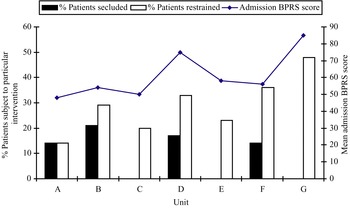
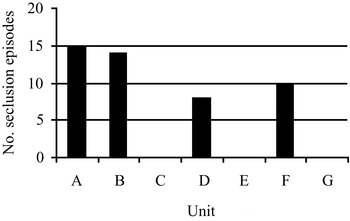
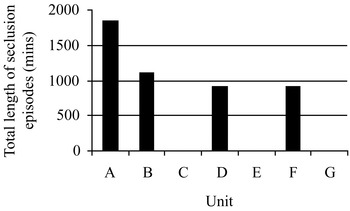
Of those patients who were secluded, twenty three (72%) were secluded once, six (19%) twice and three (9%) more than twice. One patient was secluded six times in the context of deteriorations in mental state associated with use of crack cocaine. The mean length of time spent in seclusion by an individual patient was 154 minutes (median 100 minutes, range 25–600 minutes). The proportion of patients on each unit who were subject to seclusion, the total number of seclusion episodes and the aggregate length of seclusion recorded by each unit are shown in Figs. 1, 2 & 3.
Proportion of patients subject to seclusion or physical restraint on each of seven English PICUs

Number of separate seclusion episodes recorded by each unit

Aggregate length of seclusion episodes recorded by each unit

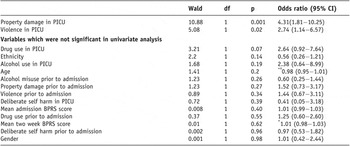
The associations between the pre-selected factors and a patient being secluded are shown in Table 1 as multiple logistic regression analysis. Factors that were non-significant in univariate analysis are also included.
Multiple logistic regression analysis of factors associated with the seclusion of an individual patient

* Odds ratios are /one unit change in BPRS and /year of age respectively
# Odds ratio of <1 indicates an association between physical restraint and younger age
Physical restraint
Formal physical restraint was used five times as often as seclusion, albeit sometimes as part of the process of getting a patient into seclusion rather than as a discrete intervention. Ninety patients (27%) were formally physically restrained at some point in their PICU admission. There were 208 reported episodes of physical restraint. Fifty one percent (N = 46) of the patients who were restrained were only restrained once, 23% (N = 21) were restrained twice and 26% (N = 23) more than twice. The mean number of episodes among those patients who were restrained was 2.4 (median 1, range 1–30 episodes). Only six units recorded the length of each episode of physical restraint; among these the mean length of each episode of restraint was 7.2 minutes (median 5 minutes, range 3–150 minutes) and the mean length of time spent in restraint by each restrained patient was 17.3 minutes (median 10 minutes, range 3–150 minutes). There was no significant difference in mean duration of patient restraint (16.9 vs 18.2 minutes, t = 0.26, df = 76, p = 0.79) nor in the proportion of patients who were physically restrained (54/190 vs 25/82, chi squared = 0.26, df = 1, p = 0.61) between those units that used seclusion and those that did not.
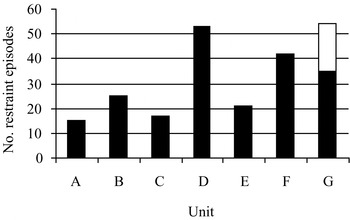
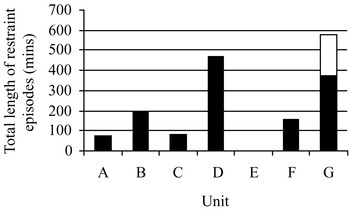
The proportion of patients on each unit who experienced formal physical restraint is shown in Fig. 1. The total number of restraint episodes and total time spent by patients in restraint in each unit are shown in Figs. 4 & 5.
Number of separate restraint episodes recorded by each unit (figures for unit G projected to show expected episodes if 50 patients had been admitted during study)

Aggregate length of restraint episodes recorded by each unit* (figures for unit G projected to show expected episodes if 50 patients had been admitted during study) *Unit E did not record length of episodes of restraint

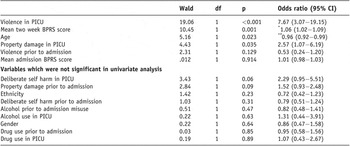
Factors associated with a patient being physically restrained are shown in Table 2 in a multiple logistic regression analysis. Violence prior to admission and initial BPRS score were significant in univariate analysis but this significance disappeared when other variables were included in the multivariate analysis. Other factors that were non-significant in univariate analysis are also shown.
Multiple logistic regression analysis of factors associated with the physical restraint of an individual patient

* Odds ratios are /one unit change in BPRS and /year of age respectively.
# Odds ratio of <1 indicates an association between physical restraint and younger age
DISCUSSION
This study suggests that there is considerable variation between units in their approach to use of seclusion and restraint. Four units used seclusion, three did not. There was relatively little difference in frequency and duration of seclusion among those units where it was used. Physical restraint was used more frequently than seclusion and the pattern of use differed between units. There was a nearly five fold variation between the highest and lowest unit in episodes of physical restraint, and a six fold variation in the total time patients spent being physically restrained. Whilst physical restraint was most commonly used as a brief intervention (possibly to facilitate other interventions such as seclusion or forcible medication) it was occasionally used as a discrete longer term intervention.
Bias
This prospective study measured the use of seclusion and physical restraint in seven different English PICUs. The results are part of a large survey that pragmatically endeavoured to provide baseline data on the patient characteristics and clinical practices of these units. The PICUs involved were self selected and actively involved in the National Association of Psychiatric Intensive Care units (NAPICU), either in research or through a clinical governance network (Dye et al., Reference Dye, Johnston and Pereira2005). Six were NHS facilities and one an independent unit that took its referrals from the NHS. The units were therefore probably not representative of English PICUs. The results nevertheless provide useful baseline reference data for future clinical audit.
Patients in this survey were probably representative of those treated on these particular PICUs – the study described 332 consecutive admissions and lost only three from follow up. The protocol aimed to collect data on fifty consecutive admissions at each site (350 admissions) but one unit (G) ceased data collection after 32 admissions following a change in unit function. This unit admitted more unwell patients, did not use seclusion and had higher rates of restraint usage. The loss of eighteen data sets probably slightly depressed the figures on the use of restraint but raised those on use of seclusion. A further weakness was the failure of one of the units (which did not use seclusion) to record the length of restraint episodes. This unit did not differ significantly in total restraint usage (it used restraint in 23% of admissions compared to the mean usage in other units of 28%).
Data collection was deliberately limited to issues where we could be reasonably confident of collecting robust information. We acknowledge lack of analysis of other aspects of the management procedure of agitated and disturbed behaviour. Effective use of non-pharmacological or less restrictive interventions may reduce the use of physical intervention and seclusion but the effectiveness and individual practice of de-escalation, nursing and psychological interventions are difficult and expensive to measure accurately and reliably in a multi-centre study.
The main weakness of the study was its reliance on individual units to collect data about their own performance. This methodology was used because of limited available resources but must leave open the possibility of selective reporting. The use of seclusion is monitored closely thus there is no reason to doubt figures received. Physical intervention should also always be recorded separately within incident reporting mechanisms (however length of time was not a standard organisational necessity in all units) thus we are relatively confident that all incidents were captured. The fact that relatively few incidents of seclusion and restraint were recorded leaves open the possibility of type 2 errors in the analysis.
Management strategies
In this study, the use of restraint and seclusion were both associated with patient violence and property damage within the PICU. Restraint usage was associated with the two-week total BPRS score (i.e. disturbed mental state continuing following admission). This is broadly consistent with the findings of Steinert et al. (Reference Steinert, Bergbauer, Schmid and Gebhart2007) who reported that physical aggressive behaviour and the Positive and Negative Syndrome Scale hostility item at admission best predicted seclusion or restraint usage. That and the association with violence and property damage in PICU suggests that seclusion and restraint is used as a response to risky behaviour. Whether it is an appropriate response is largely beyond the scope of this paper other than to note firstly that these methods were used on a minority of patients in all units and secondly that there was an almost five fold variation in the use of restraint and 50% variation in the use of seclusion between the units with highest and lowest use. This variation may reflect appropriate individual responses to clinical situations but may also represent a differential willingness to use particular interventions.
This study does little to clarify whether the presence of seclusion facilities means that they are used to manage behaviour that could be managed in a less restrictive manner. The units that used seclusion did not differ significantly in rate of restraint usage or length of individual restraint episodes compared to those that did not use seclusion. However, physical intervention is usually needed to place someone within seclusion and furthermore, one unit did not record the length of each episode of restraint. This finding must therefore be interpreted with caution and may represent a type 2 error.
Of the three units that did not use seclusion, one (Unit E) had no seclusion facility and had an average use of restraint. One (Unit G) had a seclusion and de-escalation area outside of the PICU, admitted more disturbed patients (Brown et al., Reference Brown, Chhina and Dye2008) and had the highest use of restraint. The third (Unit C), introduced a seclusion facility mid way through the study, had a generally less disturbed patient group (Brown et al., Reference Brown, Chhina and Dye2008) and had low use of restraint.
In this cohort, the use of rapid tranquillisation (RT) was significantly associated with the use of physical restraint and the use of seclusion (Brown et al., Reference Brown, Chhina and Dye2009). It has been suggested that effective use of RT may reduce the need for seclusion and physical restraint (Macpherson et al., Reference Macpherson, Dix and Morgan2005) but physical restraint is usually required to administer RT to an unwilling patient. This question could possibly be further clarified by schemes such as the Prescribing Observatory for Mental Health (Paton et al., Reference Paton, Barnes, Cavanagh, Taylor and Lelliott2008).
An interesting difference between seclusion and restraint was the negative correlation of age with restraint usage (i.e. younger patients were more likely to be restrained), but no significant association was found with seclusion. This somewhat replicates Wynn (Reference Wynn2002) who found that physical restraint was a more common strategy in patients who were male, younger and non-psychotic, whereas seclusion was used with older male patients with an organic psychotic disorder.
The independent inquiry following the death of David Bennett implicated the use of prolonged restraint in the prone position and recommended that under no circumstances should any patient be restrained in this way for longer than three minutes (Norfolk, Suffolk and Cambridgeshire SHA, 2003). NICE guidance states that physical intervention should be ‘appropriate, reasonable and proportionate to a specific situation and should be applied for the minimum possible amount of time’. (NICE, 2005). The present study measured the time spent by a patient within restraint but did not discriminate between different restraint positions. It is difficult to comment further on the length of restraint episodes due to the paucity of publications from the UK.
There is some previous evidence for patient ethnicity being a factor in management following an ‘untoward incident’ (Flaherty & Meager, Reference Flaherty and Meagher1980; Gudjonsson et al., Reference Gudjonsson, Rabe-Hesketh and Wilson2000) but this has been an inconsistent finding (Price et al. Reference Price, David and Otis2004). In keeping with Gudjonsson et al. (Reference Gudjonsson, Rabe-Hesketh and Szmukler2004), our survey did not suggest this and found no association between patient ethnicity and the use of seclusion / restraint.
Reducing usage
Within the units surveyed, 27% of patients were physically restrained during their PICU stay. In PICUs where seclusion was used, 16% of patients were subject to it. Extrapolating these figures, using Pereira et al.'s (Reference Pereira, Dawson and Sarsam2006) figures of 53% of 170 PICUs operating seclusion (57% of the units within this survey used seclusion), would indicate a very approximate annual prevalence estimate of 500 patients being secluded and 750 seclusion episodes in UK PICUs. The same methodology produces equivalent figures for physical restraint of about 3700 episodes of restraint per year, involving 1500 patients.
Specific interventions to reduce use of restraint and seclusion have included change of policies (Hellerstein et al., Reference Hellerstein, Staub and Lequesne2007; Hucksorn, Reference Hucksorn2006), environmental improvement (Champagne & Stromberg, Reference Champagne and Stromberg2004), the effective use of medication (Klinge, Reference Klinge1994) and increased training (Farrell & Cubit, Reference Farrell and Cubit2005). Introductions of control and restraint (C&R) training (Parkes, Reference Parkes1996) and training around issues of prevention of aggression (Forster et al., Reference Forster, Cavness and Phelps1999) have been shown to reduce seclusion episodes, although Bowers et al. (Reference Bowers, Hackney, Nijman, Grange, Allan, Simpson, Hall and Eyres2007b) questioned whether some aspects of training might exacerbate conflict rates. Anecdotal reports from the Star Wards initiative, which aims to help create actively therapeutic in-patient stays (Janner, Reference Janner2007), indicated that violence decreased upon wards that embraced the scheme.
Effective management of violence requires adequate staff numbers as well as training. Increased staffing levels can reduce seclusion use (Outlaw & Lowery, Reference Outlaw and Lowery1992; Morrison & Lehane, Reference Morrison and Lehane1995), possibly because the availability of staff leads to increased use of restraint. Palmstierna & Wistedt (Reference Palmstierna and Wistedt1995) concluded that higher staff numbers decreased severity of violent incidents, but not their frequency. The introduction of specific nurses to assist in change implementation led to reductions in aggression, absconding and self harm but no significant change in containment method use (Bowers et al., Reference Bowers, Brennan, Flood, Lipang and Oladapo2006).
Another promising area is that of patient involvement in care planning decisions. This is advocated within NICE guidance (NICE, 2005). Many patients have a clear preference regarding the management of their violent behaviour (Veltkamp et al., Reference Veltkamp, Nijman, Stolker, Frigge, Dries and Bowers2008; Van Citters et al., Reference Veltkamp, Nijman, Stolker, Frigge, Dries and Bowers2007). Patient involvement in care planning has been introduced (alongside debriefing of staff and patients) by some PICUs through the PICU / Low Secure Governance Network (Dye et al., Reference Dye, Johnston and Pereira2005) however further research is needed to evaluate whether these preferences are actually taken into account in the event of violence.
Thus methods to manage disturbed behaviour must be viewed in a systemic fashion and a multi-faceted approach must be undertaken (Fisher, Reference Fisher2003; Gaskin et al., Reference Gaskin, Caderyn, Elsom and Happell2007; Antonelli, Reference Antonelli2008). Nationally, this has been adopted in the UK by publication of several documents that address the management of disturbed behaviour and give organisations a framework for delivering and measuring service improvement. PICU staff are experienced in the management of disturbed behaviour and should be at the forefront of the debate in these initiatives. Research should now focus upon best practice and governance surrounding the use of such measures. We need to progress to collecting valid data about actual day to day clinical activity of PICUs in order to identify and promote good (and reduce poor) practice in what are controversial, distressing and at times dangerous interventions.
CONCLUSION
This study presents a synopsis of current use of seclusion and physical restraint in seven English PICUs. The units themselves may not be entirely representative but the results are robust enough to serve as initial reference data for clinical governance purposes. These intervention methods have attracted much controversy and their practice needs close monitoring to ensure the safety of our patients. This study suggests that the use of both interventions is associated with violent behaviour, property damage and level of psychiatric symptoms. We could find no evidence that the presence and usage of seclusion decreased either the use of, or time spent within, restraint.
Randomised controlled trials of emergency interventions to disturbed patients who lack capacity are probably impossible but further research is needed into specific practices used to manage seriously disturbed behaviour. This should focus on actual clinical practice and should, if possible, be undertaken by independent researchers.
ACKNOWLEDGEMENTS
We would like to thank everyone who contributed towards this study and especially want to acknowledge the input of the project leaders at each site: Agron Ramadani, Felix Kadzombe, Veronica Daus, Jo Pittam, Lisa Archibald and Catherine Seabourne.
This study was partly financed by a travel grant of £500 to NC from the National Association of Psychiatric Intensive Care Units (NAPICU). We do not identify any conflict of interest.