

DISCUSSION QUESTIONS
-
• Solid-state caloric effects propose to offer a high efficiency and cleaner alternative to conventional vapor-compression technology for electronic cooling applications.
-
• Large entropy change associated with phase transformation in ferroic materials can be exploited for giant caloric effects.
-
• Elasto-caloric effect offers a bulk, high refrigeration capacity alternative for efficient cooling under low load conditions.
Introduction
Solid-state refrigeration is generally associated with small scale cooling applications. For example, it is often necessary to install an on-board refrigeration system to maintain the temperature of electronic systems, Reference Ju1 where it is essential to remove unwanted heat which is generated during operation. With modern advances in solid-state technologies, electronic devices are shrinking in size while simultaneously increasing in efficiency. The amount of heat generated by such devices often exceeds their capacity to dispel it, thereby creating a thermal imbalance resulting in a temperature increase. This in turn could lead to a decrease in performance or increased degradation. Hence, there is a need to develop new generation of cooling technology capable of on-board installation and rapid heat extraction. Such refrigeration systems are required to be compact, effective, responsive, and highly efficient. Vapor compression technology presently forms the backbone of current refrigeration architecture. However, the successful application of a vapor compression system for small scale cooling has some inherent drawbacks: (i) the system can be large and therefore does not facilitate on-board installation, (ii) the system is relatively slow and requires several cycles to be fully operational and (iii) for intermittent cooling requirements, the system can be inefficient and uneconomical. Reference Chen and Lin2 Therefore, research has focused on the successful development of small, energy efficient, and robust cooling systems. Reference Eames, Aphornratana and Haider3–Reference Phelan, Swanson, Chiriac and Chiriac5 In this context solid-state refrigeration is of relevance Reference Manosa, Planes and Acet6,Reference Lu and Zhang7 since it offers a solution for small scale and on-board cooling. A solid-state refrigerator thus offers the following advantages: (i) the material itself is the major part of the refrigeration system, thus, the volume of the installation is reduced, (ii) a rapid response, (iii) it is potentially efficient and requires less power compared to other systems, (iv) the number of moving parts is minimal, allowing for less wear and extended operational life and (v) many of the materials used in solid-state refrigeration are environmental friendly. Reference Brück8 These advantages in terms of energy usage and sustainability indicate that solid-state refrigeration is an attractive route for future small scale cooling technology.
Ferroic materials are the prime contender for solid-state refrigeration through suitable application of their associated caloric effects. A caloric effect is described as the thermal response of a material when it is subjected to an external stimulus. All forms of matter display some level of caloric effect. However, ferroic materials are capable of exhibiting large entropy ordered variations when subjected to a suitable external stimulus and when accomplished adiabatically, this gives rise to large temperature changes which forms the basis of solid-state refrigeration. Depending upon the change in material parameter and the nature of external field applied, the various caloric effects can be classified as: magneto-caloric (ferromagnetic materials), Reference Krenke, Duman, Acet, Wassermann, Moya, Mañosa and Planes9,Reference Gschneidner and Pecharsky10 electro-caloric (ferroelectric materials), Reference Mischenko, Zhang, Scott, Whatmore and Mathur11,Reference Neese, Chu, Lu, Wang, Furman and Zhang12 thermo-electric or Peltier (metallic heterojunction), baro-caloric, Reference Mañosa, González-Alonso, Planes, Barrio, Tamarit, Titov, Acet, Bhattacharyya and Majumdar13,Reference Mañosa, González-Alonso, Planes, Bonnot, Barrio, Tamarit, Aksoy and Acet14 and elasto-caloric (ferroelastic materials). Reference Manosa, Planes and Acet6 In addition, a thermo-acoustic effect has also been reported. Reference Imamura, Sakamoto and Watanabe15,Reference Paek, Braun and Mongeau16 A detailed discussion of the major solid-state cooling technologies has recently been made. Reference Manosa, Planes and Acet6,Reference Fähler, Rößler, Kastner, Eckert, Eggeler, Emmerich, Entel, Müller, Quandt and Albe17 Among these, the thermo-electric (Peltier) effect is the only approach to be successfully commercialized for solid-state refrigeration. While prototyping has begun for the commercialization of magneto-caloric effect devices, other effects are either in the developmental stage or pilot testing is being undertaken. Reference Gaskill18,Reference Abramov, Shishov, Scherbakov, Sushkov and Ivanov19 The scientific and technological importance of this field is evident from the large number of papers being published annually in this domain. Further, recent reviews have presented the development and technological advances achieved to date. However, a dedicated review in the field of elasto-caloric refrigeration is still lacking due to its lower exposure compared to both electro-caloric and magneto-caloric effects. Thus, in this paper, we review and highlight the underlying parameters that affect the performance of elasto-caloric materials. Recently, a number of studies have reported a “giant” elasto-caloric effect in shape memory alloys (SMAs) which can be utilized for solid-state refrigeration. Reference Cui, Wu, Muehlbauer, Hwang, Radermacher, Fackler, Wuttig and Takeuchi20–Reference Xiao, Fukuda and Kakeshita23 This has renewed interest in the field of elasto-caloric cooling Reference Castillo-Villa, Soto-Parra, Matutes-Aquino, Ochoa-Gamboa, Planes, Mañosa, González-Alonso, Stipcich, Romero, Ríos-Jara and Flores-Zúñiga24 and a potential advantage of elasto-caloric systems would be their ease of design owing to minimal part movement and operation under only unidirectional forces. This review will present a description of the elasto-caloric effect, its underlying mechanism, the variety of classes of materials exhibiting this effect and the parameters which ultimately decide the material's performance along with the present challenges and prospects in this field.
Elasto-caloric effect
It has been widely observed that specific materials undergo a change in temperature when subjected to a sudden change of an external field (such as electric, magnetic or mechanical stress fields). This effect is known as the caloric effect Reference Manosa, Planes and Acet6 and is demonstrated by most materials to some extent. In materials systems where this effect is prominent it has the potential to be successfully utilised for solid-state refrigeration. The caloric effect involves either a change in entropy of the material when the change in the external field is isothermal or a change in temperature if the material is excited under adiabatic conditions. The adiabatic change in the material attribute leads to an increase or decrease of temperature depending upon the nature of change induced. The resulting temperature difference (ΔT) with applied field is an indicator of the extent of the caloric effect. Consequently, the larger the change in the entropy with applied field the greater will be the change in temperature. The nature of external field required to produce an apparent caloric effect varies for different classes of materials. For the electro-caloric effect, the polarization of the material changes upon application of an electric field, and this effect is confined to ferroelectric materials. In the magneto-caloric effect, the magnetization of the material changes due to a change in magnetic field applied (ferromagnetic material). However, in case of elasto-caloric effect, a change in strain of the material is observed upon application of suitable compressive/tensile or hydrostatic stress; the details of which shall now be discussed.
Force-elasticity and entropy-elasticity
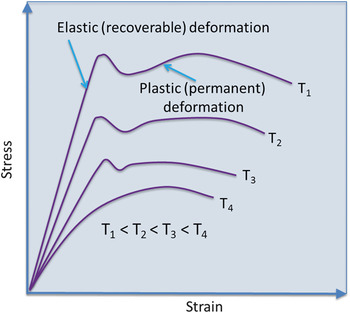
To understand elasto-caloric effect, the difference between elastic deformation mechanisms between conventional and ferroelastic materials needs to be understood. Two types of elastic responses exist; these are force-elasticity and entropy-elasticity. Most metals, ceramics, and glasses are categorized under force-elasticity which has two associated attributes which distinguish it from entropy-elasticity. Force-elasticity is primarily characterized by an initial linear relationship between stress and strain up to the elastic limit of the material and subsequent permanent plastic deformation, or fracture, when stressed beyond the elastic limit. It should be noted that the magnitude of the elastic modulus is a material characteristic and is inversely dependent on temperature. Figure 1 shows a typical stress–strain response of a ductile force-elastic metal at different temperatures; the elastic modulus (the gradient of the stress–strain curve in the elastic region) decreases with increasing temperature.
Stress–strain behavior of typical force-elastic material (ductile metals).

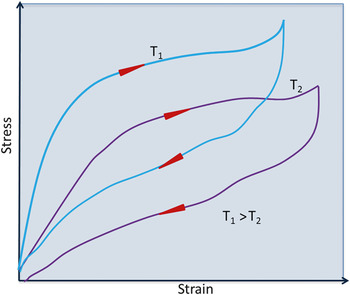
In entropy-elastic materials, elastic deformation is highly correlated to the change in lattice structure of the material which is often a function of temperature and applied stress. Reference Fukuhara, Inoue and Nishiyama25,Reference Holzapfel and Simo26 These materials display a hysteresis loop in their stress–strain response which is illustrated in Fig. 2; in this case the material is a SMA. The relationship between the stress and strain is nonlinear and the loading and unloading paths are different. The area of the hysteresis loop represents the difference in the energy required to load the material and the work done by the system during unloading. From Fig. 2 it can be established that the material associated with entropy-elastic behavior has a modulus of elasticity that increases with temperature, Reference Kim, Satoru, Kim, Hosoda and Miyazaki27,Reference Melton and Mercier28 unlike the force-elastic material in Fig. 1. However, this is not the sole criteria to define candidate ferroelastic materials for elasto-caloric applications. It has recently been established that some ferroelectric materials Reference Chauhan, Patel and Vaish29–Reference Chauhan, Patel and Vaish33 are also capable of exhibiting a perceptible change in temperature when subjected to an applied stress in an adiabatic manner. This category of “ferroelastic” materials is often able to exhibit an elasto-caloric effect which is equivalent or even exceeds the conventional electro-caloric effect for which these materials are traditionally investigated. Reference Chauhan, Patel and Vaish29,Reference Patel, Chauhan and Vaish32,Reference Chauhan, Patel and Vaish33 Additional details will be provided later in the article to explain the mechanism behind such behavior.
Stress–strain behavior of entropy-elastic materials (SMA).

Entropy-elastic stress–strain behavior for solid-state cooling
In order for a practical device to produce cooling using a thermodynamic cycle, some specific conditions must be met. The coolant or material must be able to reduce its entropy (reject heat) at a higher temperature and then increase its entropy (absorb heat) at a lower temperature, when subjected to an applied external stimulus. This is necessary to establish a system which is capable of extracting heat from the source and expel it to the sink. This is the primary requirement that limits the type of materials which can be used for such cooling applications. Force-elastic materials are unable to provide any cooling since from Fig. 1 it can be seen that they lack hysteresis; the loading and unloading response is fully reversible up to the elastic limit with negligible hysteresis. Thus, little or no difference in energy exchange occurs between the material and its surrounding, during the loading and unloading processes. Additionally, the amount of stress required to produce the same amount of strain (entropy change) reduces with increasing temperature.
In contrast, entropy-elastic materials possess the required characteristics to produce solid-state cooling. The nonlinear stress–strain relation leads to a hysteresis loop and the increase of the elastic modulus with increasing temperature enables the material to be used in a refrigeration cycle. Entropy-elasticity is primarily displayed by three types of materials, namely cross-linked elastomeric polymers (elastomers), Reference Holzapfel and Simo26,Reference Guyomar, Li, Sebald, Cottinet, Ducharne and Capsal34,Reference Pellicer, Manzanares, Zúñiga, Utrillas and Fernández35 SMAs, Reference Bonnot, Romero, Mañosa, Vives and Planes36–Reference Schmidt, Schütze and Seelecke39 and ferroelectric materials. Reference Manosa, Planes and Acet6,Reference Mañosa, González-Alonso, Planes, Barrio, Tamarit, Titov, Acet, Bhattacharyya and Majumdar13,Reference Mañosa, González-Alonso, Planes, Bonnot, Barrio, Tamarit, Aksoy and Acet14,Reference Chauhan, Patel and Vaish29–Reference Patel, Chauhan and Vaish32,Reference Melvin40 It is to be noted that the mechanism for a strain driven entropy change is different in cross-linked polymers, SMA, and ferroelectric systems and will now be described.
Cross-linked elastomeric polymers
Most metallic and ceramic materials exhibit a limited region of elastic deformation. The degree of elastic deformation is generally less than 1% since the strain is achieved as a result of the displacement of atoms from their equilibrium position. However, elastomers are unique in that they can be easily stretched to several hundred percent of their original size without any appreciable permanent deformation. Reference Boonstra41 Polymer materials can be classified into two types: cross-linked and straight-chained. Among them the cross-linked materials can be further classified as heavily-linked, medium-linked, and low-linked. Elastomers are classified as polymers with a medium number of cross-links along the polymer chains. Reference Guyomar, Li, Sebald, Cottinet, Ducharne and Capsal34 Natural rubber (NR) has been widely studied as an elastomer that exhibits the elasto-caloric effect. Reference Fukuhara, Inoue and Nishiyama25,Reference Holzapfel and Simo26,Reference Guyomar, Li, Sebald, Cottinet, Ducharne and Capsal34,Reference Pellicer, Manzanares, Zúñiga, Utrillas and Fernández35 Several studies have been undertaken regarding the thermodynamic and elasto-caloric effect associated with NR and a detailed thermodynamic analysis of NR has been reported. Reference Pellicer, Manzanares, Zúñiga, Utrillas and Fernández35 The ability to deform to large levels and corresponding giant strain is the result of polymer chains that are able to reversibly rotate around the chain bonds (cross-links). A schematic of the mechanism is shown in Fig. 3. In an unstressed state, the polymer chains are randomly aligned and the cross-links are evenly distributed [Fig. 3(a)]. However, as the material is stretched the polymer chains are aligned and the molecular segments are separated from each other in the direction of deformation. Thus, on a molecular level the entropy is said to have decreased as the state of order has increased. According to the second law of thermodynamics, if the volume and internal energy of a system remains constant, the entropy of that system will remain constant. Thus, when an external stress is applied to an entropy-elastic material it increases the level of order and decreases the molecular entropy; this results in the deformed state being metastable. To compensate for the decrease in entropy, heat can be released during deformation [Fig. 3(b)]. Upon the removal of external stress, the material will tend to revert to its higher entropy state and will return to its un-stretched state, while absorbing heat from the surrounding environment [Fig. 3(c)].
Thermo-elastic behavior of NR under the application of uniaxial strain. The figure illustrates the orientation of polymer chains and respective cross links under the application of tensile stress and its release. The related entropy and caloric effect with different states have also been represented.

If the application of the load is instantaneous/adiabatic no exchange of heat takes place between the system and surroundings: the temperature of the material increases in accordance to the Helmholtz equation for free energy (A) Reference Guyomar, Li, Sebald, Cottinet, Ducharne and Capsal34 :
 $$A = U - TS,$$
here, U represents the internal energy (J) of the material, T denotes temperature of the material (K), and S signifies its entropy (J/K). For a constant temperature and volume, the differential form of Eq. (1) is:
 $${\rm{d}}A = {\rm{d}}U - T\,{\rm{d}}S - S\,{\rm{d}}T.$$
We now proceed with the assumption that NR is not an ideal elastomer since a finite amount of energy is required to rotate the polymer chains about the cross-links. In such condition, the change in internal energy dU is given by:
 $${\rm{d}}U = {\rm{d}}Q + {\rm{d}}W,$$
Here, dW is the work done by the system and dQ is the energy change in terms of heat added. For an isothermally varied load, the right hand terms in Eq. (3) can be represented by Reference Guyomar, Li, Sebald, Cottinet, Ducharne and Capsal34 :
 $${\rm{d}}Q = T \cdot {\rm{d}}S,$$
 $${\rm{d}}W = F \cdot {\rm{d}}l.$$
In Eq. (5), the work done is in terms of energy spent in stretching the material through an additional length dl, using a force of magnitude F. In addition, the change in entropy of the NR under constant volume can be calculated as Reference Pellicer, Manzanares, Zúñiga, Utrillas and Fernández35 :
 $${\rm{d}}S\left( {T,V} \right) = \int_{{L_0}}^L {{{\left( {{{\delta S} \over {\delta L}}} \right)}_{T,V}}{\rm{d}}L} ,$$
Here, L 0 represents original length and L represents the final length after the application of force. From Maxwell's relation Reference Pellicer, Manzanares, Zúñiga, Utrillas and Fernández35 we know that
 $${\left( {{{\delta S} \over {\delta L}}} \right)_{T,V}} = - {\left( {{{\delta \tau } \over {\delta T}}} \right)_{L,V}},$$
where, δτ represents the change in mechanical force. It has been established that
 ${{\delta \tau } \over {\delta T}}$
is positive for elastomers such as NR,
Reference Cottinet, Guyomar, Galineau and Sebald42
thus dS is negative and indicates that the entropy of rubber decreases upon stretching. Again from Maxwell's relation:
 $${\left( {{{\delta T} \over {\delta L}}} \right)_{S,V}} = {T \over {{C_{L,V}}}}{\left( {{{\delta \tau } \over {\delta T}}} \right)_{L,V}},$$
Here, C L,V (J/kg K) is the heat capacity of NR at constant length and volume. Since, all terms to the right in Eq. (8) are positive, this indicates that NR will heat up when stretched.
From the Clausius equality Reference Guyomar, Li, Sebald, Cottinet, Ducharne and Capsal34 :
 $${\rm{d}}S = {{{\rm{d}}Q} \over T}.$$
Therefore, the higher the entropy change, higher will be the heat content. Thermodynamic analysis of elasto-caloric effect associated with NR has been discussed in detail Reference Guyomar, Li, Sebald, Cottinet, Ducharne and Capsal34 and it has been reported that for a 400% increase in elongation, a temperature increase of 3 K can be achieved for NR. Reference Guyomar, Li, Sebald, Cottinet, Ducharne and Capsal34
Shape memory alloys
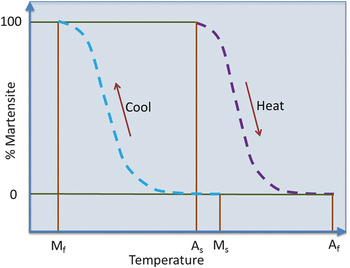
SMAs have the ability to return to their original shape after being subjected to a permanent deformation Reference Schetky38 and are typically used in various actuation applications. Upon being subjected to a sufficiently high mechanical load, SMAs are able to undergo a stable plastic deformation by a process of twinning; this is in contrast to the plastic deformation of a conventional metal (as in Fig. 1) where there are changes at the atomic order due to dislocation motion. Upon heating of the deformed martensite phase a diffusionless structural transition from the martensitic to the austenite phase takes place, this can be seen as the austenite start, A s, and finish, A f temperatures, in Fig. 4. This phase change leads to the original shape of the SMA being recovered. The austenite phase has a very high degree of compactness and thus, offers higher yield strength compared to the martensite phase. Reference Otubo, Rigo, Coelho, Neto and Mei43–Reference Otsuka and Shimizu45 As the metal is cooled down to its original temperature the phase reverts back to the martensite phase and a typical temperature-phase transition is shown in Fig. 4 by the martensite start, M s, and finish, M f, temperatures. This cycle can be repeated a number of times. Reference Huang37,Reference Manosa, Planes, Vives, Bonnot and Romero46
Phase transition diagram for shape-memory alloys.

The austenite phase of SMA as a higher state of order compared to martensite and therefore has lower entropy. This results in austenite phase being less stable than the martensitic phase and hence, upon cooling the martensitic phase is restored. Reference Wu and Wayman44,Reference Otsuka and Shimizu45,Reference Orgéas and Favier47 Since the phase transformation is diffusionless, it is reversible in nature, much like the rotation of polymer chains in the case of elastomers. Such transformations are known as first-order transformations Reference Boyd and Lagoudas48 and are responsible for producing the elasto-caloric effect in these materials.
SMAs display hysteresis during loading and unloading paths in stress–strain plots as shown in Fig. 2. The phase transition in the material is not sharply defined and occurs over a range of temperatures, see Fig. 4, which can vary with the material composition. Reference Wu and Wayman44 This difference in phase formation (start) and completion (finish) temperatures creates a transition zone and in this region SMA displays typical pseudoelasticity Reference Otsuka and Shimizu45,Reference Tanaka, Kobayashi and Sato49,Reference Raniecki and Lexcellent50 ; implying that a stress-induced phase transformation can be achieved in the transition zone. Reference McKelvey and Ritchie51 This phenomenon has been depicted in Fig. 5. Figure 5(a) shows the crystal structures of martensite and austenite phases associated with NiTi SMA, while Fig. 5(b) shows the pseudoelastic phase transformation undertaken by NiTi SMA. The dependence of pseudoelasticity on various factors such as crystallographic orientation, temperature, and strain rate has been described. Reference Otsuka and Shimizu45 Reports regarding the thermo-mechanical aspects of transformation pseudoelasticity have been discussed in detail Reference Tanaka, Kobayashi and Sato49 along with the thermo-mechanical equations and kinetics governing transformation pseudoelasticity for uniaxial stress states. Reference Tanaka, Kobayashi and Sato49 A study expanding upon the thermodynamic theory of pseudoelasticity to include the observed effects in isotropic materials has also been undertaken. Reference Raniecki and Lexcellent50 Theoretical and experimental results have been compared and these properties can be effectively utilized to achieve refrigeration. Reference Manosa, Planes and Acet6,Reference Cui, Wu, Muehlbauer, Hwang, Radermacher, Fackler, Wuttig and Takeuchi20–Reference Xiao, Fukuda and Kakeshita23,Reference Bonnot, Romero, Mañosa, Vives and Planes36,Reference Bechtold, Chluba, Lima de Miranda and Quandt52,Reference Castillo-Villa, Manosa, Planes, Soto-Parra, Sanchez-Llamazares, Flores-Zuniga and Frontera53
(a) Martensite and austenite crystal structures for NiTi SMA and (b) pseudoelastic behavior as observed in NiTi SMAs.

Based on the previously described applied theory for elastomers, the change in entropy of an SMA can be described by:
 $${\rm{d}}S = - \int_0^\sigma {{{\left( {{{\delta \varepsilon } \over {\delta T}}} \right)}_\sigma }{\rm{d}}\sigma .}$$
Equation (10) is based on Maxwell's relation for entropy change in ferroic materials, where the dependent material property is the rate of strain change with respect to temperature
 $\left( {{{\delta \varepsilon } \over {\delta T}}} \right)$
while stress (σ) is the driving force. Equation (10) is valid for cases where the variation in stress is isothermal.
Reference Bonnot, Romero, Mañosa, Vives and Planes36
A major part of the entropy change occurs from the stress-induced phase transformation at a predefined transition temperature T
t. In the vicinity of transition temperature, the strain is expected to follow a predescribed relationship
Reference Pellicer, Manzanares, Zúñiga, Utrillas and Fernández35
:
 $$\varepsilon \left( {T,\sigma } \right) = {\varepsilon _0} + \Delta \varepsilon \cdot F\left[ {{{\left( {{T_{\rm{t}}}\left( \sigma \right) - T} \right)} \mathord{\left/ {\vphantom {{\left( {{T_{\rm{t}}}\left( \sigma \right) - T} \right)} {\Delta T}}} \right. \kern-\nulldelimiterspace} {\Delta T}}} \right],$$
Here, ε0 is the initial strain outside the (pseudoelastic) transition zone. F is a shape dependent function and ΔT is the range of temperature over which the transition is spread. Under the assumption that Δε and ε0 are constant and using Eq. (11) in Eq. (10) we arrive at:
 $$\Delta S\left( {0 \to \sigma } \right) = \left\{ {\matrix{ { - {{\Delta \varepsilon } \over \alpha },\quad T \in \left[ {{T_{\rm{t}}}\left( 0 \right),{T_{\rm{t}}}\left( \sigma \right)} \right]} \cr {0,\quad T \notin \left[ {{T_{\rm{t}}}\left( 0 \right),{T_{\rm{t}}}\left( \sigma \right)} \right]} \cr} ,} \right.$$
Here, α = dT t/dσ and is considered constant. Reference Pellicer, Manzanares, Zúñiga, Utrillas and Fernández35 It can be inferred from Eq. (12) that a stress induced entropy change remains constant over a broad range of temperatures. The major part of entropy change results from the phase transformation, which is best described as the latent heat of transformation associated with the martensite to austenite phase change. This latent heat is responsible for producing the significantly large elasto-caloric effect in SMAs.
Ferroelectric materials
A number of other phase-ordered materials have also been associated with entropy-ordered elastic states including ferroelectric materials, Reference Lisenkov and Ponomareva21,Reference Lisenkov, Mani, Chang, Almand and Ponomareva54,Reference Entel, Sahoo, Siewert, Gruner, Herper, Comtesse, Acet, Buchelnikov and Sokolovskiy55 phase separated manganite, Reference Choi, Fisher, Lima Sharma, Qin, Zhou and Cheong56 and ferromagnetic materials. Reference Annaorazov, Nikitin, Tyurin, Akopyan and Myndyev57 Detailed explanations have been published in the literature relating to the origin and nature of elasto-caloric effects (or baro-caloric/mechano-caloric) in ferroic materials. Reference Melvin40,Reference Moya, Kar-Narayan and Mathur58 The elasto-caloric effect associated with ferroic (electronic/dipolar) materials does not originate from martensitic transformation or pseudoelasticity, it originates from the distinctive difference in the entropy states of these materials under high intensity mechanical stresses.
In ferroelectric and ferromagnetic materials, there exists a long range order of structural arrangements; these are referred to as domains. The domains represent a unidirectional arrangement of dipolar or magnetic moments for a given volume of the material. Within a single domain, the material properties are anisotropic and the polarization or magnetization states are perfectly ordered. However, throughout the material the domains exist in random orientations within the total volume of the material and are separated by domain walls. Therefore, on a macroscopic level, a state of disorder is maintained and a high entropy level is exhibited in the virgin material.
When these materials are subjected to an adiabatic application of electric or magnetic field, for ferroelectric and ferromagnetic materials respectively, the moments are aligned along the direction of the externally applied field. Consequently, the domains are rotated simultaneously in a unidirectional manner and a higher state of order is established within the material. Since the application of field is of an adiabatic nature, the reduction of entropy is followed by an increase in the temperature of the material. These phenomena are known as the electro-caloric Reference Neese, Chu, Lu, Wang, Furman and Zhang12 and magneto-caloric Reference de Oliveira and von Ranke59 effects for ferroelectric and ferromagnetic materials, respectively. It has been reported Reference Melvin40 that a coupling may exist between ordered states which can predict and explain many giant multi-caloric phenomena which have been reported. Reference Krenke, Duman, Acet, Wassermann, Moya, Mañosa and Planes9,Reference Mañosa, González-Alonso, Planes, Barrio, Tamarit, Titov, Acet, Bhattacharyya and Majumdar13,Reference Mañosa, González-Alonso, Planes, Bonnot, Barrio, Tamarit, Aksoy and Acet14,Reference Nikitin, Myalikgulyev, Annaorazov, Tyurin, Myndyev and Akopyan22,Reference Castillo-Villa, Manosa, Planes, Soto-Parra, Sanchez-Llamazares, Flores-Zuniga and Frontera53–Reference Choi, Fisher, Lima Sharma, Qin, Zhou and Cheong56,Reference Moya, Kar-Narayan and Mathur58
Recent developments have been made with regards to quantifying stress-driven caloric effects in ferroelectric materials. Relations developed in Ref. Reference Melvin40 can be used to explain the underlying theory of the origin of elasto-caloric effect in ferroelectric materials. Due to the coupling that exists between moment order in ferroelectric materials and mechanical load, when these materials are subjected to mechanical stress, they undergo a reversible transition between a lower entropy state (alignment) to a higher entropy state (randomization/dispersion). This can be explained by considering ferroelectric materials as an example. Ferroelectric materials, being a sub-class of piezoelectric materials, are able to exhibit a change in their polarization when subjected to an external stress. This effect is easily observed for poled/activated ferroelectric materials in the form of the conventional piezoelectric effect. However, it has also been established that an entropy change in ferroelectric materials is primarily governed by polarization ordering. Thus, a simple deduction points to the fact that ferroelectric materials should possess some form of stress-driven caloric component. This has long been speculated and has been the subject of many theoretical (first principle) investigations, where predictions were made for large stress-driven caloric effects in ferroelectric materials. Reference Lisenkov and Ponomareva21,Reference Lisenkov, Mani, Chang, Almand and Ponomareva54,Reference Barr, Beckman and Nishimatsu60 Recent developments in this regard have been able to successfully confirm this effect using a variety of lead-free ferroelectric ceramics of different compositions and morphologies. Reference Liu, Infante, Lou, Bellaiche, Scott and Dkhil61,Reference Liu, Wei, Janolin, Infante, Kreisel, Lou and Dkhil62 Most notably, Liu et al. recently demonstrated a giant room-temperature (300 K) elasto-caloric effect in ultra-thin films of barium titanate (BaTiO3). Reference Liu, Infante, Lou, Bellaiche, Scott and Dkhil61 Liu et al. achieved a maximum temperature change of 5.5 K upon application of a uniaxial compressive stress in thin-films with a thickness of 6 nm. In addition, they also successfully demonstrated that depending upon loading conditions both positive and negative elasto-caloric effects can be obtained within the same material. A continuing study by Liu et al. further confirmed the baro-caloric potential in BaTiO3 single crystals where the application of a hydrostatic pressure was reported to produce a maximum temperature change of 3 K Reference Lu, Xiao, Yan and Liu63 ; this phenomenon was corroborated using mean-field theory. However, in both studies the authors used the polarization change as a function of temperature to interpret the net change in entropy of the system and this formed the basis of predicting the elasto-caloric effect. However, it is thought that such an approach cannot help to quantify the true elasto-caloric potential of ferroelectric materials.
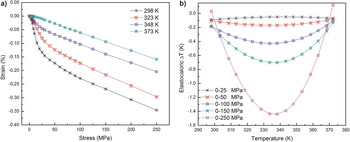
In ferroelectric materials, the relationship between strain and polarization is not essentially linear. Even for discontinuous strain gradients, the polarization change may vary as a function of applied stress and temperature. Thus, the stress–strain response of the ferroelectric is required to fully assess the true elasto-caloric potential of ferroelectric materials. In this regards, our group has been able to successfully demonstrate the same for bulk-ferroelectric materials. Utilizing the actual stress–strain response for Ba x Ca1−x Zr0.1Ti0.9O3 (BCZTO) Reference Patel, Chauhan and Vaish32 and Pb(Mn1/3Nb2/3)O3–32PbTiO3 (PMN–32PT) Reference Chauhan, Patel and Vaish29,Reference Chauhan, Patel and Vaish30 we were able to demonstrate that bulk ferroelectric materials possessed a strong potential for enhanced stress-driven caloric effects. This is represented by Fig. 6, where Fig. 6(a) demonstrates the actual stress–strain graphs for BCZTO as a function of temperature; while the corresponding elasto-caloric effect is shown in Fig. 6(b). It can be observed from Fig. 6 that bulk ferroelectric materials possess two distinct regions within their stress–strain behavior. Initially the increase in strain energy is compensated by ferroelastic switching, as observed by the nonlinear zone. However, upon complete domain rotation, a linear stress–strain behavior is observed, akin to normal ceramics. It can also be observed that the intensity of ferroelastic switching decreases with an increase in temperature. This behavior is expected since an increase in temperature leads to thermal relaxation of the domain structure, which is also responsible for affecting the polarization, pyroelectric, and piezoelectric properties in such materials. However, the most intriguing fact is that stress-driven caloric effects, as observed for bulk materials, could easily match or exceed conventional electro-caloric effects for which these materials are traditionally investigated. For example, in BCZTO bulk ceramics a peak elasto-caloric temperature change of 1.55 K was observed, which is twice as large as the previously reported peak electro-caloric effect for bulk material of the same composition. A similar phenomenon was observed for PMN–32PT single crystals where a maximum elasto-caloric temperature change of 0.36 K was observed as opposed to a previously reported peak electro-caloric effect of 0.27 K. In addition, the same study also discussed the possibility of combining the individual caloric effects for further cooling. Thus, these studies constitute what can be stated as the first step toward establishing a new field of caloric effects in ferroelectric materials. The most redeeming quality of ferroelectric materials lies in the fact that relatively small strains are required to produce relatively large temperature changes, as opposed to conventional ferroelastic materials. These materials are capable of displaying elasto-caloric effect to a significant extent. Reference Moya, Kar-Narayan and Mathur58
(a) Stress–strain behavior of bulk BCZTO polycrystalline (poled) ceramic under uniaxial compressive loading and (b) corresponding elasto-caloric effect observed in the material, represented as a function of operating temperature.

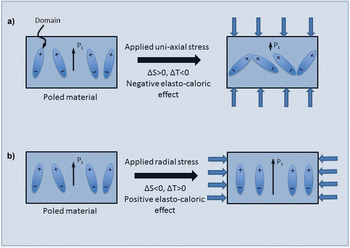
This effect can manifest itself in a positive or negative caloric effect depending on the initial state of the material. In a “poled” ferroelectric sample a significant number of domains are already aligned in a specific direction (low entropy state) and this lends the material its activity (piezoelectric or pyroelectric). However, when a suitable uniaxial compressive stress is applied to the material, the domains experience a stress induced rotation which increases the overall entropy of the system, as shown in Fig. 7(a). This behavior can be attributed to non-180° domain rotation that is associated with ferroelastic switching. Reference Patel, Chauhan and Vaish64–Reference Patel, Chauhan and Vaish69 Consequently, the resulting effect is an overall decrease of temperature to compensate for the entropy increase, resulting in a negative caloric effect.
Ferroelastic domain switching in poled ferroelectric materials under the application of (a)uni-axial stress and (b) radial stress.

However, if the direction and magnitude of the applied stress is appropriately selected, it can result in an overall decrease in the entropy of the system. Upon the application of radial stress, additional domains are aligned along the material's net moment due to ferroelastic domain rotation. Reference Valadez, Sahul, Alberta, Hackenberger and Lynch70,Reference Marsilius, Frederick, Hu, Tan, Granzow and Han71 This increases the overall polarization of the system and consequently, the state of order is increased, as shown in Fig. 7(b). Hence, the effective decrease in entropy can result in a positive caloric effect. Thus, both positive and inverse caloric effects can be obtained Reference Mañosa, González-Alonso, Planes, Barrio, Tamarit, Titov, Acet, Bhattacharyya and Majumdar13 and an attempt in this direction has been recently reported where ultra-thin ferroelectric films have been reportedly used to obtain both negative and positive giant elasto-caloric effect near room temperature. Reference Liu, Infante, Lou, Bellaiche, Scott and Dkhil61
Performance parameters
During the selection of a suitable elasto-caloric material, such as the NRs, SMAs or ferroelectrics for a solid-state refrigeration system, several parameters have to be considered. These enable us to compare the performance of the potential materials when used as coolants for employing the elasto-caloric effect.
Elasto-caloric effect (ΔT)
The elasto-caloric effect is used to refer to the maximum achievable change in temperature through the application of a mechanical force. Thermodynamically, the temperature change in an adiabatic process can be evaluated as:
 $$\Delta S = C \cdot {\rm{ln}}\left( {{{{T_1}} \over {{T_0}}}} \right).$$
Equation (13) can be rewritten as
 $${{{T_1}} \over {{T_0}}} = {{\rm{e}}^{{\raise0.7ex\hbox{${\Delta S}$} \!\mathord{\left{\vphantom {{\Delta S} C}}\right.\kern-\nulldelimiterspace!\lower0.7ex\hbox{$C$}}}},$$
here, C (J/kg K) is the heat capacity at constant pressure, and T
1 and T
0 are final and initial temperatures. It is clear from Eq. (14) that the higher the change in entropy of the material due to a phase change, the higher the
 ${{{T_1}} \over {{T_0}}}$
ratio. It is expected from this expression that the
 ${{{T_1}} \over {{T_0}}}$
ratio will increase exponentially with ΔS. This is observed in the case of NR where ΔT
NR is 2–3 K when the strain is low, but increases to 10 K for strain levels of 500%.
Reference Guyomar, Li, Sebald, Cottinet, Ducharne and Capsal34,Reference Pellicer, Manzanares, Zúñiga, Utrillas and Fernández35
It has been reported that a temperature variation ΔT
NR between 5 and 10 K has been achieved experimentally.
Reference Pellicer, Manzanares, Zúñiga, Utrillas and Fernández35
A similar observation was reported where the refrigeration capacity of NR increased exponentially with strain.
Reference Guyomar, Li, Sebald, Cottinet, Ducharne and Capsal34
An experiment reporting a ΔT
NR of 7 K has been reported, taking the initial and lowest temperature as Ref. Reference Guyomar, Li, Sebald, Cottinet, Ducharne and Capsal34. Thus, to achieve a high ΔT, the entropy change should be as high as possible. In elastomers the entropy change is expected to be higher in materials with a larger number of cross-links. However, as the number of cross links increases, the polymer tends to lose its super-elastic property and behave more like thermosets. Conversely, a lower number of links leads to a higher elastic limit, but an increased tendency for the material to flow like a viscous liquid under load, due to relative motion of molecular chains. Therefore, an optimization of the number of cross-links is desired.
Reference Guyomar, Li, Sebald, Cottinet, Ducharne and Capsal34
In SMAs the entropy change occurs during the phase transformation between the austenite and martensite phase. A higher ΔT SMA would then be expected when there is a high entropy change between the two states. A study of the change of entropy with temperature and applied stress has been undertaken Reference Bonnot, Romero, Mañosa, Vives and Planes36 where the entropy change associated with the phase transition is relatively independent of temperature. This can be explained in terms of latent energy of transformation, which is essentially isothermal in nature and is only dependent on the nature of the phase change. The higher the energy of transformation, the greater the heat extracted and associated temperature change (ΔT SMA). For some SMAs the transformation energy can be as high as 31 J/g. Reference Otubo, Rigo, Coelho, Neto and Mei43 A recent study by Xiao and co-workers demonstrated that elasto-caloric behavior in SMAs is also dependent on crystallographic orientation. Reference Xiao, Jin, Liu and Jin72 Using Ni50Fe19Ga27Co4 single crystals it was demonstrated that a temperature change of 9–10 K was obtained for single crystals oriented in [001] direction (328–398 K). However, this value was reduced to 3 K for a sample orientated in the [111] direction.
An experimental study regarding the elasto-caloric effect in NiTi polycrystalline samples has been made Reference Cui, Wu, Muehlbauer, Hwang, Radermacher, Fackler, Wuttig and Takeuchi20 and a ΔT SMA of 17 K was measured for an applied tensile stress of 580 MPa on a 3 mm × 1.780 m cylindrical sample. The extrapolated data predicted a ΔT SMA of 20.8 K under adiabatic loading and unloading conditions. Additionally, the study reported that the elasto-caloric effect increases with an increase of the cross-section of the material. This is a result of the cylindrical nature of the material used in the study; the heat loss is inversely proportional to the surface area of the cylindrical material used. Thus, the thickness of the material and heat transfer characteristics of the material become an important factor. Reference Cui, Wu, Muehlbauer, Hwang, Radermacher, Fackler, Wuttig and Takeuchi20 A recent study by Tušek et al. reported a maximum ΔT SMA of 21 K (unloading) for NiTi wires that were trained at different temperatures. Reference Tušek, Engelbrecht, Mikkelsen and Pryds73 The training procedure involves monitored thermal and mechanical loading and unloading cycles for a pristine SMA so as to stabilize its thermo-mechanical actuation behavior. This process enables the material to “remember” its shape and to reacquire it after deformation. A ΔT SMA of 16 K has been measured for magnetron sputtered Ni50.4Ti49.6 20 μm thick films. Reference Ossmer, Chluba, Krevet, Quandt, Rohde and Kohl74 It was reported that compared to bulk samples, larger strain rates and reduced heat transfer times were obtained due to the larger surface area to volume ratio that is achievable for a thin-film morphology.
While for ferroelectric materials the peak adiabatic temperature change is governed by the strain gradient (with respect to temperature) and the accompanying polarization change. In some classes of ferroelectric materials, the strain response is large Reference Patel, Chauhan and Vaish32 ; this is primarily dependent on the lattice geometry of the sample at the time of loading. It is possible for a ferroelectric material to under-go first and second order phase transitions when subjected to a specific magnitude and nature of external stimulus. This effect is especially pronounced for ferroelectric materials fabricated near their morphotropic phase boundary (MPB). Reference Chauhan, Patel and Vaish29,Reference Chauhan, Patel and Vaish30 A MPB in a ferroelectric indicates the presence of two or more phases separated by only a small difference in their free energy. The phenomenon of phase transition in the vicinity of ferroelectric MPB has been discussed in detail in relevant literature. Reference McLaughlin, Liu and Lynch75,Reference McLaughlin, Liu and Lynch76 Thus, upon selection and application of suitable external impetus a desired phase change can be achieved. This is often accompanied by a large strain and polarization change. Hence, the adiabatic temperature change in ferroelectric materials is dependent on the quality and quantity of entropy change that is exhibited by the material.
The upper and lower limits of the elasto-caloric effect also define the range of working temperatures of the refrigeration cycle. Reference Schmidt, Schütze and Seelecke39 Essentially, a higher elasto-caloric effect means that the cycle can be operated between wider ranges of operating temperatures, being able to extract heat from lower temperature sources and rejecting it at a higher temperature sink; thus becoming more efficient in terms of the Carnot parameters.
Previously, theoretical predictions have been made for an achievable elasto-caloric ΔT for ferroelectric materials. A maximum ΔT of 9 K obtained for a Ba0.5Sr0.5TiO3 ferroelectric material near its Curie temperature has been reported. Reference Lisenkov and Ponomareva21 Additional data showing the dependence of ΔT on initial temperature have also been provided. The study reports that a ΔT of 4 K can be obtained in the vicinity (±50 K) of the Curie temperature which is attributed to a stress induced ferroelectric–paraelectric phase change near the Curie point. Additionally, a recent study Reference Lisenkov, Mani, Chang, Almand and Ponomareva54 details the possibility of a giant elasto-caloric effect, for example in PbTiO3 ferroelectric material, through a first principle approach. For ferro-magnetic materials, a elasto-caloric ΔT of 5.17 K has been reported in a Fe49Rh51 alloy when exposed to a tensile stress of 529 MN/m2. Reference Nikitin, Myalikgulyev, Annaorazov, Tyurin, Myndyev and Akopyan22 The observed negative caloric effect was attributed to a stress induced antiferromagnetic to ferromagnetic phase transformation.
Specific heat capacity
A higher specific heat capacity essentially means that a higher amount of heat can be extracted per cycle. This indirectly affects the overall refrigeration as it reduces the number of cycles required to produce the necessary cooling. Therefore, it is also an important parameter to consider while selecting materials for solid-state refrigeration. For elastomers such as NR, the specific heat capacity is a direct measurement of the amount of heat that can be extracted by the material [Eq. (13)] and a large specific heat capacity is desirable. For a phase change material, such as SMAs, the maximum ΔT SMA = L/C p (Ref. Reference Cui, Wu, Muehlbauer, Hwang, Radermacher, Fackler, Wuttig and Takeuchi20); therefore, a lower C p would be preferred for a particular value of L. However, it does not affect the refrigeration capacity of SMAs as no sensible heat is involved. The best example of this phenomenon can be observed in a study which reported a giant refrigeration capacity in a Fe–31.2Pd (at.%) single crystal SMA. Reference Xiao, Fukuda and Kakeshita23 Even though the observed ΔT SMA was low at approximately 2 K (compared to a ΔT SMA of 15 K for NiTi alloy) a high cooling capacity of 2 MJ/m3 was observed under an applied stress of 100 MPa. The high cooling capacity can be attributed to the large latent heat associated with the martensitic transformation in Fe-31.2Pd single crystal. A similar trend is also expected in ferroelectric materials, where the temperature change is determined by quantification of entropy change within the material. A higher value of specific heat capacity may reduce the adiabatic ΔT. However, it does not affect the heat extraction capacity, nor does it affect the overall performance. Nevertheless, published literature Reference Thacher77–Reference Valant80 indicates that a material with lower specific heat capacity would ultimately benefit from a higher caloric effect which would increase its versatility in terms of operating and temperature range.
Endurance limit
The performance of a material often degrades as the number of working cycles is increased. This effect is known as fatigue and can eventually lead to degradation of properties and material failure. In this regard, the endurance limit is defined as the maximum magnitude of load which can be applied repeatedly for a sufficiently large number of cycles without any appreciable reduction in the performance of the materials. Clearly a high endurance limit is vital for the materials as they are expected to go under a large number of loading cycles to achieve long term cooling. Elasto-caloric materials suffer from two major types of fatigue, namely structural and functional. Structural (mechanical) fatigue is a result of cyclic loading and functional fatigue is due to reversible thermal stresses. A literature survey regarding the fatigue analysis approaches for rubber has been reported Reference Mars and Fatemi81 where two approaches, namely crack nucleation and crack propagation, have been discussed for fatigue life analysis of rubber components. The failure of polymers due to the application of alternating loads has been discussed Reference Sauer and Richardson82 such as the effects of important material parameters including polymer structure, molecular weight, and crosslinking; and the effect of external parameters such as stress intensity, frequency, temperature, and environment. The study also included a description of methods to improve the fatigue life of polymers. The addition of fillers, such as short glass fibers, has shown to significantly increase the fatigue life of polymers. Shorter fibers were shown to inhibit fatigue crack initiation and micro-voids introduced during the kneading process help to inhibit crack growth. Additionally, it was also observed that reducing the amount of diluents or plasticizers during the polymerization process decreases the fatigue crack growth rate. For SMA materials, thermo-mechanical fatigue has been reviewed Reference Hornbogen83 with a discussion of thermo-mechanical treatments to improve the endurance limit. Another study discussing structural and functional fatigue of NiTi SMA reports that satisfactory performance can be achieved for up to 106 loading cycles Reference Eggeler, Hornbogen, Yawny, Heckmann and Wagner84 with a small change in performance. The material can be subjected to a high number of recoverable cycles provided the stress required for pseudoelastic phase change is smaller than the yield stress of the austenite phase. Reference Eggeler, Hornbogen, Yawny, Heckmann and Wagner84 A recent study by Xu et al. reported that dual phase alloys are expected to exhibit a better endurance limit as opposed to single phase alloys. Reference Xu, Lu, Sun, Yan and Liu85 Their study demonstrated that while mechanical fatigue in Ni–Fe–Ga alloys begins at only 10 cycles for single phase samples while a dual phase sample can readily remain insensitive to fatigue after 100 cycles. This makes a valuable contribution toward considering the material phase while evaluating its suitability for elasto-caloric applications. A recent study by Tušek et al. established the functional integrity of NiTi wires for over 400 cycles, Reference Tušek, Engelbrecht, Mikkelsen and Pryds73 while a study by Schmidt et al. discussed in detail the effect of thermal training on the functional and mechanical fatigue in NiTiCuV magnetic SMA ribbons. Reference Schmidt, Ullrich, Wieczorek, Frenzel, Schütze, Eggeler and Seelecke86 It was observed that the nature of applied training leads to evolution of peculiar temperature profiles, with thermal behavior displaying local temperature peaks and distribution pattern which is highly dependent on the number of cycles. Reference Schmidt, Ullrich, Wieczorek, Frenzel, Schütze, Eggeler and Seelecke86 The NiTiCuV ribbons exhibited promising resistance against functional fatigue, indicating their promise for practical applications; while the endurance limit can be high (>1000 cycles) for SMA single crystals Reference Xiao, Jin, Liu and Jin72 its applicability is severely limited due to its high cost. While a high endurance limit is an important factor for a long lifetime a high strength is also desirable since the magnitude of load applied to achieve the desired cooling can be high; for example the applied stresses can be up to 700 MPa (Ref. Reference Cui, Wu, Muehlbauer, Hwang, Radermacher, Fackler, Wuttig and Takeuchi20) and thus, possibility of mechanical failure exists. Reference Eggeler, Hornbogen, Yawny, Heckmann and Wagner84 In addition, since the material experiences additional fatigue in the form of thermal cycles, repeated use can degrade the shape-memory and elasto-caloric effects. Reference Eggeler, Hornbogen, Yawny, Heckmann and Wagner84 Although SMAs and NR seem to have a sufficiently high Mean Time Between Failures, Reference Guyomar, Li, Sebald, Cottinet, Ducharne and Capsal34,Reference Bechtold, Chluba, Lima de Miranda and Quandt52 a higher endurance limit is clearly beneficial in terms of economy and reliability.
In the case of ferroelectric materials there is significant data present in the literature to indicate that they would make excellent candidates for stress driven solid-state refrigeration. A number of articles are present which describe the fatigue behavior of various classes of ferroelectric materials. Reference Chon, Kim, Jang and Yi87–Reference Pan, Yue and Tosyali92 Ferroelectric materials possess good functional stability over extended periods of operation time Reference Gerber, Kügeler, Ellerkmann, Schorn, Böttger and Waser93,Reference Chen, Harmer and Smyth94 and they also possess good functional and mechanical endurance. Reference Gerber, Kügeler, Ellerkmann, Schorn, Böttger and Waser93,Reference Chen, Harmer and Smyth94 Finally, since the required actuation strain (typically 0–0.4%) and stress (typically 0–200 MPa) is small, Reference Chauhan, Patel and Vaish30,Reference Patel, Chauhan and Vaish31,Reference Chauhan, Patel and Vaish33 it is possible to employ them for applications where neither polymers nor SMAs would work. As an additional advantage, when the size of a ferroelectric is reduced their efficiency and performance increases rapidly; for example in thin-films. Reference Liu, Infante, Lou, Bellaiche, Scott and Dkhil61 This is in contrast to the degradation in performance of conventional ferroelastic materials when subjected to similar downscaling to either micro or nano levels. Reference Moya, Kar-Narayan and Mathur58 Thus, ferroelectrics can be used for diverse applications and is a topic of interest for future research.
Transition/inversion temperature
The transition temperature in the context of SMA materials, the inversion temperature for elastomers such as NR and the Curie or Néel temperature for ferroic materials will now be described. In SMAs, the entropy change originates from the phase change between the austenite (A) and martensite (M) phases. This change is not sharply defined and occurs over a range of temperature (as in Fig. 4) and there are two temperatures, namely start (s) and finish (f), associated with each phase which represent the start and completion of the phase formation respectively. A reference temperature known as the transition temperature is used to indicate a point in the phase diagram that represents a 50% concentration of austenite and martensite phases. This is important since if the transition temperature of the material is too high with respect to the working temperature, then the heat extracted would be low. Ideally, the transition temperature should be close to the working temperature so that maximum heat can be extracted. If the heat input is not able to achieve a phase transition to the austenite phase then clearly no heat extraction would occur and similarly if the transition temperature to the martensite phase is too low the material would remain in the austenite phase.
In elastomeric materials, the inversion temperature (thermo-elastic inversion) refers to the point where the inversion in the slope of linear (thermal) expansion coefficient takes place. Reference Pellicer, Manzanares, Zúñiga, Utrillas and Fernández35 For low strains (up to 10%), the dependence of thermal expansion coefficient on temperature is positive. However, beyond the inversion temperature thermo-elastic inversion takes place on the temperature–strain graph Reference Pellicer, Manzanares, Zúñiga, Utrillas and Fernández35 where there is a negative coefficient of linear thermal expansion defined by:
 $$\alpha _0^3 = {{1 + 2{\lambda _0}T} \over {1 - {\lambda _0}{T_{\rm{i}}}}}\exp \left[ {3{\lambda _0}\left( {{T_{\rm{i}}} - {T_0}} \right)} \right],$$
here, α0 = L/L 0(T 0) represents the strain of the elastomer associated with its original length at a reference temperature; λ0 is the coefficient of linear expansion of an elastomer in unloaded condition; T 0 is the reference temperature, and T i is the inversion temperature. Using Eq. (15) we can observe that for λ0 = 2.2 × 10⁻⁴ K−1 (NR) and T 0 = 298.15 K = T i (isothermal stretching) the required value of α0 = 1.067. This signifies that a thermo-elastic inversion can be obtained at room temperature with a strain of 6.7% or higher. Therefore, such a level of strain is required for cooling to the desired inversion temperature, and this represents a lower limit. Thus, the inversion temperature and the corresponding strain are to be considered carefully. The inversion temperature for ferroic materials is their Curie or Néel temperatures, for ferroelectric, ferromagnetic, and antiferromagnetic, ferrimagnetic materials, respectively. Beyond this temperature, the ferroelectric/ferromagnetic property disappears completely due to induction of a paraelectric/paramagnetic phase. Since beyond this point there is no possibility to attain entropy ordered state, this forms the upper working limit (temperature) for ferroic materials. The Curie or Néel temperature differs with material composition, structure, Reference Tang, Sorensen, Klabunde and Hadjipanayis95 and applied external impetus. Reference Brouha and Buschow96 However, relaxor ferroelectric materials have been reported which display a broad transition temperature range due to presence of nano-domains. Reference Cross97 Recent advances in ferroelectric elasto-caloric phenomenon have also revealed that stress driven adiabatic temperature change in ferroelectric materials is also a function of material temperature. Reference Chauhan, Patel and Vaish29,Reference Chauhan, Patel and Vaish30,Reference Patel, Chauhan and Vaish32 A maximum caloric effect is observed in the vicinity of phase transition temperature, whether ferroelectric–ferroelectric or ferroelectric–paraelectric Reference Chauhan, Patel and Vaish29,Reference Chauhan, Patel and Vaish30,Reference Patel, Chauhan and Vaish32 ; as observed from reported studies on PMN–32PT single crystals Reference Chauhan, Patel and Vaish29,Reference Chauhan, Patel and Vaish30 and Ba0.85Ca0.15Zr0.1Ti0.9O3 bulk ceramics. Reference Patel, Chauhan and Vaish32
Coefficient of performance (COP)
The COP for a cooling cycle is defined as:
 $${\rm{CO}}{{\rm{P}}_{{\rm{cooling}}}} = {{{Q_{\rm{c}}}} \over W} = {{{T_{{\rm{cold}}}}} \over {{T_{{\rm{hot}}}} - {T_{{\rm{cold}}}}}},$$
here, Q c is the amount of heat extracted from the cold reservoir and W is the work done on the system. The second term in Eq. (16) is used when the cycle in question is a Carnot cycle. Since it is a measure of heat extracted per unit work done, it can be used as a performance measurement criterion. A high COP indicates an efficient process and recent reports on elasto-caloric studies of SMAs have reported a COP up to 3.07 (COPrelative = 21.6%) Reference Cui, Wu, Muehlbauer, Hwang, Radermacher, Fackler, Wuttig and Takeuchi20 where;
 $${\rm{CO}}{{\rm{P}}_{{\rm{relative}}}} = {\raise0.7ex\hbox{${{\rm{CO}}{{\rm{P}}_{{\rm{cycle}}}}}$} \!\mathord{\left{\vphantom {{{\rm{CO}}{{\rm{P}}_{{\rm{cycle}}}}} {{\rm{CO}}{{\rm{P}}_{{\rm{carnot}}}}}}}\right.\kern-\nulldelimiterspace!\lower0.7ex\hbox{${{\rm{CO}}{{\rm{P}}_{{\rm{carnot}}}}}$}}.$$
In this case the material is mechanically loaded up to its elastic limit; if the unloading part of the cycle can be used to recover mechanical work, such as pumping, the COP can potentially be improved to a value of 11.8 which corresponds to a COPrelative = 83.7%.
Reference Cui, Wu, Muehlbauer, Hwang, Radermacher, Fackler, Wuttig and Takeuchi20
Thus, if care can be taken to utilize the unloading energy to do mechanical work for the refrigeration system, high efficiencies can be achieved. The only disadvantage of this route would be an increase of the lower temperature reached upon unloading. This would arise due to the finite amount of time required for the material to do mechanical work and could result in the unloading curve deviating from the adiabatic path and a finite amount of heat being exchanged with the surrounding environment. Moya et al. have recently published an excellent article discussing the fundamental principle of the required and recoverable work for caloric effects in ferroic materials.
Reference Moya, Defay, Heine and Mathur98
Information relating to the magnitude and nature of the actual work required to drive the material parameter/phase transition has been discussed. To assess the relative efficiency of materials with respect to different caloric effects and within the same caloric effect, a (dimensionless) figure of merit was used termed the material efficiency
 $\left( {\eta = \left| {{Q \over W}} \right|} \right)$
.
Reference Moya, Defay, Heine and Mathur98
To justify the approach, a comparison was made for the situation involving similar amount of heat flow/extraction (Q). Even though it was concluded that the relative efficiency of stress driven caloric effects is low, this statement was made on the assumption that high grade electric work is recoverable for re-use in electro-caloric materials. However, when this assumption is ignored it is observable that elasto-caloric effects have the ability to reach efficiencies higher than electro-caloric effect. Further, this data is only limited to conventional ferroelastic shape-memory alloys requiring high strains and fails to consider the recently reported values for elasto-caloric effects in ferroelectric materials. In addition, the generation of high intensity electric fields and magnetic fields require special apparatus while mechanical strains, if need be, can also be driven manually. This theory has been corroborated by Tušek et al.
Reference Tušek, Engelbrecht, Millán-Solsona, Mañosa, Vives, Mikkelsen and Pryds99
who describes in detail the working mechanism and performance evaluation of a practical solid state refrigeration system employing elasto-caloric effects. Two different SMAs, NiTi and Cu–Zn–Al, were evaluated for their cooling capacity using a novel regenerative cycle. The performance was evaluated with respect to various operational parameters such as frequency of operation, loading conditions, and operating temperatures. Further, the performance was evaluated with respect to a magneto-caloric cooler employing Gd. It was observed that not only do the SMAs provide the necessary progressive temperature change capacity required for room temperature cooling applications (30 K or more); but the cooling performance can even exceed that of a magnetic refrigerator and electro-caloric effect, at higher temperatures.
Reference Tušek, Engelbrecht, Millán-Solsona, Mañosa, Vives, Mikkelsen and Pryds99
This makes mechanical refrigeration a versatile option to be used in remote conditions.
Other important parameters
Other important selection criteria for considering the performance of a material based on its volumetric and material efficiency involves three additional parameters namely (i) isothermal entropy change
 ${\left( {{{\partial \varepsilon } \over {\partial T}}} \right)_T}$
, (ii) wide operation range near room temperature (temperature invariant performance), and (iii) field normalized caloric effect
 $\left( {{{\Delta T} \over {\Delta \sigma }}} \right)$
, also known as material efficiency. The isothermal entropy change, as represented here, is a means of quantifying the heat extraction capacity of the material of interest per unit volume. A higher number also contributes indirectly toward the adiabatic temperature change; however its main significance is being able to determine the thermal inertia. Hence a material possessing higher volume specific entropy change will be able to extract more heat per cycle than the competing material.
A wider operation range or temperature invariant performance helps the material to perform the temperature uplift required to provide a consistent performance under varying heat loads. An adiabatic temperature change assumes a parabolic shape when plotted against the operating/material temperature; this implies that the cooling capacity first increases, assumes a maximum value and then decreases. This is true for all materials; however, the shape or slope of this parabolic behavior can help to assess the performance of the material. A sharper slope would indicate that the material performance/cooling capacity degrades rapidly upon departure from the inversion temperature. Thus, under varying thermal loads such a material would perform poorly, since a change in heat load causes the sink temperature to rise or fall from the inversion temperature. Conversely, if this slope is lower the material would respond better to fluctuating heat loads, making it more suitable for practical cooling applications.
Finally, the material should also possess good field normalized performance. This translates to having a caloric effect for reduced input (stress). From the nature of Maxwell's relations used for predicting caloric effects [Eq. (10)], it can be easily determined that the elasto-caloric effect is expected to scale linearly with the intensity of applied stress. In this regard, a material which is able to demonstrate a larger ΔT a reduced input (stress) would be beneficial to enhance the overall performance and efficiency of the system. Thus, these criteria should also be considered while selecting a suitable material for elasto-caloric solid-state refrigeration.
Challenges and future prospects
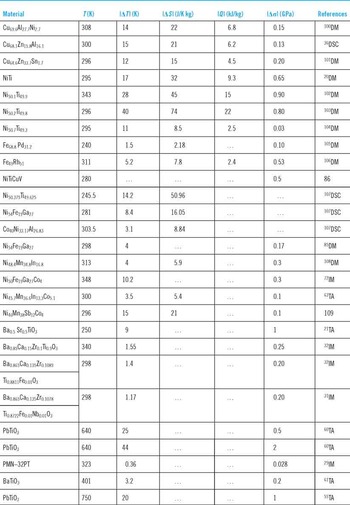
Apart from the material parameters discussed above, materials for elasto-caloric applications present ample scope for development before they can be successfully formulated into competitive technologies. Table 1 provides a list of potential ferroelastic materials reported in the literature for elasto-caloric cooling applications along with their thermodynamic performance parameters. The table is not exhaustive but represents some of the best reported materials to date. However there remains a lack of materials for tapping into successful association between two or more caloric effects. The main challenge lies with the development of suitable materials for coupled caloric effects. A simultaneous coupling of multiple caloric effects within the same material could yield large amounts of heat transfers utilizing co-existing “electric,” “magnetic,” and “elastic” entropy transitions.
Elastocaloric properties of various SMA and ferroelectric materials.

DM—direct measurement, IM—indirect measurement, TA—theoretical analysis.
Finding a suitable material chemistry that is able to successfully couple multi-ferroic ordered phase transitions is already underway. A giant electro-caloric effect has already been reported for thin film PbTiO3–PbZrO3 (PZT) ferroelectric pervoskite material. Reference Mischenko, Zhang, Scott, Whatmore and Mathur11 PZT is a solid solution of two independent ferroelectric phases of lead-titanate and lead-zirconate. Its properties can be easily tailored to move between the extremes of these two individual phases by varying the concentration of constituent materials and doping of additional elements such as lanthanum. Additionally, recent studies Reference Lisenkov, Mani, Chang, Almand and Ponomareva54,Reference Barr, Beckman and Nishimatsu60 have identified the existence of the elasto-caloric effect in lead-titanate through a first principles approach. By controlling the chemical composition of the material, the two effects of elasto-caloric and electro-caloric effects can be made to coincide at the same temperature. This will result in a transition between states of very high and low entropy and thereby lead to a giant coupled caloric effect.
A similar phenomenon has been reported for magnetic SMAs. A large number of Ni–Mn and other magnetic SMAs have been reported to exhibit a baro-caloric (or elasto-caloric) effect apart from magnetically ordered phase transformation. Reference Manosa, Planes and Acet6,Reference Krenke, Duman, Acet, Wassermann, Moya, Mañosa and Planes9,Reference Mañosa, González-Alonso, Planes, Bonnot, Barrio, Tamarit, Aksoy and Acet14,Reference Castillo-Villa, Manosa, Planes, Soto-Parra, Sanchez-Llamazares, Flores-Zuniga and Frontera53,Reference Entel, Sahoo, Siewert, Gruner, Herper, Comtesse, Acet, Buchelnikov and Sokolovskiy55 Since the elasto-caloric effect in SMAs is purely stress driven, it can be made to coincide with the magnetic ordered phase transition to produce giant entropy variations. Furthermore, the magnetic phase order transition can be controlled by varying the ratio of Ni and Mn with respect to other constituent elements. Reference Castillo-Villa, Manosa, Planes, Soto-Parra, Sanchez-Llamazares, Flores-Zuniga and Frontera53 The maximum entropy change for ferroic materials is expected to appear near their ferroelectric-paraelectric transition. When a ferroic material is heated past its Curie or Néel temperature, the material transforms into a paraelectric/paramagnetic phase accompanied by complete loss of functional attributes. Thus, the Curie/Néel temperature should ideally be close to the required operating temperature to achieve the maximum material efficiency and COP for any practical application. However, such an operation (beyond Curie/Néel temperature) should only be accomplished within the presence of an external electric/magnetic field to reorient the domains once the material is cooled back to its initial temperature. In this regard, we have proposed an electro-thermo-mechanical cycle to successfully combine the elasto-caloric and electro-caloric effects in ferroelectric single crystals. Reference Chauhan, Patel and Vaish29 Similar phenomena are also expected in other ferroelectric compositions and research in this direction is under progress.
However, the availability of multi-ferroic materials capable of pseudoelastic phase transition is currently limited. The fabrication of composite multi-ferroic materials may therefore prove to be highly beneficial. Such composites are ideally expected to contain at least two individual phases capable of entropy transition in the vicinity of the required operating temperature. Even though no direct coupling is expected to exist in such materials, the caloric effect to be obtained in such situations can be larger than its individual components. Reference Melvin40
Apart from coupled caloric effects, any refrigeration working on elasto-caloric effect still has disadvantages associated with its practical implementations. The primary concern is to reduce the magnitude of actuation field and work done on the system by the applied stimulus. While the electro-caloric and magneto-caloric effects operates with no moving parts, the elasto-caloric effect requires the development of a suitable load cell to apply the necessary forces (and accommodate associated strains); for example the elastic deformation can be up to several 100% for elastomers. Additionally, the design of heat pumps and circulation devices for such technologies is still under development. Many alternatives such as heat switches, thermal diodes, Reference Li, Wang and Casati110 Peltier units Reference Mathur and Mishchenko111 and convection through liquid crystals Reference Hwalek and Carr112 have been proposed to this effect but require further investigation. However, efforts are being made to overcome the associated limitations and prototyping is under development. Most notably, the efforts by Schmidt et al. Reference Schmidt, Ullrich, Wieczorek, Frenzel, Schütze, Eggeler and Seelecke86,Reference Schmidt, Schütze and Seelecke113 and Tušek et al. Reference Tušek, Engelbrecht, Mikkelsen and Pryds73,Reference Tušek, Engelbrecht, Millán-Solsona, Mañosa, Vives, Mikkelsen and Pryds99 must be noted who have designed and analyzed the performance of a practical refrigeration system employing the elasto-caloric effect. It is expected that reliable and efficient systems would be realized within the next decade that are ready for mass deployment.
Sustainability and environmental impact
The last century has witnessed a global temperature increase of about 0.6 K and a study by the UN Intergovernmental Panel on Climate Change has projected an increase of the average global temperature by 1.4–4.5 K by 2100. Reference Houghton, Ding, Griggs, Noguer, van der Linden, Dai, Maskell and Johnson114 An increase of this magnitude has the potential to have an impact on the shift in rainfall seasons, migration patterns of various life forms Reference Root, Price, Hall, Schneider, Rosenzweig and Pounds115 and increase in the frequency of extreme weather effects among others. Reference Houghton, Ding, Griggs, Noguer, van der Linden, Dai, Maskell and Johnson114,Reference Mendelsohn, Nordhaus and Shaw116–Reference Miller and Russell118 These factors have triggered efforts toward reducing activities and emissions that are responsible for climate change. The foremost effort in this direction has been the initiative in the form of Kyoto Protocol. 119 Among the main agendas, the protocol has made it legally binding for industrialized countries to reduce the collective emission of greenhouse gases and outlawed the use of various chlorofluorocabons (CFCs) used in the refrigeration industry.
Refrigeration is one of the main energy sinks in the industrialized world and forms a major part of the European electricity consumption. Reference Fähler, Rößler, Kastner, Eckert, Eggeler, Emmerich, Entel, Müller, Quandt and Albe17 Thus it is also one of the largest producers of carbon footprints and contributes greatly to greenhouse emission; the low operational efficiencies and the use of halofluorocarbons (HFCs) 120 in vapor compression systems is one potential concern. The maximum theoretical limit for efficiency of a vapor compression system peaks at 60% of Carnot efficiency. However, most of the refrigeration systems employ compressors with substantially reduced performances and an overall efficiency of 40–55% is practically obtainable. 121 Secondly, even though the harmful CFCs have been phased out, commercially available refrigeration systems still employ HFCs. These gases are less toxic and do not contribute to ozone depletions. However, these are classified as super-greenhouse gases and contribute greatly to the global warming. 120 One possible alternative is to employ low boiling point organic refrigerants like pentane Reference Powell, Poole, Capper and Thomas122 or ammonia. Reference Wong, Yudin, Bonaquist and Rashad123 Nonetheless, the limited range of operating temperatures hinders wide scale applicability.
In the light of these circumstances solid-state refrigeration provides a route to offer high reduction potentials in medium to small scale refrigeration and cryogenic requirements. Reference Fähler, Rößler, Kastner, Eckert, Eggeler, Emmerich, Entel, Müller, Quandt and Albe17,Reference Moya, Kar-Narayan and Mathur58 The high order phase transitions associated with ferroic materials allow for large entropy changes and corresponding giant caloric effects. Reference Moya, Kar-Narayan and Mathur58 The thermal inertia of such systems is low which limits their applicability to low load regimes but the associated benefits of solid-state refrigeration can be their high efficiency and COP. Theoretical values of COP close to 83.7% of Carnot has been reported for polycrystalline Ni–Ti SMA. Reference Cui, Wu, Muehlbauer, Hwang, Radermacher, Fackler, Wuttig and Takeuchi20 This represents a substantial improvement over conventional vapor compression systems. Reference Lu and Zhang7,Reference Fähler, Rößler, Kastner, Eckert, Eggeler, Emmerich, Entel, Müller, Quandt and Albe17 Additionally, solid-state cooling essentially operates without the requirement of a refrigerant as the material itself forms the source of heat exchange and the need for HFCs is eliminated. Apart from their nonpolluting and environmental-friendly application, minimization of moving parts can lead to enhanced operational life, less failures and safer operation. Long term life cycle assessment for ferroelectric materials Reference Dingquan124 has been proposed which would help to develop sustainable solid-state technologies. One of the first steps in this direction has been the development of lead-free ferroelectric materials. Reference Saito, Takao, Tani, Nonoyama, Takatori, Homma, Nagaya and Nakamura125 The matter is even more simplified for alloy and polymer based elasto-caloric materials as these can benefit from established reutilization and recycling. Therefore, further research is warranted into the field of solid-state cooling materials and technologies. Such systems will not only prove to be economically beneficial but will have a lesser environmental impact than existing conventional devices.
Conclusions
This paper has explained the underlying characteristics responsible for the elasto-caloric effect in SMAs, polymeric materials, and ferroic materials. The two types of elasticity, namely force-elasticity and entropy-elasticity have been discussed with the underlying mechanisms explained. The thermodynamic equations governing the behavior of entropy-elastic materials were used to derive the respective expressions for the elasto-caloric effect. Parameters associated with the performance of the materials for elasto-caloric cooling were discussed. These parameters include the elasto-caloric magnitude, specific heat capacity, endurance limit, transition temperature, and COP. Some additional background relating to coupled caloric effects in multi-ferroic materials and its potential applicability to practical realization of mechanical refrigeration has been discussed. A brief insight has also been provided into the current technological limitations to the successful application of elasto-caloric effect for commercial applications. Additionally, the long term sustainability and environmental impact of solid-state cooling technologies has also been discussed. The presented study is expected to promote interest and research in the field for efficient and practical use of the elasto-caloric effect for environmentally-friendly solid state refrigeration.
Acknowledgments
One of the authors (Rahul Vaish) acknowledges support from the Indian National Science Academy (INSA), New Delhi, India, through a grant by the Department of Science and Technology (DST), New Delhi, under INSPIRE faculty award-2011 (ENG-01). Bowen acknowledges funding from the European Research Council under the European Union's Seventh Framework Program (FP/2007–2013)/ERC Grant Agreement No. 320963 on Novel Energy Materials, Engineering Science and Integrated Systems (NEMESIS).