Introduction
Black medic (Medicago lupulina L.) infestations are problematic for Florida strawberry [Fragaria × ananassa (Weston) Duchesne ex Rozier (pro sp.) [chiloensis × virginiana]] production (Webster Reference Webster2014), with the weed growing exclusively as a winter annual and persisting through seed. New M. lupulina seed becomes fully dormant when the developing testa becomes water impermeable (Sidhu and Cavers Reference Sidhu and Cavers1977). Breaking M. lupulina seed dormancy is characterized by disruption of the hard seed coat by either mechanical means or temperature-mediated seed softening (Braul Reference Braul2004; Taylor Reference Taylor1981). Seed softening occurs either when a chilling period is followed by fluctuating warmer temperatures or elevated temperatures are followed by cooler fluctuating temperatures (Braul Reference Braul2004). The second scenario is more closely associated with environmental conditions in Florida.
Strawberries are produced in a cultivated annual plasticulture system. Medicago lupulina escapes current integrated pest management practices such as fumigation and PRE herbicides applied under the plastic mulch and emerges during crop establishment. While the cause for escape is unknown, it is speculated to be due to herbicide dissipation and incomplete seed control by fumigants (Sharpe et al. Reference Sharpe, Boyd, Dittmar, MacDonald, Darnell and Ferrell2018d).
Clopyralid is a registered POST herbicide for broadcast use in strawberry crop, is generally applied during harvest, and only suppresses M. lupulina (Anonymous Reference Anonymous2011). McMurray et al. (Reference McMurray, Monks and Leidy1996) speculated that crop shielding permitted M. lupulina survival. This was later confirmed by Sharpe et al. (Reference Sharpe, Boyd, Dittmar, MacDonald, Darnell and Ferrell2018d), who found only 8% spray coverage on water-sensitive paper below the strawberry canopy at the planting hole. Further confounding factors for M. lupulina control with clopyralid include size-based tolerance (Sharpe et al. Reference Sharpe, Boyd and Dittmar2016), limited translocation out of treated stems, and earlier than anticipated field emergence (Sharpe Reference Sharpe2017). Control of M. lupulina with clopyralid necessitates coordinating application timings with a vulnerable growth stage. Such timings likely would occur earlier in the production cycle when the strawberry plant is smaller, which may increase spray penetration and avoid application during the harvest period. Clopyralid applications earlier in the production cycle have been shown to be safe on the strawberry crop (Sharpe et al. Reference Sharpe, Boyd, Dittmar, MacDonald and Darnell2018a), though there are crop safety concerns at higher temperatures (Sharpe et al. Reference Sharpe, Boyd, Dittmar, MacDonald and Darnell2018b). Therefore, a M. lupulina emergence prediction tool would be a critical asset to strawberry producers for coordinating clopyralid application timing.
For prediction of phenological events such as emergence, heat units, measured in growing degree days (GDD), have improved prediction accuracy compared with other approaches, such as number of days after the biofix date (tillage, bed formation, or freezing temperatures) (McMaster and Wilhelm Reference McMaster and Wilhelm1997; Werle et al. Reference Werle, Sandell, Buhler, Hartzler and Lindquist2014). GDD functions have predicted weed emergence for many annual species, including common ragweed (Ambrosia artemisiifolia L.), common cocklebur (Xanthium strumarium L.), common lambsquarters (Chenopodium album L.), ivyleaf morningglory (Ipomoea hederacea Jacq.), velvetleaf (Abutilon theophrasti Medik.), barnyardgrass [Echinochloa crus-galli (L.) P. Beauv.], woolly cupgrass [Eriochloa villosa (Thunb.) Kunth], yellow foxtail [Setaria pumila (Poir.) Roem. & Schult.], green foxtail [Setaria viridis (L.) P. Beauv.], Pennsylvania smartweed [Persicaria pensylvanica (L.) M. Gómez] (Werle et al. Reference Werle, Sandell, Buhler, Hartzler and Lindquist2014), wild oat (Avena fatua L.) (Martinson et al. Reference Martinson, Durgan, Forcella, Wiersma, Spokas and Archer2007), catchweed bedstraw (Galium aparine L.), false cleavers (Galium spurium L.), and threehorn bedstraw (Galium tricornutum Dandy) (Royo-Esnal et al. Reference Royo-Esnal, Torra, Conesa, Forcella and Recasens2010). GDD-based functions perform well for temperate climates, where GDD accumulation begins before or during a warming period following a chilling period. This contrasts with the strawberry growing season of subtropical Florida, where a cooling period follows a high-temperature period. Strawberry bed formation begins in August, when the 8-yr monthly average air temperature in Dover, FL (a major strawberry production area) was 27 C, compared with 23 C in October (strawberry planting) and 15 C in January (peak harvest) (IFAS 2017; Whitaker et al. Reference Whitaker, Boyd, Peres, Noling and Renkema2017). Medicago lupulina emergence was between mid-November to mid-December in 2014, during crop establishment (Sharpe Reference Sharpe2017). This high-temperature period inhibits dormancy release and therefore M. lupulina field emergence (Braul Reference Braul2004; Van Assche and Vandelook Reference Van Assche and Vandelook2010; Van Assche et al. Reference Van Assche, Debucquoy and Rommens2003).
Hydrothermal time is a GDD model adaptation to account for water availability (Grundy Reference Grundy2003). Currently, little research has been conducted to examine the impact of soil water potential on M. lupulina germination in the field. Given that it is a hard-seeded annual with reliance on its seed coat to enforce dormancy, the importance of water availability for the seeds to imbibe is likely a limiting factor in germination after dormancy release (Van Assche et al. Reference Van Assche, Debucquoy and Rommens2003). The base water potential for M. lupulina seed germination of a European population was −0.6 MPa (Tribouillois et al. Reference Tribouillois, Dürr, Demilly, Wagner and Justes2016). The authors further found that Fabaceae species seed germination was more sensitive to water potential reductions than Poaceae or Brassicaceae. Strawberry plasticulture beds are drip irrigated, so water likely will not be a limiting factor. Given how closely M. lupulina germinates to the surface (2 cm) (Sidhu and Cavers Reference Sidhu and Cavers1977), drying in the recruitment zone within the planting hole of the bed and within the middle of rows is unknown and may be influential on germination and emergence characteristics. Study of varying osmotic potential in a controlled environment is a widely used approach in germination studies (Boyd and Van Acker Reference Boyd and Van Acker2004; Tribouillois et al. Reference Tribouillois, Dürr, Demilly, Wagner and Justes2016) and gives insight into simulated drying by reducing the available water for seed imbibement through decreasing potentials.
An empirical approach to M. lupulina field emergence in commercial strawberry fields was first explored (Sharpe Reference Sharpe2017). In 2014, using the standard daily GDD accounting formula, where GDD = (T mean−T base), with T base = 0, the onset of M. lupulina emergence in Florida strawberry fields occurred at 861 GDD and reached peak (90%) emergence by 1,416 GDD after punching holes in the plastic mulch (Sharpe Reference Sharpe2017). This timing corresponded with mid-November to late-December, approximately 1 to 2 mo after planting. In 2015, M. lupulina failed to emerge in those fields (Sharpe Reference Sharpe2017). This was unexpected, and the author speculated that temperature played a dominant role in emergence dynamics with warmer, constant temperatures (daily average ≥25 C) into the strawberry establishment period inhibited emergence.
Given the staggering differences in emergence between years, a reductionist approach was undertaken to examine the components leading to field emergence: dormancy, germination, and PRE growth (Grundy Reference Grundy2003). For strawberry production, M. lupulina seed dormancy may also be broken by seed softening, mechanically by tillage (Turkington and Cavers Reference Turkington and Cavers1979), or through scarification by fumigants, although the extent of each is unknown. Germination is an important component of M. lupulina emergence that warrants consideration. Medicago lupulina germination in response to temperature has previously been examined for a Canadian population (Braul Reference Braul2004; Sidhu Reference Sidhu1971), though no predictive models were generated. Sidhu (Reference Sidhu1971) determined that >70% of seed germinated between 5 and 35 C. Braul (Reference Braul2004) reported similar results, demonstrating >71% germination between 10 and 30 C. In Italy, scarified M. lupulina seed demonstrated 100% germination between 10 and 25 C (Gresta et al. Reference Gresta, Avola, Anastasi and Miano2007). Both Braul (Reference Braul2004) and Sidhu (Reference Sidhu1971) studied M. lupulina adapted to the northern taiga climate, and Gresta et al. (Reference Gresta, Avola, Anastasi and Miano2007) reported results from a Mediterranean climate, but there is a lack of research focused on M. lupulina emergence in subtropical climates. PRE growth may also be influential on field emergence and accounts for the time lag between seed germination and the successful emergence of a seedling, primarily affected by burial depth (Grundy Reference Grundy2003).
Empirical modeling of M. lupulina field emergence was inconsistent between years, likely due to underlying temperature-mediated factors (Sharpe Reference Sharpe2017). Incorporation of reductionist considerations in the form of daily GDD accounting restrictions based on dormancy, germination, and PRE growth should reduce variability between years (Grundy Reference Grundy2003). The resultant emergence model can be used in tandem with previously developed M. lupulina growth and development models (Sharpe et al. Reference Sharpe, Boyd, Dittmar, MacDonald, Darnell and Ferrell2018c) to coordinate clopyralid spray timings. Therefore, the objectives of the study were to: (1) examine the influence of temperature and osmotic potential on M. lupulina germination, (2) develop a novel germination-based daily GDD accounting restriction, and (3) develop a single GDD-based model for the full range of temperatures encountered in Florida strawberry production.
Materials and Methods
Medicago lupulina seed for all experiments was collected on April 4, 2014, at the Florida Strawberry Growers Association field site in Dover, FL (28.01°N, 82.23°W), from mature plants growing in competition with strawberry plants. Seed was kept dry in a refrigerator at 4 C until the initiation of each study. Preliminary experiments indicated satisfactory seed viability and softening had occurred, so additional scarification was deemed unnecessary.
Unless otherwise noted, experiments were conducted at the Gulf Coast Research and Education Center (27.75°N, 82.22°W) in Balm, FL, under the following parameters. The experimental design was a randomized complete block with four blocks, and the experiment was run twice. The blocking factor was proximity to the incubator door. Petri dish preparation consisted of the placement of two pieces of filter paper (Fisherbrand™, Thermo Fisher Scientific, Waltham, MA) in each petri dish (Fisherbrand™, Thermo Fisher Scientific), and 25 seeds were deposited on the filter paper. Distilled water (5 ml) was added to each petri dish, and then dishes were sealed with Parafilm M® (Bemis Company, Neenah, WI). Petri dishes were randomly assigned to treatments and placed into incubators (model I30BLLC8, Percival Scientific, Perry IA). Incubator light levels were between 89 and 114 µmol m−2 s−1, and the day/night period was 12/12 h. Germinated seedlings were counted at 1, 2, 3, and 4 wk after placement in the incubators. A seed was considered germinated if the radical penetrated the seed coat. Multiple germination counts were conducted to calculate daily GDD accounting over time. The constant-temperature studies were divided into two ranges due to the limited number of incubators available to run experiments concurrently.
Constant Temperature: Low Range
The experiment was initiated on September 12, 2016, and was repeated on October 5, 2016. Treatments consisted of seed incubation at constant temperatures of 5, 10, 15, 20, or 25 C. Seed germination was counted at 7, 15, and 21 d after placement into the incubators (DAP). Data were analyzed using ANOVA, and means were compared using Tukey’s honest significant difference (HSD).
Constant Temperature: High Range
The trial was initiated on June 8, 2016, and repeated on June 9, 2016. Treatments consisted of incubation of seeds at constant temperatures of 20, 25, 30, 35, or 40 C. Germination was counted at 7, 14, and 25 DAP. Data were described with a quadratic equation of the form:
 $$y{\equals}ax^{2} {\plus}bx{\plus}c $$
where a, b, and c are shaping parameters, and x is temperature; a linear function of the form:
 $$y{\equals}ax{\plus}b$$
where a is the rate of change in germination with temperature, and b is the y intercept; or a 4-parameter Gaussian peak function:
 $$y{\equals}ae^{{{\minus}b\left( {{{x{\minus}m} \over c}} \right)^{2} }} $$
where a is the peak germination, b and c are shaping parameters, and m is the temperature at which peak germination occurs.
Fluctuating Temperature
Both experimental runs were initiated on July 22, 2016, at different locations within the incubators. Treatments consisted of fluctuating temperatures of 35/25, 35/20, and 25/15 C day/night temperatures. Constant-temperature treatments of 35 and 25 C were included for comparison. The daytime temperature corresponded to the high temperature and when the incubator lights were on. Data were analyzed using ANOVA, and means were compared using Tukey’s HSD.
Osmotic Potential
The experiment was initiated on September 2, 2016, and repeated on September 21, 2016. The main factor was seed incubation at: 0, −0.25, −0.5, and −1 MPa. Polyethylene glycol (PEG) was added to water at a rate of 0.1325 g ml−1, 0.195 g ml−1, and 0.283 g ml−1 to produce the −0.25, −0.5 and −1 MPa treatments, respectively (Michel Reference Michel1983). PEG was selected because it is a nonpenetrating solute and would only affect osmotic potential outside the seed (Almansouri et al. Reference Almansouri, Kinet and Lutts2001). Incubators were set to a constant 25 C. Data were analyzed using ANOVA, and means were compared using Tukey’s HSD.
GDD Model
The objective of the following derivations were to develop a germination-based daily GDD accounting restriction to give subsequent Weibull functions sensitivity to the observed temperature effects when using accumulated GDD as a germination predictor. To achieve this, percent germination was chosen instead of percent accumulated germination. Data from the three temperature studies were pooled and cumulative GDDs were calculated. All three studies were temperature-based and covered a range of conditions to which M. lupulina seed may be exposed. The data contained three trends based on T mean, the mean daily air temperature, so a daily value for GDD was assigned based on decision logic using the following three conditions.
First GDD Condition
The first trend was a positive relationship between germination and temperature. This trend occurred when T base <T mean <T optimum, where T base was the lowest temperature at which M. lupulina germination would not occur, and T optimum was the optimum temperature for M. lupulina germination. The value for T base was derived from preliminary research (0 C) (Sharpe Reference Sharpe2017). The value for T optimum was calculated from the constant-temperature studies described earlier. The first condition was, therefore, if T base <T mean ≤ T optimum, then:
 $${\rm GDD}{\equals}(T_{{{\rm mean}}} \,{\minus}\,T_{{{\rm base}}} )$$
Second GDD Condition
The second trend was a negative relationship between temperature and germination. This occurred when T optimum <T mean <T maximum, where T maximum was the threshold temperature above which M. lupulina seed would not germinate. The value for T maximum was calculated from the constant-temperature studies described earlier. A modified GDD equation was produced to calculate daily accumulation (Equation 5). First, temperatures above the optimum did not have further positive effect on germination compared with the optimum. Therefore, T optimum replaced T mean in the numerator (Equation 4), which is known as the “86,50” method used in corn production (Eckert and Thomison Reference Eckert and Thomison2017).
Second, temperatures above the optimum demonstrated diminishing returns for high temperatures on germination over time. The initial value of that temperature range on germination was high (stimulating germination), but that value rapidly decreased with increasing time, resulting in a rapidly reached plateau early in the study. The GDD formula was modified into a fraction, and a diminishing returns operator (d) was placed in the denominator, where d was the number of days in which GDDs accumulated above the optimum. This change assumes increases in temperature above the optimum no longer generate increases in gain, with the maximum therefore being the optimum.
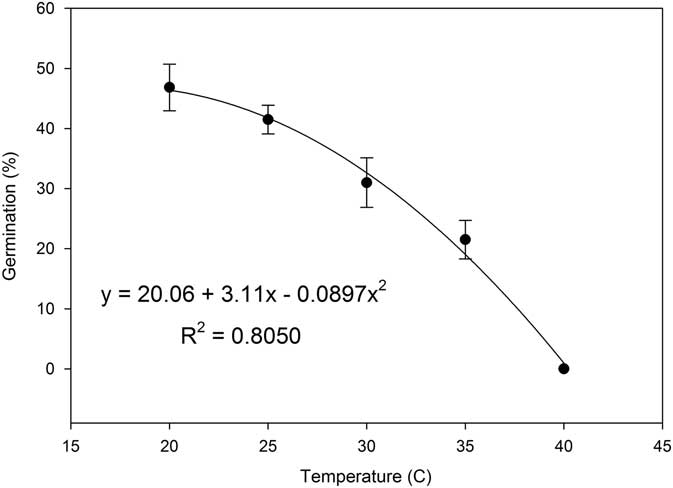
Third, a modification was added to the denominator to account for the negative relationship between germination and mean temperature above the optimum. A fraction containing T maximum and T mean was added to the denominator. This accounted for the negative effect of higher temperature on germination (Figure 1). The second condition was, therefore, if T optimum <T mean <T maximum, then:
 $${\rm GDD}{\equals}{{(T_{{{\rm optimum}}} \,{\minus}\,T_{{{\rm base}}} )} \over {d\left( {{{T_{{{\rm mean}}} } \over {T_{{{\rm maximum}}} }}} \right)}}$$
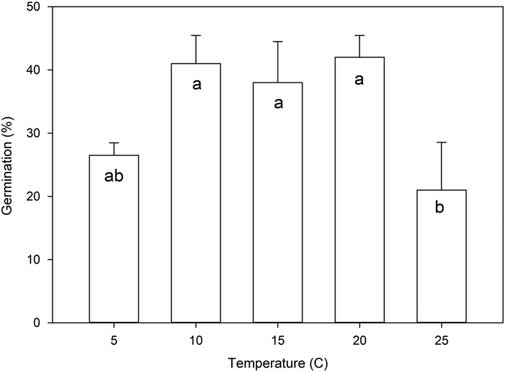
Medicago lupulina germination in response to a low range of constant temperatures in petri dishes contained in incubators at 24 d after experiment initiation at Balm, FL, in 2016. Bar heights are least-square means, differences in letter values represent a significant difference (α = 0.05) using Tukey’s honest significant difference, and error bars represent standard error of the arithmetic mean.

Third GDD Condition
The third trend resulted from a lack of germination above T maximum. The third condition was, therefore, if T mean ≥ T maximum, then GDD = 0.
In summary, daily GDDs were calculated with the following logic: if T base <T mean ≤ T optimum, then use Equation 4; if T optimum <T mean <T maximum, then use Equation 5; or if T mean ≥ T maximum, then GDD = 0. GDDs were then summed from the trial initiation date, and M. lupulina germination was modeled as a function of cumulative GDDs using a Weibull equation:
 $$y{\equals}k[1\,{\minus}\,e^{{({\minus}b({\rm GDD}\,{\minus}\,m)^{c} )}} ]$$
where y is the percent germination of M. lupulina seed, k is the theoretical maximum germination, b is the rate of increase in percent germination, m is the lag phase until germination initiates, and c is a shaping parameter (Martinson et al. Reference Martinson, Durgan, Forcella, Wiersma, Spokas and Archer2007; White et al. Reference White, Boyd and Van Acker2012).
ANOVAs were performed using the GLIMMIX procedure in SAS v. 9.4 (SAS Institute, Cary, NC). Block and trial runs were considered random variables using the RANDOM statement, specifying the compound symmetry covariance structure. Model assumptions of normality and constant variance were verified. Mean separation was performed on the osmotic potential and fluctuating temperature data using Tukey’s HSD (α = 0.05).
Linear and nonlinear regression were performed using SigmaPlot v. 12.5 (Systat Software, San Jose, CA). Model fit for regression was judged based on the adjusted coefficient of determination (R2) and the root-mean-square error (RMSE) for nonlinear regression. A pseudo-R2 was calculated assuming the Gaussian and Weibull functions y-intercept was defined as 0 for nonlinear models (Schabenberger et al. Reference Schabenberger, Tharp, Kells and Penner1999). R2 values were calculated by
 $${\rm R}^{2} {\equals}1\,{\minus} \,{{\mathop{\sum}{(y_{{{\rm obs}}} \,{\minus}\,y_{{{\rm pred}}} )^{2} } } \over {\mathop{\sum}{(y_{{{\rm obs}}} \,{\minus}\,\bar{y})^{2} } }}$$
where ȳ is the overall mean across all observations, y obs the observed values, and y pred the predicted values. The coefficient of determination was adjusted for the number of model parameters by the formula:
 $${\rm R}_{{{\rm adj}}}^{2} {\equals}1\,{\minus}\,{{n(1\,{\minus}\,{\rm R}^{2} )} \over {n\,{\minus}\,p}}$$
where n is the number of observations, and p is the number of model parameters (White et al. Reference White, Boyd and Van Acker2012). The RMSE was calculated as:
 $${\rm RMSE}{\equals} \sqrt {\left( {{1 \over n}} \right)\mathop \sum\limits_{i{\equals}1}^n (y_{{{\rm obs}}} \,{\minus}\,y_{{{\rm pred}}} )^{2} } $$
(White et al. Reference White, Boyd and Van Acker2012).
Results and Discussion
Constant Temperature: Low Range
At 25 DAP, there was an effect of temperature on M. lupulina seed germination (P = 0.0014). The optimal temperature range for M. lupulina germination was 10 to 20 C (Figure 2). Seed germination was not impeded by the lowest temperature in the study (5 C). This was consistent with previous research (Gresta et al. Reference Gresta, Avola, Anastasi and Miano2007). The lower cardinal temperature for M. lupulina germination was unachieved in the current study due to limitations of the incubators. The base temperature for M. lupulina seed germination has been reported to be 0 to 0.6 C (Sharpe Reference Sharpe2017; Tribouillois et al. Reference Tribouillois, Dürr, Demilly, Wagner and Justes2016).
Medicago lupulina germination in response to a high range of constant temperatures in petri dishes contained within incubators for 21 d at Balm, FL, in 2016. Error bars represent standard error of the arithmetic mean.

At 25 C, M. lupulina germination was 20% lower than the optimum plateau. This was in contrast to Tribouillois (2016), who estimated the optimum seed germination temperature as 26.2 C. Gresta et al (Reference Gresta, Avola, Anastasi and Miano2007) also found that M. lupulina seed germination was not reduced at 25 C. This temperature represents a declining period from peak optimum germination toward temperature-induced inhibition. Reduced germination under 25 C temperatures was consistent across other studies presented later (“Constant Temperature: High Range” and “Fluctuating Temperatures”) (Figure 1; Table 1) but demonstrated some variability within studies. This may be an adaptive response for survival in subtropical climates, though further study is required.
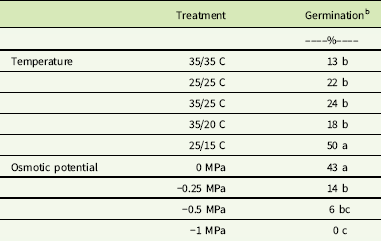
Medicago lupulina seed germination in response to fluctuating and constant day/night temperature and osmotic potential changes within petri dishes contained in incubators for 4 wk at Balm, FL, in 2016. a

a Values are least-square mean estimates. Different letter groupings between columns within a group indicate a significant difference using Tukey’s honest significant difference (α = 0.05).
b Data are expressed as a percentage of the total number of germinated seeds, with 25 seeds per petri dish.
Constant Temperature: High Range
The response of M. lupulina seed germination to the high-temperature range was strongly negative (Figure 1). Germination completely ceased at 40 C, so the upper limit to germination was between 35 and 40 C (Figure 1). The decline from the optimum temperature range (10 to 20 C) was similar to the low-temperature range study (Figure 2). Scarified M. lupulina seed germination was reduced from 88% at 20C to 61% at 30 C (Braul Reference Braul2004). This negative relationship between increasing high temperature and germination is likely a non-deep-temperature-mediated physiological dormancy (Van Assche and Vandelook Reference Van Assche and Vandelook2010). In Florida, M. lupulina is a winter annual and rarely observed in summer crops. Temperature-mediated M. lupulina combinational dormancy, long-term seed coat–meditated physical dormancy, and short-term high-temperature-mediated physiological dormancy may explain such observations.
Fluctuating Temperatures
There was a significant effect of temperature treatments on M. lupulina seed germination (P <0.0001). Maximal germination occurred for the 25/15 fluctuating temperature (Table 1). This treatment had an average temperature of 20 C, which corresponded to optimum germination at constant temperatures (Figure 2). Average daily temperatures at or above 25 C consistently reduced the percentage of germinating seed. With fresh, unscarified M. lupulina seed, no differences were measured between fluctuating 10/20C and constant 5, 10, 23, and 30 C, although maximal germination was only 4.3% (Van Assche et al. Reference Van Assche, Debucquoy and Rommens2003). Based on the temperatures evaluated, fluctuations do not appear to influence germination, and the mean daily temperature plays a dominant role. This contrasts with M. lupulina seed softening for dormancy release, which require fluctuating temperatures (Braul Reference Braul2004; Taylor Reference Taylor1981).
Osmotic Potential
There was as significant effect of the osmotic potential treatment (P <0.0001) on M. lupulina seed germination. Germination was greatest under 0 MPa (Table 1). Reducing the osmotic potential below −0.25 MPa nearly completely impeded M. lupulina seed germination. A similar germination response to changing osmotic potentials has been described for three perennial weed species: dandelion (Taraxacum officinale F. H. Wigg), perennial sowthistle (Sonchus arvensis L.), and curly dock (Rumex crispus L.) (Boyd and Van Acker Reference Boyd and Van Acker2004). Results were similar to a European population in which the base water potential was −0.6 MPa (Tribouillois et al. Reference Tribouillois, Dürr, Demilly, Wagner and Justes2016). This pattern was in contrast to annuals, which generally exhibit a greater percentage of germination at −0.5 MPa (Boyd and Van Acker Reference Boyd and Van Acker2004) and may be specifically related to Fabaceae, which have demonstrated similar results across several species (Tribouillois et al. Reference Tribouillois, Dürr, Demilly, Wagner and Justes2016). The hard seed coat is the primary factor for enforcing dormancy (Van Assche et al. Reference Van Assche, Debucquoy and Rommens2003), assuming other environmental factors are not limiting (temperature, burial); therefore, the ability of the seeds to imbibe water becomes the limiting factor.
Strawberry bed moisture is maintained near field capacity after formation until strawberry transplant, then followed by a period of overhead irrigation to relieve heat stress in the strawberry plants, with continued saturation of the beds (Reed et al. Reference Reed, Boyd, Wilson, Dittmar and Sharpe2018). Medicago lupulina may germinate as deeply as 2 cm (Sidhu and Cavers Reference Sidhu and Cavers1977). Unfortunately, the rate of drying and the season-long moisture profile are unknown for the M. lupulina recruitment zone in strawberry beds and require further study. Should the development of a hydrothermal M. lupulina seed emergence model be required, then the current findings and previous work (Tribouillois et al. Reference Tribouillois, Dürr, Demilly, Wagner and Justes2016) may aid further research linking actual in-bed soil water potential to seed germination and seedling emergence.
GDD Model
For GDD calculation, T base = 0 (Sharpe Reference Sharpe2017), T optimum = 20 (peak plateau edge; Figure 2), and T maximum = 40 (Figure 1). The base GDD equation (Equation 4) proved ineffective in accounting for M. lupulina germination above 20 C (Figure 3). Base GDD equations perform well under warming periods following an initial chilling period, but such does not occur in Florida. The germination period for M. lupulina is mid-November to mid-December (Sharpe Reference Sharpe2017) where temperatures typically decline as the growing season progresses (IFAS 2017).
Medicago lupulina germination as a function of accumulated growing degree days (GDDs) when exposed to fluctuating and constant temperatures between 5 and 40 C within incubators at Balm, FL, in 2016. Error bars represent standard error of the mean. GDDs were calculated by:
 $${\rm GDD}{\equals}\mathop \sum\limits_{i{\equals}1}^n (T_{{{\rm mean}}} {\minus}T_{{{\rm base}}} )$$
where T mean is the mean daily air temperature and T base is the lowest temperature at which germination does not occur, which was 0.

Above 20 C, germination was rapid, reached a maximum by the first measurement timing, and then subsequently plateaued (unpublished data). An early germination plateau resulted in ongoing GDD accounting and accumulation that failed to match germination. Furthermore, higher temperatures inhibited germination instead of promoting it (Figure 1). These situations resulted in an inflated GDD accumulation value, which demonstrated the limitations for the base equation. This necessitated introduction of germination-based restrictions to daily GDD accounting and additional application logic for their implementation to develop a single M. lupulina germination model applicable to Florida.
Implementation of a germination-based restriction to daily GDD accounting (Equation 5) using the derived determination logic performed reasonably well to align both cool- and heat-limited germination for description by a single equation (Figure 4). While the Weibull model
 ${\rm R}_{{{\rm adj}}}^{2} $
was not exceptional (0.5199) (Figure 4), this method for daily GDD accounting under three distinctly separate temperature trends proves promising. Such Weibull models are often used to predict cumulative field emergence of plants (Werle et al. Reference Werle, Sandell, Buhler, Hartzler and Lindquist2014; White et al. Reference White, Boyd and Van Acker2012). One limitation was the daily GDD accounting for M. lupulina germination at 25C. This temperature was a transition zone between optimal and heat-limited germination and demonstrated increased variability (Figures 1 and 4; Table 1).
Medicago lupulina germination as a function of accumulated growing degree days (GDDs) using determination logic and modified GDD formula when exposed to constant and fluctuating temperatures within incubators at Balm, FL, in 2016. The following logic dictated daily GDD accounting: (1) if 0 <T mean ≤ 20, then GDD = (T mean – T base), where T mean is daily mean air temperature; (2) if 20 <T mean < 40, then
 $${\rm GDD}{\equals}\mathop{\sum}\limits_{i{\equals}1}^n {{{(20)} \over {d\left( {{{T_{{mean}} } \over {40}}} \right)}}} $$
where d is the number of days in which GDDs have accumulated; or (3) if T mean ≥ 40, then GDD = 0.

Development of the germination-based restriction for daily GDD accounting satisfies the first milestone toward development and employment of a reductionist field-emergence predictive function for Florida strawberry production. Further study is necessary to develop additional restrictions based on dormancy and PRE growth. Medicago lupulina dormancy has been well studied (Braul Reference Braul2004; Van Assche et al. Reference Van Assche, Debucquoy and Rommens2003; van Assche and Vandelook Reference Van Assche and Vandelook2010), and a potential dormancy-based restriction could likely be derived from the literature. While some work has been done for M. lupulina emergence in response to burial (Sidhu and Cavers Reference Sidhu and Cavers1977; Van Assche et al. Reference Van Assche, Debucquoy and Rommens2003), additional experimentation examining temperature-controlled emergence would determine the influence and necessity of PRE growth–based restrictions for daily GDD accounting.
Overall, the peak optimal range for M. lupulina germination was between 10 and 20C. Temperatures above 20C inhibited M. lupulina germination in a curvilinear fashion, leading to complete cessation at 40C. Low temperatures (5 and 10C) reduced the rate of germination. Fluctuating temperatures did not influence M. lupulina germination. Medicago lupulina was sensitive to changes in osmotic potential, with reductions at −0.25 MPa and germination cessation at −0.5 MPa. The introduced germination-based daily GDD accounting and derived determination logic for its application did reasonably well to align cool- and heat-limited germination. The developed germination-based daily GDD accounting restriction represents an important milestone toward development of a predictive M. lupulina field-emergence model.
The feasibility of using accumulated GDDs as an environmental predictor for M. lupulina emergence to time clopyralid primarily suffered from a single limitation. This limitation was that accumulated GDDs did not adequately describe biological phenomena when the biofix date was above the optimum. An example of this is M. lupulina germination (Figure 3). With the development of GDD accounting restrictions, accumulated GDDs now have biological meaning in relation to progressive biological phenomena (such as germination) (Figure 4). Even so, germination is only one component of field emergence, and further study is required to determine the necessity of GDD accounting restrictions for dormancy and PRE growth. Once these components are developed, field emergence can be tested to develop predictive models. The recommended biofix date for GDD accumulation in plasticulture production is after holes are punched in the plastic mulch to transplant strawberry plants. This biofix date timing is desirable due to the observed absence of M. lupulina emergence during the summer months, lack of emergence through the plastic mulch, and an easy practical application for strawberry growers. Given the complexity of the resulting model, it is necessary to develop a web application using weather station data such as AgroClimate (Southeast Climate Consortium, Gainesville, FL, http://agroclimate.org). With this tool, strawberry growers can be alerted to the window of M. lupulina emergence to initiate scouting and coordinating clopyralid application to a susceptible growth stage.
Acknowledgments
No conflicts of interest have been declared. This research received no specific grant from any funding agency or the commercial or not-for-profit sectors.