The Problem
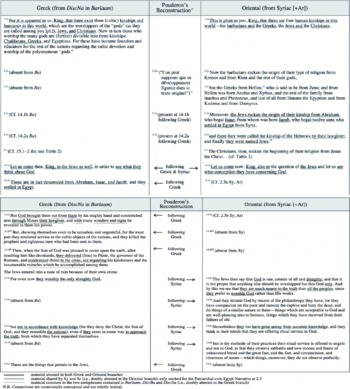
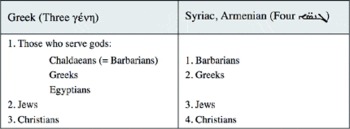
These fresh methodologies have enriched Apology scholarship, which had previously emphasized historical-critical issues. At the same time, recent studies of Apology's articulation of Christian and Jewish identities would benefit from reopening some thorny historical-critical questions. In particular, the literary shape of the earliest text of Apology and the subsequent transmission history of the text remain problematic. Key passages relative to Jewish-Christian relations (Apology 2.2–4; 14.1b–15.2) differ widely between Greek and Syriac versions of the text. And their respective evaluations of the Jews diverge just as widely. In the Greek version, for example, Jews are characterized as Christ-killers who are similar to “the nations,” having separated themselves from the truth. According to the Syriac version, on the other hand, Jews imitate God by their benefaction, worship one God unlike the nations, and have not strayed far from truth. Furthermore, we cannot at present say for certain what the basic classification scheme of Apology originally was. The Greek has a threefold, the Syriac a fourfold, division of human “kinships” (see 2.2a in Table 1).Footnote 4 Did Aristides compare Christians to Jews and polytheists, the latter encompassed by Chaldaeans, Greeks, and Egyptians (per Greek)? Or to Jews, barbarians, and Greeks (per Syriac)? Resolution of these and similar issues could provide additional avenues for analyzing Apology's literary construction of “Jewish” and “Christian” identities as well as the role Apology played in the discursive processes which shaped early Jewish-Christian relations.
On the Jewish  (Apology 2.2–4 and 14.1–4)

It is further of singular significance that the one scholar who has recently addressed the textual issues in greater detail, Bernard Pouderon, has produced a rather different, eclectic version of Apology 14 than heretofore posited (see middle column of Table 1). In a paper delivered at the International Conference on Patristic Studies in 1999, Pouderon argued for a reconstruction of the original text that included the entirety of Apology 14, as preserved partly in Greek (14.1–2) and partly in Syriac (14.3–4).Footnote 5 As such, Pouderon argues for the authenticity of the very negative evaluation of the Jews at 14.2b, in which Jews are portrayed as “senseless and ungrateful,” “rendering service to the cultic objects of the nations,” responsible for “killing the prophets and righteous men,” having “delivered Christ to Pilate,” and having “condemned him to the cross.” Pouderon's reconstruction pits Jewish and Christian communities in stark opposition,Footnote 6 an evaluation that hardly squares with the glowing plaudits of earlier scholars! Perhaps Apology's perspective on the Jews has been all too often mischaracterized.
Since Apology represents our earliest extant Christian work of the apologetic genre and has direct bearing on scholarly reconstructions of early Jewish-Christian relations,Footnote 7 it is of particular historical and religious significance to evaluate properly the development of the manuscript tradition from the primitive Apology onward. Furthermore, since Pouderon is the first to take up textual concerns in earnest since the scholarship of “the golden years” that immediately followed the publication of the editio princeps,Footnote 8 it is vital to revisit his theories on the text.
This article offers a fresh look at the ancient witnesses of this important text, critiques Pouderon's attempt to reconstruct a primitive text of Apology 14, builds on Pouderon's valuable contributions through comparative analysis of material in the “Egypt Narrative” (14.2a Ba; 2.3b Sy), and broadens the scope of investigation to include Apology 2.2–4 and 14.1b–15.2. It now appears most plausible to argue that a single major redaction is responsible for the current state of textual variation between the Greek and Syriac witnesses of Apology 2.2–4 and 14.1b–15.2. I suggest that this redaction happened in the Greek tradition and shaped the text in a direction that was highly unfavorable to the Jews. If this theory is correct, then the Syriac translation best preserves the structure of the most primitive Apology in these chapters as well as Aristides’ own surprisingly favorable attitude towards the Jews. It is my sincere hope that, by providing a firmer basis for the text of Apology 2.2–4 and 14.1b–15.2, this article will result in renewed attention being directed to these portions of Apology and to their value for early Jewish-Christian relations.
The Plan of Apology
The interpretive key to Apology surfaces in an early programmatic appeal. “Let us proceed to the human race,” the text urges, “so that we might perceive which among them participates in truth and which in error” (2.1b). On this procedural point both Syriac and Greek agree.Footnote 9Apology constructs an epistemic ethnography in which various human groupings are indexed according to their participation in “truth” or in “error.”
What the text intends by truth and by error is indicated from the brief transition that precedes the purpose claim: “Now that these things have been said about God . . . let us proceed to the human race” (2.1ab). Truth and error recall certain assertions about God from chapter 1, in which the apologist relates his own conversion to truth. Through a rational and emotive process of observation and scrutiny of the natural universe and its orderly arrangement, our apologist claims to have come to “comprehend” the authentic nature of God.Footnote 10 The true God is a supremely transcendent, rational being who is the efficient cause of the ordered universe and is without beginning, without end, immortal, perfect, incomprehensible, without limit, etc. (1.2a). The via negationis culminates in the assertion that this ineffable God has no need of sacrifice, libation, or anything in the sensible world, for the divine nature is entirely self-sufficient (1.2b).
Apology 2.1 stands Janus-faced. It invokes the apologist's claim in chapter 1 to “comprehend” the divine nature, and then it integrates that claim into a totalizing framework whose logic builds structurally on it. The apologist's individual discovery of the divine nature maps onto the plane of human collectivities, pars pro toto. In this way, knowledge of the divine nature (i.e., participation in truth) or lack thereof (i.e., participation in error) is framed as the single criterion against which human groupings are properly indexed. Herein is the plan of Apology. Apology 2.2–17.3 schematizes sameness and difference among various human communities ( ) based on their collective participation, or lack of participation, in right or wrong knowledge of the true God whose nature is spelled out in the first chapter.
Human collectivities are organized differently in the recensional evidence (2.2a). The Greek classifies the human “race” ( ) into a threefold schema of human “(cultic) kinships” (
 )—polytheists (encompassed by Chaldaean, Greek, and Egyptian ), Jews, and Christians. The Syriac version, alternatively, invokes a fourfold division of human “kinships” (
 )—barbarians and Greeks, Jews and Christians.Footnote 11 These different patterns should not at present distract us. For if we leave aside the status of Jews and Christians, all other “groups,” however classified, are found to be ignorant of God (chapters 3–13). Since they failed to acknowledge the clear indicators of a single God discoverable through the natural order of things, they came to participate in a social system founded upon many gods. They cannot worship the true God of Apology 1 in accordance with truth.
Next are the Jews: “Let us come, King, to the Jews, in order that we may see what they think about God” (14.1a). At this point Syriac and Greek depart markedly in their evaluation of Jewish knowledge of the one true God. In the Syriac, Jews participate in truth with some qualification in regard to ritual activity; in the Greek, Jews fully participate in error (see discussion below). Finally, Christians provide the paradigm of a human community that manifests in its worship and practice an accurate and authentic knowledge of the divine nature: “And these are the ones who more than all the nations of the earth have found the truth” (15.3 Ba; see Sy). The Christians offer the epistemic standard for all other nations on earth. The discursive logic of Apology makes an implicit appeal. If knowledge of God is the quintessential and universal human desideratum, then become a Christian. In that community, more than any other, you will participate in truth.
The State of the Text
We are fortunate to possess Apology in four textual traditionsFootnote 12—papyrological, Greek, Syriac, and Armenian—representing three distinct “geographic” recensions—Egyptian, Greek, and Oriental.Footnote 14 The two papyri ( ) that comprise the current texts of the “Egyptian” recension are lacunary. Since they do not contain chapters 2 and 14 and are only available for the latter part of chapter 15, the Egyptian recension provides no immediate benefit to this discussion.
The “Greek” recension is preserved in two metaphrases (Discourse of Barlaam [DiscBa] and Discourse of Nachor [DiscNa]) contained in a single medieval romance, The Lives of Barlaam and Joasaph (Ba).Footnote 15 Traditionally, the Greek text of Apology comprises the lengthier Discourse of Nachor with additional material added at 8.1 from the much shorter and fragmentary Discourse of Barlaam. The editor of Barlaam and Joasaph, not (as traditional) John of Damascus but Euthymius the Georgian,Footnote 16 adapted the copy of Apology at his disposal (i.e., text x) to fit it at two locations into the larger narrative of the Georgian Balivariani, a Christianized version of the story of Siddhatta Gotama's renunciation.Footnote 17 Euthymius did not craft the shorter Discourse of Barlaam by copying the longer Discourse of Nachor. Instead, he looked back to his exemplar of Apology. We catch a glimpse of this process at Apology 8.1, which is attested in Syriac and Discourse of Barlaam (and thus original to Apology) but not in Discourse of Nachor. The latter metaphrase could therefore not have served as source for the former metaphrase.Footnote 18 These metaphrases provide independent testimony to a single exemplar x.
The “Oriental” recension is preserved in extenso in a Syriac translation (Sy) and in an Armenian relative (Ar) available for chapter 2 but not 14 or 15. Both texts are similar enough in their shared portions to posit common heritage (e.g., they both contain an interpolation at 2.5 on the four elements), suggesting a shared Greek precursor (GrFootnote 3). Yet each of them contains material not present in the other that distinguishes them as independent witnesses.Footnote 19
We are therefore concerned with two recensional branches (Greek, Oriental) preserved primarily in an extensive Greek metaphrase (DiscNa) and a Syriac translation. These are supplemented by a shorter Greek metaphrase (DiscBa) and an Armenian translation.
Yet this relative wealth of manuscript evidence comes with a price, for the representations of the Jews in Greek and Syriac could hardly be wider apart, and the differences depend almost entirely on the shape of the text itself as preserved in the extant manuscript evidence. A glance at Tables 1, 2, and 3 demonstrates that nearly every difference between Greek and Oriental Apology 2.2–4 and 14.1b–15.2 is a major one. In the remainder of this article, I argue that the Syriac version best reflects the structure of this section of text as it appeared in Aristides’ original second-century Apology.Footnote 20
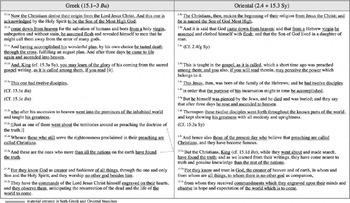
On the Christian  (Apology 15.1–3 Ba and 2.4 + 15.3 Sy)
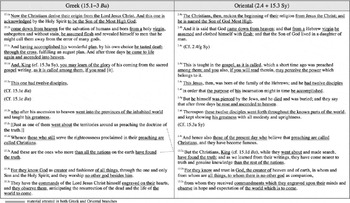
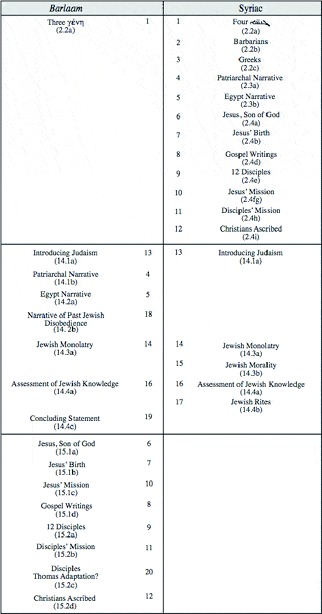
Order of Text Units in Apology 2.2–4 and 14.1–15.2

What Are They Saying about the Text of Apology?
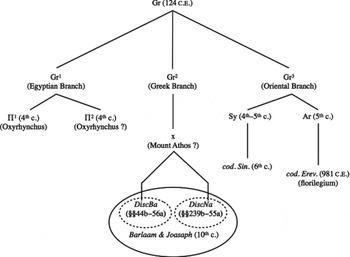
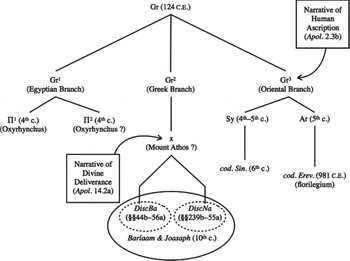
A generally-accepted eclectic edition of Apology has yet to be produced and will likely not be forthcoming barring new manuscript discoveries or the use of new analytic techniques for resolving long-standing issues. The scholarly editions and literature reflect a sense of confusion about how to reconstruct the original text, particularly the text of chapters 2 and 14.Footnote 25 The latest scholar to address the issue seriously is Bernard Pouderon, and his reconstruction offers important advances on previous work. Pouderon makes three primary contributions. First, in his Sources chrétiennes edition, he discusses each textual witness in detail and crafts a stemma, which I have translated and adapted for illustrative purposes in Figure 1 above. His rigorous work (in collaboration with Marie-Joseph Pierre and Bernard Outtier) in constructing this stemma has placed us in his debt and has finally opened up possibilities for solutions to long-debated textual difficulties. Pouderon is also the first to directly compare material from the shorter Discourse of Barlaam with material from the longer Discourse of Nachor and to establish that these represent discrete, independent witnesses to text x, the Greek text of Apology that lay before the Barlaam editor. Finally, he demonstrates that the negatively-charged evaluation of the Jews in 14.2b was present in text x, since it is attested in both metaphrases.
Stemma for Apology Footnote 13

Yet I believe Pouderon makes an unnecessary deduction when he claims that exemplar x “can be none other than the original Apology.”Footnote 26 If this were the case, primitive Apology would have described the Jews with great vitriol, since it contained 14.2b. Juxtaposed with these fulminations, Pouderon's reconstruction follows Syriac at 14.3 and claims that the Jews are “much nearer to the truth than all the peoples,” “they imitate God,” “have compassion on the poor,” and “do things . . . acceptable to God and . . . well-pleasing also to humans.” His conclusion that the text is “strongly contrastive, yet entirely coherent” appears to me to understate the internal tensions that mark his proposed text.Footnote 27 These tensions call into question, if not the plausibility of his entire proposal of conflating Greek and Syriac witnesses, then at least his assumption that Euthymius's exemplar reflects the primitive Apology at 14.2b.
A Refined Approach
Pouderon's close analysis of the two metaphrases represents a leap forward in textual studies of Apology, since he is first to directly compare their shared material. He is thus to be commended. His reconstruction, however, does not offer the simplest explanation for the present variation in Apology manuscripts. Let us assume that Pouderon's reconstruction matches the primitive Apology, that is, that the middle column of Table 1 resembles what Apology originally looked like. To arrive at the current form of Syriac and Greek texts would have necessitated major structural changes to Apology in both Oriental and Greek traditions. Moving from the middle to the left column, we see that the Greek would have greatly reduced the length of 14.3a and dropped 14.3b and 4b. On the other side of the chart, the Oriental tradition would have excised 14.2b, and shifted 14.1b and 2a to chapter 2. Such a double-stream of significant, independent modifications of primitive Apology across two stemmatic branches is highly unlikely.Footnote 28
Re-Narrating the History of the Jews (Apology 14.1b–2b Ba // 2.3 Sy)
Pouderon's identification of text x with original Apology is an unnecessary assumption, and it overlooks the broad implications of a unit of text that I designate the “Egypt Narrative,” a very brief passage in Apology that recounts a story about the Jews in Egypt. The Egypt Narrative appears at 14.2a in the Greek and finds its parallel in 2.3b of Syriac and Armenian translations (Table 3, no. 5). Although displaced, there is no doubt these units of text are parallel. For in both Greek and Oriental branches, the Egypt Narrative occurs in a verse unit preceded by reference to a passage which I call the Patriarchal Narrative (Table 3, no. 4). This Patriarchal Narrative in both branches recounts the Jewish genealogy from the patriarchs and refers to the settling of the Jews in Egypt.
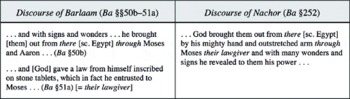
What is perhaps more surprising than the dislocation of these two narratives between chapters 2 and 14 is the different versions of the Egypt story that Greek and Oriental recensions recount. The story of the Jews in Egypt is so different in the recensions that only two phrases are shared between them—the words “there” and “through/by their lawgiver.” A comparison of these diminutive phrases proves enlightening.
First, it is clear from the independent Greek metaphrases (Table 4) that our phrases of interest were present in Euthymius's copy of Apology (text x). Comparing shared material we see a similar narrative context in the witnesses of the Greek recension. God brought the Jews out from Egypt with signs and wonders by the secondary agency of Moses, their lawgiver. In both texts, “there” and “through their lawgiver” are sandwiched in a narrative of divine deliverance of the Jews from Egypt.Footnote 29 The emphasis of exemplar x rests on the activity of God in the key event of early Jewish narrative history, the exodus from Egypt.
Greek Tradition of the Egypt Narrative (Apol. 14.2a)
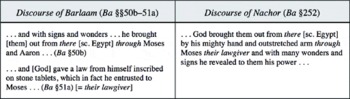
The parallel passage in the Oriental texts has a different emphasis, as Syriac and Armenian texts make no reference to divine activity. Rather, they independently paint a less theologically-charged, kinship portrait of Jewish history focused on the naming of the Hebrews in Egypt by their lawgiver.
From following these two miniscule phrases—“there” and “through/by their lawgiver”—across four textual witnesses, we see in Figure 2 that Euthymius's Vorlage x had a narrative of divine deliverance from Egypt in chapter 14, while the precursor to both Syriac and Armenian translations (i.e., Gr3) had a narrative in chapter 2 of the Hebrew lawgiver ascribing the name of “Hebrews” to his people in Egypt. This allows us to reach two very important conclusions: both a major transposition of material between Apology chapters 2 and 14 and an emendation that altered the descriptive framework of the Egypt Narrative have already occurred at Gr2 (i.e., prior to Euthymius and his text x)Footnote 30 or Gr3 in our stemma.
Recensional Witnesses for the Egypt Narrative

It is simplest to understand these shifts in the Egypt Narrative as having occurred at the hand of a single redactor. Two options are available. Either an editor in the Oriental tradition altered an original narrative of divine deliverance from Egypt and moved the Egypt Narrative from chapter 14 to chapter 2. Or, an editor of the Greek tradition altered an original narrative of Mosaic ascription and moved the Egypt Narrative from chapter 2 to chapter 14.
I add two other critical observations. First, the Egypt Narrative is closely joined with the Patriarchal Narrative in Greek and Oriental traditions (Table 3, no. 4). Our redactor must surely have shifted them as a unit. Second, the Egypt-cum-Patriarchal material (Table 3, nos. 4–5) is further integrated with a fulmination against the Jews at 14.2b in both witnesses of the Greek recension (DiscNa; DiscBa). We may call the diatribe at 14.2b the “Narrative of Past Jewish Dis-obedience” (Table 3, no. 18), for it implicates ancient (14.2bα) and first-century (14.2bβ) manifestations of the Jewish in rejection of God's agents. Taken together, 14.1b–2b inscribes the Jewish story through a Christian lens, crafting a sequential progression from the patriarchs through the exodus to patterns of idolatry and disobedience that culminate in Christicide and consignment to divine judgment.Footnote 31 There is, however, no comparable (i.e., parallel) upbraiding of the Jews at all in the Oriental witnesses. We should therefore consider 14.1b, 14.2a, and 14.2b to be the product of a single redactional effort. Whoever edited the Egypt-cum-Patriarchal Narratives also simultaneously added the Narrative of Past Jewish Disobedience (if a Greek editor) or expunged this fulmination against Jewish behavior (if an Oriental editor). And the person who accomplished this editing must have displaced the unit on the Jews (14.1b–2b Ba; 2.3ab Sy, Ar) from an original location in chapter 2 to chapter 14, or vice versa.
Shifting the Christians (Apology 15.1–2 Ba // 2.4 Sy)
This conclusion finds support in another notable piece of evidence. Scholars have proceeded to reconstruct the text of chapters 2 and 14 in piecemeal fashion, culling individual verses or units of text at will. Material from chapter 15 is often sidelined when discussing textual issues in chapters 2 and 14. This pick-and-choose, case-by-case approach is misguided, for the transposition of material that affected chapters 2 and 14 also involved material from 15.1–2 on the Christians.Footnote 32 By comparing shared material in 15.1–2 (Greek) and 2.4 (Oriental), we see that here again an entire block of text has been shifted, this time from chapter 2 to 15, or vice versa (Table 3, nos. 6–12). When we come to 15.3, however, Greek and Oriental recensions return to sequential, parallel order (see Table 2). The simplest explanation for all these observations is to propose that a single effort produced a transposition of texts across chapters 2.3–4 and chapters 14.1b–2b, 15.1–2. I proceed on the assumption that the individual who effected this transposition is none other than the very editor who transposed the narratives of earlier Jewish history (Table 3, nos. 4–5), who altered the descriptive framework of the Egypt Narrative, and who added/removed the Narrative of Past Jewish Disobedience (no. 18). The editorial process involved both a restructuring of Apology and a reshaping of its argument.
Contextualizing Contemporary Jewry (Apology 14.3–4)
Since this redaction covered a broad swath of material in 14.1b–2b and 15.1–2, the intervening text at 14.3–4b (Table 3, nos. 14–17) would not have been overlooked in the process.Footnote 33 Like the Egypt Narrative, this material was also subjected to an invasive editorial process, though it was not transposed. For the shaping of 14.3–4 is quite distinctive in the different manuscript recensions. Syriac 14.3–4 provides a more expansive commentary on the Jews than does the Greek, and it makes fundamentally different claims about the quality and character of Jewish “knowledge” and praxis than the Greek. It is hardly controversial, then, to suggest that this textual unit suffered a qualitative reduction or expansion that reshaped the image of the Jews at some point(s) in the transmission history of Apology.
The issue at hand is whether the editorial change(s) that affected 14.3–4 would have accompanied the displacements and alterations that we have shown reshaped 2.3–4, 14.1b–2b, and 15.1–2. There is in fact strong evidence internal to the texts which suggests that the fate of 14.3–4 was intimately bound up in the same major emendation that affected the Egypt Narrative. To explore this issue, we need to locate 14.3–4 within the discursive plan of Apology. As a textual unit, 14.3–4 occupies a distinctive position in the text. It is the locus of Apology's evaluation of contemporary Jewish knowledge of God and hence indexes their present participation in truth or error. And yet the evaluations of Jewish knowledge in Greek and Syriac differ markedly.
Apology 14.3–4 in Greek
According to 14.3–4 of the Greek text, the Jews follow an ancient tradition in worshipping the only Almighty God.Footnote 34 While this distinguishes them from the “ones who worship many gods” of chapters 3–13 (2.2a Ba), the Greek in no way condones the Jewish cult. Instead it offers an immediate riposte ( ) to this initial concession (14.4a). Jews do not, in fact, worship the one only God in a manner consistent with knowledge.Footnote 35 Despite perceptions that Jewish monolatry approaches truth, the character of their cultic system is quite unsubstantial. The point is driven home by the accumulation of lexical qualifiers—“even if they seem in some way to approach the truth”Footnote 36—that distance Jewish monolatrous practice from the truth. The final clause confirms that Jews themselves are complicit in this state of affairs, since they have actively “separated themselves from the truth.”Footnote 37 In the single area where Jews have distinguished themselves from the nations—exclusive cult to the one God—they nevertheless participate in error.
On what basis does the text make such a prohibitive claim? In chapter 1, the apologist was shown to participate in truth because he had uncovered the knowledge of the divine nature as made generally accessible through the witness of the natural world. After the methodological shift of 2.1, the controlling concern of Apology becomes whether the mode of life within a resonates with the genuine nature of the divine as attested by the created order. Yet the Greek's negative evaluation that Jews participate in error is groundedFootnote 38 not in naturally-accessible knowledge but in what turns out to be Christian theological claims available only through specifically revelatory means. Jewish exclusivist monolatry is confessionally deficient (“they deny the Christ, the Son of God”) and morally defunct (they “behave like the nations” as did their ancestors). Christian kergyma and scriptural readings proscribe contemporary Jewry from knowledge of God.Footnote 39 The character and assessment of “knowledge” has shifted from natural revelation (ch. 1) to special revelatory forms.
Despite the broader epistemic shift, the condemnatory verdict of contemporary Jews fits seamlessly within the narrative of chapter 14.1–2, which assails ancient and more recent expressions of the Jewish . The Greek text begins by introducing the Patriarchal Narrative (14.1b) and Egypt Narrative of divine deliverance through the agency of Moses (14.2a). Following the powerful acts of divine mercy in the exodus, the entire Jewish community as a matter of course ( ) proved themselves to be dull and ungrateful. They descended into idolatry and murdered the prophets and righteous men. Their sordid history and implacable insubordination culminated in the condemnation of the Son of God himself (14.2b); Roman culpability in Christicide is entirely excluded.Footnote 40 As their ancestors had spurned the “portents,” “signs,” and “power” of the God who delivered them from Egypt, so more recent generations have disregarded the kindnesses of his Son. For the sum of this disobedience, the people who had long ago received the law from Moses “entered into a state of ruin because of their own crime.”Footnote 41 This Narrative of Past Jewish Disobedience consigns the entire Jewish kinship of ancient and first-century Judaism to idolatry and recidivism. Contemporary Jewry of 14.3–4 only mimics its ancestors—ancient and more recent—in behaving like the nations (14.2bα) and in the rejection of God's Son (14.2bβ) in the face of God's gracious act of deliverance from Egypt (14.2a).
The picture from the Greek text is clear. The story of the Jews is one of long, dark recidivism into cultic idolatry, syncretism with the nations, and unmitigated betrayal of God's Son. Contemporary Jews are simply the modern counterparts of their ancient co-religionists, having inherited both an immoral and an irreligious pedigree. Ethically, they live like the nations, and though there is no explicit mention of idolatry among contemporary Jews, their rejection of the divine Son of the one God has invalidated their brand of exclusivist monolatry. They “have separated themselves from the truth.” The evaluation of the Jews in the Disobedience Narrative at 14.2b closely supports this epistemic assessment and is wholly consistent with the image of the Jews projected in the Greek tradition of Apology 14.3–4.
Apology 14.3–4 in Syriac
The Syriac of 14.3–4 is much more accommodating in its assessment of contemporary Jewry. In fact, the Syriac text does not envision an evaluation of the “knowledge” of the ancient Jewish kinship ( ) but only of the contemporary one. The text lauds as markers of contemporary Jewish identity the ideals of monotheistic confession and monolatrous practice.Footnote 42 Unlike barbarians and Greeks, Jews recognize the ordered structure in the universe as reflective of the divine nature. They identify God as maker of all things and understand that devotion belongs to that one God alone, rather than to his works. This explains why “they are much nearer to the truth than all the peoples” (14.3a).Footnote 43 This concept is altogether absent from the Greek text, in which the Jewish people have excised themselves entirely from the truth. Jewish participation in truth is instantiated in a corporate mimetic ethic that was received “from their fathers of old” (14.3b). Jews “imitate God” by their beneficence and compassion towards humanity, things which are “acceptable to God” and “well-pleasing also to humans.”Footnote 44 They provide for the poor, ransom the captive, bury the dead, and other like acts. Syriac evinces a favorable commentary on Jewish morality that is entirely unparalleled in the Greek tradition.
The element of continuity with Christianity is unmistakable, as the particularities of Christian ethics presented in 15.4–9 are parallel to and modeled upon the lineaments of Jewish ethics in 14.3b.Footnote 45 And despite the fact that Christian moral tradition has received its sanction from a different authority, the Messiah (15.8), there is a strong continuity, since the Messiah himself was previously established as a member of the Hebrews (2.4e) who had thereby inherited ethical values from the Hebrew lawgiver (2.3ab Sy). The ethical continuity of Judaism with Christianity is a fortiori strengthened considering that, for Aristides, issues of morality occupy a much more significant portion of his description of Christianity than does theology.Footnote 46
In the Syriac of Apology 14, Jewish monotheistic belief and ethical practice prove powerful elements of continuity with the Christian kinship. To this extent contemporary Jews are adopted as co-religionists, or rather, co-participants in truth. Yet Jewish participation in truth is qualified (i.e.,  ) as only partial and incomplete (14.4a). In matters of cultic practice they have in fact “gone astray from accurate knowledge” (14.4a).Footnote 47 The Jews have not, as in the Greek tradition, “separated themselves from the truth,” but rather they have inadvertently erred in the methods of their cultic praxis. Their intentions are admirable—“they think in their minds (
 ) that they are offering ritual service to God” (14.4a). Yet in ritual performance they actually direct their service to angelic beings (14.4b). The textual logic seems to indicate that the Jews recognize that God alone is to be worshipped and not his works (14.3a). And this is the very thing that they intend to do in their worship (14.3a, 4a), as they enact it in the rituals of Torah—“the methods of their practices” (14.4b). Yet Torah itself, as a system of ritual, enslaves the Jews and channels their devotion to angelic beings subordinate to the true God. Still we are not informed precisely as to how the observance of time-honored Jewish religious institutions such as sabbaths, feasts, festivals, fasts, circumcision, and dietary laws is related to the practice of angel veneration.Footnote 48 The text simply adds that the Jews do not even observe these ritual obligations “perfectly” (14.4ab). The restrictions of 14.4 place a check on the unqualified approbation of Jewish monotheistic confession in 14.3 and serve further to offer a key distinguishing identity marker between Jews and Christians.Footnote 49 The Syriac is significantly more explicit in its approbation of much contemporary Jewish piety than is the Greek tradition. The Jewish criminal pedigree of 14.2b Ba finds an entirely antithetical counterpart in 14.3 Sy with its rather positive evaluation of Jewish monotheistic ideals and ethics, although the Syriac demurs from painting an entirely glowing picture of contemporary Jewish ritual practice (14.4).
The Syriac text offers only a neutral voice when it speaks of the ancient Hebrews and their patriarchs (2.3ab), and strikingly it links Jesus’ own birth to the Hebrew “family” ( ; 2.4e). A single passing claim, profound though it may be, offers comparable material to 14.2b of the Greek. The highly stylized confession of 2.4g that Jesus was “pierced by the Jews” surfaces in a fragment of received tradition—born of a Hebrew virgin (2.4b), born of the Hebrew family (2.4e), pierced, died, buried, risen after three days, and ascended to heaven (2.4g)—and bears strong linguistic resonance with the text of Zech 12:10.Footnote 50 This passage must be read sensitively in its present literary setting, which is in a section epitomizing the Christian . It is thus not directly linked with the evaluation of Jewish “knowledge” of God proper in chapter 14. In its textual location it speaks more to the place of creedal formulae and early kerygma in the ancient church than to a programmatic and purposive, epistemic evaluation of the Jews, qua .Footnote 51 The confessional character and literary setting of this brief statement attenuate its value as a specifically anti-Jewish claim. In light of the Syriac's generally positive evaluation of the Jewish ethic and approach to truth in chapter 14 and in light of these literary observations, it is preferable to seek another explanation for the function of the Jewish “piercing” of Jesus. I suggest that the claim more potently serves to root Christian cultural genesis in ancient Hebrew scripture and kinship. From the Hebrew family was born a divine Son (2.4be Sy, Ar), whose prophesied rejection—“piercing”—becomes the basis for the text to differentiate fraternal Hebrew subgroups. Jews constitute those Hebrews who reject this divine Son. Christians, too, are Hebrews, affiliated as a different strand of that ancient cultural kinship through reception of Jesus.
Comparative Summary
We have now observed that in the Greek recension, Jews do not participate in truth. The highly negative evaluation of Jewish knowledge at 14.3–4 Ba is deeply integrated with the Narrative of Past Jewish Disobedience (14.2b Ba) found only in the Greek tradition, and these passages work in synergy to consign the Jewish community, past and present, to ignorance of the true God. We have also seen the Syriac's rather glowing appraisal of the Jewish as “much nearer to the truth than all the peoples” (14.3a). In place of a Narrative of Past Jewish Disobedience that condemns the ancient (14.2bα Ba) and near-contemporary (14.2bβ Ba) Jewish , the Syriac offers no condemnation of the former and makes no mention of the latter. Rather, the text inscribes the founding father of the Christian , Jesus, into the lineage of ancient Hebrew patriarchs (2.3ab, 4e). The Syriac further lauds the monotheistic ideal and monolatrous practice of contemporary Jews—“they prefer to worship God rather than His works”—and eulogizes their God-pleasing ethic. It demurs from an entirely positive evaluation by offering a single, broad-brushed qualification. Despite their best intentions, contemporary monolatrous Jews channel their cultic energies to traditional feasts, festivals, and ritual and dietary requirements, which amounts to a “service to angels” (14.4). Though enigmatic, this qualification aligns with the entire narrative framework. Without it, the presentation of the Jews would be wholly favorable. The claim that “they have gone astray from accurate knowledge” leaves room for Christian distinctiveness (chapters 15–17).
An Eclectic Text of Apology 14?
It is clear that a qualitative alteration and structural change reshaped 14.3–4 in either the Greek or Oriental recension in a way that altered the image and character of the knowledge of God among contemporary Jewry. It is also evident that 14.3–4 was edited as a coherent unit of thought. For all their differences, the claim(s) at 14.3 is intimately tied with the respective evaluation at 14.4 in each recension. The link is both structural and logical,Footnote 52 since in both recensions the latter offers some contrasting qualification to the claim(s) at 14.3. In Syriac, Jewish monolatrous practice (14.3a), which generates a mimetic ethic (14.3b), is compromised by the Jews’ commitment to Torah-based ritual practices that implicate them in angel devotion (14.4); they are thus one step removed from wholesale participation “in accurate knowledge.” In Greek, Jewish monolatrous practice (14.3a) is entirely disqualified from “knowledge” because of the highly intentional character of the Jewish rejection of God's Son and involvement in immorality (14.4a).
Would the editorial change(s) that affected 14.3–4 have accompanied the displacements and alterations that, as we have already demonstrated, reshaped 2.3–4, 14.1b–2b, and 15.1–2? We may answer by asking a related question. Can we imagine that the Narrative of Past Jewish Disobedience (14.2b Ba) that presently offers seamless support to the Greek's negative evaluation of contemporary Jewry (14.3–4 Ba) could ever have coexisted with the positive evaluation of the Jews at 14.3–4 offered by the Syriac text, either in the primitive Apology (as Pouderon suggests) or at an intermediate stage of transmission? Could an eclectic text of Apology have spoken of the senseless, ungrateful, idolatrous, homicidal Jews of antiquity and recent history (14.2b Ba) only to commend contemporary Jews for their God-pleasing ethic and proper confessions about God as “much nearer to the truth than all the peoples” (14.3 Sy)? I must answer with a firm negative.
The internal juxtapositions between a favorable analysis of contemporary Jewish morality and confession (14.3 Sy) and a Narrative of Past Jewish Disobedience and blatant rebellion against God (14.2b Ba) would have been far too severe to have produced an internally coherent text.Footnote 53 The invective of 14.2b Ba that highlights the comprehensive moral depravity of antique and recent manifestations of the Jewish , particularly in relation to the murder of God's righteous messengers and his Son, is in my opinion irreconcilable with the eulogy of contemporary Jewish beneficence and philanthropy ( ) pictured in 14.3b Sy.Footnote 54 The editorial process that reshaped the evaluation of Jewish knowledge at 14.3–4 was necessarily bound to the removal or addition of the Narrative of Past Jewish Disobedience at 14.2b. If 14.2b was added by a Greek editor, it was accompanied by alterations to 14.3–4. If 14.2b was removed by an Oriental editor, it was accompanied by alterations to 14.3–4. There is good reason why these two texts do not presently coexist in some eclectic format in our manuscript traditions. They never did because they never could!
This comparative literary approach indicates quite simply that 14.3–4 would have been caught up within the very editorial process that interposed or excised 14.2b, which in turn was involved in the broader emendation of 2.3–4 and 14.1b–15.2. It is no longer preferable to envision a series of small incremental shifts by multiple hands as responsible for the major transpositions of material reflected in our present textual witnesses at 2.3–4 and 14.1b–15.2. We need a systemic solution that envisions a single editor transposing and altering an entire block of text. This is the simplest solution to the present state of textual disparity in these sections of Apology.
“It's All Greek to Me”
There is compelling evidence to suggest that the emendation of chapters 2, 14, and 15 occurred within the Greek branch in a way that reinscribed the Jewish in a decidedly negative direction. A consideration of the classification patterns of Apology 2.2a (Table 6) confirms this claim, for the fourfold kinship pattern of the Syriac is almost certainly more primitive than the threefold pattern of the Greek.
Oriental Tradition of the Egypt Narrative (Apol. 2.3b)

Classification Patterns Set Forth in Apology 2.2a

The argument on behalf of the primacy of the fourfold structure of Syriac is twofold.Footnote 55 First, somewhere in the chain of transmission, the terms “barbarians” and “Chaldaeans” were interchanged as formal equivalents. Pouderon compares these terms across the versional witnesses and concludes that “barbarians” in Syriac always corresponds to “Chaldaeans” in Barlaam.Footnote 56 Further examination of the nomenclature through the entire Barlaam romance reveals that  never occurs elsewhere, while
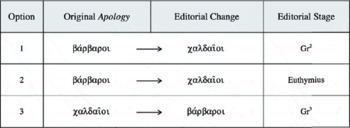
 figures three additional times.Footnote 57 Three options are available to explain this evidence (Table 7).
Options for Editorial Change in Apology 2.2a

1) Original was changed by an unknown editor at stage Gr2 such that Euthymius's exemplar of Apology (text x) already spoke of , Greeks, and Egyptians. When Euthymius adapted his copy of Apology and placed it in the Barlaam romance, he retained the language of “Chaldaeans” and even allowed this to shape additional references to “Chaldaeans” within his wider novel. 2) Euthymius's exemplar of Apology (text x) followed the primitive Apology in reading . When Euthymius adapted text x and inserted it in the Barlaam romance, he altered every reference of to to fit the classification scheme of Apology into some sweeping editorial plan for Barlaam. 3) The Oriental precursor to Syriac and Armenian, text Gr3, read “barbarians” because an editor in the Oriental tradition had already effected a shift from an original “Chaldaeans.” The second option appears likely when we consider the editorial needs of Euthymius, for “barbarians” would have been quite “out of place in an Indian court,” that is, the literary setting of Barlaam.Footnote 58 At any rate, it is unnecessary to resolve this problem. For purposes of comparing classification patterns, we need only note the formal equivalence of “barbarians” and “Chaldaeans.”
Once we recognize this equivalence it becomes quite easy to establish the primacy of the Syriac on the basis of larger macro-structural issues. For only the barbarians,Footnote 59 Greeks,Footnote 60 Jews,Footnote 61 and ChristiansFootnote 62 receive a corresponding genealogy in one or the other version of Apology. A fictive ancestry for barbarian, Greek, Jewish, and Christian kinships finds discrete mention in chapter 2 of the Syriac (and Armenian). The absence of any independent corresponding Egyptian genealogy in either Syriac or Greek argues strongly against its original inclusion within the overall program of Apology as stated in the plan of 2.2a. It is difficult to explain why a later Oriental editor would have taken a tripartite prologue that included Egyptians as a distinct (as in Barlaam) and then added a discrete genealogy for barbarians and Greeks but not for Egyptians (see 2.2bc Sy).Footnote 63 On the other hand it is relatively easy to explain how a later Greek editor would have altered an initial fourfold classification plan to fit more closely with his perception of the overall structure of Apology, since Egyptian piety finds exposition in chapter 12. The Greek editor would have shifted Christian and Jewish genealogies initially in Apology 2.3–4 to their respective locations later in the work (14.1b–2b; 15.1–2). The lack of corresponding genealogy for barbarians and Greeks in Barlaam (Table 3, nos. 2–3) suggests further that these were deleted while Egyptians were added to the prologue (Table 3, no. 1) alongside barbarians/Chaldaeans and Greeks in an effort to conform with the commentary on the Egyptians in chapter 12.
We see from this that the classification scheme of 2.2a is intimately implicated in the changes that affected 2.2b–4. It would have been highly unlikely for an editor to alter the classification pattern of 2.2a without simultaneously reshaping the genealogies at 2.2b–4 (if a Greek editor) or 14.1b and 15.1–2 (if an Oriental editor). If, as I suggest, the Syriac tradition reflects the more original structure at 2.2a, then the Greek tradition subsequently edited that primitive classification scheme, which in turn is closely aligned with the shape of 2.3–4 and 14.1b–15.2. All these changes were foisted on Apology within the Greek tradition in a single concerted effort.
We should no longer implicate the editor of Barlaam as the individual responsible for major structural transpositions or qualitative transformations of this or that passage in Apology 2.2–4 and 14.1b–15.2.Footnote 64 The emendation and transposition must have taken place prior to the copy of Apology that Euthymius inserted into Barlaam. For we have seen that Discourse of Barlaam and Discourse of Nachor both attest to the fact that text x already demonstrated a very different version of the Egypt Narrative from the Oriental witnesses. Both metaphrases also attest to the presence of the Patriarchal Narrative and Narrative of Past Jewish Disobedience in association with the Egypt Narrative. So all of 14.1b–2b was present in text x. Euthymius may have been responsible for changing “barbarians” to “Chaldaeans” and for other minor alterations in these chapters.Footnote 65 Yet the evidence no longer substantiates the assertion that he foisted a major redactional restructuring on his Vorlage at 2.2–4 and 14.1b–15.2 when he produced Discourse of Nachor.Footnote 66 He did not fundamentally alter the tenor of his Vorlage in these passages. On the contrary, Euthymius shows a remarkable faithfulness to his exemplar x in this material.
When It All Took Place
This process of structural change reflects the work of a single hand. The alteration of the number of human  and their fictive kinships at 2.2–4 was concomitant with the anti-Jewish interpolations at 14.1b–15.2. Nothing prevents these emendations from having occurred at an early stage in the transmission process. There is strong precedent in other early Christian literature for a threefold classification scheme of Jews, Christians, and a third “other” (usually Greeks),Footnote 67 such that transition in the Greek tradition to a tripartite strategy is conceivable as early as the second century. The tenth century provides the terminus ad quem. At that time, the major editorial changes were already present in Euthymius's copy of Apology, which he used to craft the Barlaam romance. The Georgian Martyrdom of Saint Eustace of Mtskheta (ca. 570 c.e.) may provide evidence of a sixth-century or earlier alteration of Apology, since Martyrdom evinces a threefold ethnic pattern—Persians, Hebrews, Christians—in seeming dependence on a copy of Apology.Footnote 68 However, this connection remains insecure,Footnote 69 and until a more specific determination of dependency between Martyrdom and Apology can be secured, the tenth century remains the most certain terminal date. The edit took place between the mid-second and tenth centuries. It is difficult to further delimit this editorial timeframe with certainty, yet absence of the claim to Jewish angel devotion in the Greek tradition (Table 3, no. 17) may provide some indication of a (tentative) date in the third to fifth centuries (see below).
Summary
Thanks to the detailed work of Bernard Pouderon in constructing a stemma for Aristides’ Apology and establishing the metaphrases of Barlaam as independent witnesses, we now have the tools to unlock a vital textual difficulty that has plagued Apology research for over a century. The Egypt Narrative provides the key that opens the door. It allows us to examine across four independent witnesses (DiscBa; DiscNa; Sy; Ar) a single passage from the jumbled manuscript evidence of Apology on the Jewish . The evidence reveals that at some point in Apology's transmission the descriptive framework of the Egypt Narrative was altered in concert with a major transposition of material between chapters 2 and 14. Text by text we worked outward to unravel the skein, until we discovered that the simplest solution to the present textual disparity was to envision a major editorial process that transformed the entire character and shape of 2.2–4 and 14.1b–15.2. The Syriac tradition appears to retain the original classification scheme of Apology at 2.2a. By extension it also preserves the original structure of Apology 2.2–4 and 14.1b–15.2 and Aristides’ own favorable attitude towards the Jewish . The major editorial reworking of Apology occurred in the Greek tradition in a way that reinscribed the Jewish in a highly negative direction. For the first time we now see the sorry tale of an intentionally reworked Jewish in Apology. Sometime between the mid-second and tenth centuries, a single hand unilaterally altered the structure of Apology 2.2–4 and 14.1b–15.2 and reevaluated the nature of Jewish participation in the “knowledge” of God in a direction highly unfavorable to the Jews.
One Additional Avenue
Near the beginning of the article I suggested that resolution of this textual problem could provide additional avenues for further historical and literary analysis of Apology with respect to Jewish-Christian relations. In concluding, I would like to substantiate this claim with an example of one such avenue by taking a very preliminary sounding in the reception of a theme from Apology 14 Syriac that is not found in Greek Apology. Specifically, absence of the topos of Jewish angel devotion in the Greek tradition (Table 3, no. 17) is conspicuous, and it raises the question as to why and when a Greek editor would have subsequently removed reference to it when such a theme would ostensibly have served to advance the negative, anti-Jewish evaluation that his own edits were designed to effect. An answer to this question might help to refine current models for describing the social processes that brought about “Jewish” and “Christian” differentiation in the Roman Empire.Footnote 70
The claim that Jews devote themselves to angels is certainly authentic to Apology. I have already traced the internal consistency of this assertion within chapter 14 of the Syriac. The accusation also has the advantage of contextual authenticity, for it resonates with another early second-century Christian text that accuses Jews of angel devotion, Kerygma Petrou.Footnote 71Kergyma embarks on a classification stra-tegy that indexes human groups according to their “knowledge” of the one God, who is described in a way that is conspicuously similar to the nature of the deity outlined in Apology 1. According to Kerygma, Christians worship God “in a new manner” ( ), in a third way (
 ) alongside Greek and Jewish ritual modes. The text admonishes avoidance of Greek and Jewish forms of worship and is unyielding in its description of Jewish practice:
And do not worship in the manner of the Jews. For those people, while supposing that they alone know God, do not have knowledge [of this God], since they render cultic service to angelsFootnote 72 and archangels, to month and moon. And soFootnote 73 if the moon does not appear they do not observe the sabbath called “First,” and neither do they observe the new moon, nor the Festival of Unleavened Bread, nor the Festival [of Booths?], nor the Great Day [of Atonement].Footnote 74
Kergyma aligns “service to angels” with the keeping of Jewish festivals that in turn depends on lunar cycles. This triumvirate sustains a unified cultic system opposed to the “third [i.e., Christian] way” of worship. Structural similarities with Apology have suggested to some a relationship of dependence between these texts.Footnote 75 Such claims remain uncertain. More importantly for the argument at hand is the fact that Kerygma and Apology inhabit a shared discursive space which privileges a topos that situates Jews in a ritual system administered by and/or directed to angels.
The presence of this claim in two early second-century texts likely indicates that it had some verisimilitude at that time. Later rabbinic warnings against minim who believed in “two powers in heaven” indicate that some, perhaps many, Jews engaged in forms of worship directed to or through a (angelic?) mediator figure (or figures) during the second century.Footnote 76 The appeal of this trope in Apology, particularly to outsiders,Footnote 77 may have rested somewhat in its correspondence to these para-rabbinic strands of Jewish practice. Yet Apology positions all Jews, as kin group, in a system of devotion whose methods are integrated with angels. In this way, it collapses the diverse phenomenology of the second-century Hellenistic Jewish ritual landscape and imagines instead a single mode of “Jewish” worship. This suggests that a more primary appeal of the trope rests with its potency as a literary strategy capable of articulating and propagating for Christian auditors a sense of their own difference in the empire through consignment of “Jews” en toto to a ritual system governed by angels.Footnote 78 Viewed this way, it most likely reflects an expansion of a literary theme already inchoate in the New Testament—that Torah was “ordered/spoken [by God] through angels” (Gal 3:19; Heb 2:2) or an angel (Acts 7:38, 44), or that the Jewish “ancestors” through rebellion were handed over “to render cult to the host of heaven” (Acts 7:39–43). In the logic of Apology, this meme offers an authoritative (i.e., scriptural) means to articulate a “Christian” theology of “Jewish” Torah, at least with respect to the ritual orientation of the latter. Torah offers a cultic system ostensibly directed to the one God (14.3a, 4a Sy) though actually mediated through (and thereby directed to) angelic subordinates (14.4b Sy).Footnote 79 “Christian” worship, on the other hand, is directed to the one God because it is mediated through the messianic Son of God (15).
In the mid-third century, Origen, who regularly participated in disputations with Jews,Footnote 80 is bemused that the philosopher Celsus could claim in the late second century that Jews worship angels. “Where in the Mosaic writings,” he wonders, “did Celsus find the lawgiver instituting a tradition of angel worship?”Footnote 81 Celsus likely did not find the accusation in the Mosaic writings. It is more probable that he discovered it in second-century Christian texts like Kerygma and Apology, which in turn substantiated it from their received scriptural traditions.Footnote 82 Origen himself is aware of the invective of Kerygma against Jewish angel cult,Footnote 83 and he knows the theme has its moorings in second-century Christian literature as a means of articulating Jewish and Christian ritual difference. Yet against Celsus, Origen chooses to defend Jewish worship from that claim in order to align Christians with the respectable antiquity of the Jewish cult to the one true God. Origen is also aware of the Pauline theological claim that angels mediated the Mosaic law (Gal 3:19), yet in his Commentarius in Canticum he employs this theme not as a means of differentiating Jews from Christians but as a means of expressing the role of law (spoken by angels) in preparing the Church-Bride for her coming Groom.Footnote 84 From this sampling of Origenic texts, it appears that Origen has broken from earlier tradition. He has decoupled the accusation of Jewish angel devotion from its moorings in the scriptural claim that angels mediated the law. For Origen, the fact that angels mediated Torah does not imply that Jews worship angels. In fact, he regards the accusation of Jewish angel worship as offering an implausible description of the Jewish ritual landscape. What in the early- and late-second century had some plausibility in respect to Jewish ritual performance holds less for Origen in the mid-third.
Does this thematic shift from Aristides’ Apology to Origen simply reflect the different discursive strategies of each? Perhaps. They write for different purposes. An alternative reading might suggest that the shift signals a corresponding turn in the Jewish ritual landscape—from the second century when the claim that Jews worship angels held greater verisimilitude—to the mid-third century when it had become a less productive, because less plausible, vehicle for Christian differentiation. Recent models of Jewish and Christian differentiation in the empire suggest that the belief in “two powers” and other para-rabbinic strands of Jewish belief and practice were only gradually displaced by rabbinic modes of Jewishness.Footnote 85 Rabbinic Judaism and its advocacy of exclusive monotheism eventually won hearts and minds to become the predominant strand of Jewish expression in the cultural landscape of fourth- to fifth-century imperial Christendom. This larger narrative would provide a suitable framework within which to set the shift of this theme from Apology to Origen. It might also provide explanatory insight into when the editorial process that reshaped Apology—and removed the claim of a Jewish angel cult at 14.4b—took place. I cautiously suggest that an emendation of Apology that excised mention of Jewish angel devotion at 14.4b is explainable in this third- to fifth-century context, when rabbinic forms of Judaism and their strong penchant for monotheism were gaining prominence and the claim that Jews en masse worship angels was losing verisimilitude.
Our data set in this brief survey is too narrow for certainty. Nevertheless, the survey indicates the potential that the present study has to inform the fascinating field of Jewish-Christian relations. A revised understanding of the history of the text of Apology and the editorial reworking foisted upon it has opened a new avenue to investigate how the text and themes of Apology move through time and interact with other texts. And this is certainly not the only avenue for further investigation.