


I. Certainty in Law and Equity
An enduring and probably intractable challenge for the law is the perceived desideratum that it should be consistent and predictable, that is, certain. Representative iterations of this attitude from the early seventeenth century include Sir Francis Bacon's observation that the “Primary Dignity of Laws” is “that they be certain,”Footnote 1 and William Hakewill's affirmation that the common law “(as also all other wise Lawes in the World) delight in certainty, and abandon incertainty, as the mother of all debate and confusion, than which nothing is more odious in Law.”Footnote 2 The problem of certainty in law, complex enough in any event, is probably even more complex in the context of judicial equity, which, historically, was intended to mitigate the rigor of the strict common law, to be responsive to the particular circumstances of individual cases. The flexibility of equity appears to be at odds with the desideratum of certainty.
This problem was recognized at an early stage—certainly by the sixteenth century. So, for example, William Lambard contemplates the specter of “an irregular and uncontroulable authority,” as contrasted with “ruled Law and bounded Jurisdiction,” and speaks of equity that is not “restrained by the Chain of Law” as susceptible of being “carried away with unruly affection.”Footnote 3 He directly confronts—but ultimately does not answer—the question whether the Chancellor should make “any certaine Rules and Limits of Equity.” In contemplating this question, Lambard is cognizant of the paradox that it involves: “It is thought as hard a thing to prescribe to Equity any certaine bounds, as it is to make any one generall Law to bee a meet measure of Justice in all particular cases.”Footnote 4 If a problem with fixed rules is that their strict application may work injustice in some cases, and if the whole raison d'être of equity is to qualify such rules, does it make sense to require of equity a character that duplicates that of the rigid system it is supposed to soften?
A jurist whom many observers regard as having gone some way, perhaps even definitively, to resolving this issue is Heneage Finch, Lord Nottingham, Lord Keeper and Lord Chancellor (1673–82). Uncontroversially “one of the great lord chancellors,”Footnote 5 he has been portrayed as the “father of systematic equity,”Footnote 6 a kind of watershed figure in the transformation of equity from a “praetorian” jurisdiction to something more like regular law. This portrayal has two aspects. One is that Nottingham is reputed to be “the father of [modern] equity”Footnote 7—a seminal figure in the development of the jurisdiction. The other is that one thing that made him so seminal was his role in transforming equity into a system: so, for example, Lord Campbell says that Nottingham's ambition was to reduce equity “into a scientific system.”Footnote 8 W. S. Holdsworth observes that it was in Nottingham's time that “the decisive step” towards fixing the doctrines of equity was takenFootnote 9 and the authors of Snell's Equity, fairly typically, speak of “the systematisation of rules” that characterized his chancellorship.Footnote 10
To say this is not, of course, to maintain that before his chancellorship equity was simply a matter of discretion, and that it was a system of rules thereafter. J. H. Baker, for example, observes that, as a result of the regular reporting of Chancery cases after 1660, “the reduction of equity to a system of principles” was “completed”—suggesting that the process began before Nottingham's tenure of the Great Seal.Footnote 11 Indeed, as we have seen, earlier commentators were acutely aware of the conundrum, and such of Nottingham's predecessors as Lord Ellesmere (Lord Keeper/Chancellor, 1596–1617) and Sir Thomas Coventry (Lord Keeper, 1625–40) evince growing deference to precedent as a way of imparting consistency to equity. Conversely, in the mid-eighteenth century, Lord Hardwicke (Chancellor, 1737–56) still was able to give only an equivocal answer to the question whether a court of equity ought to be governed by general rules: “Some general rules there ought to be, for otherwise the great inconvenience of Jus vagum et incertum will follow; and yet the Praetor [that is, chancellor] must not be so absolutely and invariably bound by them, as the judges are by the rules of the common law.”Footnote 12 To assess the extent to which Nottingham might indeed have been the progenitor of modern systematic equity would require a fairly nuanced comparative study. My aim here is more modest: it is simply to consider the adequacy of the quite common view that Nottingham was essentially a formalist in equity, that is, a chancellor who was committed to devising and applying settled and precise rules.
One can identify a number of Nottingham's own more or less well-known statements that may be regarded as encapsulating his attitude toward Chancery equity. Notably, in Earl of Feversham v. Watson, he asserts that “equity itself would cease to be Justice if the rules and measures of it were not certain and known. For if conscience be not dispensed by the rules of science, it were better for the subject there were no Chancery at all than that men's estates should depend upon the pleasure of a Court which took upon itself to be purely arbitrary.”Footnote 13 In a similar vein, in Cook v. Fountain he proclaims that “the conscience”—that is, the standard typically associated with the equitable jurisdiction—“by which I am to proceed is merely civilis et politica and tied to certain measures.”Footnote 14 Broadly, each of these asseverations insists that, for equity to be law, it has to be governed by rules. Such assertions tend to reinforce the common characterization of his judicial attitude—that “certainty” must be a primary feature of law, including equity. In what follows, my object is to elaborate aspects of his construction of certainty in his judicial practice, but also to identify contrary tendencies, and to suggest that there may be a disjuncture between how he depicts his project and what he actually does. Beneath the rhetoric of fixed rules, there remain what might be considered significant elements of fluidity.
II. Law as “Measure”
Significantly, Nottingham associates legal (including equitable) rules with “measures”: the “rules and measures” of equity must be “certain and known”; the conscience of equity must be “tied to certain measures.” Now “measures” is an ambiguous word, as, indeed, is “certain.” So the expression “certain measures” could simply mean “a number of steps”—as in, “the authorities took certain measures to limit the spread of disease.” Fairly clearly, Nottingham does not intend the expression “certain measures” to mean this. Rather, he intends “certain” to mean something like fixed or precise, and he intends “measures” to mean the set standards or criteria against which something else is judged. That is, “measures” in these contexts is essentially synonymous with “rules” but with the added implication that a rule, like a measure, is something that measures.
What I am getting at is perhaps better expressed by Nottingham's near contemporary, John Tillotson, who was to become Archbishop of Canterbury (1691–94), explaining the meaning of “rule”:
A Rule … is a Metaphorical word, which in its first and proper sense being applied to material and sensible things, is the Measure according to which we judge of the streightness and crookedness of things. And from hence it is transferred by analogy to things moral or intellectual. A moral Rule is the Measure according to which we judge, whether a thing be good or evil; and this kind of Rule is that which is commonly called a Law, and the agreement or disagreement of our actions to this Rule, is suitably to the Metaphor called rectitude, or obliquity. An intellectual Rule is the Measure according to which we judge whether a thing be true or false … . So that the general notion of a Rule is that it is a measure, by the agreement or disagreement to which we judge of all things of that kind to which it belongs.Footnote 15
Several things are worth remarking about this passage at this point. One, of course, is the general observation that a rule is a measure, a standard against which something else is assessed. Another is that, at least at that stage in its evolution, the word “rule” was regarded as metaphorical: that is, its primary meaning was what we would now call a “ruler,” in the sense of a device for making physical measurements or (as Tillotson suggests) for determining whether something is straight or crooked. By a process of semantic transference, the word applies to moral or intellectual (or, one might add, legal) matters. Moreover, other words associated with these transferred meanings themselves partake of this metaphoric quality: rectitude (literally, physical straightness) and obliquity (literally, physical crookedness) correspond to their moral analogues. Finally, implicit in the characterization of rules as measures is that there might be a quasi-mathematical or geometric precision about them, that they might be “certain” in a rather exact way.
One can identify many instances of the association of moral or legal rules with measurement in the physical sense. Some are very well known. Thus, Aristotle likens equity to the pliable leaden “rule” (that is, ruler, or measuring device) of Lesbian artificers, contrasting it with rigid, iron rulers that, like the strict law, have the virtue of remaining consistently straight, but the defect of being unresponsive to the circumstances of particular cases.Footnote 16 For Aristotle, the flexible measure allows for a more perfect kind of justice. Some invocations of the measurement metaphor in the early modern period are similarly positive in thrust. For example, in the Faerie Queene, Astraea teaches Artegall “to weight both right and wrong/In equall balance with due recompense, / And equitie to measure out along / According to the line of conscience.”Footnote 17 Here the measure, conscience, is described as a “line”—perhaps suggesting straightness or “rectitude”—which provides “equall balance.” Around the same time, Lambard, observing that “positive or written Law … of it selfe neither is nor can be such a perfect Rule, as that a Man may thereby truely square out Justice in all Cases that may happen,”Footnote 18 invokes Aristotle's simile: “Law is like to a stiffe rule of Steele, or Iron, which will not be applied to the fashion of the Stone or Timber whereunto it is laid: And Equity … is like to the leaden rule of the Lesbian Artificers, which they might at pleasure bend, and bow to every stone.”Footnote 19 William West, noting that posited laws are “appointed to be rules and squares of men's actions,” similarly suggests that these measures must be refined by equity, which provides “the square and rule of good and egall, that is to say: of God's law, and the Lawes of Nature.”Footnote 20 Equity in this account offers a finer, more perfect measure, but by reference to laws—of God, of nature—that may be harder to discern than ordinary positive law. Paradoxically, what makes equity so accurate a measure is that it is not fixed.
On the other hand, the metaphor of flexible measurement, and specifically of the leaden rule, is often invoked with a negative implication that takes account of this difficulty or variability of discernment. Thomas Cranmer is reported to have counseled Thomas More to obey the king's command, “which was certain, rather than follow his conscience, that Lesbian rule which was uncertain”;Footnote 21 in a reading in the Middle Temple in 1581, Robert Snagg insisted upon the importance of set general rules so that judges might not “make of the Golden Rule of the Law, a Leaden Rule, to bend at [their will]”;Footnote 22 and Richard Eedes complained that his “age” “hath deuised to make the rules of good and euill like that leaden rule of Lesbia, pliable to purposes and to serve turnes: how many plees iniustice hath found out to iustifie it selfe out of iust lawes.”Footnote 23 Each of these can be taken to suggest that a flexible rule may not be a rule at all: it is variable, unstable, uncertain.
For lawyers, perhaps the best known invocations of measurement metaphors—albeit not specifically of the iron or leaden rule—in connection with law are those of Sir Edward Coke and John Selden. Coke, it may be recalled, was responding to King James's contention that, since “law was founded upon reason” and since he was endowed with reason, he ought to be able to dispense the law. The rejoinder was that the laws of England depended not upon natural reason, but upon artificial reason (that is, the reason of a constructed or devised art) and that “the law is the golden metwand [that is, literally, measuring rod] and measure to try the causes of the subjects.”Footnote 24 Selden contrasts the common law and equity: “for Law [that is, common law] we have a measure, know what to trust to,” while “Equity is according to the conscience of him that is Chancellor, and as that is larger or narrower, so is Equity. ‘Tis all one as if they should make the standard for the measure we call a ‘foot’ a Chancellor's foot; what an uncertain measure would this be!”Footnote 25 There are certain measures, and there are uncertain measures—the latter perhaps implicitly not really being measures at all, since measurement essentially entails certainty and consistency.
Others before Selden had associated equity particularly with uncertain measurement. As we have noticed, Lambard, who appears to have regarded the flexible leaden rule sympathetically, doubted whether Chancery equity should be bound by “certaine Rules and Limits.” Edward Hake took the position that “iudiciall actes” in the Chancery “ought not to be lymitted by rules … but sholde be derived upon Conscience.”Footnote 26 Sir John Doderidge again quite starkly contrasts the law and judicial equity: law must “stand upon permanent Rules, as of Iron not to be bent or broken upon this or that occasion … (for else there need no Court of Law, but all should be one with the Court of Conscience, and have their proceedings framed according to the Arbitrary conceipt of the Iudge).”Footnote 27 It was to the imputation that equity was an uncertain or inconstant measure that Nottingham was ostensibly responding.
Just as “rules” and “measures” would have had for Nottingham the kind of quite specific connotations I have outlined, so too would related words that he applies to his concept of equity. Thus, for example, in more than one place he describes the equity he is administering as regular: he speaks of “the regular and political administration of equity,”Footnote 28 of there being “no law nor regular equity” to oblige a party to pay,Footnote 29 of a person being bound “in honour and private conscience”—with which Nottingham says he has “nothing to do”—but not in “legal and regular equity.”Footnote 30 Again, to the modern mind, “regular” might connote something like “ordinary” or “unexceptional.” But, again, I believe that for Nottingham, it would have had a sense much closer to its etymology, regula, a rule. So, in language somewhat reminiscent of Tillotson, Eedes observes that “rectum as the philosopher teacheth est regula sui & obliqui, right is the rule both of right and of crooked.”Footnote 31 And Jeremiah Dyke, another religious writer, insists (repeatedly) that in order to be “regulars,” people must live by God's rule; conversely, of those who walk “irregularly,” he says that it is “no marvell” that they have “crooked wayes … when they will not live by Rule.”Footnote 32 Indeed, in the Prolegomena, immediately after referring to the “regular” administration of equity, Nottingham explains, “for if equity be tied to no rule, all other laws are dissolved and everything becomes arbitrary.”Footnote 33 What is “regular” is subject to rules—or alternatively, to “measures.”
III. Law, Certainty, and “Science”
Another crucial term in this complex of ideas is “science.” In the passage from Earl of Feversham v. Watson already quoted, Nottingham insists that “conscience”—here effectively a synonym for equity—must be “dispensed by the rules of science.” Again, “science” connotes precision, accuracy, verifiability, consistency—and, probably, “measurement.” Thus, for example, Stephen Siegel describes Aristotle's conception of science, which would still have constituted part of the intellectual inheritance at Nottingham's time, as “an art of demonstration and explanation”: “To know something scientifically is to have proof of its certainty and immutability.”Footnote 34 Broadly, “science” suggests knowledge acquired as a result of the application of a method and forming part of a coherent system. Indeed, “knowledge” is often treated as synonymous with “science” and knowledge, in the view of some, and in contrast with “opinion” or “belief,” entails certainty.
Much has been written about law and science or, more precisely, law as science. Making the study of law, and the law itself, “scientific” in one way or another has been a recurrent project over the centuries. Some authors have observed that, at times, this project has involved making the law “mathematical.” Siegel quotes Spinoza's claim that he will explore moral questions (which would presumably comprehend law) “in exactly the same manner as though [he] were concerned with lines, planes and solids.”Footnote 35 This language is rather reminiscent of Spenser's “line” (of conscience) or West's “square” (of good and equal), although the latter are quite clearly metaphorical, while Spinoza's assertion seems to indicate a literal parallelism. Similarly, M. H. Hoeflich speaks of the development, in the early modern period, of “the geometric paradigm in law.”Footnote 36 If law could be reduced to something like geometry, that would fit neatly with Nottingham's efforts to make equity—a kind of law frequently impugned for being subjective, arbitrary, and variable—measured and scientific.
“Science”
We must, however, qualify the possible contexts for Nottingham's understanding of “science.” As Barbara Shapiro notes, the view adumbrated in the previous paragraph was more characteristic of Continental than of British intellectuals. The former, she says, had “a greater commitment to rationalism, certainty and mathematical demonstration.”Footnote 37 Here she is referring to scientists generally and not specifically to jurists, but she does for example point to civilian forms of proof, which she calls “a kind of numerical jurisprudence,” as exemplifying the tendency.Footnote 38 And Hoeflich observes that Roman or civil law methodology was seen as more concordant with deductive or syllogistic reasoning than was the method of “customary law” (like the common law), which he describes as “enumerative.”Footnote 39
The person most associated with the revolution in scientific theory in England was probably Francis Bacon—himself of course a lawyer and indeed Lord Keeper/Chancellor (1617–21). But, when Hoeflich, say, observes that “for Bacon, law, like astronomy or chemistry, was a science, and was susceptible to the application of reason and the new scientific method,”Footnote 40 we should not assume that he was applying “the geometric paradigm,” or taking mathematics as his model. As is well known, Bacon's scientific approach was essentially empirical, what the first historian of the Royal Society has called “the Experimental Philosophy” or “the right course of slow, and sure experimenting.”Footnote 41 Daniel Coquillette has argued that, like his general scientific approach, Bacon's approach to law and lawmaking was “empirical” and “inductive,”Footnote 42 involving close observation of the phenomena of the law and deriving axioms from that observation. My point at this stage is simply to note that, while the seventeenth century may have witnessed the emergence of “a new science,” that science should not be taken to have been a unitary phenomenon. Science as the syllogistic deduction of conclusions from a priori axioms may not be the same—or yield the same kind of certainty—as science as the postulating of inferences based on the extensive but, by hypothesis, not exhaustive examination of particulars.
Indeed, even within the earlier English empirical tradition, there were significant differences. Both Shapiro and Henry Van Leeuwen, although recognizing Bacon as a progenitor of that tradition, observe that while for Bacon the goal of scientific knowledge was certainty,Footnote 43 later seventeenth-century English scientists or “virtuosi” saw the scientific method as producing some degree of probability only.Footnote 44 So, Shapiro notes that the word “science” itself might have become problematic: “In one sense, the scientific knowledge of the seventeenth century was not considered ‘science’ at all, since its principles and conclusions could not compel assent.”Footnote 45 Each points out that a school of “natural theologians”—including William Chillingworth, Tillotson, and John Wilkins—postulated schemata identifying the different kinds of assent that were possible in various areas of inquiry. That of Wilkins is more or less typical.Footnote 46 He says that from the several kinds of evidence available there are broadly two kinds of assent: “Knowledge or Certainty” and “Opinion or Probability.” But even the first does not always involve absolute certainty. Significantly, he defines knowledge or certainty as the kind of assent arising from the kind of “plain and clear Evidence” that “doth not admit of any reasonable cause of doubting.” Within this category he identifies three subcategories: physical certainty, based on “the Evidence of sense,” “Mathematical Certainty,” involving apparently self-evident propositions such as “the whole is greater than the part,” and “Moral Certainty,” those other matters that admit of no reasonable doubt. The first two he refers to as “infallible” (albeit not absolutely, but only conditionally, infallible), and the last as “indubitable certainty.” The point is that there is not simply certainty and not certainty, but a continuum of relative certainty. Unlike the “geometric paradigm” to which Hoeflich refers, certainty—especially moral certainty—may fall short of absolute demonstration.
Thus, what “science” implied and, indeed, what “certainty” implied were not uncontroversial in Nottingham's time. We do not have any direct statement from Nottingham himself on these matters. That he was aware of and thought in terms of some of the kinds of distinctions we have seen is suggested by his having said, when defending the Declaration of Indulgence (1673), “[a] Mathematical security we cannot have: a moral one we have from the King.”Footnote 47 What he understood by certainty, and by “certain measures,” must be assessed by consulting the phenomena—how he actually went about reasoning, and what ingredients went into that reasoning.
Sir Matthew Hale and Legal Science
Just before embarking upon that inquiry, however, we should take account of some of Sir Matthew Hale's reflections on these matters since they might afford insight into or at least a context for Nottingham's appreciation of them. I do not mean to suggest that Nottingham's views corresponded exactly to Hale's. But Hale, like his contemporary Nottingham, was a jurist—one who explicitly made the connection of some of the ideas I have been discussing with the law. Nottingham knew him well, and clearly admired him, or, as Lord Campbell says, “worshipped [him] as his great master.”Footnote 48 Nottingham refers to Hale in one place as “Gamaliel”Footnote 49 and in another as “the ablest mind” that ever presided over the Court of King's Bench,Footnote 50 observing that one could “truly say of his knowledge in the law as St. Augustine said of St. Jerome's knowledge in divinity: Quod Hieronimus nescivit nullus mortalium unquam scivit.”Footnote 51 In this context, Nottingham refers to law as “science”: Hale was an “absolute master of the whole science of the Common Law and even the most abstruse and hidden parts of it.”Footnote 52 Here “science” could mean simply “body of knowledge,” but that is only one dimension of its meaning almost certainly for Nottingham and certainly for Hale.
Hale's first biographer, Gilbert Burnet, emphasizes that Hale's approach to law was “scientific.” For example, he says that Hale devoted himself to the study of Roman law because “a Man could never understand Law as a Science so well as by seeking it there,”Footnote 53 and he relates Hale's response to some interlocutors who objected that the common law was “a Study that could not be brought into a Scheme, nor formed into a Rational Science by reason of the Indigestedness of it … or reduced to a Method.” Hale “quickly after … drew with his own hand, a Scheme of the whole order and Parts of it, in a large sheet of Paper.”Footnote 54 If “science” entailed only the comprehensive knowledge of the law, presumably knowing all the cases and statutes would amount to science. But more is required: susceptibility to a “method” and to being reduced to a “scheme”—presumably an internally coherent system. For Hale, mastery of the whole science of the law would involve not just encyclopedic knowledge of the “Multiplicity of Cases” but the kind of reasoning they entail and how they fit together. Burnet incorporates into his biography a character study of Hale by “one of the greatest Men of the Profession of the Law”Footnote 55—said to be none other than Nottingham himself.Footnote 56 In it Hale—who as Chief Baron of the Court of Exchequer (1660–71) had presided over a court exercising equitable jurisdictionFootnote 57 and who frequently assisted the Lord Keeper or Lord Chancellor in the ChanceryFootnote 58—is described as similarly regarding equity as a science: “He did look upon Equity as a part of the Common-Law, and one of the Grounds of it; and therefore as near as he could, he did always reduce it to certain Rules and Principles, that Men might Study it as a Science, and not think the Administration had anything arbitrary in it.”Footnote 59 Campbell remarks that in this passage Nottingham “may be considered as having drawn his own portrait.”Footnote 60
One fairly compact treatment of the relevant issues occurs in Hale's reflections on Hobbes's “Dialogue of the Common Laws,”Footnote 61 notably in the first part, “Of Laws in Generall and the Law of reason.” Hale begins by considering various meanings of “reason.” The first of these is what might be called the reason inherent in things, which Hale styles “Subjective reason,”Footnote 62 an epithet that the modern mind might not find entirely apt. That is, within things that are to be understood by a second kind of reason, human intellect, is a “Congruity, Connexion, and fitt Dependence of one thing upon another.”Footnote 63 Such reason in things is “antecedent to any Exercise of any humane Reasonble [sic] facultie”;Footnote 64 it exists prior to and independent of our understanding. Thus, for example, “the Proportion between Lines and Superficies … and the Reasonableness thereof in the Mathematicks would be antecedent to any Operation of a humane understanding upon them.”Footnote 65 Similarly, “in Moralls though the objects thereof are more obscure, and not soe open to a distinct and Cleare Discoverie, yet there is a Certaine Reasonableness and Congruitie, and Intrinsick Connexion and Consequence of one thing from an other antecedent to any Artificiall Systeme of Moralls or Institution of Laws.”Footnote 66
Morals and law, like mathematics, have their own internal reason or coherence. One might infer from this that Hale would describe the science of law as the rational inquiry into that preexisting reason, or reasonableness, that is intrinsic to the law. But he in fact fairly radically qualifies this expectation. Although, he says, respecting morals and law “tho the Cõmon Notions of Just and fitt are cõmon to all men of reason,” “of all Kind of Subjects where about ye reasoning Facultie is conversant, there is none of So greate a difficulty for the Faculty of reason to guide it Selfe and come to any Steddiness as that of Laws, for the regulation and Ordering of Civill Societies and for the measurement of right and wrong, when it comes to particulars.”Footnote 67 That is, although human reason, which gives us access to the reason of things, allows us to discern general principles of justice, it is not so useful in respect of the particular matters of which laws must be the measure. Respecting such matters, “it is not possible for men to come to the Same Certainty, evidence and Demonstration touching them as may be expected in Mathematicall Sciences.”Footnote 68
Because those seeking to answer these particular questions by reason alone come to such discordant conclusions—and, indeed, “are transported from the ordinary Measures of right and wrong by their over fine Speculacons [sic] Theoryes and distinctions”—a different approach is required so that “Men might understand by what rule and measure to live and possess; and might not be under the unknowne arbitrary, uncertaine Judgmt of the uncertaine reason of particular Persons.”Footnote 69 Thus, wiser persons “have in all ages agreed upon Some certain Laws and rules and methods of administration of Common Justice.”Footnote 70 In words that are reminiscent of Coke, he says that “Institutions of Law” are largely “Artificial.” Although the resulting “certain and determinate law” might have some drawbacks, such as its awkward fit with unforeseen circumstances, it is much to be preferred to an “Arbitrary and uncertaine rule.”
What this means for the “Science of Law” is that it involves not the search for the law's intrinsic rationality, but the application of human reason to acquiring knowledge about the law as instituted. As Hale points out, “if any the most refined Braine under heaven would goe about to Enquire by Speculation, or by reading of Plato or Aristotle … to find out how Landes descend in England … he wou'd lose his Labour, and Spend his Notions in vaine, till he acquainted himselfe with the Lawes of England.”Footnote 71 Unlike, say, “the Positions and Conclusions in the Mathematics,” which “are more Naturally Seated in the minde then Institutions of Laws,” those of the law, being largely artificial, entail that the “Science of the Law requires much more assiduity and application to itt, then other Studyes.”Footnote 72
Not only does the artificial positing of the particulars of law impart certainty to it, but that certainty can only be maintained if a body of persons have accurate knowledge of it. The integrity of the law depends upon the science of the law: the “Conservation of Laws within their boundes and Limitts,” the maintaining of “a Consonance and Consistence of the Law to it Selfe,” could not be achieved “without much readeing, and observation and Study of the law itself.Footnote 73 Here, Hale emphasizes especially the need to maintain the internal coherence of the law, “a Consonance and Consistence of the Law to it Selfe.” This suggests another dimension to the law as science: it is a self-contained system. This entails at least that its integrity depends upon its observing its “boundes and Limitts” and, probably, that it should resist the intrusion of extraneous elements. Again, this characteristic specifically contributes to its “certainty.”
It might be objected that what Hale is describing here is “strict law,” and that, of course, these are or are conventionally styled to be its features. But, the objection would continue, the whole point of equity is that it is complementary to that law, allowing a discretionary rectification of those cases in which the strict law is too hard or rigorous. As we have seen, Bacon, like Hale and many others, insists that certainty is the “Primary Dignity of Laws.” However, recognizing (again like many others) that “the narrow compass of human wisdom” cannot anticipate every situation that might arise, he acknowledges the need for, among other things, “jurisdictions empowered to decide according to the arbitration of a good man and sound discretion.”Footnote 74 One might say that it is just in such jurisdictions, involving “the judgment and discretion of a conscientious man,”Footnote 75 that the “reason” about which Hale is so doubtful must operate. Indeed, in Bacon's view, it is because of their discretionary character that “Praetorian” courts must be kept separate; if discretion were allowed in the ordinary courts, “the distinction of cases will not be retained, but discretion will in the end supersede the law.”Footnote 76 On this view, what keeps equity limited or confined is not so much that it follows rules, but that its area of operation is kept distinct and within narrow boundaries. Even Nottingham, in the Prolegomena, appears to acknowledge the “irregular” element in equity, at least traditionally: “Equity, being opposite to regular law, it is in a manner an arbitrary disposition administered by the Chancellor in the King's name.”Footnote 77
To this objection, however, the answer is manifest. Although equity is associated with discretion, it is specifically equity that Nottingham says must be reined in, must be tied to certain, known “rules and measures.” Indeed, it is just a few pages after he makes the “arbitrary disposition” observation that he says that if equity is not so tied, “all other laws are dissolved, and everything becomes arbitrary.” We have seen, too, that Hale adopted a similar attitude toward equity. What the dubiety does point to is that—leaving aside the more radical question whether any law can be determinate—equity might be more resistant to being rendered certain than “ordinary” law, just because it is conceived to abate the rigor of that law in “extraordinary” cases. Concomitantly, a judge like Nottingham who undertakes to reduce equity to “certain measures” is faced with an unusually daunting task. Examining what he actually does reveals a continuing ambivalence, in spite of his vigorous protestations that equity must be so measured.
IV. Nottingham and the Construction of Certainty
Nottingham's commitment to making equity ruled, regular, and “scientific” is manifested in a variety of ways. In Earl of Feversham v. Watson, as we have seen, he proclaims that “Justice”—including equity—“is a severe thing,” irrespective of uncomfortable consequences, and he applies the rules. This case was appealed to the Lords, where the distinction between the “legal equity” that Nottingham has applied and a more expansive variety of equity, “equity at large,” is debated. Significantly, it is not in issue whether the Court of Chancery is tied to rules: all the Lords accept that it is. The question is whether the Lords themselves are similarly constrained, or whether they might apply a less confined kind of equity. Some argue that they are so constrained: the Earl of Shrewsbury, observing that “Law and equity stand upon rules and are not arbitrary,” says that the Lords must do as Chancery does in this regard;Footnote 78 Lord Holles insists that “we are not above rules.”Footnote 79 Others take the contrary view: “we are not tied up here by the rules of legal equity” (Lord Fretchville);Footnote 80 “this Court is not tied to the rules below but hath a right to use the latitude of their consciences” (Lord Privy Seal);Footnote 81 the Lords may judge according to “equity at large” (Lord George Berkeley);Footnote 82 there is a distinction between “the King's conscience limited to rules” and “his conscience administered with more latitude” (Lord Treasurer).Footnote 83 Apart from the agreement that Chancery equity must follow rules, and the explicit distinguishing of two types of equity, this debate is significant because it implicitly draws boundaries around Chancery equity: the quasi-geographical metaphors—equity “at large” involves greater “latitude,” it is “unbounded”Footnote 84—suggest that “legal equity” is a confined, circumscribed space. Its restriction to rules and measures is, in a sense, a measure of its extent. This, at least in this context and on this occasion, is unambiguously Nottingham's view: there are limits beyond which Chancery equity may not go.
Not only does Nottingham assert in general that equity must be rule-governed, but he actively promotes this view in a number of strategies he adopts. For example, in Cook v. Fountain, he says that, before deciding whether there is a trust, “it is necessary to lay down some rules and distinctions touching trusts which I must keep to and by which I must govern myself in all cases whatsoever.”Footnote 85 In other words, at the outset he articulates the rule—or as he calls it later in the case, the measure—by which equity must proceed. To his “one good, general and infallible rule” he opposes judicial “liberty,” observing that if the Chancery does allow itself such liberty in implying or presuming trusts, “a way is opened to the Lord Chancellor to construe and presume any man in England out of his estate.”Footnote 86 The image of the opening of a “way” suggests a means of escaping from what should be a confined space, or, perhaps, a measured space. The rule he enunciates is that trusts should be discerned only in cases of “absolute necessity.” Expressions like “in all cases whatsoever” (that is, no exceptions), “infallible” and “absolute” tend to suggest very great certainty, or fixity, indeed. At the same time, however, what constitutes “necessity” is a potentially controversial criterion or measure in many cases, so that Nottingham's rhetoric here might belie an underlying indeterminacy in the rule upon which he insists.
Another way in which Nottingham seeks to achieve certainty in equity is to model its rules on those of the common law. So, for example, in Thornborough v. Baker, he observes that, for cases like this, “there ought … to be some certain rule. And the best rule is to come as near the rule and reason of the Common Law as may be.”Footnote 87 This approach conduces to certainty in at least four ways: (i) it makes equity subject to rules; (ii) it seeks those rules in an existing pattern; (iii) that pattern being the common law it makes equity concordant with the prototypical domestic law, thus promoting consistency; and (iv) it replicates the certainty which ostensibly characterizes the common law.
Yet another dimension of this approach is Nottingham's professed deference to precedent. The rule he has to follow is what has been decided in a prior case, if there is such a case. Given the rule as so established, whatever broader equity might appear, “being tied up to rules,” he cannot deviate from them, even though their application might entail rigor.Footnote 88 An aspect of this concern with precedent is close analysis of prior cases, including distinguishing them as appropriate or as expedient, as is exemplified in Thornborough v. Baker.Footnote 89 This process may lead him to refuse to follow a precedent, apparently not because following it would yield a harsh outcome, but because he regards the precedent as not observing appropriate legal constraints—so, for example, he disapproves a case because it appears to have been based upon “an argument of compassion, not of right.”Footnote 90 In other words, if the law that purports to bind him includes nonlegal elements, if it does not confine itself within recognized boundaries, it is an impaired rule.
Apart from his apparent commitment to the ruledness of equity, Nottingham displays tendencies consistent in other ways with his concern that equity should be “scientific.” Thus, he evinces a predilection for what we would today call “research,” not only in the sense of finding precedents but also the broader sense of tracing the history and rationales of legal concepts. In Coulston v. Gardner, for example, in order “to settle this point [namely, when does a sequestration in equity bind land?] once for all”—that is, establish a fixed and final rule—he says that he will “for learning's sake and for use enlarge myself a little upon the nature of sequestration in Chancery.”Footnote 91 There follows a systematic disquisition on the development and parameters of sequestrations. He self-consciously sees himself as contributing to a body of knowledge. Similarly, in Nurse v. Yerworth, he deems it “necessary … to observe by what degrees the law came to be settled” with respect to dispositions involving an infant en ventre sa mère.Footnote 92 The elaboration and application of rules in Chancery involves systematic exposition of relevant legal doctrines.
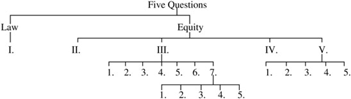
Another manifestation of this kind of impulse is Nottingham's habit of presenting what might be called structured arguments. He regularly categorizes and even numbers his reasons. So, for example, in Nurse v. Yerworth, he observes that there are five questions in the case, “one of law, four of equity.”Footnote 93 He proceeds to set them out in a list and then to work through them systematically, in order, including subcategories, so that, structurally, the judgment can be charted, using his numbering, as follows:
Another example is Salsbury v. Bagott,Footnote 94 the structure of which (again following Nottingham's enumeration) is:

Shapiro points out that an aspect of the “scientific culture” of the time was “a concern for classification and systematic communication.”Footnote 95 Ostensibly, the foregoing indicates Nottingham's very deliberate application of the “scientific” habit of mind to equity, a further indication that it is subject to being reduced to a coherent method.
Nottingham applies this approach not only to points of law but also to matters of fact—or of “proof” as well. Indeed, in the examples given above, parts of the structures involve questions of fact. Elsewhere he applies a similar analytical or representational technique to questions of evidence more particularly. In Lord Grey v. Lady Grey,Footnote 96 where the issue was whether property purchased by a father in the name of his son gave rise to a resulting trust, Nottingham sets out the evidence systematically, or even symmetrically, as follows:

In Cook v. Fountain, another case exhibiting a fairly elaborate classificatory structure, he explicitly invokes a measuring—here, weighing—metaphor as part of his exposition: “And though advocates may think themselves obliged to give some kind of answer to every argument, the judge who holds the scales is not so; for the slightest scale hath always some weight in it; but the duty of the judge is to cast the balance on that side which ought to preponderate.”Footnote 97 He proceeds to list the factors that weigh most heavily in the balance, again itemizing them in some detail:

It is at the end of this enumeration, indeed, in a paragraph constituting “13” in the enumeration, that he insists that the “conscience” by which he is to be governed must be “tied to certain measures.” That these “certain measures” have an evidentiary as well as a normative implication appears from his saying that there is no proof to “make out” the alleged trust, and that he cannot decide on the basis of his own “fancy and imagination”Footnote 98 —which presumably would correspond to the “conjectures and inferences” that he just dismissed as being inadequate grounds for finding a trust.Footnote 99 Viewed in this context, “certain measures” could be what goes into the balance: items of proof must be substantial, not merely speculative, and, again, they must be perspicuous. That is, they must be available in the public forum of the court—as opposed to being the kind of secret evidences that are a matter “only between a man and his confessor.”Footnote 100 This is not to say that Nottingham insists upon “mathematical certainty” of proofs in his cases, but that proofs must be objectively supportive of the propositions for which they are advanced.
Thus, Nottingham's concern to make equity systematic, certain, or even “scientific” is evinced in various ways: his insistence upon identifying or formulating definite rules and applying them consistently, his use of a discourse of equity that is analytical and methodical, and so on. Indeed, in at least one case he appears to take this tendency to an extreme by invoking a mathematical or geometrical principle as a reason for judgment. In Furner v. Lane, a case addressing the status of children of the half blood, he determines that they are “equally capable of administration [of a parent's estate] with them of the whole blood”: “And the reason of it is mathematical, for quod tangit in puncto aeque tangit ac si tetigesset toto latere: a globe upon a plane doth touch it as near though not so much as one plane can touch another.”Footnote 101 The reasoning here is curious: he says that the reason itself is mathematical; he does not say that mathematics provides an analogy or a metaphor. I doubt, however, that he means, literally, that because a circle or globe might touch a contiguous plane in this way that children of the half blood should have a certain status. Moreover, his mathematical analogy is not all that apt, since children of the half blood would appear to be proportionally closer to those of the whole blood than a point on a plane is to adjacent planes touching in their entirety. Further, rather inconsistently, Nottingham goes on to say that the same principle would exclude the children of the children of the half blood since they “do not now tangere in eodem puncto.”Footnote 102 These difficulties notwithstanding, however, it is significant that Nottingham should invoke a “mathematical” reason—and not, say, some vaguer but probably more cogent notion like “fairness.” It is consistent with his aspirations to make equity scientific—or at least to deploy the rhetoric of scientific measurement to persuade himself and others that equity can be made “certain.”
V. “Irregular” Equity
The foregoing is an elaboration of the fairly conventional general observation that Nottingham's project was to render equity more systematic and ruled, or, in terms of the point I am emphasizing, “measured.” For most commentators, the observation tends to stop at this point. However, examination of the phenomena—what Nottingham actually does—reveals that the conventional wisdom must be qualified. Nottingham is much less consistent in reducing equity to “certain measures” than that orthodoxy might imply. Many aspects of his actual judicial practice cast doubt on the absoluteness of his commitment in this regard, or at least upon the practicability of such a commitment. More broadly, his incomplete realization of his self-conscious project might be an illustration of the generally refractory nature of the enterprise of making the law determinate.
Critique of Legal “Nicety”
One aspect of his ambivalence is evident in his often less than wholehearted endorsement of his ostensible model—the “law”—and what it entails. The attitude is illustrated in statements like, “since the plaintiff seeks an extremity and refuses a fair offer …, ‘tis fit to hold him to strict justice,” and his relegating him “to his course at law.”Footnote 103 There is something rather pejorative about law and what it entails here. Holding a party to “strict justice” is almost a penalty for his failure to be “fair.” Here, what is more certain, or “strict,” is in some sense reprobated. One is reminded of the invocation of the letter of the law against Shylock attendant upon his declining the exhortation to be merciful.
Other examples, particularly involving an implied critique of legal “nicety”—that is, precision or fineness of measurement—in favor of what is apparently a much more nebulous kind of measure may be cited. In Duke of Newcastle v. Clayton, he says that, “since the Duke had so honourably acquitted himself from any kind of intention to deal hardly by this woman” and “now she stands upon every nicety,” he leaves her to the presumably tender mercies of the law.Footnote 104 Again, rather more expansive values, like honor (his protestation in Honywood v. Bennett that he has “nothing to do” with such matters notwithstanding) and magnanimity, are set in contrast to “niceties,” the more exact measures that supposedly characterize legal rules. In Gibson v. Kenvyn, a case in which a testator explicitly gave his widow a power of appointment over the residue of his estate, Nottingham refuses to be constrained by the ostensibly clear meaning of words. Observing that “there could be no certain rule in the exposition of powers of this nature, but it ought to vary with the circumstances,” he opines that “such clauses are [not] to be suffered to take place according to the literal sense or legal strictness of the words.”Footnote 105 And, in Farmer v. Marston, citing the aphorism “apices juris non sunt jura,” he relieves a petitioner not because the strict rule favors him, but because he “thought the case very pitiable.”Footnote 106
Conscience as the Measure of Equity
Not only does Nottingham sometimes impugn the overly fine measurement that may be thought to characterize the law but he also explicitly opposes it to the standard traditionally associated with equity—conscience. So, for example, in Williams v. Day, he says “let the mother”—an executrix who had entered into an agreement with her co-executor son to pay certain of the testator's debts—“be charged no further than in good conscience she ought to be and not according to the niceties of law.”Footnote 107 Here we have juxtaposed two contrasting kinds of measures: “the niceties of the law” and “conscience.” Elsewhere, Nottingham similarly remarks that the criterion in Chancery is conscience: while “rights in law are governed by rules of law, … rules in equity are governed only by conscience”;Footnote 108 a tenancy in tail in equity is “not governed by the statute of Westminster 2, as estates at law, but by the rules of good conscience as they are administered here”;Footnote 109 he will not countenance a modus decimandi, “though it be according to law,” because it “is utterly against conscience”;Footnote 110 where a previous award is affected by “manifest partiality and injustice” he will not confirm it, “for a court of conscience will never … decree an award against conscience.”Footnote 111
That one standard—conscience—is contrasted with another—nicety—does not necessarily of itself mean that the former is uncertain. Indeed, as we have just seen, Nottingham speaks of the rules of good conscience, and, in the quotation from Cook v. Fountain it is specifically conscience that he says must be “tied to certain measures.” In Coulston v. Gardner he identifies “the rules of good conscience” as setting at least some of “the bounds and limits” of sequestrations.Footnote 112 But, as Selden's observations suggest, conscience as a criterion was seen by many as variable. I have addressed this issue in detail elsewhere.Footnote 113 Here, I want merely to take note of the generally vaguer criteria that conscience seems to entail. This might be exemplified by Nottingham's observation in Salsbury v. Bagott of the effect of a claim's not having been brought for over sixty years: “length of time is not to be measured by revolutions of years only, but by … wilful and inexcusable negligence.”Footnote 114 One would have thought that the obvious certain measure of time would be revolutions of minutes, hours, days, years, and so on. But rather than this more precise, even scientific or mathematical, measure, Nottingham measures equitable time in terms of much harder to pin down factors of conscience. We have noticed other examples of his willingness to invoke rather elusive factors implicating conscience—fairness, honor, absence of hard dealing, sympathetic circumstances, and so on.
Latitude in Equity
In at least one place, and apparently contrary to the purport of some of his other dicta, Nottingham does explicitly acknowledge that the basis for decision making in equity is less constrained than in the law. In Dennis v. Frazier, involving an appeal from a decree previously made, he says “in cases of equity there ought to be much more tenderness in reversing decrees than there is at law in reversing judgments, for in all cases of equity there is some kind of latitude.”Footnote 115 We might recall that in Earl of Feversham v. Watson, certain of the lords invoked the same metaphor of latitude, arguing that the equity administered by the House was less confined than that of the Chancery. Here, Nottingham (who, as we have seen, insisted there on the ruledness of equity) says that there is more latitude in equity than in law. Because of this space for the exercise of discretion, higher tribunals hesitate to interfere; they should not “alter [a decree] merely upon a variety of opinion.”Footnote 116 Presumably, by contrast, judgments at law are more susceptible to review, on the basis that, since the measures of legal decision making are certain and objective—by contrast with the “opinion” involved in the exercise of equitable discretion, there is a fixed criterion of correctness against which to assess the judge's decision. Nottingham's position here does involve a paradox: leaving the decree as it is might, in a sense, contribute to certainty. Thus, he says, reversing the decree might “shew too much levity and incertainty”—at least in the absence of “great necessity.”Footnote 117 Although the initial decision might involve latitude or discretion, and be less certain in that sense, leaving it stand renders it certain in the sense that it is more fixed and final. Since it is a matter of latitude of judgment, a mere difference in appreciation of the case would be too light—as the word “levity” impliesFootnote 118—a measure upon which to disrupt the decision already made.
Precedent and Principle
Nottingham displays a similar ambivalence towards precedent, the observing of which should conduce to making the law known and certain. We have seen that sometimes he considers himself bound by previous decisions, but once more this aspect of what I have called the orthodox view needs to be qualified.
The problem had been raised before Nottingham's tenure as Chancellor in Fry v. Porter, in which Vaughan C.J. had, famously, expressed surprise that Keeling C.J. should cite precedents in an equity case, “for Equity is an universal Truth, and there can be no President in it.”Footnote 119 The argument seems to be that equity is a pure form of justice, immediately discernible by reason, and transcending the rules of positive law. Lord Keeper Bridgman responded by observing that “Presidents are very necessary and useful …, for in them we may find the reason of the Equity to guide us.”Footnote 120 Note that he is not saying that precedents are to be blindly followed, but rather that they offer evidence of the reason that infuses equity. Another take on the relationship is offered by the compiler of Reports of Cases Taken and Adjudged in the Court of Chancery, who says that, although “Equity and right Reason in it self is an universal thing,” “Mens Judgments, especially in Politicks or Morals, can seldom be said to amount to Mathematical Decisions: No one can imagine himself to have such refined Powers of Soul as to decree Aequitatem ad pondus.”Footnote 121 Therefore, precedents are necessary. One thing to note about this is its invocation of the idea of mathematical certainty, and of the difficulty of making some kinds of decisions on the basis of exact weighing of a case in isolation. Another is that it is consonant with Hale's view that, although the general principles of justice are universal and may be discerned by reason, practical decisions can be made certain only by the following of positive rules. A difficulty that emerges is whether making reason, or something like it, the criterion against which to assess those detailed positive rules undercuts the certainty that they are reputed to afford.
Nottingham's position must be understood within this kind of context. Earlier, I noted that in Thornborough v. Baker he declined to follow a precedent because, in his view, it was based on considerations of compassion, not of “right.” That is, he rejected the precedent because of its contamination with nonlegal elements. This approach is consistent with a strict view of legal certainty: legal decision making must be confined, and what is beyond those confines must be excluded. But this is far from a comprehensive account of the bases upon which Nottingham is prepared to reject precedents. Thus, in the same case, he gives as a concomitant reason for disapproving the precedent involving compassion that it applied “the wrong measure of justice”Footnote 122 and he approves another because it was “right and just.”Footnote 123 In yet another, he rejects a number of earlier cases because it would be unjust “to maintain them where Conscience and common Honesty was concerned to preserve the people from tricks and cheats.”Footnote 124 It is one thing to question a precedent because it ostensibly contains extraneous, nonlegal elements; it is another to question it because you disagree with its application of legal rationales—“justice” and rectitude. At least it can be said that he assesses the precedents, sometimes, against his appreciation of that of which they are supposed to be the evidence: equity.
Elsewhere, he appears to downplay the role of precedent, or even of rules, in Chancery. In Hele v. Hele, he says that the court “shall do what in Conscience [a testator] ought to have done” and comments that, while “the Common Law relieves not particular Cases against the general rule,” “in Chancery every particular Case stands on its own particular Circumstances.”Footnote 125 The measure here, conscience, applies in unique ways to each case; this seems antithetical to the idea of a uniform standard or “certain measure.” Of his decision in this case, Nottingham says that “it is not like to be a Precedent.”Footnote 126 An individual case might be the measure only of itself. We might here be reminded of Blount's characterization of the artificers of Lesbos: they made “Rules and Squares” in response to their materials, rather than making their materials conform to preset measures.
Equity's Unstable Boundaries
Indeed, Nottingham sometimes appears to reject precedent as an appropriate measure. Asked by counsel in the seminal perpetuities case Howard v. Duke of Norfolk “where will you stop if you do not stop at Childe & Baylie's Case”—that is, a precedent ostensibly on point—he replies: “I will stop everywhere any inconvenience appears, nowhere before.”Footnote 127 Stopping implies that one has reached a limit, a point beyond which one may not go. Nottingham here prefers the vaguer and more variable limit “inconvenience” to the more precise and definite one offered by the ruling in a prior case.
Walter Williams records that Nottingham once proclaimed that “he would leap over Hedge and Ditch” to come at justice.Footnote 128 Broadly, this suggests that he is prepared to make strenuous efforts to ensure that justice is done. But the metaphor of leaping over hedge and ditch had, I believe, a more specific connotation in Nottingham's time. The use of the hedge and ditch was a common, indeed typical, method of marking the extent of enclosed land, indeed, of enclosing it. In other words, hedges and ditches were not merely obstacles to jump over, as on a hunting course—although they were that—but they were boundaries, limits, measuring confined spaces.Footnote 129 So, for example, George Gascoigne admonishes “countrie clownes”—farmers—to set out clear boundaries to their lands: “your closes see you keepe, / With hedge, & ditche, & marke your meade with meares.”Footnote 130 As Blomley points out, the hedge had an extended, figurative import, so that “for theologians, as well as for other commentators, the hedge was a common metaphor for impenetrability and the prevention of misrule.”Footnote 131 Thus, Thomas Watson writes that “When the Devil spurs a Sinner by a Tentation, he will over Hedge and Ditch break all God's Laws.”Footnote 132
By this I do not mean to suggest that Nottingham was a judicial radical, recklessly prepared to demolish established limits—or, much less, to suggest that he was irreverent. But I do want to suggest that he might not have consistently been the legal precisian that he is sometimes portrayed to be. Against his proclaimed commitment to observing certain measures in equity must be juxtaposed his readiness, at least on occasion, to go beyond conventional or formal metes and bounds, or, in other words, not to adhere to Hale's requirement that laws should be conserved “within their boundes and Limits.” Observations such as “in a case so full of equity as the plaintiff had I would not suffer form to be too hard for right if it were possible to get over the objection”Footnote 133 must be understood in this context. “Form,” which may provide precise demarcations or shapes, must sometimes be “got over,” got out of, so as to vindicate less rigid measures, such as “equity” or “justice.”
Perhaps even more significant than Nottingham's readiness to leave the confined, or defined, space of formal equity is his tendency to import “nonlegal” elements into his system, although these are probably two sides of the same coin. As we have seen, one aspect of the quest for certainty is circumscription, defining of limits, including limits upon where one might go to find the rules one is applying. So, for example, one kind of limit might be the previously posited law or precedent, which implies a definition of the norms to be applied. A rather broader or wider limit might be considerations beyond posited law, but nevertheless regarded as intrinsic to law—that is, considerations of “right” or “justice.” We have intimated already that Nottingham is prepared sometimes to exceed both these kinds of limits, or, from another perspective, to bring in elements from outside these confines. Thus, his invocation of precedent as a measure is qualified by his measuring of those precedents against broader but intrinsically “legal” concepts such as “justice.” Moreover, he shows himself ready to admit considerations of emotion (pity) or courtesy (honor) in making decisions, thus going beyond the theoretically legal. Indeed, as we have noticed he even admits “mathematical” reasons into his cogitations. This last example has a dual aspect: on the one hand, mathematical or geometrical reasoning strongly suggests precision and certainty; on the other hand, invoking it involves importing elements from a different system into the process of equitable (that is, legal) decision making. If one aspect of making measures certain is confining them to a closed system, then the opening of the system to perhaps eclectic extraneous elements would presumably compromise that certainty.
In the case of East India Company v. Blake, Nottingham appears to distinguish between situations where there is an established system and where there is not, acknowledging that, in the latter case, a more amorphous kind of measure might be appropriate. He observes that, where covenants are “to be performed in an infidel's country where no ordinary justice can be had,” they “must not be measured by the rules of Common Law but by the rules of natural and universal justice.”Footnote 134 This seems to imply that “natural and universal justice” is a default measure, to be invoked in the absence of a developed system of positive law. Concomitantly, it would seem to imply that, where there is such a system, those posited rules are to be the measure, and that broader considerations are somehow extraneous, or “extraordinary.” This assessment would be consistent with Hale's insistence, say, that actual common-law rules of property—and not philosophers' lucubrations on abstract justice—are the proper measure in the municipal system.
Nevertheless, as I have already intimated, Nottingham is not averse to importing notions of broad justice, and related concepts, into his reasoning. A few examples will suffice. In Thornborough v. Baker he observes that “in natural justice and equity” a mortgagee's “principal right” to land is only as security for payment of the debt;Footnote 135 in Hatchett v. Bindon he appears to make “the natural honesty of the case” a measure of a party's obligations, in spite of the strict terms of an agreement;Footnote 136 in Buckridge v. Buckridge he refuses to execute a prior decree because of its “apparent injustice”;Footnote 137 in Earl of Huntingdon et al. v. Greenville, where each party relied on rather legalistic arguments, he says that “both sides were unreasonable” and the “the truth and justice of the case lies between them”;Footnote 138 and in Nurse v. Yerworth he asserts that “it is according to natural equity for every man to dispose of his own.”Footnote 139 It would of course be perverse to fault a judge for being concerned about justice in exercising his functions, and I am not faulting Nottingham for this. But I do want to suggest that his willingness to invoke broad concepts like justice, honesty, reason, and equity might unsettle the certainty to which he aspires.
Recurring to Nottingham's distinction in the East India Company case, it could be argued that, even where there is a developed system of positive law, there will inevitably be lacunae, situations that the rules do not reach. This would still leave room for principles of justice to be applied, perhaps as the basis for generating specific rules for the new situation. So, arguably, Nottingham's resort to these broader principles need not be incompatible with his insistence on adherence to rules. This account, while plausible in many instances, is problematic for more than one reason. Sometimes he invokes fundamental principles as a reason for not following an existing rule: justice is called upon not just to fill gaps, but effectively to support a competing rule. Moreover, as I have already intimated, it is not only principles of justice that inform his readiness to depart from legal rules.
Importing the “Other”: Extra-Systemic Elements
Thus, even if one might acknowledge that “justice” is intrinsic to the system of law that Nottingham is administering, and that he is therefore not importing extrinsic matter, he does fairly regularly bring into play considerations that appear to be more clearly outside the system.
Some of these importations, while extrinsic, are still “legal” in the sense of being elements of other juridical orders. That is, Nottingham sometimes invokes other (that is, non-English) law. A good illustration of this is Nurse v. Yerworth, a case involving the right of a posthumous son to take under his father's will, which provides for the latter's children. The common-law position, roughly, was that, at least in the absence of explicit language, the son should not take, not having been in rerum natura at the time of the father's death. This is a pretty clear rule. But Nottingham does not like it: the legal rule stands “upon hard terms”;Footnote 140 it is “of an infinite rigour and extremity”;Footnote 141 moreover, the defendant has already got more than was intended “by a nicety of law and picking holes in the settlements.”Footnote 142 Although he accepts that the common-law rule governs common-law interests, he refuses to model the equitable approach on that rule. In so doing, he looks to other sources. One, paradoxically, is “the ancient simplicity and integrity of the Common Law,” which he sees as having been distorted, or at least overrefined, by lawyers' “subtlety.”Footnote 143 In the present context, this is paradoxical partly for the nostalgia Nottingham (whose project is to transform equity from its own “ancient simplicity”) displays for a less developed legal dispensation but also because one might expect the more fully elaborated common law to be more precise, and the more “primitive” law to be at least less comprehensive, and perhaps more intuitive or vague. Nottingham refers not only to an earlier, in his view more pristine, stage of the common law, but, more significantly, also to other legal dispensations. Observing that “this kind of rigorous construction is against natural and universal justice and would be laughed at in any other part of the world,”Footnote 144 he looks to how other legal orders would treat the issue. One of these is the “spiritual court” or “court christian,” which he says will take into account “the presumptive intent” of the testator, “notwithstanding the will.”Footnote 145 Another is “the court pagan”—apparently tribunals applying Roman law and its derivatives—and he cites both Tully and Grotius.Footnote 146 In an earlier hearing of this case he had given the same civilian sources as evidence of “the law of equity through all the world,”Footnote 147 and in Weaver v. Woodyear he again offers them as evidence of “natural right and common justice.”Footnote 148
What this case illustrates, broadly, is that where Nottingham might have stated a specific rule consonant with the common law—that is, “if you want an unborn child to inherit, you have to say so”—he instead searches for a rule of universal equity, for which he finds evidence in extraneous sources, the limits of which are rather nebulous.Footnote 149 The uncertainty of the potential range of sources, or perhaps of reasons, means that what even might count as a measure of what the law should be is in doubt. The “measure” is not necessarily the law immediately at hand. Rather, it may be “universal law.” But when that universal law is to be invoked, what constitutes evidence of it, and indeed what it is may be unclear.
The syndrome is aggravated by Nottingham's willingness not only to import “alien” legal elements but even nonlegal ones. While, therefore, he is ready to refer to ecclesiastical law for analogies or for evidence of what universal law might be, he goes beyond this, invoking simple religious considerations in some cases. Thus, in Grey v. Grey, a case involving the presumption of advancement, he says that “the reason why land does not lineally ascend is … from moral philosophy, quia amor descendit non ascendit, and from divinity.”Footnote 150 Elsewhere, apparently, he elaborated, saying that the true reason was “from Moral Philosophy … and from the Law of Nature … and the Law of God,” citing for the last 2 Corinthians 12:14.Footnote 151 Divinity is a source of law. Similarly, in Clerk v. Perryer, a case concerning bailees' liability, he refers not only to civil law principles, but also says that the position he adopts is “grounded on the law of God”: “Jacob did make good to Laban all that was lost or stolen; and it is part of the judicial law that all men should do so, as appears by 22 Exodus, v. 11.”Footnote 152 It is no great wonder that Nottingham should display reverence for biblical authority but, again, this suggests a rather more porous and amorphous system of equity than some of his other dicta might suggest.
His willingness to import spiritual considerations appears in other ways as well. In the Prolegomena he makes the observation that a particular doctrine—that a mortgagor's debt “doth more nearly concern the executors than the heir”—“was anciently thought to concern the soul.”Footnote 153 The word “anciently” suggests that he regards this kind of consideration a thing of the past. Nevertheless, in some of his own cases, he imports into his judgments what might be termed “concern for the soul.” For example, in Nurse v. Yerworth, observing that a doctrine that would make a testator unintentionally disinherit his own son is “contrary to piety,” he opines that it would make “a good Christian die worse than an infidel.”Footnote 154 In Hickson v. Wytham, he holds that (at least in the absence of a specification to the contrary) a testator's debts should be paid before legacies because to do otherwise would be “to expound the testator's will so as to die in mortal sin,”Footnote 155 adding “nemo praesumatur immemor aeternae salutis.”Footnote 156 In yet another case he observes that although a litigant had the law on his side, yet he had no equity because to hold otherwise “were to visit the sin of the father on the child.”Footnote 157 One of the measures that Nottingham applies, or one of the elements in the measure he applies, is “sin,” which has the potential to distort the parameters of “legal right,” not to mention of “strict law.”
Nottingham imports not only religious norms but also criteria taken from other aspects of the social order into his reasoning. Thus, I have already mentioned considerations of “courtesy,” noting for example his opposing the honorable conduct of one party to the other's insistence on “nicety” in denying the suit of the latter in equity. He defers to honor elsewhere as well. One of the things he regards as “fit to be considered” in Earl of Leicester v. Sidney is that, even though a particular rationale might not be “a legal and meritorious consideration in strictness of law,” nevertheless it is “a very just and honourable motive and inducement between families of … great quality.”Footnote 158 Again, one might think that “strictness of law” would provide a more certain measure than “honourable inducement,” but Nottingham does not confine himself to the former. Similarly, he invokes honor in Shipton v. Lucy (the residue of an estate “ought in honour and conscience to be made as beneficial to [the plaintiff] as possible”)Footnote 159 and in Bostock v. Ireton (“a retraction [of consent to a marriage] of the executors against the rules of honour and justice ought not to be penal to the married parties”).Footnote 160
One discerns here a picture of a range of normative orders operating simultaneously: equity as defined by precedent, the common law, natural justice, universal law, civil law (at least as evidence of universal justice), ecclesiastical law, biblical law, the social code of honor, and perhaps others. Given one's impression of Nottingham as a systematizer, one might expect him to stick fairly closely to, say, the first two of these. But he does not—at least not consistently—so limit himself. The “system” he is ostensibly operating is one with quite permeable boundaries, through which might intrude a variety of kinds of “measures.”
Not only do we encounter these extrasystemic normative elements figuring in Nottingham's equitable reasoning but we also find more purely affective elements. Thus, on more than one occasion he observes, apparently as a relevant consideration, that a suit is “ungrateful.”Footnote 161 A party's failure to display appropriate gratitude might be a telling factor in equity. And, as we have seen before, although Nottingham on at least one occasion questions a precedent because it involved an argument of compassion (an extraneous consideration) as opposed to an argument of right (strictly legal), he does allow “pity” to affect his judgment at times.Footnote 162 Indeed, in Nurse v. Yerworth he specifically appeals to “that legal compassion due to all dying men who are inopes consilii—a compassion that will induce a court “to put words into the will which the testator never spake” in order to give effect to his apparent intent.Footnote 163
The foregoing does not purport to be an exhaustive account of Nottingham's importation of extralegal factors into his equitable reasoning. Elsewhere, we find him invoking economic utility (he refuses to execute an agreement beyond a certain point “since it tended to the discouragement of all honest industry”Footnote 164), cultural stereotypes (an executrix behaved “like a true stepmother,” he saysFootnote 165), proverbial wisdom (“let him that … is a cold blow the fire”Footnote 166), and concern for a dead man's reputation (he refuses to give effect to a power of appointment left to a widow because “whether the husband died like a wise man or a fool” cannot be left to depend upon his wife's exercise of discretion).Footnote 167 No doubt others could be identified.
Although Nottingham does profess his allegiance to regular equity, it appears that the measure he ultimately applies is his own sense of right. In Lawrence v. Berney, for example, when asked to give effect to a decree of one of his predecessors, he declines, saying that if that decree appears to him to be “unjust or corrupt” he asks to be “excused from making it my act to build upon such ill foundations”: “For I will never charge my conscience with promoting an apparent injustice.”Footnote 168 This attitude is nowhere more poignantly expressed than in Howard v. Duke of Norfolk where his opinion is contrary to that of the judges sitting with him and, as we have seen, may be inconsistent with precedent. “Upon the whole Matter,” he says, “I am under a Constraint, and under an Obligation which I cannot resist,”Footnote 169 namely, “I must be saved by my own Faith, and must not decree against my own Conscience and Reason.”Footnote 170 What in the end confines him is the imperative of his own conscience. This does not mean, of course, that his conscience will not frequently, or even usually, dictate that he shall do what he can to maintain the regularity of the law. Nor, however, does it mean that, where what his conscience requires does not accord with the strict or regular law, he will nevertheless stick to the latter.
VI. Conclusion
I would not want to be taken to be overstating my case, which is essentially that Nottingham did not consistently adhere to or achieve the “certain measures” that he proclaimed to be a primary desideratum of his system of equity. I would not dispute that a central project for him was to make equity more ruled and systematic, more “law-like.” But I would argue that this standard account must be qualified—it is one thing to profess that one is making an area of the law regular and scientific, but it is another actually to attain that objective. The rhetoric of judicial regularity may not be matched by the reality.
Something of what I am getting at may be illustrated by revisiting a case like Nurse v. Yerworth. Earlier, I suggested that the structure of the judgment might be schematized like this:
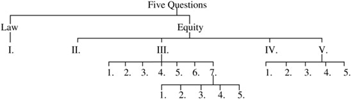
I suggested as well that such a structure might represent an orderly, systematic, or even scientific approach to equitable reasoning. But, in considering the case further, we saw that, substantively, it involves very wide-ranging considerations: what the common law was like in a more pristine state, the fact that the legal rule is of “an infinite rigour and extremity,” the practice of the “court spiritual,” the doctrine of the “court pagan,” natural equity, “natural and universal justice,” the fact that the strict legal approach “would be laughed at in any other part of the world,” “piety and good manners,” concern that “a good Christian” should not “die worse than an infidel,” and legal compassion. In other words the case presents a mixed message. Formally or structurally it suggests a fairly tight system of reasoning, a kind of clearly demarcated container. But substantively, it is much more amorphous: the contents are, in a sense, incommensurate with the container, overflowing it, or what it seems to represent. The certain measure that the form might suggest is belied by the eclectic variety of substantive measures that Nottingham actually invokes.
Again, it is far from my intention to suggest that Nottingham cynically pretends to adhere to strict constraints while surreptitiously introducing all kinds of “unruly” factors. I have no doubt that he was sincere in his project of making equity a regulated system. The point I have been making relates more to the difficulty, or even the impracticability, of the project than to the disingenuousness of those promoting it. As Sir John Davies—who again regards law as “nothing else but a Rule, that is made to measure the actions of men”Footnote 171—points out, “Certeine it is, that lawe is nothing but a rule of reason, & and humaine reason is Lesbia regula, pliable every way … so as not onely the knowledge of the lawe, but all other rational sciences that are subiect to Argument & discourse, must needs be subiect to vncertainty & to error. Footnote 172 If this is true of the law per se,Footnote 173 it must be even more true of equity, which by hypothesis makes law less strict. Lambard's point is worth recalling here: if equity is necessary because general, fixed laws cannot be “meet measures” of justice in all cases, confining equity to “certaine bounds” would compromise its essential function. We might add to this the consideration, as Davies puts it, that “[a] Rule is dead and measures nothing, vnlesse the hand of the Architect do apply it,”Footnote 174 If equity must retain pliability, and if rules only come alive in so far as reasoning judges apply them, it is small wonder that Nottingham's objective of “certain measures” is only partially accomplished.
One further aspect of this issue merits mention. Throughout this article, an operating assumption has been that greater precision of rules, and perhaps proliferation of rules, imparts certainty to the law. But, paradoxically, the quest for legal precision might have the opposite effect. Roger North, in his biography of his brother Francis North, Lord Guilford, who was Nottingham's successor as holder of the Great Seal offers the following perhaps not entirely unbiased account of Nottingham's judicial style: “During his Time, the Business, I cannot say the Justice, of the Court flourished exceedingly. For he was a Formalist, and took pleasure in hearing and deciding; and gave way to all Kinds of Motions the Counsel would offer: Supposing that, if he split the Hair, and, with his Gold Scales, determined reasonably on one side of the Motion, Justice was nicely done. Not imagining what Torment the People endured, who were drawn from the Law and there tost in a blanket.”Footnote 175
A number of things are worth remarking here. For one thing, it depicts Nottingham as a legal formalist. For another, it invokes metaphors of precision (“split the Hair”) and of measurement, the image of the gold scales suggesting that Nottingham used a very finely calibrated measuring device. Moreover, it suggests that Nottingham regarded himself as meting out justice very exactly, or “nicely.” What is particularly noteworthy, though, is North's claim that this very precision of measurement might have led to the contrary of the certainty and settledness that it would appear to entail. Far from affording litigants security, it could have the effect of making them “tost in a blanket.” The image of being tossed in a blanket suggests the very opposite of constraint within certain bounds. A famous painting by Pierre Charles Trémolières, of Sancho Panza being tossed in a blanket, captures what this entails for the person tossed. Sancho has obviously lost control: he is not on firm ground, but high in the air; his arms are flailing as he tries to maintain stability; he has an alarmed expression on his face; and he no doubt realizes that as soon as he comes down, he will be launched again. Declaring that Nottingham's formalist method might have this result appears paradoxical. But it may be that striving after certain measures in the law, while creating the impression of certainty, may lead to the kind of intricacy—which Nottingham himself in places disparages as “subtlety”—that obscures as much as it elucidates and that becomes another version of the problem it purports to remedy.
If the supposition that Nottingham is the author of the “character” of Sir Matthew Hale reproduced in Burnet's biography is correct, that characterization might hold a further important clue to Nottingham's ultimate judicial attitude. He lauds Hale in the following terms: “As great a Lawyer as he was he would never suffer the strictness of Law to prevail against Conscience, as great a Chancellor as he was, he would make use of all the Niceties and Subtilties in Law when it tended to support right and equity.”Footnote 176 In other words, sometimes the ends of justice are better served by consulting moral intuitions and sometimes they are better served by invoking the intricacies of the rules. If Nottingham admired these judicial qualities in Hale, it is reasonable to assume that he would have emulated them himself, that here, again, to appropriate Lord Campbell's words, he might be drawing his own portrait. If so, this outlook would go some distance in explaining the phenomena I have attempted to describe in this article.


