Introduction
This article reconstructs the biography of a musician who was active in Britain and Ireland for nearly 30 years during the late Georgian and early Victorian era, but whose name and existence have hitherto been entirely unknown: the guitarist and singer Mariano Theodoro Castro de Gistau (c. 1800–1856). The main reason for rescuing this musician from obscurity is that he was a performer upon the guitar, an instrument whose social and musical position was exceptionally sensitive to some of the principal forces affecting musical life and careers in the first half of the nineteenth century. The vagaries of fashion, the pride of provincial towns who were nonetheless dependent upon London tastes, the rise of a canonical repertoire performed in concert halls built ever larger – all these factors shaped the life of Castro as he tried to make a living from the guitar in the British Isles.
Among the many recent studies on musical life in nineteenth-century Britain the seminal works of Cyril Ehrlich and Deborah Rohr have illuminated many aspects of the musical profession.Footnote 1 In addition, William Weber’s comprehensive survey of changes in concert programming during this period and Simon McVeigh’s more specific discussion of the benefit concert provide essential context for assessing Castro’s performing career.Footnote 2 The success Castro achieved, however, and the obstacles he faced, also rested on the particular circumstance that he came to Britain at a time when the Spanish guitar was enjoying a period of high favour. Advertisements and reviews of concerts in local newspapers provide an exceptional (and often the only) means to trace the ways in which Castro capitalized upon this fashion for the guitar, but the material has obvious limitations. Although the British Newspaper Archive contains newspapers from all the main locations where Castro resided, it is not complete, with some towns or cities much better served than others, while for some there is as yet no record at all. Furthermore, the accuracy of search engines using OCR software leaves something to be desired, especially in cases where the legibility of the original source is poor. Such caveats notwithstanding, the material that may be retrieved concerning Castro is surprisingly comprehensive. It reveals how a musician could make a career and livelihood, in shifting circumstances, on an instrument with little or no accepted place in the musical mainstream.
The Rising Fashion for the Spanish Guitar
When J. Jousse published A compendious dictionary of Italian and other terms used in music in 1829 he observed that ‘the Spanish guitar is become lately very fashionable in England’.Footnote 3 With some notable exceptions, however, the vogue for the guitar during the early nineteenth century is a largely unexplored aspect of British musical life.Footnote 4 This fashion was not confined to England or to Britain; a similar wave of interest in the guitar swept across much of Europe in the early decades of the century and reached as far as Moscow. Already in 1801 a Moscow correspondent to the Allgemeine musikalische Zeitung (hereafter AMZ) expressed his concern that the guitar might displace the piano as the preferred domestic instrument there.Footnote 5 Things were afoot in Vienna as well; although the guitar had been little known before 1800, a visitor observed in 1808 that the guitar was now the favourite instrument of the ‘fair sex’.Footnote 6 Paris, on the other hand, had been home to a flourishing guitar scene since the last third of the eighteenth century,Footnote 7 and by 1819 a reporter in the AMZ went so far as to declare that there were amateur guitarists in almost every house in the French capital.Footnote 8
In stark contrast, another 1819 report in the AMZ claimed that the guitar was not widely known in England,Footnote 9 and some other contemporary observers in London also noted that the instrument was making unexpectedly slow progress. Even as late as 1826 a contributor to the Quarterly Musical Magazine and Review could declare that ‘We have often wondered that the guitar is not in more general use amongst amateurs’, although, in the same breath he chose to add that ‘It has lately however been brought into more notice’.Footnote 10 The true picture, however, is both more complex and more positive. There was an elite coterie of guitarists in London’s West End during the very first years of the nineteenth century,Footnote 11 and the guitar was cultivated by Princess Charlotte (died 1817) who received the dedication of one of the half dozen instruction books for the guitar printed in London during the first 15 years of the century.Footnote 12 By the 1820s, the fashion for the guitar was undoubtedly waxing in Britain, a development which a contributor to the Harmonicon in 1824 believed could be attributed to the ‘exquisite and wonderful performances’ of the Catalan guitarist Fernando Sor.Footnote 13
Sor’s stay in London from 1815 to 1822 may certainly have been influential, but there were other important factors, many of which concern British interactions with Castro’s homeland of Spain.Footnote 14 When Britain and Spain found themselves allies against Napoleon in the Peninsular War from 1808 to 1814, the Spanish began to be romanticized as brave fighters for freedom in an exotic land of warm nights, serenades and guitars. Whether the liberty at issue was deemed to be freedom from political oppression by the Bourbon monarch (as it was for Shelley) or from the imperialist ambitions of Napoleon (as it was for many who were not poets) the result was the same: travellers and soldiers on campaign in Iberia encountered guitars and brought them home.Footnote 15 In 1833, a contributor to the first niche magazine for guitarists in English, the Giulianiad, went so far as to credit officers returning from the Peninsular War with the introduction of the guitar into Britain.Footnote 16
The arrival of Spanish exiles was perhaps equally important. Some came with the retreating troops at the end of the war in 1813/14, while a new wave came after the suppression of the trienio liberal in 1823 and the expulsion of Spanish liberals from France that same year. London thus became the intellectual and political centre of Spanish exiles between 1824 and 1830, and it has been estimated that at least a thousand Spanish families resided there, the majority being former soldiers but others being lawyers, clerics, doctors, merchants and men of letters.Footnote 17 Among them were musicians such as José Melchor Gomis, Santiago Masarnau and the young singer Madame Paulina de Vigo, Manuel García’s protégé. Their presence did much for the appreciation of Spanish music among the London elite.Footnote 18
Finally, the guitar was felt to be ‘romantic’ in the sense that it was associated with remote settings, dreams and stories of love, heroism or chivalry. Already in 1800, the Allgemeine musikalische Zeitung in Leipzig referred to it as ‘romantic’,Footnote 19 and Berlioz (who played the guitar) in his 1844 treatise on instrumentation described the instrument as ‘melancholic and dreamy’ (mélancolique et rêveur).Footnote 20 Poets made much of its soft, beguiling timbre judged to be so evocative of Mediterranean Europe considered as an exotic cultural margin of the continent,Footnote 21 and some associated it with the lute. There were even some among the new breed of critics, stern observers of the guitar for the most part, who took this view. In 1836 George Hogarth wrote that ‘the guitar is the most romantic of all modern instruments, because it is the direct offspring of the lute, and is almost always conjoined with the canzonets of Italy, and the boleros and seguedillas of Spain’.Footnote 22
These considerations begin to explain why Britain was seen as a promising land for Continental guitarists in the second half of the 1820s, when the fashion for the instrument was already on the wane in other parts of Europe.Footnote 23 Guitarists in great numbers crossed the Channel: George Derwort, Carl Eulenstein, Felix Horetzky, Trinidad Huerta, Luigi Sagrini, Leonard Schulz and Giulio Regondi, to mention some of the better-known figures, all arriving between 1824 and 1831. Now we may add another.
Mariano Castro: Early Life and London
According to the Aberdeen census of March 1851, Mariano Castro (registered as ‘Teacher of French and Music’) was Spanish by birth and then aged 51.Footnote 24 He had a young wife named Hannah, then aged 28, born in Ireland where Castro probably met her. The couple had three children. Mariano was therefore born at about the time when his father Salvador Castro de Gistau, who was also a guitarist, left his native country for Paris where he became active as a musician, composer and small-scale publisher until about 1815. (He was the first to print some of Sor’s guitar music there.) Castro senior was subsequently engaged for some years as Hofguitarist at the court of Prince William, Prince d’Orange, in the Netherlands.Footnote 25 Mariano no doubt learned the art of guitar playing from his father, but during a later period in Dublin he declared that he had once been a pupil of Fernando Sor. If so, the apprenticeship probably took place during Sor’s first Paris period from 1813 to 1815. Mariano also claimed to have been educated at the Lycée Napoléon (now the Lycée Henri-IV), already regarded as one of the best schools in France.
On 28 April 1829 a notice appeared in the Morning Post briefly stating that ‘Mons. Castro de Gistau, Professor of the Spanish Guitar, has the honour to announce his arrival in London’. The text does not mention the guitarist’s first name which is unfortunate, as there are indications that Castro senior also visited London around this time. We have no further precise information of the Castros in London,Footnote 26 but early in 1831 a guitarist by the name of Castro de Gistau can be traced in Edinburgh, and this time it was certainly Mariano.
Edinburgh
‘In this place we are not much acquainted with the guitar’, commented a reviewer after Mariano Castro’s first Edinburgh appearance, but this was not entirely true. A Spaniard, Don Celestino de Bruguera, had visited the town in 1825,Footnote 27 and advertisements show that music by Sor, Giuliani, Anelli, Derwort, Sola and others was for sale in the second half of the 1820s, indicating a demand among local amateurs. Another Spaniard, a certain Dr Llacayo, had also settled there sometime before 1827, teaching the Spanish language and the guitar in addition to practicing as a physician. His name appears in the newspapers now and again in the ensuing years, most notably in connection with some lecture-recitals he gave on the history and repertoire of the guitar in 1831 and 1833.
The concert life of Edinburgh in the 1820s was much affected by new musical trends and ideals. The Professional Society of Musicians had been founded in 1819 upon the model of the Philharmonic Society in London and was devoted to ‘improving the state of popular taste, by rendering familiar to their auditors the purest and most refined productions of the great masters of modern music’.Footnote 28 That same year the noted violinist Felix Yaniewicz (1762–1848), who had been one of the founders of the London Philharmonic, introduced a long-lasting series of Morning Concerts which focused on instrumental chamber works by the Austro-German classics.Footnote 29
The occasion for Castro’s Edinburgh debut on 22 January 1831 was Yaniewicz’s First Morning Concert that season,Footnote 30 duly announced and reviewed in the Caledonian Mercury.Footnote 31 With the exception of ‘a few vocal notes thrown in by Signor Castro’, the programme consisted exclusively of instrumental music, including string quartets by the classical trinity of Haydn, Mozart and Beethoven played by an ensemble of resident performers led by Yaniewicz.Footnote 32 In addition, his two daughters contributed on the harp and piano with music by Kalkbrenner, Bochsa and Herz. Castro performed a ‘Fantasia on the Spanish Guitar’ in the first half, and what was announced as a ‘Bolero, Spanish March &c’, in the second.
‘We apprehend that there are few even of the initiated, who would not be of opinion that a little of the human voice occasionally might afford relief and variety to the tout ensemble’, wrote the critic. This remark is not surprising; as William Weber has observed, the new fashion for all-instrumental programmes taxed the average concertgoer (even the London Philharmonic quickly compromised by including less demanding vocal music in its concerts).Footnote 33 Thus, although Castro’s playing was ‘nothing very wonderful’ on this occasion, it was nevertheless ‘extremely neat and accurate’; furthermore, he also sang ‘in a very pleasing style’. As a composer of instrumental music, however, he did not impress: ‘The Fantasia with which he introduced himself was utterly destitute of modulation; indeed we have seldom heard any thing more disagreeably monotonous’. Castro made ‘ample amends by the excellent March and Bolero with which he concluded, which seemed to afford unmingled pleasure to every one’ – a concession to less exalted musical taste that was clearly welcomed by the audience.
Perhaps the most remarkable part of the review from a guitar-history perspective, however, is the commentary on Castro’s guitar: ‘The instrument upon which he plays is now rarely seen, a guitar of twelve strings, being double the number of the ordinary modern guitar’. This is an allusion to a guitar strung in the old Spanish manner with six double strings or courses. As the reporter rightly commented, the six-course guitar ‘has been for many years almost entirely exploded’; even in Spain, players in general had turned to single-string instruments by 1830.Footnote 34 It is hard to believe that the Castros had stubbornly retained double-string guitars for all their activity during the many years in France and the Netherlands; in their daily teaching, they must have resorted to the single-string instruments used by everybody else around them. It seems more probable that Mariano Castro sometimes performed on the six-course guitar to add an exotic flavour to his public appearances, especially when accompanying songs in the Spanish style.
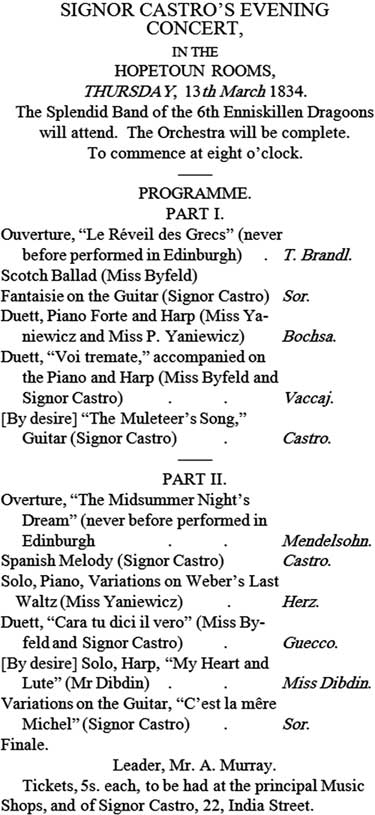
In 1832, Castro published two works with Purdie in Edinburgh: a guitar method (Instructions for the Spanish Guitar) and a Selection of Airs for solo guitar.Footnote 35 Apart from this, there are no reports of Castro in the next three years, but in early March 1834 he appeared in a Grand Concert in Leith, given by R. B. Stewart, the leader of the Leith Philharmonic Society. Just a week after, he arranged his own Evening Concert in Edinburgh whose programme was printed in the Caledonian Mercury (Figure 1).
A diplomatic reproduction of the programme of Castro’s Evening Concert on 13 March 1834, as detailed in the Caledonian Mercury, 10 March.
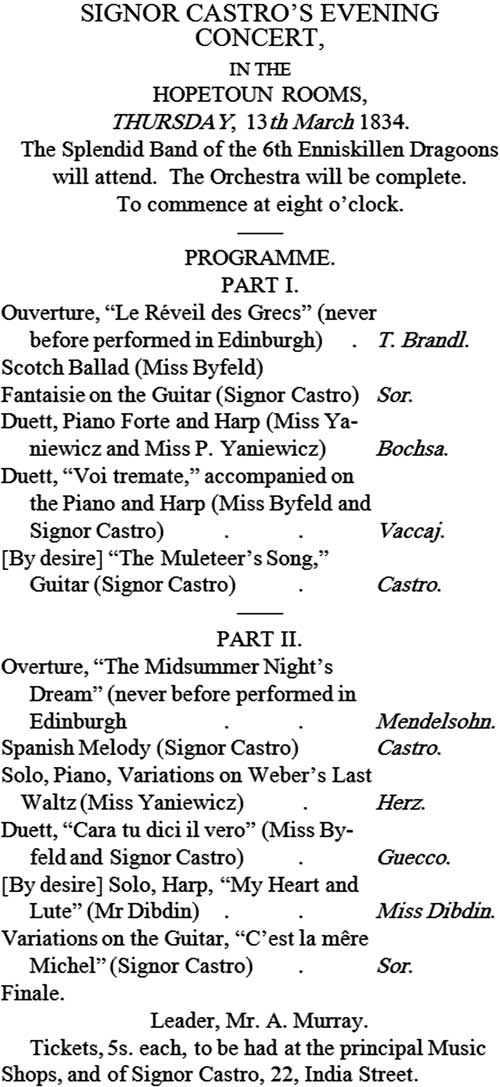
This was a typical miscellaneous concert of the period with a blend of vocal and instrumental music. A singer, a pianist and two harpists contributed, among them the two Yaniewicz daughters. Furthermore, the 6th Enniskillen Dragoons Band opened each part of the concert with an overture (the Mendelssohn ‘Midsummer Night’ was at the last minute supplanted by another, unspecified work). The Caledonian Mercury reported that the Hopetoun Rooms were ‘literally crowded with a brilliant and fashionable audience’ for this programme, suggesting Castro’s standing in Edinburgh’s musical and social life. The review confirms his eminence by giving a much more positive assessment of his own talents than three years before; ‘Signor Castro, it is well known, is not only the first guitarist in Edinburgh, but one of the finest performers upon that instrument to be met with amongst any people’. The review praises his masterly execution of several songs to his own guitar accompaniment, ‘being all except one encored’, while the duet by Vaccai was ‘not only exceedingly beautiful, but exceedingly well sung’.Footnote 36 The ‘Muleteer’s Song’ which, by brazenly appealing to the Spanish stereotypes of the British public’s imagination, was to become a favourite throughout Castro’s career.
Even though the author admitted that his review was not as full as ‘the professional eminence of the individual’ who mounted the concert required, it is still surprising that there is no mention whatsoever of Castro’s solo playing which included two major solo works by Fernando Sor, an unspecified Fantaisie and variations on ‘C’est la mère Michel’ (from op. 30). Perhaps he passed over them in discreet silence because Castro did not really have the ability to deliver such music in a truly impressive manner. It is also quite likely that the reviewer, like many music critics and writers at that time, saw the guitar as an appropriate companion to the voice, but inadequate as a solo instrument and therefore not worth mentioning in that regard.Footnote 37
The last we hear of Castro in Edinburgh comes from some advertisements for the newly opened North British Academy for the Education of Young Ladies in October and November 1834. Among the academy professors (where also the Yaniewicz sisters appear), Castro was listed as a teacher of guitar and of Spanish language and literature.Footnote 38 He did not remain long at the academy, however, and a few months later we find him in Ireland.
Dublin
On 20 January 1835, readers of the Dublin Evening Packet and Correspondent could find the following brief notice:
Senor Castro has the honor to announce to the Nobility and Gentry that he intends visiting Dublin on the 25th instant, for the purpose of giving Lessons on the Spanish Guitar.
An editorial in the same paper noted that Castro ‘has been delighting the lovers of music in Edinburgh for some time’. This introduced a five-year period in Ireland.
The guitar was nothing new to Dubliners. Young Giulio Regondi had caused quite a sensation when he played in the city in June the previous year (he was still in Ireland when Castro arrived) and the child prodigy Leonard Schulz had visited the town with his father and brother in 1826. (Both Schulz and Regondi returned in 1836.) Of resident guitar teachers, a Signor D. de Vescovi announced his services throughout the 1820s and 30s, claiming that he had arrived about 1816.Footnote 39 There were also music warehouses to furnish amateurs with instruments. In November 1826 I. Willis, the proprietor of the Royal Harmonic Saloon, placed three corresponding advertisements in the Dublin Evening Mail informing his customers of stock selected from the ‘most eminent Manufacturers’ in London.Footnote 40 The instruments were
15 Grand Piano-Fortes
14 Cabinet Ditto
10 Cottage and Harmonic Ditto
60 Square and Circular DittoFootnote 41
16 Harps, Double and Single Action
6 Organs, Finger and Barrel
46 Spanish Guitars
Such particularized inventories were not often given in newspaper advertisements and these figures are particularly arresting, not only because they show the precise number of instruments in each category but also indicating the level of demand anticipated. Two months later, after receiving another fresh supply from London, Willis again itemized his stock.Footnote 42 We find the same variety of instruments with only slight changes in their numbers except for the guitars, which had now increased to 68. It seems that Castro came to a city well supplied with eager amateur guitarists.
Castro soon became an acknowledged figure on the musical scene of Dublin, as revealed by the number of leading resident musicians who invited him to contribute to their benefits. The first occasion was a ‘Grand Concert of Vocal and Instrumental Music’ in early April 1835, given by the cellist Samuel J. Pigott (1797–1853) at the Rotunda, perhaps the most prominent concert venue in Dublin.Footnote 43 This was indeed a grand event, with a large number of singers and instrumentalists in addition to an orchestra of nearly one hundred players. The miscellaneous programme featured music by renowned composers such as Beethoven, Mozart, Spohr, Auber and Mayseder, and in the midst of all this Signor Castro performed his ‘Spanish Muleteer’s Song’.Footnote 44 Only a few weeks later he appeared at the ‘Annual Grand Concert’ of Signor Antonio Sapio (1792–1851), a celebrated tenor of Italian background. Vocal music predominated in the programme, Castro contributing his ‘Spanish War Song’.Footnote 45 (Like the ‘Muleteer Song’, this was to become one of his trademarks in the years to come, and for the same reasons that form a minor but fascinating chapter in the history of British and Irish conceptions of Spain and of ‘national’ musical styles). Soon afterwards, in mid-May, Castro gave his own Morning Concert. This was a typical miscellaneous benefit in which a number of resident singers and instrumentalists participated, including Pigott and Sapio. Castro performed what the programme announced simply as Spanish Melodies which were almost certainly songs. He also played ‘Introduction and Variations’ – no further details are given – by Sor, once again giving prominence to the music of his former teacher.Footnote 46
Castro’s Irish enterprise must have been successful, because late in 1835 he announced that he had been induced to take up residence in Dublin permanently, ‘for the purpose of giving instructions on the Spanish Guitar’.Footnote 47 In 1836 and early 1837 there are reports of a few concerts in Dublin and Wexford,Footnote 48 but in the following years his name appears only sporadically in some teaching advertisements for guitar and singing. However, ‘Senor M. Castro de Gistau, the celebrated Guitarist from the Nobility’s Concerts London and Dublin’, appeared again at concert in Limerick in January 1840, and four months later at the Rotunda in Dublin.Footnote 49 On this occasion, which is also the last we hear of him in Ireland, he performed his own ‘Air and Variations: Le Troubadour’ for solo guitar – a sign of the guitar’s growing involvement with romantic medievalism – and a vocal duet with Sapio, Mercadante’s ‘Non mi parler d’Eliza’.Footnote 50
Cheltenham
Castro now returned to England and stopped in Cheltenham. Like other fashionable spa towns, Cheltenham in the summer season drew a large number of wealthy visitors from London and elsewhere; women were very much in the majority, reflecting the popularity of such towns as places of genteel residence or holiday for unmarried or widowed women of some financial means. Cheltenham therefore provided good prospects to those who could play to a high standard on an instrument then strongly gendered as female when played by amateurs.Footnote 51 Castro was not the first to seize this opportunity. In the second half of the 1820s and the 1830s, at least a dozen visiting guitarists had announced their services in the local press.Footnote 52 Most of them – the majority were Italians (no Spaniards recorded) – stayed only for a short time but one, a certain Signor Pedrotti, had settled in 1823 and advertised as teacher of Italian language and guitar regularly for almost two decades. One female, Madame Julie Fondard, in 1834 and 1835 even announced herself, seemingly with good reason, as former pupil of Sor.Footnote 53
Although music teaching must also have been a central activity for Castro, no such advertisements are known from his one and a half year in the spa town. There are, however, many reports of concerts in which he took part, and they show that he soon attained a similar position in the local musical life to the one he had occupied in Edinburgh and Dublin. We first hear of him at a matinée musicale of the visiting flautist Johann Sedlatzek (1789–1866) at the end of September 1840.Footnote 54 Soon after, in mid-December, Castro gave his own concert in the Lecture Hall of the Literary Institution. Several of Cheltenham’s most distinguished resident musicians contributed: the singers Miss Davis and Mr Sapio,Footnote 55 the pianist Pio Cianchettini (1799–1855) and the violinist James Uglow (1813–1894). According to one review,
the Signor himself executed several pieces on the guitar in a style of excellence such as we never before heard on that instrument. His performance and singing of the Spanish War Song, was of its kind quite a masterpiece.Footnote 56
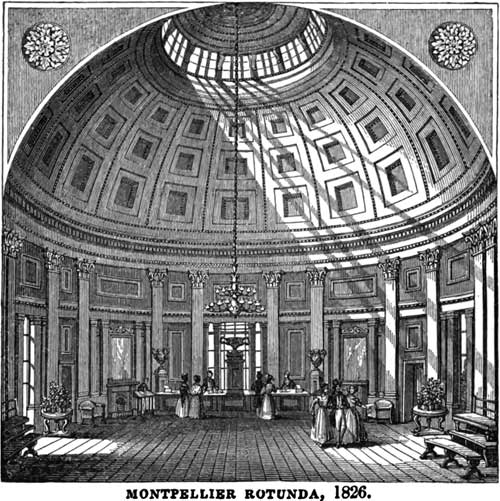
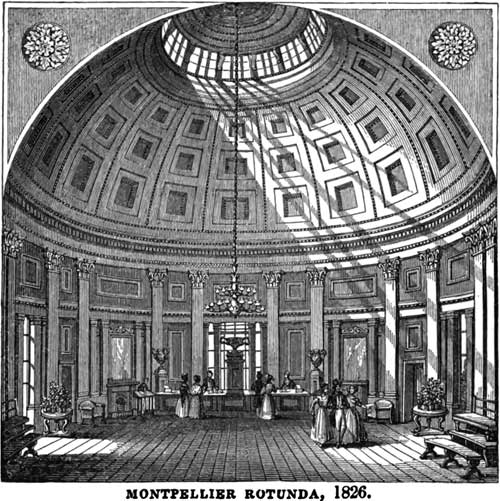
In August 1841 Castro took part in the Benefit of the Montpellier Band, an annual social and musical event which attracted a large and fashionable audience to Montpellier, the most renowned of the Cheltenham spas.Footnote 57 The programme was in three parts; the first and last consisted of wind music played by the full 17-member band, or smaller groups from its ranks, and took place outdoors close to the Montpellier Pump Rooms and Walk. The middle part, with mostly vocal and some instrumental chamber music, was held indoors in the Montpellier Rotunda, a magnificent building modelled on the Pantheon and constructed in 1826 (Figure 2).
The Montpellier Rotunda, 1826. The diameter of the Rotunda was 15 metres (50 feet), and its height to the apex of the lantern, 16.5 metres (54 feet). Illustration from Henry Davies, A View of Cheltenham, in its Past and Present State (Cheltenham, n.d. [1843]): 60. (Courtesy of the Bodleian Library. Reproduced under the Creative Commons Licence, https://creativecommons.org/licenses/by-nc-sa/2.0/uk/legalcode)
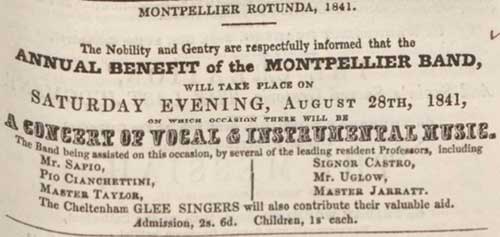
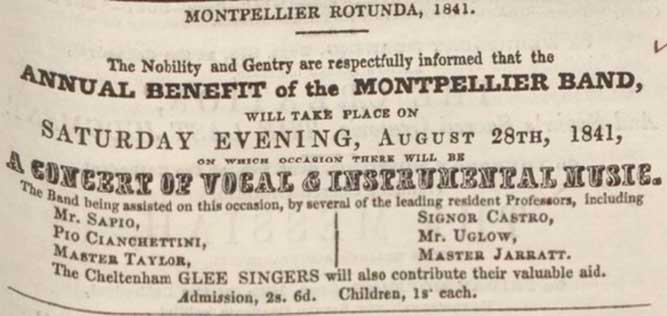
The programme was detailed in several advertisements. Besides the familiar names of Mr Sapio, Pio Cianchettini and Mr Uglow, we also find a young singer and harpist, and a group of glee singers. Castro performed only his ‘Spanish War Song’; this notwithstanding, all the contributors were given equal billing and classified as ‘leading resident Professors’ in the advertisements (Figure 3).
Advertisement of the Benefit of the Montpellier Band in the Cheltenham Looker-On, 28 August 1841 (British Newspaper Archive online).
There are reports of several other concerts in 1841 and early 1842.Footnote 58 On 15 April 1842 Castro arranged his own Farewell concert at the Assembly Rooms which was thinly attended; one newspaper suggested that this was the result of some last-minute programme changes leaving many confused as to whether the concert would take place at all. Not everything pleased the reviewer, but ‘the instrumental portions of the entertainment were well executed, particularly El Senor’s own Guitar performances’.Footnote 59 Despite the unquestionable standing ‘El Senor’ had attained in Cheltenham, he left the town after only a year and a half. Shortly after he left, another guitarist and singer, the flamboyant Italian Giuseppe Anelli (who had been active in Bath, Bristol and ExeterFootnote 60 ), announced that he was taking up residence in the town.Footnote 61
Aberdeen
Nothing is known of Castro’s whereabouts for one year or so after his Cheltenham Farewell Concert, but on 13 September 1843 the Aberdeen Journal announced his new arrival in Scotland. Under the heading ‘French Language’, the readers were notified that ‘upon the request of several Families of distinction’ Castro had been induced to establish himself in Aberdeen ‘for the purpose of giving Instructions in the French Language’. Only towards the end of this notice, after a paragraph giving his credentials (including the claim that he was educated at the Lycée Napoleon in Paris) did he also inform that he gave instructions on the Spanish guitar and in singing.
This shift of emphasis is conspicuous and would become habitual. Out of some 20 known teaching advertisements Castro placed in Aberdeen newspapers during his ten years there the great majority were for French classes; on only a few occasions were guitar and singing also mentioned. Although music teachers had other means to make their services known (such as cards in bookshops and music shops), this most certainly shows that the guitar by now had lost some of its appeal for the leisured classes. Some of the advertisements demonstrate that these language classes filled much of the day and evening, three days a week. Furthermore, they show that, in addition to giving private lessons, Castro was from 1845 onwards engaged as a French teacher in various private schools and academies that were now emerging.Footnote 62 It appears that he was an acknowledged language teacher, to judge by an editorial article, ‘Acquirement of modern languages’, in the Aberdeen Herald and General Advertiser (8 September 1849) where he is particularly mentioned. In the early 1850s he was also teaching at the Mechanics’ Institution, and two years later the town Council granted him permission to open French classes in the Grammar School.Footnote 63 He also claimed to be French Master at King’s College, the University of Aberdeen.Footnote 64
Castro had not ceased to perform, however. His first public concert took place about a year and a half after his arrival, in January 1845 (doubtless, his voice and guitar would have been heard in private settings before that). This was a joint concert with a resident violinist, Mr R. H. Baker. The press reviews after this and other Aberdeen concerts show how far Castro was from being considered as a mediocre exponent of an outmoded instrument now compelled to present himself only as a teacher of French:
We now come to notice Mons. Castro’s performance, which formed a novel and certainly most pleasing part of the entertainment. His ‘Spanish War Song’, and ‘Song of the Spanish Muleteer’, (both his own compositions), were given with exquisite taste and feeling, and in the latter he received a hearty encore. In these and his other songs, he accompanied himself on the Guitar, of which simple and elegant instrument he is a thorough master, and drew from its chords the sweetest music, such as we had little idea of its producing.Footnote 65
In a Grand Concert of the 87th Band of the Regiment toward the end of 1845, Castro (despite the contrast in sound level) ‘completely carried captive the audience’ with his two crowd-pleasers, the ‘Spanish War Song’ and the ‘Song of the Muleteer’.Footnote 66 In the coming years he performed in a number of other events. At one of these, Castro’s own concert at the Mechanics’ Institution in April 1849, he was assisted by his old colleague from Dublin, Antonio Sapio. A reviewer deemed this to have been an ‘exquisite musical entertainment’, and continued enthusiastically:
Indeed, the success of the concert was complete. Mons. Castro has long been known to fame, as one of the first performers on the guitar, and we need only say that, on this occasion, he fully maintained his character. His performance had all that elegance and refinement of style, which we have often had occasion to admire; and although the tones of his instrument seem at first thin and feeble, it is singular how soon this is forgotten, in the stream of rich harmony and beautiful modulations which, in his hands, it is made to produce.Footnote 67
The music hall of the Mechanics’ Institution in Market Street, an edifice constructed in 1845, was a much-used venue for concerts. These events could have a traditional programme, but many were also of a more popular nature (such as an accordion band concert in April 1852) addressing the tastes of the social classes that generally frequented that institution. A ‘Musical Entertainment’ there in November 1850, featuring Castro and the favourite Scottish vocalist Mr Milne, was particularly noticed for its broad appeal. With lowered ticket prices the hall was crowded to excess, but the concert was disturbed by ‘a number of Vandals, chiefly located in the back part of the room, who apparently could not appreciate the exquisite performances’.Footnote 68 Milne sang popular songs and ballads; Castro contributed guitar solos and songs which inevitably included his ‘Muleteer’s Song’ but also a ‘Spanish Negro Song’. His performances were, ‘as on many former occasions, eminently successful’, and he ‘succeeded in electrifying his audience by a kind of quality of musical effort rarely to be met with in the ungenial north’.Footnote 69
In late summer 1851 Castro sojourned in Inverness, some 100 miles northwest of Aberdeen, where he offered instruction in the French language, Spanish guitar and singing.Footnote 70 It is not clear how long he stayed, but in August 1852 he had ‘resumed his professional duties’, as a teacher of French and the Spanish Guitar in Aberdeen.Footnote 71 The last we hear of him there is from a newspaper notice about French classes in November that year.
Cheltenham again – the Final Years
Sometime between late 1852 and early 1854, Castro moved back to Cheltenham with his family. We first hear of him as one of several ‘talented artistes’ performing in a ‘Grand Evening Concert’ towards the end of April 1854, ‘in aid of the fund for relieving the wives and children of the soldiers who have embarked for the East’, that is to say for the Crimean War.Footnote 72 There are no details about his role in the programme, but the advertisements give his name equal billing with the other contributors. The only other time his name appears in the newspapers before his death in 1856 is in three identical advertisements for instructions in French and the guitar, placed in the Cheltenham Looker-On in the spring of 1855. In the meantime, his wife Hannah had given birth to their fourth child in 1854. The birth certificate is the only known source for Castro’s full name: Mariano Theodoro Castro de Gistau.Footnote 73
What made Castro abandon the prestige and – we may suppose – the relative economic security he had enjoyed in Aberdeen after so many years? The most plausible explanation is that he did so for health reasons. He died unexpectedly on 8 October 1856, in circumstances that suggest as much. The Cheltenham Chronicle carried a brief but vivid notice of the incident:
Sudden Death. – Monsieur De Castro, a teacher of languages, of Townsend Street, in this town, while shaving on Wednesday last, suddenly burst a blood vessel. His wife, on going into the room, and seeing a razor in his hand, and his mouth and throat covered with blood, gave an alarm that he had cut his throat. But a surgical examination proved the contrary and that death resulted from the eruption of a blood vessel.Footnote 74
The death certificate, which gives his age as 55, specifies the cause as ‘Rupture of a Blood Vessel on the Lungs’.Footnote 75 This may indicate that he suffered from an obstructive lung disease, such as tuberculous bronchiectasis.Footnote 76 If so, it may explain why there are no reports of public appearances during the last two and a half years of his life. It would also explain his move to a gentler climate. The Cheltenham Looker-On carried a similar notice of his death, along with some details about the family’s situation. Sad to relate, his wife and four children were ‘in a state of utter destitution – so utter, indeed, as to have neither food nor money wherewith to meet the common claims of nature and humanity’.Footnote 77 Conspicuously, the two notices refer to Castro only as a teacher of languages with no hint of his musical profession.
After Castro’s death, his wife and children returned to Dublin, but their fortunes did not improve. In 1858 they were registered at the South Dublin Union Workhouse; the widow’s occupation recorded as needlework.Footnote 78 She later moved to Liverpool where she died in 1867, at the age of 43. Only one child, the eldest daughter Cathalina, can be traced there; she married in 1871 and later gave birth to a daughter.
Castro’s Life and Career in Perspective
Almost without exception, Castro’s playing was warmly received in the press, but reviews of a resident musician may not always offer the most reliable evidence of their qualities. In a local community, musician and critic would often frequent the same circles, perhaps develop a personal friendship, and these circumstances could colour a published review. Nonetheless, there is a reassuring unanimity in the assessments of Castro in the various towns where he resided, and this deserves to weigh heavily. Critics in those days could be ruthless, not least toward guitarists, but there is never any suggestion in Castro’s reviews that he should have chosen a more worthy instrument (a remark often made in reviews of other laudable guitar players).Footnote 79 It should be remembered, however, that Castro often appeared as a singer-guitarist, on many occasions probably only so, and that such use of the guitar was very much in accordance with the prevailing concept of the instrument’s capabilities. Furthermore, Castro persistently accentuated those aspects of his repertoire that he knew his British listeners would find evocative of Spain, notably the ‘Spanish War Song’ and the ‘Muleteer Song’ which were his showpieces par excellence. The muleteer, slowly toiling through a Spanish landscape commonly imagined by the industrialized British (and with some reason) as essentially rural and primitive, was an archetypical figure in the Anglo-American image of Spain; he is present on the very first pages of Washington Irving’s Tales of the Alhambra, published simultaneously in America and England in 1832, and appears repeatedly in romanticized prose and verse in the 1820s and 1830s, some of which was set to music by various composers.
This was also the case with the ‘Spanish War Song’, the title given to a number of poems printed in newspapers or magazines which celebrated the Spanish fight for political freedom. Like many guitarists of real or claimed Spanish background, Castro capitalized on that identity. With his Spanish six-course guitar, perhaps also dressed in a version of national costume, he must have kindled his audiences’ imagination – their memory of serialized stories, cheap prints and novels – when performing those songs, especially when they were weary of Mozart, Beethoven and others represented on the same programme.
The great majority of the concerts in which Castro performed were benefit events or variants thereof; in some he was listed with the principal vocal performers, in others with the instrumentalists, and sometimes with both. His own concerts during the span of twenty years from 1831 to 1851 mirror some general modifications and transformations that occurred in benefits in that period, discussed by McVeigh and Weber.Footnote 80 Thus the March 1834 concert in Edinburgh, the programme of which appears in Figure 1, was in most respects a typical miscellaneous benefit within the collegial tradition with another singer, a pianist and two harpists in addition to a full military band. Vocal and instrumental genres alternated, and each half of the programme opened conventionally with an overture played (in the place of a symphony orchestra) by the military band which would probably also have been responsible for the unspecified Finale. The most atypical feature of the event was Castro’s own quite prominent role; whereas earlier benefits would often include three items, at the most, involving the beneficiary, Castro performed in six out of ten numbers (not counting those played by the military band). This reflects a general trend as the century progressed, and one that was perhaps amplified in Castro’s case by the fact that he was ‘two gentlemen at once’, being both a vocalist and an instrumentalist.Footnote 81 His benefit in Dublin one year later (May 1835) was constructed in much the same way; a Rossini overture opened the concert which then proceeded with a blend of vocal and instrumental items (the second half was without an orchestral opening). This time Castro was active in four out of ten numbers excluding the overture and Finale. We find him playing a guitar solo by Sor in addition to singing his own Spanish songs and in an Italian duet.
Such particulars are lacking for his concerts in Cheltenham. It seems, however, that they were conducted without the aid of an orchestra of any kind; this was also the case with his subsequent Aberdeen concerts. Again, this reflected a general tendency in the 1830s and 1840s; the cost and complexity of hiring an orchestra often led musicians to omit it altogether.Footnote 82 The Aberdeen concerts show how Castro also adjusted to another trend at the time, that of arranging small concerts jointly with only one or two other instrumentalists or singers (perhaps with an accompanying pianist in addition).Footnote 83
Although large concerts in prestigious venues could earn considerable social capital, they did not necessarily add much to the musician’s income. The miscellaneous benefit concert depended on the gratis assistance of participating artistes, which meant that the musicians involved performed without pay much of the time, and even with the free labour such events were not always financially successful for the concert giver.Footnote 84 We must assume that Castro’s own concerts sometimes left him with a profit, but also could result in a loss if they were thinly attended, like his Cheltenham farewell event in 1842. He probably earned rather more from various private concerts and parties in aristocratic or upper-class residences. Such events have rarely left any traces in the press (privacy and discretion being a token of their exclusiveness) although they are sometimes alluded to there. An Aberdeen newspaper reported that ‘except to those who were fortunate enough to meet with him in private parties, there was no opportunity of enjoying his unrivalled performance of the beautiful music of his country’.Footnote 85 In a few advertisements, Castro also referred to the Nobility’s Concerts (‘the celebrated Guitarist from the Nobility’s Concerts’) as many musicians did for self-promotional purposes. In such cases ‘Nobility’s Concert’ would be used in its broad meaning, denoting any private concert with a fashionable audience, not a specific concert or concert series. The treatment and the pay the musician received at such events could vary, but there are reports of respectable payments, also to guitarists.Footnote 86
In addition to generating some of a musician’s earnings, private performances (like public ones) had an important function in that the artiste thereby became known to potential pupils or to their parents.Footnote 87 Teaching was a necessity for nearly all musicians and for many it was their core professional activity, offering the security of a small but regular income and respect within the community through a network of social connections; Deborah Rohr refers to one observer who in 1818 remarked that ‘of all classes of musicians, the teachers are the most respectable’.Footnote 88 The demand for self-employed music teachers fluctuated with fashion, however, to which guitarists were very vulnerable; hence they needed to piece together an income by exploiting their expertise in various domains. Castro was not unusual among musicians for offering lessons in French and Spanish, in addition to singing and the guitar, for foreign musicians, above all those from Italy, Germany and France, regularly extended their services to include their native tongue. It was also common for musicians to supplement their earnings with small-scale sales of instruments or music to their pupils. While in Dublin, Castro announced that he had ‘an assortment of Spanish Guitars to dispose of’.Footnote 89
The great majority of Castro’s pupils would have been women, as the British attitude to male instrumental playing was decidedly ambivalent, particularly with regard to instruments whose associations were markedly domestic, like the guitar.Footnote 90 Young, unmarried girls probably predominated; whatever learning to play the guitar (or piano) contributed to the satisfactions of a young woman’s life, it was also a means to enhance her marital prospects since these were genteel and companionable arts which showed that she had been ‘finished’. The gendered aspect was not absolute, however, and the only Castro students whose names have emerged from the shadows were two males. The first, a gentleman of French background, Théodore F. Huet, offered his services in various advertisements in Cornwall and Devon newspapers between 1832 and 1839. He opened a Music and Dancing Academy in Plymouth in 1832 and two years later in Exeter, claiming that he was a pupil of ‘Signor Sagrini, Signor D’Castro at London, and Monsieur Pousse at Paris’.Footnote 91 Two decades later, in 1858 and 1859, a Joseph Ferguson in Dublin also claimed to have studied under ‘the eminent Guitarist, Senor De Castro (pupil of the celebrated Ferdinand Sor)’.Footnote 92 This was more than 15 years after Castro left Dublin.
Mariano Castro spent most of his life in Britain and Ireland far from the metropolis. He was not alone in preferring provincial towns; many visiting musicians stayed only briefly in London or bypassed it altogether because of the increasing opportunities available elsewhere in the kingdom. Other guitarists also side-stepped the capital; the careers of Anelli and Eulenstein unfolded mainly in the West Country, in towns like Bristol and Bath.Footnote 93 Obviously, there was less competition in the provinces, for although London had many more aspiring novices on the guitar than any provincial centre, the town was overflowing with known and lesser-known guitarists offering lessons. (Between 1825 and 1835, some twenty tutor books for the guitar were published in London by authors whose names are otherwise mostly obscure.Footnote 94 ) Rohr mentions that the increased competition between musicians in London seems also to have led to a decline in teachers’ fees by 1830.Footnote 95 For Castro, not on a level to compete with virtuoso performers like Schulz or Regondi, it was thus wise to withdraw to other areas where there were few guitarists of significance to rival him.
Furthermore, and as mentioned briefly above, the guitar was an instrument overwhelmingly subject to the vicissitudes of fashion led by the metropolis. Leading critics in the specialized music press – a new breed of men in Castro’s lifetime – generally spoke very disparagingly of the guitar. It did not accord with the belief that absolute music, in its most sublime manifestations, was a vehicle for realizing aesthetic and philosophical truth.Footnote 96 The guitar was accepted within a domestic context because it was suitable for accompanying sentimental songs, but critics who felt obliged to write highbrow pieces for the press were only intermittently persuaded that the guitar had any a place in serious concerts where it could so easily be overshadowed by instruments of superior resources. Even as a domestic instrument, however, the guitar was soon challenged. In 1839, a contributor to the Musical World wrote (actually with a note of sympathy for the guitar) that ‘in the higher circles it has been dethroned by the tyrannical piano-forte’.Footnote 97 Although this appeared in an article about the state of music in Madrid, much the same could be said for the rest of Europe: mass production had by that time resulted in considerably lower prices of the piano which took over as the principal domestic instrument. In the late 1830s and 1840s, as Castro’s career clearly shows, the regional towns could offer better opportunities for guitar-related activities than London, but the change inevitably hit the provinces in due course, and was indeed mentioned in Aberdeen in 1851 when a notice of a forthcoming concert remarked on the high position Castro held as a teacher of the guitar, ‘when that instrument was more in vogue than it now is’.Footnote 98 The fact that he was more involved with language tuition in later years most certainly reflects the dwindling interest.Footnote 99
Some of the concerts in which Castro participated included music by the Austro-German composers that was rapidly advancing into the more serious segments of contemporary concerts, but there was none in his own programmes. In this he was progressively more out of date, and in the long run new forms of concert planning which offered a concentrated encounter with the emerging classics, rather than a miscellany, made it progressively more difficult for guitarists like Castro to find a place in public concert life.Footnote 100 Pure chamber-music series were introduced in Britain around this time, but the guitar had no place in such settings, for the classical masters had ignored it.Footnote 101 The emergence of recitals further complicated the situation. Few guitarists had the technical or musical powers, let alone a sufficiently varied repertoire, to bear the bulk of a programme; they would also have found it hard to attract a sufficiently large (and fashionable) audience sensitive to the nuances of their low-voiced instrument.Footnote 102
For this was (as it remains) the guitar’s greatest defect. The situation worsened as the growing size of concert halls in the nineteenth century made public performance on the guitar virtually impossible. Already in 1829 William Ayrton, the editor of the Harmonicon, wrote that in the concert hall the guitar becomes ‘as ineffective as a piping bullfinch perched on a trombone in the midst of a great military band’.Footnote 103 By mid-century, the time of the guitar in Britain was certainly over. The odd visiting virtuoso could still appear occasionally in London or some other major city, but most of the prolific generation of guitarists who arrived with the tide in the 1820s and early 30s were gone. Some had returned to the Continent or were seeking new grounds across the Atlantic; some turned away from the guitar and expanded their musical horizons to accommodate to changing fashions; some were already dead and yet others just disappeared in oblivion. It should take over a century until the guitar would again rise to a popularity like that of the 1820s and 30s.