INTRODUCTION
Picoeukaryotes (eukaryotes smaller than 2–3 µm in diameter) have key roles in marine ecosystems, particularly in primary production, nutrient cycling and for food-web dynamics (Caron et al., Reference Caron, Peele, Lim and Dennett1999). They occur in aquatic environments worldwide at concentrations between 102 and 104 cells ml−1 in the photic zone (Massana, Reference Massana2011). Marine picoeukaryotes belong to a wide range of different phylogenetic groups (Sherr & Sherr, Reference Sherr, Sherr and Kirchman2008; Jardillier et al., Reference Jardillier, Zubkov, Pearman and Scanlan2010; Caron et al., Reference Caron, Countway, Jones, Kim and Schnetzer2012). In fact, nearly every algal phylum has picoplanktonic representatives (Thomsen, Reference Thomsen1986). In the open oceans, most picoeukaryotes are coccoid or flagellated forms with (phototrophic) or without chloroplasts (heterotrophic), and with few morphologically distinct features (Thomsen, Reference Thomsen1986; Simon et al., Reference Simon, Barlow, Marie, Partensky and Vaulot1994; Andersen et al., Reference Andersen, Bidigare, Keller and Latasa1996). This phytoplankton is mainly composed of phyla such as haptophytes, dinoflagellates, prasinophytes and many phylogenetic groups within these very broad phyla still lacking cytological analysis. However, the extent of the diversity, distribution and abundance of the different taxa in situ remain unknown (Partensky et al., Reference Partensky, Guillou, Simon and Vaulot1997). Over the past decade, 18S rDNA-based molecular approaches, such as Sanger-based sequencing of clone libraries, 454 pyrosequencing and Illumina MiSeq platform sequencing, have provided broad insights into picoeukaryotic diversity in many areas, such as in the hypoxic north-western coast of the Gulf of Mexico (Rocke et al., Reference Rocke, Jing and Liu2013), in the South China Sea (Wu et al., Reference Wu, Huang, Liao and Sun2014) and in subtropical coastal waters of Hong Kong (Cheung et al., Reference Cheung, Au, Chu, Kwan and Wong2010).
Aquaculture is a fast-growing industry because of significant increases in the demand for fish and seafood throughout the world (Naylor et al., Reference Naylor, Goldburg, Primavera, Kautsky, Beveridge, Clay, Folke, Lubchenco, Mooney and Troell2000). Marine aquaculture in China consists of four sea regions including the Bohai Sea, Yellow Sea, East China Sea and South China Sea. Qinhuangdao aquaculture area is an important aquaculture area in the Bohai Sea, currently extending to ~214,510 hectares (Cao et al., Reference Cao, Wang, Yang, Yang, Yuan, Xiong and Diana2007). The key shellfish crop in Qinhuangdao is devoted to intensive scallop cultivation in an area of ~37,300 hectares (Cao et al., Reference Cao, Wang, Yang, Yang, Yuan, Xiong and Diana2007).
In eutrophic waters of aquaculture areas, picoeukaryotes were abundant and the main food organism of shellfish (Muller-Feuga, Reference Muller-Feuga2000), and some species blooming could cause ‘red tides’ even ‘brown tides’, which occurred due to a picoplanktonic (~2–3 µm) alga in North America, Africa and Asia (Gobler & Sunda, Reference Gobler and Sunda2012). Moreover, there are protozoa-like ciliates which are major consumers. They together participate in the energy flow and element cycling. So, to understand the complex ecosystem of aquaculture areas is very important, especially since the research on picoeukaryotes is still scant. In this study, we used Illumina's MiSeq platform sequencing V4 variable region within the 18S rDNA gene to analyse genetic diversity and relative abundance of picoeukaryotic communities in the Qinhuangdao scallop cultivation area.
MATERIALS AND METHODS
Microbial diversity analysis
SAMPLE COLLECTION
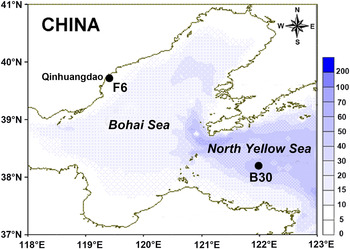
Surface seawater samples (1 L) were collected from two stations in June 2012 (Figure 1). Station F6 was in the Qinhuangdao scallop cultivation area. Located far from the eutrophic aquaculture area, Station B30 was a contrasting open water station in the North Yellow Sea. Each water sample was filtered first through a 3 µm and then through a 0.22 µm pore-sized polysulphone/polycarbonate filter (Whatman, Piscataway, NJ) using a gentle vacuum pump (<20 cm Hg). The 0.22 µm filter was then transferred to a 5 mL tube and covered with 2 mL of lysis buffer. Samples were immediately frozen in liquid nitrogen and stored at −80°C until DNA extraction. Seawater temperature and salinity were recorded with a SBE19-CTD profiler. Environmental parameters were measured simultaneously.
Sampling sites. F6, Qinhuangdao aquaculture area; B30, contrasting water in the open sea area.

DNA EXTRACTION AND PCR AMPLIFICATION
DNA was extracted from the 0.22 µm filters using a modified phenol: chloroform extraction and alcohol precipitation procedure (Bostrőm et al., Reference Boström, Simu, Hagström and Riemann2004). The 18S rDNA fragments were amplified by polymerase chain reaction (PCR) (95°C for 2 min, followed by 35 cycles at 95°C for 30 s, 55°C for 30 s, and 72°C for 45 s and a final extension at 72°C for 10 min) using primers 3NDF 5′-barcode-GGCAAGTCTGGTGCCAG-3′ and V4 5′-ACGGTATCT(AG)ATC(AG)TCTTCG-3′ (Stoeck et al., Reference Stoeck, Bass, Nebel, Christen, Jones, Breiner and Richards2010), where the barcode was an eight-base sequence unique to each site. PCR reactions were performed in a triplicate 20 µL mixture containing 4 µL of 5 × FastPfu Buffer, 2 µL of 2.5 mM dNTPs, 0.8 µL of each primer (5 µM), 0.4 µL of FastPfu Polymerase and 10 ng of template DNA.
ILLUMINA MISEQ SEQUENCING
Amplicons were extracted from 2% agarose gels and purified using the AxyPrep DNA Gel Extraction Kit (Axygen Biosciences, Union City, CA), according to the manufacturer's instructions and quantified using QuantiFluor™-ST (Promega, USA). Purified amplicons were pooled in equimolar and paired-end sequenced (2 × 300) on an Illumina MiSeq platform according to the standard protocols. The raw reads were deposited into the NCBI Sequence Read Archive (SRA) database (accession number: SRP056556).
PROCESSING OF SEQUENCING DATA
Raw fastq files were demultiplexed, quality-filtered using QIIME (version 1.17) with the following criteria: (i) The 300 bp reads were truncated for any site with an average quality score <20 over a 50 bp sliding window, discarding the truncated reads shorter than 50 bp. (ii) Exact barcode matching, 2 nucleotide mismatch in primer-matching and reads containing ambiguous characters were removed. (iii) Only sequences that overlapped by more than 10 bp were assembled according to their overlap sequence. Reads which could not be assembled were discarded.
Operational Taxonomic Units (OTUs) were clustered with 97% similarity cutoff using UPARSE (version 7.1, http://drive5.com/uparse/) and chimeric sequences were identified and removed using UCHIME. The phylogenetic affiliation of each 18S rRNA gene sequence was analysed by RDP Classifier (http://rdp.cme.msu.edu/) against the silva (SSU115)18S rRNA database using a confidence threshold of 70% (Amato et al., Reference Amato, Yeoman, Kent, Righini, Carbonero, Estrada, Gaskins, Stumpf, Yildirim, Torralba, Gillis, Wilson, Nelson, White and Leigh2013).
Phylogenetic and statistical analysis
PHYLOGENETIC ANALYSES
We determined the phylogenetic relationships of the picoeukaryotes based on maximum likelihood analysis of the V4 area of 18S rDNA gene sequences from the Bohai Sea and Yellow Sea site. FastTree (version 2.1.3, http://www.microbesonline.org/fasttree/) was used to build a maximum-likelihood (ML) tree informed by the methods of Philippot et al. (Reference Philippot, Spor, Hénault, Bru, Bizouard, Jones, Sarr and Maron2013), and using R language tools to draw the phylogenetic tree (Figure 2S). Metazoan OTUs were excluded.
STATISTICAL ANALYSES
Non-parametric species richness ACE, Chao1, and diversity indices (Shannon and Simpson) were calculated using the Mothur package (version v.1.30.1, http://www.mothur.org/wiki/Schloss_SOP#Alpha_diversity) (Schloss et al., Reference Schloss, Westcott, Ryabin, Hall, Hartmann, Hollister, Lesniewski, Oakley, Parks, Robinson, Sahl, Stres, Thallinger, Van Horn and Weber2009). Rarefaction and Shannon–Wiener curves were also performed using Mothur, and using R language tools to create curve. SIMPER (similarity percentage analysis) test was performed using PAlaeontological STatistics (PAST) version 2.17 (Hammer et al., Reference Hammer, Harper and Ryan2001) based on the relative proportion of taxa abundances.
RESULTS
Environmental conditions
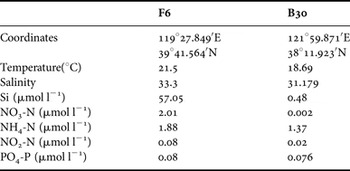
The environmental conditions of the two stations were determined by chemical analysis by the chemistry group. The seawater temperature and salinity were slightly higher in the aquaculture area water than the open water (Table 1) and the concentrations of ammonium (NH4-N), nitrite (NO2-N) and phosphate (PO4-P) were slightly higher in F6 than those in B30. Notably, nitrate (NO3-N) and silica (Si) concentrations were substantially elevated in the eutrophic aquaculture area compared with the contrasting station (Table 1). Furthermore, the satellites map (Supplementary Figure S1) showed the distribution of concentrations of chlorophyll, the primary productivity of the aquaculture area water were significantly higher than that of the open water. On the basis of these values, stations F6 and B30 were confirmed to be two different habitats.
Sampling sites and their physical and environmental characteristics.

Si, silica; NO3-N, nitrate nitrogen; NH4-N, ammonium nitrogen; NO2-N, nitrite nitrogen; PO4-P, phosphate.
Sequencing conditions
After removal of all low-quality, unassembled and potentially chimeric sequences, a total of 149,038 high-quality sequences were obtained from the two water samples. Following the exclusion of metazoan sequences, 74,845 and 2474 high-quality target tags from F6 and B30 were clustered into 234 OTUs (190 OTUs in F6 and 136 OTUs in B30) and these were used in the downstream genetic analyses. The average tag length was about 444.3 bp.
Picoeukaryotic communities between two habitats
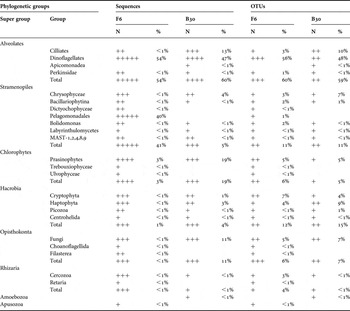
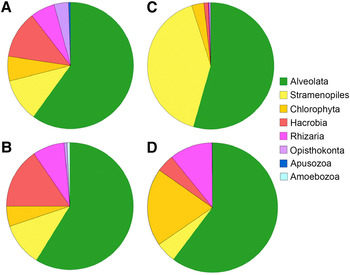
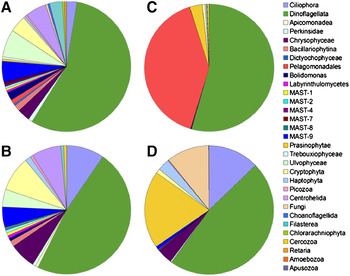
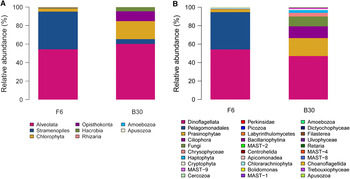
The sequences we found were widely distributed across eight major eukaryotic supergroups: alveolates, stramenopiles, chlorophytes, hacrobia, rhizaria, opisthokonta, apusozoa and amoebozoa. The community captured by our approach was dominated by three super groups, the alveolates (54%), stramenopiles (41%) and chlorophytes (3%), and three groups comprising dinoflagellates (54%), pelagomonadales (40%) and prasinophytes (3%) in the aquaculture area. But in the open water, the dominated super groups were alveolates (60%), chlorophytes (19%), stramenopiles (4%) and opisthokonta (11%), the groups were dinoflagellates (47%), prasinophytes (19%) and ciliates (13%) (Figure 4 and Table 2).
Sequence abundance and diversity of picoeukaryotic OTUs found in this study.
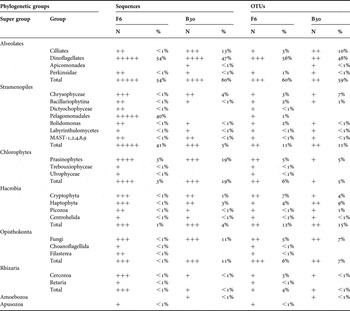
N, number (+ = 0–10, ++ = 10–100, +++ = 100–1000, ++++ = 1000–10,000, +++++ = over 10,000).
A communality between the F6 and B30 stations was that the alveolata contributed more than half (54% and 60%) of the total community. Of these the overwhelming majority belonged to the dinoflagellates, which accounted for almost half of all the sequences (54% and 47%). But another group, ciliates were more abundant in B30 than F6 (13% and <1%). On the other hand it was notable that the stramenopiles were more abundant at F6 than at B30 (41% and 5%). Of the stramenopiles-affiliated sequences, pelagomonadales represented up to 40% at F6, whereas at B30, the chrysophyceae was the dominant group (3.9%) (Table 2). Chlorophytes represented the third most abundant group in this study. They were almost exclusively composed of prasinophytes and were just over six-fold more abundant at B30 vs F6 (19% and 3% respectively). Prasinophyceae, Cryptophyceae and Bolidomonas were more abundant at B30, but the relative contributions of their phylotype OTUs were higher in F6 (Figures 2 and 3 and Table 2).
Composition of picoeukaryote community with species number and relative abundance percentage of each super group assemblage. (A) species number percentage of F6; (B), species number percentage of B30; (C) relative abundance percentage of F6; (D) relative abundance percentage of B30.

Composition of picoeukaryote community with species number and relative abundance percentage of each group assemblage. (A) species number percentage of F6; (B) species number percentage of B30; (C) relative abundance percentage of F6; (D) relative abundance percentage of B30.

Relative abundance of picoeukaryotes in super group (A) and group (B).

Phylogenetic relationships of picoeukaryotes based on maximum likelihood analysis of the V4 area of 18S rDNA gene sequences from stations F6 and B30 are shown in Supplementary Figure S2. The scale bar indicates 0.01 nucleotide changes per position. Yellow icons represent clones collected from the aquaculture area F6 and blue icons represent those at B30 (Supplementary Figure S2). Most of the OTUs obtained from F6 were represented by dinoflagellates, stramenopiles, prasinophytes, cryptophyta, haptophyta and cercozoa. As for B30, most OTUs were represented by dinoflagellates, stramenopiles, prasinophytes, cryptophyta, haptophyta and ciliates. The difference in the OTUs between the two stations were mainly associated with pelagophyceae, dinoflagellates, ciliates, prasinophytes and cercozoa (Table 2).
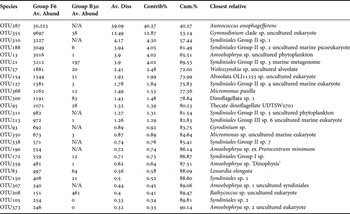
The contribution of the top 26 species to the average Bray–Curtis dissimilarity, which is 97.07%, in terms of occurrence and abundance for the samples from the Qinhuangdao aquaculture area and the contrasting station was analysed by SIMPER (Table 3). These OTUs were closely related to species belonging to pelagophyceae, dinophyceae and prasinophyceae, including Aureococcus anophagefferens, Gymnodinium sp., Syndiniales sp., Micromonas sp., etc. (Table 3).
Contribution of the top 26 species to the average Bray–Curtis dissimilarity (97.07%) in both occurrence and abundance between the samples of the Qinhuangdao aquaculture area and the contrasting station.
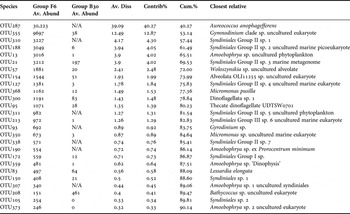
Av. Abund, average abundance; Av. Diss, average dissimilarity; Contrib%, percentage of contribution; Cum.%, cumulative percentage of contribution.
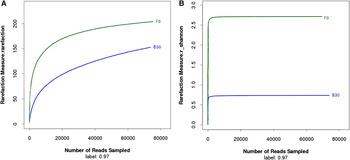
Shannon and Simpson diversity indices were calculated for all samples to give an indication of species diversity. Non-parametric ACE and Chao 1 estimators and rarefaction curves were used to estimate the OTU richness in this study (Table 4). The Shannon index indicated higher diversity in the aquaculture area, as well as rarefaction curves reaching saturation (Figure 5).
Rarefaction curves and rarefaction Shannon curves of operational taxonomic units (OTUs). (A) rarefaction curves; (B) rarefaction Shannon curves.

The species richness estimates of the two stations.

DISCUSSION
Our study sites, aquaculture waters (station F6) and open waters (station B30) showed distinct and dissimilar hydrographic features. In general, the main source of pollution from shellfish culture is the excreta of the shellfish, which can result in local anoxia of bottom sediments (Cao et al., Reference Cao, Wang, Yang, Yang, Yuan, Xiong and Diana2007). The seawater temperature, salinity and concentration of inorganic salt in the two environments were different. Notably, nitrate and silica concentrations were substantially elevated, and the primary productivity showed by the satellites map was significantly higher in the eutrophic aquaculture area compared with the contrasting station. In addition, Sun et al. (Reference Sun, Wang, Wang, Song, Shao and Zhen2014) found that the picoeukaryote count in the same aquaculture area in 2012 was about 3.23 × 10⁵ cells mL−1 while in the same open sea area it was about 5.24 × 10⁴. However, comparative study of the composition and genetic diversity of the picoeukaryote community in those two environments is still scant.
The present results showed that there are also strong differences of community composition in the two sites. In previous studies, the diversity of picoeukaryotes in different seas has been investigated. Cheung et al. (Reference Cheung, Au, Chu, Kwan and Wong2010) showed that coastal waters of Hong Kong were dominated by three super groups, the alveolates, stramenopiles and chlorophytes. Similar results were found in the north-eastern Red Sea coast (Acosta et al., Reference Acosta, Ngugi and Stingl2013), in the coast of the Gulf of Mexico (Rocke et al., Reference Rocke, Jing and Liu2013) and in our two stations. But at the level of dominating groups, dinoflagellates, prasinophytes and ciliates, B30 is more similar to these previous studies, and was particularly dissimilar with F6. For example, dinoflagellates and ciliates were both abundant in B30, but in F6, ciliates account for only a little.
Dinoflagellates are important components of aquatic environments, where they play various functional roles (Taylor, Reference Taylor1984). Although photosynthetic dinoflagellates are important primary producers in marine ecosystems, some bloom-forming species produce toxins that can cause illness and even death in humans (Zingone & Enevoldsen, Reference Zingone and Enevoldsen2000). These HAB species are particularly prevalent in warm, stratified and nutrient-enriched coastal waters (Smayda & Reynolds, Reference Smayda and Reynolds2003). Documented HAB events have increased substantially during recent decades as a result of extensive coastal eutrophication and, possibly, global climate change (Chambouvet et al., Reference Chambouvet, Morin, Marie and Guillou2008). Based on the environmental monitoring of the red tide monitoring area in Qinhuangdao, and the red tide records of the China Oceanic Information Network in 2001–2011, it is clear that HAB dinoflagellates often cause ‘red tides’ in this area (Wang et al., Reference Wang, He, Liu and Liu2013). According to current research, uncultured Gymnodinium sp., Woloszynskia sp., Gyrodinium sp. and Lessardia elongata were in the top 26 OTUs, all representing photosynthetic dinoflagellates. Furthermore, alongside their ‘red tide’ roles, these are also important food organisms for shellfish.
Ciliated protozoa are one of the main components of the microbial community and they play an important role in the functioning of microbial food webs, especially in terms of energy flow and element cycling (Zöllner et al., Reference Zöllner, Hoppe, Sommer and Jürgens2009). They act as primary producers in marine ecosystems and as consumers at different levels and thus play pivotal roles in the recovery and uptake of carbon nutrients and in their transfer to higher trophic levels (Kyewalyanga et al., Reference Kyewalyanga, Sathyendranath and Platt2002). Similar results were found in a study by Doherty et al. (Reference Doherty, Costas, McManus and Katz2007). In this study, free-living ciliates were more abundant in the open sea of B30, where they consisted mostly of pelagic species, such as species in the genus Strombidium. In contrast the eutrophic waters of F6 showed mostly periphytic species, such as Aspidisca leptaspis. These species locomote by relatively fast crawling on a substratum, and play an important role in water self-purification and wastewater-treatment processes. Some species of this type can be used as reliable indicators of water quality based on their higher tolerance to eutrophic or toxic environments than pelagic ones (Curds, Reference Curds1992). Notably, Myrionecta sp., a cosmopolitan, estuarine and neritic photosynthetic marine planktonic ciliate appeared in eutrophic F6 water, which is also known to cause serious ‘red-water’ blooms (Herfort et al., Reference Herfort, Peterson, Prahl, McCue, Needoba, Crump, Roegner, Campbell and Zuber2012).
Prasinophytes sequences recovered during this study included mainly uncultured Bathycoccus, Micromonas and Ostreococcus sp. within the order Mamiellales. These organisms are known to be more common in coastal areas than in open waters (Not et al., Reference Not, Massana, Latasa, Marie, Colson, Eikrem, Pedrós-Alió, Vaulot and Simon2005). We found that, although both samples shared comparable contributions of phylotype OTUs, prasinophytes were more abundant in open waters of B30 than in the eutrophic waters of F6. A similar result was found in a previous study using the cloning and 454 sequencing strategy (Cheung et al., Reference Cheung, Chu, Li, Kwan and Wong2008). Viprey et al. (Reference Viprey, Guillou, Ferréol and Vaulot2008) reported a greater dominance of Micromonas and Ostreococcus environmental sequences in relatively mesotrophic waters compared with contrasting coastal waters. Taken together, these results suggest that these genera are well adapted to coastal waters of intermediate productivity, although the role of water temperature should not be neglected (Lovejoy et al., Reference Lovejoy, Vincent, Bonilla, Roy, Martineau, Terrado, Potvin, Massana and Pedrós-Alió2007).
The top 26 OTUs were the main contributors to the average Bray–Curtis dissimilarity (97.07%) in both occurrence and abundance between the samples of the Qinhuangdao aquaculture area and the open area. The top one OTU was closely related to species belonging to pelagophyceae, and other OTUs belonged to dinophyceae and prasinophyceae.
Aureococcus anophagefferens (Pelagophyceae; DeYoe et al., Reference DeYoe, Chan and Suttle1995) is a picoplanktonic (~2–3 µm) alga that periodically blooms, dramatically causing ‘brown tide’ in North America, Africa and Asia (Gobler & Sunda, Reference Gobler and Sunda2012). Recently, large-scale brown tides have been reported in China, including present investigated waters of Qinhuangdao, northern China, where they have occurred in early summer for six consecutive years from 2009 to 2014 (Zhang et al., Reference Zhang, Qiu, Yu, Kong, Wang, Yan, Gobler and Zhou2012). Our result showed that A. anophagefferens was the most dissimilar OTU between the two stations; accounting for 40% of all the sequences in F6, but none in B30. While not recognized as a toxin producing alga, A. anophagefferens is classified as a harmful algal bloom (HAB) species as cell densities exceeding 1.7 × 10⁶ mL−1 are sufficient to effectively attenuate light reaching seagrasses and other photosynthetic organisms, which has caused degradation of seaweed beds (Bricelj & Lonsdale, Reference Bricelj and Lonsdale1997). Then, this HAB has plagued many coastal ecosystems in the eastern USA and South Africa since its discovery in 1985 (Lu et al., Reference Lu, Qi, Gu, Dai, Wang, Gao, Shen, Zhang, Yu and Lu2014). Indeed, the loss of Zostera marine, which is an important contributor to seaweed beds and preyed upon by scallop larvae, can lead to widespread shellfish mortality (Bricelj et al., Reference Bricelj, MacQuarrie and Schaffner2001). So, the abundance of A. anophagefferens found at the F6 station in our study appears to be the main reason for the large-scale brown tide in the Qinhuangdao aquaculture area, and needs special attention for monitoring in future.
It has been estimated that 7% of all known dinoflagellates are parasites of aquatic organisms, such as fish, crustaceans, annelids, appendicularians, radiolarians, ciliates, diatoms and other dinoflagellates (Drebes, Reference Drebes1984; Coats, Reference Coats1999). Among dinoflagellates, the Syndiniales group represents the largest portion of dinoflagellate sequences from various marine ecosystems (especially the <2 µm picoplankton fraction), and this group also comprises the majority of sequences for marine environment clone libraries (López-García et al., Reference López-García, Rodriguez-Valera, Pedrós-Alió and Moreira2001; Moon-van der Staay et al., Reference Moon-van der Staay, De Wachter and Vaulot2001; Not et al., Reference Not, Valentin, Romari, Lovejoy, Massana, Töbe, Vaulot and Medlin2007). Environmental sequences belonging to Amoebophrya have been detected in almost every marine ecosystem (Guillou et al., Reference Guillou, Viprey, Chambouvet, Welsh, Kirkham, Massana, Scanlan and Worden2008). The widespread existence of Amoebophrya sp. was ‘rediscovered’ by culture-independent methods and renamed as ‘novel alveolate group II’ (López-García et al., Reference López-García, Rodriguez-Valera, Pedrós-Alió and Moreira2001; Moon-van der Staay et al., Reference Moon-van der Staay, De Wachter and Vaulot2001; Díez et al., Reference Díez, Pedrós-Alió and Massana2001), but most of the reported clades are related solely to environmental sequence data. Most marine planktonic groups are potentially affected by these parasites, which like the viruses that control bacterial populations, play a top-down control role on their host populations. The distribution of the parasitic Amoebophryideae is closely related to the availability of nutrients. Amoebophrya sp. produce more dinospores under nutrient-replete conditions and they are more successful in infectivity than those produced by parasites grown at low nutrient concentrations (Yih & Coats, Reference Yih and Coats2000). Siano et al. (Reference Siano, Alves-de-Souza, Foulon, Bendif, Simon, Guillou and Not2011) have also observed a strong positive correlation between dinospore populations and nitrate levels. In Qinhuangdao aquaculture area, the nitrate plus nitrite concentration was more than 100 times higher (>128 µg L−1) than in the contrasting area. Amoebophrya sp. was an important contributor to the dissimilarity between the two stations. Toxic bloom-forming species of the dinoflagellate group are recognized as one of the most common hosts of Amoebophrya (Bai et al., Reference Bai, Adolf, Bachvaroff, Place and Coats2007). In this study, sequences affiliated with the host-specific Amoebophrya were widely related to several known species, for example Amoebophrya sp. ex Gymnodinium sp., Amoebophrya sp. ex Prorocentrum minimum, and Amoebophrya sp. ex Gonyaulax sp. (Johansson & Coats, Reference Johansson and Coats2002). The parasitic relationship between Amoebophrya sp. and bloom-forming species of dinoflagellates means that the red tide caused by those species might be restrained or possibly even degraded. Therefore, it might be speculated that the abundant Amoebophrya sp. could be one reason for the occurrence of ‘brown tide’ in this area. However, further study is needed to confirm their ecological roles in marine ecosystems.
This is the first study using the Illumina MiSeq platform to compare the picoeukaryotic diversity in surface waters of the Qinhuangdao scallop cultivation area and a contrasting offshore site. Water samples from two hydrographically different sites displayed different high-level taxonomic groups and phylotype OTUs for picoeukaryotes. The data suggest that aquaculture regions may develop very specific picoeukaryote communities which obtain higher diversity and more HAB species. With the rapid development of next-generation sequencing, the Illumina MiSeq platform sequencing technology has become an increasingly powerful tool for diversity surveys, aimed at a more comprehensive picture of marine picoeukaryotic diversity. Our research provides a basic dataset for the picoeukaryote community in an aquaculture eutrophication area, and will help in the understanding of brown tide issues.
SUPPLEMENTARY MATERIAL
To view supplementary material for this article, please visit http://dx.doi.org/10.1017/S0025315416000205
ACKNOWLEDGEMENTS
We thank the captain and crews of the RV ‘Dong Fang Hong 2’ for their support and the splendid atmosphere on board. We thank the chemistry group for chemical analyses.
FINANCIAL SUPPORT
Support for this work was provided by the National Natural Science Foundation of China (41076088, 31500339); Public Science and Technology Research Funds Projects of Ocean (201205031); China Postdoctoral Science Foundation (2015M570612); The Project Sponsored by the Scientific Research Foundation for the Returned Overseas Chinese Scholars, State Education Ministry.
CONFLICTS OF INTEREST
The authors declare no conflicts of interest.