Introduction
Children's sociolinguistic knowledge is circumscribed by the spaces they inhabit and the individuals with whom they interact. As their social position evolves and they develop a greater understanding of the social facts and sociolinguistic patterns around them, children gradually gain awareness of the adult community's sociolinguistic norms. For children who move from one community to another, acquisition of the sociolinguistic patterning of local features is mediated by several factors, including the complexity of linguistic constraints and access to speakers from the local community (Payne Reference Payne1976; Chambers Reference Chambers2002; Tagliamonte & Molfenter Reference Tagliamonte and Molfenter2007; Nycz Reference Nycz2015). Acquiring local sociolinguistic knowledge becomes far more complex, however, in settings featuring a high level of transnational migration, in which newcomer children do not necessarily take on local identities or share a common understanding of the boundaries and structure of the local speech community.
In the 1960s, sociologist Ruth Useem dubbed expatriate children ‘third-culture kids’, referring to their navigation of three cultural spheres: the culture of their parents’ home country, the culture of their present residence, and the transnational, hybrid expatriate culture (Useem & Useem Reference Useem and Useem1967; Useem & Downie Reference Useem and Downie1976). Useem's original model characterizes Western expatriates as constructing hybrid identities while local children (i.e. those native to the community) remain immersed in their native cultures. But in the context of modern globalization, particularly in urban contexts that encompass both local and globalized elements, expatriate children are not the only third-culture kids: local children are also exposed to a complex array of intersecting cultures, both within the local cultural sphere and in their contact with transnational migrant cultures. It is therefore equally important to investigate how local children in transnational migration settings develop their knowledge of sociolinguistic patterns in these communities, in addition to examining how children who have migrated develop this knowledge.
Our study explores expatriate and local children's understandings of how English is spoken by different community members in the city-state of Singapore. Over the past twenty-five years, Singapore has rapidly expanded and developed into an international hub for transnational migrants across the socioeconomic spectrum: 43% of low-skill and 21% of mid-to-high-skill labor is now being performed by foreign work-visa holders (National Population and Talent Division 2016). Already a multicultural, multilingual society since its founding as a British colonial port in 1819, modern Singapore typifies how globalization and transnational migration has further diversified and transformed the sociolinguistic landscape of postcolonial urban communities.
The extent to which children in the local and expatriate communities in Singapore share sociolinguistic norms depends crucially on the spaces they inhabit and the sociolinguistic patterns to which they are exposed. In recent years, the degree of separation of expatriate and local children in Singapore has decreased, although a certain segment of expatriate children continue to spend most of their time in spaces catering to expatriates or to specific nationalities, such as international schools and social clubs (Beaverstock Reference Beaverstock2011). Nonetheless, children of transnational migrants in Singapore are increasingly intermingling with local Singaporeans by attending local schools and enrichment activities, living in government-administered public housing, and shopping and dining in ‘heartland’ venues. At the same time, more Singaporeans have adopted lifestyles formerly associated with expatriates, such as living in private condominiums, traveling overseas, and shopping in high-end malls.
Singapore is a particularly intriguing site for the study of children's understanding of English varieties due to its position in the so-called ‘outer circle’ of English, as opposed to inner circle nations such as Britain, America, and Australia, and expanding circle nations such as China (Kachru Reference Kachru, Bolton and Kachru2006:242–43).Footnote 1 Outer-circle nations were originally characterized as those in which English plays a major role in local institutions and is widely learned as a nonnative language while the community upholds an exonormative standard (for example, Received Pronunciation). Although Singapore used to meet this definition, its status in the outer circle has become problematic as Singapore English continues to move towards greater indigenization and endonormativity (Schneider Reference Schneider2007:160–61). As of 2015, English has become the most commonly spoken home language in Singapore and appears poised to become the dominant language of most Singaporeans in the coming years (Department of Statistics Singapore 2015). Nonetheless, many still perceive Singapore English to be a nonnative variety, and local institutions, such as the school system, have continued to nominally uphold British English norms (Park & Wee Reference Park and Wee2009:399; Rubdy Reference Rubdy, Wee, Pakir and Lim2010:218). As a result of the ambiguous status of Singapore English, expatriate children, and even local children, may experience various social pressures to avoid acquiring the local variety, and may develop varied understandings of the status of the local variety in relation to other English varieties prevalent in Singapore.
The present study addresses two primary research questions: how do children's social circumstances shape (i) their knowledge of the regional origins of varieties present in Singapore, and (ii) their evaluation of the social positions occupied by speakers of these varieties? We will focus in particular on contrasting the sociolinguistic knowledge of native Singaporean children with the children of expatriates who have moved to Singapore, and on further contrasting children who attend local government-run schools with those who do not.
In the following section we introduce relevant background information, including previous research on children's acquisition of sociolinguistic knowledge, transnational migration in Singapore, the local status of the English varieties to be studied, and children's schooling options. The subsequent sections present the methods, participants, and findings of our study encompassing two tasks that evaluate region identification and perception of occupation, respectively. We then discuss these findings and preview future directions being taken in our larger project investigating the sociolinguistic development of children in Singapore.
Background: Child acquisition of sociolinguistic knowledge
Identification of regional dialects
One crucial step in children's development of an understanding of sociolinguistic patterns is the ability to perceptually group a set of features into a cohesive dialect and distinguish that dialect from others. Recent research has begun to explore at what point children can discriminate between dialects. Floccia, Butler, Girard, & Goslin (Reference Floccia, Butler, Girard and Goslin2009) found that seven-year-olds, but not five-year-olds, could distinguish between their local Plymouth accent versus Irish and French accents. Jeffries, Foulkes, & Llamas (Reference Jeffries, Foulkes and Llamas2014) found that preschool-aged children in Yorkshire were able to group speakers by their use of phonetic features corresponding to Yorkshire versus Southern English accents, and that this ability improved significantly from ages three to four. The authors also observed that children with parents who were not from Yorkshire outperformed children with local parents in the condition requiring matching of different phonemes based on knowledge of regional variation patterns. Jeffries (Reference Jeffries2015), also studying Yorkshire preschoolers, found that children were more likely to confuse a novel speaker with a familiar speaker when the novel speaker had the same regional accent. She again observed that children with parents who were not from Yorkshire outperformed others in the speaker recognition task. Taken together, these studies suggest that exposure to a wider variety of English dialects facilitates the development of knowledge of regional variation and cross-dialect linguistic processing.
While the research described above has investigated whether children are able to classify speakers as belonging to similar versus different dialect groups, this work has not addressed whether children have the sociolinguistic knowledge necessary to explicitly label a set of features as, for example, Yorkshire English. Some scholars assume that young children are incapable of performing this sort of task: Chambers (Reference Chambers2002:122) proposes that children do not have any conscious awareness of accent differences until ‘well into [their] school years’, arguing that this accounts for reports of children of immigrants claiming to be unaware that their parents have nonnative accents. There is little research that tests this anecdotal claim or investigates exactly when, if ever, children gain the sociolinguistic knowledge needed to identify particular language varieties. Indeed, knowledge of regional variation has been found to be somewhat limited among adolescents and even adults. Williams, Garrett, & Coupland (Reference Williams, Garrett, Coupland and Preston1999:352), studying adolescent listeners from different parts of Wales, found that they performed poorly in identifying the regional origins of speakers, including those from their own region. Clopper & Pisoni (Reference Clopper and Pisoni2004:125) found that American adult listeners were able to select the regional origin of a US speaker out of six alternatives with only approximately 33% accuracy. Preston and other researchers in folk linguistics and perceptual dialectology have convincingly demonstrated that individuals’ knowledge of the geographic distribution and features of regional dialects is mediated by various language ideologies and often differs from academics’ understanding of dialects (see Preston Reference Preston and Preston1999, Reference Preston1989; Long & Preston Reference Long and Preston2002).
Regarding adult English speakers’ ability to identify outer and expanding-circle varieties, McKenzie (Reference McKenzie2015:155) found that, while 93.3% of British university student listeners were able to identify Indian English, only 11.9% could identify Chinese-accented English, and only 15.9% reported that this variety came from anywhere in East Asia, despite the large numbers of Chinese students attending the university from which participants were drawn. McKenzie's finding underscores that, when it comes to sociolinguistic knowledge of this sort, the presence of speakers in the community is not necessarily sufficient to ensure familiarity.
Little investigation has been done regarding Singaporeans’ awareness of regional dialects. Chen (Reference Chen1990), in an undergraduate thesis on the language attitudes of 160 Singaporean secondary-school students and teachers, found that while 98% and 94% of participants were able to identify the origins of colloquial and standard Singapore English speakers respectively, only 63% could accurately identify a Received Pronunciation speaker as being from Britain, 47% could identify an American speaker, and 6.8% an educated Australian English speaker (Chen Reference Chen1990:49).Footnote 2 Chen's study provides a glimpse into the more limited sociolinguistic world of Singapore in 1990, when the country had half the population (and less than one fifth of the foreign migrants) that it does today.
Contemporary Singapore, in contrast, has a few key features that may boost children's understanding of regional variation in English. First, today's Singapore is a cosmopolitan, ‘superdiverse’ environment in which many individuals hold liminal and transnational identities. Second, as Singapore English is an outer-circle variety lacking full legitimacy as a ‘native’ variety, English language education in Singapore is, to some extent, exonormative, meaning that both local and expatriate children in Singapore are often encouraged to target external sources of English. Additionally, Singapore is a small country with limited resources to generate local media content, meaning that a large proportion of English language media consumed in Singapore is of nonlocal origin or involves nonlocal speakers. Finally, due to historical, geographical, and cultural factors, Singapore is positioned to have high levels of access to multiple English-speaking regions (America, Britain, Australia, India, The Philippines, etc.), rather than receiving an overwhelming amount of English exposure from a single external source. All of these factors conspire to turn Singapore into an intensive sociolinguistic classroom for regional English variation.
It is inevitable that certain regional or national varieties of English will become more noteworthy to children earlier in life; this process may not correspond straightforwardly to the level of exposure children have to a particular variety, or even to the perceptual distinctiveness of the variety, but rather to its markedness within children's communities. For example, it is possible that expatriate children living in Singapore, rather than local children, will gain an earlier awareness of what constitutes Singapore English, as this category is likely to be more prominent as an overt label in their social world.
Social evaluation of linguistic variation
While the development of children's ability to distinguish between dialects is a relatively new object of study in sociolinguistics, scholars have more extensively investigated how and when children come to connect patterns of speaking to social meanings. Children's understanding of social meaning in linguistic variation is shaped both directly, by personal experience with individuals in certain social roles and groups, and indirectly, by development of general understandings about the world. Previous work has demonstrated that children gain knowledge of variation via interaction with others in common social roles, most notably caregivers (Kerswill Reference Kerswill1996; Foulkes, Docherty, & Watt Reference Foulkes, Docherty and Watt2005; Smith, Durham, & Fortune Reference Smith, Durham and Fortune2007; Smith, Durham, & Richards Reference Smith and Richards2013), peer group members (Kerswill Reference Kerswill1996), and teachers (Mougeon, Nadasdi, & Rehner Reference Mougeon, Nadasdi and Rehner2010; Starr Reference Starr2016). By as early as two and a half years of age, children are able to modify their speech in appropriate ways to portray various familiar social roles and speakers of differential status in play scenarios (Corsaro Reference Corsaro1979; Andersen Reference Andersen1984).
Just as interaction with interlocutors in certain social roles may vary considerably from child to child, children's knowledge of sociolinguistic variation indirectly gained by exposure to general social concepts may vary depending upon their life circumstances. Hirschfield & Gelman (Reference Hirschfield and Gelman1997:216) propose that children's knowledge of between-language variation, for example, develops in relation to children's understanding of the existence of different nation-states and the general notion of cultural variation. We therefore assume that children do not come to understand that individuals from different countries speak with different accents in English solely through independent contact with speakers from each country, but rather that children acquire the general notion that different countries use different languages and dialects, and subsequently formulate an assumption that speakers from each country will use a distinctive accent in English. Similarly, children may develop an understanding of the social roles performed by speakers of certain varieties based upon general sociolinguistic knowledge rather than direct experience: for example, based upon a mapping of their perception of the prestige of an occupation to the socioeconomic power of each national group.
The present study uses an occupation-based approach to explore children's social evaluation of regional accents and their familiarity with the local sociolinguistic landscape. The use of occupation as a proxy for status was a common methodology in early language-attitude studies (Labov Reference Labov1966; Bouchard Reference Bouchard1969; R. Lee Reference Lee1971; Ryan, Carranza, & Moffie Reference Ryan, Carranza; and Moffie1977). While perhaps old-fashioned in a Western setting, the occupation approach is well suited to Singapore, in which the labor market is highly stratified by nationality and encompasses large social inequalities, as we address in the following section. Moreover, for children, judging a speaker's occupation is a more familiar and concrete task than rating abstract notions such as ‘educated’. The use of occupation in this study also allows us to tease apart whether children's evaluation of speakers reflects specific knowledge of the labor market or overall prestige, thus addressing the broader question of whether children's sociolinguistic knowledge is derived from direct experience with speakers in different social roles or from indirect knowledge of general social facts.
Background: Transnational migration and education in Singapore
Singapore's transnational labor market
Singapore's citizen population is the product of multiple waves of immigration over several centuries, primarily from Southern China, India, and the Malay Archipelago. Over the past three decades, as the city-state has experienced rapid economic growth, recruitment of foreign workers has accelerated considerably (Yeoh & Lin Reference Yeoh and Lin2013). In 2015, out of a total population of 5.54 million, 2.16 million were noncitizens (Department of Statistics Singapore 2016). When permanent residents and naturalized citizens are taken into consideration, it appears that a majority of individuals living in Singapore today were not born in Singapore (The Economist 2015).
Transnational migrants in Singapore come from a wide range of countries and speak many different languages: most notably for the present study, migrants use a diverse set of Englishes. In addition to Singapore English, the present study incorporates one variety from each ‘circle’ of English (Kachru Reference Kachru, Bolton and Kachru2006): Australian English from the inner circle, Filipino English from the outer circle, and Northern-China-accented English from the expanding circle. These varieties have been selected as they are not ubiquitous in media but are prevalent in Singaporean society, meaning that sociolinguistic knowledge regarding these varieties is likely to have come primarily via in-person exposure. The following paragraphs briefly introduce the social situation of speakers of these varieties in Singapore, followed by a corresponding description of the status of Singapore English speakers.
Australians
Singapore has close economic, political, and cultural ties to Australia. Thousands of Singaporeans travel to Australia each year for education, employment, and tourism (Asia Society 2012; Davie Reference Davie2015; Teng Reference Teng2016). In addition to the estimated 20,000 Australians living in Singapore, Australia is Singapore's largest source of English-speaking tourists, attracting over one million visitors per year (Singapore Tourism Board 2013). Australians working in Singapore are primarily high-skill, high-income professionals.
Filipinos
There are approximately 167,000 Filipinos working in Singapore: 70,000 of these are foreign domestic workers, meaning live-in maids (locally called ‘helpers’) (T. Wong Reference Wong2014; A. Tan Reference Tan2015). While Filipinos have worked as maids in Singapore for many decades, a recent labor shortage has led to a dramatic influx of educated Filipino workers in higher-earning positions, including in the service, healthcare, and education sectors (T. Wong Reference Wong2014).
Mainland Chinese
The Singapore government began encouraging migration from Mainland China in the 1990s (Yeoh & Lin Reference Yeoh and Lin2013). While this immigration drive initially focused on admitting high-skill professionals and then students, in the late 2000s Singapore began to recruit large numbers of unskilled workers from China for jobs such as bus driving (C. Wong Reference Wong2013; Lim Reference Lim and Lian2016). Mainlanders are now ubiquitous in a variety of job sectors across socioeconomic levels: unlike Filipinos, however, Mainlanders are not eligible for foreign domestic worker visas and thus do not work as maids (Ministry of Manpower 2016).
The rapid increase in Mainland Chinese migrants has become the primary focus of anti-immigrant rhetoric and discontent in Singapore (Jacobs Reference Jacobs2012; Yeoh & Lin Reference Yeoh and Lin2013). Although almost three quarters of Singaporeans are of Chinese ethnicity, a vast gulf is perceived to exist between Singaporean Chinese and recent migrants from Mainland China in terms of behavior, culture, and language. Singaporean Chinese generally descend from immigrants from Southern China who arrived in the nineteenth and early twentieth centuries, or from Straits Chinese who arrived far earlier. Because Singapore English is a contact language with Malay and Southern Chinese varieties serving as its primary substrates (Ansaldo Reference Ansaldo and Lim2004), there are many differences between Singapore English and the Mandarin-influenced English spoken by most migrants from Mainland China.
Singaporeans
Native-born Singaporeans skew towards the top of the socioeconomic ladder relative to nonnatives; Singaporeans make up roughly half of the mid-tier service sector and constitute a large majority of high-skill professionals (National Population and Talent Division 2012). While certain low-skill jobs, such as taxi driving, are still being done by Singaporeans, many jobs in this class, such as domestic helper and construction worker, are almost entirely performed by foreigners.
As previously discussed, native-born Singaporeans may be a minority of those living in Singapore today. We therefore might wonder about the extent to which those living in the expatriate community are aware of Singapore English. Despite the cosmopolitan mixture of nationalities in Singapore, Singapore English is most likely a variety familiar to residents across diverse subcommunities. In a nation perceived to have few unique cultural products, Colloquial Singapore English (a.k.a. ‘Singlish’) is enregistered and highly visible as a cultural commodity: it is seen as emblematic of Singapore's multiracial, postcolonial culture (Chng Reference Chng, Rubdy and Tan2008). Singlish is routinely highlighted in media and official nation-building events as one of the most prominent cultural symbols of Singapore and has become commodified in the form of T-shirts, notebooks, and other goods consumed by both tourists and locals (Low Reference Low2015; see Johnstone Reference Johnstone2009).
Schools in Singapore
This study investigates how children in Singapore from different backgrounds understand the local sociolinguistic landscape. The type of school children attend plays a crucial role in determining their exposure to and sociolinguistic knowledge of dialects not spoken in the home, particularly in the Singaporean context.
‘Local’ (government-administered) schools in Singapore have been universally English-medium since 1987 (Pakir Reference Pakir1991); because most teachers are locals, the variety used in classrooms is predominantly Singapore English. Although most students in local schools are Singaporean, as the reputation of the Singapore school system has risen internationally and many employers have stopped subsidizing international school fees, expatriate enrollment in local schools has increased (Team Expat 2015; Tulshyan Reference Tulshyan2015). Local schools are also a draw for ‘educational migrants’, students from other Asian countries who move to Singapore specifically to attend school (Kang Reference Kang, Plüss and Chan2012; Huang & Yeoh Reference Huang and Yeoh2005). In addition to evenly distributing races among schools, the government limits the number of foreigners in each school (the precise quota for foreign students has not been made public). This tendency to distribute foreign students is significant for the present study, because it means they are widely dispersed throughout the local school system and do not attend enclave schools with large numbers of foreigners and few Singaporeans. As of 2015, noncitizens made up 14% of local school students overall (Teng Reference Teng2015).
Virtually all schools in Singapore that are not part of the local government-administered system are ‘international’ schools (officially termed ‘foreign system schools’), many of which are overseen by or affiliated with other countries. These schools feature varying levels of national diversity among their student body and different degrees of national versus global affiliation. Avondale Grammar School, for example, has 69% Australian students and follows the Australian National Curriculum (HoneyKids 2016), while United World College Southeast Asia has students from ninety-one nationalities and offers the International Baccalaureate Diploma (UWCSEA 2016). For a variety of reasons, Singaporean citizens rarely attend international schools: most significantly, Singaporeans must obtain government permission to opt out of local schools by demonstrating that their child is unable to cope with the local system, generally due to time spent abroad or learning disabilities (P. Lee Reference Lee2013; Ministry of Education 2016b). As of 2013, Singaporean citizens comprised only 4% of the total enrollment in international schools (P. Lee Reference Lee2013).
Due to recent restrictions on local-school admissions and high international-school fees, an increasing number of expatriate children are engaged in alternative schooling, including online schools, independent tuition, and home-schooling (Team Expat 2016). Some Singaporeans also home-school their children, albeit at low rates due to government restrictions (Chua Reference Chua2012; Marican Reference Marican2016; Ministry of Education 2016a).
Methodology
Data collection
The two tasks in the social evaluation study presented here represent a portion of a larger project, entitled Voices of Children in Singapore, that investigates the sociolinguistic development of Singapore's children in both English and Mandarin. The social evaluation study was administered as part of a longer English-language session involving several tasks: participants completed the social evaluation study, a reading task, a cross-dialect picture identification task, a semi-structured interview, and an expressive vocabulary assessment. Sessions were conducted by Singaporean undergraduate students (the co-authors of this article). Parents of participants also completed a background questionnaire detailing their child's migration history, languages used at home, school attendance, and so on.
The social evaluation study was administered on a computer using headphones in a quiet space at the participant's home or in the experimental linguistics laboratory at the National University of Singapore. The study was developed and administered on the OpenSesame software platform (Mathôt, Schreij, & Theeuwes Reference Mathôt, Schreij and Theeuwes2012). To engage children's attention, the study was framed as a game, with participants entering in their responses using a USB game controller. The game, titled ‘Flags and animals’, consisted of a general introduction followed by three game ‘levels’, corresponding to tasks. In the first level, participants completed a flag-identification training task to familiarize them with the controller and the flags of the four countries involved in the study (Australia, China, the Philippines, and Singapore). The second and third levels consisted of the region identification and occupation judgment tasks that are discussed in detail in the following sections. In each of the two main tasks, participants were given positive feedback for each item regardless of their response; at the end of the tasks, they were informed that they had attained a gold star for their performance and a new ‘high score’. The game was narrated by a cartoon squirrel voiced by a male undergraduate student who grew up as a mobile expatriate and uses a mixture of Indian and American English features. This speaker was selected to contrast with the female speakers of tested varieties in the main tasks and to avoid priming participants for any of the four tested varieties.
The vocabulary assessment was performed using the Pearson Expressive Vocabulary Test, Second Edition (Pearson EVT-2). This assessment tool, developed in the United States, is a guided picture description task producing standardized expressive-vocabulary scores that have been normalized by Pearson according to the performance of a sample group of American speakers (Pearson 2016).Footnote 3
Stimuli
The two main social evaluation tasks used speech stimuli recorded by twelve speakers, including three speakers of each of four varieties: Australian English (AusE), Northern China-accented English (NChiE),Footnote 4 Filipino English (FilE), and Singapore English (SgE). Speakers were female undergraduates, graduate students, and postdoctoral fellows in their late teens and twenties.Footnote 5 Stimuli were recorded in a sound-attenuated studio at the National University of Singapore, except for two of the Australian English speakers, who were recorded in phonetics laboratories in Australia.
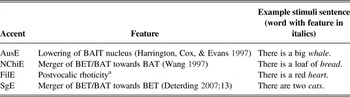
There is a wide array of differences between these four accents throughout the segmental and suprasegmental levels. Nonetheless, to maximize the distinctiveness of the accents in the task, speakers were recorded reading sentences that incorporated certain features that distinguish each accent from the other three (see Table 1).
Accent features incorporated into recorded stimuli.

a While some speakers of NChiE and SgE variably realize postvocalic /r/, FilE uniformly uses postvocalic rhoticity due to influence from American English (Millward & Hayes Reference Millward and Hayes2011:399). Moreover, the rhoticity in FilE is perceptually distinctive, perhaps due to duration, although the authors are unaware of previous phonetic research on this feature. Postvocalic rhoticity is a highlighted feature in Singaporean imitations of FilE in media.
As indicated in Table 1, all stimuli consisted of brief sentences describing a visual scene. The sentences were paired with corresponding images for each task; this methodology is described in more detail in the following sections.
Participants
A total of 115 children aged five to nineteen participated in the English session for Voices of Children in Singapore. Of these, 114 completed the social evaluation study and are included in the following analysis; one was unable to complete the tasks due to computer problems.
Participants included fifty children categorized as ‘Singaporeans’ and sixty-four categorized as ‘Expats’. For the purposes of this study, we have defined the category of ‘Singaporean’ relatively conservatively, as we are interested in contrasting those who are familiar with local sociolinguistic norms with those who may not be. Thus, Singaporeans are defined here as only those individuals who (i) were born in Singapore or moved to Singapore before one year of age, and (ii) have at least one parent who was born in Singapore. Children who do not meet these criteria are referred to as ‘Expats’, a term adopted here for expediency, as most of the participants in this category meet the traditional definition of expatriate, meaning that their parents are high-skilled, highly educated professionals from a developed country (Gatti Reference Gatti2009). Nonetheless, these categories should be taken with the caveat that the question of who counts as a Singaporean in Singapore is a complex one. The country does not automatically grant citizenship based upon birthplace, but has been liberal with naturalization, allowing many individuals, particularly immigrants from Malaysia and China, to become ‘new citizens’ in recent decades (Jacobs Reference Jacobs2012; Yeoh & Lin Reference Yeoh and Lin2013). Conversely, native-born Singaporeans often spend time overseas for study or work, sometimes obtaining foreign citizenship. As a result, many children in Singapore do not neatly fit into the boxes of Singaporean or Expat; in particular, children of parents from Malaysia, Indonesia, China, and India who have grown up in Singapore may be considered ‘Singaporean’ by locals to varying degrees.
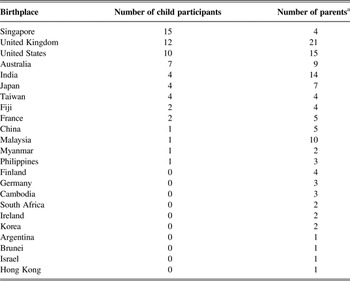
All participants in the study had lived in Singapore for at least one year. 60.9% of Expat participants were either born in or have at least one parent born in an inner-circle English nation, most commonly the United Kingdom and United States. An additional 34.3% were born in or have at least one parent born in an outer-circle English nation, most commonly India (see Appendix A for further details). 82% of Singaporean and 92.2% of Expat participants reported exposure to English from before age three; all participants had begun learning English by age five. All Singaporean and 96.8% of Expat participants were spoken to in English at home at least some of the time. All participants were attending schools or other educational programs in which English was a major medium of instruction (including three children enrolled in Mandarin-English two-way immersion programs), with the exception of two English-speaking Expat children attending a French-medium school.
Participants’ school attendance by background class is given in Table 2.
Number of participants currently attending various school types (N = 114).

a The one Expat student in home-schooling attended a local kindergarten until the prior year, and therefore is grouped with Expats enrolled in local schools.
As discussed in the previous section, few of the Singaporean participants are enrolled in nonlocal schooling due to government restrictions.
Region identification task
Task description
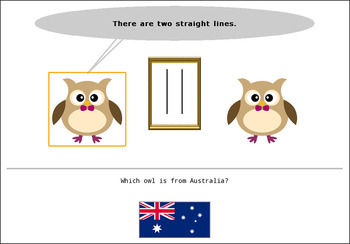
In the introduction to the region task, participants were presented with an animated cartoon scenario in which a group of owls were visiting an art museum to look at paintings. Participants were told that, although the owls all looked the same, in fact some of them were from Singapore, some were from Australia, some were from China, and some were from the Philippines. The narrator suggested that the participant might be able to figure out where each owl was from by listening to them talk (see Appendix B for complete script). Participants then completed a pair discrimination task: for each item, participants were presented with two owls looking at a framed image representing a ‘painting’ in the museum. The owls each spoke the same sentence describing the painting (sentences included the distinctive pronunciation feature corresponding to the country for each item; see Table 1). Each of the two audio clips was played twice in a row, accompanied by a speech bubble with text and a box outline indicating which owl was speaking (see Figure 1). After hearing the two owls speak, participants selected the owl they believed was from a particular country (e.g. Australia).
Screenshot of example item from region identification task.

The region identification task was untimed; participants’ responses and response times were recorded by OpenSesame. Participants completed one training item first, followed by three randomized blocks containing four randomized items each. Participants were randomly assigned to one of two groups, with each group hearing a different set of speakers in the region identification task versus the following occupation judgment task.
Findings
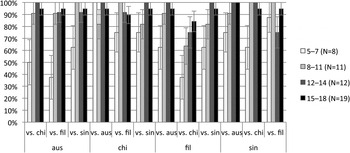
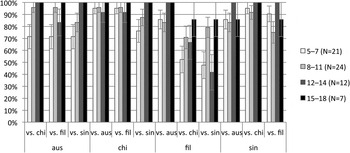
Figures 2 and 3 illustrate Singaporean and Expat participant accuracy in the region identification task by pair comparison type, with participants grouped into age bins of three to four years. Accuracy is given for each regional accent condition, subdivided according to the distractor speaker in the pair (e.g. under the category ‘aus’, ‘vs. chi’ means that the two speakers in the task were speakers of AusE and NChiE, and the participant was asked to identify which speaker was from Australia).
Region identification task: Singaporean participants by age group (N = 50).

Region identification task: Expat participants by age group (N = 64).

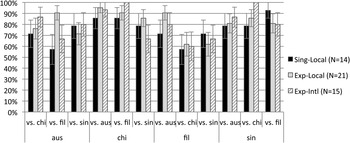
For the Singaporean children in Figure 2, a dramatic jump is evident between the youngest age group, five to seven, and the older groups. In the case of AusE, for example, Singaporean children in the youngest group do not perform significantly better than chance (Fischer's Exact p = 0.613), while in the eight to eleven group this performance leaps up to over 90% accuracy for all three comparisons. In contrast, the youngest children show high awareness of NChiE, performing at over 70% accuracy for each comparison at significantly above chance level (FE p = .0152). Overall, by the age of eight, Singaporean children perform almost at ceiling in this task, with the exception of the FilE vs. NChiE and FilE vs. SgE conditions.
Moving to the Expat children in Figure 3, some contrasts with Singaporean children are immediately apparent. First, the youngest group of Expat children can identify all accents significantly above chance level, with the exception of the FilE vs. NChiE and FilE vs. SgE comparisons—the same two pairs that caused trouble for Singaporean children. As predicted, Expat children in the youngest age group show a greater ability to identify SgE than Singaporean children in all three comparison conditions. This finding suggests that Expat children become familiar with the sociolinguistic category of ‘Singaporean’ earlier in life than Singaporean children do.
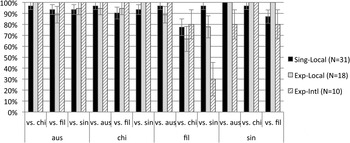
Figures 4 and 5 show the performance of participants in the three major background classes—Singaporeans enrolled in local schools, Expats enrolled in local schools, and Expats enrolled in international schools—in age brackets of below ten and above ten years old (these figures exclude the five Singaporean participants enrolled in international schools and home-schooling). Figure 4 demonstrates that the strong performance of younger Expat children in the region identification task is not accounted for solely by those attending local schools: in fact, younger Expat-Intl children slightly outperform the Expat-Local group in SgE identification. By contrast, Figure 5 reveals that some of the poor performance observed among older Expat children is accounted for by the Expat-Intl group. Most notably, it is older Expat-Intl children who show relatively poor performance in the FilE vs. SgE, SgE vs. AusE, and SgE vs. FilE conditions, while Expat-Local children perform more comparably to Singaporean children.
Region identification task: Children five to nine years old, by nationality and school type (N = 50).

Region identification task: Children ten to nineteen years old, by nationality and school type (N = 59).

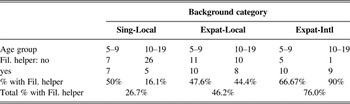
The fact that Expat-Intl participants perform relatively poorly in FilE comparisons is notable given the distribution of Filipino domestic workers among participants. Table 3 indicates the number of participants from each major background category who currently have or have had a domestic worker from the Philippines in their home.
Distribution of Sing-Local, Expat-Local, and Expat-Intl participants with Filipino domestic helpers (N = 109).

Filipino domestic workers command higher salaries than those from other countries, and thus are more heavily represented at the higher end of the socioeconomic spectrum; this is reflected in their distribution among the participant classes. Although all but one of the older Expat students attending international schools have had Filipino helpers, they can only identify FilE at 77.8% accuracy overall; in contrast, older Singaporean local school students, only 16.1% of whom have had Filipino helpers, can identify FilE at over 90% accuracy. When participants are further categorized according to how many hours of exposure to FilE they have each week from caregivers, there is no apparent correlation between FilE exposure in the home and the ability to identify FilE. We therefore conclude that the major source of participants’ sociolinguistic knowledge of FilE is likely to be exposure via noncaregivers outside the home.
Mixed-effects models were generated in Rbrul (Johnson Reference Johnson2009) to identify significant factors predicting correct region identification for the four accent regions while controlling for the random effect of participant. Fixed factors tested included age, EVT-2 percentile, national background, school type, local experience, helper background, speaker, and speaker pair comparison.
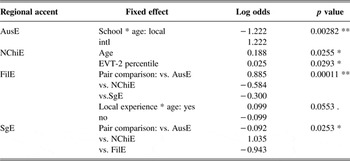
Table 4 shows the significant fixed effects for each region (see Appendix C for complete models). For AusE, there is a significant interaction between school type and age, such that increasing age corresponds to a greater increase in accuracy among international school students. For NChiE, older participants and those with a higher normalized vocabulary score are significantly more likely to respond correctly. For FilE, a significant difference was found between the pair comparisons: this variety was correctly identified more often when paired with an AusE distractor speaker and least often when paired with a NChiE distractor speaker. Correct identification of FilE was also marginally significantly predicted by an interaction between age and the binary category of ‘local experience’, which contrasts Expats in international schools with the other three groups of students, all of whom have greater exposure to local norms, either via school or personal background. As suggested in Figure 5, correct identification increased more with age for participants with local experience than for the Expat-Intl group. For SgE, the only significant effect found was pair comparison, such that NChiE distractor speakers yielded highest accuracy and FilE distractor speakers lowest accuracy.
Fixed factors predicting correct identification of each regional accent in Rbrul mixed-effects models including participant as random effect. Log odds indicate effect size and direction (see Appendix C) (. p < 0.1, * p < 0.05, ** p < 0.01).

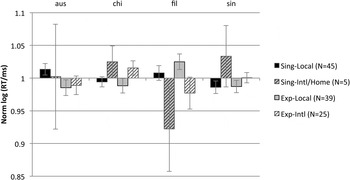
In addition to rate of correct responses, the length of time it took participants to correctly identify speakers’ regional origins may be helpful in revealing differences between children of different backgrounds. To account for potential differences in children's overall speed, particularly between different age groups, reaction time was normalized by taking the log transform of the reaction time in milliseconds and dividing it by the participant's average log reaction time for the task. This normalized measure therefore reflects whether the participant took a relatively short versus long time to enter in a response on a particular item, with numbers below one indicating a relatively fast response. Figure 6 shows normalized reaction times for identifying speakers from each region, only for those items that participants answered correctly. Overall, it appears that AusE reaction time follows a ‘national background’ pattern, in which both Expat groups are relatively fast at identifying AusE, while the other three regional accents follow a ‘school attendance’ pattern, with both Singaporean and Expat children attending local schools faster at identifying NChiE and SgE but slower at identifying FilE. A mixed-effects model in Rbrul identifies the interaction of school attendance and region as significant (p = 0.00411; see Appendix C).
Log of reaction time for correct responses, normalized by participant's average reaction time for region identification task (N = 114).

Keeping the findings of the region identification task in mind, we now move to the occupation judgment task, followed by further discussion of both sets of results.
Occupation judgment task
Task description
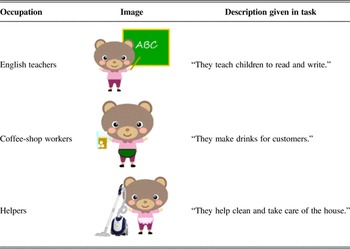
The occupation task used a methodology similar to the region task, with owls replaced by bears at the art museum in the introductory scenario. Participants were told that the bears all looked the same, but actually did three different jobs: English teacher, coffee-shop worker, and helper (see Appendix B for complete script). The occupations were each illustrated and described as shown in Table 5.Footnote 6
Occupations and corresponding visual presentations and description given in occupation judgment task.

The occupations selected for the task represent three major labor sectors in Singapore: professionals, service jobs, and foreign domestic workers. These particular occupations were chosen as they were likely to be familiar to children in Singapore, had clear social stratification, and were easy to illustrate and explain. Teachers are a relevant high-skill profession for school-aged children, for obvious reasons. Among jobs in the service sector, coffee-shop workers are likely to be particularly familiar to children: the coffee shop, or kopitiam, is a prominent cultural institution in Singapore. The bear coffee-shop worker in the study is presented as carrying a brown drink with ice that could represent iced coffee or tea but also Milo peng, a popular drink among children. The helper (or maid) is another familiar figure to children: 65% of our participants reported having a helper. Even for those children who do not have a helper themselves, helpers are a familiar sight as they commonly perform childcare tasks, such as accompanying children to classes. The helper is represented as holding a vacuum cleaner and is described as taking care of the house to emphasize that she is a domestic worker, rather than a janitor or cleaner.
In contrast to the region identification task, only one speaker was presented at a time in the occupation judgment task. For each item, a bear was presented with a ‘painting’ from the art museum; as in the previous task, the sentence stimulus was played twice and presented in text and audio form. Participants were asked to respond to the question “is this bear a [profession]?” by selecting ‘yes’ or ‘no’. Participants completed one training item followed by three randomized blocks of six randomized items each. As discussed in the previous section, individual participants did not hear the same speakers across the two tasks: participants were assigned to one of two groups that collectively judged all speakers in all conditions. No sentences were repeated from the previous task.
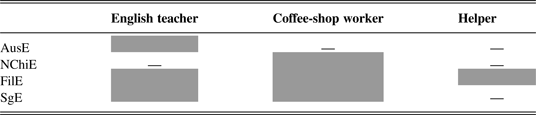
Based on the earlier introduction of the Singapore transnational labor market, we already have some idea of how these occupations are situated in relation to the four regional accents. Table 6 gives a rough representation of how speakers from each region are distributed in these three occupations.
Jobs performed by speakers of each English variety (indicated in gray).

Two of the regional accents, AusE and NChiE, are only compatible with a single occupation category. We therefore expect that, if children are familiar with the local labor market and are rating occupations accordingly, they will show higher certainty for speakers from these two regions. We also predict that, based on prior research regarding how humans lack sensitivity to the base-rate frequency of outcomes and tend to evaluate probability by representativeness (see Tversky & Kahneman Reference Tversky and Kahneman1974), children will rate FilE speakers as very likely to be helpers because they are highly representative of the category of helpers, even though this is irrational relative to the actual distribution of FilE speakers in the labor market. Along similar lines, children may also show an overall bias towards assigning speakers to the helper occupation, because this occupation is exclusively performed by women, while teachers and coffee shop workers can be of either sex.Footnote 7
The predictions above will hold only if children base their judgments on direct knowledge of the individuals likely to perform various jobs. As previously discussed, one of the quirks of the labor market in Singapore is that only a select group of nationalities are eligible for foreign domestic worker visas; therefore, speakers with socioeconomically low status in general do not necessarily have access to this specific low-status occupation. If children base their judgments on their perception of the general status of speakers of these varieties, we will see a very different pattern, in which NChiE speakers may also be rated as likely to be helpers.
Finally, another factor that may be significant in children's judgment of the occupations of the speakers is intra-regional variation. Specifically, we must consider the impact of the high education levels of the speakers who have recorded the stimuli. This factor may be particularly significant for the SgE and FilE speakers, as Singaporeans and Filipinos with higher education levels are more likely to speak English as a first language. In fact, in recent years, Filipinos working as foreign domestic helpers have come from more rural areas of the Philippines and may not even speak Tagalog as a first language; in other words, most Filipino helpers in Singapore sound rather different from the FilE speakers in this study. Children who can perceive these distinctions are expected to rate the SgE and FilE speakers as more likely to be teachers, as this profession is most consistent with a university-level education. The potential impact of intra-regional factors is considered further in the discussion.
Findings
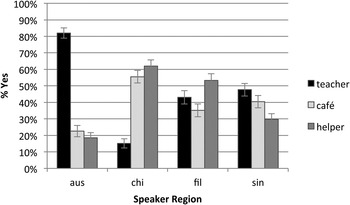
Figure 7 illustrates the overall occupation ratings for the four regions. Consistent with the local labor market, participants are confident that AusE speakers are teachers, rather than coffee-shop workers or helpers.Footnote 8 Skipping for the moment to FilE, participants do not show the ‘representativeness bias’ predicted, but rather give ratings that are surprisingly faithful to the reality of the distribution of FilE speakers in Singapore: while they are rated as most likely to be helpers, they are also rated as possibly doing the other two jobs, with no high degree of certainty for helper. SgE speakers are also rated with a high degree of uncertainty, with teacher as the highest-rated profession, followed by coffee-shop worker. Finally, the ratings for NChiE are dramatically inconsistent with the local market: although there are no NChiE speakers who work as domestic helpers, ‘helper’ is the highest-ranked occupation. In fact, NChiE is rated as the most likely accent to belong to a helper, surpassing FilE. In contrast, the NChiE ratings for teacher and coffee shop worker are more consistent with the local market: NChiE is rated as least likely to be a teacher and most likely to be a coffee shop worker of all of the varieties.
Overall percentage ‘yes’ ratings for three occupations for each region (N = 114).

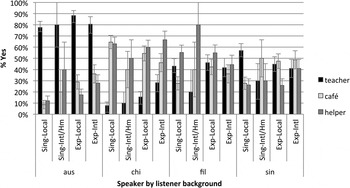
The ratings given by participants from each of the four background groups for each regional accent are indicated in Figure 8. Although AusE speakers were consistently rated as likely to be teachers, students in international schools and home-schooling also rate them as more likely to be doing other jobs, relative to students in local schools. For NChiE, local-school students give higher ratings for ‘coffee-shop worker’, while the Expat-Intl group most strongly favors ‘helper’, meaning that they are the group that is least consistent with local norms. All groups have similar ratings for FilE with the exception of Sing-Intl/Home participants, who show the expected ‘high-representativeness’ pattern in which FilE speakers are rated as highly likely to be helpers. Finally, Singaporeans attending local schools give the highest SgE rating to ‘teacher’, while other groups give the highest rating to ‘coffee-shop worker’; this suggests that only the Sing-Local group can detect that the SgE speakers are highly educated. The Expat-Intl group also gives a relatively high score for ‘helper’, a response that is inconsistent with the local labor market.
Occupation task ratings by listener background (N = 114).

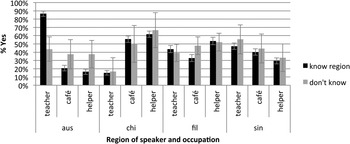
Given that not all participants were able to correctly identify each region in the previous task, we might wonder how knowledge of the regional origin of each accent correlates with occupation rating. Figure 9 provides this information, dividing the occupation ratings into two categories: ‘know region’, meaning participants who were able to identify the regional origin of that particular accent more than 50% of the time, versus ‘don't know’, participants who were not able to do this. For NChiE and SgE, it appears that the ability to identify the regional origin of these accents makes no significant difference in how each of the three occupations were rated. For FilE, there is a difference in the rating of coffee-shop worker: participants who were able to identify FilE speakers believed that FilE speakers are less likely to work in a coffee shop. The most dramatic difference in ratings occurs with AusE: those who can identify AusE speakers are far more likely to believe that AusE speakers are teachers and less likely to believe that they do other jobs.
Occupation ratings by participants who correctly identified the regional accent more than 50% of the time (‘know region’) versus those who did not (‘don't know’) (N = 114).

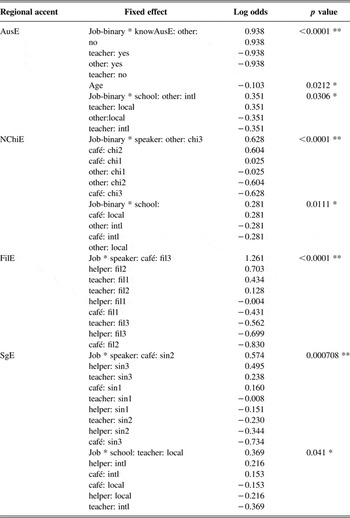
Table 7 lists the significant fixed effects that condition participant ratings for each regional accent (see Appendix D for full models). Fixed factors tested included age, EVT-2 percentile, national background, school type, local experience, helper background, speaker, job, and ability to identify the region in the previous task. As shown in Figure 8, students in international schools are more likely to believe that AusE speakers are doing other jobs and not teaching; participants who can recognize AusE, meanwhile, are more likely to believe the speaker is a teacher. For NChiE, in addition to significant differences in ratings by speaker, students enrolled in local schools are significantly more likely to believe that NChiE speakers are coffee shop workers and less likely to believe that they are teachers or helpers. For FilE, there is a significant interaction between speaker and occupation rating, as shown in Figure 8; having a Filipino helper and exposure to FilE are not significant predictors of occupation ratings. For SgE, in addition to the speaker and occupation interaction shown in Figure 8, there is a significant interaction between occupation and school attendance, such that local-school students are more likely to believe that SgE speakers are teachers and international-school students are more likely to believe that they are helpers.
Fixed factors predicting occupation ratings of each regional accent in Rbrul mixed-effects models including participant as random effect. Log odds indicate effect size and direction (see Appendix D) (* p < 0.05, ** p < 0.001).

Summary of findings
This study has examined children's performance in two tasks: region identification and occupation judgment. In the first task, children listened to two speakers and selected which was from a particular region—either Australia, China, Singapore, or the Philippines. While Expats were found to outperform Singaporeans in the five-to-seven age range, both groups quickly rose to ceiling for almost all comparisons. Students attending local versus international schools were found to have significantly different reaction time patterns. Expat students in international schools experienced particular trouble in identifying Filipino English, even though almost all of these participants had domestic helpers from the Philippines at home.
In the second task, children judged whether speakers were English teachers, coffee shop workers, or domestic helpers. School type was a significant predictor of job rating for three out of the four regional accents, with local-school attendees, both Singaporeans and Expats, showing more awareness of the local labor market in their ratings. Knowledge of the regional origin of an accent as demonstrated in the first task was a significant predictor of occupation rating in the case of Australian speakers.
Discussion
The two tasks presented above have investigated what children in Singapore understand about the regional variation present in their local environment. This work adds to the prior body of research on children's acquisition of sociolinguistic knowledge by demonstrating that young children can not only discriminate between accents at a basic level, but they can also master the regional labels for particular accents. Consistent with previous studies (e.g. Jeffries et al. Reference Jeffries, Foulkes and Llamas2014), children of parents from a nonlocal background have shown certain advantages in gaining sociolinguistic knowledge. Specifically, in the region identification task, a dramatic difference was observed between Singaporean and Expat participants in the youngest age group, with Expats more advanced in their ability to accurately label regional varieties; that being said, Singaporean participants caught up with Expats rather quickly.
While participants generally performed well on the region identification task regardless of background, interactions between school type and participant age were found for AusE and FilE. The effects of school attendance were also evident in participants’ reaction times: local school students identified NChiE and SgE relatively quickly but FilE relatively slowly, while Singaporeans attending local schools were slowest to identify AusE. These reaction time findings, as well as the observation that NChiE was the only variety that the youngest Singaporean participants were able to identify above chance level, indicate that NChiE has become a particularly noteworthy variety in local Singapore schools, as more children of Mainland Chinese immigrants and educational migrants from China enter the system.
The FilE vs. SgE discrimination performance of older Expat children attending international schools was the only case in which any participant group performed below chance in identification accuracy: this finding indicates that some of the older Expat-Intl participants have formed the mistaken belief that Filipinos sound like Singaporeans. This pattern is surprising given that older Expat-Intl participants almost all have helpers from the Philippines, and have the highest exposure to FilE of any participant group in terms of caregiver hours. It is conceivable that the FilE spoken by domestic workers in the highest socioeconomic strata sounds similar to SgE because these helpers tend to have lived in Singapore for a long time. It is also possible that these older children are less engaged with their helpers than younger children are, as they do not need close supervision and are busier with activities outside the home, and therefore do not have as much knowledge of what FilE sounds like. At the same time, while Expat-Intl students were less aware of FilE on the whole, those who did correctly identify FilE speakers were able to do so relatively quickly, as measured by normalized reaction time. Taken together, these two tasks indicate that international-school students have more exposure to FilE, but often lack awareness of the regional origin of this dialect. This pattern is consistent with the observation that, in contrast to Mainland Chinese migrants, Filipino workers have maintained relatively low saliency as a migrant group in Singapore, even as they increasingly fill jobs in the service and professional sectors. The difference between overall response accuracy and reaction time patterns for FilE among international school students underscores the utility of examining both measures for these sorts of tasks.
In the second task, judgment of speakers’ occupations, participants were found to rate speakers along a consistent prestige scale, as shown in (1) below.
-
(1) AusE > SgE > FilE > NChiE
While this scale is not entirely consistent with the Singapore labor market, it is consistent with the circles of English model and the level of indigenization of English in each of these regions. Does this mean that participants based their ratings on which speakers sounded most fluent in English? Evidence suggests that this is not a satisfactory account for these data. Most crucially, among the participants who could not identify the regional origin of the AusE accent, AusE speakers were rated as equally likely to be teachers as speakers of SgE and FilE. This pattern supports the notion that there is no inherent, perceptible difference between the ‘standardness’ or ‘fluency’ of AusE, an inner-circle variety, versus FilE and SgE, outer-circle varieties. It is only when children become aware that AusE originates from Australia that they assign it more strongly to the occupation associated with Standard English. The finding that children come to elevate AusE as they become aware of its origin illustrates how both local and expatriate children take on language ideologies that privilege inner-circle English.
As discussed in the section on previous work, there is some uncertainty as to the extent to which children develop their sociolinguistic knowledge primarily based upon personal exposure to sociolinguistic patterns or upon general knowledge of social status. In the occupation judgment task, NChiE speakers were rated as highly likely to be domestic helpers, although they do not perform this job in Singapore: moreover, NChiE speakers were rated just as likely to be helpers regardless of whether the participant was able to consistently identify the regional origins of NChiE speakers, suggesting that speakers were not receiving this rating simply because participants thought they sounded nonnative. The findings of the occupation task suggest that, when the relative prestige of occupations does not line up neatly with the relative prestige of language varieties, children will assign speakers to occupations based on their understanding of the overall social status of their language variety: speakers of high-status varieties will be assigned to high-status jobs, and so forth. Surprisingly, older participants were just as likely as younger ones to believe that NChiE speakers were helpers; this raises the question of whether adults in Singapore would behave similarly on such a task. We speculate that, as an individual's social role transitions from student to working adult, his or her relationship with the domestic-worker class will shift considerably, resulting in a greater awareness of who occupies this class in Singapore.
School attendance made a significant difference in occupation ratings for three of the four regional accents. Overall, students attending local school demonstrated intuitions that were more consistent with the realities of the local labor market: they were more likely to believe that AusE speakers were teachers and not coffee shop workers or helpers, that NChiE speakers were coffee shop workers, and that SgE speakers were not helpers. Expat children attending local schools, however, were not entirely consistent with their Singaporean peers: most notably, for SgE speakers, Singaporean children in local schools showed a strong preference for ‘teacher’, giving low scores to ‘coffee-shop worker’. In contrast, Expat children in local schools gave equivalent ratings for both ‘teacher’ and ‘coffee-shop worker’. There are two plausible accounts for this difference: first, Singaporean children are more sensitive to intra-regional differences in pronunciation and can perceive that the SgE speakers in this study are highly educated and more likely to be teachers than coffee shop workers. Second, there is an overall difference in Singaporean versus Expat perception of the prestige of SgE that is leading Singaporeans attending local schools to underestimate the possibility that SgE speakers could be coffee shop workers. In either case, these ratings suggest that the sociolinguistic knowledge of Singaporean and Expat children in local schools involves some crucial differences, despite these children's shared exposure to sociolinguistic variation in schools.
Conclusion
This study has evaluated the development of sociolinguistic knowledge among local and expatriate children living in Singapore using two tasks involving regional accent identification and judgment of occupation. Participants were found to have mastered the ability to identify the regional origin of speakers of Australian English, Northern-Chinese-accented English, Filipino English, and Singapore English by early primary school. The pace at which children develop knowledge of particular accents reflects which varieties are most marked in Singapore society: participants were able to identify NChiE the earliest and lagged most on identification of FilE. While Expats outperformed Singaporean children in the youngest group (ages five to seven), both groups performed comparably as they grew older. Whether children attended local versus international schools was found to influence when they became familiar with certain dialects and how quickly they could identify them.
Overall, regardless of background, children did exceedingly well on the region identification task; we suspect that all groups of participants in Singapore are performing at a high level relative to children living in more homogeneous cultural contexts. Unfortunately, as research on young children's ability to accurately label varieties of English has not yet been carried out in other settings, we cannot state definitively that our participants have outperformed anyone else. Studies such as Jeffries et al. (Reference Jeffries, Foulkes and Llamas2014), for instance, investigate children's ability to group speakers by accent, but not their ability to label speakers as coming from a particular region. Researchers working in this area have perhaps been operating under the assumption that grouping speakers by accent in the abstract, without labels, is an easier task for children than a task in which explicit labels are introduced (e.g. asking children to group speakers under the labels ‘Yorkshire’ vs. ‘Scotland’). We believe that research into children's development of both the ability to group speakers and the ability to assign accurate labels, and the relationship between these skills, will prove to be a fruitful area for future work. Additionally, given that the present study found that Expat children performed quite well on the region identification task in the youngest age bracket, it would be of use to look at even younger children, aged three and four, to determine more precisely when these children first develop the ability to identify and label regional varieties.
The fact that not only expatriates, but also Singaporean children enrolled in ordinary government schools show such familiarity with a wide range of international accents today contrasts notably with Chen (Reference Chen1990), in which, for example, only 6.8% of secondary-school student participants were able to identify Australian English. This change can be viewed as a sociolinguistic consequence of the ‘global city’ vision for Singapore, first articulated by then-Foreign Minister S. Rajaratnam in 1972, under which Singapore has been deliberately positioned to become increasingly embedded in a globalized economic system through the development of the international finance sector, maritime trade, and other multinational industries (Rajaratnam Reference Rajaratnam1972). Previous research suggests that this increasing international orientation has come at a sociolinguistic cost: Singaporeans of university age are now less able than older listeners to identify the ethnicity of a Singaporean by their speech (i.e. distinguish between Chinese, Malay, and Tamil Singaporeans) and have less knowledge of the languages of other Singaporean ethnicities (Y. Tan Reference Tan2012). This prior work raises the question of whether older Singaporeans have gained the same globally oriented sociolinguistic knowledge of younger Singaporeans, or whether they are simply more locally oriented. Further research that examines children's ability to identify intra-Singaporean ethnic differences and older listeners’ performance on the same tasks conducted here would help elucidate this question.
In the occupation judgment task, children were asked to rate the likelihood that speakers of each variety were English teachers, coffee shop workers, or domestic helpers. Participants’ judgments were largely consistent with the local labor market; however, participants inaccurately labeled NChiE speakers as highly likely to work as domestic helpers, showing a preference for mapping speakers to occupations based upon general prestige correspondence, indicating that children use indirect knowledge of social facts in their development of sociolinguistic knowledge. Given this finding, we might wonder whether children are assigning individuals to occupations based upon the social status of the speaker, or the social status of the language variety used by the speaker. In other words, do children perceive NChiE speakers as likely to be helpers because they use NChiE, which is a nonstandard, nonnative variety of English, or because they are from China? In ongoing follow-up work, we are evaluating the same participants’ ratings of the same speakers from Singapore and China, with the speakers using Mandarin instead of English. The Mandarin situation is crucially different from the present study because, in contrast to English, Singapore Mandarin is perceived to be less standard than Northern China-accented Mandarin. Our preliminary results suggest that, when the same speakers are evaluated speaking Mandarin, their occupation ratings flip, so that speakers from China are now assigned to the higher-prestige occupations. This pattern suggests that children's perception of the status of a speaker is closely tied to the prestige of the speaker's language variety, rather than to the status of the regional background indexed by that individual's language use.
Our investigation of children in Singapore has demonstrated that children in this dialectally diverse environment develop sophisticated knowledge of sociolinguistic variation, regardless of whether they are expatriates or locals. The contrasting performance of children attending local versus international schools has further revealed how the spaces inhabited by children shape their understanding of the sociolinguistic landscape. Future work on children's sociolinguistic development in other regions may clarify which factors contribute to the integration or divergence of the sociolinguistic knowledge of children from different backgrounds in transnational migration settings.
Appendix A. Participant background information: Birthplaces of Expat participants and parents

Appendix B. Script for experiment narration: Instructions for two tasks
Region identification task instructions
(Note: Begins after flag-training task. Script is accompanied by visual animation)
Look at all these owls! Where are they going? Oh, they're all going to the art museum to look at paintings. Owls love to look at paintings.
All these owls look the same, but actually they are from different countries. Some of them are from Singapore, some of them are from China, some of them are from Australia, and some of them are from the Philippines. I wonder which owl is which? Even though they all look the same, maybe we can tell where each owl is from by listening to them talk.
Let's listen to the owls talk about the paintings at the art museum and try to guess where they are from. I'll show you two owls at a time. Listen to the two owls talk about a painting, and then decide which one of them is from the country I am asking you about. If you think it is the left owl, press the left button. If you think it is the right owl, press the right button. It's okay if you're not totally sure about the answer, just make your best guess!
Let's do one practice first. Get ready, here we go! Which of these owls is from China? Listen to each of them talk, and then pick the left owl or the right owl.
Great job! Okay, you're finished with the practice, so let's get started! Which of these owls is from [Australia/China/the Philippines/Singapore]?
Occupation identification task instructions
Are you ready for our final game? Oh, looks like the owls are going home.
Hey, look at all these bears! Now the bears are coming to the art museum. It's a busy weekend for the museum.
These bears all look the same, but they all do different jobs. Some of them are English teachers: they teach children to read and write. Some of them are coffee shop workers: they make drinks for customers. And some of them are helpers: they help clean and take care of the house. I wonder which bear is which? Even though they all look the same, maybe we can tell which job each bear does by listening to them talk.
Let's listen to the bears talk about the paintings at the art museum and try to guess if they do some job or not. This time, I'll just show you one bear at a time, and ask you if you think they do some job. Listen to the bear talk about the painting, and decide whether you think they do that job or not. If you think the answer is no, pick the red cross on the left. If you think the answer is yes, pick the green mark on the right. It's okay if you're not totally sure about the answer, just make your best guess!
Let's do one practice first. Ready? Is this bear a teacher? Listen to the bear talk, and then pick yes or no.
Great job! Okay, the practice is done, let's start! Is this bear a [teacher/coffee shop worker/helper]?
Appendix C. Statistical models: Region task
a. AusE identification

b. NChiE identification

c. FilE identification

d. SgE identification

e. Normalized reaction time

Appendix D. Statistical models: Occupation task
a. AusE occupation

b. NChiE occupation

c. FilE occupation

d. SgE occupation