Introduction
Dementia causes irreversible decline in global, cognitive, social and physical functioning (Weiner and Lipton, Reference Weiner and Lipton2003). It is one of the most common and serious disorders in later life, with a prevalence in Sweden of 5% in those aged over 65 (SBU, 2006). With an aging population, it is estimated that the number of elderly who will experience dementia, either personally or as a caregiver, will increase (Bond, Reference Bond1999). Formal caregivers have become an integral component of the continuum of care needed by the people with dementia (Weiner and Lipton, Reference Weiner and Lipton2003), with the majority of the elderly with late-stage dementia living in nursing homes. However, such homes tend to practice different forms of care with limited means of evaluation (Swedish National Board of Health and Welfare, 2005). A report from the Swedish Council on Technology Assessment in Health Care (SBU, 2006) concluded that dementia care in Sweden needs to be improved and that there is a need for assessment tools to evaluate treatment impact on quality of life (QoL) in late-stage dementia.
Although there is no universally accepted definition of QoL, most researchers agree that it is a multidimensional concept that encompasses the individual's subjective experience of life, as well as objective criteria related to activities valued by society (Lawton, Reference Lawton1994; Reference Lawton1997; Ettema et al., Reference Ettema2005a; Smith et al., Reference Smith2005). According to Lawton (Reference Lawton1994), QoL in dementia may be further divided into four underlying components, such that the objective criteria comprise behavioral competence and aspects of the external environment, while the subjective experiences of life comprise perceived QoL and psychological well-being. Owing to the progression of dementia, the constituent components are modified throughout the different stages of the disease. In the more severe stages of dementia, when cognitive deficits and loss of language might hinder the patient from self-reporting on psychological well-being and perceived QoL, QoL assessment may be based on the objective components, in combination with the apparent expressive state. Engagement in positive activities, presence of positive affect, absence of negative affect, participation in meaningful activity and a sense of community are assumed to correlate with QoL in late-stage dementia (Lawton, Reference Lawton1983; Reference Lawton1994; Reference Lawton1997). In dementia, as in any other chronic disease, the impact of treatment on QoL is a key consideration (Ready, Reference Ready2002; Ready et al., Reference Ready, Ott, Grace and Fernadez2002; Ballard and Margallo-Lano, Reference Ballard and Margallo-Lana2004) and an outcome criterion (von Steinbuechel et al., Reference von Steinbuechel, Richter, Morawetz and Riemsma2005).
The assessment of QoL in dementia is, however, a challenging venture (Rabins and Kasper, Reference Rabins and Kasper1997). In addition to the above-mentioned difficulties in conceptually defining QoL in late-stage dementia (Logsdon et al., Reference Logsdon, Gibbons, McCurry and Teri2002; Ettema et al., Reference Ettema2005a), there is also an inherent difficulty of gathering valid and reliable QoL data since the disorder may interfere with the person's ability to self-assess on subjective experience (Ready et al. Reference Ready, Ott, Grace and Fernadez2002; Thomson, Reference Thomson2004). Since QoL self-reporting requires partially intact cognitive functioning, observer ratings are preferred for persons with late-stage dementia (Rabins and Kasper, Reference Rabins and Kasper1997) and self-report measures are seen as problematic (Lawton, Reference Lawton1997).
According to a literature review by Ettema et al. (Reference Ettema, Dröes, de Lange, Mellenbergh and Ribbe2005b), several disease-specific and generic instruments are available to measure QoL in dementia; however, our review of existing dementia-specific measures revealed that no such instruments exist in Swedish. Thus, instruments are lacking to evaluate QoL effects of interventions designed to enhance QoL in Swedish dementia care.
The Quality of Life in Late-stage Dementia (QUALID) scale was originally developed by Weiner and co-workers in 2000 (Weiner et al., Reference Weiner2000). The QUALID is a late-stage dementia specific questionnaire, providing information about the late-stage dementia sufferers’ quality of life, through assessments made by proxy informants. A strength of the QUALID is that assessments are based on concrete, observable behavior and emotions, rather than of inner states. Research shows that the accuracy of observer ratings is higher when the information sought is concrete and observable (Novella et al., Reference Novella2001; Reference Novella2006). The aim of the present study was to evaluate the validity, reliability and responsiveness of a Swedish version of the QUALID.
Method
Patients
The target patient population consisted of all 209 residents living at 19 dementia special care units (SCU) in eight long-term care facilities in the Gothenburg city region. The closest relative of each patient was sent a letter informing them about the study and requesting their approval for participation. Patient demographic and clinical data (age, sex, dementia diagnosis, psychotropic drug use) were collected from medical records and level of cognitive impairment was determined by the Mini-mental State Examination (MMSE) (Folstein et al., Reference Folstein, Robins and Helzer1983). Of the 209 patients, six relatives declined participation, and nine participants died before data collection commenced. In one of the care units, only substitute healthcare providers who were poorly acquainted with the residents were available to act as proxy informants, and thus the patients who resided there were not included in the study (n = 25). Thus, a total of 169 elderly patients participated in the study.
The study was approved by the Ethics Committee at Göteborg University (575–05), as well as by responsible officials and heads of nursing homes.
Informants
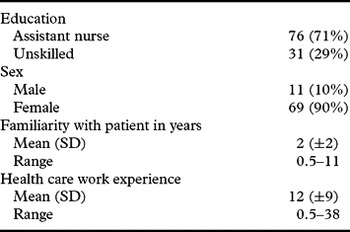
Each care unit housed on average 11 patients and was staffed on average by 0.8 carers per bed (night staff excluded). The care provided at all care units is organized such that each resident is assigned his/her own healthcare provider (contact person) who has extensive knowledge about the patient and responsibility for his/her nursing care. A total of 107 healthcare providers assessed the 169 patients in the study (on average, one healthcare provider assessed 1.6 patients). Demographic data on the proxy informants (education, years of experience and familiarity with participant) were collected (see Table 1).
Informant characteristics (n = 107)

Questionnaires
The QUALID is a domain-specific, brief, proxy informant-based instrument with a one-week recall period. It is designed for use specifically with late-stage dementia patients in institutional settings (Weiner et al., Reference Weiner2000). The original U.S. version of the instrument has demonstrated good internal consistency and adequate construct validity (Weiner et al., Reference Weiner2000), as well as sensitivity to change (Martin-Cook et al., Reference Martin-Cook, Hynan, Rice-Koch, Svetlik and Weiner2005). The scale consists of 11 items, comprising both positive and negative dimensions of concrete and observable mood and performance, thought to be indicative of QoL in late-stage dementia. The items are rated as to frequency of occurrence on a five-step scale and scores are summed to range from 11 (best QoL) to 55 (worst QoL). The instrument is administered in a structured interview format and the average time of administration is five minutes. The proxy informants need to be well acquainted with the dementia sufferers’ general behavior, and to have spent a significant amount of time with the dementia sufferer during the week previous to the QUALID assessment.
After obtaining permission from the original authors, a cyclic process of forward translations, back translations, and evaluation of translation correspondence by a bilingual expert was conducted to achieve conceptual equivalence between the original and Swedish translation of the QUALID.
Following standard methods to examine the criterion validity of the QUALID (Altman, Reference Altman1991), we included two other proxy informant-based questionnaires – the General Behavior Assessment Scale (GBAS), and Patient Mood Assessment Scale (PMAS) (Edberg, Reference Edberg2000). Both of these questionnaires are constructed to provide information about general behavior and mood, thought to be indicative of well-being in elderly people, though not specifically in patients with late-state dementia. Together they consist of 18 items, with scores summed to range from 18 (highest well-being) to 90 (lowest well-being). Both instruments have demonstrated good internal consistency, validity and reliability (Edberg, Reference Edberg2000).
Before completing the questionnaires, the informants were asked to make an overall assessment of the patient's sense of global well-being on an 11-point VAS scale, where 1 represented maximum well-being and 11 represented minimum well-being. In a subset of 40 patients who were examined twice over time for tests of reliability and sensitivity, this global assessment was reformulated at the follow-up in order to consider changes in well-being. Thus, the 11-point scale was in the follow-up anchored with 1 representing maximum improvement, 6 unchanged well-being and 11 representing maximum deteroriation.
Statistical analysis
The QUALID score distribution was examined regarding skewness, kurtosis, proportions of respondents scoring at maximum (ceiling) or minimum (floor) levels and the extent that the full range of possible scores was used.
Internal consistency reliability and unidimensionality of the 11 items included in the QUALID was examined using Cronbach's α coefficient and principal components analysis. Item-scale correlations, corrected for overlap, were also computed. The criterion level for acceptable reliability was set to α ≥ 0.7 (Nunnally, Reference Nunnally1978; Altman, Reference Altman1991). Cattell's scree plot, absorption of variance and face validity of potential dimensions (Gorsuch, Reference Gorsuch1983) were used as criteria for multidimensionality.
Test-retest reliability was examined by assessing 40 patients twice by the same informants. The time period between these assessments was three weeks. Intra-class correlation was calculated (single rater, absolute agreement) on those patients who were judged to be unchanged in the global assessments of well-being.
Inter-rater reliability was investigated in a subset of 26 patients who were assessed by two different informants on the same occasion. Also, here the intra-class correlation (single rater, absolute agreement) was used as the reliability measure.
Criterion validity was tested by calculating Spearman correlations of the QUALID with the GBAS, PMAS and global well-being rating. Clinical validity was assessed by correlating the level of cognitive impairment as determined by MMSE and total score on the QUALID. It was expected that high levels of cognitive impairment would be inversely related to QoL. To further investigate the clinical validity of the QUALID, patients prescribed with neuroleptics and antidepressants were compared with those without any psychotropic drug treatment. It was hypothesized that patients with neuroleptics and/or antidepressants would have lower levels of QoL. These comparisons were performed with the Mann-Whitney U test.
Finally, the sensitivity of the QUALID was examined in those patients whose overall well-being had changed over the three-week period. Change scores, p-values and Standardized Response Means (SRM) were calculated for this sub-group of patients.
Results
Patient demographic and clinical data
The mean age of the 169 included patients was 86 years (SD 6; range 66–99 years). Twenty-one (12%) were male and 148 (88%) were female. Thirty-nine (23%) were diagnosed with primary degenerative dementia (including Alzheimer's disease, dementia with Lewy bodies, and vascular dementia with frontal lobe localization), 39 (23%) with secondary degenerative dementia (including multi-infarct dementia, cerebrovascular infarcts, and post-subarachnoidal bleeding), and eight (5%) with a mixed pathology. Eighty-three (49%) were diagnosed with non-specific dementia (NUD). The mean MMSE score for the sample was 10 (SD 7; range 0–25 p), indicating moderate to severe cognitive impairment. Thirty percent of the residents were not undergoing any psychotropic drug treatment, 31% were treated with neuroleptics, 25% with cholinesterase inhibitors, 53% with antidepressants, and 25% with sedatives.
Demographic data on informants
The majority of the 107 proxy informants were assistant nurses (71%), and female (90%). They had a mean length of health care work experience of 12 years, and had been acquainted with the patient on average for two years (Table 1).
Score distributions
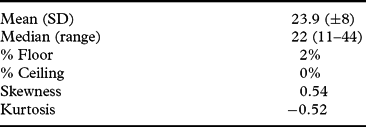
Table 2 shows the score distributions for the total sample. The distribution is relatively normally distributed as indicated by the proximity of the mean and median, as well as by the low skewness and kurtosis coefficients. Proportions of patients rated at the floor or ceiling were low, suggesting that the scale adequately covered the possible range of QoL in the sample.
Total score characteristics for the QUALID

Reliability tests
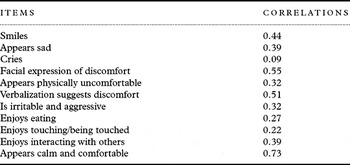
The Cronbach's α coefficient of the 11 QUALID items was 0.74, indicating a satisfactory level of internal consistency. Principal components analysis revealed no strong evidence for multidimensionality according to the chosen criteria. Correlations between items and scale, corrected for overlap are shown in Table 3. These ranged between 0.73 (appears calm and comfortable) and 0.09 (cries) with a mean of 0.39. Thus, the item considering crying did not correlate with the total score. However, removal of this item did not increase Cronbach's α. This item also showed the lowest correlation with total score in the original study by Weiner et al. (Reference Weiner2000).
Correlations, corrected for overlap, between items and total score

Of the 40 patients who were assessed twice over time, 23 were rated as having stable overall well-being between the two assessment points. The intra-class correlation (ICC) between assessments among those patients was 0.86, indicating good test-retest reliability. Inter-rater reliability, estimated by intra-class correlation in those 26 patients who were judged by two independent informants on the same occasion, was also satisfactory (ICC = 0.69).
Validity tests
The correlations between the QUALID and the other QoL indices (GBAS, PMAS and global well-being) were positive and high (Table 4), indicating good criterion validity. The QUALID also correlated as expected (weak but significant) with the MMSE, suggesting that lower levels of cognitive functioning were related to lower QoL (Table 4). Likewise, those patients who were prescribed with neuroleptics and/or antidepressants showed lower QoL compared to those without any psychotropic drug (Table 5). Both these tests give evidence of good clinical validity of the QUALID.
Correlation coefficients between the QUALID and other measures

**Correlation is significant at the 0.01 level (2-tailed).
Comparison between the occurrence of neuroleptics or antidepressants and the QUALID

**Correlation is significant at the 0.01 level (2-tailed).
Sensitivity tests
The sensitivity of the QUALID was assessed in those patients who were rated as changed in global well-being between assessments. This subgroup consisted of ten deteriorated and seven improved patients. These two groups were merged and the QUALID scores for the improved patients were inverted in order to increase the sample size. A paired samples t-test of change scores for this merged subgroup showed a significant but moderate decrease in QUALID ratings (p = 0.015). The SRM was 0.66, suggesting moderate responsiveness of the QUALID scale (Fayers and Machin, Reference Fayers and Machin2001).
Discussion
The aim of this study was to examine the psychometric properties (reliability, validity and responsiveness) of a Swedish translation of the Quality of Life in Late-Stage Dementia (QUALID) Scale. The results indicated good reliability and validity, and acceptable responsiveness to change. A total of 107 proxy informants assessed 169 dementia residents, representing a response rate of 81% of those residents initially approached. Scores on the QUALID were normally distributed, indicating that this instrument is appropriate for use in this patient population. Although QoL has become a major topic of study in dementia research (Ettema et al., Reference Ettema2005a; 2005b), people with late-stage dementia are a neglected group, mainly because of the methodological challenges that arise in gathering reliable data. Some argue that it is impossible to stipulate whether observable displays of affect actually index feeling in persons with severe dementia (Kolanowski et al., Reference Kolanowski, Litaker and Catalano2002; Byrne-Davis et al., Reference Byrne-Davis, Bennett and Wilcock2006), whereas others believe that the most effective way to approach the dementia patient's experiential world is to describe his or her observable behavior and affective state, with the subjective tinge that it implies (Lawton, Reference Lawton1994). According to Rabins and Kasper (Reference Rabins and Kasper1997), instruments that measure QoL in dementia should be scaled similarly for all individuals, use proxy informants of externally observable behaviors and expressions, and be specific for dementia. Agitation, depression, anxiety and irritability, and the consequences of these difficulties, are likely to impair QoL (Selai, Reference Selai2001; Banerjee et al., Reference Banerjee2006). At the same time, it is our belief that joyfulness, sense of community and human contact are likely to improve QoL in late-stage dementia. A distinctive aspect of QoL in late-stage dementia is that we must rely on externally evaluated behavior as our window onto the inner life and subjective well-being of the more cognitively impaired (Lawton, Reference Lawton1994), since such patients are unable to self-report reliably. There seems to be a need for instruments that assess both positive and negative dimensions of mood and behavior (Edberg, Reference Edberg2000), and the QUALID targets both components through assessments of concrete and apparent behaviors and affective states. The QUALID is based on Lawton's (Reference Lawton1983; Reference Lawton1994; Reference Lawton1997) definition of QoL in dementia. It is our belief that the QUALID comprises two interrelated domains of Lawton's four-component division: behavioral competence and psychological well-being, which represent the objective criteria related to activities valued by society, and the subjective experience of life. The items are summarized to a single index, which makes it ideal for evaluation purposes. Based on this study, it is our impression that the QUALID may provide reliable estimates of QoL in Swedish late-stage dementia patients.
The non-random selection of patients and proxy informants limits the generalizability of our results; however, the patients were elderly nursing-home residents with late-stage dementia according to MMSE at a number of special care units in different parts of the Gothenburg city region. The study could have benefited from examining the correlation between QUALID scores and the occurrence of neuropsychiatric symptoms or physical conditions in the late-stage dementia population. However, systematic data concerning this were not available from patient records. Further research on these connections is needed in order to establish valuable cut-off values, and determine the clinical importance of a specific QUALID score. The proxy informants were health care providers with different levels of training (assistant nurses and untrained caregivers), working all shifts (night shift excluded). Diversity within the patient and proxy informant groups adds to the generalizability of our findings. It is vital to identify the biases of proxy informants. According to Rabins and Kasper (Reference Rabins and Kasper1997), drawbacks of proxy ratings are that they filter an experience through the opinion of another person, and that proxies tend to underestimate the patient's QoL (Novella et al., Reference Novella2001). The use of proxy informants to assess subjective elements of QoL, such as inner life, can be seen as problematic (Bond, Reference Bond1999). According to a review of the literature assessing the validity of proxy reports, the accuracy of proxy ratings is higher when the information sought is concrete and observable (Novella et al., Reference Novella2001). In order to minimize proxy bias, QUALID items target observable and concrete aspects of life. Observable emotional and behavioral responses are a major key to enhance our knowledge about late-stage dementia patients’ preferences and responses to our nursing interventions.
The face-to-face interview mode of administration of the instrument is time consuming; however, given that the success of any investigation depends on the quality of its data, this administration method was advantageous in that it yielded no missing data and permitted immediate detection of misinterpretation of questions by the informants. Interpretation of QUALID results is not straightforward since the scores have little intrinsic meaning. Predefined validated cut-off values, for example, are needed to enable us to evaluate the significance of individual scores and to help appraise the effects of interventions designed to enhance QoL in late-stage dementia. Nonetheless, agreement in score distributions between the original and the Swedish versions of the QUALID suggest that results obtained from the former may be valid for comparison when interpreting Swedish results.
As important clinical decisions may derive from perceived QoL effects, it is vital that the QoL data be reliable, valid and sensitive to change. One of the principal strengths of quantitative data is that they remove much of the guesswork in gathering information (Polit and Hungler, Reference Polit and Hungler1995). A psychometrically sound QoL measure that provides objective and precise information about QoL specifically in late-stage dementia, such as the Swedish QUALID, may be useful in a number of settings and the range of applications is large.
Conflict of interest
None.
Description of authors’ roles
H. Falk and L-O. Persson designed the study. H. Wijk and L-O Persson supervised the data collection, which was carried out by H. Falk. L-O Persson was responsible for the statistical design of the study. Statistical analysis was carried out by H. Falk under supervision from L-O Persson. H. Falk wrote the paper, with assistance from L-O Persson and H. Wijk.