I. INTRODUCTION
TiH2 is the blowing agent most frequently used to foam aluminum alloys. This applies to the various melt routes and to the powder-based manufacturing route considered here (see Ref. Reference Banhart1 for an overview of manufacturing routes). TiH2 is suitable because it releases hydrogen gas in the melting range of most aluminum alloys, especially when it has been pretreated by oxidation or chemical filming.Reference Matijasevic and Banhart2–Reference Jiménez, Garcia-Moreno, Rack, Tucoulou, Klaus, Pfretzschner, Rack, Cloetens and Banhart8 However, the cost of TiH2 is quite high, adding ∼1 EUR to the cost of 1 kg of foamable precursor (∼25% of the total cost). As use of metal foam is currently limited by its high production costs any possible savings are crucial. Alternative blowing agents have been proposed and tested. Carbonates are cheap and have been shown to blow and even stabilize Al foam,Reference Nakamura, Gnyloskurenko, Sakamoto, Byakova and Ishikawa9–Reference Yang, Hur and Yang11 but their use in conjunction with the powder route is difficult and the foams obtained are still inferior to those blown with TiH2. Hydrides have the advantage that no oxide remnant is left behind after decomposition, thus avoiding weakening of the metallic matrix. Besides TiH2, other hydrides of a single element have been evaluated experimentally, including ZrH2,Reference Li, Li, Li, Sun, Zhang and Yao12 HfH2, LiH, LaH3, MgH2,Reference Körner, Hirschmann, Bräutigam and Singer13 and CaH2,Reference Mondal, Goel and Das14 but none of these showed advantage over TiH2. In this study, we include complex hydrides, which contain a metal and boron, namely MBH4 (M = Li, Na, K), and LiAlH4. These hydrides contain a high amount of hydrogen per unit mass of blowing agent, which determines its price. Moreover, as some of these hydrides are considered hydrogen storage materials for a future hydrogen economy they are (or will be) inexpensive materials.Reference Au, Spencer, Jurgensen and Zeigler15–Reference Chandra, Reilly and Chellappa21
A comparison of hydrogen concentration for several borohydrides, TiH2 and LiAlH4 is shown in Fig. 1. We may assess the effect of the different blowing agents on foam production by either (i) considering the variation of theoretical foam expansion produced by a fixed mass fraction of blowing agent, e.g., 0.5 wt% as typically used for TiH2, or (ii) by reducing the amount of the respective blowing agent so as to achieve the same foam expansion as for TiH2. Reducing the blowing agent content has the advantage that the powder blend might be easier to compact, which in turn could have a positive impact on foaming.Reference Helwig, Hiller, Garcia-Moreno and Banhart22 Furthermore, it could reduce costs significantly.
Comparison of hydrogen concentration and theoretical maximum expansion of foams blown by different blowing agents assuming complete utilization of gas contained in each agent. The red arrow indicates a higher theoretical expansion based on equal mass fractions of blowing agents, and the blue arrow indicates a reduction of the required amount of agent while maintaining a similar expansion.

The real situation is more difficult than suggested by Fig. 1. Theoretical maximum foam expansions are not reached in practice due to only partial liberation of hydrogen from the blowing agent at a given foaming temperature and after a given time and hydrogen losses occurring during foaming.Reference Rodriguez-Perez, Solorzano, De Saja, Garcia-Moreno, Lefebvre, Banhart and Dunand23–Reference Jiménez, Garcia-Moreno, Mukherjee, Goerke and Banhart25 Calculating the content of each hydride that would provide an amount of gas equal to that liberated by the benchmark blowing agent TiH2 is not possible without knowing the details of gas generation. Therefore, we decided to leave the mass fraction of each of the new hydrides fixed to 0.5 wt% for this exploratory study. This implies that some of the new hydrides might not be added in optimal quantities. Once the desorption behavior of the hydrides under foaming conditions is known one will be able to compare the hydrides on the basis of equal amounts of released hydrogen gas.
II. EXPERIMENTAL
A. Materials
For our foaming trials, we selected the AlSi8Mg4 alloy that is used as a metal foam core material for aluminum foam sandwich panels due to its good foamability.Reference Helwig, Garcia-Moreno and Banhart26 The metallic elemental and alloy AlMg50 (wt%) powders described in Table I were mixed with one of the blowing agents for 15 min. Uniaxially hot-compacted tablets of 30 g mass and 36 mm diameter were prepared under the usual conditions, namely by first cold compacting for 5 s at 300 MPa pressure and then hot-compacting at 400 °C for 15 min at the same pressure. 10 × 10 × 4 mm3-large samples were machined from the precursor for foaming.
Metal and blowing agent powders used for the foaming experiments.

B. Foaming and x-ray analysis
To study the evolution of expansion and foam structure, x-ray radioscopy was performed during foaming. The imaging system consists of a tungsten microfocus x-ray source operated at 100 kV, and a 2240 × 2368 pixel flat panel detector, both from Hamamatsu, Japan. Between these two elements, foaming of samples was performed on a heating plate at a foaming temperature of 700 °C, see also Ref. Reference Garcia-Moreno, Fromme and Banhart27. Image analysis allows for the calculation of expansion profiles. A minimum of 3 samples per analysis were analyzed to assess statistical fluctuations.
C. Mass spectrometry
Hydrogen release from blowing agents and foamable precursor materials including filings thereof was studied by mass spectrometry in the thermal analysers Netzsch 209C and 409C (Netzsch Gerätebau GmbH, Selb, Germany) coupled via a capillary and a skimmer, respectively, to a quadrupole mass spectrometer. For characterizing the blowing agents dehydrogenation, 10 mg of powder were heated at 10 K/min in an Ar atmosphere. Compacts of 1 g and 120 mg of filings prepared from tablets were heated at 40 K/min under synthetic air up to 660 °C. Protective gas prevented ignition of Mg and formation of MgO that would block both the capillary and the skimmer.
D. Density and electrical conductivity measurements
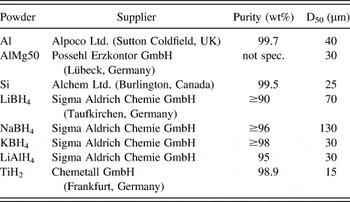
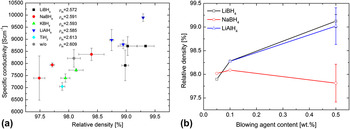
The precursor density provides information on the quality of powder densification. It was measured using Archimedes’ buoyancy method and a precision balance CPA225SD from Sartorius AG (Göttingen, Germany). Absolute densities were converted to relative densities by dividing them by the theoretical full density ρth of the materials listed in Fig. 2(a).
(a) Specific conductivity versus relative density for AlSi8Mg4 precursors containing 0.5 wt% blowing agent. Error bars represent each individual sample of a precursor. The calculated full reference densities ρth are given. (b) Relative density vs. blowing agent content for Li and Na-containing agents.

The electrical conductivity reveals not only the quality of powder compaction (related to the density), but furthermore the degree of metallic bonding between the individual powder particles. To achieve a good conductivity the oxide layer of the powders have to break during the consolidation process as Al2O3 has a much higher resistivity than Al. This happens mostly due to friction during compaction, which is anisotropic in the case of uniaxial compaction.Reference Rodriguez-Perez, Solorzano, De Saja, Garcia-Moreno, Lefebvre, Banhart and Dunand23 The conductivity was measured using the four-point method as described in the literature.Reference van der Pauw28 The sample surface was treated with 1000 grit paper to ensure a good and reproducible electrical contact for all the samples.
III. RESULTS AND DISCUSSION
A. Density and electrical resistivity
The electrical conductivity is given as a function of relative density in Fig. 2(a). This way of presenting the data shows that higher relative densities lead to higher conductivities of the compacted powder mixtures. Specifically, both the Li-containing blowing agents yield a higher precursor densification. Both densities and conductivities of all these samples exceed the values of the “traditional” precursor containing TiH2. Figure 2(b) gives the relative density as a function of blowing agent content for three of the blowing agents.
Discussion of Fig. 2: In air, aluminum usually forms a tenacious alumina layer that isolates and protects the metal surface. Lithium addition is known to modify these oxide layers and make them less impenetrable due to the reactions it gives rise to.Reference Partridge29 Like Mg, Li breaks the closed oxide surfaces and therefore enhances diffusion of metal atoms across metallic contacts and eventually aids sintering. Li further enhances the effect of Mg in Al–Mg alloys.Reference Shirzadi, Assadi and Wallach30,Reference Ureña, de Salazar, Quinones, Merino and Martin31 For this reason it is near at hand to ascribe the better densification of samples containing Li-containing hydrides to the presence of that metal. Figure 2(b) provides further evidence for this picture since the Li content is correlated with the density of the powder compact for both blowing agents. This does not hold for NaBH4.
NaBH4 is strongly hygroscopic and therefore the inclusion of some water into the powder mixture is hard to avoid during handling. This adverse effect provides an explanation for the lower densification (and conductivity) of the precursor containing that hydride. This negative effect of moisture on Al powder compaction has been studied previously.Reference Jiménez, García-Moreno, Banhart, Zehl, Lefebvre, Banhart and Dunand24,Reference Jiménez, Garcia-Moreno, Mukherjee, Goerke and Banhart25 However, KBH4 is not hygroscopic and is only marginally better compacted, so that other effects may play a role.
B. Mass spectroscopy
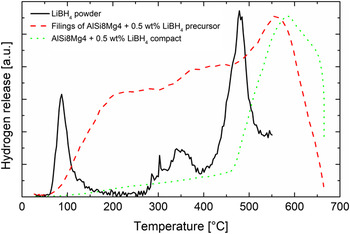
Hydrogen desorption from LiBH4 powder has three peaks at 90, 350, and 480 °C, see Fig. 3. Filings made from compacted Al powder containing LiBH4 show two less pronounced shoulders and one peak. If one relates the 3 features in each of the curves to each other, one sees that the gas release in filings is shifted to higher temperatures compared to loose powders. Finally, the single piece of powder compact exhibits the maximum gas release at one single temperature T = 590 °C, which is higher than the other temperatures involved.
Hydrogen release from LiBH4 powders, fillings and compacts of AlSi8Mg4 + 0.5 wt% LiBH4 measured in an Ar atmosphere. Solid: hydride powder (heating rate 10 K/min), dashed line: filings, dotted line: precursor (heating rate is 40 K/min in the two latter cases).

Discussion of Fig. 3: The three hydrogen desorption peaks of the powder can be related to the following partial reactionsReference Züttel, Wenger, Rentsch, Sudan, Mauron and Emmenegger32:
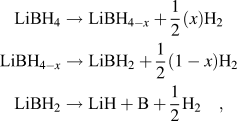 $$\displaylines{ {\rm{LiBH}}_4 \to {\rm{LiBH}}_{4 - x} + {1 \over 2}\left( x \right){\rm{H}}_2 \cr {\rm{LiBH}}_{4 - x} \to {\rm{LiBH}}_2 + {1 \over 2}\left( {1 - x} \right){\rm{H}}_2 \cr {\rm{LiBH}}_2 \to {\rm{LiH}} + {\rm{B}} + {1 \over 2}{\rm{H}}_2 \quad, \cr}$$
during which the borohydride releases hydride in three steps and boron is formed. The remaining simple LiH is stable up to 900 °C, i.e., beyond the temperature range studied here.Reference Züttel, Wenger, Rentsch, Sudan, Mauron and Emmenegger32
The compacted precursor exceeds 99% density, see Fig. 2. Therefore, the gas cannot escape easily and gives rise to a signal in the spectrometer. Rather, the hydrogen released by the borohydride accumulates in internal voids that later grow to bubbles. Insofar, the weak hydrogen release below 500 °C confirms the quality of the precursor but does not tell us much about the release from the blowing agent.
On the other hand, the hydrogen released from pure powder is transported to the spectrometer quickly, which gives rise to a fast and direct reading. However, it has been observed for TiH2 that loose powder behaves differently from powder that has been mechanically stressed during compaction and is encapsulated in a gas tight Al metallic matrix. Three effects have been discussed: (i) surface oxides on the blowing agent particles can be broken during compaction, which reduces the temperature of gas release.Reference Jiménez, Garcia-Moreno, Pfretzschner, Kamm, Neu, Klaus, Genzel, Hilger, Manke and Banhart33 (ii) the gas released accumulates in the area around the blowing agent particle and builds up a counter pressure of hydrogen which slows down hydrogen release.Reference Matijasevic-Lux, Banhart, Fiechter, Görke and Wanderka6 (iii) Reactions of the blowing agent with the matrix material or other alloying elements forming e.g., Al3Ti5 or TiSi intermetallics might also modify gas release.Reference Campana and Pilone34
The use of filings combines the behavior of powders and compacts since the gas released diffuses to the surface more quickly than in single pieces of powder compacts but still the effect of the metal matrix is present. Therefore, the effects of oxide cracking and gas counter pressure are accounted for, while gas detection is immediate enough to allow us to relate the measured sample temperature to gas release and we use gas desorption measurements on filings to compare the various blowing agent powders.
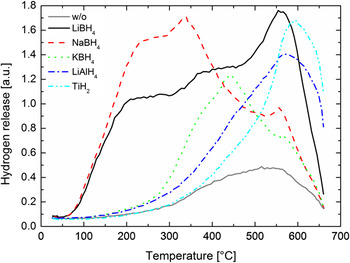
Figure 4 demonstrates that the various hydrides contained in filings release the gas at very different temperatures. LiBH4 and NaBH4 release the gas to the surroundings at a very early stage, whereas KBH4-containing filings do not. Gas release from both NaBH4 and KBH4 starts to drop above 450 °C (not counting the small peak at 550 °C for NaBH4). In contrast, the two Li-containing blowing agents, TiH2 and the blowing agent-free compact, show an increasing gas release rate up to 550–600 °C. Especially, the Li-containing hydrides deliver gas up to the highest temperatures.
Hydrogen release from AlSi8Mg4 filings containing 0.5 wt% of one of the hydrides (or none = w/o). The heating rate was 40 K/min and a synthetic air atmosphere was used.

Discussion of Fig. 4: Both the early gas release from NaBH4 and its early exhaustion can be related to the lower degree of compaction of that sample. LiBH4 also yields the gas early, probably enhanced by blowing agent particles close to the surface of the filings, but retains some gas up to high temperatures due to its good compaction. This is important for foaming since the gas is needed for the inflation of bubbles and to maintain the pressure in the bubbles after maximum expansion has been reached. LiAlH4 can also hold gas up to high temperatures since it is well compacted as well. This applies to the blowing agent-free sample too, which can also be foamed by pressure manipulation due to the desorbed gases and the good compaction achieved in conjunction with sufficient gas generation in and after the foaming stage.Reference Garcia-Moreno and Banhart35
C. Expansion
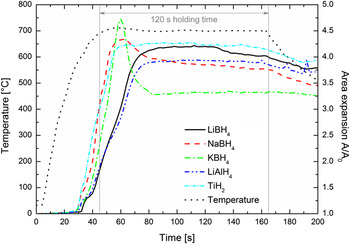
Foam expansion curves of various materials are given in Fig. 5. The temperature profile applied is shown only for one sample but was very similar in all cases. At least three experiments were carried out for each blowing agent (in some cases more). The statistical scatter of such experiments is nonnegligible and especially maximum expansion shows variations of ±10%, while the general features of the expansion curves are more reproducible. We selected a typical average experiment for Fig. 5 and discuss only features that appear in all the experiments.
Area expansion of AlSi8Mg4 foams containing 0.5 wt% of different blowing agents. The nominal temperature profile was the same for all the samples, which is why only one exemplary temperature curve is given.

Materials containing one of the Li-containing blowing agents consistently start to foam later (or at a higher temperature). Such samples reach about the same maximum expansion. They reach their expansion maximum without the temporary overshooting that is observed for the K- and Na-based hydrides. Correspondingly, the latter materials show a visible collapse tendency, whereas the Li-containing hydrides produce foams that remain stable for most of the holding time of 120 s. LiAlH4 gives rise to the most stable foams, which are comparable to the foams blown with TiH2.
Discussion of Fig. 5: All foams show a similar maximum expansion although their blowing agent content is fixed in terms of mass fraction (0.5 wt%) and not in terms of gas volume. We do not know how much is released by each blowing agent during foaming but we can assume that the amount varies between the different agents. This demonstrates that the value of maximum expansion does not directly scale with the gas content. It has been reported that an increasing TiH2 content increases the maximum expansion only up to 0.45 wt% and that contents beyond 0.5 wt% do not increase foam expansion any more except for a short temporary expansion peak such as the one observed for NaBH4 and KBH4 in Fig. 5, after which the foam collapses.Reference Stanzick, Duarte and Banhart36 The interpretation is that the ability of a liquid metal film to withstand the stress generated by stretching limits foam expansion rather than the amount of gas available for foaming. According to this interpretation, all the blowing agents investigated in our experiments provide enough (or even too much) hydrogen to achieve the maximum possible expansion level. Even though some of the complex hydrides might provide more gas than TiH2 (where 0.5 wt% has been found to be an ideal content), they do not give rise to more foam expansion. In future studies, one might want to investigate whether the content of those hydrides can be lowered without sacrificing foam expansion.
The sluggish expansion of the foams blown with the Li-containing agents can be related to the better compaction of the corresponding precursors that have been pressed to a higher density and the counter pressure the hydrogen gas builds up in the melting matrix. Hydrogen released in the liquid state gives rise to growth of round bubbles as opposed to release in the solid state that rather opens and widens cracks and other nonspherical features. The Li-containing blowing agents provide gas up to above 600 °C, see Fig. 4, whereas NaBH4 and KBH4 reach exhaustion and correspondingly the foams collapse partially after no gas is supplied any more. Na could also have an indirect influence via melt properties such as surface tension (i.e., reduced) and solidification contraction (increased) but the exact mechanisms are not known.Reference Emadi, Gruzleski and Toguri37
D. Foam structure
The evolution of the foams blown with different blowing agents as monitored by x-ray radioscopy is shown in Fig. 6. Starting from the initial precursor (1st column) the foams develop small bubbles after about ½ min. Here, a difference can be noticed: Li-containing blowing agents or TiH2 lead to a uniform nucleation over the entire sample volume and a convex contour of the early foam, see 2nd column and Fig. 6(f). NaBH4 and KBH4-containing precursors start foaming in the bottom part only and are concave at the top. As already seen in the expansion curves, see Fig. 5, the Li-containing powders blow the foam slower, reflected by the longer time needed to reach the stage shown in the 2nd column.
X-ray radioscopic image sequence of AlSi8Mg4 foams in different expansion stages. The blowing agent content was 0.5 wt% of (a) LiBH4, (b) NaBH4, (c) KBH4, (d) LiAlH4, and (e) TiH2. The expansion stages corresponding to different columns are labeled as: 1: unexpanded precursor, 2: stage of nucleation, 3: stage of growth, 4: stage near maximum expansion and 5: after 120 s of isothermal holding. Detailed and magnified views of stage 2 of (f) LiBH4 at 44 s and (g) NaBH4 at 36 s are also given.

The later foaming stages, columns 3–5, reflect the differences seen already in the initial nucleation stage. The foams blown by the Li-containing agents or TiH2 maintain their uniform bubble morphology up to maximum expansion, see column 4, and even until after the isothermal holding stage, however, with some coarsening. NaBH4 and especially KBH4-foamed metal remain nonuniform and prone to drainage as seen from the accumulation of liquid at the bottom of these foams.
Discussion of Fig. 6: In cases where the precursor material foams uniformly and adopts a convex shape, a uniform heat transfer into the sample has taken place and has ensured that foaming started everywhere in the sample. In the other cases, the sample has partially lost contact with the substrate at an early stage. Reasons for this could be the insufficient integrity of the samples that were not compacted so well, which enables the formation of cracks and deformation of the sample. Another factor is the lower heat conductivity of the less well compacted samples, which brings heat to the upper part of a foamable tablet at a slower rate.
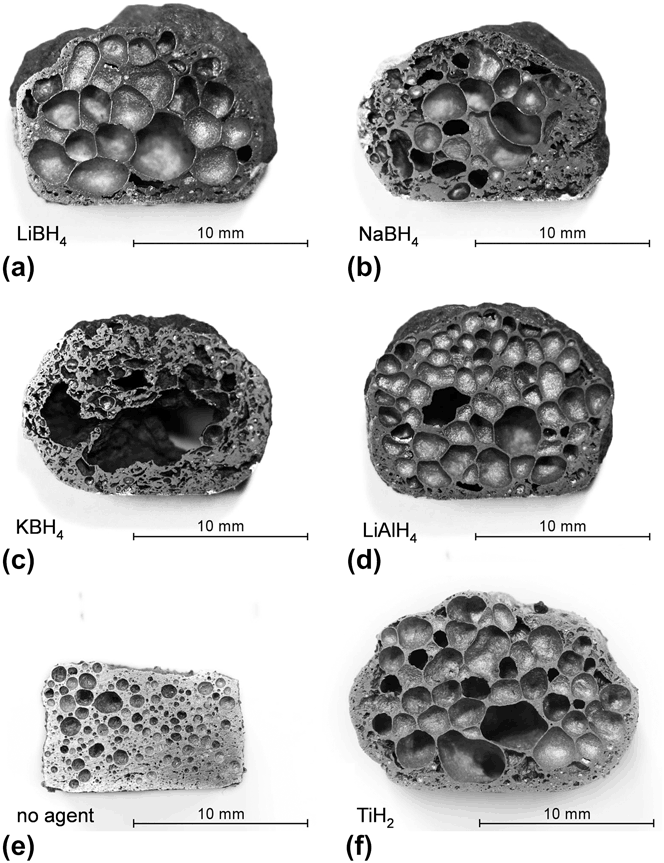
Postfoaming analysis of the foams solidified after the x-ray experiments, see Fig. 7, confirms the impressions gained by x-ray radioscopy. The Li-containing agent and TiH2 produce the most uniform foams. NaBH4 produced only a small region of the good foam structure, while the foam blown with KBH4 has totally collapsed with one large pore remaining in the center surrounded by densified structures. The latter foams also have some open porosity at the outer surface. The best pore structure is obtained for LiAlH4.
Cross-sections showing the pore structure of AlSi8Mg4 foams blown with (a) LiBH4, (b) NaBH4, (c) KBH4, (d) LiAlH4, (e) no agent, and (f) TiH2.
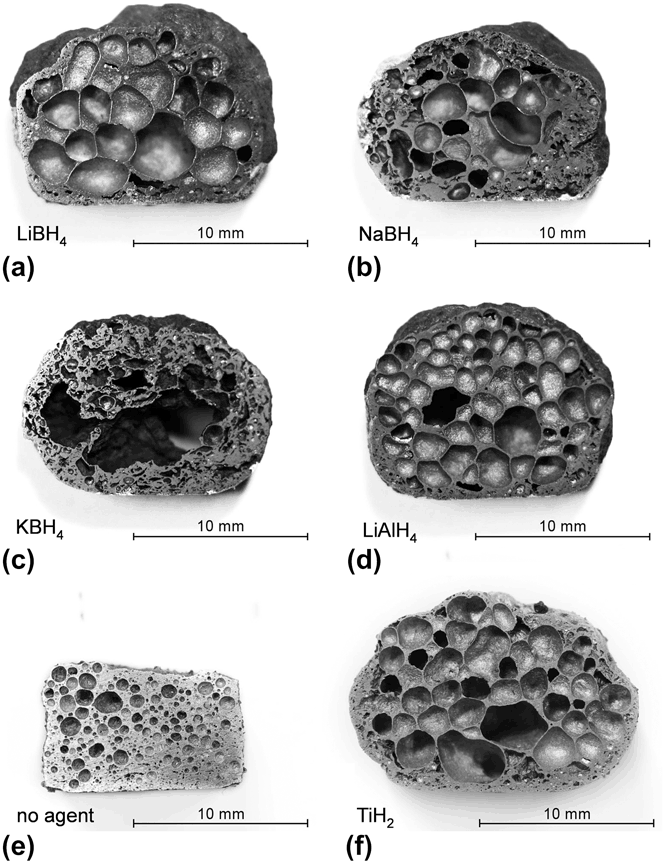
Discussion of Fig. 7: The blowing agents containing Na and K have a negative effect on the films between individual bubbles. Possibly hydrogen can diffuse through the metal films due to fractures, oxide layers or some residual pressing porosity. Gas losses appear largest near the surface, which speaks for the proposed gas loss mechanism by out diffusion.
IV. SUMMARY
(i) AlSi8Mg4 foams could be produced with all complex blowing agents investigated: LiBH4, NaBH4, KBH4, LiAlH4.
(ii) LiAlH4 followed by LiBH4 produced the foaming results that were closest to the “traditional” blowing agent TiH2.
(iii) Both density and electrical conductivity of the pressed powders were correlated to the expansion height, foam stability and pore quality of the corresponding foams.
(iv) The lithium contained in two of the blowing agents investigated was found to improve compaction. Li has a beneficial effect – similar to Mg – when aluminum powders are sintered since it breaks the tenacious oxide layer around Al powder particles that hinders metallic bonding.
(v) LiAlH4 is a suitable blowing agent and is commercially interesting due to its low price. It has a favorable desorption behavior for Al alloys and leads to foams with a uniform pore structure.
(vi) The content of the new blowing agents needs to be optimized and the compaction conditions could possibly be further adjusted to improve the already very promising first results.