Introduction
Australia is renowned for having the highest incidence of skin cancer in the world as a result of its proximity to the equator and the mutagenic effects of long-term, intense ultraviolet exposure.Reference Goh, Bova and Fogarty 1 The annual incidence of cutaneous squamous cell carcinoma (SCC) in Australia can be up to 1300 in 100 000.Reference Buettnner and Raasch 2 While primary malignant tumours of the parotid gland are relatively uncommon, the parotid is anatomically considered a ‘basin’ for lymphatic metastasis of cutaneous head and neck SCC because of a rich network of intercommunicating lymph vessels draining the scalp and face, containing up to 30 lymph nodes.Reference Veness, Porceddu, Palme and Morgan 3 It is reported that SCC accounts for up to 20 per cent of all skin head and neck cancers, approximately 5 per cent of which metastasise.Reference Goh, Bova and Fogarty 1
Therefore, cutaneous SCC is the most common malignancy in the parotid region in Australia and continues to impose a significant burden on the Australian health system.Reference Goh, Bova and Fogarty 1 , Reference Bova, Saylor and Coman 4 Around 20 per cent of parotidectomies are performed for metastatic cutaneous SCC and this represents 50 per cent of parotid region malignancies.Reference Bova, Saylor and Coman 4
It is well known that early locoregional control of the cancer and the extent of neck disease are key to survival and quality of life.Reference Corlette, Cole, Albsoul and Ayyash 5 Thus, it is common practice to perform a parotidectomy and selective neck dissection in most cases, followed by adjuvant radiotherapy. However, the extent of neck dissection remains an area of debate because of an absence of randomised controlled trials and a lack of consensus in the published literature, which reveals varying incidences of occult neck disease. This study aimed to investigate the rate of occult neck disease in those patients with parotid SCC who were deemed to have negative neck nodes based on clinical and radiological findings.
Materials and methods
The review involved a consecutive series of patients with metastatic SCC to the parotid gland treated at the department of head and neck surgery within the Northern Sydney Local Health District, Australia, between 2001 and 2014. All patients were reviewed at the multidisciplinary head and neck meeting and the data were collected prospectively over a period of 13 years. The electronic patient files were extracted and reviewed. The project was approved by the human research ethics committees and conducted according to the ethical guidelines.
Patients were included for analysis if they had evidence of metastatic SCC to the parotid gland, with no clinical or radiological evidence of metastatic disease in the remainder of the neck. Patients were included if they underwent a parotidectomy, with or without a neck dissection, and were excluded if the parotidectomy was performed for a primary SCC overlying the parotid. The decision to perform a neck dissection was usually based on patient co-morbidity. Patients were also excluded if they received radiotherapy as a primary treatment for their SCC (because of potential lack of fitness for surgery).
Patients' demographic data and clinically relevant information included: patient assessment and investigative findings on initial presentation, operative and pathological reports, radiotherapy treatment, clinical outcome, and survival. The primary outcomes of interest were the pathological status of the neck lymph nodes and survival. Other variables analysed included: age at presentation, sex, co-morbidity, immunosuppression status, O'Brien staging,Reference O'Brien, McNeil, McMahon, Pathak, Lauer and Jackson 6 perineural infiltration, extracapsular spread of nodes, margin status of the parotid disease, the maximum dimension of tumour deposits, radiotherapy, locoregional recurrence and distant metastases. Information regarding the primary lesions was incomplete and not included in the analysis.
The clinical staging for the patients was revised using the O'Brien system.Reference O'Brien, McNeil, McMahon, Pathak, Lauer and Jackson 6 Patients were considered to have neck nodal disease on clinical examination, confirmed by findings of computed tomography and positron emission tomography (PET) (when conducted).
In this report, ‘immunosuppressed’ patients included those with chronic lymphocytic leukaemia and other haematological malignancies (lymphoma and leukaemia), solid organ transplant patients, and those on immunosuppressants.
Statistical analysis
The statistical software JMP (SAS Institute, Cary, North Carolina, USA) was used to analyse the patient data. Associations between categorical variables were assessed using a chi-square analysis; the results are reported as p values, odds ratios and 95 per cent confidence intervals (CIs). The comparison of numerical variables was performed using a one-way analysis of variance. Univariate analysis of survival and the effect of the variables was assessed using the Kaplan–Meier method, with significant differences in the effect of variables being assessed using the log-rank method. A Cox regression model was used for univariate and multivariate analyses of both disease-specific and overall survival. Multiple logistic regression was used for multivariate analyses. Modelling was performed using a backward elimination technique, and included variables with a p value of 0.10 or less in the initial model. Significance of association was set at a p value of 0.05.
Results
Demographics
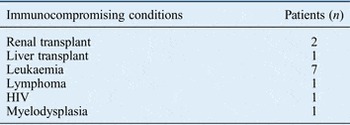
Ninety patients with a SCC metastasising to the parotid gland presented to the unit during the study period. After excluding the patients who received radiotherapy alone and those who presented with neck disease at the same time, there were 65 patients left to analyse. A male predominance was apparent, with 58 males (89 per cent) and 7 females (11 per cent) in the cohort. The patients' median age was 79 years, with an interquartile range of 72 to 85. Thirteen patients (20 per cent) were immunocompromised. A breakdown of the patients' immunocompromising conditions is provided in Table I.
Patients' immunocompromising conditions

HIV = human immunodeficiency virus
Surgery
A superficial parotidectomy was performed on 56 patients, total parotidectomy on 3 patients and radical parotidectomy on 6 patients. Forty-six patients underwent neck dissection (Table II). Selective neck dissection was performed on the majority of patients (n = 39) and a comprehensive neck dissection was performed on seven patients.
Surgical treatments offered

Neck dissections were complicated by haematomas in one patient. In two patients (who underwent selective neck dissection), neurapraxia of the accessory nerve occurred. The rate for accessory neurapraxia in the selective neck dissection group was thus 2 out of 39 (5 per cent). One of these patients recovered fully and one was left with mild residual weakness.
Pathology
All 65 patients who underwent parotidectomy had confirmed SCC on histopathology. In 20 patients (31 per cent), the tumour was graded as poorly differentiated, in 25 patients (38 per cent) it was moderately differentiated and in 4 patients (5 per cent) it was well differentiated. The histopathology findings for the remaining patients did not specify SCC. Multiple nodes in the parotid specimen were seen in one case (1.6 per cent). Margins were involved in 20 out of 63 cases (31.7 per cent) where this information was provided. Extracapsular spread was reported in 19 of 65 cases (29.2 per cent).
Occult nodes
In those 46 patients who underwent elective neck dissection, only 8 (17.3 per cent) were found to have occult neck disease. The only significant predictor for the occult neck disease was the presence of immunosuppression. Patients were 10 times more likely to have occult neck disease if immunocompromised (Pearson chi-square; odds ratio = 10.2, 95 per cent CI = 2.0–51.3, p = 0.0013). Features of the parotid pathology (margins, size of deposit, number of involved nodes, extracapsular spread and perineural infiltration) were not associated with the presence of occult metastases.
Recurrence and survival
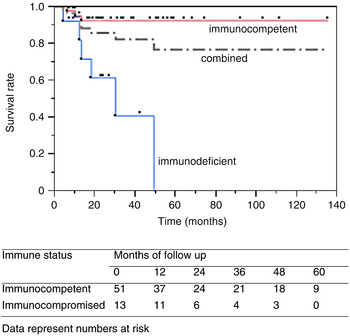
The disease-specific five-year survival rate was 77 per cent for the whole cohort (Kaplan–Meier method). There was a significant difference between the survival of immunocompromised and immunocompetent patients, with immunocompromise conferring a five-year disease-specific survival rate of 0 per cent compared to a rate of 92 per cent in the immunocompetent (p = 0.0001) (Figure 1).
Disease-specific survival rates, calculated using the Kaplan–Meier method, for immunocompetent versus immunodeficient patients (log-rank test p = 0.0001).

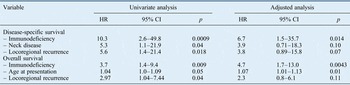
On univariate analysis, the statistically significant factors for disease-specific survival were immunodeficiency, occult neck disease and locoregional recurrence. However, on multivariate analysis, only immunodeficiency was found to be statistically significant (Table III).
Univariate and multivariate analysis data*

*Obtained using Cox proportional hazards method. HR = hazard ratio; CI = confidence interval
On univariate analysis, overall survival was affected by immunodeficiency, age at presentation and locoregional recurrence. On multivariate analysis, age at presentation and immunodeficiency were found to be significant factors affecting survival (Table III).
Locoregional recurrence occurred in nine patients and distant metastases in four patients (Table II). On multivariate analysis, the only significant factor for locoregional recurrence was the presence of perineural invasion (odds ratio = 7.8, 95 per cent CI = 1.4–47.7, p = 0.018).
Radiotherapy
Fifty patients (76.9 per cent) received post-operative radiotherapy. Eighteen of those received intensity-modulated radiotherapy and 32 patients received conventional radiotherapy. One patient received chemoradiotherapy. The differences in adjuvant regimes occurred because of a change in treatment protocol over the period of investigation. Two patients did not receive radiotherapy as they died shortly after the operation. Two patients were deemed unsuitable because of other co-morbidities (e.g. scleroderma). One patient declined radiotherapy treatment.
Positron emission tomography
In 18 cases, a PET scan was performed prior to treatment. The PET scan accurately predicted the extent of disease in 15 cases. There was one false positive finding (for a case with lymphoproliferative disease, where involved nodes showed up on PET) and two false negative findings (both in the occult disease group). The sensitivity and specificity were 67 per cent and 87 per cent respectively in this series.
Discussion
Metastasis from cutaneous SCC is uncommon and a marker of more aggressive disease. Treatment commonly involves a combination of surgery and radiotherapy, in patients who are often elderly and suffer from co-morbidities. This study aimed to evaluate the occurrence of previously unsuspected metastases in neck dissections associated with parotidectomies, and, by doing that, gather more information regarding the most optimal way to manage this group of patients.
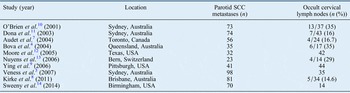
This study revealed a rate of occult neck disease of 17.3 per cent in those who had metastatic cutaneous SCC to the parotid gland. This finding is similar to published studies by Audet et al.Reference Audet, Palme, Gullane, Gilbert, Brown and Irish 7 and Kirke et al.,Reference Kirke, Porceddu, Wallwork, Panizza and Coman 8 which demonstrated the incidence of occult neck disease at 16 per cent and 14.7 per cent, respectively. However, other recent studies have demonstrated rates between 35 and 44 per cent,Reference Veness, Porceddu, Palme and Morgan 3 , Reference Ying, Johnson and Myers 9 , Reference O'Brien, McNeil, McMahon, Pathak and Lauer 10 as illustrated in Table IV.Reference Veness, Porceddu, Palme and Morgan 3 , Reference Bova, Saylor and Coman 4 , Reference Audet, Palme, Gullane, Gilbert, Brown and Irish 7 – Reference Sweeny, Zimmerman, Carroll, Schmalbach, Day and Rosenthal 14 The methodologies of the studies may provide an explanation for this, including differences in the ways pathological specimens were dealt with and whether nodes were attributed to the neck or the parotid.
Studies of metastatic cutaneous scc to the parotid, with occult neck node involvement data

SCC = squamous cell carcinoma
It is largely agreed that the neck needs to be treated, either by radiotherapy or surgery, in cases of metastatic cutaneous SCC to the parotid.Reference Veness, Porceddu, Palme and Morgan 3 , Reference Kirke, Porceddu, Wallwork, Panizza and Coman 8 , Reference O'Brien, McNeil, McMahon, Pathak and Lauer 10 , Reference D'Souza and Clark 15 There is disagreement as to whether a clinically negative neck should be dissected. Although our detected rate of occult metastasis was at the lower end of the reported spectrum, we continue to perform selective neck dissections in these patients for several reasons. Selective neck dissection of levels II and III is a low morbidity procedure that provides useful information in cases where neck disease is found. In this series, there were two cases of accessory neurapraxia following selective neck dissection, both of which at least partially recovered. If occult nodes are found, our adjuvant therapy becomes more extensive, involving all nodal groups of the ipsilateral neck.
Decisions regarding which treatment to adopt are often modified according to patient factors. The median patient age in this cohort was 79 years, which is in keeping with other reports.Reference O'Brien, McNeil, McMahon, Pathak, Lauer and Jackson 6 – Reference Kirke, Porceddu, Wallwork, Panizza and Coman 8 This is indicative of the nature of the disease process affecting an elderly group of patients. It also means that the commonest reason for altering a treatment plan would be related to the patients' fitness for surgery.
In this series, when elective neck dissection was performed, it was usually level I–III, or level II and III selective dissection. There was no association between the performance of neck dissection and patient survival. In our cohort, 76.9 per cent of patients received radiation treatment, which is in keeping with the modern trend of giving these patients both modalities of treatment.
This study demonstrated that the presence of immunosuppression was the most significant predictor not only of patient survival but also of occult neck disease, with a 10-fold increase in the presence of occult neck disease in immunosuppressed patients. Immunosuppression is well known to worsen survival rates in patients with metastatic SCC from skin primaries.Reference Shao, Wong, McIvor, Mylnarek, Chaplin and Izzard 16 Immunocompromise as a predictive factor for the presence of occult metastases is a new finding.
In immunocompromised patients, the risk of more widespread metastasis is higher and the chance of survival is lower. Therefore, while desirable to treat the neck more extensively in this group, this has to be balanced with the knowledge that this group is more likely to succumb to the disease.
-
• Metastatic cutaneous squamous cell carcinoma to the parotid gland is often treated by parotidectomy, neck dissection and radiotherapy
-
• The extent of neck dissection has been debated
-
• This series found the rate of clinically undetected nodes in neck dissection specimens to be 17 per cent
-
• ‘Occult’ nodal metastases are significantly more likely in immunocompromised patients
In this study, PET was only utilised pre-operatively in 18 patients. The sensitivity and specificity were 67 per cent and 87 per cent respectively. (Previously reported ranges for specificity and sensitivity in more general studies of metastatic head and neck SCC are quite broad, with the highest sensitivity rate being 90 per cent and the higher specificity rates being 95–99 per cent.Reference Gordin, Golz, Keidar, Daitzchmann, Bar-Shalom and Israel 17 – Reference Jeong, Baek, Son, Ki Chung, Kyung Lee and Young Choi 19 ) While the patient numbers are too small to be of value for an overall evaluation of the technique, the findings do highlight some difficulties with PET scanning and the concurrent existence of lymphoproliferative disorders, which make interpretation more difficult. Occult metastases are difficult to identify on PET scans, with a resolution of around 5 mm.Reference Yamazaki, Saitoh, Notani, Tei, Totsuka and Takinami 18 Although PET scans are useful, they do not completely resolve the issue of finding of occult metastases.
Conclusion
Current treatment for metastatic SCC to the parotid gland involves parotidectomy and neck dissection in many cases. Selective neck dissection is most commonly practised because of the relatively low complication rates and uncertainty about occult neck disease. This review demonstrates that the presence of occult metastases in clinically and radiologically negative necks was 17.3 per cent. As a secondary finding, the presence of immunosuppression was the most significant predictor of worse patient survival and occult neck disease in patients presenting with metastatic parotid SCC.
Acknowledgement
Help with statistics was given by Dr Philip McCloud.