Introduction
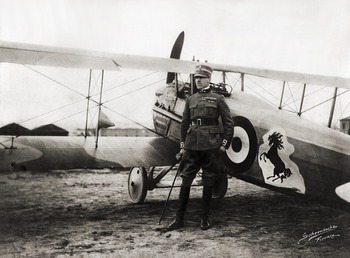
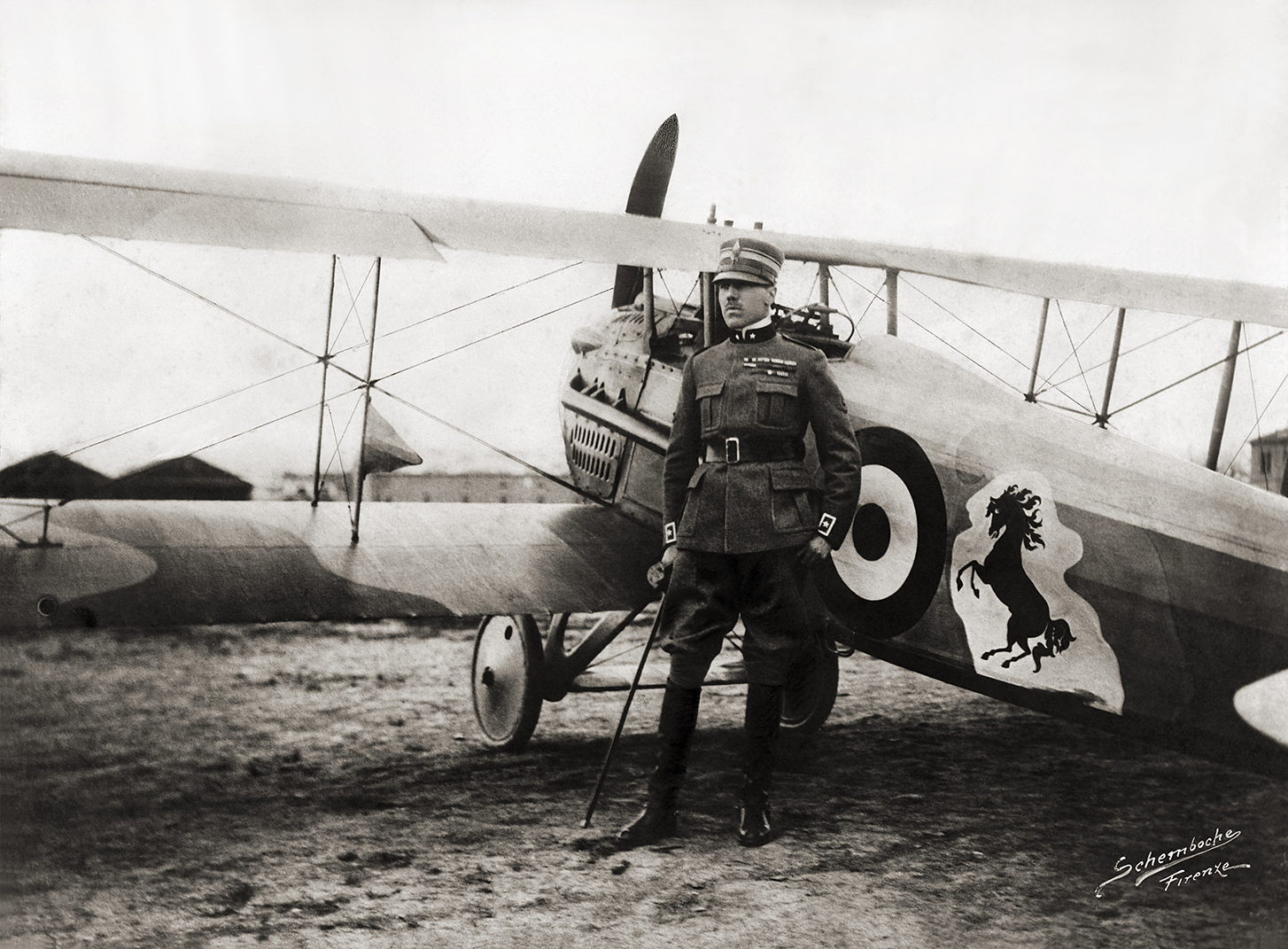
Ferrari currently ranks as the most powerful brand in the world.Footnote 1 Its iconic logo, the “Prancing Horse” on a yellow background, is univocally associated with Ferrari and elicits a quasi-religious devotion among its fans, who are known as tifosi. Footnote 2 Enzo Ferrari (1898–1988) and his legacy progressively built the company’s reputation on narratives of racing success obtained by the Ferrari cars and drivers that have cemented its leadership in the motorsport and luxury road car businesses.Footnote 3 However, few recall the military origins of the Ferrari logo, which can be traced back to the Italian military aviator Francesco Baracca, a “forgotten hero of the Great War.”Footnote 4 Although they were contemporaries from the same region, Enzo Ferrari and Francesco Baracca never met in person. When the picture below (Figure 1) was taken in Padova on April 10, in 1918, Enzo Ferrari, later the founder of the namesake car company, was an unknown nineteen-year-old blacksmith serving in the Third Mountain Artillery Regiment of the Italian Army.
Francesco Baracca in front of his Spad S.XIII airplane, Padova, April, 10, 1918.
Source: Museo Francesco Baracca, Lugo di Romagna, Italy.
It was not until 1923 that Ferrari, at the beginning of his racing career, had the opportunity to adopt the Prancing Horse, at the time a symbol of national renown, for his race cars and to use it as his company logo from 1939 onward. A number of historical accounts report the events through which Ferrari obtained Baracca’s coat of arms.Footnote 5 However, no systematic exploration has been conducted on the business rationale and potential motivations underlying this process within cultural branding and, in particular, the specific factors enabling the successful strategic repurposing of this symbol from aviation to motorsport in support of Ferrari’s newly established venture. To understand the significance of the logo in Italy’s interwar society and to trace how Ferrari used it to gain a competitive advantage, this article draws on cultural branding literature, specifically Douglas Holt’s concepts for studying iconic brands, together with insights from anthropological work by Grant McCracken that established how the meaning that culture supplies to the world can be transferred onto consumer goods.Footnote 6
More often than not, iconic brandsFootnote 7 emerge through different and idiosyncratic myths and stories, some of which are strongly contingent on the contexts in which the brands were first rooted.Footnote 8 How to establish this context is of utmost importance because “if brands exist as cultural, ideological, and sociological objects, then understanding brands requires tools developed to understand culture, ideology, and society.”Footnote 9 However, scholars argue that we are still far from unpicking the nuanced, multifaceted interface between brands and society.Footnote 10 Here, historical methods of contextualizing the brand within sociopolitical processes and events can deliver such a tool. They allow us to see how redeploying an iconic and meaningful symbol from a cultural context or historical period to a business may ultimately establish and reinforce a brand’s unique identity based on broader, shared cultural categories. This redeployment can achieve differentiation and competitive advantage in fierce markets, valuable for newcomers that often have to compete with inferior resources against established incumbents.Footnote 11 However, this process can present in different forms, depending on the industry and context in which it takes place. For example, although most research has investigated advertising campaigns to explain how this process happens for consumer goods (e.g., fashion, sport equipment, soft drinks, spirits, design furniture, automobiles), we have little understanding of other business settings (e.g., industrial goods, sport industries) or other cases in which advertising is not adopted as a tool.
Our study focuses on the transfer of a symbol from a cultural context to a business setting in the form of a logo, thus aiming to explore the underpinnings of this specific, important, yet understudied process within cultural branding.Footnote 12 Our study argues that the success of this operation is due to a process we term strategic repurposing—which can be conscious or incidental. The process starts with the transfer of meaning and values from the original to the new context, and it eventually can lead to the replacement of such elements with the firm’s own narratives. This may also help the firm dissolve prior cultural associations with meanings that have become undesirable.
The case of Ferrari in its early years, in which the emergence of the cultural icon predates the company foundation, is an ideal setting to explore this process through a novel perspective. Whereas most studies to date have explored the processes of cultural branding aimed at targeting consumers and users, we focus on a phenomenon in which the company’s actions instead obtained the institutional support of critical nonmarket stakeholders (i.e., political and cultural elites) at a time when Ferrari was not selling road cars. Our analysis thus makes a contribution by looking at political context that produces cultural categories and principles to show how a transfer of meanings and values from the socially constructed world to a brand can be fundamental in securing institutional support for a firm, especially in economic systems with higher levels of state intervention.Footnote 13 In turn, the change in culture after the end of the fascist regime also explains why, in the postwar era, Enzo Ferrari downplayed the ties between his brand and the meaning originally associated with the logo. This might be the reason why, today, few recall the connection of the Prancing Horse with the WWI fighter pilot.
The source base of this study revolves around two main aspects. First, the life and mythologizing of Francesco Baracca and, second, Enzo Ferrari’s adoption of Baracca’s coat of arms and the business effects of this operation. The former aspect is explored with the help of published war histories and archival documents retrieved from the Military Aeronautics Archive of the Italian Army in Rome and the Archive and Library of Lugo di Romagna—materials that bring into focus Francesco Baracca and his myth. Of great importance were the materials of two exhibitions, Cavaliere del Cielo. Il Mito di Francesco Baracca (Knight of the Sky. The Myth of Francesco Baracca), held in Bologna in 2015, and Nel Segno del Cavallino Rampante (In the Sign of the Prancing Horse), held in Trento from 2014 to 2015. For the latter aspect, we used a large number of publications and documentaries about the life of Enzo Ferrari and his company, including his only autobiography,Footnote 14 which helped in tracing the prehistory of the company before its refoundation under the name “Ferrari” in 1947, marking the point when the company begins to manufacture luxury road cars.Footnote 15 In the period under observation, Enzo Ferrari’s activities exclusively focused on motor racing and, during the war years, mechanical war supplies. Differently than previous studies with their reliance on advertisement,Footnote 16 we looked at correspondence, newspaper articles, pictures, diaries, and official company documents because racing teams of the interwar years lacked the practice of advertising to a consumer base. Our method differs further in that we used interviews with present and past company executives, experts of WWI history and military aviation, automotive and motorsport historians, literature and art experts, as well as museum directors and curators, to carefully craft the cultural context from which the Prancing Horse received its iconic status and to trace how the meaning and values it symbolized were transferred onto Ferrari’s racing team first and business venture second.
The article is structured in five parts. First, we introduce the literature on cultural branding and explore unresolved aspects related to brand repurposing across different fields. Second, we connect the birth of Ferrari’s iconic brand to the historical origin of the Prancing Horse as it first appeared on the plane of the aviator Francesco Baracca during WWI, and to the meaning and values that were associated to Baracca’s persona and coat of arms. Third, we discuss the historical context that turned Baracca and his Prancing Horse into an Italian cultural icon: the rise of nationalism, futurism, and irredentism as artistic and intellectual forces, which ultimately fed into fascism’s cult of military heroism and sacrifice. Fourth, we explore the facts underpinning Ferrari’s adoption of the Prancing Horse and Scuderia Ferrari’s transition from a subsidized race team within Alfa Romeo to a fully-fledged and independent company against the backdrop of the militarized economy in the fascist period. Finally, we discuss our contribution vis-à-vis prior literature on cultural branding. All in all, this study examines the historical case of one of the most iconic logos to showcase strategic repurposing as a specific cultural branding process that can contribute to the establishment of distinct company identities.
Brands, Icons, and Cultural Branding
The American Marketing Association defines a brand as a name, term, design, symbol, or other aspect that identifies a seller’s product or service in a unique and distinctive way compared to other sellers.Footnote 17 Branding is considered one of the key factors for business success, as it traditionally supports organizations in achieving a unique identity in their stakeholders’ eyes.Footnote 18 The symbolic meanings of a brand may also satisfy customers’ emotional appetites, such as the need for self-reflection and social identification.Footnote 19
Branding is crucial for organizations in most industries—particularly those strongly relying on intangible elements such as identification and hedonic consumption—because it can influence a firm’s reputation and the stakeholders’ loyalty to a firm’s products or services,Footnote 20 thus ultimately enhancing firm performance and sustained competitive advantage.Footnote 21 Brands—their names, terms, designs, symbols, and features that characterize a company’s products or services—are progressively less considered as an orchestrated configuration of diverse components, but rather as a fluid “process of becoming,”Footnote 22 a discourse that actively involves different public or private agents, individuals, consumers, communities, or business organizations. These actors interact with, appropriate, and continuously (re)shape the brand, its kaleidoscopic image, and its perceived identity in the eyes of the different stakeholders.
Contemporary brands, indeed, are more often than not embedded within and affected by cultural contexts and have recently attracted the attention of historians, anthropologist, and sociologists.Footnote 23 Scholars have begun to consider the appeal of a brand as driven by emotions, which are at times intentionally, at times intrinsically, related to its history and heritage.Footnote 24 However, whereas there is wide acknowledgment and agreement among scholars and practitioners that cultural branding matters to enhance brand awareness,Footnote 25 brand equity, and ultimately firm performance,Footnote 26 scholars lament the lack of theorization on individual processes, which underpin different operations of cultural branding despite the rich anecdotal literatureFootnote 27 on various cases. Our research addresses this phenomenon by asking: H ow can firms use cultural branding to develop a business icon without a consumer good or sustained advertisement?
Companies are not the only entities developing the brand identity, but they often play a fundamental role, particularly in the initial entrepreneurial phases and in situations in which the brand is purposefully led through a process of transformation.Footnote 28 It is important to note, however, that building a successful brand likely requires extensive resources and capabilities, which are often rare in new firms. Thus, young ventures often try to establish their brands by anchoring them to existing myths, narratives, renowned or symbolic characters, and a series of events and memories that might be meaningful for their key stakeholders. Particularly for exclusive luxury brands, unique and powerful associations play a pivotal function in enhancing brand equity,Footnote 29 which is a proxy for the customers’ perception of quality,Footnote 30 their loyalty,Footnote 31 and their willingness to buy.Footnote 32
Creating a brand implies several subtasks, such as defining a distinct brand identity, connecting it to a set of founding values, and engaging with activities that can support a credible and effective establishment.Footnote 33 However, if creating a brand is a complex task, elevating it to a business icon is even more challenging. Holt proposes that iconic brands are established by targeting “the myth markets currently in play in popular culture … and … most appropriate for the brand.”Footnote 34 Three building blocks constitute a myth market: national ideology, populist worlds, and cultural contradictions. For our case, helpful categories in thinking through the processes at work in the repurposing of the Prancing Horse logo are national ideology and populist worlds. National ideology embodies the values, ethos, and system of ideas that create links between everyday life and those of a nation, thus representing the overall moral consensus of a specific society at a specific point in time. National ideology is often reflected in myths.Footnote 35 Populist worlds are formed of “groups that express a distinctive ideology through their activities” based on shared ethos and motivations for their actions.Footnote 36 Populist worlds are especially powerful as they are perceived as true and voluntary, and are guided by intrinsic values, not by commercial or political interests—in a word, they are perceived as authentic. Iconic brands are often built by members of the populist worlds or individuals who are deeply immersed in them. However, the brand’s customers are often far removed from the populist worlds, hence the association of the brand to the myth happens only thanks to the credibility of the narrative that suggests an association to its principles.Footnote 37 Therefore, iconic brands can borrow myths from populist worlds to promote the credibility of the associations they suggest and the authenticity of the values they reference.
Holt’s work focuses on consumer products whose brands emerge primarily from storytelling of associated values rather than features of the products themselves (e.g., performance, innovation, technology). Accordingly, his genealogy methodology relies mainly on ads, which might not be viable for nonconsumer products (e.g., industrial products, sports teams, etc.) or products developed without major use of advertisement. Ferrari’s employment of a cultural symbol, as we will show, instead triggered meaningful associations in groups of nonmarket stakeholders whose engagement was critical for the company’s success as they essentially functioned as “celebrity endorsers.” Previous concepts of “celebrity endorsers,” who are commonly hired as brand ambassadors for reasons of birth, value, appearance, or accomplishments—qualities that they “own” and that facilitate the transfer of meaning from the celebrity to the advertised product—have stressed that these celebrities are part of complex marketing campaigns as a desirable model to emulate by individuals who enjoy inferior reputation or visibility.Footnote 38 Thus, the marketing campaign is the means through which the celebrity’s support of the firm and its products is made visible. However, we posit that in situations without advertisement, such mechanisms can be observed in the cultural context surrounding the phenomenon. By making visible the “invisible scaffolding” of cultural categories that provide meaning in society, we can trace strategic meaning transfer that repurposes intrinsic values from contemporary populist worlds and national ideology to the company as a novel process within cultural branding.Footnote 39 Crucially, the credibility of the transfer motivates celebrities to endorse the company as they value its association to a set of authentic meanings that are connected to the myth of populist worlds and national ideology.
In addition, it is interesting to note that certain brands benefit from the association to populist worlds for a limited period of time, and later on, once fully established, they not only dissolve the prior connections to the cultural origin, but consciously replace the original meaning.Footnote 40 This differs from most studies in cultural branding, which tend to emphasize the importance of continuously nurturing the association with the original myth, its meaning, and its values. Following this line of inquiry, our work furthers historical investigation of the early days of Ferrari, today one of the world’s most iconic brands, to understand how the adoption of the Prancing Horse, a popular symbol from a distant context, resulted in a successful strategic repurposing supported by the credible transfer of associated values and meanings to the company.
The Birth of the Prancing Horse Myth
Enzo Ferrari was born in Modena on February 18, 1898. He recalled that in 1908, at the age of ten, he witnessed race car driver Felice Nazzaro win the race Circuito di Bologna, an event that inspired him to pursue a career as a racing driver.Footnote 41 Ferrari acquired most of his material understanding and mechanical skills in his father Alfredo’s metal carpentry workshop, where he worked during his adolescence. After completing little formal education and serving in the army during WWI, he found employment at a motor company in Turin and shortly thereafter moved to Milan, where he worked for Costruzioni Meccaniche Nazionali C. M. N. (National Mechanical Constructions), which converted light trucks into cars. Ferrari was hired as a test driver, and soon he was promoted to racing driver in 1919.Footnote 42 In 1921, Enzo Ferrari took part in a number of races, gained visibility in the racing community, and eventually was hired to drive exclusively for one of Italy’s leading car manufacturers: Alfa Romeo.
On June 19, 1923—incidentally, the day of the fifth anniversary of Francesco Baracca’s death—Ferrari won his first race, held at Circuito del Savio, near Ravenna.Footnote 43 There he met Francesco Baracca’s parents, Enrico Baracca and Paolina de Biancoli, who attended the race as spectators. Enzo Ferrari and Enrico Baracca quickly developed mutual esteem and friendship.Footnote 44 The Baracca family had been regular clients of the Alfa Romeo dealer, where Ferrari used to work, and Ferrari remembered Enrico Baracca as a compassionate and humble gentleman.Footnote 45 Most importantly, Ferrari (as many Italians at the time) was aware of the legendary reputation surrounding their deceased son, Francesco Baracca.
In his only autobiography, Ferrari mentioned that during his second meeting with the Baraccas, the Countess de Biancoli suggested displaying her son’s Prancing Horse emblem as a lucky charm on Ferrari’s cars.Footnote 46 There are no documented reasons that reveal the motivation of this gift, and Ferrari himself never directly addressed them. Other sources speculate that the mutual sympathy was based on intertwining life stories, such as the fact that Ferrari was from the Modena region, where Francesco Baracca had joined the Military Academy of Modena, or the fact that Ferrari’s older brother Alfredo fell ill and died while volunteering for the ground crew of the 91st Squadriglia (Ninety-First Squadron), whose most celebrated fighter ace was Francesco Baracca.Footnote 47 One might wonder why the symbol of a military aviator who had been killed in action could be considered a lucky charm, or what value a heretofore modest race car driver such as Ferrari might have seen in the unusual gift. However, it is important to remember that anything related to the mythic persona of Francesco Baracca became a quintessential symbol of the dominant national ideology in Italy. Thanks to a tremendous institutional propaganda effort during WWI, Baracca had become a household name since his aviation victories in 1917, which posthumously turned into an equally powerful memorialization culture, sponsored by nationalist forces in Italian politics and society.
The aviator and flying ace of the Italian Air Force, Francesco Baracca, was born in Lugo di Romagna (Emilia-Romagna region, Italy) on May 9, 1888.Footnote 48 Francesco was the only child of an upper-class family with noble connections. His father, Enrico, was a landowner and a wine producer. His mother, the Countess Paolina de Biancoli, was a member of the Italian aristocracy.Footnote 49 Francesco Baracca was an eclectic individual: expert equestrian, skilled motorcycle driver, and advanced cello player.Footnote 50 Although his family origin could have guaranteed him a protected and comfortable life away from the battlefront, his patriotism motivated him to pursue a military career at the age of nineteen. Already, during his education in secondary school, Baracca had developed a strong interest in the army, and after graduating, he joined the Military Academy of Modena, where he remained for two years (1907–1909).Footnote 51 Despite not being particularly fond of academic study, he enrolled in and graduated from the Scuola di Applicazione di Cavalleria (School of Cavalry) in Pinerolo, a small village close to the Italian Alps.Footnote 52 He then joined the prestigious Piemonte Reale Cavalleria (Royal Piedmont Cavalry), garrisoned in Rome, where he reached the rank of second lieutenant.Footnote 53
In 1909, the renowned aviator Wilbur Wright had opened a school for airplane piloting in Centocelle, Rome, where, at the beginning of 1912, Francesco Baracca had the opportunity to observe a training session. The experience inspired him to become a military aviator.Footnote 54 At the end of April 1912, Baracca moved to Bétheny, in the canton of Reims, France, where he attended a flying school and obtained his pilot’s license that same year.Footnote 55 During the spring of 1915, the Italian Army reinforced its aviation equipment with an agile, light aircraft, the French sesquiplane Nieuport 10. Fully loaded, these airplanes weighted just 411 kilograms, which made them ideal for quick maneuvers, training, and fighting.Footnote 56 On May 23, 1915, (the day before Italy officially declared war and allied with Britain and France) Baracca arrived in Paris, where he underwent two months of pilot training with these planes. On April 8, 1916, he returned to Italy to initially join the Eighth Nieuport Fighter Squadron, and subsequently the First Fighter Squadron—part of the Italian Corpo Aeronautico Militare.Footnote 57 Baracca’s deeds soon became renowned, and his achievements found important admirers. The Italian King Vittorio Emanuele III himself shot a picture of the first enemy plane that Baracca downed on April 7, 1916, (which was also the first WWI air-fight victory for Italy)Footnote 58 and had the image publicly exhibited in a museum in Udine.Footnote 59 War records report that on February 11, 1917, Baracca shot down his fifth enemy, a victory that consolidated his fame across Italy. At a time when pilots would hardly survive more than a couple of air combats, Baracca, with an overall record of thirty-four victories, eventually became Italy’s most successful military pilot during WWI.Footnote 60
For his service in Italian military aviation, Francesco Baracca collected an impressive number of public recognitions—or endorsements—from high-ranking political “celebrities” of the time. For instance, Vittorio Emanuele III himself presented Baracca with a Silver Medal, and he received the prestigious War Cross from Albert I of Belgium.Footnote 61 The council of Lugo di Romagna gave him the Sword of Honor, and he also received a special acknowledgment during a public celebration at Teatro alla Scala in Milan in 1917. During the conflict, Baracca was awarded four medals in total—one gold, two silver, and one bronze—for military bravery, and on September 6, 1917, he was promoted to the rank of major by war merit.Footnote 62
On May 1, 1917, the 91st Squadriglia, also known as Squadron of the Aces, was created to join together all the top aviators in the Italian army, which included, among others, Francesco Baracca, Luigi Olivari, Ferruccio Ranza, and Fulco Ruffo di Calabria. Beginning in 1917, the 91st Squadriglia allowed its pilots to add their personal emblem to the cockpit.Footnote 63 This is when Francesco started painting the emblem of a black Prancing Horse on a white background on his planes (the Nieuport 17, the SPAD S.VII, and the SPAD S.XIII).Footnote 64 In a letter written to his mother on April 27, 1918,Footnote 65 Baracca explained that the emblem was chosen to display his early affiliation with the prestigious Royal Piedmont Cavalry Regiment.Footnote 66
Thus, officially recognized by military and political leaders, both the authorities and his family pleaded with Baracca to withdraw from the front. The former were worried about the possibility of seeing their war hero defeated, destroying his—and by extension the nation’s—aura of invincibility. The latter was concerned about the burgeoning risks and considered Francesco’s contribution to the war sufficient to grant him an honorable retirement. Documents from Baracca’s private correspondence provide extensive evidence of his mother’s dissuasion attempts.Footnote 67 Still, Francesco Baracca decided to continue his military career, which ultimately led to his death.Footnote 68 Commander Franco Osnago, who was flying with Baracca during his final mission, offered the most comprehensive eyewitness account of Baracca’s sole defeat.Footnote 69 On June 19, 1918, at 6:00 p.m., Baracca and Osnago went on a reconnaissance mission in two airplanes over the Neveglia, Montello, and Buso delle Rane areas near Treviso, Italy. The Austro-Hungarian forces positioned in these areas launched a ground attack against the Italian airplanes. Baracca was shot dead in flight, and his aircraft crashed on Montello hill near Treviso. His body was recovered four days later, on June 23, 1918.Footnote 70
Mythologizing WWI Aviation in Italy
Whereas the battle in the trenches along the mountainous Italian-Austrian border has been considered one of the darkest parts of Italian WWI history, the air combats in the skies across Europe have evoked images of an epic and chivalrous conflict. Since the beginning of the twentieth century, airplanes were internationally admired as magnificent flying machines, and narratives presented them as the most advanced military technology to win battles.Footnote 71 In reality, however, military aviation had a modest bearing on the outcome of the war, given the small number of casualties that airplanes of that generation could inflict on the enemy, particularly when compared to the high death toll of trench warfare. In wartime Italy, aerial combat was imbued with idealized militaristic values and ethos that reflected the promoted Italian national ideology. The flying aces in particular presented a powerful instrument for nationalist war propaganda and served as heroic role models and symbolic inspiration to motivate the troops at the front and the people at home.Footnote 72 Their courageous deeds and deaths offered a great source for vivid narratives, which, thanks to the increasing diffusion of photography, were often enriched by spectacular pictures.Footnote 73
Artistic expressions of the era, ranging from music to photography and from literature to film, echoed the public cult around airplanes.Footnote 74 The influential ultranationalist intellectual and celebrated author Gabriele D’Annunzio (1863–1938) was one of the first artists in Italy to express his fascination with aviation through poetry, envisioning how aircrafts could change the world.Footnote 75 In a 1910 interview with the Italian journalist Luigi Barzini, D’Annunzio enthusiastically described flying as “a new experience, a new essential need. The only thing I can think is to fly again soon.”Footnote 76 His passion for flying was an inspiration for his artistic production, and as early as 1910, he dedicated his romantic novel Forse che sì, forse che no (Maybe yes, maybe no) to aviators, love, and death.Footnote 77 D’Annunzio’s nationalist political views aligned with the irredentist movement, which sought to unify territories inhabited by Italians and safeguard Italian culture from foreign influence. For instance, D’Annunzio famously flew over the Dalmatian town of Fiume to release fliers announcing the reign of Italy. In 1915, Italy had broken its alliance with Germany and Austria after the Entente Allies promised Italy these parts of Austrian Dalmatia densely populated with ethnic Italians. Italy briefly reigned over the territory in 1918. However, in 1919, the Entente reneged on the agreement, fueling an Italian sense of betrayal that would feed into the nationalistic fascist movement.
The combination of speed and progress that aviators represented also attracted the futurist movement. The movement’s program, known as the “Manifesto of Futurism,” published by Filippo Tommaso Marinetti in 1909, enthusiastically celebrated emerging technologies such as airplanes and race cars, which were seen as symbols of modernity.Footnote 78 The main positions promoted by futurism and its early representatives, such as Marinetti, Umberto Boccioni, Carlo Carrà, Giacomo Balla, Gino Severini, and Luigi Russolo, encouraged artists and intellectuals’ active engagement with broader society and particularly a direct, sometimes disruptive, involvement in industry, politics, and business matters.Footnote 79 Futurists were also specifically fascinated by the aesthetics of speed, as Marinetti wrote in the Manifesto: “The magnificence of the world has been enhanced by a new concept of beauty; the beauty of speed. A racing car with its big tubes similar to snakes on its bonnet is more beautiful than the Nike of Samothrace.”Footnote 80 Alongside the growing fascination with speed and modern technology, aviation, and with it Baracca, the archetypical Italian aviator and war hero, became the subject of several artistic works.Footnote 81 Eventually, parts of the futurist movement politically aligned with rising nationalistic forces in Italy—and the forthcoming changes in national ideology—which in the early 1920s would coalesce in the fascist movement under the Partito Nazionale Fascista (PNF) that ruled during the Ventennio Fascista (1922–1943).Footnote 82 Futurist artists contributed to the “aestheticization of politics” in early twentieth-century Italy, and especially to the symbolic production of fascism. Seeking “a synthesis between nationalism and modernity,” these futurists saw in fascism “first a movement, then a regime that was capable of realizing that synthesis by instituting a political religion of the nation and creating an ‘Italian modernity.’”Footnote 83
Baracca’s victories vividly fit this symbolic production that merged nationalism and modernity, and it was eagerly adopted by the Italian press. Official records from the library of Lugo di Romagna report more than four hundred newspaper articles dedicated to the renowned aviator during his lifetime, and an even higher number after his death.Footnote 84 The numerous photos taken, alongside the exposure in the press and the many public events held in his honor, created and spread the legend of Francesco Baracca as the “ace of the aces.”Footnote 85 Reporters described his fights as authentic patriotic gestures, idealized acts of heroism, and extreme commitment to the national cause. Baracca’s public image relied heavily on archetypical qualities. Wartime propaganda pictured him as a “flying knight” who followed his personal philosophy and moral standard for aerial battles, which were likened to duels among gentlemen.Footnote 86 These reports contributed authenticity to the public perception of his persona. Meanwhile, in a more pragmatic way, the point of the aerial fights was the defeat of the opponent, which often ended in death. Hence, aviators’ reputation reflected their commitment to kill enemies in defense of the fatherland, to follow military discipline with respect for hierarchy and orders, and to display bravery in the face of death. Baracca’s fascination with adventures and the new possibilities that the numerous technological and industrial advances of the time offered have been documented.Footnote 87 All in all, his public persona was inspired by the idea that aviators were destined to be part of an elite, which further consolidated Francesco Baracca as the archetypical Italian war hero posthumously.Footnote 88 Fascinated with Baracca, D’Annunzio attended his funeral, where he gave a solemn speech. His tribute to the aviator described Baracca with exceptional celebratory rhetoric.Footnote 89 The emerging remembrance culture surrounding the flying aces, and Baracca in particular, not only reinforced the patriotic feelings of WWI national ideology, but also conveyed positive messages about service to the country.
The deployment of the heroic figure of Baracca continued with the nationalist political and artistic movements that emerged from the precarious conditions in which WWI and the Treaty of Versailles had left Italy. The effort aimed at mobilizing the masses by using images of Italian military greatness, while downplaying the losses and atrocities that accompany warfare. For instance, the early interwar governments began to name streets, squares, gentlemen clubs, and sports events in memory of Francesco Baracca—a trend that continued with the advent of the fascist regime in 1923.Footnote 90 Of those the Coppa Baracca (Baracca Trophy), held between 1921 and 1925, became the most famous sports event, not least because its organizing committee included fascist leader Benito Mussolini (1883–1945) and Gabriele D’Annunzio. The latter played a major role in Italian interwar politics and had a strong influence on Mussolini’s political thinking—yet D’Annunzio never accepted an official political role with the fascist regime.
Futurists also contributed to the interwar memory culture surrounding the WWI hero, and thus to the populist world negotiating the changes in Italian national ideology, by mythologizing Baracca as an icon in the process. Poet Paolo Buzzi, instructed by D’Annunzio, wrote a sonnet dedicated to the speed competition, Raid Aereo (Airplane Attack) in 1920, which was published in the brochure alongside two aviator pictures of the sport club Francesco Baracca.Footnote 91 Similarly, futurist painter Mario Sironi received the commission for the poster for the 1924 Coppa Baracca. Other artworks inspired by the flying ace include a portrait of Francesco Baracca, completed by the artist Franco Lucchini in 1919, and the 1920 opera L’Aviatore Dro (The Dro Aviator), directed by Francesco Pratella.Footnote 92 Domenico Rambelli, one of the most famous Italian sculptors of the time, was commissioned by the fascist regime to build a commemorative monument honoring Francesco Baracca in Lugo di Romagna’s main square. The construction of the monument—which still exists today—started in 1927 and was inaugurated on June 21, 1936, under the watchful eyes of local PNF representatives. Interestingly, Rambelli decided to design and build Baracca’s monument in a wing-shaped form.Footnote 93 The design recalled a famous line in D’Annunzio’s eulogy to Baracca: “His glory was not just a number; but it was a wing over a triumphant Italy.”Footnote 94 In tracing this multifaceted remembrance culture, it emerges clearly how the populist worlds of nationalists, futurists, and fascists engaged in active mythmaking to disseminate the cult around Baracca and, simultaneously, to transfer meaning to the desired national ideology. The futurists’ idealization of the aviator’s role, and D’Annunzio and Mussolini’s joint mythologizing of Baracca’s figure, manifested the aviator from Lugo as a national hero.Footnote 95
From Wings to Wheels: Ferrari’s Adoption of Baracca’s Prancing Horse under Fascism
In the totalitarian regimes that arose across Europe during the first half of the twentieth century, industries and private business came under government influence to redirect domestic production toward national reconstruction, military buildup, and autarchic industrial practices. In Mussolini’s Italy, which experienced a number of financial crises in the interwar period, such as the 1927 deflation of the lira and the banking crisis in the early 1930s, this step was taken with the creation of the Istituto per la Ricostruzione Industriale (IRI, Institute for Industrial Reconstruction) in January 1933.Footnote 96 IRI took over the shareholdings of the struggling Credit, Comit, and Banco di Roma. “The chain-like nature of shareholding meant that IRI was the major shareholder representing some 42% of all joint-stock company capital,” Vera Zamagni observes.Footnote 97 This included Alfa Romeo, at the time arguably the most popular and successful Italian race car, but a rather small “artisan” car manufacturer when compared to FIAT, which held about 90 percent of the Italian market share.Footnote 98 It should be noted that most Italians could not afford a private car at the time. In fact, there were only just over two hundred thousand motor vehicles on Italian streets by 1929. This indicates that the domestic automobile industry had not yet reached the scales of mass production.Footnote 99 Survival of artisan carmakers such as Alfa Romeo, Lancia, Bianchi, and Maserati therefore depended on external subsidies, both via funding and government contracts.
The benefit was mutual, however, because the highly technical environment of car racing made it an ideal setting that could showcase industrial development under fascism. By the mid-1920s, Mussolini, a racing enthusiast, had noted the international prestige that this sport held.Footnote 100 In the 1920s and 1930s, Mussolini’s goal was to rival and beat the international competitors, particularly Germany’s Mercedes. By collecting victories with Alfa Romeo cars, he wanted to demonstrate the superior potential of Italian engineering and industrial products.Footnote 101 In an attempt to preserve the image and authenticity of Alfa Romeo as the quintessential Italian car, he requested the director of Alfa Romeo, Nicola Romeo, to exclusively buy from Italian suppliers. Mussolini complained that several parts of his own Alfa, such as the magnets (German), the clock (Swiss), and the malfunctioning horn (French), were imported.Footnote 102 Eventually, the state protected the domestic automotive industry from foreign competition with a legislative bill on November 18, 1929, “which included the motor industry among those which were of strategic importance to national defense and where every single piece of any vehicle sold in Italy had to be manufactured in the country.”Footnote 103 Although the majority of autarky policies came in later years, this groundwork quickly deepened dependence on the fascist regime among the automobile industry and related engineering clusters. The experience of these changes at Alfa Romeo possibly played a role in Enzo Ferrari’s decision to start his own company in 1939 and build the quintessential Italian racing car that fascism hoped for, while financing racing with supply contracts for the government.Footnote 104
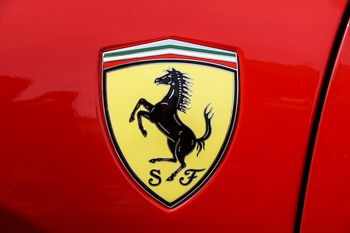
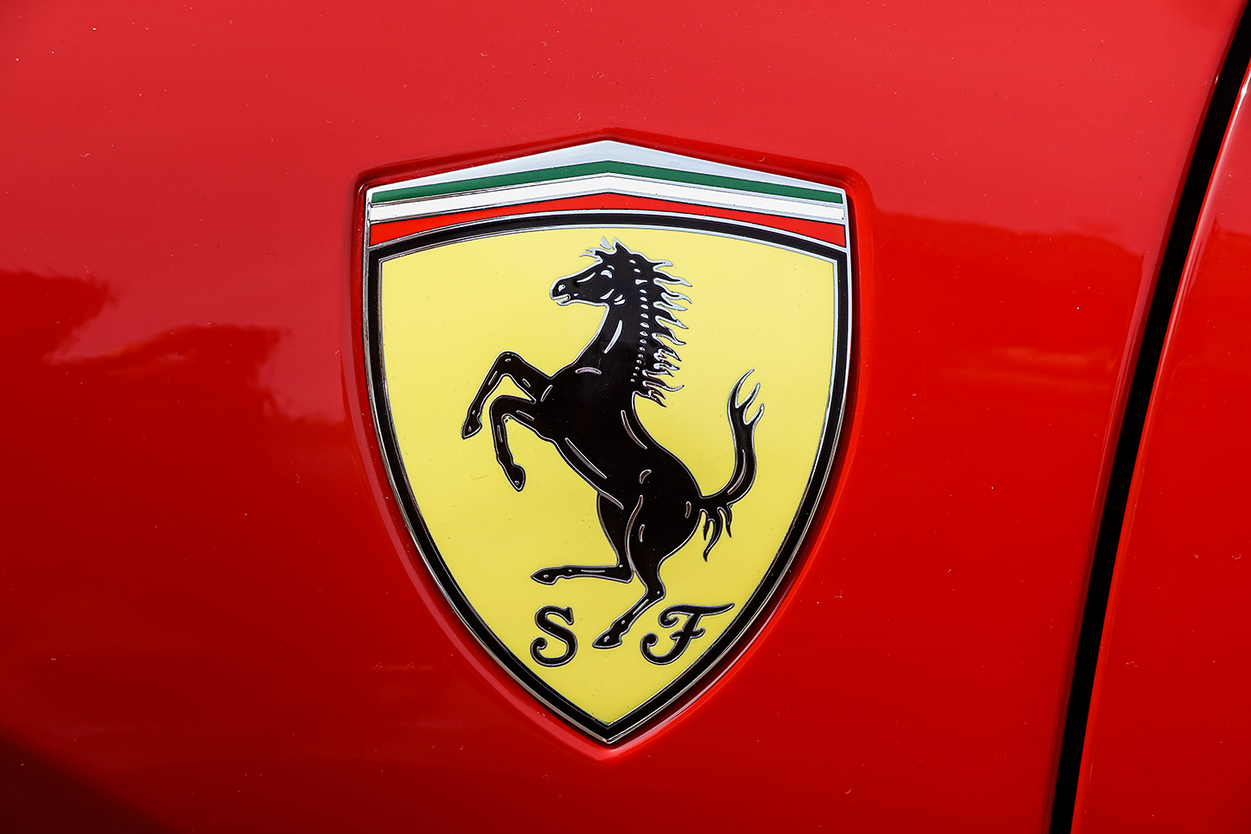
It is therefore important to understand Alfa Romeo’s business model in the racing segment. The Alfa Romeo racing division was run as a “gentlemen driver club,” whose customer base—and one of the main sources of funding—traditionally consisted of (usually wealthy) car owners and collectors who preferred to drive their vehicles themselves rather than to pay a chauffeur, a common practice among the upper–middle class at the time. However, in most clubs, a smaller number of talented individuals received payment to race for the club, and since 1920 Ferrari was one of them. The experience and reputation he gained over the course of the 1920s allowed him to establish the Scuderia Ferrari (Ferrari Racing Team) in Modena on November 29, 1929, a racing team external to Alfa Romeo in which gentlemen drivers and track owners subsidized those costs related to car racing: buying, tuning, and repairing cars. Scuderia Ferrari rapidly became a technical racing outpost of Alfa Romeo, and Ferrari hired several famous figures, such as the chief designer Vittorio Jano, alongside renowned drivers such as Antonio Ascari, Giuseppe Campari, and Tazio Nuvolari.Footnote 105 At this point, nine years after he first obtained it, Ferrari decided to systematically adopt Baracca’s emblem. Starting with the twenty-four hours of the Spa-Francorchamps race on July 9, 1932, the iconic Prancing Horse logo appeared on every Ferrari car. However, Enzo Ferrari significantly modified the original horse of Baracca over the years: The horse tail was shifted upward, the outline was made slimmer, the anterior legs were remodeled, and the right rear leg was placed at a 90-degree angle to the body, while the left rear was placed above the letters “S” and “F” of the name Scuderia Ferrari (see Figure 2).Footnote 106 The altered logo was then placed on a yellow shield, representing the Italian town of Modena, with the Italian tricolore flag on top, anchoring the brand locally and nationally, respectively.Footnote 107
Ferrari logo.
Source: Shutterstock; Royalty-free stock photo ID: 753188377
Picture Credit: Shutterstock/Stefano Carnevali.
Ferrari retired from professional driving shortly after the birth of his son Alfredo (Dino) in 1932. From that moment onward, he focused on the organization and development of what was effectively perceived as Alfa Romeo’s racing department.Footnote 108 Despite its commercial and racing successes, Alfa Romeo had struggled financially since its early days. David Owen noted that “they had spent too much on sporting success and not enough on sound production cars.”Footnote 109 Therefore, in 1933 Alfa Romeo decided to radically cut back costs for racing, and Ferrari took the opportunity to acquire Alfa Romeo’s official racing department.Footnote 110 This proved to be a fairly effective arrangement for the Milanese manufacturer, as it managed to stage competitive race cars at little or no cost.Footnote 111 Around the same time, Alfa Romeo’s financial distress opened the door to state intervention via the IRI. This took the form of both direct injection of capital into the company as well as a reorganization of its priorities. With aeroengine manufacturing (aimed at increasing turnover and supporting military armament), car racing, and some special editions “Alfa was increasingly expected to enhance the prestige for the regime.”Footnote 112 The racing department also depended on the goodwill of the regime, and in 1934 Ferrari and his mechanics became members of the PNF. Enzo’s only living son, Piero Ferrari, later claimed that party membership was a prerequisite for traveling to races abroad.Footnote 113
However, at the beginning of 1938, after a few years of successful competitions under the banner of Scuderia Ferrari, Alfa Romeo reversed its decision and took its racing department back to Il Portello, the area of the original company headquarters in Milan. Subsequently, Scuderia Ferrari was disbanded, and Enzo Ferrari’s role at Alfa Romeo was then reduced to racing manager. This was the beginning of a series of disagreements between Alfa Romeo’s executives and Enzo Ferrari, which culminated in 1939 with a definitive separation, ending twenty years of successful collaboration.Footnote 114 Importantly, the terms agreed upon by the separating parties enforced a noncompetition agreement that banned Ferrari from building cars branded with his name for four years.Footnote 115 Therefore, Ferrari returned to Modena and founded a new company named Auto Avio Costruzioni (Car and Plane Manufacturing).
After the financial and economic crises at the beginning of the decade, and by the late 1930s, the Italian economy had recovered because of measures such as the 1935 nationalization of foreign investments and the 1936 confiscation of gold possessions among the Italian population on the “day of the wedding ring.” With large military orders, industrial output grew by 15 percent in 1937 and continued to grow until the outbreak of the war.Footnote 116 However, with Italy on the verge of entering World War II as Germany’s ally, the situation was anything but promising for companies focusing on niche markets. Ferrari’s new venture could not count on any customer base or awareness, and it was born in volatile times for business. Auto Avio Costruzioni needed to develop a consistent business model that reduced the uncertainty. Enzo Ferrari’s professional experience at Alfa Romeo had exposed him to a specific business arrangement in which the high costs of racing—which were unsustainable per se, given the modest racing prizes and the lack of sponsorships—were subsidized by the government through military contracts, often in the aviation industry. As a matter of fact, technologies such as lightweight engines and materials were common to both airplane and race car manufacturing, and their symbiosis has served as the basis for success among other car companies, such as BMW in Germany, and Rolls Royce and Lotus in England. Enzo Ferrari thus approached his first entrepreneurial venture by replicating a business model that was incredibly similar to Alfa Romeo’s and combining his traditional racing car activities with government commissions for mechanical and aviation supplies.
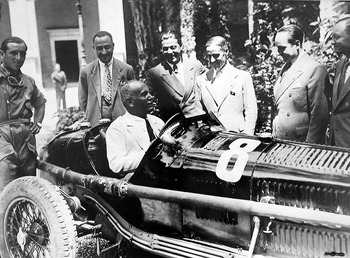
This was possible because Ferrari had put in place important prerequisites to please the fascist regime—now at its acme—as well as broader audiences. His company was based in the Emilia-Romagna, the homeland region of Mussolini and fascism. It was also the focal point for Italian motorsport, today known as the “Italian Motor Valley.”Footnote 117 As reported in an interview with Piero Ferrari, Enzo admired Gabriele D’Annunzio and shared his patriotic views—thus suggesting, to a certain extent, an authentic alignment with the populist worlds that had nurtured the national ideology of the fascist period. More importantly, he knew Benito Mussolini personally, as he had met him in 1924 and spent an entire day with him.Footnote 118 In the same year, the fascist government endorsed Enzo Ferrari and his venture by awarding national honors: the Cavaliere dell’Ordine della Corona d’Italia (Knight of the Italian Crown Order); followed by the Ufficiale dell’Ordine della Corona d’Italia (Officer of the Italian Crown Order) in 1927; and Commendatore dell’Ordine della Corona d’Italia (Knight Commander of the Italian Crown Order) in 1929. This is a paradigmatic case of “celebrity endorsement” by nonmarket stakeholders, taking place in a politicized setting in which institutional support had become a matter of business survival. Mussolini and Ferrari crossed paths again on August 19, 1932, when Il Duce received Ferrari’s racing team in Villa Torlonia after the Alfa Romeo racing team won the titles of Italian and International Champion at the Coppa Acerbo (Acerbo Trophy) in Pescara. A famous photograph (Figure 3) documents this encounter, with Mussolini sitting in the race car surrounded by Ferrari’s team members. Finally, two years later, Ferrari and his mechanics joined the PNF.
Benito Mussolini sitting in an Alfa Romeo race car in 1932.
Source: Wikimedia Commons; Prospero Gianferrari Archive.

Ferrari’s racing team was also known for motorsport success, and thus had become a valuable representative of Italianness. Further, it could use the famous Prancing Horse as its own symbol, and by doing so strategically repurpose values established in about thirty years of mythologizing the most acclaimed Italian war hero within a changing national ideology. The cultural categories operative at the time favored and even warranted such credible associations: fascist nationalism was the dominant ideology; the populist worlds of the intellectual and political elites that had sustained the Baracca myth beyond WWI were in power; and the “celebrity endorsement” by the political regime was a most necessary requirement for business survival.Footnote 119 Adopting a logo with iconic meaning for local culture and national ideology surely facilitated the establishment of the new brand, and when speaking about Ferrari’s adoption of Baracca’s emblem, sources reveal that “Ferrari was certainly shrewd enough to be thinking already about the appeal of such connection.”Footnote 120
Another reason for such an effective logo redeployment might have been that Ferrari credibly portrayed a fit with its cultural meaning: bravery, adventurism, and patriotism. Like Baracca, Enzo Ferrari and his family members had served in WWI and understood the sacrifices warfare claimed. Moreover, both racing and air fighting were competitive activities in which life was at stake for glory. Coming from different socioeconomic backgrounds, the middle-class Ferrari shared with the upper-class Baracca a common regional origin as they were born within the same territory (Emilia-Romagna) only ten years apart.Footnote 121 Hence, they had been exposed to very similar cultural, ideological, and social influences, markers of belonging that were even more pronounced in the strong regional identities of the young Italian nation. Both the aviator and the race car entrepreneur came from a region where the philosophy, intellectual influence, and artistic impulse of a populist world such as futurism had been strongly spreading its message since the beginning of the twentieth century.Footnote 122 In the 1920s, several futurists had also lived and worked in the Emilia-Romagna, particularly in Modena, one of the major towns in the region and Ferrari’s hometown. The Emilia-Romagna not only hosted several futurists but was Mussolini’s home region as well. All of these authentic commonalities contributed credibility to the association of the two identities—that of Baracca and Ferrari—sealed together by the repurposing of the iconic Prancing Horse symbol.
Given all of the above, it comes as no surprise that early on Auto Avio Costruzioni obtained contracts from the fascist government to support the war production by manufacturing aircraft parts, hydraulic grinding machines, ball bearings, and machine tools.Footnote 123 Two years into the war, the government issued an order for Italy’s companies to decentralize and reduce the concentration of production plants in urbanized areas in order to safeguard them from air raids. In 1943, Ferrari’s manufacturing plant moved from Modena town center to the countryside village of Maranello, which was considered unlikely to be a bombing target. However, probably because of its military production, the Ferrari plants were bombed twice, first in November 1944 and then in February 1945.
As many other industrialists during the Ventennio Fascista, Ferrari benefitted from the collaboration with the regime, which became problematic during the liberation period. Italian republican partisans of Modena accused him of being a supporter of the fascist government and threatened his life. His public encounters with Mussolini, party membership, and known dealings with the political leadership to ensure his venture’s survival, which were common among Italian businesses at the time, provided reason enough for suspicion. Allegedly, Ferrari’s life was sparred thanks to the intervention of a friend who paid a ransom of 500,000 lira.Footnote 124 After the war, Ferrari made sure to deny any voluntary collaboration with the fascists and their industrial policies. He declared that he had been forced to accept contracts from the regime. What is known is that after the registration of the company Ferrari in 1947, Enzo Ferrari has remained vague and dismissive about the rationale for the adoption of Baracca’s Prancing Horse. He rather downplayed the original meaning of the symbol in favor of establishing independent awareness of his company’s brand through racing success and exclusive high performance road cars. This strategy has been incredibly successful, to the point that the overlap with the values and meanings of the Baracca myth—so important during the fascist regime—are now, for all intents and purposes, forgotten.
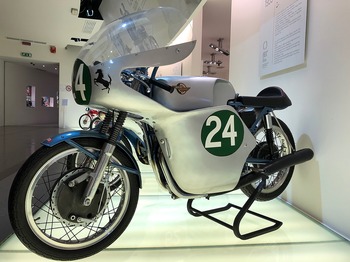
Today, Ferrari’s brand overshadows Baracca’s myth as the main identifier for the Prancing Horse. For instance, between 1956 and 1961, the racing department of Ducati, a renowned motorcycle producer in Bologna (also in the Emilia-Romagna region), adopted the Prancing Horse as a lucky charm on some of its racing motorbikes. This was a decision of Fabio Taglioni, the Ducati’s chief designer, who (just as Baracca) was originally from Lugo di Romagna. Sources report that Taglioni obtained permission to use the Prancing Horse from Baracca’s descendants to celebrate the eminent war hero.Footnote 125 Interestingly, however, he consistently used the icon in Ferrari’s modified version, rather than Baracca’s original version (see Figure 4).Footnote 126
The Prancing Horse logo on the 1960 Ducati 250 GP Desmo at Ducati Museum, Bologna.
Picture Credit: Valentina Tolomelli.
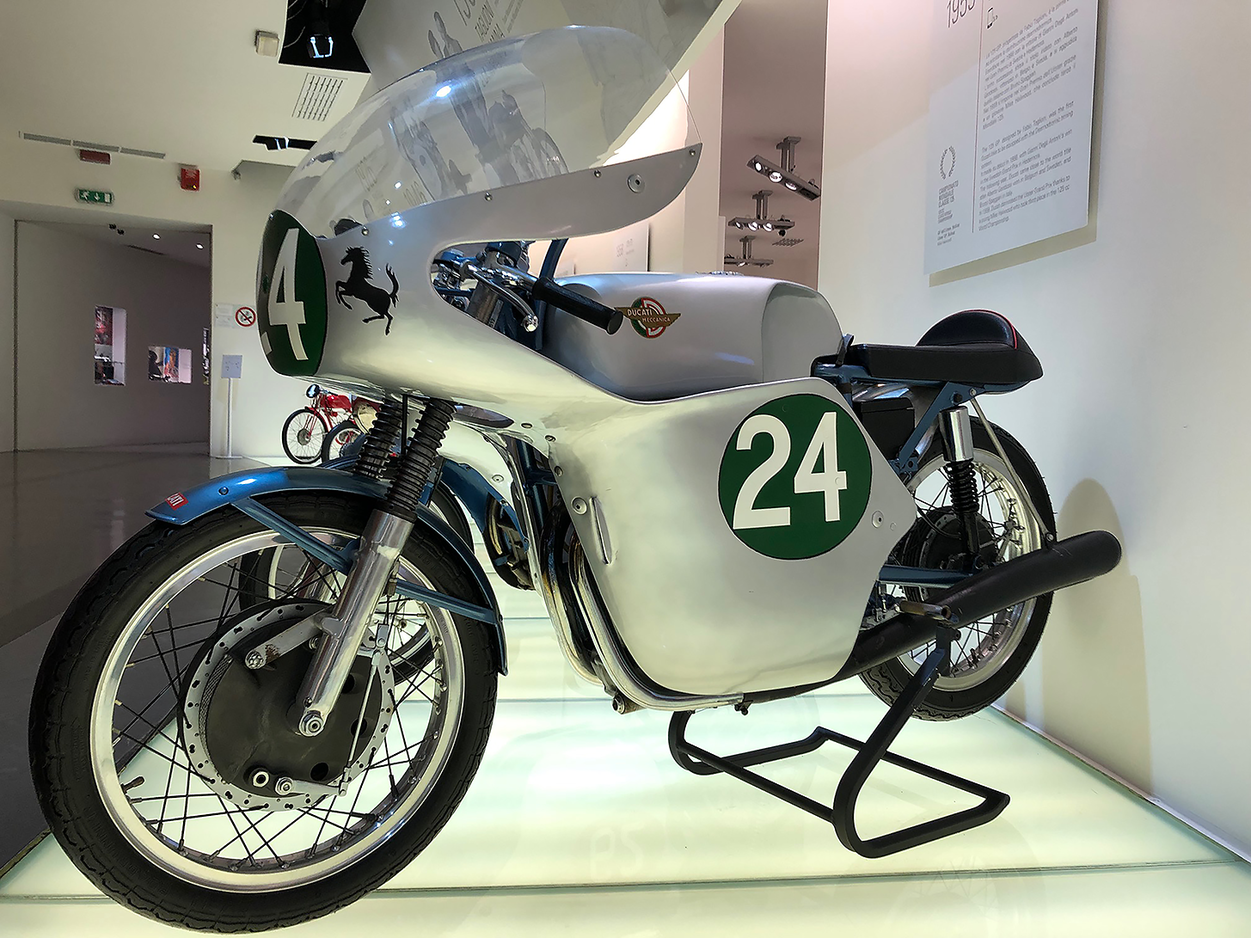
This detail is worth further reflection as it points, in our opinion, to two possible interpretations, which both confirm our analysis. The first is that Fabio Taglioni and his entire staff were unaware of the significant graphical differences between the two icons and picked the wrong one. This would prove that Ferrari’s logo had effectively submerged Baracca’s emblem. However, it seems unlikely that an entire team of expert motorsport professionals and enthusiasts was unaware of the difference and repeated the same mistake at multiple occasions across multiple motorbike models. Particularly, it is hard to believe that Taglioni, being from Lugo di Romagna, had not noticed the difference. The second interpretation is that Taglioni was rather aiming for an association with Ferrari. Lacking the permission to directly associate Ducati to the Ferrari brand and its trademarked logo, he used instead the connection with Baracca as an excuse to suggest such association. It is plausible that Ducati’s market positioning as a premium motorcycle with a winning race record and equally high commercial ambition sought to benefit from the association to the most prestigious Italian race car, Ferrari, with whom it also shares the team color, red. Perhaps most importantly, the motorbikes that Taglioni selected to display the Prancing Horse were equipped with a technological innovation, the “desmodromic system,” which Taglioni had at the time directly adapted from Formula 1 cars—hence the connection with Ferrari. This system was destined to become one of the distinctive innovations in Ducati engineering, which today features in every motorcycle that the company produces. This second association with the Prancing Horse underlined concepts like speed, success, and technological innovation, rather than military honor, bravery, and discipline. Although the sources offer no explanation for why Taglioni used the “wrong” Prancing Horse, both interpretations support our thesis regarding the effectiveness of strategic repurposing.
Conclusions
This work adopts a cultural branding perspective to explore the historical case of Ferrari’s Prancing Horse logo. It identifies the term strategic repurposing as a specific process within cultural branding, aimed to establish an iconic brand by redeploying a symbol from a domain, deeply rooted in a society’s cultural and national ideology, to a business domain. We have shown that the strategic repurposing of cultural symbols to a business domain can support the establishment and identification of new entrepreneurial ventures, and this article provides a contribution to the conversation about the emergence of business icons through cultural branding.
Cultural branding identifies a general approach to the creation, establishment, and development of brands that are derived from and empowered by powerful cultural associations. Strategic repurposing presents a specific process within cultural branding from which it borrows some of the traditional concepts and assumptions. However, our investigation of strategic repurposing allows us to not only better detail how cultural branding may happen in practice, but to also extend the scope of its applicability to contexts that span beyond consumer goods and advertising-based markets—which have been the exclusive focus of cultural branding to date. Indeed, our analysis builds upon the work on cultural branding and consumer culture by investigating how firms can leverage populist worlds to source myths that support the establishment of their brands. The authenticity of the underlying ethos and motivations surrounding these populist worlds allows a firm to benefit from powerful associations that are imbued in the national ideology of the time. Scholars have extensively used advertising to investigate how this process happens for consumer brands. Contemporary or historical populist worlds can thus function as a symbolic source that constructs brands.Footnote 127 For instance, these processes have been examined in cultural business histories based on nation branding strategies in response to globalization, tracing narratives that developed around important national industries, such as Danish furniture, Swiss watches, or Italian fashion.Footnote 128 Our study extends this concept to explore nonconsumer brands, and it sheds light on some underlying mechanisms in industries (such as sports or industrial goods) in which advertising may be less prominent, or not present at all. This methodological contribution also complements Holt’s “brand genealogy,” which is, instead, focused on analysis of advertising for consumer goods. In adopting this perspective, we narrow down our analysis to the cultural value of symbols for brand identity, and we explain how the successful repurposing of the Prancing Horse from aviation to motorsport helped build one of the most iconic company logos. We thus provide a granular exploration of how cultural branding processes can establish meaningful company logos that support the institutionalization of a new venture and help secure its financial sustainability.
Scholars have also underlined the importance of “celebrity endorsers” to create imitative behaviors that stimulate demand for consumer goods.Footnote 129 However, in our case, the absence of a main consumer base that could be targeted in such a way to fuel the company’s growth through sales shifts the attention to the critical role of institutional actors, such as governments and cultural elites. This offered us an opportunity to explore the mechanisms of cultural branding regarding this specific type of “celebrity endorsers.” Our study thus brings nonmarket stakeholders (i.e., government and political authorities, regulators, cultural and intellectual elites) into the conversation of cultural branding. We suggest that the strategic repurposing of a symbol substantiates one viable option within the broader gamut of nonmarket strategies (i.e., strategies not focusing on actors traditionally involved with the supply or the demand)—a currently debated topic in strategy and organization literature.Footnote 130 We observed how Enzo Ferrari’s adoption of the Prancing Horse positioned his venture in close proximity to the cultural categories that were valued and promoted by the political and cultural elites of the time. In line with McCracken, we acknowledge the intangible nature of such cultural categories, the “invisible scaffolding” that provides meaning to the world.Footnote 131
The analysis of the cultural and historical context in which the strategic repurposing takes place allows us to make such invisible scaffolding visible, and it contributes to a rather new strand of literature examining the importance of history for claims of brand authenticity.Footnote 132 However, this strand uses a different understanding of “authenticity,” which in the cultural branding literature would be referred to as “credibility” (i.e., the plausible association between the populist worlds and the company’s values). Organizational literature on the uses of history has established that companies can create an identity and claim credibility (i.e., authenticity in their terms) by proxy of “borrowed” history and suggested that historical narrative can be used to create a “substantial and sustainable” competitive advantage.Footnote 133 We echo these claims by showing that successful strategic repurposing of a cultural symbol into a brand can have important implications for a firm’s survival and competitive advantage.
The evidence suggests that by deploying Francesco Baracca’s iconic coat of arms from military aviation to his motorsport company logo, Enzo Ferrari obtained at least three significant advantages. First, he associated his new company, Scuderia Ferrari, with a vivid portfolio of profound aspirational meanings and values, which were originally associated with the Italian flying ace: an admiration for technology, speed, and fast piloting; the appreciation of heroic, often dangerous gestures; and the promise of elevating Italy’s international prestige. Second, the logo could, early on, enjoy a high level of brand awareness thanks to the exposure that Francesco Baracca and the Prancing Horse symbol had received in hundreds of media pieces, artworks, and honors dedicated to his persona. This was a valuable endowment for the early days of Ferrari, a new venture focused on a niche market, which could not afford an intense and costly advertising campaign leading to comparable brand awareness. Third, and perhaps more importantly, by adopting a symbol that represented the national ideology and had been largely endorsed by populist worlds, including the political, intellectual, and artistic Italian elite, Enzo Ferrari came to enjoy significant institutional support, which allowed him at the very least to continue his business activity. Institutional support was expressed materially in personal awards, commercial contracts, and brand visibility at a time when the political regime was increasingly steering business initiatives in the national economy.
The case we analyzed presents idiosyncrasies and historical contingencies that need careful contextualization. Ferrari’s opportunity to use the Prancing Horse came about thanks to the fortuitous and unexpected donation of the Baracca family’s coat of arms. Without this event, Ferrari would not have had the opportunity to launch, nine years later, his own logo as an elaboration of the original aviator’s coat of arms. Further, the military aviation and early motorsport presented features that were, at the same time, distant but strongly related. Speed, thrill, international antagonism, popular enthusiasm, bravery, technological prowess, and life-threatening risks were aspects that, although with diverging purposes, clearly overlapped across the origin in air warfare and the final association to motorsport racing. This overlap provided fertile ground for successful strategic repurposing of a cultural brand, as points of contact between the two spheres enhanced the credibility of such transfer of meaning. Scuderia Ferrari’s association with Baracca drew on the myth of pioneering aviation and WWI heroic warfare as one of the populist worlds of the time. Because of government propaganda and official endorsement, this populist world became linked to the cultural principles of interwar national ideology. Last but not least, the perceived credibility of the association between the company’s values and the specific myth was crucial to the success of Ferrari’s strategic repurposing: Both Baracca and Ferrari came from entrepreneurial families, had directly experienced the rise of the nationalist movements, and had both served in the army during WWI. They had both been exposed and influenced by those intellectual and artistic movements that praised speed, racing, technology, and action, for which they expressed passion at multiple occasions. Baracca’s family was interested in modern car racing and sympathized with Ferrari as a young, successful driver from their own region of Emilia-Romagna, while Ferrari endorsed Francesco Baracca’s heroic persona. In the eyes of consumers, supporters, and stakeholders, the presence of some genuine shared interests and values between the two figures contributed credibility and validated the transfer of meaning from a cultural domain to a business domain, despite involving two activities whose pursuit might have appeared, at least on the surface, quite distant.
Our study thus highlights the importance of strategic repurposing of cultural symbols in pursuing and enhancing brand awareness and brand equity, and proposes how a deeper understanding of the historical context remains a pivotal aspect for executives and entrepreneurs.Footnote 134 By mastering the cultural categories in which they operate, brand creators can interpret the national ideology and have a clear map of the current populist worlds with which to identify and target the best-fitting myth at any particular historical moment.Footnote 135 The establishment of the Ferrari brand is highly indebted to nationalistic ideas, networks, and social memory that connect the main characters of this story—Francesco Baracca, Enzo Ferrari, Gabriele D’Annunzio, the futurist intellectuals, and Benito Mussolini. Ferrari’s brand development across the 1943 armistice divide is an example of historical appropriation and forgetting.
There is, however, an additional reflection worth mentioning. Because the personal archive of Enzo Ferrari is inaccessible, it is impossible to fully establish Ferrari’s agency in the repurposing process. Nevertheless, we posit that confirming a conscious, intended strategy is not necessary to affirm the dynamics and the impact of this cultural symbol repurposing. In other words, the element that shows the significance of Ferrari’s decision to use the Prancing Horse is not the premeditation of its potential effects, but rather the effects themselves. Consciously or not, Enzo Ferrari’s usage of Baracca’s symbol signaled to the regime that he shared the nationalistic ethos and values that were part of the national ideology. In other words, the strategic repurposing successfully impacted Ferrari’s institutionalization vis-à-vis the fascist regime even if we must, for the benefit of doubt, assume that it happened in a serendipitous, or not fully planned way. With this approach, we make a departure from the Chandlerian view that emphasizes rational entrepreneurs, managerial talent, and leadership. Rather, our study underlines historical contingencies in the narrative and instrumentalizes the methodological strength of contextualization.
All in all, although we cannot provide evidence of conscious agency in the associations underpinning the strategic repurposing process up to the point of 1943, Enzo Ferrari’s role in forgetting the earlier connection to the nationalistic militarism of the fascist years is more evident in the postwar period, a time when such national ideology had been condemned and the Italian industry no longer needed to ingratiate itself domestically with the regime but instead could compete globally.Footnote 136 Unlike firms that have used cultural or national branding strategies to grow from local to global brands, Ferrari severed ties to a particular national ideology during a period of enormous international growth in the postfascist era, while succeeding at remaining a quintessential Italian brand. In what ways this strategic forgetting allowed the brand to become the international icon we know today raises interesting questions for further investigation.
Acknowledgement
We gratefully acknowledge the editor in chief Andrew Popp, the associate editor Shane Hamilton, and the two anonymous reviewers for their knowledgeable guidance in developing our manuscript. This work benefitted from insightful conversations with colleagues in the marketing and strategy groups at Cass Business School, among which we would like to mention Marius Luedicke and Gianni Lorenzoni for their expert suggestions. Finally, we would like to thank all the informants that provided their time and expertise, in particular Mauro Antonellini, Mauro Bianco, Luigi Candiani, Ada Fichera, Livio Lodi, and Daniele Serafini. We also acknowledge the support of the Center for Sport and Business at the Stockholm School of Economics. Errors are our own.