I. INTRODUCTION
Thermoelectric (TE) converters for power generation aim at reducing CO2 emission via the conversion of a part of the low-grade waste heat generated by engines, industrial furnaces, gas pipes, etc. to electricity. The recovery of waste heat from the exhaust of an automotive engine, in particular, is an attractive, albeit not very efficient way for reduction of fuel consumption. TE converters with high overall efficiency convert heat directly into electricity without moving parts and, thus, not only decrease our reliance on fossil fuels but also actively counteract global warming. State-of-the-art converters are simply too inefficient to be economic, partly due to expensive elementary constituents (Te, Ge, etc.). On this background, the half-Heusler (HH) compounds stand out on account of their relatively low cost components and, indeed, have been extensively studied as potential TE materials for high temperature power generation up to 1000 K.Reference Cui, Zhu, Shi, Zhang, Zhao and He1–Reference Culp, Poon, Hickman, Tritt and Blumm15
The HH compounds with a valence electron count of 18 crystallize in the cubic MgAgAs-type structure that consists of four interpenetrating face-centered cubic sublattices. The crystallographic sites (0, 0, 0) and (1/4, 1/4, 1/4) are occupied by two different transition metal elements, the (1/2, 1/2, 1/2) sites are occupied by sp elements such as Sn, Sb, and Bi, whereas the (3/4, 3/4, 3/4) site is vacant. Each occupied sublattice can be doped or substituted individually to optimize the TE properties. The most widely studied materials are the n-type ANiSn-based compoundsReference Cui, Zhu, Shi, Zhang, Zhao and He1, Reference Katsuyama, Matsuo and Ito2, Reference Muta, Kanemitsu, Kurosaki and Yamanaka5–Reference Sakurada and Shutoh9, Reference Culp, Poon, Hickman, Tritt and Blumm15 and p-type ACoSb-basedReference Ponnambalam, Alboni, Edwards, Tritt, Culp and Poon11, Reference Culp, Simonson, Poon, Ponnambalam, Edwards and Tritt12 compounds (A = Ti, Zr, Hf). The TE properties of the n-type HH compounds are higher to those of the p-type counterparts. Currently, the ANiSn-based compounds still display the best TE performance among all known HH compounds. The ANiSn compounds are narrow-bandgap semiconductors with an indirect bandgap of the order of ∼0.1–0.2 eV.Reference Cui, Zhu, Shi, Zhang, Zhao and He1 Complex ANiSn phases, with various doping additions, exhibit exceptionally large power factors. The main drawback of the HH compounds that detracts from their efficiency, or figure of merit (ZT) value, is their relatively high lattice thermal conductivity (κ1), as high as 10 W·m−1·K−1.Reference Shutoh and Sakurada8
Over the past years, numerous efforts have been made to fine tune the band structure, thereby optimizing the electrical properties of the ANiSn-based HH alloys by doping the Sn-site.Reference Shutoh and Sakurada8 Substitution on the A and/or Ni sites can also effectively decrease the lattice thermal conductivity, κ1 via point-defect phonon scattering. It has also been reported specifically that substitution in the form of A0.5A′0.5NiSn (A, A′ = Ti, Zr, Hf) resulted in a ∼50% reduction of κ1 and yielded a ZT value of ∼0.5 at 700 K.Reference Shutoh and Sakurada8 The highest ZT value (ZT = 1.5 at 700 K), so far, was obtained for the complex Ti0.5(Zr0.5Hf0.5)0.5 NiSn0.998Sb0.002 compound in which Sb was added as a donor to tune the electronic properties.Reference Shutoh and Sakurada8, Reference Sakurada and Shutoh9, Reference Culp, Poon, Hickman, Tritt and Blumm15
Deliberate doping and atom substitution are known to affect the transport properties of the HH compounds and expand the span of their relevant properties. Much of the spread of the reported results, however, is still attributable to nonintentional processing related causes, in particular, in these multicomponent systems with widely different melting point components.
HH alloys are most commonly synthesized by arc melting or induction melting the individual components. The presence of the low melting temperature component, Sn, is a usual source of the nonhomogeneity of the resulting alloy and its remains turn out as a segregated impurity phase.Reference Balke, Fecher, Gloskovskii, Barth, Kroth, Felser, Robert and Weidenkaff16 To ensure homogeneity, the solidified compounds after comelting are submitted to lengthy heat treatments before being further processed by powder technology techniques. The latter includes comminution, compaction, and densification by sintering. Spark plasma sintering (SPS) densification has lately gained great popularity because of its relatively short required processing duration.
Beside the elimination of the secondary minority phases, heat treatments are an important factor in determining the level of ordering of the individual components on their respective sublattices. The temperature and durations of these heat treatments have to be determined carefully to find the right balance between acceptable mobility of the components and the desired degree of order. Heat treatments also affect the microstructure, which has some bearing on the TE performance. This latter point is of relevance because thermoelectrical components are often required to perform at elevated temperature and, therefore, the long-term stability of the microstructure is of direct relevance.
Even though the HH compounds have been and currently are the subject of numerous investigations, relatively little attention has been given to the above mentioned issues, which are of significant relevance for the performance of this family of TE compounds. This study is, therefore, concerned with both the electronic and lattice TE properties variations, of undoped TiNiSn, following different heat treatments at 890 °C after the SPS consolidation process. The variation of the TE properties after the heat treatment is linked to the compositional and morphological modifications, associated with the elimination of secondary metallic/intermetallic phases and with the grain coarsening process that runs in parallel.
II. EXPERIMENTAL
A. Synthesis
TiNiSn alloys were prepared by arc melting a mixture of stoichiometric amounts of the pure metals, nickel (99.99%), titanium (99.99%), and tin (99.999%). To ensure homogeneity, the samples were turned over and remelted several times. The as-cast samples were subsequently annealed at 800 °C for 72 h followed by quenching in ice-water to improve the crystalline order. Then, the resulting ingots were milled for 5 h in a high-energy ball miller (PM-100, Retsch, Germany) under a protective argon atmosphere. The presence of the compositionally homogeneous phase was verified by x-ray powder diffraction (XRD) using Mo Kα radiation. The comminuted powder was loaded in the graphite dyes of a SPS (type HP D 5/1 FCT Systeme GmbH, Germany) apparatus and maintained at 1050 °C for 10 min under a mechanical pressure of 50 MPa and a vacuum atmosphere of 4 Pa. The heating/cooling rates were ∼50 °C/min. These SPS regime allowed obtaining dense samples (>99%) without any lateral cracks. Finally, homogenization treatments under an argon atmosphere were performed at 890 °C for 24, 48, and 72 h. For the grains coarsening study, the HH samples were treated at 890 °C for durations of up to ∼90 h.
B. Electrical properties
Seebeck coefficient and the electrical conductivity measurements were performed in a self-constructed apparatus under an argon atmosphere up to ∼500 °C at a heating rate of 3 °C/min. For Seebeck coefficient measurements, an auxiliary heater was used to maintain a temperature difference of 10 °C between the extremities of the samples. Electrical conductivity was measured by the “four probe” method using an alternating power source of 1 V/50 Hz.
C. Thermal conductivity
The thermal conductivity (κ) was determined as a function of temperature from room temperature to 500 °C using the flash diffusivity method (LFA 457, NETZSCH). The front face of a disc-shaped sample (Ø = 12 mm, thickness ∼1–2 mm) is struck by a short laser burst and the resulting rear face temperature is recorded and analyzed. Thermal conductivity values were calculated using the equation κ = α·CP·ρ, where α is the thermal diffusivity, CP is the specific heat [measured using differential scanning calorimetry (DSC); STA 449, NETZSCH], and ρ is the bulk density of the sample (calculated from the sample’s geometry and mass).
D. Structural
All samples were structurally characterized by optical microscopy (OM; Zeiss Axiovert 25, Germany), scanning electron microscopy (SEM; JEOL JSM-5600) and XRD (Philips PW-1050/70, Netherlands). Samples for grains size analysis under OM were previously etched by a hydrofluoric acid solution for 45 s.
E. Thermal stability
Thermal stability characterization for phases evolution monitoring (DSC) and mass variations [thermal gravimetric analysis (TGA)] was performed for the SPS sample up to ∼1000 °C, using STA 449 NETZSCH, under Ar atmosphere.
III. RESULTS AND DISCUSSION
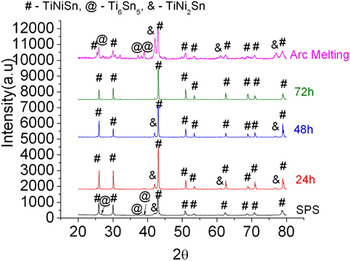
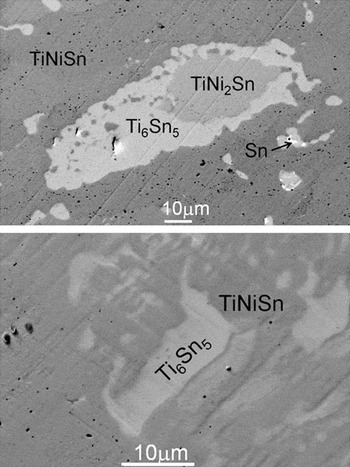
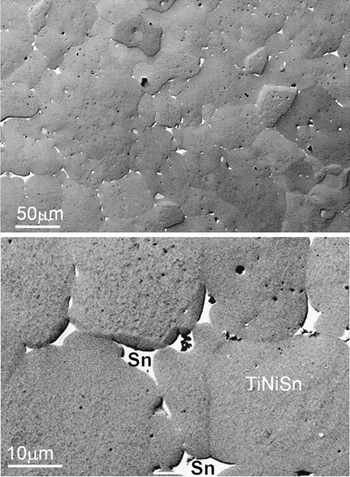
The XRD patterns of the arc melted TiNiSn, spark plasma sintered TiNiSn, and TiNiSn treated at 890 °C for 24, 48, and 72 h are presented in Fig. 1. The arc melting and SPS treatments yielded a multiphased structure, consisting mainly of the HH TiNiSn, the Heusler compound TiNi2Sn, and Ti6Sn5 phases. Subsequent heat treatment at 890 °C for 24 h eliminated the Ti6Sn5 phase. The presence of the Heusler TiNi2Sn phase was still apparent even following the 48-h heat treatment. It is noteworthy that a small amount of free Sn phase was discernable by SEM 72 h after the heat treatment at 890 °C, as shown in Figs. 2 and 3, even though it did not show up in the XRD spectra. In contrast to the SPS condition in which the Sn phase is generally located in the vicinity of the Ti6Sn5 phase, after elimination of the latter, Sn segregates to grain boundaries. The microstructures shown in Figs. 2 and 3 are quite typical following SPS consolidation and 72-h heat treatment at 890 °C. The influence of this Sn phase on the transport properties will be discussed later.
X-ray diffraction patterns of arc melted TiNiSn, spark plasma sintered TiNiSn, and TiNiSn treated at 890 °C for 24 and, 48, and 72 h.

Back scattered electrons scanning electron microscopy (SEM) images of spark plasma sintered sample, showing the various phases apparent, namely the HH TiNiSn, the Heusler compound TiNi2Sn, Ti6Sn5, and a free Sn phase.

Back scattered electrons SEM images of 72 h heat treated sample at 890 °C, showing a major TiNiSn matrix with scattered Sn precipitates, which segregated to grain boundaries.

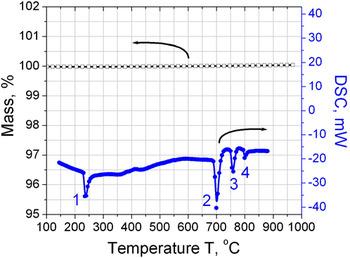
The presence of Sn, although not identified in the XRD spectra, was observed not only by SEM but also by DSC that was performed on the synthesized powder (Fig. 4). The temperature profiles of this analysis followed that of the SPS process. Four endothermic peaks (marked as 1–4) were identified; the first (at 231.9 °C) of which is clearly associated with the melting of pure Sn. The other peaks are attributed to the ternary reactions that take place in the Ti-Ni-Sn system. As an example, the third peak can be related to the eutectoid reaction of Ti-7 wt%Ni (765 °C).Reference Gupta17
Differential scanning calorimetry and thermal gravimetric analysis for the synthesized powder, under similar conditions of the spark plasma sintering (SPS) process.

TGA performed in parallel to the DSC run gave no indication of any mass losses due to sublimation, up to 1000 °C. Since high temperature sublimation is the major degradation mechanism in IV–VI-based TE devices, this finding underlines a further advantage of the HH compounds incorporated in practical TE devices, at least up to 1000 °C.
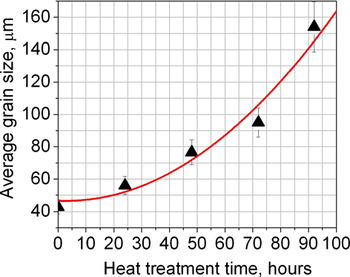
In addition to the compositional modifications described earlier, after the different heat treatments, grains coarsening took place in the samples, yielding up to ∼160 μm grain size after 90 h, as compared to an initial ∼45 μm average size, obtained after an SPS treatment at 890 °C (see Fig. 5).
Grain size analysis after various heat treatment durations at 890 °C.

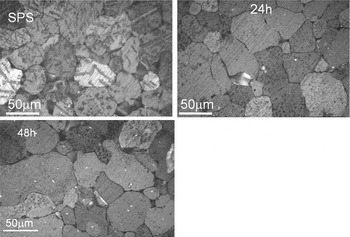
Optical microscope images of the first 48-h treated samples are shown in Fig. 6. In this figure, besides the average grains size growth, a coalescent of two adjacent grains can be seen after 48 h.
Optical microscope images of spark plasma sintered samples and samples treated at 890 °C for 24 and 48 h, after etching by hydrofluoric acid for 45 s.

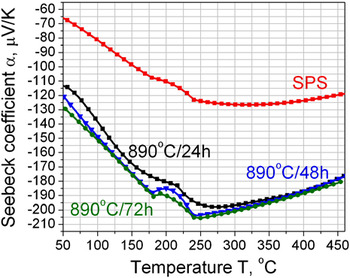
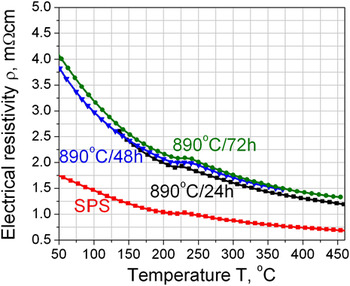
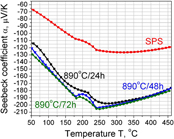
The Seebeck coefficient and the electrical resistivity values measured after SPS and heat treatments at 890 °C for 24, 48, and 72 h are shown in Figs. 7 and 8, respectively. Both the absolute values of Seebeck coefficient and the electrical resistivity increase consistently as a function of the duration of the heat treatment, suggesting the reduction of the carrier concentration. The reduction of the carrier concentration is much more pronounced after the first (24 h) heat treatment suggesting that it is related to the elimination of the intermetallic Ti6Sn5 compound and the reduction of the full-Heusler TiNi2Sn phases. It is noteworthy that all curves in Figs. 7 and 8 display a discontinuity in the vicinity of 230 °C, which may be attributed to the melting of the residual minority Sn phase (Tm = 231.9 °C), in agreement with the DSC analysis (Fig. 4).
Temperature dependence of Seebeck coefficient after SPS and heat treatments at 890 °C for 24, 48, and 72 h.

Temperature dependence of the electrical resistivity after SPS and heat treatments at 890 °C for 24, 48, and 72 h.

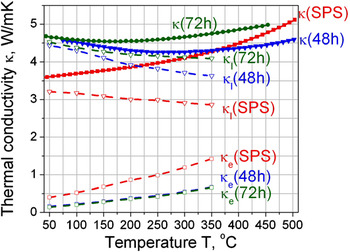
The total, lattice, and electronic thermal conductivities (κ, κl, and κe, respectively) after SPS and heat treatments at 890 °C for 48 and 72 h, are shown in Fig. 9. The κl values were calculated by subtraction of κe (=LT/ρ, where L and T are Lorenz number and the absolute temperature, respectively) from κ, using a procedure that was described in detail elsewhere.Reference Gelbstein, Dado, Ben-Yehuda, Sadia, Dashevsky and Dariel18, Reference Gelbstein, Dashevsky and Dariel19 According to this procedure, the correct Fermi energy dependent Lorenz number was calculated from the measured Seebeck coefficient values. The κe values decrease upon heat treatments at 890 °C for 48 and 72 h, as compared to the as SPS condition, because of the decrease of the carrier concentration, as mentioned previously in connection with Figs. 7 and 8. On the other hand, however, the κl values increase; the latter being attributed to the grain growth (Figs. 5 and 6) and the elimination/reduction of minority phases, which may have acted as phonon scattering centers. The specific role of each of these mechanisms for the increase of κl is unclear at this time. However, in case that the grains growth mechanism is predominant, it will be plausible to heat treatment the synthesized alloy prior the SPS.
Temperature dependence of the total, lattice, and electronic thermal conductivities (κ, κl, and κe, respectively) after SPS and heat treatments at 890 °C for 48 and 72 h.

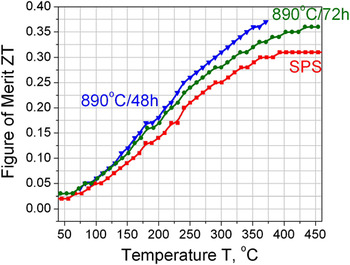
The dimensionless TE ZT after SPS and heat treatments at 890 °C for 48 and 72 h, are shown in Fig. 10. Higher ZT values were obtained after the 48-h heat treatment, as compared to the as SPS condition, despite the increase of the lattice thermal conductivity, κl. These results can be attributed to improved electronic properties after the 48-h heat treatment, possibly due to the elimination/reduction of minority intermetallic phases and an increased contribution of the TiNiSn HH phase. These ZT values can be further improved upon reduction of the κl values, possibly by heat treating the synthesized alloy prior the SPS, as suggested previously.
Temperature dependence of the dimensionless thermoelectric figure of merit, ZT, after SPS and heat treatments at 890 °C for 48 and 72 h.

Further improvement of ZT is expected by optimized doping and alloying both for improving the electronic power factor and reducing of κl.
IV. CONCLUSIONS
HH TiNiSn samples after melting, comminution, and consolidation contain secondary intermetallic/metallic phases that affect the TE properties.
The transport properties of TiNiSn samples were determined after SPS consolidation and after various homogenizing heat treatment periods at 890 °C. The improvement of the electronic properties observed by increased ZT values is associated with the elimination or reduction of the secondary intermetallic Ti6Sn5 and TiNi2Sn phases. On the other hand, increased lattice thermal conductivity values were also observed with lengthening heat treatments, possibly associated with grain coarsening and elimination/reduction of minority phases, which could have acted as phonon scattering centers. These findings put forward the significance of understanding the influence of the various minority phases on the TE performance of HH compounds. The approach for controlling these phases by appropriate heat treatments, as was performed for TiNiSn alloy in this work, can serve as a guideline for design of improved and stable TE HH-based composites.
ACKNOWLEDGMENTS
The authors wish to thank Jean-Claude Tedenac, Nini Pryds, Anke Weidenkaff, Matthew Rosseinsky, Martin Köhne, and Jeff Snyder for the fruitful discussions about the potential thermoelectric applications of half-Heuslers, discussions that inspired us to write this article. The work in Mainz was financially supported by the Stiftung Rheinland Pfalz für Innovation (Projekt 863).