




1. Introduction
We are entering an era of unprecedented astronomical datasets with the advent of Stage IV galaxy surveys (Albrecht et al. Reference Albrecht, Bernstein and Cahn2006), such as Euclid (Euclid Collaboration et al. 2025), the Vera C. Rubin Observatory’s Legacy Survey of Space and Time (hereafter, Rubin-LSST, Ivezi' et al. 2019), DESI (DESI Collaboration et al. 2022), and 4MOST (de Jong et al. Reference de Jong, Agertz and Berbel2019). These surveys will measure positions, magnitudes, and shapes for billions of galaxies, and redshifts for tens of millions of them, enabling transformative advances in cosmology and galaxy evolution. However, the statistical power of these datasets makes systematic uncertainties the dominant limitation. For example, weak-lensing cosmology depends critically on accurate galaxy redshift distributions (Newman & Gruen Reference Newman and Gruen2022), motivating the use of forward-modelling approaches that generate realistic synthetic surveys constrained against real data to provide the required accuracy on the redshift distributions (Fischbacher et al. Reference Fischbacher, Kacprzak and Tortorelli2025; Tortorelli et al. Reference Tortorelli, Fischbacher and Grün2025; Thorp et al. Reference Thorp, Peiris and Jagwani2025). At the same time, the inference of galaxy physical properties for billions of galaxies demands orders-of-magnitude improvements in modelling efficiency.
Both forward-modelling and the inference of physical properties rely on spectral energy distribution (SED) generative codes, which connect galaxy physical properties to their observable stellar emission through stellar population synthesis (SPS; Conroy Reference Conroy2013). Codes such as FSPS (Conroy et al. Reference Conroy, Gunn and White2009) and ProSpect (Robotham et al. Reference Robotham, Bellstedt and Lagos2020) provide physically consistent predictions, but their runtimes (tens of seconds for FSPS, tens of milliseconds for ProSpect) remain prohibitive for generating many synthetic survey realisations or running large-scale Monte Carlo Markov Chain (MCMC) inference of galaxy properties. Accelerating SPS predictions while preserving accuracy is therefore essential (see also Hearin et al. Reference Hearin, Chaves-Montero and Alarcon2023; Alsing et al. Reference Alsing, Peiris and Leja2020).
To address this, we introduce ProMage (
ProSpect Magnitude emulator), a feed-forward neural network that emulates galaxy magnitudes in observer and rest frames computed with ProSpect. Trained on physical inputs (redshift, star formation history, dust, gas parameters), ProMage predicts individual bands independently, simplifying extension to new filters and parameter spaces. It delivers a factor of
 $\sim10^4$
speed-up in computation with respect to ProSpect, evaluating magnitudes for
 $10^5$
sources in less than half a second, while maintaining per-mille accuracy across Hyper-Suprime Cam (HSC) g,r,i,z,y bands. This performance enables both efficient forward-modelling with GalSBI-SPS (Tortorelli et al. Reference Tortorelli, Fischbacher and Grün2025) and scalable inference of galaxy properties for Stage IV surveys, including amortised simulation-based inference (Cranmer et al. Reference Cranmer, Brehmer and Louppe2020) and accelerated MCMC. ProMage is already implemented within GalSBI-SPS and will also be released as a standalone module for ProSpect.
2. Training sample
We train ProMage on observer- and rest-frame magnitudes generated with ProSpect in the g,r,i,z,y HSC bands. HSC is an ideal test case, given its depth and galaxy density, making it a precursor to Stage IV surveys. Tests conducted on different neural network architectures show that prediction accuracy improves, at fixed training set size, when networks are trained per band, consistent with results from Alsing et al. (Reference Alsing, Peiris and Leja2020); Thorp et al. (Reference Thorp, Peiris and Jagwani2025). ProMage predicts total galaxy magnitudes conditioned on the physical inputs used by ProSpect, excluding AGN for now. Stellar emission is based on a custom single stellar population (SSP) created with ProGeny (Robotham & Bellstedt Reference Robotham and Bellstedt2025; Bellstedt & Robotham Reference Bellstedt and Robotham2025), using MIST isochrones (Dotter Reference Dotter2016), C3K spectra (Conroy et al. Reference Conroy, Villaume and van Dokkum2018), and a Chabrier (Reference Chabrier2003) IMF. Star-formation histories follow the truncated skewed Normal form of Robotham et al. (Reference Robotham, Bellstedt and Lagos2020), parameterised by the peak SFR (mSFR), peak time (mpeak), width (mperiod), and skewness (mskew). Gas-phase metallicity histories are tied to stellar mass growth (Driver et al. Reference Driver, Robotham and Bland-Hawthorn2013; Bellstedt et al. Reference Bellstedt, Robotham and Driver2021), governed by the final metallicity Zfinal. Coupled with the ionisation parameter
 $\log U$
, these control nebular emission through MAPPINGS-III tables (Levesque et al. Reference Levesque, Kewley and Larson2010). Dust attenuation follows the two-phase model of Charlot & Fall (Reference Charlot and Fall2000), with
 $\tau_\mathrm{screen}$
for stars older than
 $10\,\mathrm{Myr}$
and
 $\tau_\mathrm{birth}$
for younger stars. Dust emission is added using Dale et al. (Reference Dale, Helou and Magdis2014) templates, parameterised by
 $\alpha_\mathrm{SF,screen}$
and
 $\alpha_\mathrm{SF,birth}$
.
These ten physical parameters plus redshift z constitute the inputs to the network. We generate training data by sampling
 $10^7$
galaxies in the redshift range
 $0<z<5$
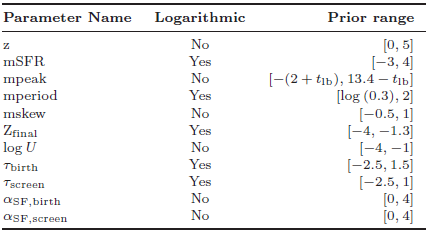
. with Latin hypercube sampling. ProSpect is then used to compute the true observer- and rest-frame magnitudes in the five HSC bands. Sampling ranges for the input quantities are listed in Table 1, with output magnitudes spanning a wide range in i-band observer-frame,
 $5<i<35$
.
Prior range for the network input parameters.

3. Network architecture and training phase
ProMage is implemented in PyTorch (Paszke et al. Reference Paszke, Gross and Massa2019) as a feed-forward neural network with five hidden dense layers of [512, 256, 128, 64, 32] neurons. Inputs are 11-dimensional, scaled with a standard scaler, and mapped to a single magnitude output. The dataset is split into 80% training, 10% validation, and 10% testing. We also tested a Speculator-like architecture with four 128-neuron layers, but the deeper network achieved higher accuracy; an additional final 32-neuron layer is included to stabilise extreme predictions.
We adopt the activation function of Alsing et al. (Reference Alsing, Peiris and Leja2020), with
 $\gamma$
and
 $\beta$
initialised to 1 and 0.1, respectively, and optimised during training. The loss function is the mean squared error, evaluated on the original magnitudes values rather than the scaled ones. Training uses the Adam optimiser with batch size 64, a maximum of 200 epochs, and early stopping after 20 epochs without validation loss improvement. The learning rate starts at
 $10^{-3}$
and is reduced adaptively with ReduceLROnPlateau. Separate networks are trained for each band (observer- and rest-frame). The network training phase is performed on the EL-9 cluster of the Leibniz Supercomputing Centre with a single Nvidia A100 GPU.
4. Results
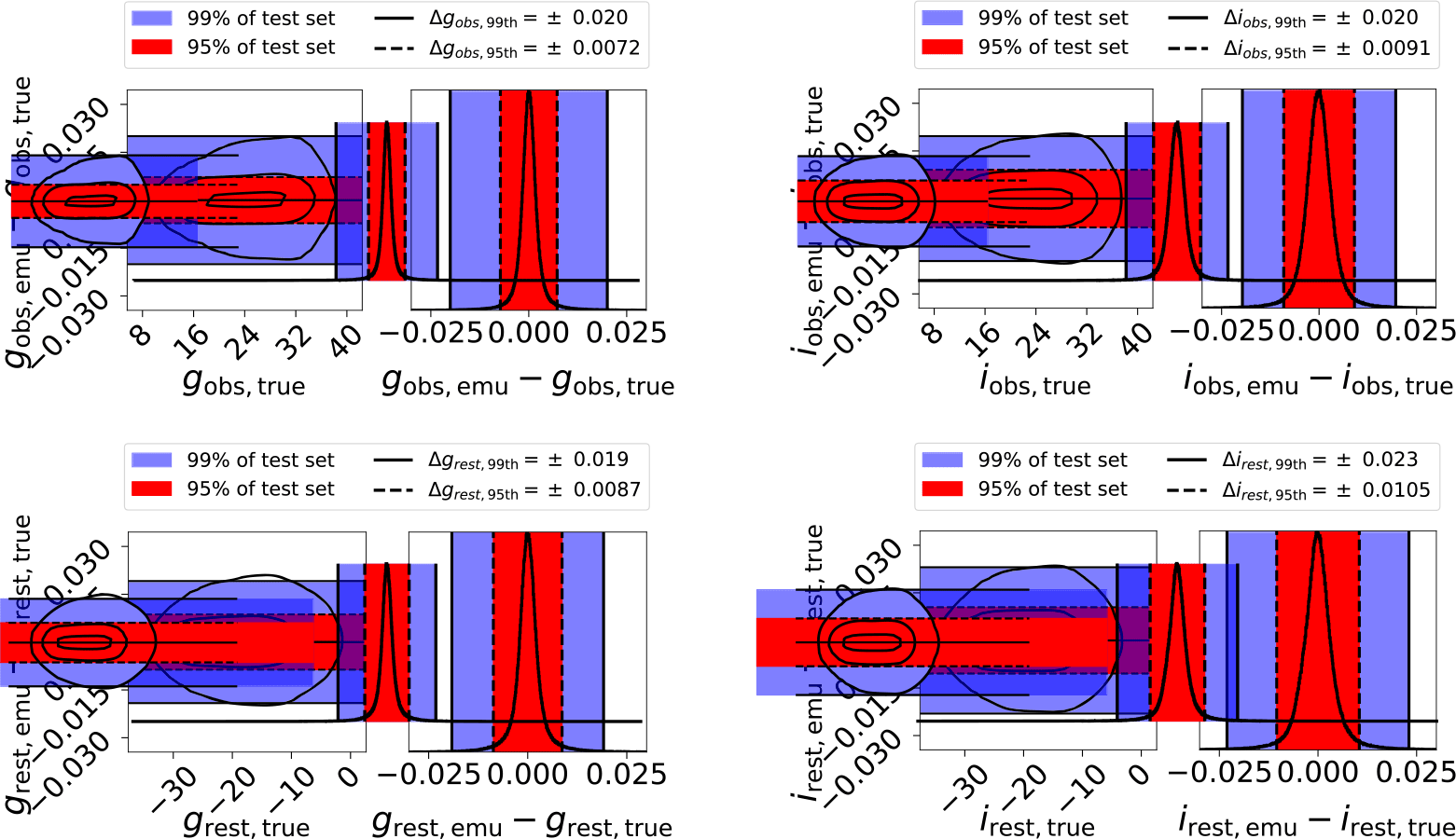
We show in Fig. 1 results for the g and i observer- and rest-frame HSC bands, representative of the overall performance. The left panels display the prediction accuracies (difference between emulated and true magnitudes) for the observer and rest-frame g-band, while the right panels for the i-band. The results are based on a test set of
 $10^6$
sources, evaluated in under three seconds on a Mac M1 CPU, corresponding to a
 $10^4$
speed-up compared to ProSpect. The network achieves sub-percent relative accuracy for all sources and per-mille accuracy for 99% of them. Absolute errors are
 $< 0.02 \ \mathrm{mag}$
for 99% of galaxies and
 $< 0.01 \ \mathrm{mag}$
for 95% of them across all bands, in both observer and rest-frame. These values are below the typical photometric zero-point uncertainties of Stage III surveys (Wright et al. Reference Wright, Kuijken and Hildebrandt2024), and comparable or lower than the expected photometric precision of Stage IV surveys, such as Rubin-LSST (Crenshaw et al. Reference Crenshaw, Kalmbach and Gagliano2024). This demonstrates that the emulator is well suited both for galaxy property inference and for forward-modelling applications, where sensitivity to changes in SED model prescriptions depends critically on photometric accuracy (Tortorelli et al. Reference Tortorelli, McCullough and Gruen2024).
Figure showing the performance of ProMage in emulating galaxy magnitudes computed with ProSpect. The left panels refer to the g-band, while the right panels to the i-band, with upper and lower panels referring to observer (‘obs’) and rest-frame (‘rest’) magnitudes, respectively. We report both the histograms of the prediction accuracy and their distribution as function of the true input magnitude. Red and blue bands represent the ranges containing 95% and 99% of the samples, while the dashed and solid lines represent the 95th and 99th percentile values for each case. In all reported cases, 99% of the galaxies in the test set have an absolute difference with respect to the true input magnitude of
 $\Delta m < 0.02$
. The prediction accuracy is even higher,
 $\Delta m < 0.01$
, for 95% of galaxies. Similar performance occurs for the other HSC optical bands.

Acknowledgements
This work was funded by the Deutsche Forschungsgemeinschaft (DFG, German Research Foundation) under Germany’s Excellence Strategy - EXC-2094 – 390783311. The authors gratefully acknowledge the computational and data resources provided by the Leibniz Supercomputing Centre (www.lrz.de). This project was supported in part by grant 200021_192243 from the Swiss National Science Foundation. ASGR acknowledges funding by the Australian Research Council (ARC) Future Fellowship scheme (FT200100375).
 Δm<0.02
 Δm<0.01

 Open access

