Introduction
Parasitoid wasps are commonly used as natural enemies for biological control of insect pests, an essential part of integrated pest management. They are known to have an efficient mate location strategy, where sex pheromones released by females are thought to play an important role in male attraction and eliciting courtship behaviour for most species studied (Godfray, Reference Godfray1994; Ruther, Reference Ruther, Wajnberg and Colazza2013; Xu et al., Reference Xu, Veyrat, Degen and Turlings2014). After locating each other with volatile pheromones, most parasitoid wasps exhibit species-specific courtship behaviours (Drosopoulos & Claridge, Reference Drosopoulos and Claridge2006; Ruther, Reference Ruther, Wajnberg and Colazza2013). Among parasitic hymenoptera, including those of Cotesia spp. Cameron (Hymenoptera: Braconidae), males display a complex sequence of signals during courtship, which includes wing fanning (wing vibrations) and acoustic signalling (Field & Keller, Reference Field and Keller1993a ; Benelli et al., Reference Benelli, Bonsignori, Stefanini and Canale2012; Bredlau et al., Reference Bredlau, Mohajer, Cameron, Kester and Fine2013), and by chemical signals (Wyatt, Reference Wyatt2003). As is the case for visual or acoustic signals, the sex pheromones involved in this process may help individuals locate a potential mate and provide reliable information about its individual quality (Johansson & Jones, Reference Johansson and Jones2007).
Wing fanning performed by male parasitoid wasps during courtship is considered to be one of the most ubiquitous and important courtship behaviours (Bourdais & Hance, Reference Bourdais and Hance2009). Several studies have shown that male wing fanning plays a number of different roles during courtship in Braconid species, such as increasing female receptivity (Field & Keller, Reference Field and Keller1993a ; Joyce et al., Reference Joyce, Hunt, Bernal and Bradleigh Vinson2008), facilitating male orientation towards females (Vinson, Reference Vinson1972), and commencing short-range communication between the sexes (McClure et al., Reference McClure, Whistlecraft and McNeil2007).
Mating success in parasitoids is influenced by several factors such as age, longevity, density, size and male competition at time of mating (Ramadan et al., Reference Ramadan, Wong and Wong1991; Joyce et al., Reference Joyce, Bernal, Vinson and Lomeli-Flores2009). Among these factors, body size may influence success during various stages of the mating interaction (e.g., mate search, intraspecific competition, and pre- and post-copulatory mate choice) (Morbey, Reference Morbey2013). The size of a male is often dependent on nutritional condition during early development and may affect particular elements of courtship behaviour and mating tactics (Blaul & Ruther, Reference Blaul and Ruther2012), such as the ability to establish a territory or compete against rivals (Painting & Holwell, Reference Painting and Holwell2014) or to release chemical (Conner et al., Reference Conner, Roach, Benedict, Meinwald and Eisner1990) or acoustic (Wong & Candolin, Reference Wong and Candolin2005) signals. Frequently, larger males achieve higher mating success (Teder, Reference Teder2005) and exhibit greater longevity, gamete size or fecundity (Durocher-granger et al., Reference Durocher-granger, Martel and Boivin2011) compared with smaller males. For example, it has been observed in a number of ichneumonid parasitoid wasps (e.g., Chasmias paludator Desvignes, Exephanes occupator Gravenhorst) that large males are more likely to achieve successful copulation (Teder, Reference Teder2005). Similarly, Blaul and Ruther (Reference Blaul and Ruther2012) found that large males of the parasitoid wasp Nasonia vitripennis Walker (Hymenoptera: Pteromalidae) had significantly higher pheromone titres and released more sex attractant than small males, and that virgin females preferred the pheromone doses released by large males. However, when directly competing for a female, large and small males had the same mating success.
A common goal in parasitoid rearing for biological control programmes is to produce as many mated females as possible (Hardy et al., Reference Hardy, Ode, Siva-Jothy and Jervis2005; Joyce et al., Reference Joyce, Hunt, Bernal and Bradleigh Vinson2008). Most parasitoid wasps are arrhenotokous (i.e., haplodiploid), which means that mated females produce both female and male offspring, while virgin females produce only males (Godfray, Reference Godfray1994; Wajnberg, Reference Wajnberg, Consoli, Parra and Zucchi2010). Female offspring have the greatest value in building up population size. Therefore, understanding the requirements and the key aspects (e.g., mechanisms controlling mate finding) of mating behaviour and reproductive success of parasitoid biological control agents is crucial for successful rearing.
Cotesia urabae Austin and Allen (Hymenoptera: Braconidae) is a solitary, arrhenotokous larval endoparasitoid endemic to Australia that was introduced into New Zealand as a biological control agent against Uraba lugens Walker (Lepidoptera: Nolidae) (Avila et al., Reference Avila, Berndt and Holwell2013a ). Adult females oviposit their eggs inside U. lugens by inserting their ovipositors into larvae, and a single parasitoid completes its development in each host larva (Berndt, Reference Berndt2010). Previous studies conducted on C. urabae have focused on its biology (Allen, Reference Allen1990a ; Allen & Keller, Reference Allen and Keller1991), phenology (Allen, Reference Allen1990b ), competition (Berndt, Reference Berndt2010), dispersal behaviour (Avila et al., Reference Avila, Berndt and Holwell2013b ), host range (Berndt et al., Reference Berndt, Withers, Mansfield and Hoare2009; Rowbottom et al., Reference Rowbottom, Allen, Walker and Berndt2013; Avila et al., Reference Avila, Withers and Holwell2015), and host searching behaviour (Avila et al., Reference Avila, Withers and Holwell2016a , Reference Avila, Withers and Holwell b ). Additionally, there is just one previous study conducted on C. urabae describing a rearing methodology that included a recommended method to obtain mating (Berndt et al., Reference Berndt, Sharpe, Gresham, Hayes and Allen2013). However, no detailed studies are available on the courtship and mating behaviour, mate location, and aspects of mating behaviour that may assist researchers to maximize mating success of C. urabae within the laboratory. The aims of this study are (a) to examine the role of mating status in the parasitoid's mate location by investigating behavioural responses of C. urabae to chemical volatiles emitted by virgin and mated males and females in Y-tube olfactometer assays; (b) to describe the courtship and mating sequence of C. urabae; and (c) to investigate the effect of male competition and male body size on a male's mating success.
Material and methods
Source of parasitoids
Adult C. urabae used in the bioassays originated from a colony maintained at the University of Auckland for experimental purposes. The parasitoid culture was maintained on 2nd – 4th instar U. lugens larvae fed on excised leaves of Eucalyptus spp. collected from amenity trees in Auckland as described in Avila et al. (Reference Avila, Withers and Holwell2015). Parasitized host larvae, between 2nd and 4th instar, used for parasitoid colony maintenance were kept in 750 ml plastic containers in a Contherm™ incubator at 20 °C with a 12 : 12 L : D photoperiod, and fed on excised leaves of Eucalyptus spp. collected from amenity trees in Auckland. Prior to the experiments, recently hatched males were fed with a small drop of honey and kept individually in Petri dishes (60 mm diameter and 15 mm high) in a Contherm™ incubator held at 12 °C with a 12 : 12 L : D photoperiod, while females were kept unfed for a maximum of 24 h to prepare them for mating.
All C. urabae parasitoids used in the experiments were used just once. Males used in the experiments were 1–6 days old, fed, naïve and virgin. Females used in the experiments were a maximum of 24 h old, unfed, naïve of host experience, and virgin. The exception was only in the choice experiments where mated males and mated females greater than 1 day old were also tested.
Influence of mating status in mate attraction
To determine whether C. urabae males/females detect mates using airborne chemicals emitted by males/females, we employed a Y-tube olfactometer to conduct choice experiments. The Y-tube olfactometer allows the parasitoid placed in the lower entry arm to walk/fly upwards, where a choice must be made at the point where the olfactometer splits into two choice arms.
The glass-made Y-tube olfactometer used had a 1 cm inner diameter, and the basal column and each choice arm were 20 cm long. Adapter glass joints (50 ml) were attached at the end of each arm, which served as odour chambers. Additionally, a piece of nylon mesh was placed at the end of each arm separating the odour chamber material from the olfactometer, thus, preventing the parasitoids from orienting visually to or contacting the odour source. An air pump circulated air at a constant rate of 500 ml minute−1 through each of the arms of the olfactometer, previously purified through activated carbon filters connected via Teflon tubing to the distal ends of each of the odour chambers. Air flow was adjusted using a flowmeter (Precision Medical®). Bioassays were conducted by placing the odour source into one of the adapter joints, while the other adapter joint was used as a blank control that consisted of a cotton wool ball slightly moistened with distilled water (Avila et al., Reference Avila, Withers and Holwell2016a , Reference Avila, Withers and Holwell b ).
Individual C. urabae were then released into the basal column of the olfactometer, where they proceeded to walk/fly once oriented into the air flow. Each parasitoid tested was judged as having made a choice when it crossed a line, marked at the last quarter (15 cm) upwind of the Y junction, in either of the two arms. The blank control and the odour source were alternated between each replicate, and the Y-tube was also rotated 180° to avoid any directional effects. The whole apparatus was dismantled after every second trial then washed thoroughly with 90% ethanol and distilled water before being dried at 50 °C in an oven for a minimum of 45 minutes.
Four treatments were conducted to examine the attraction of individual C. urabae parasitoids to airborne chemicals emitted by males/females:
-
Female's attraction to virgin males: Individual virgin females’ response to a group of three virgin male individuals.
-
Female's attraction to mated males: Individual virgin females’ response to a group of three mated males.
-
Male's attraction to virgin females: Individual virgin males’ response to a group of three virgin females.
-
Male's attraction to mated females: Individual virgin males’ response to a group of three mated females.
Each experimental treatment had a duration of 15 min and a total of 30 replicates were conducted, consisting of an independent individual C. urabae adult parasitoid. All experiments were conducted between 0900 and 1600 hours at room conditions of 20 °C and under ambient fluorescent light provided by four recessed luminaires (Philips TBS760 4 × 14 W/840) at ceiling height.
Description of courtship and mating sequence
Thirty individual pairs (one male and one female) were introduced to mate in a mesh sided vial constructed from Nunc™ conical plastic tubes (18 mm diameter × 120 mm, with a 15 × 50 mm2 window in the side covered in nylon organza, attached with Superglue) as described in Berndt et al. (Reference Berndt, Sharpe, Gresham, Hayes and Allen2013). A small amount of honey was brushed on the mesh once courtship was observed, to feed the female. This procedure allowed the male to approach her and, if accepted by the female, to mate. Each pair of wasps was observed for a maximum of 10 min or until the successful courtship ended with the male and female physically separating after copulation. Behaviours scored from the 30 pairs (replicates) were chosen based on previous studies conducted on related species (Field & Keller, Reference Field and Keller1993a ; Joyce et al., Reference Joyce, Hunt, Bernal and Bradleigh Vinson2008; Benelli et al., Reference Benelli, Bonsignori, Stefanini and Canale2012), which included elements of courtship and copulation behaviour. A video camera was set centrally above the mesh sided vial to record C. urabae behaviour, and all courtship behavioural data on the recorded videos from the experiments were analyzed with Solomon coder® (Péter, Reference Péter2014). Post-copulatory behaviour, which typically consisted of grooming or stationary behaviour, was excluded from the analysis.
Influence of competitors on male mating success
The experiment was designed to assess the effect of male competition on male mating success when more than one male is paired with a single female, and consisted of two treatments:
-
Treatment 1: One female paired with one male. Mating behaviour of C. urabae was observed by pairing a single female and male (both virgins) in a mesh sided vial, as previously described. Parasitoid behaviour at each step of the behavioural sequence was directly tracked for 10 min with a video camera set centrally above the mesh sided vial, as described in the preceding section. A total of 25 individual pairs (replicates) were observed.
-
Treatment 2: One female with two males. We followed the same procedure used for the one female with one male treatment, but this time each of the 25 replicates involved the introduction of two males of a similar size simultaneously to each female.
The following behaviours were quantified and compared for both treatments: (1) time elapsed until mating occurred (time to mate), (2) copulation attempts of successful males, and (3) copulation duration. The behavioural information for the first mated male was used for comparisons if both males successfully mated in treatment 2. The number of successful mating events was also recorded for further comparisons between treatments. Additionally, the frequency of times when aggression behaviour occurred within treatment two was recorded, and we compared copula duration for these cases with those where no aggression behaviour was observed. We also recorded the frequency of multiple mating events within treatment two if they occurred.
Influence of male size on mating success
This experiment was designed to assess the effect of male body size on their mating success and involved pairing, in a mesh sided enclosure, two males with a single virgin female simultaneously. As described in the previous sections, parasitoid behaviour at each step of the behavioural sequence was directly tracked with a video camera set centrally above the mesh sided vial. After conducting mating observations both males were frozen and measurements of thorax, femur and wing length of successful and unsuccessful males was obtained to determine if the larger male in each pair had been more successful. A total of 35 individual observations (replicates) of mating were conducted. Each experimental observation was conducted for 10 min (or until the end of mating). At the end of this period, replicates where mating did not occur were discarded, although this occurred rarely (n = 2), and replaced with a new replicate.
Statistical analysis
Data obtained from each of the choice test treatments in the Y-tube olfactometer were analyzed with a two-sided exact binomial test. A positive response to the test odour was considered as significant when the 95% confidence interval for the overall proportion choosing the arm with the odour source was greater than 0.50 (Quinn & Keough, Reference Quinn and Keough2002).
To assess the potential effect that male competition had on male mating success, behavioural data obtained for the time until mating occurred were analyzed and compared between both treatments using a Kaplan–Meier survival analysis, and survival curves for treatments were compared using Cox's Proportional Hazards Model (Kleinbaum & Klein, Reference Kleinbaum and Klein2012). Kaplan–Meier estimates and Cox Proportional Hazards models (Cox regression) are typically applied in survival data analysis, but they are also commonly used and recommended as appropriate for the analysis of latency (the time of an event to occur) data in animal behaviour experiments (Jahn-Eimermacher et al., Reference Jahn-Eimermacher, Lasarzik and Raber2011; Kleinbaum & Klein, Reference Kleinbaum and Klein2012). The frequency of copulation attempts and the copulation duration of successful males were analyzed with a t-test, and if data were non-normally distributed a Mann–Whitney rank sum test was conducted instead (Quinn & Keough, Reference Quinn and Keough2002). A chi-square test was used to compare the proportion of successful mating events between treatments.
Measurements of thorax, femur and wing length of males were analyzed with linear regression analysis to determine the relationship between the three body parts measured. Since the three body parts measured are significantly correlated (see Results section), wing length was used as the variable to assess the role of body size in mating success. Wing length of successful and unsuccessful males was compared with a Paired t-test (Quinn & Keough, Reference Quinn and Keough2002). All the data obtained were analyzed with the statistical software package SYSTAT v.13 (Systat Software, San Jose, CA, USA).
Results
Influence of mating status in mate attraction
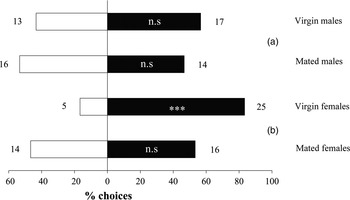
Males were no more attractive to female C. urabae than clean air (virgin males: obs. proportion = 0.57, P = 0.585; mated males: obs. proportion = 0.47, P = 0.856; fig. 1). Males were attracted to virgin females but not to mated ones (virgin females: obs. proportion = 0.83, P < 0.001; mated females: obs. proportion = 0.53, P = 0.856; fig. 1), when tested against clean air.
Response of C. urabae parasitoids in a Y-tube olfactometer to odour volatiles of virgin or mated males/females. (a) Female response to virgin or mated males and (b) male response to virgin or mated females. The number of individuals choosing either the odour source or the blank control is shown next to each % choice bar. Asterisks indicate a significant difference within a choice test: ***P < 0.001 (two-sided exact binomial test). n.s. = non-significant.

Description of courtship and mating sequence
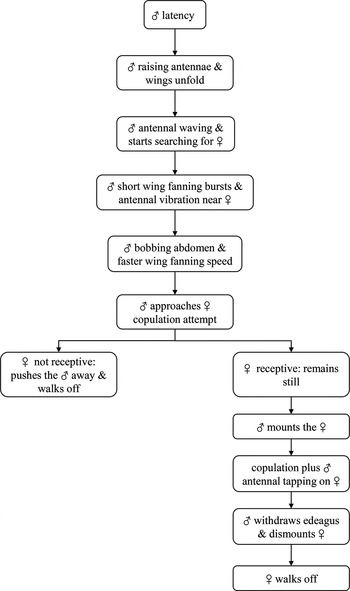
The sequence of events leading to copulation in C. urabae is shown in fig. 2. Once the pair of wasps was released in the mesh sided vial, the mean time that males spent walking around (latency phase) before starting courting the female was 1.4 ± 0.26 min. When the male detected the presence of the female, it stopped walking and then raised its antennae and unfolded its wings. After performing a few short fanning bursts, the male started walking towards the female with its wings raised, fluttering and moving its antennae up and down in opposite directions to each other. The searching male stopped walking and antennating in the proximity of the female and remained stationary, recommencing wing fanning and moving its antennae up and down, but this time in the same direction and in a synchronized way pulsing the female's body and antennae. Immediately before the male attempted to approach the female, the wing-fanning was interspersed with rapid upward bobbing movements of the abdomen and flexing of the legs until wing fanning reached a maximum speed. The male then approached the female and made one or more (in the case of an unreceptive female) copulation attempts. The mean number of copulation attempts by males that successfully copulated (n = 20 out of 30) was 3.6 ± 0.6 attempts (with a registered maximum of ten copulation attempts in the same courtship sequence). The male rapidly mounted the female from the back or the side, aligned himself along the female's body axis, and kept pulsing the female with his antennae until aligned. The receptive female remained still and the male rapidly moved backwards and curved his abdomen downwards to commence copulation. During copula the female remained completely motionless, and the male gradually stopped tapping on the female's body and raised his antennae. Mating of successful pairs (n = 20 out of 30 pairs) was observed within 3 ± 0.4 min of observation when it occurred, and the mean copulation duration of successful pairs was 0.7 ± 0.01 min. Copulation was terminated when the female started walking and the male dismounted. Copulation without prior wing fanning behaviour was never observed.
A flow chart of the courtship and mating behaviour of Cotesia urabae (n = 30 pairs).

Females that were not receptive pushed the male away with their hind legs when the male attempted copulation, and the female often tried to walk or fly away. The mean number of copulation attempts for males that failed to mate (n = 10 out of 30) was 7.1 ± 1.6 attempts (with an observed maximum of 16 copulation attempts in the same courtship sequence), before they stopped attempting. No post-copulatory interactions were observed, and no multiple matings were observed in any of the pairs observed.
Influence of competitors on male mating success
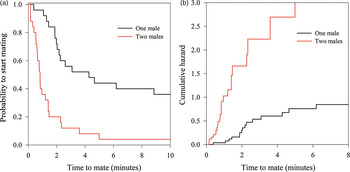
The mean time until mating occurred was lowest (1.2 ± 0.2 min) when pairing two males with a single C. urabae female, compared with 2.9 ± 0.5 min when one male was paired with a single C. urabae female (LogRank = 19.659, d.f. = 1, P < 0.001) (fig. 3a). The Cox's Proportional Hazards regression showed that the number of males paired with a single C. urabae female was significantly associated (Likelihood Ratio = 17.543, d.f. = 1, P < 0.001) with the time to mate and that a single male tends to take 75% longer time to mate than when two males are paired with a single C. urabae female (fig. 3b).
(a) Kaplan–Meier estimates for the time until mating occurred when either one male or two males are paired with a single C. urabae female, and (b) cumulative probability (hazard functions) to start mating for either one male or two males paired with a single C. urabae female. Two males have a much higher probability per unit time to start mating than one male.

The mean frequency of copulation attempts by successful males did not differ between treatments (t-test: t = 0.742, d.f. = 38, two-tailed P = 0.463). Copulation duration was longer when a male rival was present (1.1 ± 0.1 min), compared with when no rival was present (0.7 ± 0.02 min) (Mann–Whitney test: U = 77, P = 0.002). When comparing the proportion of successful mating events between treatments, mating success was more likely when two males were competing (χ 2 test: χ 2 = 6.125, d.f. = 1, P = 0.013).
Additionally, when two males were paired with a single C. urabae female (treatment 2), aggression behaviour was observed in 40% (n = 10 out of 25) of cases. This aggression behaviour consisted in the continued attempt, by males that failed to copulate after a mating attempt, to interrupt the competitor's copulation by trying to pull the successful male off the female. However, no success in mating interruption was observed. In cases where aggression behaviour did not occur, there was no interaction between the two males and they appeared unaware of each other. Within treatment two, copulation time differed significantly (Mann–Whitney test: U = 0, P < 0.001) between the two males that showed aggression behaviour to those where this behaviour was not observed. Mean copulation duration of successful males was observed to be longest (1.6 ± 0.1 min) when aggression behaviour between the two males had previously occurred, compared with 0.7 ± 0.01 min when aggression behaviour did not occur. Both males used in treatment 2 achieved mating in 12% of the cases (n = 3 out of 25) where successful mating was observed within that treatment.
Influence of male size on mating success
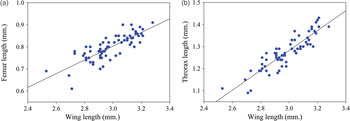
Wing length positively correlated with both femur length (fig. 4a: F 1,69 = 117.322, R 2 = 0.63, P < 0.001) and thorax length (fig. 4b: F 1,69 = 272.638, R 2 = 0.8, P < 0.001) for the C. urabae males used in the experiment, so wing length was used as the measure of body size for subsequent analyses. The mean wing length was larger (3.1 ± 0.02 mm) in successful males compared with unsuccessful males (2.9 ± 0.02 mm) (Paired t-test: t = 7.07, d.f. = 34, two-tailed P < 0.001).
The relationship between male body size parts, (a) femur vs. wing length and (b) thorax vs. wing length.

Discussion
The attraction of male C. urabae to females for courtship and mating has now been revealed to have an olfactory basis. Males were strongly attracted to the odour of virgin females in the Y-tube olfactometer, but not to mated females. Conversely, female C. urabae did not respond to odour volatiles of males. Similar behaviour has been observed in other parasitoid species (Bouchard & Cloutier, Reference Bouchard and Cloutier1985; McNeil & Brodeur, Reference McNeil and Brodeur1995; De Freitas et al., Reference De Freitas, De Lima Mendonça, Nascimento and Sant’ Ana2004; Xu et al., Reference Xu, Veyrat, Degen and Turlings2014). For example, Xu et al. (Reference Xu, Veyrat, Degen and Turlings2014) found that females of Cotesia glomerata Linnaeus (Hymenoptera: Braconidae) and Cotesia marginiventris Cresson (Hymenoptera: Braconidae) were not attracted to males, but males of both species were strongly attracted to virgin females but not mated females. Moreover, males of C. glomerata were even repelled by mated females. They conclude that sexual communication in both C. glomerata and C. marginiventris relies on the male's attraction to volatile pheromones released by virgin females, and that the lack of attraction to mated females could be explained by the potential inhibition of pheromone production in females by secretions transferred during male ejaculation (e.g., pheromonostasis).
Similar results have also been observed for the braconid aphid parasitoids Aphidius nigripes and Aphidius ervi where, in a field study, mated females attracted significantly fewer males than virgin females (McNeil & Brodeur, Reference McNeil and Brodeur1995; McClure et al., Reference McClure, Whistlecraft and McNeil2007). Likewise, our results suggest that C. urabae males may search for females in response to sex pheromones emitted by virgin females, and that females once mated, probably cease producing sex pheromones. After mating, females of a number of parasitoid species are known to switch from releasing pheromones or searching for males to searching for hosts (Jang, Reference Jang1995; Kugimiya et al., Reference Kugimiya, Shimoda, Wajnberg, Uefune and Takabayashi2010). We did not attempt to elucidate whether female C. urabae switch off pheromone production due to their own internal cues, or due to the action of male-transferred ejaculate compounds. Further research on the chemical ecology, including the identification and quantification of pheromones in C. urabae, are needed to determine their precise role in the mating behaviour.
The sequence of events leading to copulation in C. urabae was very similar to that found for other Braconidae (De Freitas et al., Reference De Freitas, De Lima Mendonça, Nascimento and Sant’ Ana2004; McClure et al., Reference McClure, Whistlecraft and McNeil2007; Benelli et al., Reference Benelli, Bonsignori, Stefanini and Canale2012). The courtship and mating sequence of C. urabae can be divided into three main steps: (1) a courtship phase, with male antennal drumming, in which visual and chemical cues probably play an important role; (2) a subsequent close-range phase, with male wing fanning, in which vibratory and visual stimuli could play a key-role; and (3) a final contact phase, with copulation attempts and male antennal tapping, in which acoustic, mechanical and tactile stimuli probably dominate.
It was observed that the mean time to mate was significantly lower and the mean copulation duration was significantly longer when pairing two males (treatment two) with a single C. urabae female, than when a single male (treatment one) was present. These results suggest that mating success is more likely when more males are present. However, we acknowledge that there might be a chance that the mean time to mate can be lower in the presence of two males by pure probability rather than innate behaviour of males being faster when other competitors are around. Aggression behaviour was also observed between males in treatment two, and the mean copulation duration of successful males was longer than when aggression behaviour did not occur. In addition, when aggression behaviour occurred, it was observed that males that failed to mount the female tried to take advantage of the other male involved in courtship behaviour, to attempt to copulate again without the accompanying wing fanning or antennal drumming behaviour. Similarly to our results, Field and Keller (Reference Field and Keller1993b ) have demonstrated that intense competition for Cotesia rubecula Marshall (Hymenoptera: Braconidae) females takes place between males. Rival C. rubecula males were observed to frequently use alternative mating tactics (e.g., sneaking), in which they exploit the courtship effort of another male in order to ‘steal’ a copulation with the female. Thus, if a courting male waits a long time before attempting to mount the female, he runs a substantial risk of losing her to a rival. Therefore, it is possible that the same mating tactics observed by Field and Keller (Reference Field and Keller1993b ) in C. rubecula may also be taking place between C. urabae males when competing for a female, although no successful ‘steals’ were observed. Additionally, Field and Keller (Reference Field and Keller1993b ) also observed post-copulatory mate guarding in C. rubecula where the first-mating male spent a longer time copulating and exhibiting a female-mimicking behaviour in an attempt to deceive the rival male for long enough for the female to become unreceptive. In our study, no post-copulatory behaviour was observed in C. urabae. However, the longer copulation time observed in our study by first-mating C. urabae males when aggression behaviour occurred might be actually a guarding behaviour where successful males might stay mounted on the female after ejaculation to reduce the risk of sperm competition by rival males, and to allow enough time for the female to become unreceptive.
Although females of Cotesia spp. normally mate once (monandrous), while males can mate several times throughout their life (Hardy et al., Reference Hardy, Ode, Siva-Jothy and Jervis2005; Quicke, Reference Quicke2014; Xu et al., Reference Xu, Veyrat, Degen and Turlings2014), there appears to be a brief window of opportunity for a second male to mate immediately after a female's first copulation, and if successful, the sperm of this male could compete with the sperm of the first-mating male (Field & Keller, Reference Field and Keller1993b ; Quicke, Reference Quicke2014). Therefore, this may explain the small number of multiple mating events observed in our study when two C. urabae males paired with a single female. According to De Freitas et al. (Reference De Freitas, De Lima Mendonça, Nascimento and Sant’ Ana2004), the observation that mated braconid females avoid re-mating could be associated with the transference of sufficient sperm during the first mating, or the transfer of a seminal compound that switches off female receptivity.
The female tendency to mate with larger males may occur by either active or passive female choice, where females either mate with the winner of a male contest or specifically prefer larger males (Blanckenhorn et al., Reference Blanckenhorn, Mühlhäuser, Morf, Reusch and Reuter2000; Joyce et al., Reference Joyce, Bernal, Vinson and Lomeli-Flores2009). In our study, when one larger and one smaller male were presented together with a single C. urabae female, larger males had a significantly higher probability of mating than smaller males. Similar observations where male size influences mating success have been found in other parasitoid species (Ramadan et al., Reference Ramadan, Wong and Wong1991; Henry, Reference Henry2008; Durocher-granger et al., Reference Durocher-granger, Martel and Boivin2011). For instance, Henry (Reference Henry2008) demonstrated that male body size in the parasitoid Aphidius ervi Haliday (Hymenoptera: Braconidae) plays a key role in male competition, where larger males have greater mating success than smaller males. Also, in a comparative study of the role of adult size on mate choice in solitary and gregarious Cotesia species, a tendency was found for larger males be more successful in achieving copulation (Joyce et al., Reference Joyce, Bernal, Vinson and Lomeli-Flores2009). Solitary female parasitoids may choose their mates to receive indirect benefits, such as larger offspring or more attractive sons, as in other insects (Greenfield, Reference Greenfield2002; Joyce et al., Reference Joyce, Bernal, Vinson and Lomeli-Flores2009). Therefore, in our study, a possible explanation for the higher success of larger male mates might be that C. urabae females actively choose them to receive indirect benefits, such as offspring with greater fitness that could live longer, disperse farther, or produce offspring with a greater competitive ability to acquire mates. However, the fact that females accepted larger males more frequently might also be explained by other factors. For example, larger males may have started courting the females before smaller males, which might have given them the chance to attempt copulation first. Further studies are needed to assess the potential benefits, if any, gained by females for mating with larger males.
The behavioural observations described above have provided important information on the mating behaviour of C. urabae, and the effect of the presence of a male competitor and male body size on mating success under laboratory conditions. Until now a single male C. urabae was paired at a time with a single female, and a second male was added only if after two attempts the single male did not respond to the female (Berndt et al., Reference Berndt, Sharpe, Gresham, Hayes and Allen2013). This method is quite labour intensive, and sometimes no mating was achieved. Now the laboratory rearing conditions can be modified to recommend pairing at least two males with a single virgin female from the beginning to increase the probability of mating success. Also, if possible, larger males should be prioritized, rather than smaller males, due to their higher success in achieving copulation. Making these recommendations standard within the laboratory rearing protocol for C. urabae ought to improve mating success and produce higher numbers of mated females able to produce female offspring.
Acknowledgments
Thanks to Maria Saavedra and Nicky Kerr who assisted with the rearing of the Cotesia urabae colony during this study. This work was partly funded by Scion as part of the Better Border Biosecurity (B3) (http://www.b3nz.org) research collaboration.