In 1886, Colonel Hüseyin Hüsnü reasoned in a memorandum that Tripolitania and Cyrenaica had the potential to be transformed into profitable centers of commerce like Egypt, Crete, and Malta. The colonel contended that, as home to important port cities on the Mediterranean coast, these regions could realize lucrative profits from controlling the Saharan caravan routes, the agricultural potential of the hinterland, and imports and exports through the construction of expansive modern ports. Moreover, he argued that the hinterland of Cyrenaica held the most potential for agricultural growth, with its fertile expansive lands that remained unexploited because of the Ottoman state's inability to settle bedouin and nomadic communities. As a solution, the colonel asserted that the Ottoman state had to settle migrants (muhacirin) from Anatolia and the Balkans in the hinterland of Cyrenaica to realize the founding of beautiful villages and towns and the settlement of those bedouin and nomads.Footnote 1 With the support of the Ottoman sultan, the settlement of such a skilled group of agrarian settlers could bring this project to fruition in Cyrenaica and also help spread industry and trade. Such an extensive project was the key for the empire to achieve development and civilization (medeniyet) to the extent that Cyrenaica would be referred to as the “second Egypt” (Mısır-ı sani).Footnote 2
If historians are accustomed to speaking of Libya as Italy's “Fourth Shore” or as an Ottoman backwater, the notion of the second Egypt introduces a new historiographical spin to our understanding of the late Ottoman Empire. Current debates on the historiography of the period known as the “second Ottoman occupation” of Libya (1835–1911) focus on how the Ottoman state extended its sovereignty into the regions of Cyrenaica, Fezzan, and Tripolitania. Although studies have shown that the Ottoman state established a successful provincial administration in the provinces of Tripolitania and Fezzan through military force and reforms, other scholars have argued that the Ottoman state had a negligible presence in Cyrenaica and depended on a complex patron-client relationship with the Sanusi order.Footnote 3 This emphasis on the Sanusi order and the marginalization of the Ottoman state in the scholarship has led some scholars to question the order's political significance in the making of modern Libya.Footnote 4 More recent studies have reevaluated the Ottoman-Sanusi relationship to be a cooperative alliance that helped cultivate an Ottoman imperialist mission into the Sahara during the scramble for Africa in the 1880s.Footnote 5
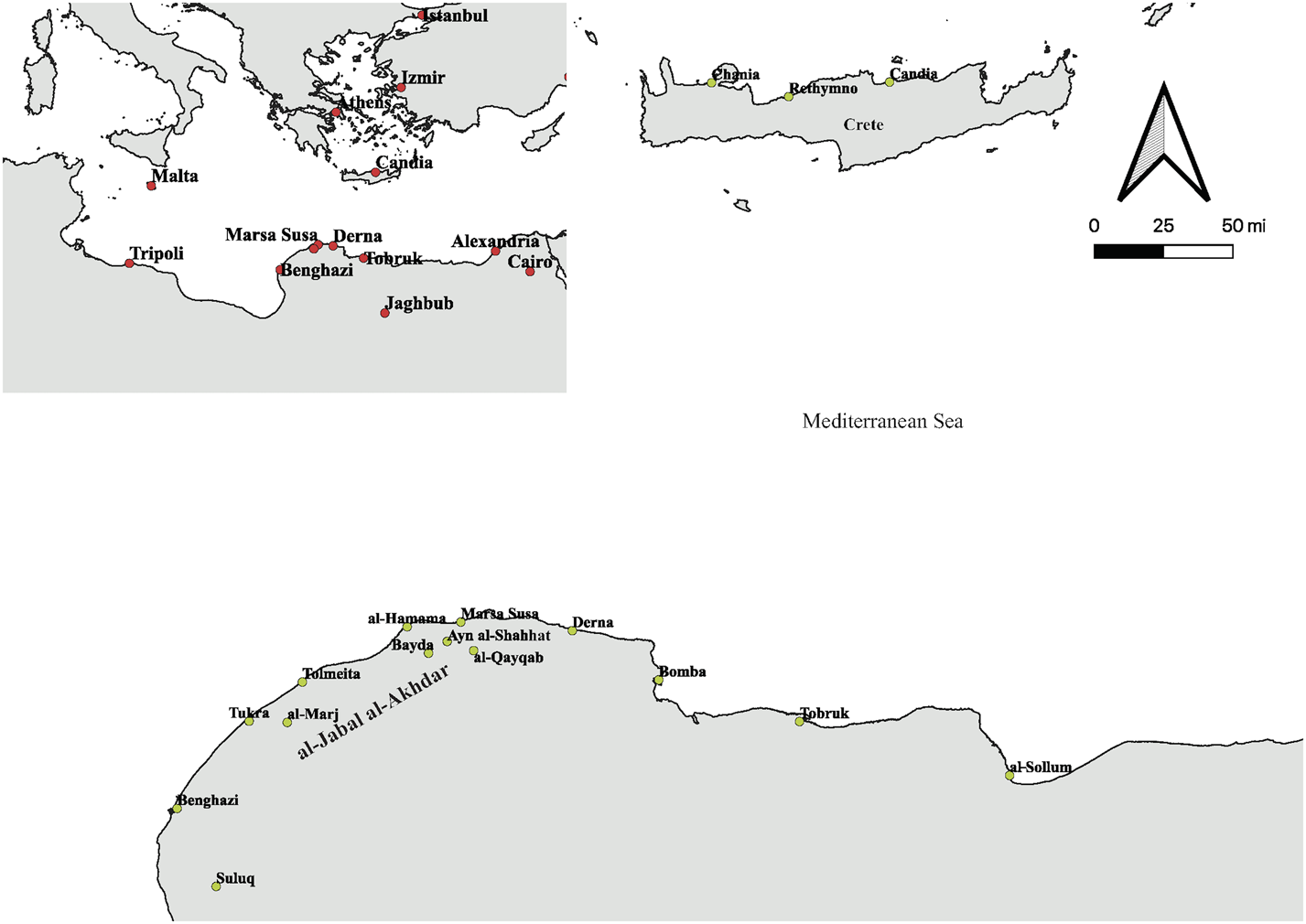
This article contributes to the historiography of Ottoman Libya by arguing that Ottoman officials harnessed the power of migration and used Cretan Muslim agricultural settlements as a means to bolster the empire's economic and military presence on the coastline and in the hinterland of Cyrenaica from 1897 to 1904.Footnote 6 Since the Conference of Berlin of 1884–85, the Ottoman Empire had redefined its relationship with its provinces in North Africa to demonstrate itself as the legal possessor of the territories in Cyrenaica, Fezzan, and Tripolitania.Footnote 7 Beginning in the late 19th century, Ottoman authorities fixed their gaze on thousands of Cretan Muslim refugees (Girit muhacirleri) whom they settled in several strategic locations between the cities of Benghazi and Derna to create the second Egypt. Rather than serve as a mediating force between the Ottoman state and the local inhabitants, the Ottoman government settled Cretan Muslim refugees to consolidate imperial authority along the coastline from Benghazi to Derna and in the immediate hinterland of al-Jabal al-Akhdar (the Green Mountain).Footnote 8 In doing so, Ottoman officials directly administered and transformed these lands in northern Cyrenaica while the head of the Sanusi order concentrated on carrying out the empire's expansionist activities in the south (Fig. 1). I argue that the Ottoman state conceived of these resettled Cretan Muslim refugees as agents of Ottoman expansionism who served to establish newly implanted agricultural colonies with the goal of cultivating the fallow territories of Cyrenaica and transforming them into productive and profitable agricultural lands. Cretan Muslim refugees-turned-settlers played an active role in the transformation of the coastline and hinterland of Cyrenaica, allowing Ottoman authorities to directly buttress state authority through its agricultural settlements.
Regional map of northern Cyrenaica and Crete. Copyright Fredrick Walter Lorenz.

Rather than viewing refugees solely as victims, I treat refugees as actors with agency and autonomy. As Isa Blumi has argued, “the refugee appears marginalized and thus bereft of agency” but in fact constitutes a significant “contributive force” to the stabilization and destabilization of modern state bureaucracy and institutions.Footnote 9 Cretan Muslim refugees-turned-settlers constituted such a generative force that they collectively shaped the Ottoman state's presence in Cyrenaica at the turn of the century. The settlement of Cretan Muslims from Benghazi to Derna and in al-Jabal al-Akhdar was a process of creating the second Egypt: the mobilization of skilled settlers to transform Cyrenaica into a civilized, cultivated, and profitable land under Ottoman control. Through this process, the Ottoman state could expand its imperial reach and consolidate authority in the most remote ends of the empire, namely, its frontier territory in Cyrenaica.
This article consists of three parts that illustrate the significance of the Cretan Muslim settlement mission in Cyrenaica and the making of the second Egypt for consolidating Ottoman authority. First, I reevaluate the historiography of Ottoman Libya that leads to the first Cretan Muslim refugee settlements in 1898. I contend that by 1898 the Sanusi order had an attenuated role in Cyrenaica, compelling the Ottoman state to supplant the order with productive, “civilized settlers” who could fulfill the central government's new goal of increasing its direct presence in Cyrenaica to limit European imperialism and expand agricultural production and security. After that, I discuss the strategies that Ottoman officials implemented to establish a new class of agriculturalists from Benghazi to Derna by settling thousands of Cretan Muslim refugees in uncultivated, fertile lands across the coastline and hinterland of Cyrenaica, which had been in the hands of the Sanusi order and other itinerant tribal federations. I focus particularly on the regions of ‘Ayn al-Shahhat and Marsa Susa—two territories that bridge the coastline of Cyrenaica to the hinterland of al-Jabal al-Akhdar—to show that refugees appropriated Sanusi and tribal lands and transformed them into cash-crop-producing farmlands. Finally, I argue that the Ottoman government's strategic settlement of Cretan refugees weaponized them as an auxiliary military force who, as frontier settlers and sentries, provided increased security against and surveillance of tribal federations, European encroachment, and Sanusi operations in Cyrenaica.
Although the Sanusi order played a major role as a proxy in securing Ottoman colonial interests in the Lake Chad basin from 1887 to 1895, this article demonstrates that the order faced a variety of difficulties toward the turn of the century because of military defeats by the French, lack of strong leadership, and the absence of necessary resources. I argue that from 1897 to 1904 Cretan Muslim refugees-turned-settlers became the major industrious force in the occupation of the hinterland of Ottoman Cyrenaica. This new emphasis on Ottoman expansionism through the lens of migration and settlement decenters the predominant focus on the Ottoman-Sanusi political relationship by offering an overlooked mechanism by which the Ottoman state extended its expansionist ambitions into North Africa. Settling migrants in territories from Benghazi to Derna reduced the Ottoman state's dependence on the Sanusi order because Ottoman authorities could directly implement reforms and development projects through its Cretan agriculturalists. Although the forced exile of tens of thousands of Cretan Muslims was a severe blow to the Ottoman Empire's sovereignty in Crete, Ottoman officials also considered this forced migration an auspicious opportunity to fulfill plans to create the second Egypt—a region comprising the vast, fertile geographical area between Benghazi and Derna. Ottoman authorities viewed Cretan Muslim refugees as agricultural settlers who possessed the labor, skills, and desirable assets to generate much needed revenues through agricultural development and, more importantly, to establish a firm imperial foothold in North Africa.
Comparative Modernization And Centralization In Tripolitania And Cyrenaica
The settlement and centralization policies of the Ottoman government in the provinces of Libya are best understood in the global context of late 19th-century empire building. The Russian and Chinese empires in the 19th century targeted subject populations in “backward” territories by settling migrants in those regions to civilize them: to improve “work skills, civilization, and loyalty.”Footnote 10 The United States in the 19th century expanded internally by using coercion and military force to subjugate the Sioux, whereas Russia consolidated its central authority by dominating the Kazakhs of the steppe.Footnote 11 Likewise, the French government implemented policies to educate and integrate unassimilated, rural “savages” by annihilating the local and regional culture of the peasantry and introducing and encouraging French-dominant culture, language, and patriotism.Footnote 12
What is clear from recent historiography of the late Ottoman period is that Ottoman officials also possessed an array of imperialist and colonialist tools to apply at the frontiers and in the borderlands. Scholars have shown that the Ottomans used a hybrid form of imperial rule by approaching marginal territories as an Ottoman project of social engineering, colonization by proxy, internal colonization, a politics of difference, and a civilizing mission.Footnote 13 Beginning in the second half of the 19th century, Ottoman government officials began to represent local peoples, nomads, and bedouin as “backward” and “savage,” which made them targets for an Ottoman project of modernity, a civilizing mission.Footnote 14 In Yemen, for example, this system of social classification created a colonial space that was governed according to the “customs and dispositions” of locals, without carrying out any censuses, cadastral surveys, conscription, or court decisions in a regular (nizamiye) court.Footnote 15
To control the movements of migrants, refugees, and nomadic communities during the long 19th century, it also was crucial for Ottoman officials to transform the ways the central and provincial administrations governed the frontiers of the empire. Although bedouin and nomadic communities had enjoyed autonomy over their local practices in previous centuries, new Ottoman laws such as the Ottoman Land Code of 1858 and the Provincial Reform Law of 1864 limited the mobility of these communities and strengthened the presence of the central administration in frontier provinces.Footnote 16 The forced displacement of millions of refugees from the Balkans, the Crimean Peninsula, and the Caucasus into Ottoman domains led to new challenges of designating appropriate space for settlements and care.Footnote 17 Settlements of Circassian and Chechen refugees were used to strengthen Ottoman sovereignty over the frontier zone of Greater Syria; this helped initiate the sedentation of bedouin.Footnote 18 The central government also undertook complex relationships with Kurdish communities in eastern Anatolia to secure the frontier and borderlands, execute a civilizing mission, and suppress Armenian revolutionary activities.Footnote 19
Known in the historiography as the second Ottoman occupation, the era of Libyan history between 1835 and 1911 should be understood as the Ottoman state's attempted centralization and mission to civilize its subjects, later citizens, in Tripolitania, Fezzan, and Cyrenaica. Establishing direct rule over peripheral territories facilitated imperial goals of bolstering security, exploiting resources, and realizing imperialist expansion. Nineteenth-century Ottoman reforms and centralization coalesced with the Tanzimat era (1839–76) in the regions of Tripolitania, Fezzan, and Cyrenaica to uphold the legitimation of Ottoman rule. With these reforms, military intervention removed any local strongmen and their communities to maximize tax revenue, conscript soldiers, and secure the region against any European encroachment. The reconquest also brought about negotiations between urban notables and Ottoman officials, both of whom contributed to the reconfiguration of administrative, social, and urban spaces in Tripolitania.Footnote 20 Local resistance to direct Ottoman rule, especially in Jafara and Jabal Nafusa of Tripolitania, stifled centralization attempts throughout the initial decades of reform.Footnote 21 It was only in the 1860s that the Karamanlis and major tribal federations in Tripolitania and Fezzan gave way to the local Ottoman government's plan for conscription and taxation through a variety of patron-client relationships.Footnote 22 In Cyrenaica, however, local tribes and communities continued to lead an armed resistance against Ottoman forces in al-Jabal al-Akhdar.Footnote 23
From 1860 to 1867, Mahmud Nedim Pasha, the governor of Tripoli, successfully realized modernization and development projects in the region—projects that the Ottoman state hoped to extend from Tripolitania to Cyrenaica. Nedim Pasha encouraged the cultivation of olive orchards in Tripolitania, the establishment of civil, commercial, and criminal courts, the introduction of a printing press to circulate Ottoman newspapers, the construction of a new gate in the city walls of Tripoli, the establishment of a postal system, and the creation of a telegraph line that extended from Tripoli to Malta.Footnote 24 He invested in public works to foster a settled civilian life that included the collection of taxes, internal communication, and sufficient security.Footnote 25 The creation of smaller administrative divisions in 1864 in the province of Tripoli also helped Nedim Pasha facilitate the collection of taxes in each administrative district, whether sub-province (liva or sancak), district (nahiye), local district (kaza), or village (karye).Footnote 26 Commercially, he maintained Tripoli's export commerce with Malta, as the British Empire was the main importer of herbs, produce, and, especially, esparto grass (ḥalfā’) coming from Tripoli, with an average of 30,000 tons annually.Footnote 27 He also encouraged local elites to participate directly in the local government administration so that they form the foundation for the administrative councils, gendarmerie, and other institutional and municipal positions.Footnote 28 Thus, the basic administrative and military infrastructure that began in the 1860s continued to support the Ottoman state's interests in upholding its authority in Tripolitania.
Ottoman-Sanusi Alliance And European Threat
Whereas the Ottoman state established a strong administrative presence in Tripolitania in the 1860s, the central government initially depended on the Sanusi order in Cyrenaica to fulfill its schemes for centralization and modernization. By 1860, the Sanusi order under the leadership of the Grand Sanusi, Muhammad ibn ‘Ali al-Sanusi, had already penetrated al-Jabal al-Akhdar and established a number of Sufi lodges where members of the order and bedouin had access to education, work, and the services of the order's religious community.Footnote 29 The Sanusi lodges were located in ancient Greco-Roman sites, on caravan routes, and at inlets on the coast, where the order collected taxes, tolls, and gifts and formed a network of merchants, nomads, and transporters who frequented the road from Benghazi to Waddai.Footnote 30 Furthermore, the strategic location of each lodge permitted Sanusi members to reach another lodge by horseback in five to six hours.Footnote 31 The construction of the Sanusi White Lodge (al-zāwiya al-bayḍā’) within the heartland of al-Jabal al-Akhdar, found in the hinterland of Cyrenaica, also offered social services and a fortified defensive position to the inhabitants.Footnote 32 With the profound influence of a total of fifty-eight Sanusi lodges in Cyrenaica, twenty in Tripolitania, and nineteen in Fezzan, the Sanusi order succeeded where the Ottoman state could not, which led to amicable ties between the two administrative entities as long as order, security, and trade were upheld throughout Benghazi and its environs.Footnote 33
From 1885 to 1897, the Ottoman government continued its close political relationship with the Sanusi order with the understanding that the order functioned as a proxy to expand Ottoman authority beyond the southern frontiers of the Libyan Desert, eastern Sahara, and Lake Chad basin. Through the “Ottoman-Sanusi united front,” the Ottoman state expanded its imperialist goals by participating in the late 19th-century scramble for Africa.Footnote 34 This relationship continued even after the order moved its headquarters in 1890 to counter European imperialism and attract new members by calling for a spiritual hijra from Jaghbub to Kufra.Footnote 35 Another benefit for the Ottoman state was that the operations of Sanusi shaykhs helped transform the nomadic Arabs they encountered into a docile, settled population, which facilitated Ottoman plans for hinterland development.Footnote 36
The creation of an effective defensive bastion along the coastline of Cyrenaica to ward off any potential invasion by European powers remained a top priority for Ottoman officials throughout the 1890s. The Ottoman Empire already had a deep history of defending the territory over the previous two centuries from the Americans, French, Germans, Italians, and Russians who sought to colonize Benghazi through expeditions and monopolize trade in the region.Footnote 37 After the 1878 Berlin Conference, the British also had an intimidating presence in the Mediterranean, with control over Cyprus and ownership of the Egyptian khedive's shares of the Suez Canal.Footnote 38 As a central location for global trade in North Africa, Cyrenaica was crucial to the Ottoman state for driving commerce throughout the Mediterranean. With its main exports consisting of barley to England, cattle to Malta and Izmir, wool to Genoa and Marseilles, and butter to Istanbul, European invasion remained a serious threat to Ottoman commercial interests.Footnote 39
Beginning in the 1880s, Italy had begun to make formal agreements or pacts of mutual understanding to secure access to Tripolitania. In the 1890s, however, Italian officials grew increasingly interested in the agricultural potential of al-Jabal al-Akhdar. The Italians assessed Cyrenaica to be more profitable than Tripolitania, with its varieties of fruit orchards and trees.Footnote 40 Merchants operating in the trans-Saharan trade also conducted business exclusively along the coastline of Cyrenaica, where they could sell valuable commodities, including but not limited to ivory, salt, skins, ostrich feathers, and slaves—the last of which was banned in 1857 but persisted into the 20th century.Footnote 41 No longer just a backwater in North Africa, al-Jabal al-Akhdar was imagined by Italian officers to be the foundation of the historical “second Greece” (seconda Grecia) with its potential for industrial agriculture.Footnote 42 Italian officials’ desire for al-Jabal al-Akhdar was compounded by the fact that the Italian government under Francesco Crispi had already initiated a gradual agricultural settlement program in 1893 through seizures of land in East Africa.Footnote 43 Under these circumstances, Ottoman officials began seeking other means to bolster coastal and hinterland defenses around Cyrenaica and harness the potential profits that the land offered through agricultural development and expansion.
Surveying The Prospects Of The “Second Egypt”
In 1890, the Ottoman state began appraising the earnings that could be acquired by maximizing Cyrenaica's agricultural production. Colonel Hüseyin Hüsnü's memorandum of the second Egypt served as a convincing blueprint for realizing its creation. After Ottoman territorial losses resulting from the Russo-Ottoman War of 1877–78 and establishment of the French Protectorate in Tunisia in 1881 and the British Protectorate in Egypt in 1882, the making of the second Egypt symbolized imperial interests to realize territorial expansion into the hinterland of Cyrenaica. Moreover, the plan to create the second Egypt shared the successful visions of reform, settled agriculture, and a strong centralized administration in Cyrenaica—developments that Mehmet Ali Pasha and Ibrahim Pasha had previously implemented in the transformation of Egypt.Footnote 44 Ottoman bureaucratic circles refocused their attention on tapping into the agricultural potential of al-Jabal al-Akhdar, which officials believed had the capacity to maximize imperial goals of “acquiring development and civilization” (kesb-i mamuriyet ve medeniyet). Officials knew that the territory of al-Jabal al-Akhdar possessed a fertile geography, and that its “empty” (hali) lands were neglected by wandering nomads and bedouin. Cultivation and exploitation of these fertile lands also provided a strategy to bring profitable returns to the bankrupt imperial treasury.
Sadık el-Müeyyed, an Ottoman officer from Damascus who wrote reports on Sanusi activities and surveyed lands in Cyrenaica in 1895, reported that nomadic Arabs (‘urban) “do not work” and asserted that if migrants were settled in these lands “an extraordinary yield” of barley and wheat could be realized.Footnote 45 These written reports were part of a larger colonialist discourse among Ottoman officials about the empire's Arab citizens, who were thought of as “savage” (vahşi) and thus hindering imperial reform.Footnote 46 Other Ottoman surveyors operating in al-Jabal al-Akhdar had also discovered pockets of “plentiful and clear water” located underground that could be used for irrigation.Footnote 47 Adding to the development of new networks of villages and expanding markets that were being established across Cyrenaica, anticipated agricultural development promised to contribute to the success of late 19th-century reforms across the coastline.Footnote 48
With the Sanusi order conducting military operations in the south, the lack of local security from Benghazi to Derna remained a barrier to executing new agricultural projects. Local landowners of Cyrenaica complained to Ottoman officials that the hinterland of Cyrenaica was not civilized like Izmir and other Ottoman domains because of the bedouin who were “residing in tents” and “living in a world of nomadism” (‘alem-i bedavette imrar-i hayat etmektedirler).Footnote 49 They pleaded with officials that violence and insecurity rendered it impossible for them to engage in farming anytime during the year. Locals of Benghazi also suggested that nomads who lived in Benghazi, Derna, and al-Marj needed to be conscripted in the imperial army to teach them to have love for the homeland (hubb-ı vatan).Footnote 50 They believed that the Ottoman military could forcibly settle these nomadic Arabs in urban dwellings in areas around al-Jabal al-Akhdar like ‘Ayn al-Shahhat, Bomba, Derna, al-Hamama, Marsa Susa, Tobruk, and Tukra and put an end to their nomadism.Footnote 51 Only with such measures did locals believed that they and bedouin alike could contribute to the productivity and security of the land.
Although the Grand Vizier, the district governor (mutasarrif) of Benghazi, and members of the Commission for Migrants debated the suggestions of the locals, they proposed a different solution to the situation. Rather than employ the military in a costly operation to discipline unruly bedouin subjects, the Ottoman government formulated a cost-effective solution to the bedouin question. On the assumption that the Sanusi order had not maintained a secure and productive environment in Benghazi since its operations had relocated further south in the 1880s, Ottoman officials sent a commission of officers to survey and map the lands from Benghazi to Derna, calculate available farmlands, the quantity of water, and the general condition of the region, and determine whether settlements of migrants could be realized in the area.Footnote 52 Surveyors reported that the weather and fresh water in Cyrenaica were “pleasant and plentiful” and estimated that one thousand households or five thousand migrants could easily be settled in the empty lands.Footnote 53 The region's many small waterfalls and meadows were the most important indicators that the land could support the settlement of large populations in most of its areas.Footnote 54
With the land surveys completed, the central question remaining was which migrants could be settled successfully in Cyrenaica. Officials insisted on selecting those communities of migrants who could fulfill the role as agriculturalists and were “civilized migrants,” with the potential of drawing bedouin and nomads into “the circle of civilization” (daire-i medeniyete idhali).Footnote 55 Given that most of the olive trees in al-Jabal al-Akhdar were wild, the Ottoman government initially considered skilled Cretan Muslim agriculturalists, whom officials viewed as possessing the necessary skills of grafting, taming, and caring for olive trees.Footnote 56 However, the ready availability and cheaper option of resettling thousands of Balkan and Circassian refugees who flooded the borders of the Ottoman Empire led officials to cancel plans to settle Cretan Muslims and consider these other refugee communities. Yet, after much deliberation, officials in Istanbul and the Commission for Migrants then abandoned this settlement proposal, believing that Balkan and Circassian refugees could never bear the severe climate of Cyrenaica.Footnote 57
The careful deliberation about importing thousands of refugees coalesced with the waning of Sanusi influence in al-Jabal al-Akhdar and along the coastline of Cyrenaica. As Sanusi operations moved further into the southern Sahara, Ottoman authorities took the initiative of securing al-Jabal al-Akhdar under their direct administrative control. Since the Sanusi order's headquarters had relocated from Jaghbub to Kufra in 1895 and then further south to Qiru in 1899, the Ottoman government had limited opposition to its plans for al-Jabal al-Akhdar.Footnote 58 By 1899, the relationship between the Ottomans and the Sanusi order also became questionable because of the French threat to the Chad Basin.Footnote 59 Ottoman officials changed their attitudes toward the Sanusi order and sought other means to strengthen imperial sovereignty over the coastline and immediate hinterland. This went as far as denying the Sanusi order any imperial military reinforcements in the 1890s as Ahmed Rasim Pasha (1881–96), the governor of Tripoli, offered only moral support for the Sanusi military campaign against the French in the Sahara.Footnote 60 In 1902, the Sanusi order began to experience defeats by the French and held a weakened position in the Sahara, especially around the regions of Bir Alali in the Chad Basin. In the same year, the death of Muhammad al-Mahdi al-Sanusi, the son and successor of the Grand Sanusi, further complicated the order's administration with rivalries over succession among the members of the Sanusi family.Footnote 61 With lack of Ottoman support, Sanusi representatives in Kufra reached out to the Italians for weapons against the French, with guarantees of using them “against our own and your enemy.”Footnote 62 By 1906, without the leadership of Muhammad al-Mahdi al-Sanusi, the Sanusi order had overextended itself and was in a state that allowed Ottoman authorities to further encroach on their possessions.Footnote 63 Moreover, the Sanusi order's military defeats in the Sahara left its lodges in Benghazi in a precarious situation.Footnote 64 This weakened military position of the Sanusi order at the turn of the century gave impetus to Ottoman officials seeking other means of bolstering Ottoman authority in Cyrenaica.
From Displaced Refugees To Agricultural Settlers
The Cretan insurrection of 1897–98 emerged as an auspicious event that allowed the central and provincial governments to carry out their plan for agricultural development and security in the making of the second Egypt. The insurrection triggered the forced exile of tens of thousands of Cretan Muslims, who abandoned their homes in rural and urban areas located around the cities of Candia, Chania, and Rethymno. The aftermath of the insurrection was a severe blow to Ottoman sovereignty, with the population of Muslims decreasing from 70,000 in 1897 to 33,496 in 1900 after the withdrawal of the Ottoman military from Crete.Footnote 65 European powers viewed the migration of Muslims as “the ultimate solution for the unsatisfactory conditions” existing on the coastlines of Crete.Footnote 66 The mass exodus of thirty to forty thousand Cretan Muslims to Anatolia, the Balkans, and other islands of the Mediterranean permanently reshaped the demographic contours of Crete and other Ottoman territories in the empire.Footnote 67
Facing the influx of tens of thousands of Cretan Muslims, officials in Izmir made arrangements to reduce overcrowding and the frictions between the refugees and Orthodox Christian subjects of Izmir by sending these clustered refugees to different regions of the Ottoman Empire.Footnote 68 While thousands of refugee families were dispersed inland across Anatolia and Greater Syria, five thousand Cretan Muslims or approximately one thousand families were assigned to settlements along the coastline of Cyrenaica and within al-Jabal al-Akhdar. Overseas resettlement of refugees from Izmir to ‘Ayn al-Shahhat, Benghazi, Derna, al-Marj, al-Qayqab, Tolmeita, and Tukra occurred incrementally (Fig. 1).Footnote 69 In this manner, the Cretan insurrection, albeit a detrimental blow to Ottoman sovereignty in Crete, paved the way for the reinforcement of the Ottoman imperial presence in North Africa.
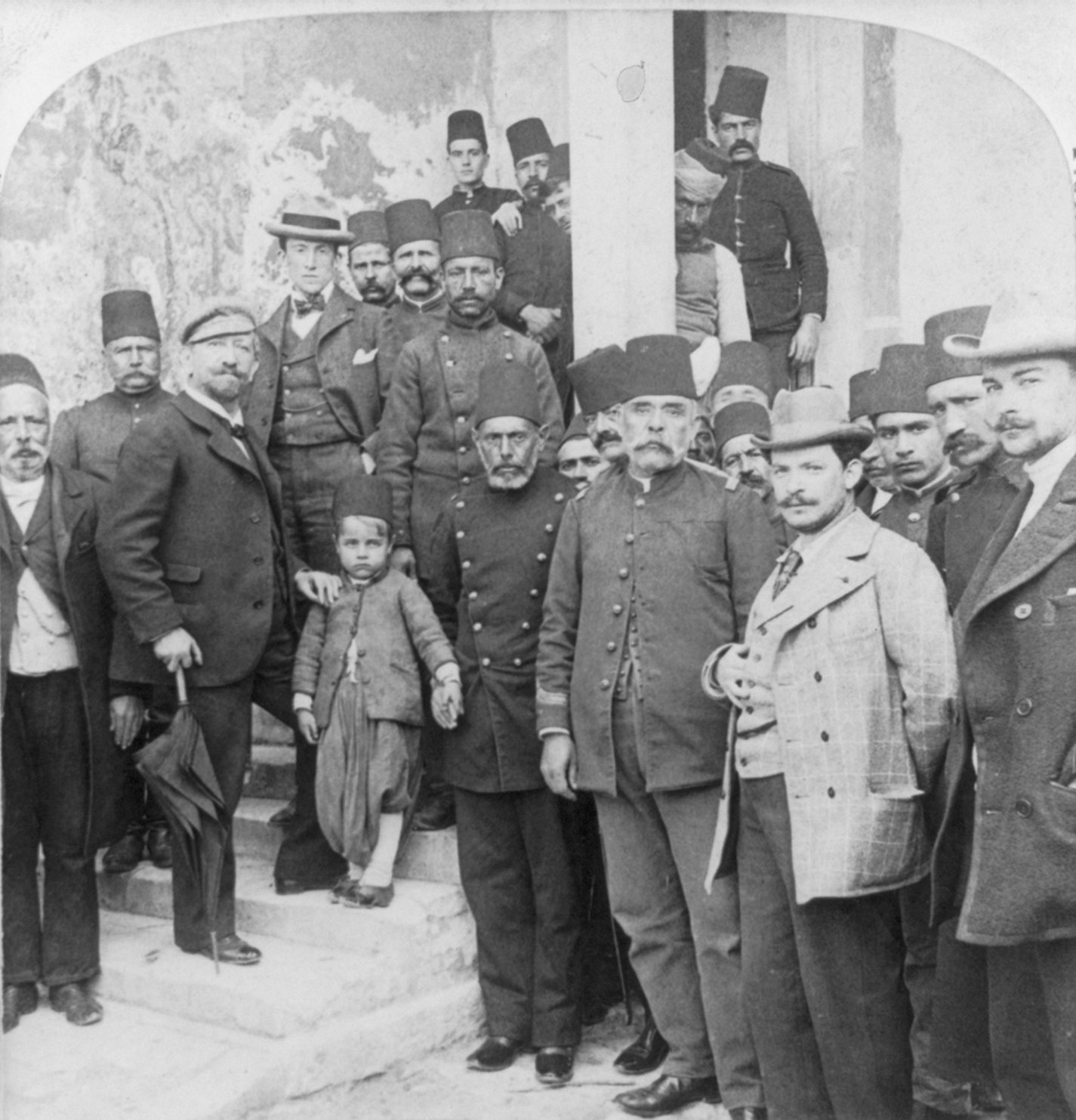
The resettlement process was a grand spectacle, used by the Ottoman government to win over the hearts and minds of these refugees (Fig. 2). At various Ottoman ports, disembarking refugees found a warm reception by the governor of the province who, along with his secretary, personally greeted each and every refugee who stepped off the steamship. The names of the refugees were registered, and they were given a certain quantity of gold. Those sent to Greater Syria, for example, were settled in the village named after Sultan Abdülhamid II, al-Hamidiya, and enjoyed newly made stone houses, mosques, and streets that also were meant to attract investment and trade from Aleppo, Damascus, and Tripoli.Footnote 70 Ottoman officials viewed Cretan refugees as a way to continue developing the network of villages, towns, and cities that connected coastline cities to the Ottoman hinterland.Footnote 71
Caption reads: Turkish officials and little “sole survivor” of a village of 350, Candia, Crete. c. 1897. Library of Congress Prints and Photographs Division, Lot 11678, Washington, DC.

In Cyrenaica, Ottoman officials made sure to settle five thousand Cretan Muslims in strategic areas that were prepared for agricultural development. The success of accommodating so many refugees depended on a reordering of local space similar to efforts conducted in Yemen, manifesting imperial rule in a land Ottoman officials conceptualized as currently backward, but ripe for civilization.Footnote 72 Ottoman commissions surveyed and mapped territories in ‘Ayn al-Shahhat and other coastal cities of Benghazi, designating target regions for agricultural settlements and specifying where nomadic Arab tribes were living.Footnote 73 Another commission led by Ahmed Subhi Bey, president of the Commission for Migrants in Benghazi, carried out the necessary identification of lands, organization of supplies, and settlement arrangements to accommodate the refugees who were to occupy these lands. This commission also calculated the distances between coastline cities and the number of inhabitable caves that could be used as refugee settlements to save money on housing.Footnote 74 A battalion of six hundred Ottoman infantry ensured that settled refugees received appropriate security during the initial phases of settlement and agricultural activities.Footnote 75 With 2,500 refugees already settled in Benghazi by 2 July 1899 and 3,500 more on the way from Izmir and Crete, Benghazi, Derna, and al-Jabal al-Akhdar soon found their shores and hinterlands filled with Cretans whose scientifically informed resettlement occupied previously “empty” lands with farms (çiftlik) and villages.Footnote 76 Only a month later, the number of refugees who arrived from Izmir exceeded the Ottoman authorities’ initial goal of five thousand inhabitants, reaching more than ten thousand individuals.Footnote 77 These refugees were resettled from Benghazi to Derna, reinforcing newly constructed settlements with more refugees, supplies, and food.
Settling refugees along the coastline and hinterland of Cyrenaica established Cretan Muslim agricultural colonies across the region and undermined the relationship between the Ottoman state and the Sanusi order in three ways. First, the Ottoman government forcibly appropriated Sanusi lands to allocate those spaces and their resources, a majority of which were located in al-Jabal al-Akhdar, to incoming refugees. The Ottoman state viewed Sanusi lands as prime territory for intensive agricultural activity and gave refugees-turned-settlers enough land, seeds, and support to successfully grow barley, beans, cotton, maize, onions, and wheat.Footnote 78 The usurpation of Sanusi properties went so far as to permit Cretans to transform the ecology of the region. Elimination of the local Sanusi monopoly over the land and the positioning of the Cretan agricultural settlements in Cyrenaica permitted Cretans to plow and cultivate unused Sanusi lands and occupy tombs for living spaces and storage areas for barley, bread, and other food products.Footnote 79 The confiscation of Sanusi properties resonated with previous Ottoman measures used to seize assets from local leaders and notables after the conquest of Tripolitania.Footnote 80 In al-Jabal al-Akhdar in 1898, however, this displacement of the local Sanusi presence in Cyrenaica caused tensions between two competing Ottoman patronage schemes when Sultan Abdülhamid II gave refugees valuable lands in Marsa Susa that previously had belonged to a neighboring Sanusi lodge.Footnote 81 Establishing Cretan Muslim agricultural settlements in the heartland of al-Jabal al-Akhdar where local Sanusi lodges had operated supported the Ottoman government's strategy of reinforcing its central authority through expansionism.
Second, the refugee settlements provided a way to monitor and regulate Sanusi activities on the main path from al-Bayda to Derna. Ottoman infantry and higher-ranking officers could now infiltrate Sanusi operations and thwart Sanusi attempts to monopolize trade between the hinterland and coastline villages. Furthermore, Cretan Muslim refugees-turned-settlers had access to water from local streams in Marsa Susa under armed escort, and they could dominate these natural resources to supply their own agricultural lands with sufficient water to realize harvests and profit in the coming seasons. The collective acts of improving and monopolizing vital aqueducts, transforming former Sanusi ecological landscapes by plowing, and erecting necessary real estate—houses, pastures, and other establishments—played a role in the permanent transfer of local Sanusi authority to Ottoman imperial and local Cretan Muslim sovereignty over the land.Footnote 82 By controlling access to these resources and pathways, Ottoman officials had not only interrupted the mobility of bedouin and nomadic communities who frequented the Sanusi lodges in al-Jabal al-Akhdar but also implemented an important strategic measure for controlling the activities of the Sanusi order. The diminished power of the Sanusi order did not go unnoticed by European visitors to Cyrenaica, who enjoyed the more secure roads in the region and commented on how Cretans had successfully encroached on Sanusi properties and were protected by armed imperial garrisons and the central administration.Footnote 83
The third way in which the relationship between the Ottoman state and the Sanusi order was strained was that the settlement of thousands of Cretan Muslim refugees brought a rival Sufi order into the region. The majority of the refugees who settled into different areas of Anatolia, Cyrenaica, the Balkans, and the islands of the Mediterranean were of the Bektashi order.Footnote 84 These Cretan Bektashis were accustomed to the environment in Crete, where they had competed against other Sufi orders such as the local Mevlevi and Nakshibandi orders in Candia and the Rifa‘i order that established camp after arriving from Benghazi in the 19th century.Footnote 85 Moreover, the Ottoman Empire had previously employed Sufi “settlers” in the Balkans and Greater Syria to realize the expansion of the agricultural frontier.Footnote 86 Shortly after the refugees arrived in Benghazi from Crete, a community of Cretan Bektashis attempted to establish their own Bektashi lodge (tekke) in Benghazi. They even invited their own Sufi shaykh, Hasan Baba, to leave Chania and come to Benghazi to lead their Bektashi lodge. However, Hasan Baba died before he could leave Crete, leaving Cretans in Benghazi and other cities on their own to continue the Bektashi tradition.Footnote 87 Relying on Bektashi Cretans as a “civilizing force” can be understood in light of Sultan Abdülhamid II's attempt to employ Sufi orders like the Shadhiliyya-Madaniyya to propagate Pan-Islamism in Libya and Tunisia.Footnote 88 Sultan Abdülhamid II had already propagated Pan-Islamism in other coastal towns of North Africa, especially Tunis, and as far as India, where Muslims of the Maliki sect and others were praising the sultan's name.Footnote 89 Utilizing Pan-Islamism for the purpose of ethnic assimilation led to framing Kurdish communities in Anatolia as part of the Ottoman state, with the hope of assimilating “non-Turkish” populations.Footnote 90 In this manner, the settlement of Bektashi Cretans aimed to unify Muslims in Cyrenaica under the banner of the Ottoman state and instill cooperation between nomadic tribes and the Ottoman administration following the weakening of the Sanusi order.
The prospect of earning profits on agricultural ventures in these colonies attracted the petitions and investments of Cretan Muslims who wanted to settle in particular habitable and profitable zones of Cyrenaica. Although approval remained in the hands of the Commission for Migrants, petitioning Cretans in Chania even pleaded with the mother (valide sultan) of Sultan Abdülhamid II to be settled in temperate ‘Ayn al-Shahhat where there was an abundance of wild olive orchards.Footnote 91 The settlement of Cretan Muslims in ‘Ayn al-Shahhat dominated the paths leading to the mountains on which Cretans now transported water to their settlements, making agriculture sustainable in the long term.Footnote 92 With secure availability of water, petitioning migrants and those who settled in ‘Ayn al-Shahhat benefited from the government's material support and obtained livestock, tents, firewood, farming tools, barley, corn, wheat, and various types of seeds that were transported by rented postal steamboats from either Crete or Izmir to the ports of Benghazi and Derna.Footnote 93 When 1,089 refugees arrived in ‘Ayn al-Shahhat on 8 August 1899, the Ottoman government also gave them 1,600 Turkish books and other provisions for their education.Footnote 94 Furthermore, the Ottoman government offered a ten-year exemption from paying taxes, free housing, building materials for homes, and small plots of lands with fruit trees and stationed an armed Ottoman garrison to guarantee security.Footnote 95 Refugees who required medical care went to neighboring Marsa Susa to visit physicians who were stationed there and charged with ensuring that these refugees-turned-settlers lived in comfort (istirahat).Footnote 96 Those who were settled in neighboring Marsa Susa received two additional goats and a donkey to support their agricultural labor.Footnote 97
The establishment of Cretan Muslim colonies helped monopolize agricultural development and establish networks of productive settlers. Refugees-turned-settlers spearheaded projects to restore ancient infrastructure to further improve their settlements and those on the path to the coastline. The most important development was that skilled Cretan Muslim engineers repaired the ancient Roman aqueduct at Marsa Susa.Footnote 98 Control of the water supply at Marsa Susa served a number of purposes. With a functioning aqueduct, Cretans had access to a secure waterway to carry away water and waste, irrigate farmlands and olive orchards, and provide neighboring villages and cities with direct access to necessary drinking water. In 1899, Cretans were “quite content” with their assigned allotments of olive orchards and farmlands in ‘Ayn al-Shahhat and found that even the local nomadic Arabs began to treat them “with sympathy.”Footnote 99 With security provided by the Ottoman military and scientific cultivation of fertile land, Cretan agricultural settlements began to transform the environment of the coastlines and hinterland of Cyrenaica.
Any temporary budgeting constraints on housing and transportation had been addressed by 1904 when foreign visitors to Cyrenaica witnessed these Cretan Muslim agricultural colonies. David George Hogarth, a British archaeologist who conducted an archaeological excursion of several regions around Cyrenaica, commented on the improvements in infrastructure and agriculture that occurred in the region. During his excursion in the region, Hogarth remarked that there was
A certain change, which we did not realize till on the spot itself has been taking place of late in the condition of the Cyrenaica, and rendering it more accessible. Since the evacuation of Crete by the Turkish troops, the Moslem inhabitants of the island have been deserting it in large numbers. After settling as many of these refugees on the Pamphylian Plain as could be accommodated without crowding out existing occupiers, the Sultan seems to have bethought himself of the once fertile and populous coast of the Cyrenaica. To certain points of this coast bodies of Cretans have been conveyed; houses and allotments have been assigned to them, and small military posts have been multiplied to ensure their safety among the Bedawi population. The old port of Cyrene, Marsa Susa, once Apollonia, is now the station of some hundred refugee families, and of a half company infantry; and at Ain Shahhat, the Apollo fountain at Cyrene itself, are some sixty more families, to oversee whom a civil mudir, supported by a handful of soldiers, has been despatched to the spot. . . . As for the Cretan Moslems, they seemed to be applying themselves to agriculture in perfect resignation to exile; and neither these nor the others we had visited at Eski Adalia, in Pamphylia, showed a trace of ill-will towards us or any discontent with the established order of things.Footnote 100
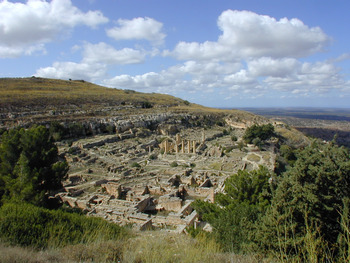
Hogarth's travelogue comprises one of the rare first-person narratives of the existence of these agricultural settlements in Cyrenaica. Hogarth's observations offer a crucial indicator of the success of these settlements. Only those American and European archaeologists who possessed a permit by decree (irade) could survey the hinterlands of Cyrenaica. That only travelers with special imperial permission could enter these lands suggests that the establishment and operations of these settler colonies were a clandestine means for the Ottoman state to consolidate its imperial sovereignty in the region (Fig. 3).Footnote 101 Hogarth's acknowledgement that “a certain change” had occurred that made the land “more accessible” conveys that the agricultural settlements were indeed integral to cultivating and developing Cyrenaica to become the second Egypt.
The Apollo Sanctuary and site of a Cretan Muslim agricultural settlement in ‘Ayn al-Shahhat. Photo by courtesy of Susan Kane.

Old Fighters, New Sentries: The Cretan Auxiliary Military Force
Strategic settlement of Cretan Muslim refugees created a defensive shield throughout the coastline and hinterland. By destabilizing nomadic, bedouin, and Sanusi activities in the ancient Pentapolis of Cyrenaica, ‘Ayn al-Shahhat, Benghazi, al-Marj, Marsa Susa, and Tukra in addition to Tolmeita and Derna, the Ottoman state left a significant imprint of civilization and modernization in the region of Cyrenaica. As agricultural development provided a way to transform the land into productive areas for cash crops, the Ottoman government weaponized Cretan Muslims as a local armed security apparatus. In addition to the armed Ottoman brigades that protected the agricultural settlements, Cretan Muslims themselves took up arms to offer auxiliary support to the Ottoman military in Cyrenaica. In this last section, I demonstrate how the Ottoman state created an auxiliary military force of Cretan Muslims who served as frontier settlers and sentries. Armed refugees-turned-settlers tightened security against and increased surveillance of tribal federations, Sanusi operations, and European encroachment in Cyrenaica.
This defensive shield around the coastline and hinterland of Cyrenaica not only strained the Ottoman state's relationship with the Sanusi order but contained the Sanusi order in the southern half of al-Jabal al-Akhdar. The former Sanusi headquarters and fortress of al-Bayda were located thirty kilometers from the sea, and a network of Sanusi lodges followed along a path throughout Cyrenaica. Located around the same area, armed refugee settlements at ‘Ayn al-Shahhat, Marsa Susa, and Tobruk served as Ottoman defensive strongholds, blocking Sanusi movements and penetration of the coastline.Footnote 102 In 1899, the governor of Benghazi ordered that the Ottoman flag be hoisted daily in Bomba and Tobruk, symbolizing Ottoman sovereignty on the coastline.Footnote 103 Moreover, the number of Ottoman infantry stationed in both regions was increased to provide added reinforcements against any threat to these territories.Footnote 104
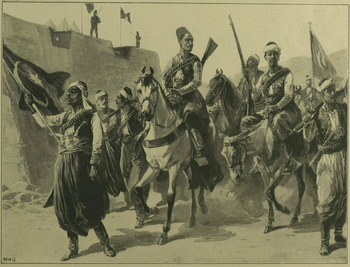
The fact that Cretan Muslims had been exposed to warfare and employed by the Ottoman state as fighters during the two decades before their settlement made them a valuable asset to the district governor of Benghazi. Cretan Muslim men had already distinguished themselves in supporting the fortification of Tripoli in 1882 alongside the Ottoman military.Footnote 105 Likewise, during the insurrection in 1897, Ottoman authorities had recruited and armed fifteen to twenty thousand Cretan Muslim refugees on the shores of Crete in hopes that they could perform paramilitary operations with Arabs of Benghazi as irregulars (bashi-bazouks; Fig. 4).Footnote 106 During the Cretan insurrection, reports estimated that among Cretan Muslims there were three armed men for every two families who fought in “compact bodies in the town” or who were scattered and fighting throughout Crete.Footnote 107 Those Cretan Muslims who were recruited into smaller paramilitary groups to hunt down armed bands of Christian Cretan bandits (eşkiya) were designated part of the armed Muslim fighters (mücahidin-i islamiye).Footnote 108 Others were organized to compose the auxiliary troops (asakir-i muavene), who were armed with Martini Henry rifles and assigned to protect local “Muslim blood.”Footnote 109 Much like the Ottoman military in Tripoli, these armed auxiliary troops and sentries could assist with performing reconnaissance, collecting taxes, safeguarding inland and coastal trade routes, and upholding the Ottoman administration in these settlements.Footnote 110 Having access to war-experienced Cretans who had cut their teeth in the Cretan insurrection assisted imperial efforts to secure a foothold in Cyrenaica and further Ottoman expansionism.Footnote 111 Likewise, the Ottoman government's strategic decision to weaponize Cretan Muslim refugees featured an imperial strategy to apply ancillary and military tactics that were effective in one conflict environment to another region to reinforce the state apparatus and address any security threat.
Illustration of Cretan Muslims as bashi-bazouks during the Cretan insurrection of 1897–98. From “The Eastern Crisis,” Illustrated London News 110, no. 3026 (1897): 513.

In 1901, only a few years after settling the Cretan Muslims, the Ottoman government made plans to mobilize them as an armed local force that could provide security around the coastline and northern end of al-Jabal al-Akhdar. The initial instructions to mobilize Cretan Muslims were sent by the Grand Vizier to the district governor of Benghazi along with funding to establish an imperial gendarmerie in Tripolitania and Cyrenaica where local men from the villages and districts and even bedouin would be trained and employed.Footnote 112 By 1897, the central government already had experience with Cretans serving in the Cretan gendarmerie.Footnote 113 Now, with new mixed gendarmeries in Cyrenaica, the government could incorporate manpower from Cretan Muslim settlements and local Sanusi and bedouin communities to control events on the ground.
The appearance of the armed Cretan Muslim settler-turned-sentry became a familiar sight around agricultural settlements. Whereas those Cretan Muslims in the gendarmerie employed Martini-Henry rifles, other armed Cretan Muslim shepherds “leaned on old Belgian rifles” when tending to their flocks and harvests.Footnote 114 Moreover, the appointment of a Cretan Muslim refugee from Candia to the position of governor of Derna ensured that Cretan Muslim auxiliary forces in the region were well armed and supported by local Ottoman infantry.Footnote 115 The creation of armed battle-experienced settler forces who defended the frontier granted a certain sense of security that locals of Cyrenaica had not experienced before 1897. With the implementation of agricultural settler colonies, a reinforced Ottoman infantry, and ancillary armed refugee units, the Ottoman state was able to infiltrate hinterland territories in Cyrenaica that were deemed savage and insecure only a decade before.
Acknowledgments
I would like to thank Beyza Lorenz, Michael O’Sullivan, James Gelvin, Miloš Jovanović, and Isa Blumi who provided valuable suggestions and feedback in the course of writing this article. Special acknowledgement must be given to Susan Kane for permission to use the image of ‘Ayn al-Shahhat and to Rachel Ainsworth for directing me to photographs of Crete in the Library of Congress. I would also like to extend my gratitude to Joel Gordon and the three anonymous IJMES reviewers for their insightful comments and suggestions.