Introduction
Informal, unpaid carers provide the majority of care for sick, disabled or older people in the community (Pickard et al. Reference Pickard, Wittenberg, Comas-Herrera, Davies and Darton2000). The work of informal carers was estimated to be US $485 billion annually worldwide just for dementia carers in 2005 (Wimo, Winblad and Jönsson Reference Wimo, Winblad and Jönsson2007), including support in personal and instrumental activities and supervision, and Aus $40.9 billion in 2010 for the replacement cost of all informal carers in Australia (Access Economics 2010). The caring role also has costs for the carers themselves. Carers often experience burden and strain from providing physical care or the psychological consequences of their caring roles (Keene and Prokos Reference Keene and Prokos2008; McConaghy and Caltabiano Reference McConaghy and Caltabiano2005). They may also have poorer mental and physical health than non-carers (Markowitz et al. Reference Markowitz, Gutterman, Sadik and Papadopoulos2003). In particular, large differences between carers and non-carers have been found in levels of depression and stress, and subjective wellbeing (Pinquart and Sörensen Reference Pinquart and Sörensen2003). In a large population-based study, Hirst (Reference Hirst2005) identified a higher risk of psychological distress in women carers compared to non-carers who have a heavy ongoing caring responsibility (i.e. caring for greater than 20 hours per week). Hirst (Reference Hirst2005) also showed that this distress can be present in these carers in the period just before they start to provide care.
Carers are typically women who are middle and older aged. As women age, they experience greater levels of disability and make greater use of health services (Byles and Carroll Reference Byles and Carroll2008; Laidlaw and Pachana Reference Laidlaw and Pachana2009). Therefore, for older women carers the role of services for their own health needs and the care needs of people they care for would be different from those of younger carers. Estimating the impact of caring on older women carers, and in turn the effectiveness of services and interventions that may alleviate burden, can be difficult as the caring role is often multifaceted and transient (Hirst Reference Hirst2002). Carers may move in and out of caring roles, care for more than one person and care for people who do not live with them. Our understanding of the impact of changes in caring is limited by the fact that most studies only examine single changes such as starting, stopping or continuing to provide care (Berecki-Gisolf et al. Reference Berecki-Gisolf, Lucke, Hockey and Dobson2008; Hirst Reference Hirst2005). Furthermore, studies may discuss changes around a single event such as bereavement (Seltzer and Li Reference Seltzer and Li2000) or the change to residential care facilities (Bond, Clark and Davies Reference Bond, Clark and Davies2003) without considering multiple events.
Carers' experiences also differ depending on whether they live with their care recipient or elsewhere (Hirst Reference Hirst2005). Co-resident caring has been found to be around four times as intensive as caring for someone living elsewhere (non-resident caring; Hirst Reference Hirst2005). This may be because carers who live with their care recipients often care for spouses/partners or children and often help with the more personal activities of daily living, such as feeding, bathing, toileting or dressing. Carers who live apart from their care recipients often help with the less-intensive instrumental activities of daily living, such as transport and household management. Hirst (Reference Hirst2005) found that levels of psychological distress in women were higher when caring for a co-resident spouse/partner or child.
In Australia, like many countries, there are both Government and privately funded community health services available to assist carers with their own health needs and to care for others. These formal community services, such as nursing, home care and home maintenance, have been shown to effectively reduce burden among carers (Kumamoto, Arai and Zarit Reference Kumamoto, Arai and Zarit2006). However, despite the availability of services, carers can be reluctant to use them (Morgan et al. Reference Morgan, Semchuk, Stewart and D'Arcy2002), and low use of services has been documented (Brodaty et al. Reference Brodaty, Thomson, Thompson and Fine2005; Litwin Reference Litwin2004; Lucke et al. Reference Lucke, Russell, Tooth, Lee, Watson, Byrne, Wilson and Dobson2008). Tennstedt, Crawford and McKinlay (Reference Tennstedt, Crawford and McKinlay1993) found that co-resident carers typically assisted with the more involved tasks of daily living but had lower rates of formal service use than non-resident carers, even after controlling for other factors such as the level of frailty of the care recipient (Tennstedt, Crawford and McKinlay Reference Tennstedt, Crawford and McKinlay1993). Brodaty et al. (Reference Brodaty, Thomson, Thompson and Fine2005) suggested potential reasons for non-use of services by carers such as their perceived lack of need for, or awareness of, services and reluctance to use them, including the perception that caring was part of the duty of being a spouse or parent.
In order to better understand the predictors of service use by carers, researchers have used the behavioural model of health service utilisation developed by Andersen and Newman (Reference Andersen and Newman1973). According to the Andersen theoretical framework, predisposing factors, enabling factors and illness factors contribute to an individual's utilisation of formal services. Predisposing factors are factors that predispose individuals to use services. They include socio-demographic characteristics like age, gender, marital status and education. Enabling factors are those that enable individuals to use services, such as income and area of residence. Illness factors are factors that indicate an individual's level of illness or need, such as the carer's impairment or illness (Andersen and Newman Reference Andersen and Newman1973). While researchers have consistently linked the three types of factors in Andersen's framework with formal health service use (e.g. Smith and Longino Reference Smith and Longino1994), carer illness factors, such as carer burden, have been found to be the strongest predictors (e.g. Bass, Looman and Ehrlich Reference Bass, Looman and Ehrlich1992; Bookwala et al. Reference Bookwala, Zdaniuk, Burton, Lind, Jackson and Schulz2004; Wolinsky and Johnson Reference Wolinsky and Johnson1991).
Given the high frequency of transitional states in providing care, and psychological distress that can occur, it is surprising that no research has examined whether and/or how the relationships between the factors of Andersen's framework and service use are influenced by changes in the caring role in older women. Indeed researchers have called for an examination of the longitudinal patterns of service predictors and service utilisation (Hong Reference Hong2010). We examined this relationship in older women carers using ten years of data from the Australian Longitudinal Study on Women's Health (ALSWH). The specific aim of the study was to determine if changes in caring over time, including where carers live, influenced the relationship between the Andersen framework factors (predisposing, enabling and illness) and service use. Three formal community support services were examined: (a) nursing or community health services, (b) home-making services, and (c) home maintenance services.
Methods
Sample
The Australian Longitudinal Study on Women's Health
The ALSWH is a prospective study of over 40,000 women who were randomly selected in 1996 from the Medicare Australia database, which includes all permanent residents and citizens. The women are from three cohorts born 1921–26, 1946–51 and 1973–78. They answer questions about their health and wellbeing, demographics and service use in three-yearly postal surveys. Details of the ALSWH recruitment and study design have been fully described elsewhere (Lee et al. Reference Lee, Dobson, Brown, Bryson, Byles, Warner-Smith and Young2005). While the ALSWH is funded by the Australian Government Department of Health and Ageing (DoHA), this particular project investigating caring transitions in the older women was funded separately by DoHA.
Participants
Women of the 1921–26 cohort who participated in the second (1999), third (2002), fourth (2005) and fifth (2008) waves of the ALSWH were included in the current study. There were 10,434, 8,646, 7,158 and 5,559 women at each of the waves, respectively. As the women aged, the overall number of participants decreased due to death (28.4%), withdrawal due to frailty (5.1%), withdrawal for other reasons (11.4%) or was lost to follow-up (10.4%).
Measures
Outcome variables: use of formal community support services
At each survey wave, the women were asked ‘Which of the following groups have you sought advice or help from in the last six months?’, with response options of formal nursing or community health services, home-making services (e.g. home care service, laundry service) and home maintenance services (e.g. odd jobs, gardening). Respite services (in home, day centre or inpatient) was also a response option. However, the number of responses was too low for statistical analysis.
Predictor variables: caring changes
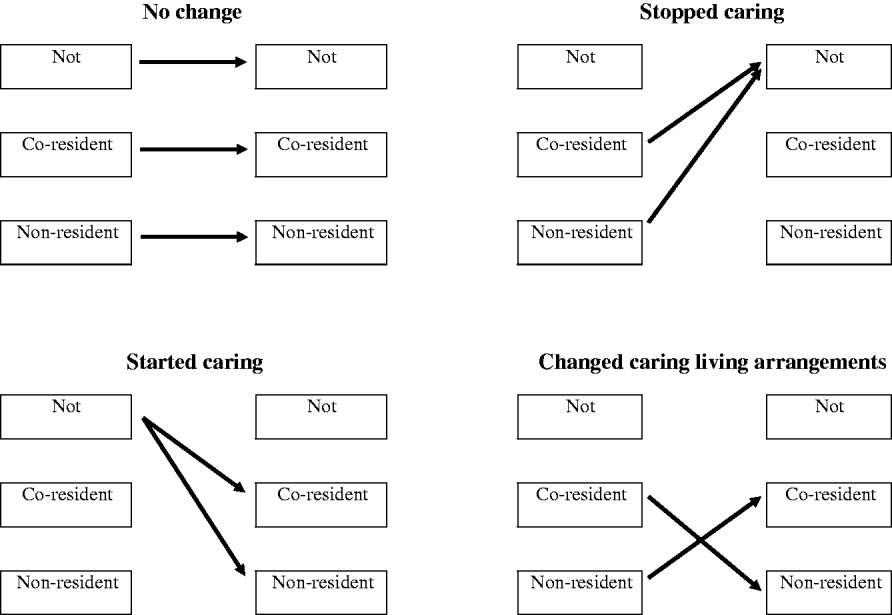
At each survey wave, the women were asked the following question: ‘Do you regularly provide care or assistance (e.g. personal care, transport) to any other person because of their long-term illness, disability or frailty?’ From their responses, the women were classified into three caring status groups at each wave: women who did not provide care (Not), women who provided ‘co-resident’ care for a care recipient who lived with them (Co-resident) and women who provided ‘non-resident’ care for a care recipient who lived elsewhere (Non-resident). The first wave (1996) of the ALSWH was not included because the question on caring did not ask where the carer lived relative to the care recipient. To capture transitions in caring by each woman across adjacent survey waves a new variable was created. Figure 1 illustrates the changes that could be captured. In brief, it captured whether the woman had ‘no change’ to their caring status, had ‘started caring’ or ‘stopped’ caring. It also took into consideration whether the women lived with the person they cared for (Co-resident) or lived elsewhere (Non-resident). For each woman, this variable could change over time (if caring scenarios changed).
Graphical representation of the carer changes groups based on women who did not provide care (Not), women who provided ‘co-resident’ care for a care recipient who lived with them (Co-resident) and women who provided ‘non-resident’ care for a care recipient who lived elsewhere (Non-resident). Carer changes were determined between each adjacent survey wave (e.g. Waves 2–3, 3–4, 4–5).

For example, the variable could capture a woman not caring between Waves 2 and 3 (Not to Not), starting co-resident caring between Waves 3 and 4 (Not to Co-resident) and changing to non-resident caring between Waves 4 and 5 (Co-resident to Non-resident). Equally, it could capture a woman being a non-carer across all surveys waves (Not to Not, Not to Not, Not to Not). The purpose of the variable was to encompass change, if it occurred, at whatever wave it occurred.
Predictor variables representing the predisposing, enabling and illness factors
Several socio-demographic, lifestyle and health-related characteristics measured in the ALSWH that represent Andersen's framework factors were included in the analysis as they may be associated with caring roles and use of community support services.
Predisposing factors:
The women provided information on their age, marital status (‘married or de facto’, ‘separated or divorced’, ‘widowed’ or ‘single’), highest educational qualification completed (‘higher school certificate or tertiary education’, ‘school certificate’ or ‘no formal qualifications’) and country of birth (‘non-English speaking country’, ‘other English-speaking country’ or ‘Australia’). Age, highest educational qualification and country of birth were only recorded at Wave 1 of the ALSWH.
Enabling factors:
At each wave, the women provided their area of residence, which was categorised by the Accessibility/Remoteness Index of Australia Plus system (‘outer regional or remote’, ‘inner regional’ or ‘major city’; Australian Bureau of Statistics 2001) and their ability to manage on their available income on a five-point scale that was dichotomised due to group sizes in each category (‘it is difficult some of the time’, ‘it is difficult all of the time’ and ‘it is impossible’ were categorised as ‘difficult’ while ‘not difficult’ included the responses ‘it is not too bad’ and ‘it is easy’).
Illness factors:
At each wave the women were asked many questions about their health status, need for care and acute/chronic conditions. Physical and mental health was assessed by the Medical Outcomes Health Survey Short-Form 36 (SF-36; McCallum Reference McCallum1995). A recent structured review of generic self-assessed instruments for community-dwelling older people identified the SF-36 as one of three instruments with extensive evidence of internal consistency, test–retest reliability, construct validity, concurrent validity and responsiveness (Haywood, Garratt and Fitzpatrick Reference Haywood, Garratt and Fitzpatrick2005). Two of the eight SF-36 subscales (physical functioning and mental health) were used in this study as multi-dimensional measures of physical and mental health. These scales are measured from 0 to 100 with higher scores indicating better physical or mental health.
At each wave, women were asked whether a doctor had diagnosed them (‘yes’ or ‘no’) with acute or chronic medical conditions, including arthritis, diabetes, heart disease, hypertension, stroke, thrombosis, low iron level, asthma, bronchitis/emphysema, osteoporosis, cancer, depression, anxiety and Alzheimer's/dementia. Women were also asked whether they had a fall with injury or without injury, whether they sometimes or often had symptoms of back pain, foot problems, leaking urine, hearing problems or eyesight problems. These conditions and symptoms contribute to weighted multimorbidity indices developed for use with the ALSWH 1921–26 cohort (Tooth et al. Reference Tooth, Hockey, Byles and Dobson2008). The women were asked if they regularly needed help with daily tasks because of long-term illness, disability or frailty, e.g. personal care, getting around, preparing meals, etc. (‘yes’ or ‘no’).
A final illness factor, sleep difficulty, was measured by the modified Nottingham Health Profile sleep subscale (Hunt et al. Reference Hunt, McKenna, McEwen, Williams and Papp1981). The women were asked whether they have any of the following sleep problems: waking up in the early hours of the morning, lying awake for most of the night, taking a long time to get to sleep or sleeping badly at night. Reporting two or more sleeping problems was categorised as ‘major sleep difficulties’, while one or no sleeping problems were categorised as ‘minor sleep difficulties’ and ‘no sleep difficulties’, respectively.
Statistical analyses
The data were examined descriptively for each ALSWH wave and each pair of waves to ensure the selected factors were suitable for inclusion in the longitudinal analysis. For the longitudinal analysis, several predictor variables were excluded due to high (r > 0.9, p ⩽ 0.001) associations with other predictor variables. Including such highly correlated predictor variables led to instability in the statistical models. The predictor variables that were excluded were marital status, because it was highly associated with carer changes group; and acute/chronic conditions, and the physical functioning and mental health subscales from the SF-36 because they were highly associated with each other and the variable ‘need for care’. Need for care was thus included as a ‘proxy’ factor to represent one illness factor of the Andersen framework.
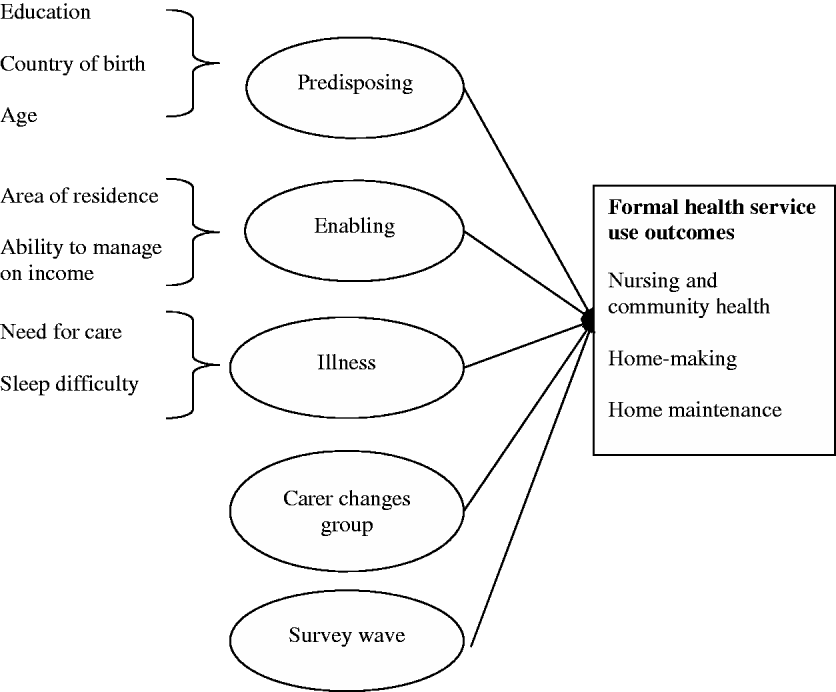
Therefore, nine selected predictor variables were examined. The predictor variables representing predisposing factors were education, country of birth and age. The predictor variables representing enabling factors were area of residence and ability to manage on income. The predictor variables representing illness factors were need for care and sleep difficulty. Predisposing factors were only at Wave 1, whereas the enabling and illness factors, wave of ALSWH survey and carer changes group were included longitudinally. Therefore, the statistical model allowed variables to change over time. For instance, a woman's ‘need for care’ could be different at each wave.
The outcome variables were the use of the three formal community support services: nursing or community health services, home-making services and home maintenance services for Waves 3, 4 and 5.
The longitudinal analyses were conducted using the Genmod feature of SAS version 9.2 (SAS Institute, Cary, North Carolina) with generalised estimating equations with a predictor correlation structure (Diggle et al. Reference Diggle, Heagerty, Liang and Zeger2002). The statistic allowed variables to change longitudinally across the waves. While the statistic took into account the wave number of the predictor variables relative to the outcome variables, it provided an overall estimate of the predictor variables on the outcome variables no matter when that relationship occurred. For instance, the effect of carer change group, Not to Co-resident, on the use of home maintenance services is a composite of all Not to Co-resident carer changes irrespective of when they occurred. The overall estimates are presented in the results.
To test the aim of whether and/or how the relationships between the factors of Andersen's framework and service use are influenced by changes in the caring role in older women, two models were run for each outcome variable. Initially, the predictor variables representing predisposing, enabling and illness factors, together with wave of survey (as an indication of time) were simultaneously entered (Model 1: Andersen model). In the second model, the predictor variables representing predisposing, enabling and illness factors, survey wave, and changes group were simultaneously entered (Model 2: Andersen + changes). See Figure 2 for a schematic representation of the predictor variables representing each of the Andersen framework factors (predisposing, enabling, illness) in addition to carer changes group for the health services outcomes.
Schematic representation of predictor variables representing each of the Andersen framework factors (predisposing, enabling, illness) in addition to carer changes group for the dichotomous outcomes of health services utilisation.
Due to the large sample size, alpha was set at ⩽0.001. Results are reported as odds ratios and 95% confidence intervals for each level of the predictor variables. Quasi-likelihood information criterion (QIC) was used to determine the goodness of fit of the generalised estimating equation models with lower values indicating a better fit to the data (Pan Reference Pan2001).
Results
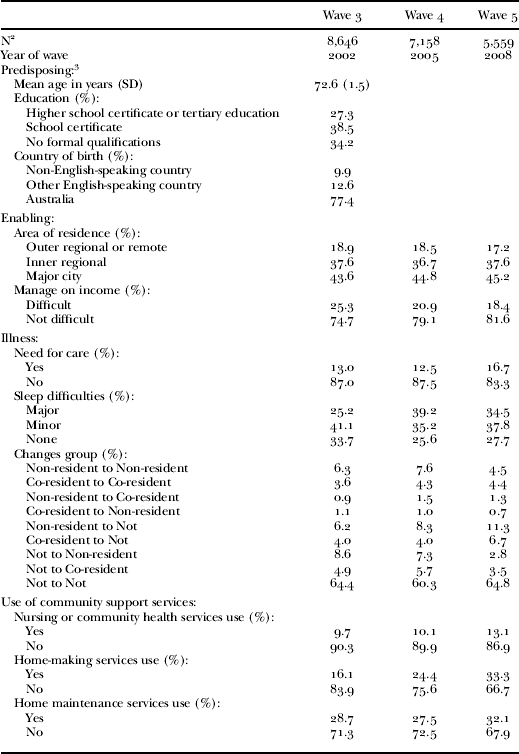
The frequency distribution of the predisposing, enabling, illness, carer changes groups and service use variables for Waves 3–5 are presented in Table 1. The women were typically Australian born, had a school certificate or higher educational qualification, lived in a major city and did not report difficulties managing on their available income. Most women did not report needing care themselves but reported minor sleep difficulties. Few women used nursing or community health services; however, by Wave 5 approximately one in three women used home-making and home maintenance services.
Profile of women in the 1921–26 cohort for Waves 3–51
Notes: 1. Wave 2 data are not presented because Wave 2 was only used to classify changes groups. 2. Actual sample sizes vary for each factor due to missing data. 3. Age, education and country of birth were documented at Wave 1 in 1996. SD: standard deviation.
Most of the women (59.9%, N = 6,320) did not provide care at any wave between 1999 and 2008. The remaining women included those who provided care at all four waves (1.6%, N = 166) and women who provided care at some time across the four waves (38.5%, N = 4,062). Therefore, of the women who provided care at some time, the majority (96.0%) changed their caring role at some time during the study period.
Use of nursing and community health services
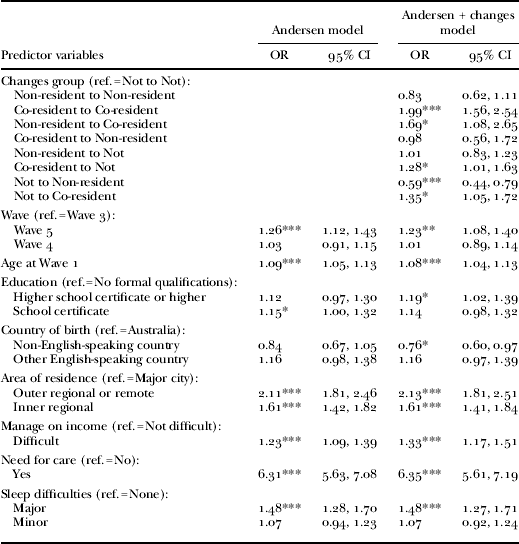
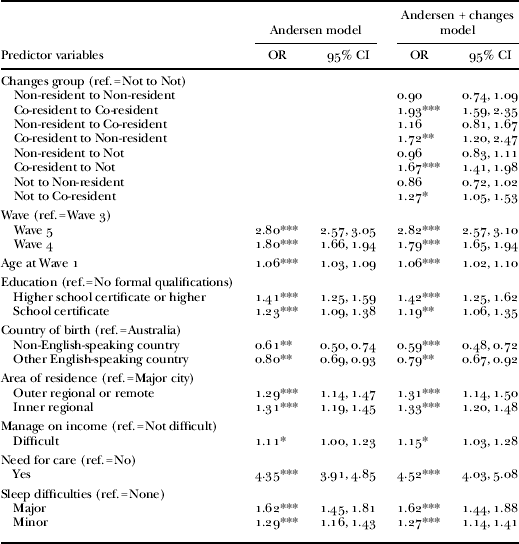
Women who used nursing or community health services were compared to those who did not use these services (Table 2). In the Andersen model, use was more likely at Wave 5 and women had higher odds of using these services if they were older at Wave 1, lived outside a major city, reported difficulty managing on available income, needed care themselves and reported major sleep difficulties. When carer changes was added to the model (Andersen plus changes model), it was statistically significant, and its inclusion did not appreciably change the magnitude of the estimates of the previously significant factors. The Andersen plus changes model (QIC = 9,287) provided a better fit to the data than the Andersen model (QIC = 10,505), as indicated in the reduction in QIC. Therefore, changes groups contributed to the model in addition to the Andersen factors. Women had higher odds of using nursing or community health services if in the Co-resident to Co-resident group and lower odds if in the Not to Non-resident group.
Overall estimates of associations between the predictor variables and the use of nursing or community health services for the Andersen and Andersen plus changes models
Notes: OR: odds ratio. CI: confidence interval. ref.: reference category.
Significance levels: * p ⩽0.05, ** p ⩽0.01, *** p ⩽0.001.
Use of home-making services
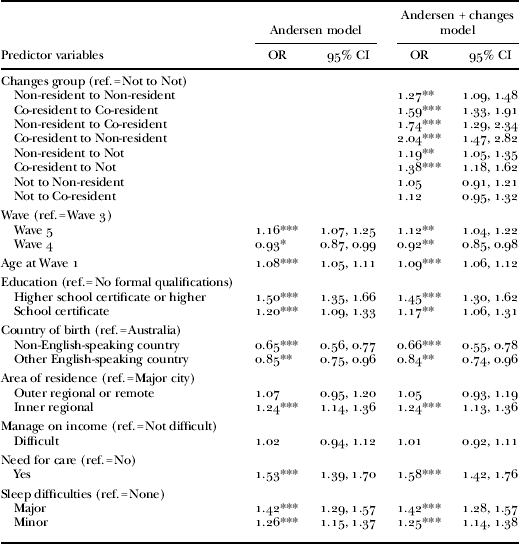
Women who used home-making services were compared to those who did not use these services (Table 3). In the Andersen model, the odds of using these services increased from Wave 3 to Wave 5 and were higher for women who were older at Wave 1, had a school certificate or higher, lived outside a major city, needed care themselves and reported sleep difficulties.
Overall estimates of associations between predictor variables and the use of home-making services for the Andersen and Andersen plus changes models
Notes: OR: odds ratio. CI: confidence interval. ref.: reference category.
Significance levels: * p ⩽0.05, ** p ⩽0.01, *** p ⩽0.001.
In the Andersen plus changes model, the carer changes factor was significant. The odds ratios showed significantly higher use of home-making services for carers in the Co-resident to Co-resident and Co-resident to Not groups. The inclusion of carer changes did not change the magnitude of the estimates of the previously significant predictor variables. The Andersen plus changes model (QIC = 15,383) provided a better fit to the data than the Andersen model (QIC = 17,231).
Use of home maintenance services
Women who used home maintenance services were compared to women who did not use these services (Table 4). In the Andersen model, use of these services was more likely at Wave 5 and if the women were older at Wave 1, had a school certificate, or higher, lived in an inner regional area, needed care themselves or were having sleep difficulties. Women who were born in a non-English-speaking country were less likely to have used home maintenance services.
Overall estimates of associations between predictor variables and the use of home maintenance services for the Andersen and Andersen plus changes models
Notes: OR: odds ratio. CI: confidence interval. ref.: reference category.
Significance levels: * p ⩽0.05, ** p ⩽0.01, *** p ⩽0.001.
In the Andersen plus changes model, the carer changes factor was significant with women more likely to have used home maintenance services if they stayed providing co-resident care (Co-resident to Co-resident), or if their co-resident caring roles changed (Non-resident to Co-resident, Co-resident to Non-resident and Co-resident to Not groups). Similarly for home-making services, the inclusion of carer changes did not change the magnitude of the estimates of the previously significant predictor variables for home maintenance and the Andersen plus changes model (QIC = 18,787) provided a better fit to the data than the Andersen model (QIC = 20,886).
Discussion
We showed that the caring changes is an important independent predictor of the use of three formal community services by older women. In particular, we found that adding carer changes to predictive models of service use did not attenuate the relationship between predisposing, enabling and illness variables, and service use over a ten-year period. Indeed, carer changes showed a consistent predictive relationship to use of services over this period. However, there was no consistent pattern for a particular carer changes group. Instead, changes involving being a co-resident carer generally had the strongest relationships with use of formal services. This relationship may reflect that co-resident carers often have a heavier caring responsibility (Hirst Reference Hirst2005). Therefore, including carer changes group with the Andersen framework provides a more complete representation of carers' circumstances.
In this study, while the longitudinal data allows us to make some predictive or causal conclusions about the directionality of relationships between carer changes and service use outcomes, it is possible that the reverse relationship may also be true and changes in service use may predict carer status. This is an area for further investigation.
In this cohort of women whose ages ranged from 70 to 87 years across the ten-year study period, the odds of using formal services, especially for home-making, increased across the survey waves regardless of whether the women were carers or not. This increase was particularly apparent by Wave 5 of the ALSWH (where the women were aged 82–87 years). This finding of increased use of health services as women age is similar to Byles and Carroll (Reference Byles and Carroll2008).
Against this general background increase in odds of use, women who change into or out of co-resident caring had appreciably higher odds of use of all the services than women caring for someone providing non-resident care. Indeed, the odds of using nursing and community health services, in particular, were higher for women providing co-resident care.
Stopping co-resident caring at some point over the ten years was also consistently linked with higher use of nursing/community health, home-making and home maintenance services, although the strength of these relationships was weaker than those found for caring changes involving being a co-resident carer. This result may reflect that the psychological distress associated with caring can increase or recur in women who had heavy care-giving responsibilities once they change out of caring and that the distress can last for several years (Hirst Reference Hirst2005). The data collected by the ALSWH surveys do not allow us to determine clearly whether the women stopped caring because they were unable to continue caring due to their own health problems or for other factors.
The illness variables were the strongest predictors. Women who needed care for their own illness, disability or frailty were more likely to use community support services. As they age, more carers are at increasing risk of physical and mental health difficulties and so the need for support services will increase (Scharlach et al. Reference Scharlach, Giunta, Chow and Lehning2008). Sleep difficulties may affect the health of carers (von Kanel et al. Reference von Kanel, Dimsdale, Ancoli-Israel, Mills, Patterson, McKibbin, Archuleta and Grant2006), and we also showed that this illness variable was significantly related to all three services. These results are consistent with previous research that indicated the strongest predictors of service use are illness variables (e.g. Bass, Looman and Ehrlich Reference Bass, Looman and Ehrlich1992).
Socio-demographic characteristics of the women were also associated with service use. In other countries, ethnicity has not been associated with patterns of formal service use (Litwin Reference Litwin2004; Tennstedt, Chang and Delgado Reference Tennstedt, Chang and Delgado1998). However, in Australia, community services are not widely used by carers from linguistically diverse backgrounds (Kratiuk et al. Reference Kratiuk, Young, Rawson and Williams1992; Ward, Anderson and Sheldon Reference Ward, Anderson and Sheldon2005) as evident in our study: women were less likely to have used home-making and home maintenance services if they were born in a non-English-speaking country. Formal care has been previously documented to be more commonly used in urban areas (Larson and Fleishman Reference Larson and Fleishman2003; McAuley and Arling Reference McAuley and Arling1984). However, in the current study, women who lived outside major cities were more likely to use formal services. Lucke et al. (Reference Lucke, Russell, Tooth, Lee, Watson, Byrne, Wilson and Dobson2008), who used a small nested sub-sample of women from the ALSWH 1921–26 cohort, also found that rural women were more likely to use services than urban women.
The cost of care can be a barrier to service use and it has previously been suggested that having more income would likely allow for the receipt of more services (Andersen and Newman Reference Andersen and Newman1973; Beeber, Thorpe and Clipp Reference Beeber, Thorpe and Clipp2008). However, the results of the current study do not support this suggestion: women were more likely to have used nursing or community health services if they reported difficulties managing on their income. The direction of causality of these associations is unclear but the associations could also be affected by differing levels of government subsidies and the availability and acceptability of the services. For the other services, income was not a significant predictor.
Strengths and limitations
This article presents a secondary analysis of existing data from a longitudinal survey of the health and wellbeing of a large representative sample of older Australian women. As recommended by Molyneaux et al. (Reference Molyneaux, Butchard, Simpson and Murray2011), to minimise the issue of women not identifying themselves as a ‘carer’, the ALSWH surveys have a clearly defined question specifying the reason the care was being provided. However, the data were limited to the questions available in the ALSWH surveys and other factors that may have been relevant to the women's use of services were not asked in the surveys. For example, frequency of use, reasons for use or service acceptability, and whether the services were used for the women themselves or because they were caring for someone were not asked. This information would be helpful for describing patterns of use and duration of caring. It would also have been useful to examine the impact of differences in care recipients' conditions. Care recipient characteristics, such as recipients' level of frailty, as measured by the extent of impairment in activities of daily living, has been documented to be an important predictor of use of formal services (Ryan et al. Reference Ryan, Weldon, Huby, Persad, Bhaumik, Heidebrink, Barbas, Staffend, Franti and Giordani2010; Tennstedt, Crawford and McKinlay Reference Tennstedt, Crawford and McKinlay1993). The surveys were also limited to the self-reported answers provided by the women for each of the three-yearly postal surveys. For instance, caring status was determined by the women's answers at those times, but undetected changes may have occurred between surveys, similar to other longitudinal studies (Hirst Reference Hirst2002).
Given the limited amount of evidence on changes in caring for older women carers, the ALSWH provides a unique opportunity to gather information about the health and wellbeing of women across time, and small effects and interactions can be examined because of its large sample size. The women were randomly selected from Medicare Australia, the nationalised health-care system, which includes all permanent residents and citizens. The women who agreed to participate in the 1921–26 ALSWH cohort were largely representative of the Australian population, although they were more likely to be married and have a tertiary education. Across the five waves of the ALSWH, 28 and 27 per cent of the 1921–26 cohort have been lost to death and non-death attrition, respectively. Brilleman, Pachana and Dobson (Reference Brilleman, Pachana and Dobson2010) conducted an analysis of the impact of these types of attrition on the representativeness, and therefore generalisability, of the ALSWH data compared to the general Australian population of similarly aged women. They found that while the non-death attrition caused the greatest biases, in terms of socio-demographic factors, self-rated health and health-related risk factors, that the biases between the remaining ALSWH women and general population remained small. Therefore, this epidemiological analysis provides a population-level perspective on carer changes for older women. In addition, the statistical model used in the current study could handle incomplete cases, rather than entirely removing them, therefore minimising data loss.
In conclusion, carer changes are a significant predictor of formal service use. Their inclusion does not attenuate the relationship between the Andersen framework factors and service use, but instead provides a more complete representation of carers' situations, which can be used to inform policy. In particular, older age, reporting sleep difficulties, needing care themselves and providing co-resident care resulted in higher odds of service use. We believe that this type of longitudinal analysis including carer changes, which has not previously been undertaken, highlights the need for service planners and providers to take into account the complex circumstances of their actual and potential clients. As argued by McNamara and Rosenwax (Reference McNamara and Rosenwax2010), interventions that are targeted according to need, and based on research evidence, are more likely to help alleviate carer burden. It is also suggested that the timely provision to carer with the services they need can reduce the incidence of institutionalisation of care recipients (Castora-Binkley et al. Reference Castora-Binkley, Noelker, Ejaz and Rose2010; Gaugler et al. Reference Gaugler, Hanna, Linder, Given, Tolbert, Kataria and Regine2005). As such, the current study's findings are important because they indicate that support services are particularly relevant to women who are changing their caring role and who are themselves in need of care.
Acknowledgements
The ALSWH is conducted by a team of researchers at the University of Newcastle and the University of Queensland. We are grateful to the Australian Government Department of Health and Ageing for funding and to the women who participated. The authors gratefully acknowledge the valuable contribution of all staff, students and colleagues who have been associated with the project since its inception.