Introduction
Anxiety and depressive disorders are highly debilitating for children and adolescents. Children and adolescents with anxiety disorders experience difficulties in emotional health, academic achievement, and social relations (Swan & Kendall, Reference Swan and Kendall2016). Those facing an early onset of a depressive disorder are at an especially increased risk for suicide, recurrent depression, and psychiatric impairment (Weissman et al., Reference Weissman, Wolk, Goldstein, Moreau, Adams, Greenwald and Wickramaratne1999). Anxiety and depressive disorders in children and adolescents are often comorbid (Angold, Costello, & Erkanli, Reference Angold, Costello and Erkanli1999; Cummings, Caporino, & Kendall, Reference Cummings, Caporino and Kendall2014; Garber & Weersing, Reference Garber and Weersing2010). Considering negative consequences and high comorbidity rates, interventions that can deal with both anxiety and depressive disorders in children and adolescents are required.
Transdiagnostic cognitive behavioural interventions that can be used to treat multiple disorders and address comorbidities have attracted attention in recent years (Barlow et al., Reference Barlow, Farchione, Fairholme, Ellard, Boisseau, Allen and May2010; Newby, McKinnon, Kuyken, Gilbody, & Dalgleish, Reference Newby, McKinnon, Kuyken, Gilbody and Dalgleish2015), and several such programmes and protocols for children and adolescents have also been developed (García-Escalera, Chorot, Valiente, Reales, & Sandín, Reference García-Escalera, Chorot, Valiente, Reales and Sandín2016; Marchette & Weisz, Reference Marchette and Weisz2017). One promising transdiagnostic cognitive behavioural intervention for the treatment of emotional disorders is the Unified Protocol (UP) (Barlow et al., Reference Barlow, Farchione, Fairholme, Ellard, Boisseau, Allen and May2010). UP for children (UP-C) and UP for adolescents (UP-A) were developed as downward extensions of the UP for adults. UP-C and UP-A include several treatment principles designed to target emotional disorders. These principles are based on multiple components, such as cognitive restructuring, problem-solving, mindfulness, behavioural activation, and exposure. Accordingly, the UP-C consists of 15 group sessions for children and their parents separately (Kennedy, Bilek, & Ehrenreich-May, Reference Kennedy, Bilek and Ehrenreich-May2019), and the UP-A consists of up to 21 individual sessions (Ehrenreich-May et al., Reference Ehrenreich-May, Rosenfield, Queen, Kennedy, Remmes and Barlow2017).
Group Behavioural Activation Therapy (GABT; Chu et al., Reference Chu, Crocco, Esseling, Areizaga, Lindner and Skriner2016) is a transdiagnostic behavioural intervention for adolescents with anxiety and depression. The GBAT is a 10-week programme with hour-long sessions. These sessions first focus on the core principles of behavioural activation, and then on graded exposure or engagement exercises to practice skills. A randomised controlled trial (RCT) of the GBAT for 35 adolescents [12.03 (SD = 0.45) years old; range 12–14 years] with anxiety or depressive disorders (Chu et al., Reference Chu, Crocco, Esseling, Areizaga, Lindner and Skriner2016) found the GBAT condition to show greater remission rates than the wait-list condition (WLC) in principle diagnosis (57.1 vs. 28.6%). Brief Behavioural Therapy (BBT; Weersing et al., Reference Weersing, Brent, Rozenman, Gonzalez, Jeffreys, Dickerson and Iyengar2017) is another transdiagnostic behavioural intervention for emotional disorders in children and adolescents. Exposure and behavioural activation are combined in the BBT as graded engagement in avoided activities. The BBT consists of 8–12 weekly 45-min sessions. In an RCT for children and adolescents [11.3 (SD = 2.69) years old; range 8–16 years] with anxiety or depressive disorders, 56.8% (50/88) were found to have improved clinically compared with 28.2% (20/71) provided with an assisted referral.
Although there is increasing support for the efficacy of transdiagnostic cognitive behavioural interventions for children and adolescents with emotional disorders, their multiple components and sessions can be a burden on children, parents, and therapists in clinical settings. Therefore, a programme with fewer components and shorter sessions is necessary to increase the feasibility and acceptability of such interventions in clinical settings, especially for younger children aged 8–12 years old. For this purpose, previous trials have identified behavioural components as key factors in transdiagnostic cognitive behavioural interventions. Although the aforementioned GABT and BBT include only behavioural components, the response rates of the clinical trials involving these therapies have been as effective as those of existing evidence-based programmes including both cognitive and behavioural components (59.7%, Child-Adolescent Anxiety Multimodal Study, Walkup et al., Reference Walkup, Albano, Piacentini, Birmaher, Compton, Sherrill and Iyengar2008; 43.2%, Treatment for Adolescents with Depression Study, March et al., Reference March, Silva, Petrycki, Curry, Wells, Fairbank and Severe2004). However, both treatment protocols require approximately 10 or more sessions, and each session lasts for almost 1 h. Moreover, because previous trials have included both children and adolescents (BBT), or only adolescents (GBAT), little is known about the efficacy of transdiagnostic behavioural interventions for children with anxiety and depression.
Streamlined Transdiagnostic Intervention for Anxiety and Depression (STREAM; Kishida & Ishikawa, Reference Kishida and Ishikawa2019, Reference Kishida and Ishikawa2020) has been developed based on previous trials for children and adolescents with anxiety and depressive disorders (Chu et al., Reference Chu, Crocco, Esseling, Areizaga, Lindner and Skriner2016; Ishikawa et al., Reference Ishikawa, Motomura, Kawabata, Tanaka, Shimotsu, Sato and Ollendick2012, Reference Ishikawa, Kikuta, Sakai, Mitamura, Motomura and Hudson2019). STREAM is a transdiagnostic behavioural intervention for anxiety and depression for children and adolescents aged 9–15 years old. STREAM consists of six sessions lasting 50–60 min with additional booster sessions. In STREAM, exposure and behavioural activation are integrated and combined as a single component that focuses on the three treatment principles of decreasing avoidance behaviours, increasing pleasant activities, and habituation of anxiety. A proof of concept (POC) trial of STREAM for Japanese children and adolescents [11.10 (SD = 1.64) years old; range 9–15 years] with anxiety or depressive disorders was conducted (Kishida & Ishikawa, Reference Kishida and Ishikawa2019, Reference Kishida and Ishikawa2020). Its results suggested that STREAM was more effective in follow-ups rather than post-treatment. In addition, no participants dropped out over the duration of the six sessions. The POC trial indicated that the programme could be feasible and acceptable for children and adolescents in a Japanese clinical setting.
The purpose of this study was to examine the feasibility (i.e., recruitment process and rates, willingness of participants to be randomised, and dropout rates for intervention or control conditions) and potential efficacy (i.e., diagnostic outcomes) of STREAM for children (aged 9–12 years) with anxiety and/or depressive disorders using a randomised controlled design with a WLC condition and blind-assessments.
Methods
Participants
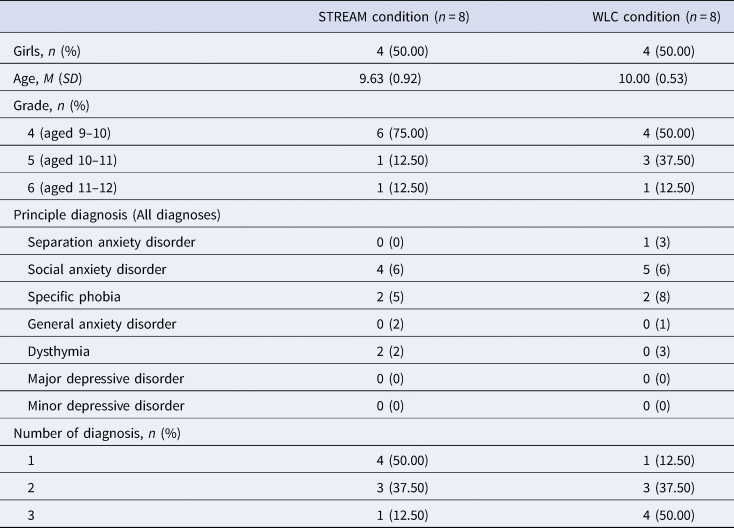
Participants were 16 children from the Kansai area, Japan, who were diagnosed with anxiety or depressive disorder [8 boys, 8 girls; mean age 9.81 (SD = 0.75) years; range 9–12 years]. The trial was conducted in a university clinical centre. Inclusion criteria were children aged 9–12 years in grades 4–6 who had a current clinical diagnosis of anxiety or depressive disorder based on a diagnostic interview. To recruit as many participants as possible, the inclusion criteria also included adolescents aged 12–15 years with a sub-clinical disorder. However, no adolescents aged 12–15 years with a sub-clinical disorder applied to participate in this trial. Participants with diagnoses of intellectual disability, autism spectrum disorder, attention deficit/hyperactivity disorder, post-traumatic stress disorder, eating disorder, and substance-related disorder were excluded. Baseline demographics of the participants are shown in Table 1.
Description of Participants at Pre-Assessment

Note: STREAM = Streamlined Transdiagnostic Intervention for Anxiety and Depression; WLC = Wait-list control.
Measurement
Primary outcome
Anxiety Disorders Interview Schedule for Diagnostic and Statistical Manual (DSM)-IV
Anxiety Disorders Interview Schedule (ADIS) is a semi-structured interview that evaluates the presence and severity of mental disorders based on Diagnostic and Statistical Manual (DSM)-IV (Silverman & Albano, Reference Silverman and Albano1996). The Japanese version of the ADIS was developed in a previous study (Ishikawa et al., Reference Ishikawa, Motomura, Kawabata, Tanaka, Shimotsu, Sato and Ollendick2012). Although independent parent and child interviews are the standard (Creswell et al., Reference Creswell, Nauta, Hudson, March, Reardon, Arendt and Kendall2020), joint parent and child interviews were conducted in this study to reduce the burden of children and parents’ attendance (Ishikawa et al., Reference Ishikawa, Kikuta, Sakai, Mitamura, Motomura and Hudson2019). In the joint interview, the clinician interviewed parents and children separately for a clinical severity rating (CSR). Then, another clinician viewed the video recording of the joint interview. The final CSR was decided based on discussions between the two clinicians. CSR is rated between 0 (not at all) and 8 (debilitating), where a score of 4 represents the clinical threshold and scores of 2 or 3 represent the sub-clinical threshold. We evaluated current diagnoses of anxiety disorders (separation anxiety disorder, social anxiety disorder, specific phobia, and generalised anxiety disorder) and depressive disorders (dysthymia, major depression, and minor depression). The principle diagnosis (PD) was determined based on the highest CSR.
Treatment
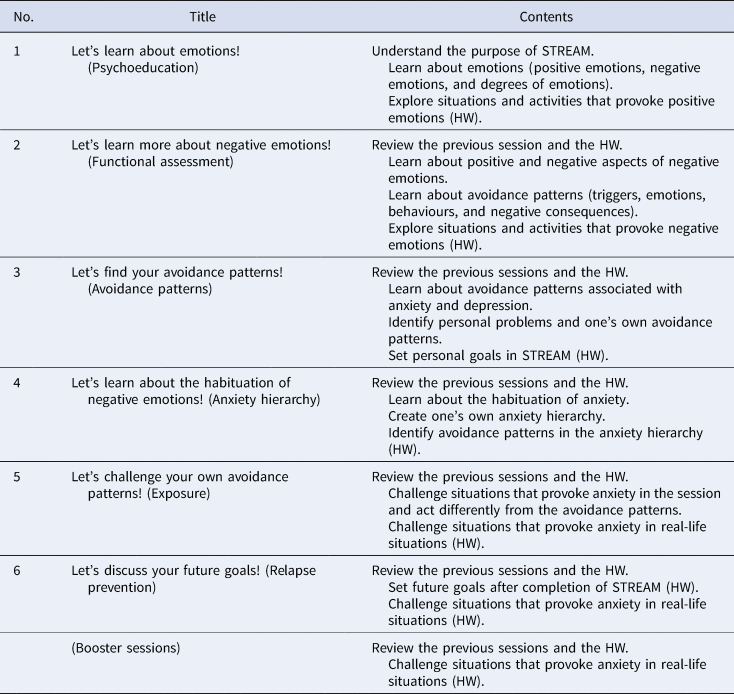
STREAM was the intervention of choice in this study. Given the young age of the children, parents were in the same room when their children participated in the programme. To enable implementation in Japanese clinical practice, the sessions were condensed into their minimum requirements, and each interval allowed for flexibility according to the families’ schedules. To compensate for sufficient practice opportunities, especially for in vivo exposures, booster sessions were scheduled once every 2 weeks to a month, with a total of up to four sessions. Table 2 shows the contents of STREAM.
Components of STREAM

Note: STREAM = Streamlined Transdiagnostic Intervention for Anxiety and Depression; HW = Homework.
STREAM was designed to streamline each treatment component, reduce the number of sessions, and increase the feasibility and acceptability of the intervention in Japanese clinical settings. Specifically, STREAM focuses on integrating and combining exposure and behavioural activation as a single component, introducing transdiagnostic and various cases with anxiety and depression, and adapting contents of the programme to the Japanese clinical setting. First, STREAM singled out three treatment principles: decreasing avoidance behaviours, increasing pleasant activities, and habituation of anxiety. Previous studies on exposure and behavioural activation (Chen, Liu, Rapee, & Pillay, Reference Chen, Liu, Rapee and Pillay2013; Chu et al., Reference Chu, Crocco, Esseling, Areizaga, Lindner and Skriner2016; McCauley et al., Reference McCauley, Gudmundsen, Schloredt, Martell, Rhew, Hubley and Dimidjian2015) have found these principles to be essential for treating anxiety and/or depression. Second, various case vignettes relating to anxiety disorders (separation anxiety disorder, social anxiety disorder, specific phobia, and generalised anxiety disorder) and/or depressive disorders (dysthymia and major depression) were introduced in this transdiagnostic programme in which children with various disorders participated. Additionally, the case vignettes were created and modified based on the participants in the POC trial of STREAM (Kishida & Ishikawa, Reference Kishida and Ishikawa2019, Reference Kishida and Ishikawa2020). Third, we used several contents to increase the feasibility and acceptability of the programme based on previous trials in a Japanese clinical setting (Ishikawa et al., Reference Ishikawa, Kikuta, Sakai, Mitamura, Motomura and Hudson2019; Kishida & Ishikawa, Reference Kishida and Ishikawa2019, Reference Kishida and Ishikawa2020). Specifically, tokens according to participation, worksheets with many illustrations, and several original characters were used. The characters were introduced as ‘Avoidance Rangers’ to promote an understanding of avoidance patterns of anxiety and depression.
Therapists, Supervisor, and Independent Assessors
The therapist (KK) for the STREAM condition was a qualified clinical psychologist of the Japanese Society of Certified Clinical Psychologists and registered in the doctoral course of clinical psychology. The therapists for the WLC condition were KK and NA, who were doctoral students. The supervisor (SI) was a qualified clinical psychologist and behavioural therapy specialist, recognised by the Japanese Association for Behavioral and Cognitive Therapies. The independent assessors, who were blind to the assignment, were two doctoral students (AU and NA).
Procedure
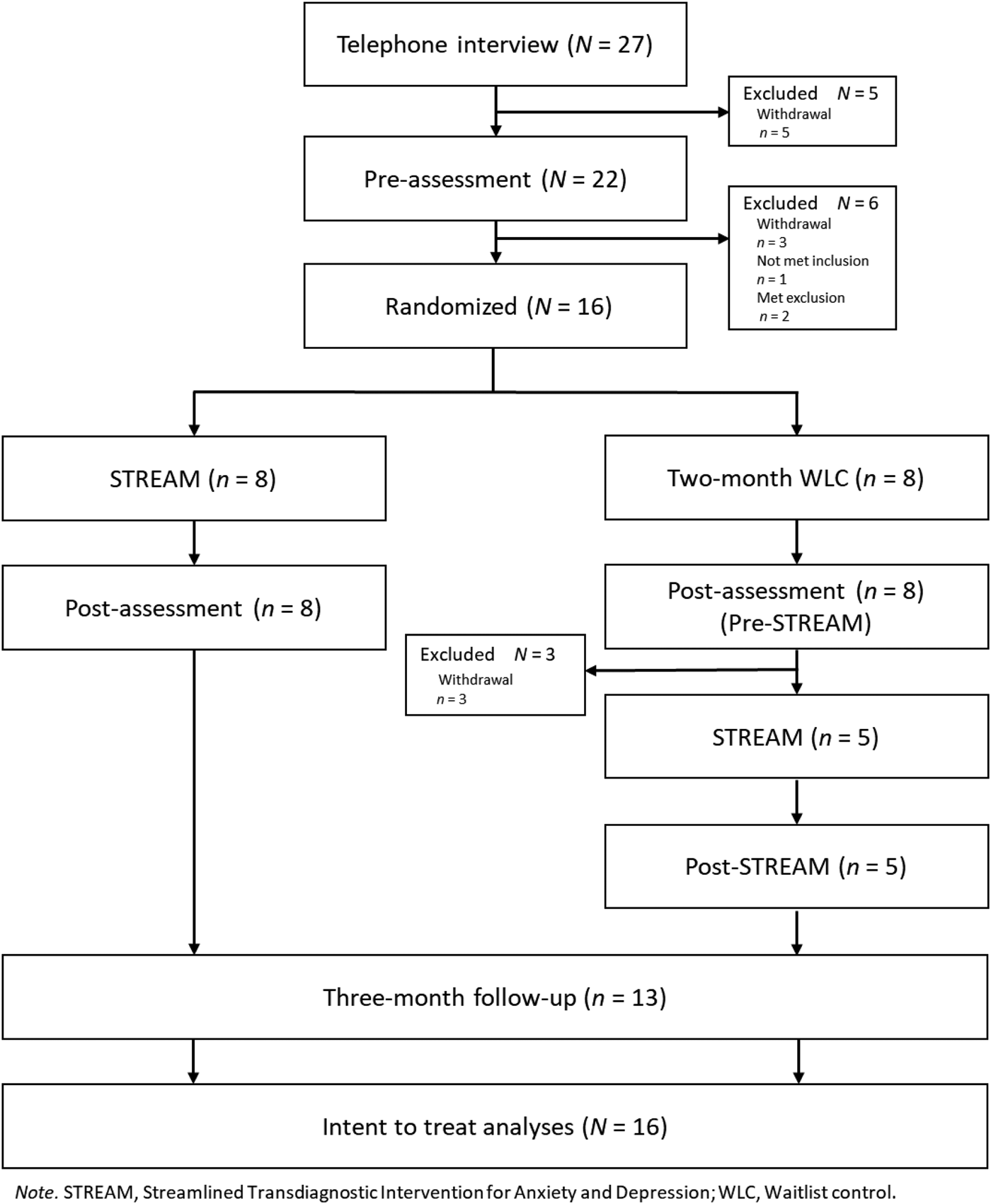
The study was conducted with the approval of the Institutional Review Board of the first author (17090) and registered in the Clinical Trial of the University Hospital Medical Information Network (UMIN000032275). Informed consent was obtained from all participants. Participants were recruited through regional newspapers and websites between April and November 2018. A brief telephone interview was conducted with each potential participant, and if the possibility of the participant having an anxiety or depressive disorder was detected, an appointment was made for the initial assessment interview. Twenty-two children and their parents participated in the pre-assessment interviews by the independent assessors. These pre-assessment interviews offered an explanation of STREAM; acquisition of informed consent; the clinician-rated semi-structured interview, self-reported scales, and parent-reported scales used in the study. Sixteen children met the inclusion criteria described above, and the independent researcher (HA) randomly assigned them to the STREAM or WLC condition using stratified blocking randomisation based on gender (male or female) and PD (anxiety or depressive disorder). All participants did not refuse to be randomly assigned to the intervention or WLC conditions. Children and their parents assigned to the WLC condition were not contacted by the research staff during the 2-month period. A follow-up (FU) assessment for both conditions was conducted 3 months after receiving STREAM. Figure 1 shows a flow chart of this study.
Flow chart for the study.

Statistical Analysis
First, we examined the difference in outcomes at pre-assessment between the STREAM and WLC conditions to confirm whether randomisation was successful. Second, a mixed model analysis was conducted for determining the CSR of the PD (CSR-PD) and ND. We conducted a mixed model analysis with time (pre-assessment and post-assessment), group (STREAM and WLC), and interaction as fixed effects, and individual as a random effect. Third, we examined the long-term efficacy of STREAM. Given that the participants in the WLC condition received STREAM after the WLC period, we combined both the STREAM and WLC conditions for a larger sample size. A mixed model analysis was conducted for the same outcomes of the combined condition (the STREAM and WLC conditions), with time (pre-STREAM, post-STREAM, and FU-assessment) as a fixed effect and subject as a random effect. The scores of pre-assessment of the STREAM condition and post-assessment of the WLC condition were used for the scores of pre-STREAM for the combined condition. All data were analysed using the intent to treat (ITT) analyses. Compound symmetry was used for the covariance model, and the restricted maximum likelihood was used for the estimation method. Effect sizes (Hedges’ g) and 95% confidence intervals (CI) were calculated using the estimated mean of the mixed model. Effect sizes of 0.2, 0.5, and 0.8 were determined to be small, medium, and large, respectively, based on Cohen's (Reference Cohen1988) standard. The proportion of participants who no longer met the criteria for PD and all diagnoses was also examined using the ITT sample through the last-observation-carried-forward method. SPSS 25 was used for statistical analyses.
Results
Preliminary Analyses
There were no differences in gender (χ2 = 0.00, p = 1.00), age (t = −1.00, p = .33), CSR-PD (t = 0.00, p = 1.00), and ND (t = −1.57, p = .14) between the STREAM and WLC conditions at pre-assessment. All children in the STREAM condition completed all six sessions. The dropout rate at post-assessment for the STREAM condition was 0% (0/8), and that at post-STREAM for the combined condition was 18.75% (3/16). The average number of booster sessions for the combined condition was 2.69 (SD = 1.18). Therefore, the average number of total sessions for the combined condition was 8.69 (SD = 1.18). Based on the pre-assessment (0 week), the post-assessment of the STREAM condition was conducted after 18.88 (SD = 5.74) weeks, and the post-assessment of the WLC condition was conducted after 11.13 (SD = 1.46) weeks. There was a significant difference in the post-assessment weeks between the STREAM and WLC conditions (t = 3.70, p < .01). Furthermore, the average number of weeks in the combined condition was 17.85 (SD = 5.03) for post-STREAM and 34.23 (SD = 5.75) for the FU-assessment.
Pre- and Post-Assessments for the STREAM and WLC Conditions
Table 3 presents the results at pre- and post-assessments of the STREAM and WLC conditions. The interaction effects of CSR-PD (F = 1.61, p = .23) and ND (F = 2.03, p = .18) were not significant. The group effect of ND was significant (F = 7.45, p = .02). The calculation of the between-subject effect size showed the effect size of CSR-PD to be moderate (g = −0.79) and that of ND to be large (g = −1.45). The remission rates of the PD at post-assessment were 37.50% (3/8) for the STREAM condition and 0% (0/8) for the WLC condition. The remission rates of all diagnoses at post-assessment were 25.00% (2/8) for the STREAM condition and 0% (0/8) for the WLC condition.
Means and Standard Deviation for Measures from pre-Assessment to Post-Assessment

Note: STREAM = Streamlined Transdiagnostic Intervention for Anxiety and Depression; WLC = Wait-list control; CSR-PD = Clinician Severity Rating of Principle Diagnosis; ND = Number of diagnoses.
Pre-STREAM, Post- STREAM, and FU-Assessment for the Combined Condition
Table 4 shows the results of pre-STREAM, post-STREAM, and FU-assessment for the combined condition. The results showed that CSR-PD (F = 10.86, p < .00) and ND (F = 12.35, p < .00) were significant. The post hoc test showed that CSR-PD improved at FU-assessment compared to pre-STREAM (p < .00). ND improved at post-STREAM (p < .05) and FU-assessment (p < .00) compared to pre-STREAM. The effect sizes of CSR-PD were large at post-STREAM (g = −0.80) and FU-assessment (g = −1.46). The effect sizes for ND were also large at post-STREAM (g = −0.80) and FU-assessment (g = −1.44). In addition, remission rates of PD were 31.25% (5/16) at post-STREAM and 62.50% (10/16) at FU-assessment for the ITT group, and 38.46% (5/13) at post-STREAM and 76.92% (10/13) at FU-assessment for the completer group. The remission rates for all diagnoses were 18.75% (3/16) at post-STREAM and 50.00% (8/16) at FU-assessment for the ITT group, and 23.08% (3/13) at post-STREAM, and 61.53% (8/13) at FU-assessment for the completer group.
Means and Standard Deviation for Measures From pre-STREAM to 3-Month Follow-up

Note: STREAM = Streamlined Transdiagnostic Intervention for Anxiety and Depression; WLC = Wait-list control; CSR-PD = Clinician Severity Rating of Principle Diagnosis; ND = Number of diagnoses.
* p < .05.
Discussion
The purpose of this study was to examine the feasibility and potential efficacy of STREAM using a randomised controlled design with a WLC condition and blind assessments. During the recruitment period, 27 families inquired about the programme. Then, Of the 22 potential participants, 16 Japanese children were eligible and enrolled. All participants did not refuse to be randomly assigned to both the conditions. The dropout rates were 0% for both the conditions at post-assessment. In terms of potential efficacy, although no significant post-assessment results were indicated for CSR-PD and ND, the treatment gain improved at the 3-month follow-up compared with pre-assessment. Therefore, this study demonstrated the feasibility of the STREAM in the Japanese clinical setting and potentially supported its efficacy for children with anxiety and depressive disorders at the follow-up assessment.
This study's results indicated that participants in the STREAM condition showed no significant improvements in their principal anxiety or depressive diagnosis compared to participants in the WLC condition. The effect size of CSR-PD at post-assessment in this study (g = −0.79) was lower than that of the GABT (d = −1.10; Chu et al., Reference Chu, Crocco, Esseling, Areizaga, Lindner and Skriner2016) and the Japanese Anxiety Children/Adolescents Cognitive Behaviour Therapy programme (JACA-CBT) (g = −1.00; Ishikawa et al., Reference Ishikawa, Kikuta, Sakai, Mitamura, Motomura and Hudson2019). The remission rate of PD (31.25%) was also inferior to that of the GABT and JACA-CBT (57.1 and 50.00%, respectively). Additionally, the effect size of CSR-PD (g = −1.46) and the remission rate of PD (62.50%) at the 3-month follow-up were comparable with those of GBAT (31.4% at 4 months) and JACA-CBT (50.98% at 3 months and 66.67% at 6 months). Considering the length of total sessions of STREAM and the booster sessions employed in this trial (8.69) as well as in the previous studies (11.2 for GBAT; 8 for JACA-CBT), dosage effects and practice opportunities should be considered to interpret these results. In other words, booster sessions, which provide additional opportunities for children to practice in vivo exposures in their daily life, may be essential to obtain adequate treatment gains for the STREAM.
This study indicated that behavioural components, especially exposure and behavioural activation, may be essential for treating anxiety and depression in children. This finding is consistent with previous RCTs of transdiagnostic behavioural interventions for children and adolescents (Chu et al., Reference Chu, Crocco, Esseling, Areizaga, Lindner and Skriner2016; Weersing et al., Reference Weersing, Brent, Rozenman, Gonzalez, Jeffreys, Dickerson and Iyengar2017). The participants of this study [9.81 (SD = 0.75) years old, range 9–12 years] were younger than the participants involved in studies of GBAT [12.03 (SD = 0.45) years old; range 12–14 years] and BBT [11.3 (SD = 2.6) years old; range 8–16 years]. Therefore, this study demonstrated the generalisability of transdiagnostic behavioural interventions for children with anxiety and depressive disorders.
This study had several limitations. First, because of the nature of the feasibility study, the sample size was insufficient to make conclusions regarding the efficacy of the STREAM. Second, there was a significant difference in the post-assessment weeks between the STREAM and WLC conditions due to a flexible schedule. In the future, it will be necessary to examine the dropout rate using a more rigid schedule. Third, the ADIS was not conducted using separate child and parent interviews. Fourth, considering the small sample size of this trial, data and analyses of the primary outcomes were only reported, while those of the secondary and process outcomes did not in order to reduce the number of analyses. Fifth, although there was no statistically significant difference, the number of diagnoses in the WLC condition was higher than those in the STREAM condition. Therefore, the efficacy at post-assessments between both the conditions should be interpreted with caution.
Despite these limitations, this study provides preliminary evidence that STREAM could improve anxiety and depressive disorders not at the post-assessment but at the follow-up assessment. Therefore, this study demonstrated the feasibility of the STREAM in the Japanese clinical setting and potentially supported its efficacy for children with anxiety and depressive disorders at the follow-up assessment. In the future, a clinical trial with a larger sample size and more rigorous methods is necessary to examine the efficacy and treatment mechanisms of the STREAM.
Acknowledgements
We were able to carry out this research with the support of many people. Naoko Kurimoto, Yukari Umezawa, Yukari Yokoyama, and Sachiyo Horie assisted in this project at the clinical centre of Doshisha University. Dr. Hiroko Sugiwaka gave us valuable input regarding the recruitment of participants and management of each case. Satsuki Ueda gave us important advice on programme development. The children and parents who participated in the study shared valuable experiences with us. Finally, we would also like to thank all those who cooperated in this project.
Funding
This study was supported by the Japan Society for the Promotion of Science (JSPS) KAKENHI (Grant No. 17J00307).
Declaration of interest
None declared.
Ethical standards
The authors assert that all procedures contributing to this work comply with the ethical standards of the relevant national and institutional committees on human experimentation and with the Helsinki Declaration of 1975, as revised in 2008.