The challenges experienced by many young people leaving statutory OOHC have been documented by several researchers from a number of different countries (Bristow, Cameron, Marshall, & Omerogullari, Reference Bristow, Cameron, Marshall and Omerogullari2012; Cashmore & Paxman, Reference Cashmore and Paxman1996; Del Valle, Lazaro-Visa, Lopez, & Bravo, Reference Del Valle, Lázaro-Visa, López and Bravo2011; Mendes, Reference Mendes2009a, Reference Mendes2009b; Stein, Reference Stein2012). The general conclusions drawn from these studies is that young people leaving care, as a group, tend to have poorer outcomes in many areas of early adult development including, but not limited to, health, financial and social domains. Although leaving care can be challenging in general, researchers have identified sub-groups of young people who vary in how well they adapt to life beyond OOHC. Some make this transition quite readily; some do so with extensive supports, but there are others who struggle to adapt. Young people who comprise the latter group often have multiple and complex needs that are difficult to accommodate in conventional leaving care services. The term “complex needs” has been used to describe people who have a range of co-occurring problems that can be caused by individual level factors (e.g., physical or psychological health) or broader social-economic factors such as exposure to deprived conditions, abuse and domestic violence (see Dowse, Cumming, Strnadova, Lee, & Trofimovs, 2014). In terms of young people in care, young people with complex needs usually present with a combination of mental and physical disabilities as well as serious behavioural and socialisation problems. Complex needs may also include young people who have borderline conditions or sub-clinical problems and as a result are not eligible to receive professional services. Such young people often need multiple forms of assistance or a combination of services because their problems interact and compound their difficulties (e.g., a young person with a mental disability may find it more difficult to seek assistance for employment or a substance use problem).
Sub-groups of care leavers are reported, for example, by Stein (Reference Stein2012) who suggests that care leavers in the United Kingdom (UK) very likely fall into three principal groups: (1) Moving on; (2) Survivors; and (3) Strugglers or victims. Young people who fall into the first group are more likely to have experienced stable and secure OOHC placements. According to Stein, these young people are more resilient and are able to make effective use of after-care supports. The “survivors” are young people who have experienced difficult care placements characterised by instability and are generally less prepared for the transition to independent living; however, they can be assisted to make this transition because they are responsive to the provision of appropriate services. The “strugglers”, however, are young people who have multiple and complex needs, who are less responsive to services and are at the greatest risk of becoming homeless, ending up in the correctional system or having mental health problems.
Stein's work is mirrored in a similar typology developed by Johnson et al. (Reference Johnson, Natalier, Mendes, Liddiard, Thoresen, Hollows and Bailey2010) in Australia. These authors differentiate between “smooth” and “volatile” transitions or pathways from care. A smooth pathway is usually described by young people who had fewer and more stable placement experiences and who felt that they had some involvement in the decision-making surrounding their transition from care. These young people usually had better social connections and achieved greater success in obtaining stable accommodation and employment. Those who experienced a “volatile” pathway typically had the opposite experiences: less stability in care; left care earlier; had poorer social connections; and experienced a range of other problems including mental health issues, substance abuse and difficulties in obtaining housing.
In general, most research and policy attention has been directed towards care leavers as a whole, whereas much less attention has been given to young people with complex needs leaving care. However, there is an established body of research which has focused on specific vulnerable groups of care leavers, including those with disabilities (see Baker, Reference Baker2007; Priestley, Rabiee, & Harris, Reference Priestley, Rabiee and Harris2003) and those involved in the youth justice system (see Cusick, Courtney, Havlicek, & Hess, Reference Cusick, Courtney, Havlicek and Hess2010; Taylor & Fitzpatrick, Reference Taylor and Fitzpatrick2006). Recently in Australia, major research reports have investigated leaving care issues pertaining to specific vulnerable groups: (1) Indigenous care leavers (see Baidawi, Mendes, & Saunders, 2015), (2) Care leavers involved with the youth justice system (e.g., Mendes, Baidawi, & Snow, Reference Mendes, Snow and Baidawi2014), and (3) Care leavers with disabilities (Mendes, Snow, & Broadley, 2013). These reports have not only identified how transitional issues for these vulnerable groups carry additional significance, they also identify ways and make recommendations for supporting these young people as they leave care. For example, Mendes, Snow, and Baidawi (Reference Mendes, Snow and Baidawi2014) found that youth involved with both the child protection and youth justice systems would be better supported through enhanced interagency collaboration and more intensive supports and interventions.
However, almost all current work is predicated on a resilience model (e.g., see Stein, Reference Stein2005) that assumes that young people have the willingness to be assisted and the capacity to respond to services. Very little discussion has been devoted to the service issues pertaining to highly complex young people who either cannot or will not engage with existing service systems. Young people who have significant difficulty receiving any formal help and who are disengaged (e.g., Stein's “strugglers”) are particularly challenging from a service delivery perspective. Problems in service delivery can arise for a number of reasons. Some young people may not meet the eligibility criteria for most commonly available services (e.g., mental health, disability) because they are of the wrong age or their conditions do not meet the formal diagnostic criteria required for service provision (e.g., borderline disabilities or health conditions). There may also be young people who present with a range of sub-clinical disorders or conditions, or a constellation of such conditions, so that their needs cannot be accommodated by any single service. Another group of young people may find it very difficult to engage with services or be unwilling to forge relationships post-guardianship for a variety of reasons. Accordingly, additional time and resources must be invested to identify the particular service issues pertaining to young people with complex needs in order to ensure that they are adequately supported when required to make the transition from care to adulthood.
The Present Study
The present study forms part of a larger research project conducted by the University of Adelaide and commissioned by the Exceptional Needs Executive Committee (ENEC), an across government senior officers group in South Australia, with funding provided through the Exceptional Needs Unit (ENU), Department for Communities and Social Inclusion (DCSI). The project was initiated in order to develop some insight into the unmet needs and service engagement requirements of young people with complex needs leaving OOHC in South Australia. The issue of service disengagement has become a major concern among professionals working in both government departments and non-government organisations (NGOs), although this issue has historically not been a principal focus of previous discussions of leaving care in South Australia (Layton, Reference Layton2003; Le Sueur, Reference Le Sueur and Seuer1991). In South Australia, a group of young people who are particularly difficult to engage and who have a range of high and complex needs have been identified by the ENU through increased referrals for assistance and support. The ENU, a specialist agency positioned within DCSI, facilitates strategic and improved operational responses from existing services and systems across both government and non-government sectors, including the demonstration of new co-ordinated approaches and their benefits.
The aim of the study was to inform ENEC in its purpose to facilitate and lead high-level, strategic oversight of contemporary government policy and service responses for people with high to exceptional and complex needs, including younger people. One component of this research was a qualitative investigation with service providers in SA which was designed to investigate the perceived needs of young people, service responses, engagement strategies and directions for policy and practice. This paper focuses specifically on the findings relating to; (1) Current leaving care services and transition preparation, and (2) Enhancing policy and practice.
Method
The study involved focus groups and one-on-one interviews (depending on the nature of the organisation) with people working in organisations who have knowledge of, or contact with, young people leaving care. Some interviews involved single participants working in specific roles relevant to the project, whereas some involved more open focus-group formats where there were opportunities for discussion within the group. Focus-group interviews ranged in size from between 2 and 8 participants.
Participants and Recruitment
Interviews were conducted with a number of organisations (both government and non-government) and covered a wide variety of services. These included government statutory agencies and support teams (N = 3), Child and Adolescent Mental Health Services (CAMHS) teams (N = 4), advocacy agencies (N = 2), corrections and youth justice (N = 2), and non-government services relating to housing and homelessness (N = 6), health (N = 1), relationship and support (N = 2). One non-government peak-body organisation (i.e., an advocacy group for young people in care) was also interviewed, along with foster carers (N = 3). The professionals involved included organisation coordinators and directors (N = 5), program or service managers (N = 14), service team supervisors (N = 4), advocates (N = 9), psychologists (N = 2), practitioners (N = 5), social workers (N = 8), support or team workers (N = 16), and foster carers (N = 3). Organisations were initially contacted via telephone or email to gauge interest to participate in an interview. Those who were interested were then followed up and a time was arranged for the interviewer to meet with participants at a time and place of their choice (usually in the organisations’ offices). Ethics approval for the study was obtained from the University of Adelaide's Human Research Ethics Committee (HREC). Participants were provided with an information sheet and were asked to sign a consent form prior to beginning the interview. Overall, a total of 29 interviews were conducted with 66 individual participants.
Data Collection and Analysis
Discussions followed a prepared semi-structured interview format that focussed on the service issues pertaining to young people leaving care, as informed by a review of the extant literature. Participants were queried about two main topics: current leaving care services and preparation (e.g., how well prepared are young people for leaving care), and factors or ideas that might be useful for enhancing policy and practice (e.g., practices or strategies that result in successful outcomes).
Each interview or focus group took a semi-structured approach in that the session began with a consistent preamble and involved a similar ordering of questions. Probes were used where appropriate to elicit more detailed responses around specific points or examples that were provided by participants. In the event that the discussion covered some later questions in advance, the interviewers did not halt the conversation but allowed those points to be made in a way that maintained the flow of discussion.
All interviews were audio-recorded and transcribed, and content was then organised into themes around the principal research questions. Two independent researchers read each of the thematic classifications to ensure that there was agreement concerning the classification of each theme. In the event of discrepancies, the two researchers would discuss the point to achieve a resolution concerning the appropriate classification.
Results
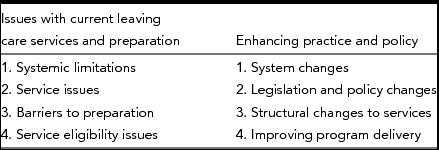
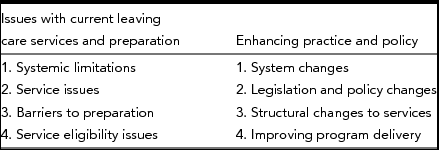
The participants’ views of the service issues pertaining to young people leaving care were organised into eight principal areas using thematic analysis. As displayed in Table 1, these areas can be differentiated into two overarching categories: (1) Issues with current leaving care services and preparation and (2) Enhancing practice and policy. Participants’ feedback did not always fall neatly into one category because of the overlapping nature of the themes. Therefore, the feedback has been organised in a way that best captures the issues raised rather than providing lengthy overlapping narratives. Each theme is discussed separately below.
Summary of identified themes.
Issues with Current Leaving care Services and Preparation
Theme 1: Systemic limitations
Issues relating to the care system were raised by participants 92 times. It was reported that there is a significant lack of planning prior to young people leaving care. Advocacy organisations emphasised the difficulties associated with developing leaving care plans for young people with complex needs, in particular those with disabilities, as well as the lack of regular and consistent attempts to engage them in this planning phase. According to these participants, it was often easy to stop trying with this population of young people when they did not appear willing to engage with services. It was argued that workers are not trained or supported sufficiently in persisting with these young people who often require a different approach to engaging them in care planning compared to other young people with less complex needs. A more intensive style of engagement which involves persistence in the face of short-term resistance and set-backs was emphasised. This idea was summarised by a worker in an advocacy organisation:
I think that's one of this system's issues. Workers aren't given the support that they need to what's required to engage this group of young people . . . we know that more intensive engagement is more effective with a vulnerable group because showing that you’re persistent, showing that you care and that you’re going to show up no matter where they are is something that has been known to work.
Participants believed that these young people need longer periods to recover from their experiences of trauma and instability in OOHC and that further nurturing experiences should continue beyond the age of 18. As stated by a manager of a government service, these young people “need strong people and services around them to help guide and nurture them, and this doesn't stop at 18.” Extending beyond this age cut-off was deemed important because young people exiting care (and particularly those with complex needs) often were not as developmentally mature as similar aged peers.
A related issue raised by participants was the lack of appropriate placements and accommodation settings for young people when they make the transition from care. It was suggested that some placements, in particularly those where young people with challenging behaviours are co-located, increase the likelihood of criminal behaviour without the appropriate supports. For example, it was suggested that some placements “inadvertently lead to criminalising behaviour” through police involvement that would have otherwise been dealt with by parents in a regular home environment. Similarly, the shared living arrangements that often occur in youth shelters or transition housing was not considered appropriate until young people had reached a certain level of maturity to be able to cope with these situations. Foster carers and services alike also reiterated the negative repercussions of frequent placement changes both in care and post-care and how this element of instability in the system results in barriers to service engagement which, in turn, influences the workers’ ability to set up, enact and adhere to transition plans.
Theme 2: Service issues
Participants raised issues in relation to service provision 90 times. The structure of current services were commonly discussed as not being amenable to the needs of this population of young people. For example, a worker in a health service pointed out that many services had opening times that may not be appropriate for young people. Services that operated in mainstream hours (e.g., 9 a.m. to 5 p.m., Monday to Friday) and which were office and appointment-based were considered to be inflexible and inaccessible to young people with complex needs because they are too conditional and structured. Some participants pointed out that such services required young people, who often have chaotic or unstable lives, to be available on certain days, keep appointments and maintain engagement in order to receive amenities. Such service structures were considered to be poorly matched with the needs of young people who might sleep at different hours or who find it difficult to obtain transport. In relation to this, a particular organisation providing access to housing indicated that their ability to operate outside of standard working hours enables them to work more effectively towards placement sustainability. It was suggested that, “if we had more appropriate opening times then issues around accessing services and the restrictions we have on opening times and days could be resolved”.
It was also pointed out that there are inconsistencies between the quality of workers in services and also a lack of collaboration and communication between different services. Some participants believed that while some workers would advocate strongly for clients, others would not. In situations involving different agencies, there was sometimes a lack of clarity about which agency should be the lead or primary agency (e.g., when a young person with a disability and mental health problems was referred for assistance). Other participants argued that the relatively lower levels of pay, support and training for staff in these services compared with other professions were major issues. A worker in a health service indicated that these were some of the reasons that contributed to a loss of more talented and experienced staff as well as higher rates of staff turnover. It was emphasised that “staff retention certainly needs to be looked at because we know that it's a very fluid workplace”.
Theme 3: Barriers to preparation
Three main barriers were identified by participants that were argued to hinder both preparation for leaving care and engagement with services. These included the problematic attitudes or behaviour displayed by young people, issues in building and maintaining relationships, and lack of skills to live independently. Participants argued that young people who are reluctant to engage in services commonly exhibited behaviours and held beliefs that act as barriers to adequately preparing them for the transition from care. This point was raised 33 times throughout the interviews and the topic emerged in several ways. Workers, particularly from government agencies, spoke about difficulties that arise due to mental illnesses, whereas others spoke about issues arising from the young person's underlying trauma experiences. For example, a manager of a housing service described how young people who have had difficult care experiences can lead to them becoming disillusioned about the ability of the service system to help them and ultimately leads to a lack of trust. It was stated that, “the experiences of multiple placement breakdowns is going to impact their future . . . if that's been their experience, then why are they going to put trust in services when that's the only experience they’ve had with them?” Other participants spoke about how young people often associate with peers who have similar mind-sets and beliefs which reinforces their antisocial attitudes. These issues were identified as being particularly problematic when they lead to young people being banned from various services which limits the options available to them when planning their transition from care. As stated by a manager of a support service, “if their behaviour has been really difficult then they get banned from services quite easily and that's a big challenge because we aren't able to refer them into other services when their needs are out of our scope or expertise.”
The importance of relationships with both workers who staff services and members of the community were raised 30 times. Developing trust for services and building meaningful connections was identified as imperative in preparing young people for the transition from care. However, some participants raised the concern that often the strongest and most meaningful relationships that these young people develop are those with their peers which can have aforementioned consequences. This was described by a psychologist working in youth justice services:
Their family are their peers and they build very strong bonds and attachment . . . there are very strong rules about what you do for your mates and these are often linked with substance abuse, disengagement from school and offending. So these peer bonds become very strong in the absence of other attachment bonds [and] connections to other prosocial communities get more tenuous . . . this peer group becomes what's most important to that young person and what most strongly meets their needs for relatedness and care but of course it has negative effects beyond just peer pressure.
Other participants also spoke about the desire for young people to reconnect with their family members. It was pointed out that although these relationships in many instances can be negative or unsafe, services that reject or alienate family members and friends might be counterproductive because young people may be more willing to engage with services if these aspects of their lives are not curtailed or inhibited by the intervention provided.
There were a further 40 instances in which participants drew attention to the lack of skills possessed by young people with complex needs leaving care. In particular, post-care services identified this as a major issue when attempting to support young people in their transition when at age 18 or older they still lack basic living skills such as budgeting, cooking and cleaning. It was often suggested that these skills are not acquired or taught to young people during their time in care, especially for those young people with disabilities and developmental delays. As described by a manager of a housing service, “they’ve just had no responsibilities . . . so for services trying to work with them, trying to get them to pay their rent, maintain their property and get a good tenancy record, it just doesn't happen and it all falls apart”. Some workers, especially those working in post-care services who offer independent living options, suggested that it becomes extremely difficult to place and assist young people who have not acquired these skills because the current service system does not accommodate them. A manager of a government service described how this is especially problematic for young people with developmental delays:
If you think about it from a psychological or emotional development perspective, they might be 18 but they’re still functioning at a young age. . . they’ve had so many developmental obstacles [and] I think the unfortunate part is our system doesn't recognise that deficit and doesn't really put anything meaningful in place for this particularly marginalised group.
Theme 4: Service eligibility issues
Service eligibility issues were raised 48 times by participants. Services lack of recognition of borderline issues was often spoken about as a major hindrance to service accessibility, especially when planning referrals become convoluted and influences the transition path. For example, a participant from a government agency drew attention to the particular problems associated with young people with disabilities who also suffered mental health problems, such as Post-Traumatic Stress Disorder which may have arisen as a result of early trauma. In such situations, it was not uncommon for disability services to direct the child away on the grounds that the mental health problems were more salient, and vice versa. As described by this participant, “disability services would argue that the majority of [this young person’s] issues are related to their mental health, not their disability, and they’ll refuse service on those grounds”. Other participants referred to the problem that disability services would withdraw from cases when mental health services were involved. These problems point to the issues of services that operate in a “silo” structure. Many drew attention to their frustration at the knowledge that there does not appear to be a satisfactory way to transition a young person from adolescent to adult services when they turn 18, and this was often raised in relation to the transition from CAMHS to Adult Mental Health. It was too often the case that a young person eligible for CAMHS would be deemed as not having a severe enough or clear-cut mental health issue that would make them eligible for adult services, particularly when the young person was suffering from borderline conditions such as personality disorders.
Participants also discussed the issues that arise when a young person has been referred to a service or sought out a service and miss out on opportunities for assistance when they do not meet the particular service's expectations. For example, some NGOs were identified as having strict time frames or windows of opportunity for young people transitioning from care. A government worker described this, suggesting that “if [the young person] is not referred to that service at 16 and a half, at 17 it's too late”. This was particularly problematic for obtaining housing and it was pointed out that if a young person misses a few appointments or is not prepared to make the steps towards obtaining a housing lease in their teenage years, this often resulted in missed opportunities and further ineligibility issues.
Enhancing Practice and Policy
Theme 1: System changes
Suggestions for ways that the OOHC and post-care systems could be changed or improved were raised 105 times. The first major changes identified related to the organisation and structure of these systems. Organisations involved in the provision of post-care assistance or advocacy argued that placement instability was a major area of concern and that both placement movements as well as staff turnover often contributed to young people's problems. To a large extent, these responses replicated many of the points raised previously about the nature of placements, problems with co-locating challenging young people and the extent that these issues leads to a loss of trust in the system. Participants identified a need for more foster care arrangements as opposed to residential care units. One participant from a peek body organisation suggested that we need to “make foster caring more attractive so that we have less 11 and 12 year olds in residential care units [and] instead in longer term home placements”. A suggested solution to this issue was having increased respite care options for foster carers.
The second major changes emphasised pertained specifically to the post-care system — a system deemed by many participants as weak and fragmented. Participants argued that systemic changes are required to integrate services and promote cross-agency collaboration. As suggested by a manager of a mental health service, “the systemic integration of our treatment process needs to be far more well considered for this particular population of kids”. Some participants suggested that the disparity between services could be reduced through greater NGO involvement because of more flexible funding arrangements and the ability to provide a variety of services. In contrast, government agencies are often only funded to address one problem area at a time (e.g., disability or mental health). Furthermore, the stigma associated with government organisations and welfare services, especially for those who have been exposed to intergenerational involvement with such services, was identified as a further reason for increasing the involvement of NGOs. This would also allow for a wider spread of responsibility and accountability across sectors and services and ensure that “not all of the responsibility is with one government organisation”.
The final system change endorsed by participants was the need to draw upon models and innovative practices that are operating nationally or internationally to improve the current OOHC and post-care systems. Nationally, initiatives in Victoria and New South Wales were commonly identified. One worker in a health service, for example, spoke positively about developments in the Victorian system and their ability to develop more specific services for particular populations of young people. It was stated that, “Victoria is very good at recognising that one size does not fit all”. Others spoke positively about the UK post-care system (for additional information on the post-care system in England and Wales see Stein, Reference Stein2012). The UK was often commended for their implementation of a national system, in addition to the way in which agencies and services integrate and collaborate and the impetus of adoption processes. According to the participants, the UK appeared to be better able to co-ordinate different service areas and to have the capacity to bring together staff from different agencies and the community to plan out what might be most suitable to meet the needs of individuals. As described by a worker in a support service:
There [is] complete inter-agency responsibility . . . whenever a young person was placed on a child protection registrar or is looked after you had a whole service response . . . you have your local authority, which is your child protection system, you had the housing sector, the welfare section, health services, [and] the police all sitting around at a table, all for the interest of that young person and that family. And that's what absolutely lacks here.
The UK was also commended for being better able to provide permanency through adoption arrangements. By contrast, the SA system was seen as more insular and less able to engage with the community to find other opportunities or solutions. As described by a manager of a government service, the adoption process is important for a young person to “feel connected to a particular family and the opportunity to feel like they were connected long term and permanently”.
Theme 2: Legislation and policy changes
There were 40 instances in which participants spoke about the possibility of legislative and policy changes. There was a general consensus among agencies and services that extending the Guardianship order (which is usually until 18 years) to 21 or 25 would be a positive legislative change for this population of young people. It was consistently argued that many young people, especially those with complex needs, require intense support into early adulthood rather than having services end at the age of 18. At the same time, some participants argued that it was still possible that the same issues might continue to occur regardless of the age enshrined in legislation, especially if the OOHC system is still unable to adequately foster the development of skills necessary for independent living. Nonetheless, these participants acknowledged that if the age of emancipation from care remains at age 18, then “we need better post-care services”. This is where the importance of strong policies and services and the ability to “pin the policy” to legislation was emphasised. A director of an advocacy organisation emphasised that although legislation “raises the level of expectation”, policies and programs need to follow in order to truly make a difference. It was also suggested that extending guardianship orders could be approached on an individual case-by-case or needs basis with increased support services.
Again, the UK system was drawn upon to illustrate a best potential solution in that it is legislated that young people can still receive formal government assistance until they reach 21 years of age, and even longer if they are in education or training. Participants argued that the personal advisor model also adopted by the UK promotes the continuity of services from OOHC through to the transition phase and into post-care by assigning each individual care leaver a mentor to assist them through their transition to independence (for more information on the personal advisor model in England and Wales see Stein, Reference Stein2006). Some believed that extending the legislation would enable young people more time to develop the relevant life skills needed for independent living. As stated by a manager of a housing service, “I have seen it work in the UK . . . it helps that transition, it helps refine those skills, get them through education, complete their schooling”.
Theme 3: Structural changes to services
It was argued that services needs to be organised and structured appropriately in order to meet the needs of young people leaving care and this was mentioned 65 times throughout the interviews. Many participants spoke about the need for services to be flexible and accessible, while others identified the need for collaborative services and inter-agency support. Services need to be flexible in their time and location of delivery, but also flexible in terms of allowing multiple opportunities for engagement so that young people who fail to attend a few appointments do not miss out. This was described by a manager of a mental health service:
I find there's not quite the flexibility that these kids need around the sense that [people think] they’re being resistant because they’re not attending appointments and they don't seem to get a lot of chances before [the services] will close off. It's not resistance . . . their anxiety or their stresses get in the way of them attending their appointments and being regular at committing to these kinds of things. I have a lot of kids saying they want to come to therapy but their anxiety about actually getting here and coming in the room and talking about this hard stuff prevents them from coming . . . I think that's where that perseverance is needed.
Flexibility was also spoken about in reference to funding arrangements, so as to avoid the need for different agencies with their own criteria and structures being unable to meet the needs of young people who are experiencing a number of problems, e.g., disability and mental health issues. Problems around eligibility were also discussed, and it was suggested that there is a need for the continuity of services from adolescence to adulthood to reduce issues that arise when a young person is eligible for a service as an adolescent but not as an adult.
Participants emphasised two particular types of services (or aspects of individual services) that are required to help reduce the issues that might arise due to the conditional and structured nature of services. These were outreach services and drop-in centres and these ideas were raised 36 times. Participants believed that assertive outreach work is a necessary feature that services need to adopt as a way to initiate and maintain engagement over longer periods of time. As stated by a worker in an advocacy agency, “I think that's what we’re missing, we’re not going to them, we’re still expecting them to come to us”. Again, participants drew upon models operating in some states of Australia in which mobile outreach buses frequent areas where young people congregate in order to distribute material aids such as food. Such services also often provide free information or Wi-Fi access areas so that staff can impart information about services or young people can explore these services for themselves using the Wi-Fi or computers provided. Similarly, drop-in centres were identified as a useful way to attract those young people who are the most difficult to engage by not restricting them to appointment-based services or formal services but still being able to introduce them to more therapeutic services when they drop-in. This was sometimes referred to as accidental or incidental therapy or exposure to education and training opportunities. As stated by a worker in a support service, “I think it's really important that we have services that young people can just drop in [because] they don't want to pick up the phone, they don't want to make an appointment [but] they can just come with a mate and drop in”. However, participants did question the feasibility of such services in terms funding, staffing and the need to appropriately locate these services to enhance accessibility.
Theme 4: Improving program delivery
Overall, the topic of program delivery emerged 85 times and changes to the current programs that were offered were viewed as fundamental for engaging young people. First, participants argued that services need to be more client-centred and developmentally appropriate. This was considered important for ensuring young people have the capacity to benefit from services based on their individual skills and needs. As a worker from youth justice pointed out, it is “not their chronological age but their developmental age” that services need to understand. Many young people with complex needs leaving care at age 18 or 19 were believed to have the cognitive development and maturity of a person much younger, so that expectations about their understanding, skills and readiness for independence need to be tempered based on the worker's understanding of individual differences between young people. The focus of interventions should also be based on the assumption that there may be underlying trauma-related problems that need to be resolved before other skills are given attention. This is where many participants also raised the importance of early intervention initiatives.
Second, the skills and experience of the staff working in services was identified as important for successful program delivery. Although it was considered important to match children to placements, it was also noted that workers should be matched to their roles. A worker in an advocacy service suggested that “there are some workers who really have the skills to work with disengaged young people and there are workers who don’t”. For example, to engage effectively with this population of young people, workers would need to be prepared to engage in outreach work that might involve having to enter potentially more risky areas where young people are located. They would require suitable communication skills and the ability to persist with young people even when faced with an unwillingness to engage and sometimes hostile behaviour. Staff training and retention was emphasised, as well as building teams which have a diverse range of skills that can engage with young people but also that can maintain objectivity and realistic expectations about each individual's transition from care. It was also emphasised that current services do not facilitate work-based learning, and the need for this was described by a manager of a government agency: “work-based learning, particularly in this area, and the ongoing learning that happens is so important and significant, and as a system I don't think we have that embedded well”.
Third, in order to achieve successful and meaningful engagement with young people, participants spoke about the need for creative and innovative approaches. Some participants felt that their ability to be creative and innovative was limited by a lack of time and resources. As stated by a worker in a support service, “they [services] are looking for innovation but the reality is that you need more resources to achieve this”. However, others felt that they were better able to achieve incidental engagement with young people through simple creative activities such as art or cooking, which also enables young people to learn new skills. Similarly, listening to music, talking whilst driving and other activities that did not involve sitting directly across from a young people and instead side-by-side were found to help when it came to engagement.
Discussion
This interview study identified several service issues that may influence the transition from OOHC to independence for young people with complex needs in South Australia. These included systematic limitations, service issues, barriers to preparation and service eligibility issues. However, participants also identified ways in which practice and policy could be enhanced to address these limitations, including suggestions for changes that could be made to the system, legislation and policy, as well as the structure of services and the programs which they deliver. Overall, a broad appraisal of responses indicates that these findings and their implications can be discussed at three primary levels: (1) Social policy and legislation; (2) The structure and funding of services; and (3) The individual practice level. The third level, individual practice, has been explored in greater depth in a previous study (see Malvaso, Delfabbro, Mills, & Hackett, in press). Therefore, this paper focuses predominantly on the findings pertaining to the first two levels, and discusses how these areas could be improved by drawing upon the interview responses and how these relate to the existing academic literature as well as initiatives operating nationally and internationally.
In terms of the issues with current leaving care services and preparation, the themes generally converged on two principal areas of concern. The first was the extent to which services were appropriate for young people with multiple and complex needs. The second related to the structure and operation of the service system. These two areas greatly overlapped, but the first captures the issues associated with young people not being in the position to engage with services due to their maturity, communication and life-skills, as well as the ongoing experience of psychological, emotional and social difficulties or experiences of trauma. On the other hand, the second points more towards the inability of the service system to adapt to the needs of this population and instead taking a “one-size fits all” approach to service delivery, resulting in many young people not receiving the continual professional support that is required. Service providers need to be aware of these underlying problems so that they do not have unrealistic expectations about the extent to which a young person with complex needs is willing or able to engage in discussions about their future. Although young people leaving care may be 18 years of age, many are not developmentally prepared for independent living and may be functioning (emotionally, cognitively and socially) at a younger age. Therefore, services need to be developmentally appropriate or sufficiently aware of the developmental challenges associated with this population of young people. As acknowledged by researchers in other Australian jurisdictions and internationally, these young people need further support in order to prepare them adequately for independent living and need to be persisted with during their time in care so as to enhance their ability to make this transition (Mendes, 2006; Stein, Reference Stein2012).
There also appears to be a poor match between the services and the characteristics or needs of young people leaving care. Services that have fixed operational structures (9 a.m. to 5 p.m., Monday to Friday) and require young people to attend appointments appear to be unsuitable for young people who might sleep at different hours, find it difficult to obtain transport, and who do not have diaries or other ways to remind themselves of when to attend. Some services also appear to operate in a “silo” structure, with minimal attempts made to coordinate or share the management of young people who might have a combination of needs (e.g., disability and mental health). Instead, the system operates so that the young person would end up at only one of the services and not be able to access the other. In other cases where young people have borderline conditions, ineligibility issues pose a major concern. Even if the appropriate services were provided, there appears to be issues in continuity in that a service would end once the young person has left care with no transition to adult services. The idea of service continuity has been explored previously and the benefit of ongoing support into young adulthood has been emphasised (Crane, Burton, & Kaur, Reference Crane, Burton and Kaur2013). Research has also demonstrated that time-limited interventions or services do not facilitate long-lasting benefits for individuals involved with multiple services (Ungur, Liebenberg, & Ikeda, Reference Ungur, Liebenberg and Ikeda2014). Similarly, the need for flexible and responsive services has been previously discussed as a crucial way to assist care leavers in leading successful lives in the community (Rogers, Reference Rogers2015). Furthermore, it has been previously pointed out that care leavers with complex needs require a broad range of services and, in order to achieve successful outcomes, these services need to be consistently communicating, collaborating and working towards common goals (Mendes et al., Reference Mendes, Snow and Baidawi2014; Rogers, Reference Rogers2015; Wade & Dixon, Reference Wade and Dixon2006). Studies have shown that better coordinated and multi-level services are more consistent, promote accessibility and participation and are useful for achieving successful outcomes because no single service is relied upon (Ungur et al., Reference Ungur, Liebenberg and Ikeda2014).
In order to address these limitations in the current leaving care system and services, suggestions were made at the broader policy and legislative level, as well as the service system level, that have the potential to lead to more fruitful outcomes for this population of care leavers. There was general support for extending the State government's responsibility beyond the current age of 18 years. Research has shown that young people who leave care earlier (at age 16 or 17), especially those with emotional or behavioural difficulties, have poorer life outcomes (see Stein, Reference Stein2006). Other researchers have also pointed out the value of extending statutory responsibility in more states in Australia (e.g., see Mendes, Reference Mendes2012). When looking to other countries, the UK appears to be more advanced in recognising and changing legislation and policy for care leavers as exemplified through the Children Leaving Care Act 2000 (applicable in England and Wales only; see Stein, Reference Stein2012). This allows young people to continue receiving formal support and advice up until they are 21. If the young person is engaged in education or training they can further extend this involvement. Systems that encourage a more gradual transition from care to independence inclusive of planning and preparation phases, transition phases and post-care support have been deemed more effective (Maunders et al., Reference Maunders, Liddell, Liddell and Green1999). Similarly, delaying transitions from care has been found to improve housing and employment outcomes (Wade & Dixon, Reference Wade and Dixon2006). Although it is recognised that legislative change alone would itself result in modest improvements because the quality of outcomes are ultimately based on the availability and quality of services, legislative change could be seen as a way to change the philosophy of the current system and facilitate the arguably necessary shift to mandatory support post-age 18.
In relation to improvements that could be made at the service system level, it is possible to draw attention to some areas of innovation in other Australian states such as Victoria and New South Wales. Although these other States still do not always deliver consistent and high-quality government-based services to young people leaving care (see Mendes, Young, & Moslehuddin, Reference Mendes, Young and Moslehuddin2011 for a review), opportunities exist to build upon some of the strategies used by NGOs. Particular examples include some of the lead tenant and outreach models that have been trialled in some locations (Malvaso et al., in press). In order to develop a more integrated system, funding structures need to be more flexible so as to allow more co-ordination across services and creativity within services. A greater reliance on the non-government sector in South Australia could be beneficial, although the staff experience and turnover rates in this sector may need to be addressed to facilitate similar changes.
It is crucial that the operation and structure of existing services adapt to the needs of this population of young people leaving care. A need for more flexibility in operating hours and opportunities for engagement appears to be central to the development of services designed to assist young people with complex needs. It might be that less formal services, such as drop-in or assertive outreach services, might be more useful for at least initiating contact with these young people and presents an opportunity to introduce more formal services. Some of these services exist in South Australia already, although they tend to be targeted towards the needs of homeless young people. However, it is conceivable that these models would also have the capacity to address some of the issues pertaining to guardianship or post-guardianship young people, especially in light of research that demonstrates that these young people have an increased likelihood of becoming homeless (e.g., see Courtney & Dworsky, Reference Courtney and Dworsky2006). Young people with complex needs often have difficulty obtaining stable accommodation and are reluctant to seek help from services, leading them to end up in situations very similar to those young people who are homeless. They live on the streets; they are highly mobile; they live their lives at different hours; and they congregate in locations preferred by young people. They seek assistance when they need it, but generally do not engage consistently in a way that is likely to be conducive to altering the general trajectory of their lives or addressing the problems that they might be experiencing.
Drop-in centres and outreach services could offer more flexibility where appointments and interviews do not necessarily have to occur between normal day working hours or in a formal setting across a desk. Young people could be made aware of such services and in a proactive manner by identifying places they like to visit. This could be promoted in a way that embeds services such as medical advice and other similar services only one step away from the frontlines services, which may simply be a meal, a place to shower, obtain general advice or a “getaway” from the streets. If these services were run by NGOs (as is usually the case) it could further have the advantage of avoiding the stigma associated with trying to encourage young people to engage with services offered by the government. Positive experiences with these services could then be used as a vehicle to develop trust and the gradual introduction of other formal services, particularly those providing mental health, housing, employment, and drug-abuse treatments. The aim would be to create highly accessible services with a clear youth focus and which have flexible operational structures. There are few studies that have been published that evaluate the effectiveness of drop-in or outreach programs for care leavers. In general, there has been research that supports improved engagement and greater flexibility and shared case-loads among clients and workers participating in assertive outreach programs (Bryant, 2001; Wharne, 2005)
Conclusion
Leaving care can be a difficult time for many young people. This study has identified the particular challenges associated with this transition for a group of care leavers who have received relatively little research and policy attention in South Australia: young people with multiple and complex needs. Although this study provides a snapshot of the challenges faced by these young people in one Australian state, similar groups have been identified in other jurisdictions and countries (Johnson et al., Reference Johnson, Natalier, Mendes, Liddiard, Thoresen, Hollows and Bailey2010; Stein, Reference Stein2012). Therefore, the potential solutions and strategies identified to assist this population might also be beneficial in other contexts. However, an important limitation of this study must be noted. Although the views and experience of people who have knowledge of, or contact with, young people with complex needs leaving care are important, the perspectives of young people themselves were not captured. The views of care leavers should be included in future research in order to gain a deeper understanding of their needs, as well as how the service system might better assist them in their transition to independence. However, this is a challenging endeavour in itself due to the fact that, in contrast to situations prevailing internationally, no Australian jurisdiction currently maintains a database of young people who have left care or beyond 18 years of age. It is evident that young people with complex needs require continual support from services that are accessible, flexible and sensitive to the needs of this population. Further research is needed to determine the most effective service strategies; however, identifying these strategies early can result in significantly better outcomes for young people, as well as being useful for policy makers, practitioners and researchers alike for the development and improvement of current service systems.
Acknowledgements
This project was overseen by a working party comprising individuals from various South Australian Government Departments, including representatives from the Executive Needs Unit, DCSI, Department of Education and Child Development, Department of Corrections, Department of Health, Office of the Guardian for Children and Young People and the Attorney-General's Department. We would like to acknowledge all working party members for their contributions in shaping this study. In particular, the authors would like to thank Nancy Penna, Pat Coidan and Bronwyn Tregenza from DCSI for all of their guidance and support.