Introduction
Effective enforcement of laws and regulations is a crucial component of governance and has important implications for the well-being of citizens. However, significant gaps often exist between written rules and how they are enforced in practice. An expanding literature examines the origins of inadequate enforcement by focusing on the interference behaviour by politicians (e.g. Collier Reference Collier1976; Calvert et al. Reference Calvert, McCubbins and Weingast1989; Wood and Waterman Reference Wood and Waterman1991; van Rooij Reference van Rooij2006b; Goodfellow Reference Goodfellow2015; Holland Reference Holland2016). The argument is that politicians exert influence on enforcement agencies to advance their own political interests at the expenses of enforcement effectiveness and fairness, giving rise to what scholars have called “politicised enforcement” (Amengual Reference Amengual2016).
Existing research on politicised enforcement has largely focused on democracies. Facing the imperative of winning elections, politicians strategically manipulate enforcement to generate outcomes favoured by their key constituencies or other types of political supporters. Fewer studies, by contrast, examine authoritarian regimes where politicians are not concerned about electoral competition so much as their counterparts in democracies.Footnote 1 The absence of representative institutional mechanisms means that authoritarian politicians’ interference in enforcement may follow different political logic. This article seeks to address this issue and thus fill in the gap in the literature.
In this research, I argue that, similar to their counterparts in democracies, authoritarian politicians are also motivated to intervene in enforcement to serve their political interests. Moreover, political interference under authoritarianism serves the purpose of maintaining political survival at both regime and individual levels. Drawing on the case of China, I develop an analysis detailing the mechanisms through which Chinese leaders’ concerns about political survival and the specific strategies they adopt to address these concerns affect the enforcement behaviour of the government. At the regime level, the Chinese Communist Party (CCP) has long viewed economic performance as a key pillar to the regime’s legitimacy and long-term survival (Zhao Reference Zhao2009). To maintain an acceptable record of economic performance, Party leaders as well as their local agents are motivated to adjust enforcement according to economic ebb and flow. At the individual level, Party leaders also face distributive pressure from their followers in the local government whose political support is crucial for individual leaders’ personal political survival (Shih Reference Shih2008). Since stringent enforcement in policy areas such as the environment and land use could hamper local officials’ political and economic interests, the latter have strong incentives to rely on their patron–client ties with powerful Party leaders to lobby for lax enforcement.
The enforcement of land laws and regulations provides an ideal case for testing the above argument. Radical urbanisation and industrialisation over the past two decades have turned land into an extremely contentious area, with land-related disputes becoming a major source of “mass incidents” (quntixing shijian), such as collective protests and petitions. Many of these incidents were triggered directly or indirectly by illegal use of land. In 2007 alone, the scale of illegal land use nationwide has reached 990 km2, equivalent to over 1.5 times of the size of Chicago, and this is only based on official statistics (Ministry of Land and Resources 2009). Undetected or unreported violations are likely to be in massive scales as well, if not even more. Despite the government’s repeated efforts to strengthen enforcement, non-compliance remains widespread.
Drawing on a panel data set on the enforcement of land laws and regulations for 30 provinces between 1999 and 2013, I test the theoretical argument about politicised enforcement in China. Measuring enforcement is a notoriously difficult empirical challenge (Holland Reference Holland2016). Taking advantage of the unique structure of the data set, I adopt a novel measurement strategy that traces the temporal variation in the intensity of land enforcement within the same locality and, by leveraging this variation, conduct hypothesis testing. Details about the strategy will be discussed in the research design section.
Three major findings emerge from the empirical analysis. First, the intensity of enforcement in a province is negatively correlated with its economic growth rates. When economic growth slows down, the government becomes more tolerant of illegal land use activities and reduces the intensity of enforcement. Second, enforcement is weaker when a province is governed by officials who have stronger patron–client ties with central leaders of the Party. Third, both of the above relationships remain strong even after the implementation of centralisation reforms that strengthened the central government’s authority in land enforcement, suggesting that politicised enforcement has its root in the strategic behaviour of the Party’s ruling elites rather than being merely driven by local officials’ behaviour.
Besides the literature on politicised enforcement, this research also contributes to the literature on policy implementation in China’s multi-level governance environment. In explaining the failure of China’s decentralised environmental governance to generate satisfactory policy outcomes, much of the existing discussion focuses on the incentives and behaviour of local governments and officials. In light of this failure, recentralisation is often prescribed as an effective policy recommendation to overcome the lack of motivation by local officials (Ran Reference Ran2017). By contrast, how the behaviour of the central government and the resulting central–local dynamics affect enforcement receives less systematic research (Kostka and Nahm Reference Kostka and Nahm2017). An analysis of the motivations behind the political interference behaviour by the central government and its ruling elites, therefore, complements the existing literature on policy implementation in China.
While the findings of the research are derived from the case of land enforcement, they are well applicable to other policy areas such as environmental enforcement. For example, facing the pressure of economic downturn caused by the trade war between China and the United States, the central government reportedly relaxed the enforcement of many harsh measures previously adopted in fighting pollution, including the forced shutdown of industrial production in heavily polluted regions (Reuters 2018). This happened despite the fact that environmental governance has become a top priority of the Xi Jinping administration.
This article proceeds as follows: The next section draws on the existing literature to develop a theoretical argument that relates politicised enforcement in authoritarian regimes to the strategies adopted by ruling elites to maintain regime and individual political survival. Then I fit this theoretical argument into the context of enforcement in China to propose the theoretical hypotheses. Then I introduce the research design and test the hypotheses using panel data on land enforcement, followed by a conclusion.
Politicised enforcement in democratic and authoritarian regimes
While the conventional wisdom attributes inadequate enforcement to weak state capacity or agency-level misconduct, an expanding literature has focused on political influence on enforcement. Politicians often meddle with regulatory agencies, undermining the latter’s neutrality and independence.Footnote 2 Holland (Reference Holland2016) conceptualises politicians’ politically motivated behaviour of reducing enforcement or withholding sanctions as “forbearance”. Non-enforcement, she argues, is not necessarily due to insufficient resources or the government’s failure to control street-level bureaucrats, but rather a result of politicians’ reluctance to carry out strict enforcement out of political considerations. Amengual (Reference Amengual2016) defines enforcement influenced by such politically motivated intervention as “politicised enforcement”.
Two features differentiate politicised enforcement from other concepts, such as state or regulatory capture, that may also be useful for characterising the relationships between regulators and the regulated. First, while the concept of capture refers to the informal influence of business interests on both politicians and bureaucrats, politicised enforcement focuses on politicians rather than agency-level bureaucrats. Second, as opposed to state/regulatory capture in which officials are motivated mainly by rent-seeking, the motivations driving politicised enforcement are mainly political (Gordon and Hafer Reference Gordon and Hafer2014).
The existing research on politicised enforcement focuses primarily on democratic contexts and highlights incentives induced by electoral pressure. Politicians manipulate enforcement to generate outcomes favourable to their key constituencies or other organised interests useful for them in getting (re-)elected. Weak enforcement is, therefore, adopted as a strategy of electoral mobilisation. In Latin America, politicians whose core support comes from the urban poor are more likely to weaken the enforcement against informal urban economic activities or squatting, especially when they face intense electoral competition (Goodfellow Reference Goodfellow2015; Holland Reference Holland2015). Politicised weak enforcement is not unique to developing countries. Even in the United States, independent agencies are also susceptible to the influence of political pressure – for example, Young et al. (Reference Young, Reksulak and Shughart2001) found that the Internal Revenue Service’s audit rates for income tax returns are significantly lower in districts that are important to the president electorally and that have representation on key congressional committees.
Politically motivated interference can strengthen as well as undermine enforcement. For example, politicians in leftist parties tend to enforce labour standards more rigorously to cater to working-class voters as their core constituencies (Mosley Reference Mosley2008; Ronconi Reference Ronconi2012), especially during election years (Ronconi Reference Ronconi2010) or under corporatist arrangements that allow labour unions to generate greater political influence (Amengual Reference Amengual2016).
Fewer studies examine the political factors that shape enforcement outcomes in non-democratic regimes (van Rooij et al. Reference van Rooij, Stern and Fürst2014). When electoral pressure is weak or absent, politically motivated interference in enforcement may follow different logics or mechanisms. On the one hand, authoritarian politicians and enforcement agencies are more insulated from political pressures from voters and other organised interests such as labour unions and environmental groups and, therefore, enjoy a higher degree of autonomy (Evans Reference Evans1995). On the other hand, with rather limited electoral accountability or other institutionalised checks and balances, such as an independent judicial system, enforcement agencies in authoritarian regimes are more vulnerable to the influence of regime elites and those who have connections with them.Footnote 3
I argue that authoritarian politicians are motivated to intervene in enforcement to serve collective and individual political interests derived from the imperative of maintaining political survival. While rarely facing real challenges on the ballot, authoritarian ruling elites do have concerns about potential threats from two major sources: mass uprising and elite defection (Svolik Reference Svolik2012). To prevent these threats from undermining their rule, authoritarian ruling elites adopt a portfolio of survival strategies that may have impacts on enforcement.
The limited existing research on how political interference affects enforcement in authoritarian regimes provides evidence to the impacts of political survival strategies on enforcement. For example, Dorman (Reference Dorman2009) found that the Egyptian government tolerated informal settlements in Cairo not because of the lack of enforcement resources or capacity but due to the ruling elites’ political imperative of adopting exclusive welfare policies while maintaining social stability – a survival strategy essential to Egypt’s post-1952 political order. Similarly, the property rights regime in Mexico, constructed during the Porfirio Díaz dictatorship (1876–1911) and persisted throughout later periods, enforced property rights selectively to allow the ruling elites to share rents with the group of asset holders who are integrated into the government (Haber et al. Reference Haber, Razo and Maurer2003).
Instead of relying on a single survival strategy, authoritarian rulers tend to adopt a combination of different strategies, and their choices can be highly contextualised, depending on the types of authoritarian regimes (e.g. single-party versus personalist regime) and the specific political environment. In this research, I will focus on two such strategies that are most prominent in China, the case to be analysed. It should be noted that these specific strategies and their impacts on enforcement may or may not be as salient in other authoritarian regimes as in the case of China.
To prevent regime-wide mass uprising, it is critically important for authoritarian governments, especially those in single-party regimes, to keep a close eye on economic performance. Poor economic performance and high unemployment ruin regime legitimacy and undermine government fiscal capacity, causing regime collapse (Haggard and Kaufman Reference Haggard and Kaufman1995; Pepinsky Reference Pepinsky2009). Unemployment during recessions fuels mass protests, as most recently demonstrated by the political turmoil in the Middle East and North Africa that has toppled many longstanding authoritarian regimes in the region. Compared with other types of authoritarian regimes, single-party regimes often have longer time horizons and are, therefore, more committed to investment and economic growth (Wright Reference Wright2008; Bizzarro et al. Reference Bizzarro, Gerring, Knutsen, Hicken, Bernhard, Skaaning, Coppedge and Lindberg2018).
Worries about economic performance prompt authoritarian ruling elites to prioritise measures that boost economic growth over strict enforcement against illegal economic activities. In fact, the practice of adjusting enforcement according to economic conditions is not unique to authoritarian regimes – democratic politicians do the same (Kagan Reference Kagan1989; Rouse and Wright Reference Rouse, Wright, Hunter and Waterman1996). However, poor economic performance entails a greater political risk for authoritarian regimes. On the one hand, economic performance is a more important source of legitimacy for authoritarian regimes than their democratic counterparts (Zhao Reference Zhao2009). On the other hand, economic prosperity and fiscal affluence are also essential for sufficient patronage resources that can be used by authoritarian regimes to construct political loyalty, especially among public employees and political elites (Bates Reference Bates2008). Moreover, opposition to lax enforcement by organised interest groups, such as environmental organisations, is generally weaker in authoritarian regimes, which further magnifies the impacts of economic conditions on enforcement (Kagan Reference Kagan1989).
In addition to the threats of mass uprising, authoritarian rulers also face potential challenges from their most powerful colleagues within the ruling circle. Svolik (Reference Svolik2009) showed that being removed by regime insiders, such as other central elites or members of the military and security forces, accounts for two-thirds of the non-constitutional exits of post-WWII dictators.Footnote 4 To prevent defection and maintain individual political survival, it is important for authoritarian leaders to construct patron–client networks as informal power bases. Through these networks, they share state resources and economic rents with colleagues and subordinates whose loyalty and political support are crucial for keeping their own rule intact (Bueno de Mesquita et al. Reference Bueno de Mesquita, Smith, Siverson and Morrow2005; Bates Reference Bates2008). Empirical studies have found that authoritarian leaders distribute various kinds of office spoils, including lucrative jobs, financial and fiscal resources, policy benefits and even legal immunity, to politically important regime insiders and those who are connected to them (Gomez and Jomo Reference Gomez and Jomo1999; Arriola Reference Arriola2009; Blaydes Reference Blaydes2010; Truex Reference Truex2014).
Patron–client networks the informal exchanges of political support and preferential treatments among political elites often exert a strong influence on enforcement. For authoritarian leaders, manipulated enforcement can generate politically desirable distributive outcomes and, therefore, can be treated as patronage. In comparison with other types of patronage, non-enforcement has the advantage of being revocable, which means patrons can “reserve the right to enforce the law and offenders believe that the rules can carry a sanction” (Holland Reference Holland2016: p. 234). Such revocability strengthens the political dependency of clients on their patrons to sustain the legal and regulatory exemptions they enjoy, and thus turns weak or selective enforcement into a useful tool for authoritarian politicians to consolidate their power bases.
While the majority of recent empirical studies focus on the effect of patron–client relationships between government officials and business interests on enforcement outcomes (Varkkey Reference Varkkey2013; Correia Reference Correia2014; Jia and Nie Reference Jia and Nie2015; Sun Reference Sun2015; Maung et al. Reference Maung, Wilson and Tang2016), the same logic can be extended to situations when local officials themselves benefit from violations that occurred in their jurisdictions. In China, local officials often lobby the central government for lenient regulatory actions in various policy areas. Support from powerful patrons is particularly important when local officials do not enjoy a strong formal control over enforcement agencies or when local enforcement behaviour is subject to rigorous supervision by the central government. Due to such central–local dynamics, plenty of room exists for patron–client relationships between central elites and local officials to play a role in shaping enforcement behaviour and outcomes.
Politicised enforcement in China: theory and hypotheses
With decades of rapid economic development, China currently faces massive enforcement deficits. Gaps between written rules and their implementation in practice exist in a wide range of policy areas, including environmental protection (van Rooij Reference van Rooij2006a; Economy Reference Economy2011), production and food safety (Wright Reference Wright2004; Tam and Yang Reference Tam and Yang2005; Jia and Nie Reference Jia and Nie2015; Yasuda Reference Yasuda2015), intellectual property rights (Mertha Reference Mertha2005; Dimitrov Reference Dimitrov2009), labour rights (Chan Reference Chan2001; Friedman and Lee Reference Friedman and Lee2010) and land use (van Rooij Reference van Rooij2006b).
Weak state capacity contributes to these enforcement deficits. Enforcement agencies often lack the funding, expertise or other necessary resources to do their jobs competently (Tilt Reference Tilt2007). Even in relatively rich cities such as Guangzhou, funding and staff available to the local Environmental Protection Bureau are still insufficient to support all of its operational needs (Wing-Hung Lo and Tang Reference Wing-Hung Lo and Tang2006). Drawing on a comparison among 10 provinces, Schwartz (Reference Schwartz2003) found that localities with stronger state capacity in terms of human capital, fiscal strength and administrative reach produce better environmental enforcement outcomes.
Local governments’ parochial interests constitute another major hurdle to effective enforcement. Local regulatory agencies in most policy areas are administratively subordinate to local governments, with the latter controlling the allocation of funding and personnel appointments. The decentralised regulatory system adopted by the Chinese government allows for flexible local interpretations of laws and regulations and enables local officials to exercise considerable discretion in enforcement. On the one hand, local officials are reluctant to carry out stringent enforcement against violations committed by sectors and firms that contribute significantly to the local economy (Wright Reference Wright2004; Lorentzen et al. Reference Lorentzen, Landry and Yasuda2014). On the other hand, ubiquitous formal and informal connections between local officials and violators also discourage the former from conducting effective enforcement (Wing-Hung Lo and Tang Reference Wing-Hung Lo and Tang2006; van Rooij Reference van Rooij2006b; Jia and Nie Reference Jia and Nie2015; Wang Reference Wang2015). These problems are further exacerbated by the relatively short time horizons of local officials (Eaton and Kostka Reference Eaton and Kostka2014) and the sheer size of the country that leads to unique difficulties in building a coherent and effective regulatory framework (Yasuda Reference Yasuda2015).
Despite the extensive scholarly discussion as to how local officials’ interests and behaviour shape enforcement outcomes, research on the influence of the central government and its ruling elites on enforcement has been rather limited. Existing literature generally holds that while the central government is strongly committed to rigorous enforcement, its efforts are compromised by the conflicts of interests with local governments. Indeed, over the past decade, the central government has consistently promoted administrative centralisation to strengthen control over enforcement agencies. It also adopted nationwide enforcement campaigns to impose top-down political pressures on local bureaucrats. However, the effectiveness of these efforts is at best limited (Kostka and Nahm Reference Kostka and Nahm2017). Moreover, as van Rooij et al. (Reference van Rooij, Zhu, Na and Qiliang2017) have correctly pointed out, centralisation has not eliminated the regional variations in enforcement among different localities.
I argue that the strategies adopted by China’s ruling elites to maintain political survival, and the central-local dynamics produced by such strategies, give rise to politicised enforcement, and provide a previously overlooked account for the inadequate enforcement performance in China and its subnational variations. First, the Party’s ruling elites in the post-Mao era share the common belief that economic growth is critical for sustaining the single-party rule, and as a result, they tend to view promoting economic growth as an overriding political priority. This view is reflected not only in the Party’s general governing philosophy, such as “development is the iron law” (fazhan shi yingdaoli), but also in the government’s periodical emphasis on achieving specific growth targets. Enforcement often swings between stringent and loose ends, depending on the balance between enforcement and growth imperatives. For example, during the 2008 global financial crisis, the government directed its regulatory agencies to be more tolerant of violations of labour laws and regulations in the hope of stabilising the declining investment. As a result, investigations and sanctions against many labour standard violations were deliberatively postponed, if not completely ignored (Friedman and Lee Reference Friedman and Lee2010). Therefore, I propose the following hypothesis:
Hypothesis 1: The intensity of enforcement is negatively associated with economic performance.
Second, patron–client ties between the Party’s central leaders and local officials also weaken the government’s willingness and capacity to carry out more stringent enforcement. Existing research on Chinese politics shows that patron–client networks are prevalent within the Party. Personal connections between officials positioned at different levels of the political hierarchy within these networks could affect the allocation of political favours and state resources (Shih Reference Shih2008; Hillman Reference Hillman2014). Local officials often take advantage of their personal connections with central leaders to lobby for more lenient regulatory requirements for their jurisdictions. Provincial and city officials frequently visit Beijing to negotiate about land violations in their jurisdictions. These negotiations often lead to the softened or ignored land violations and increased land quotas (i.e. land development rights).Footnote 5 When being asked why some localities are able to conduct more land use violations, having well-connected officials is the most common answer (Sun Reference Sun2019). Based on this discussion, I hypothesise that:
Hypothesis 2: Stronger patron–client ties between Party leaders and local officials are associated with weaker enforcement.
Lastly, from a political point of view, the central government couldn’t completely overlook the potential destabilising effect of the lack of enforcement, especially in policy areas such as land and the environment where large-scale violations and inadequate enforcement have triggered social discontent and public cries that posed serious threats to regime legitimacy and survival. Recent empirical research on the decision-making mechanisms in China has found that social discontent plays an important role in shaping government choices and policy priorities (Chen et al. Reference Chen, Pan and Xu2015; Truex Reference Truex2018). Protests driven by land conflicts have prompted the central government to adopt wide-ranging policy changes that seek to address protesters’ grievances (Heurlin Reference Heurlin2016). The central government also adopted intensive enforcement campaigns to address serious and rampant land and environmental violations. Therefore, I expect the intensity of enforcement to also reflect the scale and seriousness of violations.
Hypothesis 3: The intensity of enforcement is positively associated with the scale and seriousness of violations.
Research design
I draw on the case of the enforcement of land laws and regulations to test the above hypotheses. Radical industrialisation and urbanisation in China have dramatically increased the demand for land, turning massive farmland into industrial construction and commercial development. Before the late 1990s, land was managed in a highly decentralised and fragmented manner, allowing local governments and other state entities, such as urban units (danwei) and state-owned enterprises (SOEs), to exercise great discretion over the use of land under their control (Rithmire Reference Rithmire2015). Concerned about unregulated land use activities and their social consequences, the central government amended the Land Administration Law in 1998 to strengthen its control over the use of land. In the following decade, hundreds of laws and regulations were issued and a series of administrative reforms were adopted to streamline the land regulatory agency and strengthen its authority vis-à-vis local governments and SOEs. These reforms include the establishment of the Ministry of Land and Resources (MLR) in 1998, which essentially transformed the national land regulatory agency from a vice-ministerial level bureau to a ministry. A comprehensive land regulatory system has gradually emerged since then.
The new laws and regulations issued all aim to place the land use behaviour of local governments and firms under close supervision by the central government. Because local governments are often deeply involved in the land use activities within their jurisdictions, the new regulatory system includes detailed and stringent legal restrictions and administrative approval requirements to reduce local discretion. First, a crucial component of the system is the so-called quota system, which sets upper limits on how much farmland can be converted into construction purposes for each locality within a given period.Footnote 6 Local governments are not allowed to approve land conversion beyond the scales specified by the quotas assigned to them by their upper-level governments. Moreover, the system also stipulated numerous administrative approval procedures for land conversion, expropriation and development. For example, the expropriation of any designated “prime farmland” (jiben nongtian), ordinary farmland above 35 hectares, or any land above 70 hectares, all require approval by the central government. Third, the system also includes many regulations pertaining to the purposes of land use, including those that ban land from being used for certain types of construction projects, such as polluting industries or luxury villas.
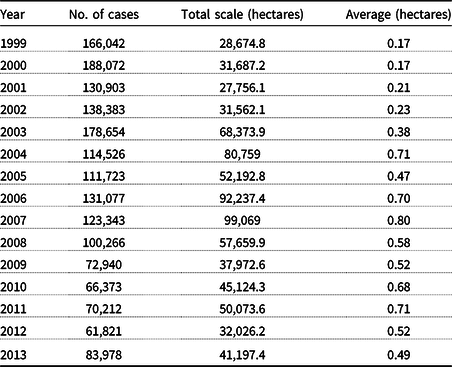
The enforcement of these laws and regulations poses a serious challenge to the central government. Table 1 reports the official statistics of detected and sanctioned land use violations between 1999 and 2013. Nationwide, the total area of illegally used land has grown from 28,675 hectares in 1999 to a record-breaking level of 99,069 hectares in 2007. In addition, there were also a large number of undetected or unreported cases of illegal land use that were failed to be included in the official statistics.
National statistics of land use violations

Data source: China Land and Resources Yearbooks 2000–2014.
Both mass media and scholarly work tend to blame the local government for the prevalent land use violations. It is often argued that local officials, motivated by career advancement and rent-seeking, are reluctant to carry out rigorous enforcement (e.g. Skinner et al. Reference Skinner, Kuhn and Joseph2001; van Rooij Reference van Rooij2006b). To overcome local resistance, the central government adopted several reforms in the mid-2000s to promote administrative centralisation in land enforcement. First, it reformed the land administration system in 2004 by adopting so-called “vertical management below the provincial level” (sheng yixia chuizhi guanli). Under the reformed regime, agencies at city or county level are no longer subordinate, financially or administratively, to local governments at the same level, but rather become the local branches of agencies at the provincial level. This aimed to reduce the influence of city- and county-level officials on land enforcement in their own jurisdictions. In 2006, the central government took a further step to establish the State Land Supervision (guojia tudi ducha), a new central agency to oversee local governments’ land approval, expropriation and other types of land use activities. Reporting directly to the central government, the State Land Supervision was designed to be less susceptible to the influence of local governments. These reforms gave rise to the partially centralised land regulatory system that is at work today. The overall effects of these reforms on enforcement outcomes remain to be systematically examined. However, as the empirical analysis below will show, they failed to effectively eliminate political interference in land enforcement.
Besides serving the political and material interests of local governments and officials, land also plays a key role in the central government’s macroeconomic management as well as the patronage networks of regime elites. Through an analysis of key episodes of macroeconomic policymaking, Rithmire (Reference Rithmire2017) found that the Party relied on the manipulation and distribution of the national land supply either to stimulate economic growth or to rein in an overheating economy. Using a fine-grained data set of land transactions, Chen and Kung (Reference Chen and Kung2018) found that real estate firms linked to the members of the Politburo obtained a price discount when bidding for land parcels for development, and local provincial leaders who facilitated such deals were more likely to receive a promotion subsequently. Sun (Reference Sun2015) also found that firms connected with central elites of the Party are more likely to engage in large-scale illegal land development projects and evade or survive enforcement actions, despite the central government’s capability of using satellite remote sensing to detect such blatant violations. Given the importance of land in macroeconomic management and patronage politics, the central government and its ruling elites have strong incentives to manipulate land enforcement to achieve their economic and political objectives.
Measuring enforcement
Existing empirical studies typically measure enforcement using indicators such as sanctioned offences or enforcement operations (Holland Reference Holland2016). However, both measures have limitations. On the one hand, sanctioned offences reflect not only enforcement efforts but also the number of violations. In other words, an increase in the number of sanctioned offences can result from either an increase in the number of violations, or an increase in the intensity of enforcement, or a combination of both. On the other hand, the number or scale of enforcement operations fails to consider the fact that the same number of enforcement operations may reflect different levels of enforcement efforts under different levels of offences. For example, one enforcement operation per five cases of violations does not represent the same intensity of enforcement as one operation per one hundred cases.
Taking advantage of a unique structure of the official statistics on sanctioned land use violations in China, this research develops a measurement strategy that captures the variation in the intensity of enforcement within the same locality across different time periods. More specifically, the data report the total scale of violations that were sanctioned by the land enforcement agency in each province at a given year.Footnote 7 Among the sanctioned violations, the data further differentiate between violations that occurred in the current year and those that occurred in previous years. In mathematical terms, let si,t denote the total scale of land use violations that were detected and sanctioned at year t in province i. Then si,t is the sum of two parts: the first part is the scale of contemporaneous violations that occurred within the same year t (denoted as si,t,t), and the second part is the scale of violations that occurred in previous years but were retrospectively detected and sanctioned at year t (denoted as si,t, - t).Footnote 8
Using the data, I develop the following three indicators to measure the relative intensity of enforcement in each province at a given year compared with up to three previous years. The common numerator of the three indicators is the scale of past offences that were retrospectively detected and sanctioned in the current year (si,t, - t), while the denominators are the average scales of offences that were detected and sanctioned contemporaneously within the past one to three years, respectively.
 $$I_{it}^1 = {s_{i,t, - t}}/{s_{i,t - 1,t - 1}}$$
 $$I_{it}^2 = 2{s_{i,t, - t}}/({s_{i,t - 1,t - 1}} + {s_{i,t - 2,t - 2}})$$
 $$I_{it}^3 = 3{s_{i,t, - t}}/({s_{i,t - 1,t - 1}} + {s_{i,t - 2,t - 2}} + {s_{i,t - 3,t - 3}})$$
The first indicator,  $I_{it}^1$, is the ratio of the scale of past violations (i.e. those that occurred before year t) that were detected and sanctioned retrospectively at year t to the scale of contemporaneous violations that both occurred and were detected and sanctioned at year t – 1. Assuming that all past violations retrospectively detected and sanctioned in year t actually occurred in year t – 1, this ratio reflects the relative intensity of enforcement in year t relative to year t – 1 in province i.
The second and third indicators relax the demanding assumption that all the past violations retrospectively detected and sanctioned in year t occurred in year t – 1. Instead, the two indicators assume that the violations identified in si,t, - t occurred within the past two and three years, respectively. More specifically, the second measure,  $I_{it}^2$, is the ratio of the scale of past violations detected and sanctioned retrospectively in year t to the average scale of violations detected and sanctioned contemporaneously in the years t – 1 and t – 2. This ratio, therefore, measures the relative intensity of enforcement at year t compared with the average intensity of enforcement in the past two years. Similarly,
 $I_{it}^3$ measures the intensity of enforcement at year t relative to the average intensity of enforcement in the past three years.
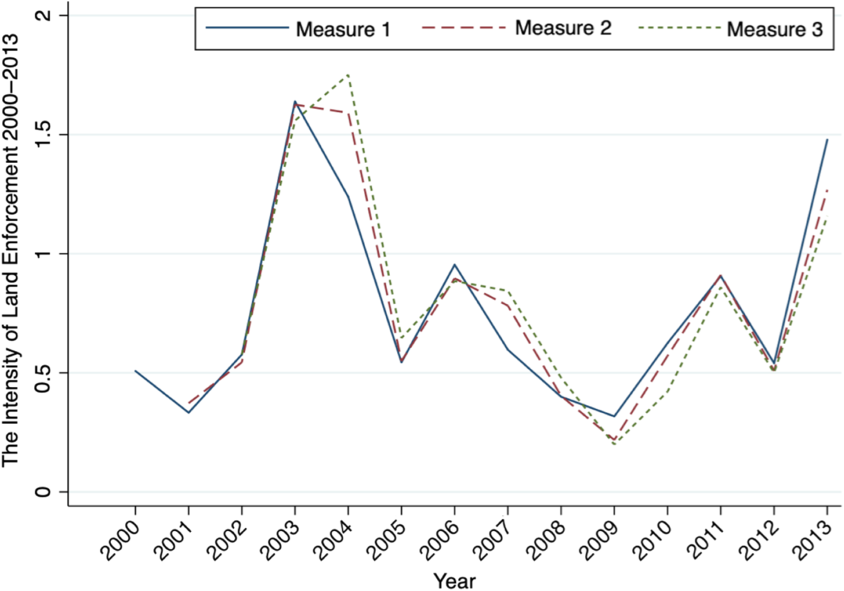
Figure 1 plots the trends on the three measures of the intensity of land enforcement between 2000 and 2013. Overall, they demonstrate nearly identical patterns and are largely consistent to known episodes of enforcement changes at the national level. For example, the first few years of the 2000s witnessed a relatively low level of enforcement. This was because the relatively poor economic performance following the Asian financial crisis prompted the government to prioritise economic growth over rigorous land enforcement. A surge in the intensity of enforcement occurred in 2003, when the Chinese economy experienced a strong growth momentum and demonstrated signs of serious overheating. For example, compared with 2002, investment and bank credit in 2003 increased by 27% and 36%, respectively. Construction projects in manufacturing and real estate occupied a massive amount of land, and many of them involved illegal use of land, promoting the central government to conduct several enforcement campaigns. For example, a national campaign was launched in July 2003 to investigate and rectify unapproved “development zones” (kaifaqu). In 2004, the central government further strengthened land enforcement by implementing the so-called “strictest land management institutions in history” (shishang zui yange de tudi guanli zhidu) and launching another campaign against land use violations. The strengthened enforcement efforts led to the sanction of many violations that were either undetected or tolerated before (van Rooij Reference van Rooij2006b).
Trends on the intensity of land enforcement, 2000–2013.

Another episode of intensive enforcement occurred in 2006 and 2007. In June 2006, MLR convened an emergency meeting, followed by the issuance of the “Circular of the State Council on Intensifying Land Control” (guowuyuan guanyu jiaqiang tudi tiaokong youguan wenti de tongzhi) in September to call for more effective land enforcement. These actions marked the onset of a new round of “land enforcement storm” (tudi zhifa fengbao) aiming to contain rampant land use violations. In 2007, MLR further launched the “Hundred-day Action on the Enforcement of Land Laws” (tudi zhifa bairi xingdong) to strengthen enforcement against the use of land without approval (yizu daizheng), a major type of land use violations. These trends are also effectively captured in Figure 1.
In contrast, land enforcement was significantly weakened during the global financial crisis in 2008–2009, by which the Chinese economy was hit hard. In response to the gloomy economic growth outlook and threat of potential massive unemployment, the government launched a massive stimulus package, injecting over four trillion yuan ($586 billion) into the economy to boost investment. Land and environmental enforcement was dramatically and deliberatively loosened to serve the purpose of maintaining economic growth. As a result, many investment projects during this period, especially those so-called “priority projects” (zhongdian xiangmu) designated by national or provincial governments involved serious violations.Footnote 9 These violations were left unaddressed or only sanctioned retrospectively after 2010, when it became clear that economic growth began to recover. However, a period of lax enforcement re-emerged subsequently in 2012, when economic growth began to decline again. The weak economic performance on the eve of leadership transition at the end of the year prompted Party leaders to once again systematically prioritise growth over enforcement in the land sector.
Model and variables
The empirical analysis draws on a panel data set on land enforcement in 30 provinces between 1999 and 2013.Footnote 10 The dependent variable is the intensity of enforcement against land use violations, using the three measures constructed above. As discussed earlier, these measures capture the temporary changes in the intensity of land enforcement. The data used in the calculation of these measures come from various issues of the China Land and Resources Statistical Yearbook.
The analysis includes three key independent variables. To test the impact of economic performance on enforcement, the first independent variable is the GDP growth rate in a province at a given year. Following the first theoretical hypothesis, I expect poorer economic performance to be associated with a lower intensity of enforcement.
The second key independent variable is the patron–client ties between central leaders of the Party and leading provincial officials. To measure patron–client ties, I follow the strategy adopted in Shih (Reference Shih2008) to use whether the career trajectory of a provincial official overlapped with that of any Politburo Standing Committee (PSC) member as an indicator.Footnote 11 The biographical information of provincial officials and PSC members are drawn from their official resumes, included in the database of central and local leaders on www.people.com.cn (renmin wang), the website of the Party’s most influential official media outlet People’s Daily (renmin ribao). Overlapping career trajectories are defined as two people working together in the same system (xitong), such as a central ministry, a Party department, a military division or a province, for at least one year and provided that the gap between their administrative ranks does not exceed one level.Footnote 12 For central leaders of the Party, I focus on PSC members because the PSC is the most important policymaking body within the Chinese political system, and their members are the most important ruling elites of the regime (Malesky et al. Reference Malesky, Abrami and Zheng2011). I expect the existence of patron–client ties between central PSC members and leading provincial officials to reduce the intensity of enforcement in the latter’s jurisdictions.
Between provincial Party secretaries and governors, the two leading officials in Chinese provinces, this research focuses on the latter. In the Chinese political system, it is generally the case that local Party leaders take the primary responsibility of fulfilling Party priorities and sustaining Party rule, whereas government executives make economic and social policies and undertake direct daily governance (Landry Reference Landry2008; Zuo Reference Zuo2015). Governors, therefore, play a more important role than provincial Party secretaries in regulatory enforcement within their jurisdictions. In the area of land enforcement, the central government explicitly requires governors to assume the primary responsibility for arable land protection and compliance with land laws and regulations (Wang et al. Reference Wang, Zheng, Shao, Chen, Huang and Zhang2012). Failure to fulfil these responsibilities can incur negative consequences on the political prospects of governors.
The third hypothesis argues that more rampant and serious violations prompt the government to strengthen enforcement. However, as discussed earlier, the actual level and seriousness of violations are difficult to measure, because official statistics on the number or scale of sanctioned offences reflect both the nature of violations and the intensity of enforcement. To address this issue, I introduce two proxy measures. The first proxy measure, following the strategy adopted by Wedeman (Reference Wedeman2012) in measuring corruption, uses the average scale of sanctioned violation cases.Footnote 13 The second proxy measure is the number of media reports in national and local newspapers that include the key word “land violations” (tudi weifa) in a province within a given year.Footnote 14 This measure seeks to capture the level of publicity given to land use violations in a province within a year, based on the assumption that more serious situations of violations receive greater media attention. It should be noted that neither measure is perfect. For the first proxy, the average scale of sanctioned violations could be a biased estimate of the average scale of all violation cases, because larger violations are more likely to involve violators with higher-level political status or closer connections with political elites and, therefore, more likely to escape sanction by enforcement agencies (Sun Reference Sun2015). For the second proxy, media reports on land violations can also be subject to political interference, given that mass media in China is controlled by the state. Because of these shortcomings, I acknowledge that these variables can point to at best suggestive findings on how enforcement varies with the level of actual violations.
The model also includes a number of control variables. First, state capacity is essential for effective enforcement. Existing empirical research on environmental enforcement in China has found that local government’s fiscal strength, human capital and administrative reach affect enforcement outcomes (Schwartz Reference Schwartz2003). Case studies on environmental enforcement have also found that local enforcement agencies, especially those in fiscally poorer localities, often lack sufficient financial and human resources to carry out enforcement actions (van Rooij Reference van Rooij2006b). In this research, I use provincial fiscal expenditure per capita as the measure of state capacity.
The analysis also controls for GDP per capita and the size of provincial population. In a study about environmental enforcement, van Rooij et al. (Reference van Rooij, Zhu, Na and Qiliang2017) found that richer and more urbanised areas have stronger and more frequent enforcement than inland areas. In another work that compares environmental transparency across Chinese cities, Lorentzen et al. (Reference Lorentzen, Landry and Yasuda2014) controlled for both GDP per capita and size of population, even though neither was found to be a significant predictor. I follow this common practice to control for both variables. As a robustness check, I also consider additional control variables, including the urbanisation rate and the share of industrial GDP. Finally, the model also includes a set of provincial and year dummies to control for unobserved provincial and temporal fixed effects. Lagged dependent variables were first included in regression, but then removed because the results showed that the first-order autoregressive effects were not significant.
Empirical results
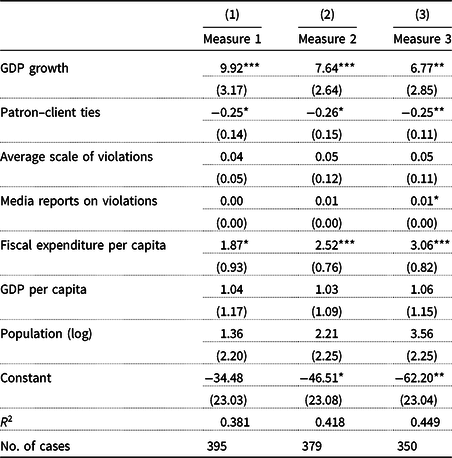
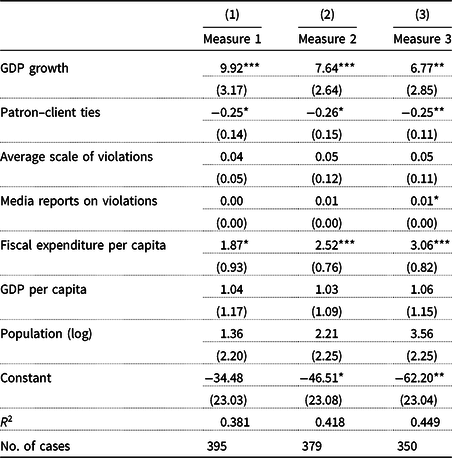
Table 2 reports the results of regression analysis. Simply put, they provide strong evidence for Hypotheses 1 and 2 but not Hypothesis 3. GDP growth has a significantly positive impact on enforcement, suggesting that land regulatory agencies adjust the intensity of land enforcement according to economic performance. More specifically, agencies reduce the intensity of enforcement when growth rates are lower while tightening enforcement when growth rates are higher. This confirms the first hypothesis. Patron–client ties between central leaders of the Party and provincial officials have negative effects on enforcement – the intensity of enforcement is lower when localities are governed by officials connected to top regime elites. This corroborates the second hypothesis. The two proxy measures on the seriousness of land violations, that is, the average scale of sanctioned violations and media coverage on violations, show positive impacts on the intensity of enforcement, although their coefficients do not reach statistical significance. This should be interpreted with caution given the fact that neither proxy is an ideal measure.
Intensity of land enforcement (1999–2013)
*p < 0.10, ** p < 0.05, *** p < 0.01.
Standard errors clustered at the provincial level are in parentheses.
Substantively, because the dependent variables are relative indicators, it is more useful to interpret the regression coefficients using their corresponding standardised or β coefficients. Standardised coefficients refer to how many standard deviations a dependent variable will change, per standard deviation increase in the independent variable. The standardised coefficients for GDP growth and patron–client ties are 0.2 and −0.1, respectively. They suggest that a one standard deviation increase in GDP growth rate is associated with a 0.2 standard deviation increase in the relative intensity of enforcement, and a one standard deviation increase in patron–client ties leads to a 0.1 standard deviation decrease in the relative intensity of enforcement.
Among control variables, fiscal expenditure per capita has a significant positive impact on the intensity of enforcement, a result consistent with the existing studies’ finding about the importance of local state capacity for effective enforcement. Neither GDP per capita nor the size of provincial population has a significant effect.
I provide three sets of robustness checks for the above results using alternative model specifications.Footnote 15 Both the first and second sets of robustness checks deal with what variables to control in the regressions. In the first set of robustness checks, I retain only the key independent variables while excluding all control variables. In the second set of robustness checks, I follow van Rooij et al.’s (Reference van Rooij, Zhu, Na and Qiliang2017) quantitative research on environmental enforcement to include additional control variables, including urbanisation rate and share of industrial GDP. The results are presented in the online Appendix, and the main findings remain unchanged.
The third robustness check adopts an alternative measure for the intensity of enforcement. The measure is the proportion of the scale of violations that occurred in previous years and sanctioned retrospectively (i.e. “past violations”) in all sanctioned violations. Using the mathematical terms consistent with those used earlier, the measure is constructed as follows:
 $$I_{it}^{alt} = {s_{i,t, - t}}/{s_{i,t}}$$
The rationale behind this measure is that strengthened enforcement tends to uncover disproportionally more violations that occurred in the past than contemporaneous violations (i.e. violations that occurred and got sanctioned in the same year). By contrast, when the intensity of enforcement is relatively low, the outcome often includes a higher proportion of contemporaneous violations because enforcement agencies tend to evade those past and stubborn cases that are more difficult to uncover or address. The correlation coefficients between this alternative measure and the three measures used in the main analysis are 0.76, 0.72 and 0.71, respectively. The result of the analysis using this alternative dependent variable is reported in the online Appendix and the main findings remain robust.
One may also argue that the above findings are not sufficient to support the proposed logic of politicised enforcement, which relates the political interference in enforcement to the political incentives of high-level regime elites rather than merely those of lower-level officials. For example, one could argue that manipulating enforcement based on economic performance and patron–client ties are simply local officials’ behaviour rather than being directed by the Party’s central elites. After all, the majority of local enforcement agencies are administratively and financially subordinate to local governments, which gives local officials great discretion to intervene in the enforcement in their jurisdictions.
To address this concern, I run another set of regressions to see whether the above relationships experienced significant changes after the reforms adopted in the mid-2000s that strengthened the central government’s authority in land enforcement. As discussed earlier, the central government adopted two major reforms in 2004 and 2006, respectively, to strengthen central supervision over land enforcement agencies. In particular, the establishment of State Land Supervision, the centralised enforcement agency independent from local governments, in 2006 significantly expanded the central government's authority and reduced the local government’s discretion in land enforcement. If political interference comes mainly from the local government, we should expect the impacts of economic performance and patron–client ties on enforcement to be weakened after these centralisation reforms took effect.
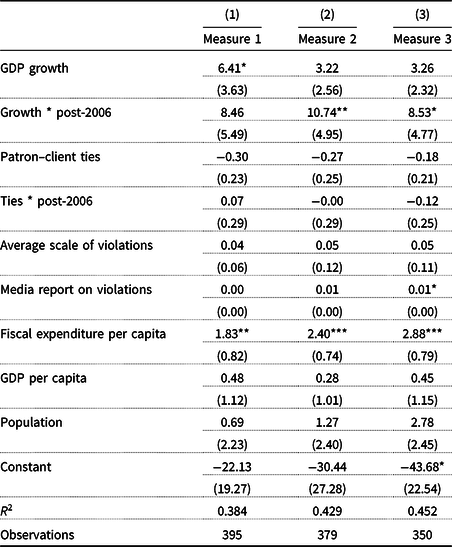
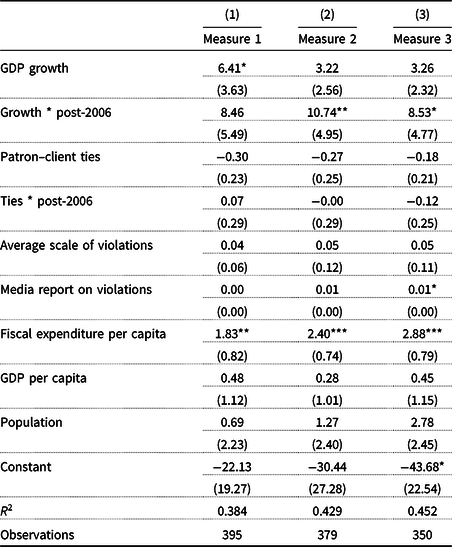
Table 3 reports the results of regressions that include interaction terms between economic performance and patron–client ties, on the one hand, and a dummy indicator for the post-2006 period, on the other. The results show that the impacts of neither economic performance nor patron–client ties have significantly declined in the post-2006 period compared with the period before. In fact, the effect of economic performance on the intensity of enforcement became even stronger in the post-2006 period. This was likely because in the aftermath of the 2008 global economic recession, the Chinese government became more concerned about economic performance; therefore, it became more willing to adjust enforcement to maintain its performance targets. For patron–client ties, their effects on enforcement during the post-2006 periods are −0.23, −0.28 and −0.30, respectively, and have reached statistical significance for regressions (2) and (3).Footnote 16 In comparison with Table 1, there is little change in the effect of patron–client ties before and after 2006. These results provide evidence that political interference in land enforcement originates from the strategic behaviour of the Party’s central elites rather than that of local officials only.
Intensity of land enforcement (1999–2013, with interaction terms)
*p < 0.10, ** p < 0.05, *** p < 0.01.
Standard errors clustered at the provincial level are in parentheses.
Conclusion
The article examines politicised enforcement, namely politically motivated interference in enforcement by politicians, in China. While the existing literature has provided ample evidence as to how political interests motivate politicians to manipulate enforcement in democracies, few studies explored the mechanisms behind politicised enforcement in authoritarian regimes. In this article, I develop an argument that relates politicians’ interference in enforcement to the strategies they adopt to maintain regime and individual political survival. More specifically, I argue that the Chinese central authority and its ruling elites adjust enforcement to promote economic growth and facilitate patron–client exchanges – two survival strategies essential to the political order of the regime.
Drawing on a panel data set on the enforcement of land laws and regulations in 30 Chinese provinces between 1999 and 2013, I develop a novel indicator to measure the temporal variations in enforcement. In explaining such variations, the empirical analysis suggests that the intensity of land enforcement in Chinese provinces depends on both economic growth rates and governors’ patron-client ties with PSC members. Moreover, both relationships remain strong after the reforms conducted by the central government in the mid-2000s that strengthened its authority and supervision in land enforcement vis-à-vis the local government. These findings confirm the theoretical proposition that central elites intervene in the bureaucratic process of enforcement to achieve political objectives related to political survival.
The findings of the research shed light on our understanding of enforcement in authoritarian regimes. As explained earlier, the limited existing research on how the political interests of authoritarian ruling elites affect enforcement outcomes points to the important linkage between elites’ strategies of acquiring political support and their enforcement behaviour (Haber et al. Reference Haber, Razo and Maurer2003; Dorman Reference Dorman2009). Following the same logic, the Chinese case further suggests that the mechanisms behind politicised enforcement may depend on the different survival strategies adopted by different regimes. In China, and perhaps also in other single-party regimes, while patronage politics plays an important role in shaping regime elites’ interference of enforcement, regime-level concerns, such as economic performance, stand out as another important motive behind politicised enforcement.
The research also contributes to our understanding of law and regulatory enforcement in China’s multi-level governance environment – a prominent issue that has attracted increasing scholarly and public attention over the last two decades. The proliferation of enforcement problems, especially those high-profile scandals, with food and drug safety, air quality and water pollution, and land use have triggered widespread public discontent and exerted a strong pressure on the government to fix its defective regulatory system. While inadequate enforcement in these policy areas is often attributed to the local government, this research suggests that the political considerations of the regime’s central elites may also affect enforcement outcomes, a finding in line with the emphasis by some recent studies on the importance of “bringing the centre back” to fully understand the central–local dynamics in China’s multi-level governance environment (e.g. Eaton and Kostka Reference Eaton and Kostka2017; Kostka and Nahm Reference Kostka and Nahm2017; Ran Reference Ran2017; van Rooij et al. Reference van Rooij, Zhu, Na and Qiliang2017). In the presence of interference by the central government and its ruling elites, existing administrative reforms that seek to strengthen the central government’s authority in enforcement, such as those conducted between 2004 and 2006 in land administration, are unlikely to effectively eliminate political interference in enforcement. As long as the Party and its leaders continue to treat enforcement as an important political tool useful for maintaining their rule, politicised enforcement will remain, regardless of whether it is under a centralised or decentralised regulatory system. The removal of political interference, likely through a strengthened rule of law and the establishment of more independent enforcement agencies, will be crucial for effective enforcement.
Supplementary material
To view supplementary material for this article, please visit https://doi.org/10.1017/S0143814X19000321
Data Availability Statement
Replication materials are available in the Journal of Public Policy Dataverse at https://doi.org/10.7910/DVN/4XWTBK.
Acknowledgements
I thank participants and discussant for the panel Political Economy and Governance in China at the 2017 European Political Science Association Annual Conference. I also thank the editor and three anonymous reviewers of the Journal of Public Policy for their very helpful comments and suggestions. Of course, all errors are mine.