


INTRODUCTION
Whether insidious or abrupt, exposure to high altitude during flight is thought to be responsible for several major air disasters (Cable, Reference Cable2003). When cabin pressure is lost or oxygen delivery systems fail without the knowledge of the pilot or aircrew, the onset of cognitive, perceptual, or motor impairment may be rapid or escape notice. For this reason, training programs have focused on improving recognition of the subjective and objective signs of high altitude exposure through controlled exposures in a high altitude simulation chamber. Aircrew can be trained to recognize the physical and perceptual changes that occur at or above 10,000 ft and are taught to descend the aircraft and adjust equipment immediately upon onset of symptoms.
Although evidence indicates that these programs have been successful (Cable, Reference Cable2003), hypobaric hypoxia has continued to be the presumed cause of several military and civilian plane crashes. Examples include the recent loss of Malaysian Airlines Flight 370 (Australian Transport Safety Bureau, 2014), and the crash of Lear Jet 35 that killed all passengers and crew, including professional golfer Payne Stewart (Newman, Reference Newman2000). Although death is relatively rare, hypoxic events during flight are common. During these incidents, the majority of trained aircrew are able to recognize the symptoms of altitude exposure and implement countermeasures before a loss of consciousness (Island & Fraley, Reference Island and Fraley1993).
In a recent review of hypoxic incidents (Cable, Reference Cable2003), the most commonly reported symptom was cognitive impairment. Despite the importance of cognitive impairment in potentially determining the outcome of hypoxic events, surprisingly little is known about the acute effects of hypoxia during flight. Perhaps as a result of this knowledge gap, pilot training programs often use very crude, unstandardized tests to evaluate cognitive function during high altitude training (e.g., playing “paddy-cake”). Tests designed to simulate more flight-related tasks may be of greater value (Gold & Kulak, Reference Gold and Kulak1972), but the use of neuropsychological instruments may also provide a broader understanding of the underlying cognitive abilities implicated in the impairment of specific flight-related tasks. Cognitive functions used in complex tasks, such as those involved in monitoring and recognizing signs of high altitude exposure and coordinating aircraft descent, involve several distinct abilities. Much of the research on the cognitive effects of high altitude exposure has been in the context of mountaineering studies (Virues-Ortega, Buela-Casal, Garrido, & Alcazar, Reference Virues-Ortega, Buela-Casal, Garrido and Alcazar2004), which entail more gradual exposures during a slow ascent, and also involve the confounding effects of exhaustion, dehydration, cold exposure, and other nonspecific factors.
High altitude simulation in a hypobaric chamber offers a method that more accurately reflects the conditions of exposure during flight, and allows for experimental designs that can manipulate exposure to investigate the mechanisms of cognitive impairment at altitude. Review of extant literature indicates possible effects on a variety of cognitive abilities (Petrassi, Hodkinson, Walters, & Gaydos, Reference Petrassi, Hodkinson, Walters and Gaydos2012; Virues-Ortega et al., Reference Virues-Ortega, Buela-Casal, Garrido and Alcazar2004), including motor learning and memory (Denison, Ledwith, & Poulton, Reference Denison, Ledwith and Poulton1966), decision-making (Frisby, Barrett, & Thornton, Reference Frisby, Barrett and Thornton1973), reaction time (Kida & Imai, Reference Kida and Imai1993; McCarthy, Corban, Legg, & Faris, Reference McCarthy, Corban, Legg and Faris1995), attention and working memory (Malle et al., Reference Malle, Quinette, Laisney, Bourrilhon, Boissin, Desgranges and Pierard2013), and cognitive flexibility and executive functions (Asmaro, Mayall, & Ferguson, Reference Asmaro, Mayall and Ferguson2013).
However, results have been remarkably mixed (Crow & Kelman, Reference Crow and Kelman1971; Green & Morgan, Reference Green and Morgan1985) with some studies reporting no effect (Crow & Kelman, Reference Crow and Kelman1973; Fowler, Paul, Porlier, Elcombe, & Taylor, Reference Fowler, Paul, Porlier, Elcombe and Taylor1985; Pavlicek et al., Reference Pavlicek, Schirlo, Nebel, Regard, Koller and Brugger2005) or even improved performance on certain tasks (Kelman & Crow, Reference Kelman and Crow1969; Paul & Fraser, Reference Paul and Fraser1994; Petrassi et al., Reference Petrassi, Hodkinson, Walters and Gaydos2012), depending on the altitude of exposure. This heterogeneity is in part related to the diversity of experimental designs and measures. The altitude and duration of exposure varies considerably across studies since some investigators have been interested in exposure to more moderate elevations (e.g., 8000–15,000 ft) more relevant to altitude exposure for military aircraft (Petrassi et al., Reference Petrassi, Hodkinson, Walters and Gaydos2012). Others have focused on more chronic exposures in an attempt to model the effects of hypobaric hypoxia on mountaineering expeditions (Virues-Ortega et al., Reference Virues-Ortega, Buela-Casal, Garrido and Alcazar2004, for review). Additionally, the outcome measures have varied substantially, tend to focus on reaction time measures, and are rarely comprehensive from a neuropsychological perspective.
One consistent finding from studies involving more prolonged exposure, such as mountaineering studies, has been a prodigious learning and memory impairment (Virues-Ortega et al., Reference Virues-Ortega, Buela-Casal, Garrido and Alcazar2004). This finding was recently confirmed by a laboratory study using gas inhalation to simulate prolonged (50–90 min) hypoxia (Turner, Barker-Collo, Connell, & Gant, Reference Turner, Barker-Collo, Connell and Gant2015). However, it remains unclear whether these memory impairments follow the more acute exposures that occur during high altitude flight. Prior studies have also lacked an experimental design that would allow interrogation of specific mechanisms of memory impairment, which may provide further insight into cognitive abilities that are impaired or preserved during the critical period immediately after exposure when corrective action must be taken. Improved understanding of the initial cognitive changes caused by acute high altitude exposure could inform pilot training programs, lead to improvements in the early recognition of the signs and symptoms of altitude exposure, and inform the design of safety equipment and procedures.
METHOD
In a series of experiments, we evaluated a range of cognitive abilities in military pilots and aircrew before, during, and after a brief (15 min) exposure to high altitude simulation (20,000 ft) in a pressure-controlled chamber (Figure 1). A control experiment was initially conducted at sea level before altitude exposure to evaluate nonspecific effect of testing within the chamber under normobaric conditions. Aircrew were administered a battery of validated neuropsychological tests that had been modified for administration in a group setting both inside and outside of a pressure-controlled chamber. Specific neuropsychological tests were selected to provide a sampling of fundamental abilities across pertinent cognitive domains, including visual and auditory attention, visual-spatial processing, and both visual and verbal memory. The following provides further methodological detail regarding experimental participants and procedures.
Summary of experiments. The experimental sequence for cognitive testing during high altitude simulations is illustrated. In a control experiment, pilots and aircrew completed the full cognitive exam in a “baseline → test” design with no manipulation of altitude environment (normobaric conditions). In experiment 1 (Exp 1), participants completed the full cognitive exam at baseline testing under normobaric conditions, followed by testing during high altitude simulation. In experiment 2 (Exp 2), participants underwent verbal learning and memory testing during high altitude exposure, followed by memory testing for the same information after a washout period and return to normobaric conditions. In experiment 3 (Exp 3), participants completed verbal learning and memory testing under normobaric conditions, followed by memory testing for the same information during high altitude exposure.

PARTICIPANTS AND SETTING
All experiments were performed at Miramar Marine Corps Air Station in San Diego, California. Participants were U.S. Marine Corps and Navy aircrew undergoing altitude exposure training. The experimental protocol was approved by the local U.S. Marine Corps Institutional Review Board. For all experiments, aircrew received a briefing on the testing protocol, became familiarized with the test record form, and underwent pre-testing with neuropsychological instruments before altitude exposure. Participants also underwent training on the subjective and objective signs of altitude exposure before entering the pressure-controlled chamber as part of their standard training experience. After the briefing, participants were seated inside of a pressure-controlled chamber and were provided with pens and test record forms. The examiners were outside of the chamber but had audio-visual access to participants through chamber windows, headsets, and microphones.
Hypobaric Chamber Protocol
The altitude exposure protocol was identical for all experiments, except the control experiment, which did not involve altitude exposure. Briefly, chamber pressure was steadily decreased from sea level conditions to 10,000 ft at a rate of 5000 ft per min, then from 10,000 ft to 20,000 ft at a rate of 3000 ft per min. Thus, in approximately 5 min participants were brought from pressure at sea level to pressure equivalent to 20,000 ft (approximately 0.46 atm or 46% of sea level pressure). Participants remained at 20,000 ft for approximately 15 min before using oxygen masks and descending back to sea level conditions. Cognitive testing began immediately upon arrival at 20,000 ft and was completed within approximately 12 min. Participants were told to signal instructors if they required oxygen during the altitude simulation. Those who used oxygen during any experiment were removed from statistical analyses due to incomplete data (n=5: 3 from experiment 1 and 2 from experiment 3). Only those who did not use oxygen are reported on below. Neuropsychological protocols were initiated upon arrival at 20,000 ft altitude simulation. The following description details each experiment.
Neuropsychological Testing
Control experiment
Nine participants underwent our neuropsychological assessment under control conditions. First, participants were assessed while in the briefing room shortly after receiving instructions regarding recognition of altitude exposure signs and symptoms. The pre-testing assessment included modified versions of neuropsychological tests designed to assess pertinent cognitive domains, including the Wechsler Adult Intelligence Scale – Fourth Edition (WAIS-IV) Digit Symbol Coding subtest as an index of visual attention, and the California Verbal Learning Tests – Second Edition (CVLT-2) Standard Form as an index of verbal memory.
The test administration protocol was modified for group format by providing group instructions and individual record form booklets to each participant. Participants were guided through each test in the booklet by an examiner with a second examiner observing to ensure adherence to instructions. To adapt the CVLT-2 to a group format under restricted time conditions, only two learning trials and a delayed free recall trial (~10 min delay) and recognition memory for list A only were administered, responses were written within a 45-s response window. Participants also completed a modified version of the Taylor figure test, including copy, delayed free recall and recognition task.
After pre-testing was completed in the briefing room, participants were transferred to the pressure-controlled chamber. The examiners re-administered the battery to participants while they were in the chamber under normobaric conditions. For the CVLT-2, an Alternate Form test was used, with stimuli developed to provide equivalent raw scores. Additionally, the Rey-O complex figure copy, delayed recall (~10 min), and recognition memory conditions were given as an alternative visual memory test since the Taylor figure test was given during pre-testing in the briefing room.
The purpose of this control experiment was to ensure that there was no difference in performance between pre-testing in the briefing room and testing in the chamber under normobaric conditions. It also allowed an opportunity to establish control values for tests that could not be analyzed within subjects for the experiment that follows (experiment 1). Specifically, data from the Taylor and Rey-O complex figure tests administered during the control experiment in the briefing room and chamber, respectively, under normobaric conditions were used in between subjects comparisons of figure copy, delayed recall, and recognition memory under hypobaric conditions in experiment 1. This was necessitated by the lack of equivalence between figure copy/memory tests which would be required for a within-subjects design.
Experiment 1
Seventeen aircrew underwent cognitive testing procedures identical to those of the control experiment described above, except that testing in the chamber was conducted during high altitude simulation. First, participants completed the same standard form battery in the briefing room, exactly as it was conducted during the control experiment. Participants then entered the pressure-controlled chamber and chamber pressure was reduced from sea level to the equivalent of 20,000 ft over a 5-min ascent period. Participants were then re-tested using the same alternate battery as in the control experiment. Testing began immediately upon reaching chamber pressure equivalent to 20,000 ft. The purpose of this experiment was to determine the impact of high altitude exposure on attention and memory functions. For the CVLT-2 and WAIS-IV Digit Symbol Coding, within subjects analysis compared performance before high altitude exposure (standard form) to performance during exposure (alternate form). For the Rey-O and Taylor complex figure tests between subjects analysis, performance was compared with control group performance.
Experiment 2
Eleven aircrew were tested with the identical CVLT-2 task as in the control experiment in the chamber (alternate form), but with testing being conducted during high altitude exposure. Aircrew were then removed from the chamber after descent and given a 10- to 15-min washout period breathing room air at sea level. After the washout period, aircrew underwent delayed free recall and recognition testing for the CVLT-2 word list. The purpose of this experiment was to determine whether memory deficits could be rescued by recovery with room air to gain insight into whether memory deficits were at the level of encoding, retention, and/or retrieval.
Experiment 3
After the control experiment was concluded, the nine participants involved in that experiment underwent further testing during high altitude exposure. As part of the control experiment, these participants had been administered the CVLT-2 Alternate Form while in the chamber under normobaric conditions. Participants were then brought to high altitude (approximately a 5 min additional delay). Once at high altitude, the participants underwent a second CVLT-2 alternate form delayed free recall and recognition test. The purpose of this experiment was to determine whether acute high altitude exposure would interfere with the retention and retrieval of memories learned before exposure, further informing our understanding of the mechanism of memory dysfunction.
Statistical Analyses
Participants from the experiment 1 were compared with those from the control experiment and experiment 2 on age, using independent samples t tests, and sex, using χ2 analyses, to ensure group equivalence. For the control experiment, paired t tests were used to investigate differences in cognitive performance between baseline testing in the briefing room versus testing in the chamber under normobaric conditions. For experiment 1, paired t tests were used to compare baseline testing in the briefing room with performance during altitude exposure for all tests, except the Rey-O complex figure and Taylor figure tasks, which were compared to performance of the control group using an independent samples t tests. Experiment 2 also used paired samples t tests to compare performance on the CVLT-2 during altitude exposure with performance under normobaric conditions after washout.
Recognition memory was only administered after washout under normobaric conditions in this experiment so performance was compared with that of experiment 1 subjects under hypobaric conditions using between subjects design (independent samples t test). Experiment 3 used paired samples t tests to compare CVLT-2 delayed recall and recognition performance during hypobaric hypoxia when the word list had been learned under normobaric conditions. Given the paucity of literature on attention and memory impairment under the conditions used in the present study, our approach was exploratory and we did not correct for multiple comparisons. All statistical tests were two-tailed with alpha set at p < .05.
RESULTS
Demographic Comparisons
The mean age of the entire sample was 31.1 years, with a standard deviation (SD) of 6.4 (range: 22 to 48 years). The sample was mostly male (89.2%), as there were only three women. Participants from experiment 1 did not significantly differ from those of the control experiment with regard to years of age, but there was a non-significant trend toward younger age in the experiment 1 group relative to the control group [mean±SD: 30.4±4.7 vs. 35.0±7.1; respectively; t(24)=1.983; p=.06; d=0.82]. Experiment 1 participants also did not significantly differ from those of experiment 2 with regard to years of age [mean±SD: 30.4±4.7 vs. 28.8±7.0, respectively; t(26)=0.724; p=.48; d=0.28]. There were no women in the control group, and there were three in the experiment 1 group, but this difference was not statistically significant, χ2=1.795, p=.18. There were also no women in the experiment 2 group, but this was also not significantly different from the three women in experiment 1, χ2=1.985, p=.16.
Control experiment
Analysis of control experiment data indicated no difference in the briefing room versus the chamber under normobaric conditions at sea level (Table 1). The following experiments investigated the acute impact of high altitude exposure on cognitive performance relative to pre-exposure performance and performance during a parallel control experiment (see the Methods section).
Results of control experiment

n=9.
Experiment 1
Relative to pre-exposure performance at sea level, aircrew tested immediately upon exposure to high altitude conditions showed little change in basic visual attention (digit to symbol coding) and auditory attention (immediate recall of a word list), although they demonstrated a clear reduction in performance on tests of learning and memory in both verbal and visual domains (Table 2). Specifically, on a serial word list learning task, performance was intact on trial 1, but little learning took place during the second learning trial, and performance was significantly worse than pre-exposure ability on trial 2 and delayed free recall (Figure 2A). On a test of memory for a complex figure, participants exposed to high altitude exhibited greater difficulty accurately copying the figure and recalled fewer design details after a delay than those in the control condition (Figure 2B).
Profile of memory deficits caused by exposure to high altitude environment. Results of memory testing from all three experiments are displayed. (A) In experiment 1 (Exp 1), performance profile on a serial word list learning test (CVLT-2) revealed that high altitude simulation had little impact on auditory attention (Trial 1), but inhibited verbal learning (Trial 2) and memory retrieval (Delayed Recall) and recognition (Recognition Errors). (B) In the same experiment, performance on a complex figure drawing, and recall test revealed a profile of mild difficulty with figure drawing (Copy) and impaired recall (Delayed Free Recall) and recognition (Recognition Errors) of figure details after a delay. (C) Experiment 2 (Exp 2) demonstrated no improvement in recall (Delayed Free Recall) or recognition (Recognition Errors) of a word list learned during high altitude simulation (hypobaric) conditions after washout and return to normobaric conditions. (D) In experiment 3 (Exp 3), participants who learned the word list under normobaric conditions displayed attenuated memory retrieval (Delayed Free Recall) and recognition (Recognition Errors) when exposed to hypobaric conditions. Note: bars represent means and error bars represent standard errors.

Results of experiment 1

n=17.
a Control participant performance in the normobaric chamber (see Table 1) was used in independent sample t-test comparisons.
Importantly, participants from experiment 1 did not differ from control participants in their baseline visuoconstruction and visual memory ability before high altitude exposure, as indicated by comparison of Taylor figure performance during pre-testing in the briefing room in control versus experiment 1 participants (see Tables 1 & 2). They also did not significantly differ from control participants in their baseline CVLT-2 learning (trial 1, t(24)=1.741; p=.10; d=0.72; trial 2, t (12.084)=1.255; p=.58; d=0.58) and recognition memory, t(24)=−1.275; p=.22; d=0.53. However, on the CVLT-2 delayed recall, control participants did slightly outperform those in experiment 1, t(24)=−1.275; p=.91.
In addition to the free recall conditions described above, participants underwent yes/no recognition testing to determine accurate discrimination between targets (words from the list and figure details) and foils (words that were not on the list and figure details not included in the learned figure). For experiment 1, recognition testing revealed that participants were less able to accurately identify target words and figure details during high altitude exposure (Figure 2A).
In the experiments that follow, we manipulated the high altitude environment at different points during learning and recall of a word list to test whether the memory impairment was due to an encoding versus retrieval deficit. Specifically, we sought to determine if aircrew were simply unable to retrieve information from memory during high altitude exposure or if they were failing to encode new memories.
Experiment 2
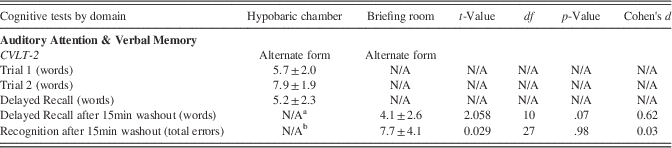
This experiment evaluated memory performance during and after high altitude exposure to determine whether memories formed during high altitude exposure could be more easily retrieved after recovery under normobaric conditions. Memory for the word list formed during high altitude exposure was tested after recovery by breathing room air at sea level for a washout period of 10–15 min. Specifically, participants were administered the CVLT-2 Alternate Form in the chamber under hypobaric conditions. They were then returned to normobaric conditions and were allowed to recover in the briefing room before being administered additional CVLT-2 delayed free recall and recognition conditions.
Findings indicated that after recovery participants showed no improvement in the retrieval of memory for words learned during high altitude exposure. They also did not improve in their ability to identify target words versus foils on recognition testing relative to performance observed in experiment 1 participants under hypobaric conditions (Figure 2C; Table 3). Importantly, participants from experiment 1 and experiment 2 did not differ with regard to CVLT-2 performance during altitude exposure (trial 1, t(26)=−0.711; p=.48; d=0.27; trial 2, t (26)=−1.147; p=.26; d=0.44; delayed recall, t(26)=0.693; p=.49; d=0.27).
Results of experiment 2
n=11.
a Comparison is paired sample t-test between the first Delayed Recall under hypobaric chamber conditions and the second Delayed Recall after 15-min washout under normobaric conditions.
b Control participant performance in the normobaric chamber (see Table 1) was used in independent sample t-test comparisons.
Experiment 3
This experiment evaluated the impact of altitude exposure on retrieval and retention of memories formed before exposure to determine whether memories formed under normobaric conditions are more difficult to access and retrieve or are otherwise not retained under high altitude conditions. Participants learned a word list under normobaric conditions and were then asked to recall and recognize this information during high altitude exposure. Specifically, participants were administered the CVLT-2 alternate form as part of the control experiment under normobaric conditions. They were then exposed to high altitude conditions. Once the target altitude was reached (approximately a 5 min additional delay), they were again administered the CVLT-2 alternate form delayed free recall and recognition conditions. During exposure, participants were less able to retrieve and recognize the words learned before exposure (Figure 2D; Table 4).
Results of experiment 3

n=9; same participants as in control experiment.
a Data from control experiment are reproduced for ease of comparison.
b Comparisons are paired sample t-tests comparing performance on delayed recall and recognition under normobaric conditions versus hypobaric conditions.
Variable Impact of Exposure
Considerable variation in response to exposure was noted. Specifically, memory was apparently unaffected or only slightly affected by exposure in some participants, despite marked effects observed in other individuals, and an overall group effect that was large in terms of statitscal effect size (Figure 3).
Experiment 1 CVLT-2 performance at individual level. Individual level data are displayed for performance differences between exposure and baseline on all CVLT-2 conditions as part of experiment 1. During exposure a subset of participants performed similarly to baseline or showed expected practice effects, despite the large overall group effect of learning and memory decline.

DISCUSSION
Our study findings indicate that acute high altitude exposure rapidly induces cognitive deficits, characterized by predominant impairment in learning and memory, mild distortions in visual-perceptual organization, and relative preservation of basic visual and auditory attention. Recognition testing allowed for further investigation of memories acquired during the learning trials under conditions in which retrieval demands have been greatly attenuated. Findings indicated that performance did not substantially improve in the recognition versus free recall format, suggesting that participants exposed to high altitude conditions were failing to form and consolidate (i.e., encode) new information into memory rather than merely struggling to retrieve the memories.
This was further evaluated experimentally by follow-up testing of memory for a word list learned under hypobaric conditions after recovery under normobaric conditions. Although the additional 15 min delay in this experiment may have had some influence on the result, findings confirmed that neither free recall nor recognition memory for the word list improved after recovery, and that performance after recovery was the either the same or worse than performance under hypobaric conditions in experiments 1 and 2. These results suggest that altitude exposure disrupts encoding of new memories, rather than merely disrupting memory retrieval.
In a final experiment, we tested whether high altitude exposure would interfere with retrieval and retention of information recently learned under normobaric conditions. Findings indicated that acute high altitude exposure caused deficits in both free recall and recognition memory for information learned approximately 5 min before exposure. This result suggests that high altitude exposure causes overlying deficits in memory retention or retrieval in addition to the immediate memory encoding deficit observed in experiments 1 and 2.
Together these experimental findings strongly suggest that military aircrew rapidly develop learning and memory deficits within minutes of high altitude exposure. Memory encoding deficits may initially go unnoticed, as other basic attentional abilities remained relatively intact. These memory deficits could also contribute to the general lack of situational awareness thought to occur during altitude exposure. Thus, memory dysfunction could be a major factor determining success or failure in recognizing the signs and symptoms of high altitude exposure and negotiating the safe descent of an aircraft.
We selected validated neuropsychological tests of attention and memory ability for the present study. Our approach was to evaluate the impact of hypobaric hypoxia on domains of cognitive function, rather than specific flight-related tasks. We chose this approach because knowing which cognitive domain is impacted has broader implications for behavioral performance across tasks and in multiple contexts, both foreseen and unforeseen. The observed encoding deficits on memory testing were substantial (little to no learning taking place beyond Trial 1 of CVLT-2) and impacted both verbal and visual domains (large effect sizes). Although there may be certain specific flight-related tasks that can be performed despite deficient memory, these memory deficits will clearly impact the likelihood of success on most complex tasks that require contextual information. For example, remembering instructions from air traffic control, communications from other aircrew or other nearby aircraft, information from pre-flight or mission briefings, in-flight events, or data from instruments.
Notably, we observed substantial interindividual variability in the cognitive effects of high altitude exposure, with some aircrew exhibiting no observable change in cognition and others showing substantial performance declines. These findings are consistent with variability in other symptoms of altitude exposure found in prior studies (Virues-Ortega et al., Reference Virues-Ortega, Buela-Casal, Garrido and Alcazar2004). Such variability may be attributable to genetic factors and/or differences in hyperventilatory response or cardiorespiratory fitness. Further study of the factors determining variable cognitive effects of high altitude exposure is warranted, as these may be useful in the training and selection of aircrew.
The exact physiological mechanism underlying the effect of high altitude exposure on memory formation and retention remains unclear since there are several complex physiological changes that occur during exposure. The observed changes in memory could be due to a combination of hypobaric hypoxia and cerebral vasoconstriction resulting from hyperventilatory response and hypocapnia (Virues-Ortega et al., Reference Virues-Ortega, Buela-Casal, Garrido and Alcazar2004). These hypoxic-ischemic events are thought to particularly impact hippocampal function (Gozal, Daniel, & Dohanich, Reference Gozal, Daniel and Dohanich2001; Kalaria, Ferrer, & Love, Reference Kalaria, Ferrer and Love2015), which may underlie the observed deficits in memory encoding and retention (Vargha-Khadem et al., Reference Vargha-Khadem, Gadian, Watkins, Connelly, Van Paesschen and Mishkin1997).
Our findings indicate that encoding of new memories was particularly impacted, which is consistent with the memory impairment profile observed in mountaineers during high altitude expeditions (Kramer, Coyne, & Strayer, Reference Kramer, Coyne and Strayer1993) and after multiple high altitude ascents without supplementary oxygen (Cavaletti, Moroni, Garavaglia, & Tredici, Reference Cavaletti, Moroni, Garavaglia and Tredici1987). Future studies evaluating memory encoding, retention and retrieval while monitoring physiological response and brain activation may shed further light on the physiological mechanisms responsible for these deficits.
Our findings specifically indicate that, upon acute exposure to high altitude, pilots and aircrew may be unable to recall information beyond their immediate attention span, and may even struggle to retain and recall information learned shortly before exposure. These deficits could influence the likelihood of successful symptom recognition and corrective action. Future studies should examine whether aircrew with a greater attention span at baseline show better symptom recognition and cognitive function during high altitude exposure.
Additionally, studies investigating how memory deficits may impact specific flight-related tasks could help inform aircrew training. Results of these studies may inform pilot and aircrew training programs and further reduce the incidence of air disasters due to high altitude exposure. Study limitations include the relatively small sample size and the lack of perfect equivalence between control and experimental groups with regard to memory performance and demographic factors. However, we note that this was only relevant for visual memory comparisons since all other analyses used a within subjects experimental design. Additional limitations include the lack of data on the course of memory impairments, longer term effects of altitude exposure, or the effects of multiple exposures.
Acknowledgments
Conflict of Interest Disclosures: Dr. Delis is the primary author of and has financial interest in the CVLT-2. The other authors (D.A.N., M.W.B., E.C.G.) have nothing to disclose. Funding/Support: This work was supported by the NIH grants K24 AG02431.



