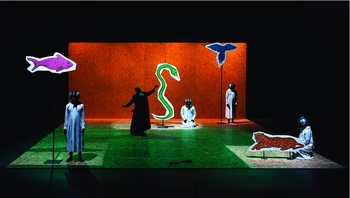
Title of show: Leite Derramado (Spilt Milk)
Producing company: Club Noir
Director and playwright: Roberto Alvim/Chico Buarque
Actor: Juliana Galdino
Lighting designer: Domingos Quintiliano
Soundtrack: Vladimir Safatle
Sound design: LP Daniel
Venue, city and date of performance reviewed: SESC Consolação, São Paulo, 2016
Leite Derramado (Spilt Milk). Photographer: Edson Kumasaka.

Using Chico Buarque's novel Leite Derramado (Spilt Milk), the director Roberto Alvim perfects his formal system as grand theatre.Footnote 2 Nothing is gained by trying to define the place that the protagonist Lalinho occupies in his family, or the years covered in his story over the course of 195 pages in Chico Buarque's novel. In the stage version written and directed by Alvim, generations and eras are embodied by the voice of the actor Juliana Galdino, transfigured in the centenarian Eulálio D'Assumpção. Grandparents, parents and children, who are indistinguishable from the delirium of his hospital bed, populate the schizophrenic dialogue.
Alvim removes most of the nostalgic content concerning Lalinho and Matilde's marriage from the novel, leaving only the bare bones: the unbroken chain of power linking one generation to the next that underpins Brazil's political, economic and cultural history. In this way, the narrator's anxieties as imagined by Chico Buarque achieve the magnitude of a national nightmare.
‘Our tragedy is all yours’, announces a placard in the play's prologue. And what follows is a performance of the slaveholding, oligarchic, corrupt Brazilian tradition, reappropriated as political commentary on the current situation. ‘Certain histories do not cease happening here, now’, Lalinho says in the play. Taking a personal poetic stance in comparison to other artists who reinvented the relationship between aesthetics and politics, the director makes aesthetics the substrate and politics the outcome from the very beginning.
There is gravity in the way that Lalinho creates a convergence through which everything passes. Alvim refuses to concede connections between narrative lines; rather he conceptualizes the staging based on the geometric figure of the point, thus disconnecting conditioned associations. In this way, he intends to generate a disruption of our routine approaches to representation, configurations of time and space, cause and effect, voice and individual. He interrupts the familiar process of meaning to allow perceptive transformation.
The director's radicalism has been seen previously in such projects as Peep Classic Ésquilo (Peep Classic Aeschylus, 2012), a staging of the seven tragedies of the Greek playwright, with super-concise texts and a spatial concept inspired by the Malevich painting Black Square. Recurring motifs in the language of the company Club Noir, founded in 2008, are present in Leite Derramado: the colouring of vocal modulations, the set composed like a painting, the actors arrayed in planes and triads, fruits of a concept guided by abstract painting.
Even a bound system like the one created by Alvim informed by Pollock and Malevich must be reinvented in order not to become a pastiche or a prison. This performance opens into a broader, albeit eccentric, theatricality. Alvim expands its complexity without sacrificing formal control.
The use of fluorescent tubes is just one of the hallmarks of the Club Noir aesthetics in the lighting design by Domingos Quintiliano. Ceiling lights trace rectangles on the floor like canvases for the body of each actor. The soundtrack by Vladimir Safatle and the sound design by LP Daniel establish an uneasy atmosphere, creating disconnected aural and visual landscapes.
In the novel, memory is described as a ‘wound’, ‘pandemonium’.Footnote 3 Alvim transforms it into a landscape of terror overshadowed by intense lights and sounds. The sinister mood keeps the spectator on tenterhooks: another way of perceiving the world (and of reacting to it) is imposed.
Juliana Galdino gave an astonishing portrayal in ‘Comunicação a uma Academia’ (A Report for an Academy, 2009) when she gave life to an ape in the process of becoming human.Footnote 4 The narratives of men and women of various ages flow out of her voice as if she had a machine to create worlds in her throat. The performance around her, more than in that earlier work, contributes enigmatic, symbolic images that destabilize the senses.
Characters extracted from the iconography of Brazilian children's literature evoke the folklorization of both indigenous and African origins and European prejudice. The Native American woman and the Afro-Brazilian religious man, along with the houseflies in scuba gear wearing white lab coats, are signs in frightening, dreamlike collages that seem to arise from the unconscious. They complete the diagnosis that says risk can reside both in the country's memory and in its present.
Juxtaposed with the paralysis that affects the actors’ bodies in so many Club Noir performances, Leite Derramado synchronizes choreographies, however minimalist. Once more in his career, director Alvim creates a vast potential out of a compact text. The innovation is that he introduces into his controlled system the intensified theatricality of bodies in movement, of objects and of music.
An enigmatic image closes the performance, but the song ‘Deus lhe pague’ (God Bless You) brings the spectator back to Chico Buarque and to the dictatorship.Footnote 5 To disrupt this perception, Club Noir dive into the abstract, but return to the reality of a convulsive society.