

Introduction
The distressing medical, social, and economic consequences of the coronavirus (COVID-19) pandemic, accompanied by a string of surprising election results in Europe and beyond, have triggered fresh scholarly interest in the impact of anxiety on voting behaviour. Understanding this relationship is important from a theoretical as well as a practical perspective: the notion that emotional states independently influence voting behaviour is a core tenet of the burgeoning field of political psychology, and anxiety is among the most common and most researched mental health conditions (Wagner and Morisi Reference Wagner, Morisi and Redlawsk2019).
Prior to COVID-19, research generally concluded that anxiety encourages information-seeking and enhances the appeal of protective policies that mitigate perceived threats – policies often espoused by conservative politicians – by increasing risk aversion (Druckman and McDermott Reference Druckman and McDermott2008; Huddy et al. Reference Huddy, Feldman, Taber and Lahav2005), susceptibility to elite persuasion (Brader et al. Reference Brader, Valentino and Suhay2008; Albertson and Gadarian Reference Albertson and Gadarian2015; Marcus et al. Reference Marcus, Neuman and MacKuen2000), and antipathy toward outgroups (Arceneaux Reference Arceneaux2017; Bove et al. Reference Bove, Efthyvoulou and Pickard2022). Developments during the pandemic, however, have led some scholars to question this conventional wisdom, particularly when anxiety stems from society-wide threats that transcend ideological divisions within the electorate.Footnote 1 Examining COVID-19’s impact on the 2020 Democratic primary election in the USA, Bisbee and Honig (Reference Bisbee and Honig2022) present evidence that anxiety induces a ‘flight to safety’ that favours status-quo candidates regardless of their specific policy platform, a proposition for which Depetris-Chauvin and González (Reference Depetris-Chauvin and González2023) find some support in the 2021 Chilean elections. Lehrer et al. (Reference Lehrer, Bahnsen, Müller, Neunhöffer, Gschwend and Juhl2021) and Erhardt et al. (Reference Erhardt, Freitag, Filsinger and Wamsler2021), by contrast, present survey results from Germany and Switzerland, respectively, suggesting that anxiety reduces support for incumbents.
Drawing on insights from psychology and public health, we seek to contribute to this important debate by arguing for an alternative approach that elucidates and gives centrality to the multidimensional, socially contingent nature of complex emotional states such as anxiety. Our varieties of anxieties (VoA) perspective is motivated by a simple observation: a given societal threat can elicit multiple forms of anxiety centred on distinct potential harms – exposure to which varies across socio-demographic groups – with heterogeneous consequences for electoral preferences.Footnote 2 Different types of anxiety, we posit, can give rise to different axes of political competition around threat mitigation and resolution that overlap with, yet are not fully subsumed by, traditional cleavages. As policies designed to address one kind of anxiety may have little bearing on – or even exacerbate – another kind, voters concerned about the same threat may favour candidates with widely varying platforms. Understanding the electoral implications of anxiety, therefore, requires asking not only: ‘How anxious are voters?’ We must also know: ‘What types of anxiety are voters experiencing?’
During the COVID-19 pandemic, two kinds of anxiety became particularly prevalent in the general population: anxiety about the disease’s adverse effects on physical health and anxiety about its disruptive economic impact. We argue that these distinct emotions have conflicting implications for perhaps the defining public policy issue of the pandemic, namely, the stringency of lockdown measures aimed at containing COVID-19 transmission. While assuaging health anxiety by reducing local infection rates, strict lockdowns are likely to deepen economic anxiety by curtailing perceived opportunities for commercial and business activity. Holding constant the role of partisan-motivated reasoning and elite cues, and other political factors shaping policy preferences during the pandemic (Gadarian et al. Reference Gadarian, Goodman and Pepinsky2022; Mehlhaff et al. Reference Mehlhaff, Ryan, Hetherington and MacKuen2024), we expect voters with high levels of health anxiety to favor political platforms that endorse stringent lockdown restrictions, and voters with high levels of economic anxiety to prefer platforms that oppose such constraints. Heeding findings from the public health literature, however, we emphasize that these emotions are not randomly distributed across the population but are rooted in socio-demographic characteristics affecting personal exposure to threats. Health anxiety, though common during the pandemic, should be more acute among groups at greater risk of developing severe COVID-19 symptoms, such as the elderly and people with underlying medical conditions. Analogously, economic anxiety should be higher among groups that stand to lose more from pandemic-induced business disruption, such as workers in close-contact occupations and individuals at the extreme ends of the wealth distribution.
To test these propositions, we investigate the impact of COVID-related health and economic anxieties on voting behaviour during Spain’s pandemic, leveraging a variety of data sources and empirical strategies. To our knowledge, Spain is the only country where a nationally representative sample of citizens was regularly surveyed by a well-established research institution – El Centro de Investigaciones Sociológicas (CIS) – on both their voting intentions and their levels of different COVID-related anxieties in the intense early months of the pandemic. Pooling monthly waves of this survey, we begin by establishing two theory-affirming patterns. First, controlling for partisan attachments as well as socio-demographic and geographical determinants of COVID-19 exposure – key components of ‘rational’ self-interest – individuals primarily concerned about the disease’s health effects were more likely to vote for parties that backed the Spanish government’s stringent lockdown measures, whereas individuals primarily concerned about its economic ramifications tended to favour parties that rejected these restrictions. Second, COVID-related health anxiety was an increasing function of age, a key predictor of vulnerability to serious illness from the disease, while economic anxiety was most severe at very low and very high levels of income and education, predictors of exposure to the pandemic’s ‘pocketbook’ consequences.
To substantiate a causal interpretation of these findings, we then present a pre-registered survey experiment on Spanish voters in which we randomize the assignment of prompts emphasizing COVID-19’s adverse impact on either public health or the economy. In line with VoA expectations, respondents receiving the health-focused frame – who report higher levels of anxiety about the pandemic’s medical consequences – strongly prefer a hypothetical political candidate who advocates stringent lockdown restrictions to a similar candidate who opposes such measures. Respondents receiving the economy-focused frame – who report greater anxiety about the pandemic’s material implications – express the reverse preference. In addition, we find that the former treatment effect increases with respondent age and possession of an underlying medical condition, while the latter treatment effect is larger for respondents in the lowest and highest categories of education and income.
Finally, we assess our argument with real voting data from the 2021 Madrid regional election, a major subnational contest in which the stringency of lockdown measures was the pivotal political issue. Analyzing changes in municipality-level vote shares since the previous election, we find that COVID-19 incidence is more strongly associated with (1) support for pro-lockdown parties in areas with a higher proportion of elderly people and individuals with respiratory conditions, and (2) support for anti-lockdown parties in areas with larger hospitality industries and extreme (top or bottom 5 per cent) mean incomes. To address possible concerns about endogeneity in the location of COVID-19 cases, we show that these results are robust to instrumenting infection rates with pre-election weather patterns, which we argue to be plausibly exogenous to other municipality-level factors affecting disease transmission and vote choice.
Our findings point to the value of a more nuanced understanding of how – and with what political consequences – voters develop feelings of anxiety in response to major societal threats. Disaggregating anxiety helps us to make sense of voting patterns that are difficult to rationalize if we treat this emotion as uniform or homogeneous, such as the sharp division in support for pro-lockdown parties among Spanish voters concerned about COVID-19. By opening up this emotional ‘black box’, the VoA approach enables us to more clearly delineate the scope conditions for existing theories of anxiety and voting behaviour. For example, our result that many COVID-anxious voters opposed pro-lockdown parties may initially seem to defy the predictions of the self-protection and flight-to-safety perspectives mentioned earlier. Once we distinguish voters whose worries centred on health issues from voters whose concerns focused on economic matters, however, it becomes clear that these theories can shed light on political preferences within each group, whose members can be seen as favouring what they consider protective policies or safe candidates. As discussed in the concluding section, we believe that the VoA perspective has broad applicability across policy areas and, with appropriate contextualization, can improve our grasp of how other complex emotional states shape political behaviour.
Disaggregating Anxiety: Theory and Application
Anxiety is an unpleasant and aversive mental state characterized by feelings of tension, apprehension, or stress arising from uncertainty about a perceived threat (Baumeister and Tice Reference Baumeister and Tice1990; Eysenck Reference Eysenck2013). By raising the psychological costs associated with undesired potential outcomes, such feelings can encourage tendencies such as risk aversion, pessimism, and uncertainty avoidance – tendencies that may undermine but also promote the rational pursuit of self-interest (Wagner and Morisi Reference Wagner, Morisi and Redlawsk2019). Following Spielberger et al. (Reference Spielberger, Gorsuch, Lushene Re and Jacobs1983), psychologists distinguish between ‘trait anxiety’, which derives from stable features of an individual’s personality, and ‘state anxiety’, a more transient response to a specific threat.Footnote 3 State anxiety, the more common focus of social science research, can take numerous forms; indeed, one literature review identifies more than 30 distinct state anxieties that have been operationalized and measured by researchers, including dental anxiety, cancer anxiety, cardiac anxiety, and pregnancy anxiety in the public health field and flight anxiety, mathematics anxiety, test anxiety, and social anxiety in other disciplines (Rose and Devine Reference Rose and Devine2014). Notably, these emotional states often derive from the same perceived threat. For instance, standardized assessments have been shown to arouse not only test anxiety but also mathematics anxiety and social anxiety in students (Dowker et al. Reference Dowker, Sarkar and Looi2016).
Individuals are not equally susceptible to state anxieties. A central finding of the public health literature is that the onset and intensity of such worries are predicted by an array of socioeconomic and demographic attributes associated with heightened exposure to potential harms. Cancer anxiety, for example, tends to be higher among individuals with a family history of the disease, poor general health, weak social support systems, and low levels of education, all of which are well-established risk factors (Hidalgo et al. Reference Hidalgo, Sotos, Herráez, Rosa, López and Ortiz2015). In addition, state anxieties comprise a more subjective component reflecting individual characteristics such as personality, upbringing, and values as well as ‘environmental’ influences from local and wider societal contexts, including social networks, public information, elite frames, and partisan cues. These various factors interact with and may be shaped by socio-demographic forces.
In the political domain, these findings suggest, some societal threats may carry the potential to elicit multiple forms of anxiety, the severity of which varies across socio-demographic groups. This heterogeneity could open up salient dimensions along which politicians compete for votes by proposing policies to avert or relieve threat-related harms. Ideally, such interventions would simultaneously alleviate all forms of anxiety provoked by a given threat; in practice, they may ease some types while making little difference to – or intensifying – other types. For example, counterterrorism laws introduced in the wake of a suicide bombing help to ease security anxiety among the general public but may induce social anxiety in voters with perceived affinities to the terrorist group (such as Muslims in the case of an Islamic organization) (Bove et al. Reference Bove, Efthyvoulou and Pickard2022). It is entirely possible that these conflicting effects counterbalance one another – within individual voters or the electorate as a whole – nullifying the overall impact of anxiety on vote choice.
More formally, this intuition can be expressed through a spatial model of voting in which vote choice is a function of the distance between a voter’s ideal policy and each candidate’s platform, plus a valence component capturing non-policy candidate attributes (such as leadership and charisma) (Adams et al. Reference Adams, Merrill and Grofman2005). In the conventional setup described by Bisbee and Honig (Reference Bisbee and Honig2022), voter
 $i$
’s utility from candidate
 $j$
’s policy response to an anxiety-inducing societal threat is given by:
 $${u_{ij}} = - (1 - {\omega _i})({x_j} - {x_i}{)^\alpha } + {\omega _i}{V_j}$$
where
 ${x_i}$
denotes
 $i$
’s preferred policy,
 ${x_j}$
denotes
 $j$
’s proposed policy,
 $\alpha $
is the shape of the distance between these positions,
 ${V_j}$
is
 $j$
’s valence, and
 ${\omega _i}$
is the weight
 $i$
attaches to this component.Footnote
4
Most existing theoretical approaches imply that anxiety affects vote choice through either the gap between
 ${x_i}$
and
 ${x_j}$
(for example, the self-protection perspective) or
 ${V_j}$
(for example, the flight-to-safety perspective).
The VoA approach, too, focuses on the voter-candidate policy distance but analyzes it as a complex function of multiple (
 $K$
) dimensions implicated by the societal threat:
 $${u_{ij}} = - (1 - {\omega _i})\sum\limits_k^K {\lambda _{ik}}{({x_{jk}} - {x_{ik}})^{{\alpha _k}}} + {\omega _i}{V_j}$$
where
 ${\lambda _{ik}}$
is the weight voter
 $i$
places on dimension
 $k$
relative to other dimensions. Voter
 $i$
’s position on
 $k$
— and the relative intensity of this preference — depend on a vector of socio-demographic characteristics shaping
 $i$
’s exposure to
 $k$
-specific harms (
 ${{\bf{D}}_i}$
). They additionally reflect a subjective component (
 ${s_i}$
) involving a mental model of the causal relationship between the societal threat, the proposed policy intervention, and desired outcomes, which is a function of
 ${{\bf{D}}_i}$
as well as the more idiosyncratic personal and environmental influences mentioned earlier (which could themselves be endogenous to
 ${{\bf{D}}_i}$
):
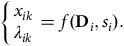 $$\left\{ {\matrix{ {{x_{ik}}} \cr {{\lambda _{ik}}} \cr } } \right. = f({{\bf{D}}_i},{s_i}).$$
As
 ${x_i}$
and
 ${\lambda _i}$
vary with
 $k$
(and
 ${V_j}$
is uniform across voters), anxiety about one policy dimension may not be accompanied by anxiety about another. Anxious voters may therefore make different tradeoffs between policy objectives based on their exposure to threat-related harms; that is, they may derive varying utility from candidate
 $j$
, with some potentially enjoying the same level as a non-anxious voter. The upshot is that we may not be able to predict vote choice solely from a voter’s overall degree of anxiety about a given societal threat; we must additionally account for the relative intensity of different kinds of anxiety and the extent to which each one is alleviated by policies designed to address this threat.
Varieties of Anxieties in the COVID-19 Era
The COVID-19 pandemic represents a fruitful setting in which to apply and empirically evaluate the VoA framework. First, it is one of the clearest examples of a salient societal threat in recent decades, tangibly impacting the welfare of virtually every segment of the electorate in most democratic countries (Lall et al. Reference Lall, Davidson and Hagemeister2023). Second, a growing body of research indicates that the pandemic gave rise to multiple types of anxiety, among which COVID-related health and economic anxieties were especially pervasive (Maaravi and Heller Reference Maaravi and Heller2020; Bareket-Bojmel et al. Reference Bareket-Bojmel, Shahar and Margalit2021). Third, as an unanticipated shock originating outside the democratic world, COVID-19 was not initially ‘framed’ by political elites, helping us to mitigate the potentially confounding impact of partisanship on anxiety and electoral preferences (Albertson and Gadarian Reference Albertson and Gadarian2015). Nevertheless, as partisan divisions over the pandemic emerged relatively swiftly in many countries (Gadarian et al. Reference Gadarian, Goodman and Pepinsky2022) – and voters could plausibly express anxiety as a means of signalling group affiliation in response to elite cues – our empirical analyses seek to more directly address this issue by controlling for political attachments.
A striking feature of COVID-related health and economic anxieties is that they imply opposing attitudes toward lockdown measures, the principal non-pharmaceutical policy intervention against the disease. Lockdowns involve the implementation of restrictions – including on movement, access to public spaces, and social contact – intended to reduce the frequency of interactions between infected and non-infected individuals. Insofar as they suppress COVID-19’s reproduction rate and hence the risk of personal infection, stringent lockdowns should alleviate anxiety about its health consequences. Such relief should be felt more keenly by individuals liable to suffer severe respiratory, muscular, or neurological COVID-19 symptoms, such as elderly people and bearers with underlying health conditions. Indeed, a consistent finding of the growing literature on attitudes toward COVID-19 policy is that these two groups expressed strong support for containment policies (Faia et al. Reference Faia, Fuster, Pezone and Zafar2021; Settele and Shupe Reference Settele and Shupe2022).
At the same time, policy experts and media outlets warned that lockdown restrictions limited opportunities for commercial and business activity, creating a ‘lives or livelihoods’ tradeoff (Settele and Shupe Reference Settele and Shupe2022). Lockdown measures can intensify anxiety about COVID-19’s economic consequences by adversely impacting both income and wealth. Negative income effects arise from the loss of regular earnings, usually due to a reduction in (aggregate or sector-specific) demand for goods and services in and around locations under lockdown. Negative wealth effects occur when declining demand and output growth put downward pressure on asset prices. Collectively, these effects should elicit more intense anxiety in individuals at the lowest and highest ends of the economic distribution: the poorest have the fewest resources with which to survive negative income shocks, while the richest tend to be disproportionately affected by negative wealth shocks. Another clear finding of scholarship on attitudes toward COVID-19 policy is that support for lockdown measures was weaker not only among the poorer and less educated but also among owners of property, stocks, and other forms of wealth (Faia et al. Reference Faia, Fuster, Pezone and Zafar2021; Peretti-Watel et al. Reference Peretti-Watel, Verger and Launay2020; Settele and Shupe Reference Settele and Shupe2022). In addition, we might expect individuals whose occupation requires close contact with customers or colleagues and thus cannot easily be conducted from home, such as most hospitality, construction, and arts and entertainment workers, to experience more severe economic anxiety in the face of the COVID-19 threat.
What are the implications for voting behaviour? Returning to the framework set out in the previous section, assume that COVID-19 is the emergent societal threat and that the state of public health and the economy are the two policy dimensions at stake in addressing this threat (also see Reference Becher, Longuet-Marx, Pons, Brouard, Foucault, Galasso, Kerrouche, León and StegmuellerBecher, Longuet-Marx, Pons, Brouard, Foucault, Galasso, Kerrouche, León Alfonso and Stegmueller 2024). While voters would ideally maximize both dimensions (subject to a tax-based budget constraint), the policy instrument available for tackling the disease – lockdown restrictions – forces them to make a tradeoff that reflects their particular balance of COVID-related health and economic anxieties. Voter
 $i$
’s utility of supporting candidate
 $j$
’s proposed level of lockdown stringency can be expressed as:
 $${u_{ij}} = - (1 - {\omega _i})[({h_j} - {h_i}{)^{{\alpha _h}}} - {\lambda _i}{({e_j} - {e_i})^{{\alpha _e}}}] + {\omega _i}{V_j}$$
where
 $h$
and
 $e$
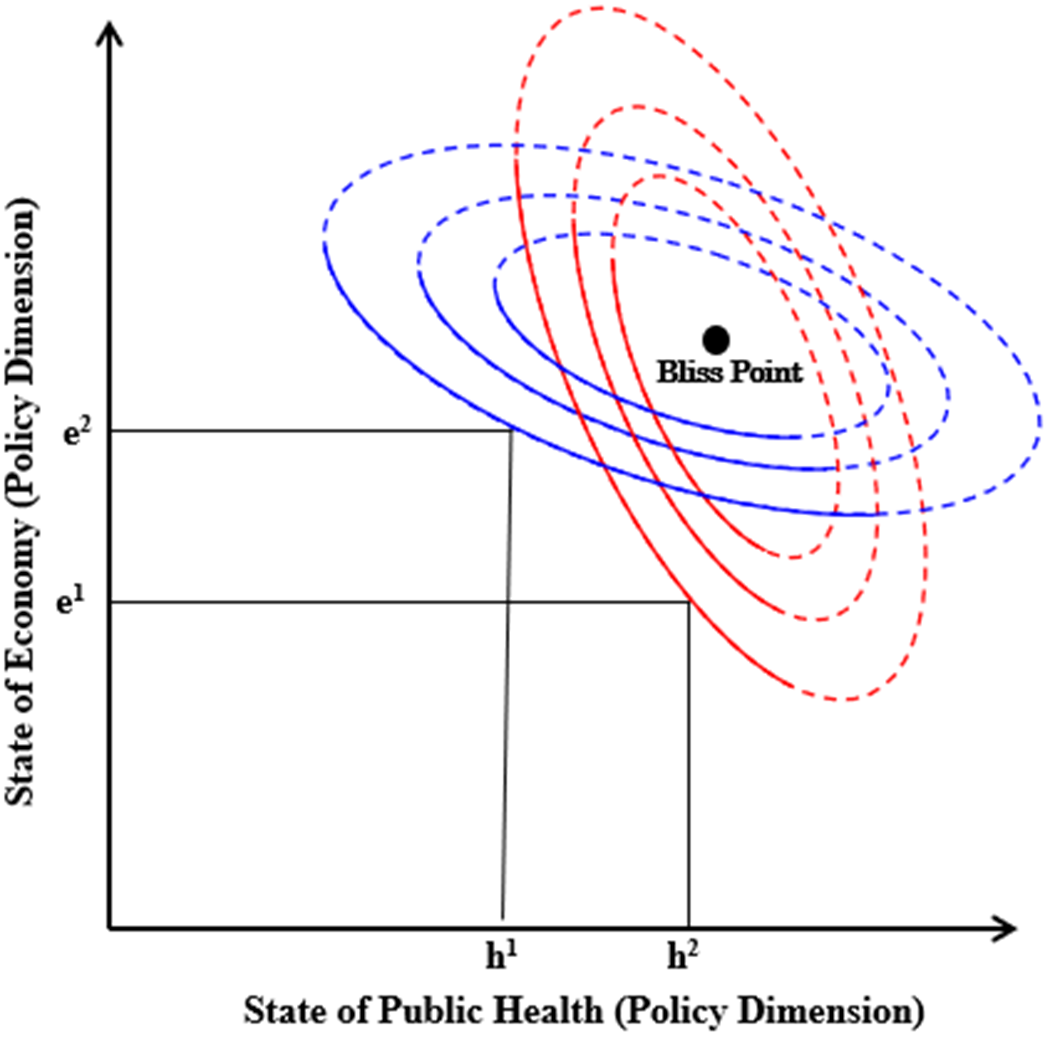
denote positions on public health and the economy, respectively. As represented by the vertically oriented indifference curves in Figure 1, voters who have greater exposure to — and hence anxiety about – COVID-19’s health consequences will be more willing to trade off disruption to the economy (
 ${e^1}$
) to safeguard public health (
 ${h^2}$
). Accordingly, they will derive higher utility from a candidate who endorses strict lockdown measures. The horizontally oriented indifference curves, on the other hand, characterize voters whose vulnerabilities and worries centre on the pandemic’s economic effects, who will be willing to tolerate a worse public health situation (
 ${h^1}$
) to maintain a well-functioning economy (
 ${e^2}$
). These individuals will derive greater utility from a candidate who favours weak restrictions.
Indifference Curves for Individuals with Varying COVID-Related Anxieties.
Notes: Horizontally oriented ovals represent individuals who are more exposed to and anxious about COVID-19’s health consequences than its economic effects; vertically oriented ovals represent individuals in the reverse situation.
Other things equal – including the partisan influences highlighted by some analyses of political behaviour during the pandemic (Gadarian et al. Reference Gadarian, Goodman and Pepinsky2022; Mehlhaff et al. Reference Mehlhaff, Ryan, Hetherington and MacKuen2024) – we hypothesize that COVID-related health anxiety is positively associated with support for pro-lockdown political platforms, whereas COVID-related economic anxiety is positively associated with support for anti-lockdown platforms. The distribution of these two emotions in the population of interest, in turn, determines the relationship between overall COVID-19 anxiety and support for each type of platform. If COVID-related health and economic anxieties are roughly balanced, their opposing impacts on lockdown preferences could offset one another, resulting in a weak or non-existent association.
With respect to the sources of COVID-related anxieties, the preceding discussion suggests two propositions. First, COVID-related health anxiety is positively associated with socio-demographic characteristics that increase exposure to severe COVID-19 symptoms, such as advanced age and the presence of an underlying medical condition. Second, COVID-related economic anxiety is positively associated with socio-demographic characteristics that increase exposure to significant financial loss due to the pandemic, such as an extremely low or high income and an occupation requiring human-to-human contact (for example, a hospitality worker).
Observational Survey Evidence: La Pandemia de España
Owing to the availability of nationally representative, high-frequency survey data on political preferences and key varieties of COVID-related anxiety, we test our hypotheses in the context of the Spanish pandemic. In Spain’s multiparty parliamentary system, five parties have dominated national politics in recent years: (1) Partido Popular (PP), a Christian democratic party that held power until shortly before the pandemic; (2) Partido Socialista Obrero Español (PSOE), a social democratic party that has frequently been in government; (3) Podemos, a left-wing populist party; (4) Ciudadanos, a centre-right liberal party; and (5) Vox, a right-wing populist party.
In January 2020, a few weeks before Spain’s first recorded COVID-19 case, PSOE joined forces with Podemos and several small left-wing and independent parties to form the first national coalition government of the modern era. After initially underestimating the seriousness of COVID-19, the coalition drastically shifted policy in mid-March, declaring a nationwide state of alarm under which citizens were required to remain in their normal residence, except to purchase food and medicines, attend work, and address emergencies. With the backing of parliament, the government extended the initial state of alarm six times between March and June 2020, after which it relaxed restrictions and granted more policy discretion to regional governments. An unexpected surge in cases over the summer triggered a new state of alarm, including a mandatory curfew, which parliament extended for six months in late October.Footnote 5
Among the five major parties, there were sharp differences in support for lockdown measures. As indicated by government policy, PSOE and Podemos favoured the robust restrictions recommended by most Spanish and international public health experts (Lall Reference Lall2023). Opposition parties were more divided. Ciudadanos was moderately supportive of the government’s position, voting for proposed extensions of the state of alarm while continually emphasizing that ‘we cannot prolong confinement excessively’ and that ‘economic activity should resume as quickly as possible’.Footnote 6 PP initially backed lockdown restrictions but refused to support the state of alarm from May 2020 onward, arguing that sustained closure jeopardized livelihoods, rights, and freedoms. Finally, Vox presented the stiffest and most consistent opposition to lockdown, only voting for the initial state of alarm and repeatedly criticizing the government’s position as inimical to economic liberties and business interests. Table A1 in Online Appendix A records each party’s votes on the seven state-of-alarm extensions; Table A2 presents a selection of policy statements illustrating their general stance on COVID-19 containment measures.
Party positions on lockdown stringency, therefore, varied within the right side of the ideological spectrum, again helping us to tease apart the effects of anxiety and partisanship on voting behaviour. Our argument implies that, holding constant partisan attachments, anxiety about COVID-19’s health consequences was positively associated with support for PSOE and Podemos (strong pro-lockdown stance); ambiguously associated with support for Ciudadanos (lukewarm pro-lockdown stance); and negatively associated with support for PP and Vox (strong anti-lockdown stance). Anxiety about COVID-19’s economic implications should be characterized by the opposite relationships.
COVID-19 Anxieties and Voting Intentions
In the first part of our empirical investigation, we examine the relationship between COVID-related anxieties and voting intentions using detailed individual-level data collected by CIS.Footnote 7 In every month except August, CIS conducts a public opinion survey containing questions on electoral preferences, socio-demographic characteristics, and, since April 2020, attitudes toward the pandemic and the policy response to it. The survey is administered to approximately 2,500 adults selected via a stratified random sampling procedure based on regional population, with quotas ensuring appropriate gender and age group representation.
Usefully for our purposes, the CIS survey includes a question not only on respondents’ overall level of anxiety about COVID-19 (April 2020 onward) but also on whether they are more concerned about its economic consequences or its health consequences (three waves between May and July 2020).Footnote 8 Pooling available survey waves over the severe phase of the pandemic stretching from April 2020 to July 2021, we regress the intention to vote for a given party on responses to these two questions using the following logistic model:
 $$\matrix{ {logit(P({\rm{Vote \ Choic}}{{\rm{e}}_{ijtp}} = 1)) = {\beta _0} + {\beta _1}\left\{ {\matrix{ {{\rm{COVID \ Anxiet}}{{\rm{y}}_{it}}} \cr {{\rm{Health\text{-}Weighted \ Anxiet}}{{\rm{y}}_{it}}} \cr } } \right. + {\beta _2}{\rm{Log \ COVID}}} \cr {{\rm{CP}}{{\rm{C}}_{j(i)t}} + {\beta _3}{\rm{Previous\ Vot}}{{\rm{e}}_{itp}} + {\gamma _j} + {\phi _t} + \theta {{\bf{X}}'_{it}} + {\varepsilon _{ijtp}}}. \cr }$$
Vote Choice
 $_{ijtp}$
, the dependent variable, is a dummy for whether respondent
 $i$
in NUTS-3 region
 $j$
in survey wave
 $t$
would vote for party
 $p$
if general elections were held tomorrow. COVID Anxiety
 $_{it}$
, the first explanatory variable, is based on the question: ‘Thinking about all of the effects of this pandemic, would you say that COVID-19 worries you a lot, quite a bit, a little, or not at all?’Footnote
9
The variable has an ordinal scale ranging from 1 for the response ‘not at all’ to 5 for ‘a lot’.Footnote
10
The second explanatory variable, Health-Weighted Anxiety
 $_{it}$
, is a categorical variable derived from the question: ‘At this time, what are you more concerned about: the effects of the [COVID-19] crisis on health, or the effects of the crisis on the economy and employment?’ It takes three values: 1 for the response ‘health effects’, 0.5 for ‘both equally’, and 0 for ‘economic effects’. The mean value of Health-Weighted Anxiety
 $_{it}$
is 0.59, indicating a rough balance between COVID-related health and economic anxieties among CIS respondents.
We control for several determinants of exposure to COVID-19’s health and economic consequences. Log COVID CPC
 $_{j(i)t}$
is the logarithm of cumulative COVID-19 cases per capita in respondent
 $i$
’s NUTS-3 region (
 $j$
) in survey wave
 $t$
, data on which come from Spain’s National Epidemiological Centre (El Centro Nacional de Epidemiología, 2022). Previous Vote
 $_{itp}$
is a dummy for whether respondent
 $i$
voted for party
 $p$
in the November 2019 Spanish general election, a proxy for partisanship.Footnote
11
 ${{\bf{X}}'_{it}}$
is a vector of six sets of socio-demographic dummies, which are transformed from their original categorical form: age (six categories), gender (two categories), social class (five categories), education level (four categories), labour situation (four categories), and job type (10 categories). A key identifying assumption is that, conditional on these covariates, there is minimal variation in voting preferences due to unobservable differences in rational self-interest (yet some variation due to differences in COVID-related anxieties).Footnote
12
Finally,
 ${\gamma _i}$
and
 ${\phi _t}$
denote NUTS-3 and survey wave fixed effects, respectively, which control for time-invariant geographical and location-invariant temporal characteristics.Footnote
13
In both variants of Equation 5, heteroskedasticity-robust standard errors are clustered at the NUTS-3 level.
Results
The top row of Figure 2 plots odds ratios for the estimated coefficients on COVID Anxiety
 $_{it}$
with 90 per cent, 95 per cent, and 99 per cent confidence intervals, first excluding (left estimate within each column) and then including (right estimate within each column) Health-Weighted Anxiety
 $_{it}$
in the model.Footnote
14
Interestingly, regardless of specification, no clear relationship emerges between overall COVID-19 anxiety and support for parties that favour stringent lockdown measures. COVID-anxious individuals were more likely to vote for Ciudadanos (column 3), which modestly backed restrictions, yet were no more likely to vote for Podemos (column 1) or PSOE (column 2), which ardently endorsed them. Among anti-lockdown parties, COVID Anxiety
 $_{it}$
is associated with a lower likelihood of voting for Vox (column 5) but with no difference in the likelihood of voting for PP (column 4). When we aggregate preferences for pro-lockdown (column 6) and anti-lockdown (column 7) parties, the odds ratios cannot be statistically distinguished from 0 in three of the four models.
Relationship between COVID-Related Anxieties and Voting Intentions.
Notes: Odds ratios with confidence intervals of varying levels based on robust standard errors clustered by NUTS-3 region. All models include NUTS-3 and survey wave fixed effects and control for gender, age, education level, social class, labour situation, job type, previous vote choice, and NUTS-3-level COVID-19 incidence.
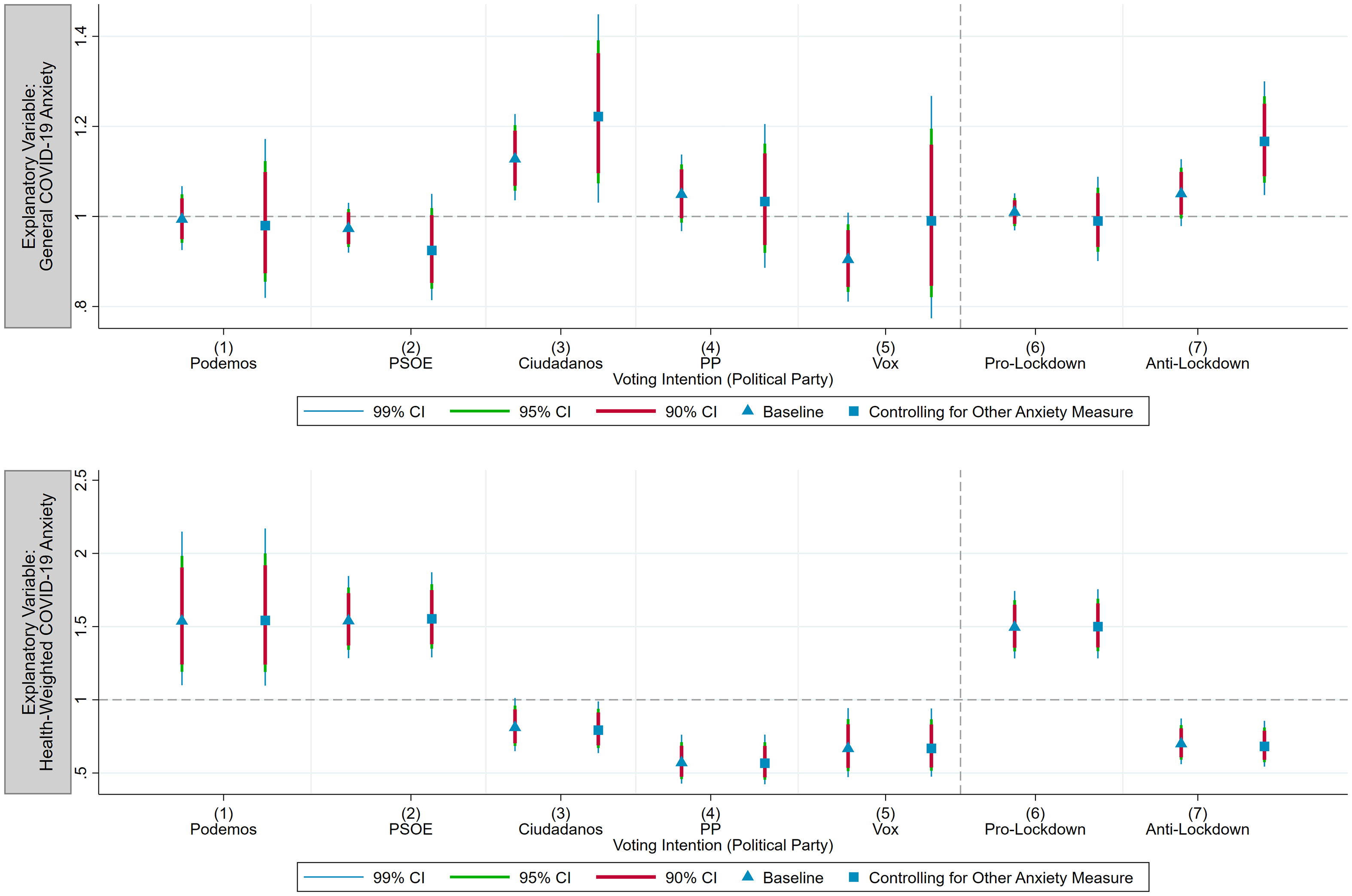
The bottom row displays the equivalent odds ratios for Health-Weighted Anxiety
 $_{it}$
from the second variant of Equation 5. Our expectations find consistent support: whether or not we control for overall COVID-19 anxiety, health-weighted anxiety is positively related to voting for Podemos and PSOE, unrelated to voting for Ciudadanos, and negatively related to voting for PP and Vox. Accordingly, the odds ratio is positive and highly significant for pro-lockdown parties as a whole but negative and highly significant for anti-lockdown parties. This discrepancy is substantively large: respondents with health-weighted anxiety are around 50 per cent more likely to vote for a pro-lockdown party and 30 per cent less likely to vote for an anti-lockdown party. These estimates suggest that the weak relationship between overall COVID-19 anxiety and support for pro- and anti-lockdown parties may be masking important heterogeneity in how distinct forms of this emotion shape voting preferences.
In Online Appendix B, we show that the second-variant results are robust to different combinations of the control variables as well as to two alternative measures of partisanship: party sympathy and left-right ideology (Table A5). In addition, using Oster’s (Reference Oster2019) test of unobservable selection, we provide evidence that these estimates are unlikely to be strongly confounded by omitted proxies for rational self-interest: under conservative upper bounds for the hypothetical
 ${R^2}$
that would be explained by both observed and unobserved measures of self-interest; the degree of selection on unobservables would have to be significantly larger than the degree of selection on observables to eliminate the results (Table A6).Footnote
15
Sources of Health-Weighted COVID-19 Anxiety
Turning to our second set of hypotheses, we next regress Health-Weighted Anxiety
 $_{it}$
on the dummies for age, education level, social class, labour situation, and job type in Equation 5:
 $$\matrix{ {{\rm{Health\text{-}Weighted \ Anxiet}}{{\rm{y}}_{it}} = {\beta _0} + {\beta _1}{\rm{Socio\text{-}Demographic \ Dumm}}{{\rm{y}}_{it}} + {\beta _2}{\rm{Log}}} \cr {{\rm{COVID \ CP}}{{\rm{C}}_{jt}} + {\gamma _j} + {\phi _t} + \theta {{\bf{X}}'_{it}} + {\varepsilon _{ijt}}} \cr }$$
where
 ${{\bf{X}}'_{it}}$
now comprises all remaining controls from Equation 5. To facilitate interpretation, each measure of Socio-Demographic Dummy
 $_{it}$
is entered in a separate regression. As Health-Weighted Anxiety
 $_{it}$
is an ordinal variable with three levels, we switch to an OLS estimator.
Figure 3 displays the estimated coefficients on Socio-Demographic Dummy
 $_{it}$
with the same confidence bands as in Figure 2. There is broad support for our conjectures about the sources of COVID-related health and economic anxieties. Older individuals tend to experience stronger health-weighted anxiety, though the second oldest category (55–64 years old) is slightly more skewed in this direction than the oldest category (65+ years old).Footnote
16
As a result, the largest gap occurs between individuals aged 18–24 years, who are 8 percentage points less likely than other age groups to report health-weighted anxiety, and individuals aged 55–64 years, who are 3 percentage points more likely.
Sources of Health-Weighted COVID-19 Anxiety.
Notes: OLS coefficients on Socio-Demographic Dummy it in Equation 6 (each measure is entered in a separate regression) with confidence intervals of varying levels based on robust standard errors clustered by NUTS-3 region. All models include NUTS-3 and survey wave fixed effects and control for gender and the four remaining sets of socio-demographic dummies in the figure. A small number of job type categories are omitted to save space.
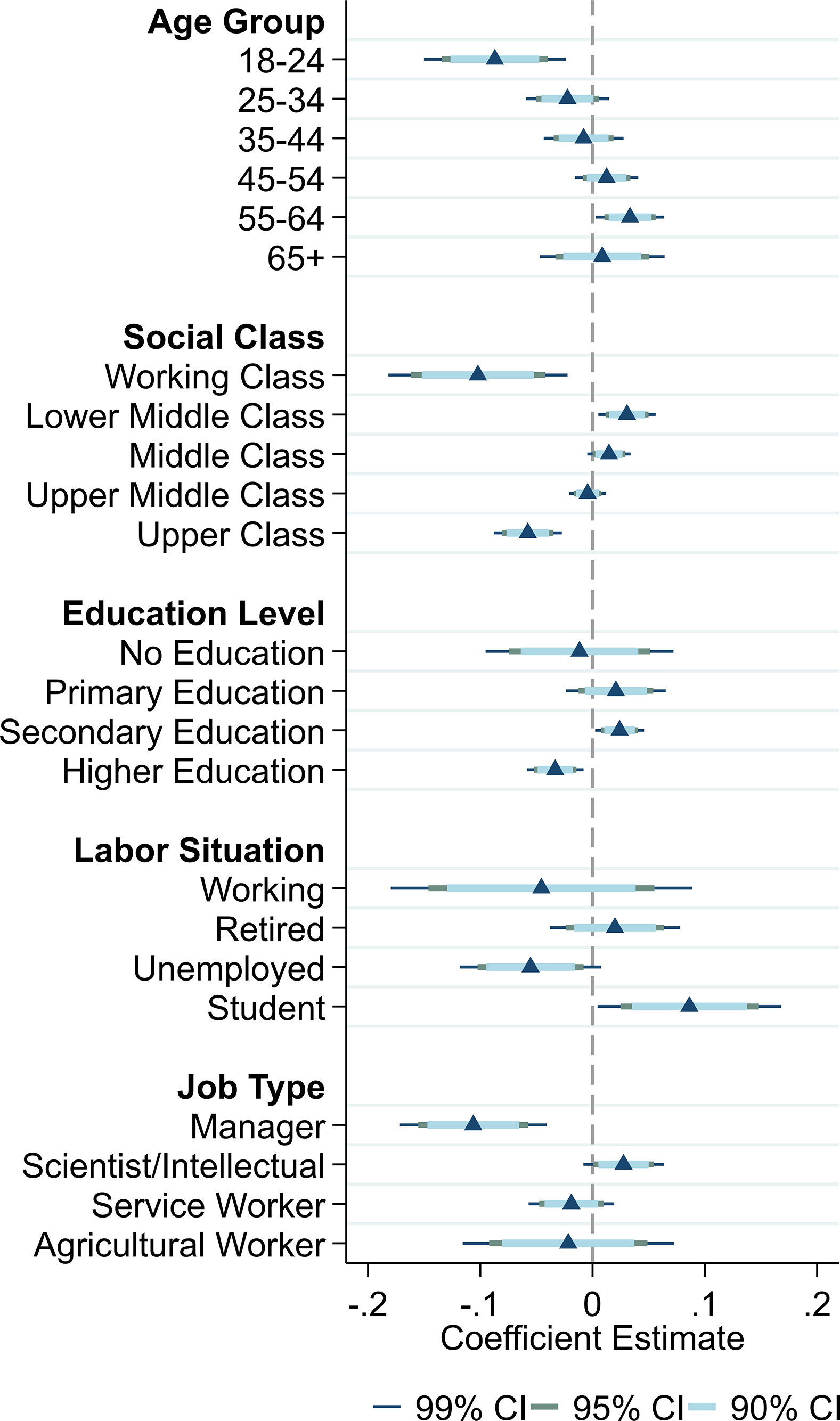
By contrast, health-weighted anxiety declines – and thus economy-weighted anxiety increases – at both extremes of social class, education level, and employment status, where we expect exposure to COVID-induced economic disruption to be highest. Working class and upper class respondents report lower levels of health-weighted anxiety than lower middle class, middle class, and upper middle class respondents. The same is true of the employed and the unemployed relative to students and retirees, and of individuals with no education and with tertiary education relative to individuals with primary or secondary education only. Statistically, these relationships are significant at the 1 per cent level for working-class individuals, who are 10 percentage points less likely to experience health-weighted anxiety than other respondents; for upper-class individuals, who are 6 percentage points less likely; and for the unemployed, who are 5 percentage points less likely.
Our expectations also receive some support in the employment category estimates. The strongest finding here is that managers and directors, the most senior and well-remunerated category, have a far lower probability – 11 percentage points, on average – of experiencing health-weighted anxiety. While the results for the remaining categories are more mixed, it is noteworthy that service and agricultural workers, whose remuneration lies at the other end of the spectrum and whose duties frequently require interpersonal contact, are also more concerned about COVID-19’s economic impact than its health effects. Conversely, scientists, intellectuals, and mid-level professionals, who are relatively well compensated and typically work in small groups or alone, exhibit the opposite pattern.
Survey Experimental Evidence
Despite their battery of control variables and fixed effects, the previous analyses do not conclusively rule out sources of unobserved heterogeneity. It is possible, for instance, that their results were confounded by political attitudes and values not captured by our proxies for partisanship – which could affect exposure to anxiety-inducing information or elite cues (Becher, Brouard and Stegmueller Reference Becher, Brouard and Stegmueller2024) – or by emotions related to anxiety, such as anger and sadness (Vasilopoulos et al. Reference Vasilopoulos, Marcus, Valentino and Foucault2019).
In the second stage of our investigation, therefore, we conduct a survey experiment modelled on that of Bisbee and Honig (Reference Bisbee and Honig2022), which tested the flight-to-safety hypothesis by randomly assigning respondents an anxiety-inducing or anxiety-relieving vignette about COVID-19, before asking them to evaluate hypothetical establishment and antiestablishment candidates for executive office. We instead randomize exposure to three conditions – a prompt intended to elicit COVID-related health anxiety, a prompt intended to elicit COVID-related economic anxiety, and no prompt (the control condition) – and distinguish the candidates by whether they advocate or oppose stringent lockdown measures. Using a combination of the Amazon Mechanical Turk crowdsourcing platform and advertising on social media, we administered the survey to almost 750 adults in Spain amid an upsurge of – and thus spike in public concern about – COVID-19 in mid-2023. As discussed in Online Appendix C, the sample is approximately representative of Spain’s overall population in terms of age, gender, ethnicity, and education level.
Our two prompts were based on recent media reporting and expert assessments of the pandemic’s impact in Spain. The first highlights COVID-19’s negative public health consequences:
The COVID-19 pandemic has been one of the deadliest plagues in history. In Spain alone, there have been 13.8 million confirmed cases and at least 120,000 deaths. Even among those who have survived, more than 40 per cent have suffered long-lasting symptoms, including organ damage affecting the heart, kidneys, skin, and brain. Some experts believe that another pandemic could occur in the near future and have even more damaging health consequences. Footnote 17
The second vignette focuses on the economic damage wrought by the pandemic:
The disruption caused by the COVID-19 pandemic sent shock waves through the world economy and triggered the largest global economic crisis for more than a century. Spain’s economy contracted by more than 10 per cent in 2020 and remains smaller than before the pandemic, with high inflation and low growth expected to persist for several years. Some experts believe that another pandemic could occur in the near future and have even more damaging economic consequences.
After reading one – or neither – of these prompts, respondents were asked to report their level of COVID-related health and economic anxiety on a scale of 1–10. They were then invited to choose between (1) a pro-lockdown candidate who, in the event of a major resurgence of COVID-19 or a similar pandemic in the future, ‘favors a prudent and vigilant response that protects all members of society’; and (2) an anti-lockdown candidate who ‘is keen to protect people’s livelihoods by minimizing any economic disturbance or damage that may arise’.
We model candidate choice as a logistic function of treatment assignment plus a host of socio-demographic, political, and COVID-related controls:
 $$\matrix{ {logit(P(\left\{ {\matrix{ {{\rm{Pro}} - {\rm{Lockdown \ Candidate}}} \cr {{\rm{Anti}} - {\rm{Lockdown \ Candidate}}} \cr } } \right. = 1)) = {\beta _0} + {\beta _1}\left\{ {\matrix{ {{\rm{Health \ Prime}}} \cr {{\rm{Economy \ Prime}}} \cr } } \right. + {\beta _2}{\rm{Previous}}} \cr {{\rm{Infection}} + \,\vartheta {\rm{PartyI}}{{\rm{D}}_p} + \theta {\bf{X'}} + \varepsilon_{p} } \cr }$$
where Pro-Lockdown Candidate and Anti-Lockdown Candidate are dummies for whether a respondent prefers the pro-lockdown candidate and the anti-lockdown candidate, respectively; Health Prime and Economy Prime are dummies for whether a respondent received the health-focused prompt and the economy-focused prompt, respectively; Previous Infection is a dummy for whether a respondent has been infected with COVID-19; Party ID
 $_p$
is a dummy for whether a respondent identifies with major political party
 $p$
; and
 ${\bf{X'}}$
, the vector of socio-demographic controls, comprises age (continuous scale), gender (dummy for female), ethnicity (dummy for white), and education level (dummies for seven categories ranging from no school to graduate school).Footnote
18
Similarly to before, these controls help us to account for the potentially confounding influence of rational self-interest.Footnote
19
To ensure that treatment effects are estimated against the appropriate baseline – members of the control group – both variants of the specification exclude respondents under the alternative treatment condition.
Odds ratios from Equation 7 are reported in panels A and B of Table 1, beginning with a bivariate correlation between the treatment and outcome (column 1), before adding the socio-demographic (column 2), political (column 3), and previous infection (column 4) controls. In accordance with our argument, all estimations reveal a positive and highly significant (
 $p \lt $
0.01) relationship between (1) assignment to the health-focused prompt and a preference for the pro-lockdown candidate, and (2) assignment to the economy-focused prompt and a preference for the anti-lockdown candidate. The treatment effects are sizable: individuals receiving the health-focused prompt are 3.5–3.7 times more likely to favour the pro-lockdown candidate than members of the control group (panel A), while individuals receiving the economy-focused prompt are 3–3.3 times more likely to favour the anti-lockdown candidate (panel B). In column 5, we show that these estimates almost double when the sample is expanded to individuals assigned the alternative treatment.Footnote
20
Survey Experiment Results
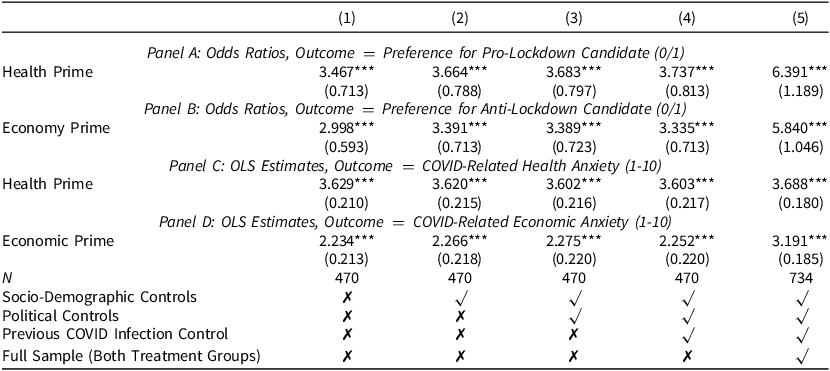
Notes
: Odds ratios from logistic regressions in panels A and B; OLS estimates in panels C and D. Robust standard errors in parentheses. Socio-demographic controls: age, gender, ethnicity, and education level. Political controls: identification with PP, PSOE, Podemos, and Vox.
 $^*p$
 $ \!\lt\! $
0.1;
 $^{**}p$
 $ \!\lt\! $
0.05;
 $^{***}p$
 $ \!\lt\! $
0.01.
To confirm that these results reflect our posited emotional mechanism, we next replace the dependent variables in Equation 7 with the scales of COVID-related health anxiety (first variant) and economic anxiety (second variant) mentioned above, employing an OLS estimator on account of their continuous 1–10 scale. The treatment coefficients remain positive and significant at the 1 per cent level across both sets of models (panels C and D).Footnote 21
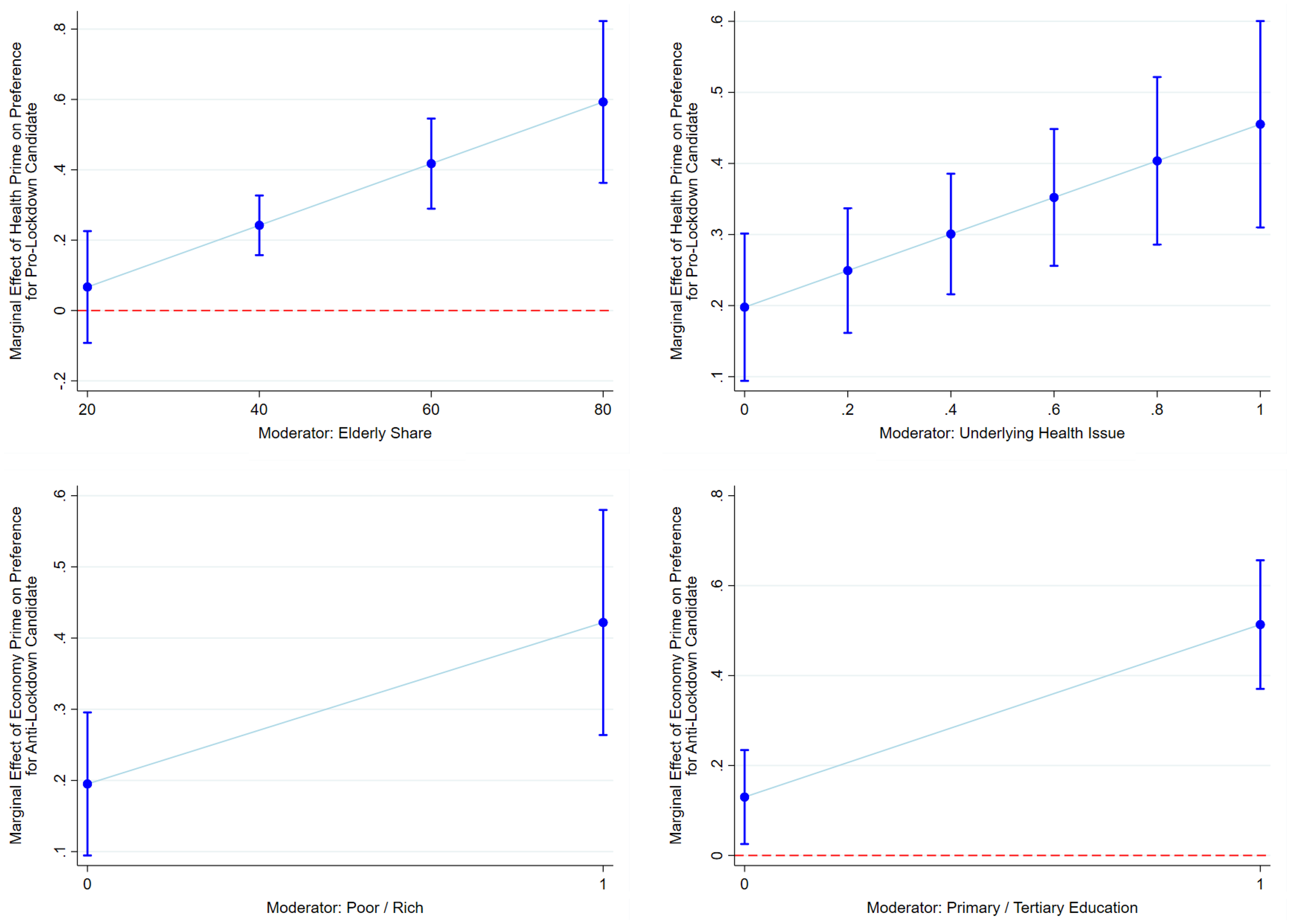
In addition to testing our main hypotheses, we take advantage of exogenous treatment assignment to probe two more subtle implications of VoA logic. First, the health-focused treatment will have a larger effect on support for the pro-lockdown candidate among individuals more exposed to COVID-19’s health consequences. Second, the economy-focused treatment will have a larger effect on support for the anti-lockdown candidate among individuals more exposed to the pandemic’s economic disruption. We test the former proposition by interacting Health Prime with (1) age and (2) a dummy for the possession of an underlying medical condition, and the latter proposition by interacting Economy Prime with (1) a dummy for whether a respondent’s annual income is either less than €10,000 (the lowest category) or more than €60,000 (the highest category) and (2) a dummy for whether a respondent’s education level is either elementary school and below (the lowest two categories) or graduate school (the highest category). As shown in Figure 4, both implications find robust support: the marginal effects of Health Prime and Economy Prime on Pro-Lockdown Candidate and Anti-Lockdown Candidate, respectively, rise sharply with each moderator (while maintaining significance at the 5 per cent level at essentially all levels).
Marginal Effects in Survey Experiment.
Notes: Marginal effect estimates based on logistic regressions with 95 per cent confidence intervals. Controls: age, gender, ethnicity, education level, identification with PP, PSOE, Podemos, and Vox. For underlying regression results, see Table A10 in Online Appendix C.
Electoral Evidence: The 2021 Madrid Regional Election
Does evidence for the VoA approach extend to real voting decisions? In this section, we turn our attention to electoral outcomes during Spain’s COVID-19 pandemic. While no general election took place in the peak years of the pandemic, regional elections were held in Galicia (July 2020), the Basque Country (July 2020), Catalonia (February 2021), and Madrid (May 2021). We focus on the Madrid election for two reasons. First, the other three regions have powerful and long-standing nationalist movements, introducing a cross-cutting policy dimension that could obscure or confound the relationship between COVID-related anxieties and vote choice. Second, and relatedly, whereas the severity of lockdown measures was one of several issues on which Galician, Basque, and Catalonian parties campaigned, it was the defining axis of political contention in the Madrid election, rendering this an ideal context in which to assess our argument.
Background and Expectations
Since the mid-1990s, PP has been the dominant force in Madrilenian politics, leading all ten regional governments. In the years leading up to the pandemic, however, support for the party was steadily dwindling. In 2019, PP failed to win a regional election for the first time since 1989, placing second behind PSOE. Nevertheless, the latter party was unable to find enough partners to form a government, allowing PP to return to power in coalition with Ciudadanos and Vox. When the pandemic struck, Madrid’s president, Isabel Díaz Ayuso, sought to revive PP’s fortunes by opposing national lockdown restrictions on economic and rights-based grounds. PP was joined in this stance by only one of its two coalition partners – Vox – creating tensions that triggered a snap election in May 2021. Ayuso framed the vote as a choice between ‘comunismo o libertad’ (communism or freedom), campaigning for the ‘rights of the family, the self-employed, the business person to remain in control of their lives’ (Dombey Reference Dombey2021). Podemos, PSOE, and Ciudadanos ran on a platform of responsible pandemic management and political moderation, with the first adopting the counter-slogan ‘democracia o fascismo’ (democracy or fascism).Footnote 22 Stringent lockdown policies were also endorsed by Más Madrid, a regional party founded in 2019 by former Podemos politicians.
PP’s strategy largely bore fruit: the party received 45 per cent of votes cast in the election, more than doubling its previous share.Footnote 23 As illustrated in panel A of Figure 5, which maps the vote share of pro-lockdown parties minus that of anti-lockdown parties in Madrid’s 179 municipalities, PP made inroads not only in traditionally conservative central and northern neighbourhoods but also in the left-leaning industrial ‘red belt’ spanning the southern periphery. Even so, the party failed to secure enough votes to rule alone, ultimately forming an anti-lockdown coalition government with Vox. Ciudadanos lost all of its parliamentary seats as its vote share plummeted from 19.5 per cent to 3.6 per cent, while PSOE suffered a smaller drop (from 24 per cent to 17 per cent). Podemos and Más Madrid saw small increases in support.
COVID-19 Incidence and Voting Patterns in Madrid, May 2021.
Notes: Municipalities are shaded by the excess vote share of pro-lockdown parties over anti-lockdown parties in the 2021 Madrid regional election in panel A; and by the logarithm of cumulative COVID-19 cases per capita on the date of this election (May 4) in panel B.
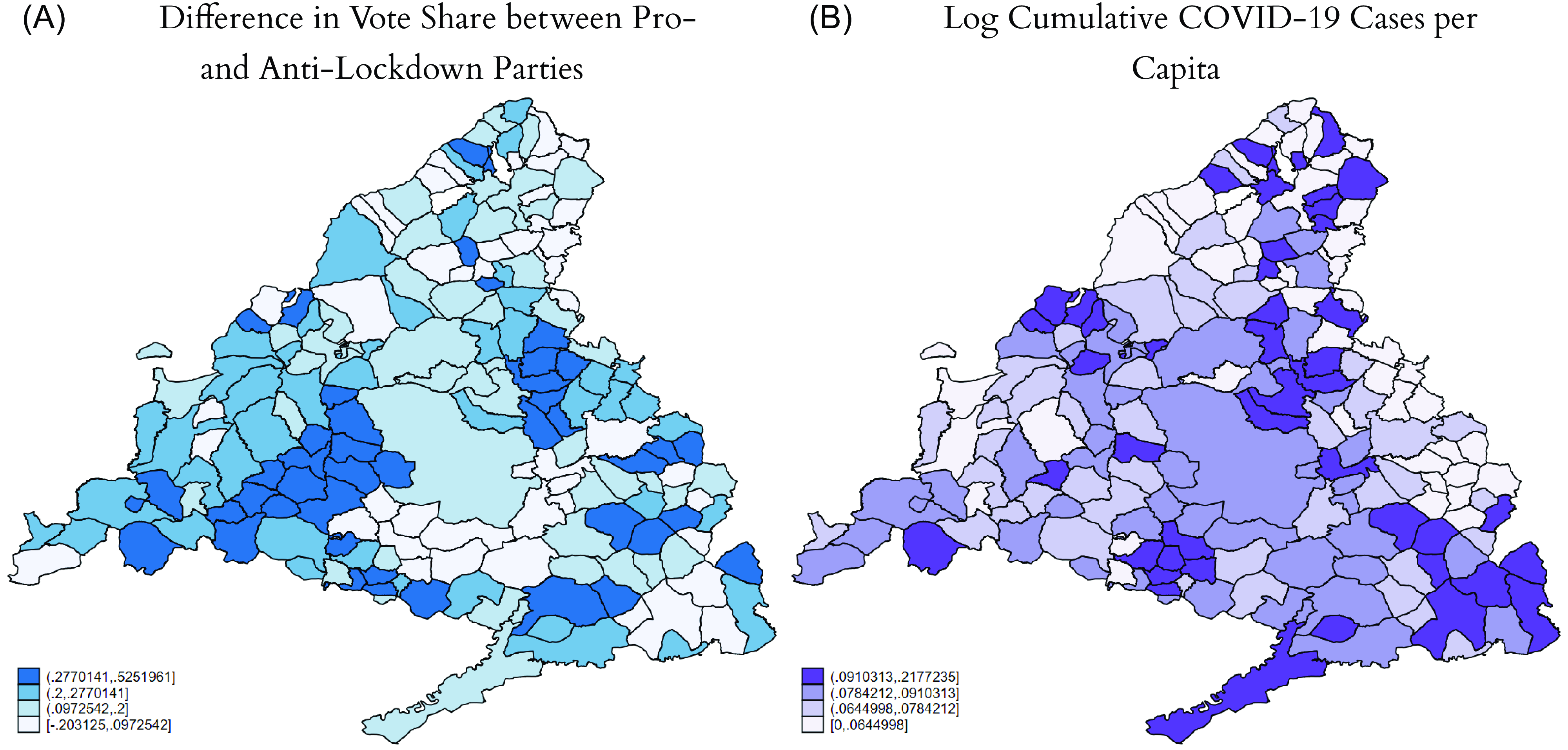
In panel B of Figure 5, Madrid’s municipalities are shaded by the logarithm of cumulative COVID-19 cases per capita as of the election. Comparing panels A and B suggests only a modest association between COVID-19 incidence and the excess vote share of pro-lockdown parties. Indeed, the correlation between the two shading variables is just
 $r$
= 0.07.
If the VoA approach is correct, however, this pattern may be concealing important heterogeneity in the relationship between distinct COVID-19 anxieties and support for pro- versus anti-lockdown parties. To generate testable implications from the framework, we follow Bisbee and Honig (Reference Bisbee and Honig2022) and Depetris-Chauvin and González (Reference Depetris-Chauvin and González2023) in assuming that concern about COVID-19 increases with local infection rates. As shown in Table A12 of Online Appendix D, the CIS survey data offer support for this assumption: conditional on the controls and fixed effects in Equation 5, Log COVID CPC
 $_{j(i)t}$
is a strong positive predictor of COVID Anxiety
 $_{it}$
. In addition, aggregate trends in new COVID-19 cases and COVID Anxiety
 $_{it}$
broadly tracked one another throughout the CIS sample (Figure A6).
Taking local COVID-19 incidence as a proxy for general anxiety about the disease enables us to derive two hypotheses about voting patterns in the Madrid election. First, in municipalities where voters are more vulnerable to COVID-19’s health consequences, such as those with a higher proportion of elderly citizens or people with underlying medical conditions, COVID-19 incidence will have a stronger positive association with support for pro-lockdown parties (that is, PSOE, Podemos, Ciudadanos, Más Madrid) and a negative association with support for anti-lockdown parties (that is, PP and Vox). Second, in municipalities where voters are more exposed to COVID-19’s economic costs, such as those at the extremities of the income distribution and with sizable hospitality or construction sectors, COVID-19 incidence will have a stronger negative relationship with support for pro-lockdown parties and a positive relationship with support for anti-lockdown parties.Footnote 24
Data and Specification
We test our conjectures at the municipality level, regressing changes in the vote share of pro- and anti-lockdown parties since Madrid’s previous (May 2019) election on interactions between COVID-19 incidence and socio-demographic proxies for exposure to COVID-19’s health and economic consequences:
 $$\matrix{ {\Delta {\rm{Vote \,Shar}}{{\rm{e}}_{mp}} = {\beta _0} + {\beta _1}{\rm{Log \,COVID \,CP}}{{\rm{C}}_m} + {\beta _2}{\rm{Exposur}}{{\rm{e}}_m} + {\beta _3}{\rm{Log \,COVID \,CP}}{{\rm{C}}_m}} \cr { \times \;{\rm{Exposur}}{{\rm{e}}_m} + \theta \Delta {{\bf{X}}'_{m}} + {\lambda _j} + {\varepsilon _{mjp}}} \cr }$$
where
 $\Delta Vote\,Shar{e_{mp}}$
is the difference in party group
 $p$
’s vote share in municipality
 $m$
between the 2019 and 2021 elections; Log COVID CPC
 $_m$
is the logarithm of cumulative COVID-19 cases per capita in
 $m$
by the 2021 election;
 ${{\bf{X}}'_{m}}$
is a vector of demographic (population, male-female ratio, age distribution), economic (employment rate, GDP per capita), and COVID-related (nursing places per capita, altitude, share of agricultural land, voter turnout) controls, most of which are first-differenced between 2018 and 2020;Footnote
25
and
 ${\lambda _j}$
denotes fixed effects for NUTS-4 regions, a territorial unit designated by Madrid authorities that is similar to a district.
We employ four measures of Exposure
 $_m$
, the first two focus on health effects and the last two on economic effects:
-
1. Elderly Share
 $_m$
: the share of
$m$
’s population aged above 65 years in 2020.
-
2. Log Respiratory DPC
$_m$
: the logarithm of respiratory deaths per capita in
$m$
in 2020. -
3. Top/Bottom Income
$_m$
: a dummy for whether
$m$
’s per capita income is in the top or bottom 5 per cent of Madrid municipalities in 2020. -
4. Hospitality Share
$_m$
: the share of the hospitality and distribution sector in
$m$
’s GDP in 2020.


Electoral results come from the Madrid regional government (Comunidad de Madrid 2022), nursing home statistics from Spain’s Ministry of Economy and Competitiveness (Envejecimiento en Red 2022), and data on the exposure proxies and remaining controls from Madrid’s statistics office (Instituto de Estadística de la Comunidad de Madrida 2022). Robust standard errors are clustered by NUTS-4 region.Footnote 26
As there were no COVID-19 cases in 2019, Equation 8 is effectively a first-difference estimator. In our two-period setting, it is thus similar to a standard difference-in-differences estimator with unit and time fixed effects. While we favour the first-difference approach due to its parsimony and statistical power – with two periods and many units, a difference-in-differences strategy entails a high ratio of variables to observations – the latter yields comparable results (see Table A16, Online Appendix E). In both designs, the key identifying assumption is that the pretreatment trend in the dependent variable does not differ between treated and control units. Figure A9 in Online Appendix E provides graphical evidence for this assumption: between the 2007 and 2019 Madrid elections, the mean vote share of pro- and anti-lockdown parties evolved in an essentially identical fashion in municipalities (1) in each quartile of Log COVID CPC
 $_m$
and (2) above and below the median of Log COVID CPC
 $_m$
.
Results
Based on the results of Equation 8, Figure 6 plots the estimated marginal effect of Log COVID CPC
 $_m$
on
 $\Delta Vote\,Shar{e_m}$
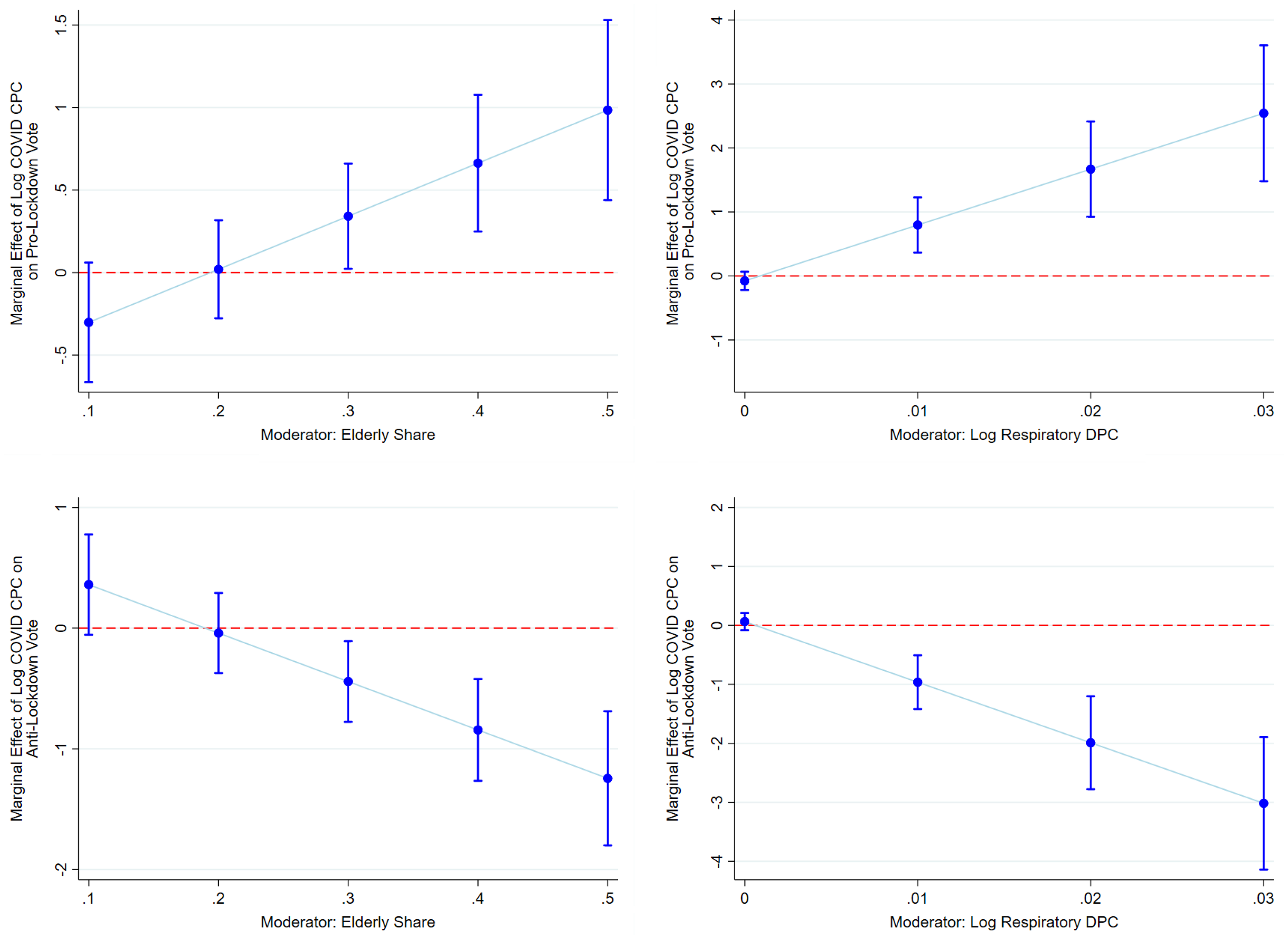
for pro-lockdown parties (top row) and anti-lockdown parties (bottom row) across the two proxies for exposure to COVID-19’s health consequences. At low values of Elderly Share
 $_m$
and Log Respiratory DPC
 $_m$
, this effect is statistically indistinguishable from 0 at a 5 per cent significance level. At high values, in line with expectations, it becomes positive and significant when the outcome is the pro-lockdown
 $\Delta Vote\,Shar{e_m}$
, rising by an average of 1.95 percentage points; and negative and significant when the outcome is the anti-lockdown
 $\Delta Vote\,Shar{e_m}$
, declining by an average of 2.34 percentage points.
Marginal Effect of COVID-19 Incidence on Support for Pro- and Anti-Lockdown Parties in Madrid Across Proxies for Health Exposure.
Notes: Marginal effect estimates derived from the results of Equation 8 (reported in panel A of Table A14, Online Appendix E) with 95 per cent confidence intervals based on robust standard errors clustered by NUTS-4 region.
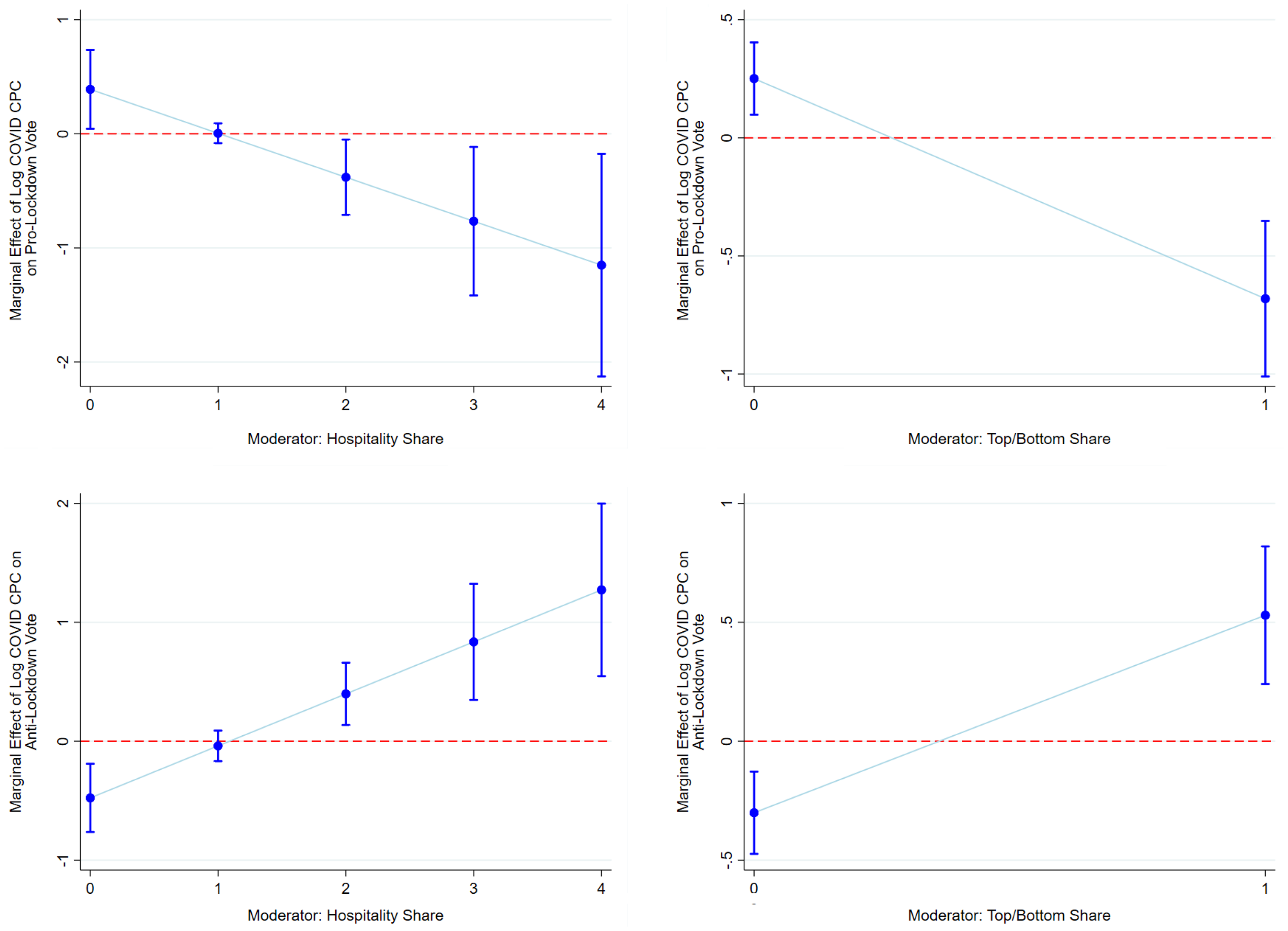
When we substitute in the proxies for economic exposure in Figure 7, the results are reversed. Log COVID CPC
 $_m$
’s marginal effect on the pro-lockdown
 $\Delta Vote\,Shar{e_m}$
is negatively associated with Top/Bottom Income
 $_m$
and Hospitality Share
 $_m$
(top row), falling by an average of 1.24 percentage points as we move from their lowest to their highest values. In contrast, its marginal effect on the anti-lockdown
 $\Delta Vote\,Shar{e_m}$
is positively associated with the two moderators (bottom row), growing by an average of 1.29 percentage points between their extremities.Footnote
27
Marginal Effect of COVID-19 Incidence on Support for Pro- and Anti-Lockdown Parties in Madrid Across Proxies for Economic Exposure.
Notes: Marginal effect estimates derived from the results of Equation 8 (reported in panel B of Table A14, Online Appendix E) with 95 per cent confidence intervals based on robust standard errors clustered by NUTS-4 region.
Instrumental Variables Strategy
COVID-19 cases were not randomly distributed across Madrid’s municipalities in May 2021, and it is conceivable that their frequency reflected unobserved municipality- and time-varying factors that also impacted voting decisions. To address this possibility, we build on Qiu et al.’s (Reference Qiu, Chen and Shi2020) analysis of COVID-19 transmission by pursuing an instrumental variables strategy that exploits local weather patterns in the run-up to the election. Using a two-stage least squares (2SLS) estimator, we instrument Log COVID CPC
 $_m$
with four month-level weather variables averaged over the half-year preceding the 2021 election: (1) municipality
 $m$
’s rainfall in millimetres; (2)
 $m$
’s mean daily temperature in degrees Celsius; (3)
 $m$
’s maximum wind speed in kilometres/hour; and (4)
 $m$
’s temperature
 $ \times $
wind speed.Footnote
28
As these variables are known to suppress COVID-19 transmission, their pre-election trends should strongly predict Log COVID CPC
 $_m$
. Conditional on covariates, however, they are unlikely to influence attitudes toward pro- and anti-lockdown parties (as distinct blocs) via an alternative channel. While election-day weather patterns have been found to directly influence party vote shares through channels such as turnout and voter mood (Mellon Reference Mellon2023), we measure our instrument before the Madrid election, rendering the exclusion restriction considerably more plausible.
The 2SLS results are presented in Table A17 of Online Appendix E. High first-stage F-statistics indicate that weather patterns are a strong predictor of COVID-19 incidence at the municipality level, allaying any potential concerns about weak instrument bias. The second-stage estimates are consistent with those in Table A14, suggesting that the OLS estimates were not merely an artefact of endogeneity in the geographical distribution of the pandemic.
Discussion
While increasingly sensitive to the wide array of subjective mental states that make up the human experience, scholarship on the determinants of voting behaviour has often treated anxiety in an undifferentiated fashion, placing voters on a continuous one-dimensional spectrum ranging from ‘anxious’ to ‘not anxious’. This study has made the case for a disaggregated approach that acknowledges and places emphasis on the multiplicity of anxieties that can arise from individual societal threats, their uneven distribution across socio-demographic groups, and their distinctive implications for political strategy and preference formation. Since one type of anxiety may be alleviated by a different or conflicting policy to another type, our VoA perspective contends, these emotions can give rise to new bases of electoral competition, with the potential upshot that – rather than behaving as a homogeneous bloc – anxious voters exhibit disparate behaviour at the ballot box.
As a mass societal threat that has spawned multiple forms of anxiety, the COVID-19 pandemic presents a useful opportunity to illustrate and assess the VoA framework. Our empirical examination focused on key phases of Spain’s pandemic, drawing on a combination of nationally representative survey data, an original survey experiment, and municipality-level electoral results. We adduced consistent evidence for two key implications of the framework. First, anxiety about COVID-19’s health consequences is positively associated with support for parties that champion stringent lockdown restrictions, while anxiety about its economic implications is positively associated with support for parties that back more permissive measures. Second, COVID-related health anxiety is an increasing function of socio-demographic characteristics that render individuals more vulnerable to severe COVID-19 symptoms; COVID-related economic anxiety increases with characteristics that expose individuals to serious financial harm as a result of the pandemic.
These findings showcase a central payoff of the VoA approach, namely, its ability to account for heterogeneity in electoral preferences among worried individuals that we would not expect if anxiety were a unidimensional emotion. In shedding such light, it complements and helps to clarify the scope of existing theories of how anxiety influences voting behaviour. Through a VoA lens, for instance, the common view that anxiety disposes voters toward protective policies requires a crucial caveat: what voters perceive as protective is contingent upon the particular type of anxiety they experience. The VoA approach hence adds nuance to standard applications of the spatial model of voting, drawing attention to the emotional complexity of voter utility functions as well as to the essentially subjective nature of the valence component, which can create sharp cleavages among voters who value the same candidate qualities.
Our perspective is less compatible with the stronger claim that anxiety benefits conservative parties or hurts incumbents. When societal threats emerge as axes of political contention, it can be challenging for any party to relieve all forms of anxiety afflicting the electorate. During the pandemic, as we have seen, parties across the ideological spectrum sought to balance the protection of public health against the minimization of economic disruption. How parties resolve such dilemmas, the VoA perspective suggests, is likely to reflect the distribution of different threat-induced anxieties across key socio-demographic constituencies.Footnote 29 The broader takeaway is that identifying anxiety’s electoral winners and losers requires a careful understanding of the varied forms it may assume in response to societal threats, the socio-demographic contexts in which such perils arise, and the strategies political elites pursue to address them.
Implicit in this discussion is an important set of scope conditions for the VoA approach itself: societal threats carry heterogeneous welfare implications for major socio-demographic groups and are sufficiently salient to create tradeoffs between competing public policy objectives. When tackling a given threat is welfare-enhancing for all or an extremely high proportion of voters, as we might expect in the case of a nuclear war or humanitarian catastrophe, the approach’s additional explanatory power will probably be limited. Even setting aside COVID-19, however, salient threats that entail challenging tradeoffs for policymakers are not difficult to find, from transnational terrorism and climate change to immigration shocks and financial crises. We are thus confident that our framework can be applied to diverse issues of interest to social scientists, while acknowledging that there are circumstances in which alternative perspectives may be more useful.
In addition, we believe that the principles of the VoA approach can be fruitfully extended to the analysis of other complex emotions that play a role in political life, such as anger, fear, disgust, sadness, hope, and enthusiasm (for example, Aytaç et al. Reference Aytaç, Rau and Stokes2020; Kupatadze and Zeitzoff Reference Kupatadze and Zeitzoff2021; Shandler et al. Reference Shandler, Gross, Backhaus and Canetti2022). While social scientists have made substantial progress in conceptualizing and delineating emotions with similar characteristics, such as anger and fear, less attention has been paid to the diversity of forms each one can take – and still less to the causes and consequences of such variation. Anger, for instance, can be triggered by any number of social, cultural, and economic phenomena, potentially generating distinct emotional states associated with varying – potentially conflicting – political attitudes and preferences (for example, anger about immigration versus anger about racial injustice). A systematic exploration of the rich variety inherent in individual emotions can, in our view, yield significant dividends for the study of political behaviour.
Supplementary material
Supplementary material for this article can be found at https://doi.org/10.1017/S0007123425000377.
Data availability statement
Replication data for this paper can be found at https://doi.org/10.7910/DVN/VD6ZBX.
Acknowledgements
For valuable comments on previous drafts, we are grateful to Ella Bayi, James Bisbee, Kirill Chmel, Ruben Durante, Jeffry Frieden, Dan Honig, John Marshall, Walter Mattli, Beatrice Montano, and seminar participants at Columbia University, the London School of Economics, the University of California, San Diego, and the University of Oxford.
Financial support
This research received no specific grant from any funding agency, commercial or not-for-profit sectors.
Competing interests
None [to disclose].


 Open access

