

1. Introduction
National and local governments have frequently used smoking bans in attempts to affect smoking behaviour. Smoking has been banned in public places, including workplaces, restaurants, and bars, as a means of limiting non-smoker exposure to second-hand smoke and of discouraging smoking (Shetty et al., Reference Shetty, DeLeire, White and Bhattacharya2011). In March 2004, the Tobacco Smoking (Prohibition) Regulations 2003 (hereafter referred to as the ‘workplace smoking ban’) were implemented in Ireland. The introduction of these regulations meant that Ireland became the first country to introduce a nationwide workplace smoking ban. With a small number of exceptions, smoking was prohibited in all Irish indoor workplaces, with employers being fined for non-compliance.
The primary aim of the smoking ban was to reduce the negative externalities associated with the consumption of cigarettes, mainly the health risks related to passive or second-hand smoke. In its 2007 Annual Report, the National Tobacco Control Office (2007) (NTCO, formerly Office of Tobacco Control) showed that 95% of workplaces were compliant with the smoking ban, suggesting that the primary aim of the ban was met. With such a high rate of compliance among employers, an extra non-monetary cost of smoking was imposed on the majority of employed smokers, thus providing them with an extra incentive to quit smoking. The aim of this paper is to examine whether the extra cost on employed smokers was enough to cause a significant reduction in smoking rates among the employed population.
The Irish workplace smoking ban is a good natural experiment to measure the impact of workplace smoking bans on smoking behaviour. First, as reported by the NTCO, compliance with the ban was good. Second, there is a clear cut-off date, a natural treatment group (the employed) and a natural control group (the non-working population). Moreover, the compulsory and nationwide nature of the Irish workplace smoking ban ensures that assortative matching between firms and workers, and endogeneity issues with the firms that choose to implement voluntary smoking bans are made redundant. This enables us to measure accurately the impact of the ban through a difference-in-differences (DiD) identification strategy. The use of DiD allows us to examine changes in smoking prevalence in both the general population and within sub-groups of the population.
The remainder of the paper is organised as follows. In section two, we examine the related literature, and discuss how this paper adds to the existing body of knowledge on the effects of smoking bans. In section three, the DiD approach and the econometric estimation techniques used in the paper are presented and analysed. Section four discusses the data and presents some descriptive statistics. Section five reports the results found from the regression analysis and provides some explanations for the patterns observed. Finally, section six concludes.
2. Context
The NTCO compiles regular statistics concerning smoking patterns in Ireland. Figure 1 shows a breakdown of smoking prevalence in Ireland by gender. Although there seems to be a reduction in smoking prevalence following the introduction of the smoking ban in March 2004, by end-2006 smoking prevalence seems to have increased close to its previous levels. In this paper, we focus on the longer term effect of the smoking ban, when smoking behaviour has fully adjusted to the smoking ban. We therefore ignore any short-term response to the ban.
Figure 2 shows the trends in the composition of smokers in Ireland around the time of the introduction of the workplace smoking ban. By 2007, three years after the introduction of the smoking ban, the proportion of regular smokers remained constant, while light and occasional smokers represented an increased share of total smokers. The proportion of heavy smokers decreased since the introduction of the ban. This could be the result of heavy and regular smokers reducing their levels of smoking or quitting smoking altogether. Alternatively, the patterns could be explained by non-smokers becoming light or occasional smokers. In this paper, we attempt to disentangle these patterns and identify the true effect of the workplace smoking ban on different groups in Ireland.
3. Literature review
Following the increase in the number of smoking bans worldwide, several strands of literature have developed examining the effects of the bans. One such area is the health of bar and restaurant staff, and the health of their customers. Allwright et al. (Reference Allwright, Paul, Greiner, Mullally, Pursell, Kelly, Bonner, D’Eath, McConnell, McLaughlin, O’Donovan, O’Kane. and Perry2006), for example, found that non-smoking bar workers’ exposure to secondhand smoke was reduced after the introduction of the workplace smoking ban in Ireland. Most relevant to this paper, however, is the research on the effect of smoking bans on smoking prevalence among different groups in society. Although most of the research on smoking bans finds some significant effect of the bans, there is also a body of literature that suggests that smoking bans have no effect on health outcomes or on general smoking prevalence.
3.1 Research on the Irish Workplace Smoking Ban
Fong et al. (Reference Fong, Hyland and Borland2006) carried out an interesting study on the psychosocial and behavioural impact of the smoking ban in Ireland. Using a telephone survey of 1679 adult smokers in Ireland and the United Kingdom (65% in Ireland) before and after the Irish ban, they surveyed respondents on smoking, quitting and socialising in bars and restaurants. They reported that 46% of Irish smokers said the law had made them more likely to quit and 83% believed that the law was a ‘good’ or ‘very good’ thing. Among Irish smokers who have quit post-legislation, 80% reported that the law had helped them quit and 88% reported that the law helped them stay off cigarettes. 16% of smokers surveyed after the legislation (n=119) had quit smoking, although we do not know how many of these cases would also have quit in the absence of the workplace smoking ban.
When modelling the market demand for cigarettes in Ireland, Reidy and Walsh (Reference Reidy and Walsh2011) found that only price, income, the introduction of the smoking ban, EU enlargement and a point of sale advertising ban were statistically significant determinants of the demand for cigarettes over the 2002 to 2009 period. They accounted for the 2004 smoking ban by introducing a binary independent variable for before and after 2004, and found that the introduction of the smoking ban resulted in a reduction in consumption of cigarettes of just over a third of a per cent. Interestingly, the authors suggested that taxation on cigarettes had moved beyond a critical point of smoking reduction, so there was greater need for other measures to stop individuals smoking.Footnote 1 If this is the case, the workplace smoking ban should act as a complement to the existing taxes by imposing a further non-monetary cost on smoking. A more thorough study of the effect of the smoking ban may therefore find a greater reduction in the consumption of cigarettes as a result of the ban.
Only the market for taxed cigarettes was analysed in the Reidy and Walsh paper. Therefore, much of the effect of the ban that they found could be the substitution effect of people switching from taxed cigarettes to counterfeit cigarettes or cigarettes purchased legally outside the state. They estimated that up to 20% of cigarettes smoked in Ireland are untaxed. The use of self-reported cigarette consumption in this paper should give a more detailed account of the effect of the smoking ban on individual smoking behaviour.Footnote 2 In addition, Reidy and Walsh did not include a time trend in their regression, and so could be misdiagnosing a downward trend in smoking rates as an effect of the smoking ban.Footnote 3 With these issues accounted for, this study should give a more accurate account of the true effect of the workplace smoking ban.
3.2 Beyond the Irish workplace smoking ban
Conducting a meta-analysis of 26 studies on the effect of smoke-free workplaces in the United States, Australia, Canada and Germany, Fichtenberg and Glantz (Reference Fichtenberg and Glantz2002) found that wholly smoke free workplaces are associated with a smoking prevalence reduction of 3.8% and 3.1 fewer cigarettes smoked per day per continuing smoker. The time between implementation of the totally smoke free workplace policies and the follow up survey ranged from one to 24 months. The authors found that the correlation between length of follow up and effect was not significant, so the effects of smoke free workplaces after they were implemented remained stable over time.
De Chaisemartin et al. (Reference De Chaisemartin and Geoffard2010) found mixed results following the introduction of a smoking ban in France. The authors found an increase in the number of people who consult tobacco cessation services and in the number of successful attempts to quit smoking. In a follow up study, De Chaisemartin et al. (Reference De Chaisemartin, Geoffard and Le Faou2011) showed that this effect is particularly strong among ‘unhappy’ addicts – those smokers who consult tobacco cessation services. However, the 2010 paper showed that the ban had no measurable effect on overall prevalence in the general population. The authors used a DiD approach, similar to the approach taken in this paper, and found the smoking ban had no impact either on French smoking prevalence nor on daily cigarettes smoked.
The small number of studies that find smoking bans have little or no effect may be due to a publication bias preventing null effect studies from being published, thus biasing the overall impression from the literature, according to Shetty et al. (Reference Shetty, DeLeire, White and Bhattacharya2011). Using US data from 1990 to 2004, the authors compared the short-term changes in mortality and hospitalisation rates in smoking restricted areas against the same measures in control areas. Using a fixed effects model, they found no statistically significant short-term declines in either mortality or hospitalisation.
Studies that examine regional or voluntary bans can suffer from the selection bias issues resulting from workers changing jobs based on their propensity to smoke, or new employees being deterred or encouraged by the existing smoking policy in the firm. Furthermore, the willingness of a firm to introduce a voluntary ban might be heavily influenced by the proportion of existing workers who already smoke (de Chaisemartin et al., Reference De Chaisemartin and Geoffard2010). In contrast, a national workplace ban makes these selection issues redundant, so these selection issues are negated in this paper.
Overall, the literature is reasonably consistent in its results. Smoking prevalence over the general population can range from remaining unchanged to experiencing a small decrease, with smoking bans, unsurprisingly, having the largest effect on those directly affected by the ban.
4. Methodology
We outline our research design by providing an overview of the DiD approach employed to carry out the analysis. This approach is similar to that followed in Madden et al. (Reference Madden, Nolan and Nolan2005). We then describe the empirical estimation methods used in the paper.
4.1 Research design
In this section, we outline the design of the DiD estimator. We identify two groups within the population: an employed group and a non-working group. We then identify two time periods: before and after the introduction of the 2004 workplace smoking ban. Let
 $$\eqalignno{ & q_{{{\rm o},\,{\rm emp}}} \,=\,{\rm the}\,{\rm percentage}\,{\rm of}\,{\rm employed}\,{\rm individuals}\,{\rm smoking}\,{\rm before}\,{\rm the}\,{\rm ban} \cr & q_{{{\rm 1},\,{\rm emp}}} \,=\,{\rm the}\,{\rm percentage}\,{\rm of}\,{\rm employed}\,{\rm individuals}\,{\rm smoking}\,{\rm after}\,{\rm the}\,{\rm ban} \cr & q_{{{\rm o},\,{\rm non}}} \,=\,{\rm the}\,{\rm percentage}\,{\rm of}\,{\rm non}{\hbox-}{\rm working}\,{\rm individuals}\,{\rm smoking}\,{\rm before}\,{\rm the}\,{\rm ban} \cr & q_{{{\rm 1},\,{\rm non}}} \,=\,{\rm the}\,{\rm percentage}\,{\rm of}\,{\rm non}{\hbox-}{\rm working}\,{\rm individuals}\,{\rm smoking}\,{\rm after}\,{\rm the}\,{\rm ban} $$
Using the DiD methodology, we compare the difference between the change in rates of smoking in each group before and after the smoking ban. For the employed treatment group, the total difference in smoking rates before and after the ban is q 1, emp−q 0, emp. For the non-working control group, the total difference in smoking rates before and after the ban is q 1, non−q 0, non. The DiD equation is therefore expressed as
 $$\left( {q_{{{\rm 1},\,{\rm emp}}} \,-\,q_{{0,\,{\rm emp}}} } \right)\,-\,\left( {q_{{{\rm 1},\,{\rm non}}} \,-\,q_{{0,\,{\rm non}}} } \right).$$
By making some reasonable assumptions, we should be able to predict the sign of this equation. First we examine the expected sign of the (q 1, emp−q 0, emp) term. We assume that the cost of smoking for the employed group increases after the introduction of the smoking ban. Therefore, we would expect the rates of smoking among the employed to drop as a result of the ban. This implies that the first term in the equation should be negative, as we expect q 0, emp>q 1, emp.
There is more ambiguity about the sign of the second term in the equation (q 1, non−q 0, non). It is likely that non-working individuals spend some of their time in workplaces affected by the smoking ban, such as pubs and restaurants, and so may be affected by the ban to a certain extent. We would therefore expect the term to be at least non-positive. However, based on the common trend assumption upon which the DiD technique relies, there is no factor that changes the incentive to smoke for the non-working group more than it does for the employed group. Critically, we assume that non-working individuals spend less time in workplaces, and so the largest increase in the non-monetary cost of smoking is on the employed. As such the model predicts that the DiD should be negative. A DiD equal to zero implies that the smoking ban has equal effect on both the non-working and the employed groups. A positive DiD implies that smoking rates among the employed increased relative to the non-working group following the introduction of the workplace smoking ban. A relative increase includes the situation where smoking prevalence in both groups reduces following the introduction of the smoking ban, but reduces by more in the non-working control group. This would result in a positive DiD coefficient, and a relative increase in smoking amongst the employed.
Using the Slán data described in the following section, we are able to clearly identify a number of potential control groups and treatment groups. We are also able to identify a control period and a treatment period. The control period is the period before the introduction of the ban and the treatment period is the period after the introduction of the ban.
4.2 Empirical estimation
We use regression analysis to estimate the DiD term. As before, we can let q o, non denote the sample average of smoking prevalence for the non-working control group for the control period and q 1, non denote its value for the treatment period. Define q o, emp and q 1, emp similarly for the employed treatment group. Then the estimator of the DiD coefficient, δ 1, can be expressed as
 $$\delta _{{\rm 1}} \,=\,\left( {q_{{{\rm 1},\,{\rm emp}}} \,-\,q_{{0,\,{\rm emp}}} } \right)\,{\minus}\,\left( {q_{{{\rm 1},\,{\rm non}}} \,-\,q_{{0,\,{\rm non}}} } \right).$$
We can estimate this coefficient in the equation:
 $$y\,=\,\beta _{0} \,{\plus}\,\delta _{0} {\rm dT}\,{\plus}\,\beta _{{\rm 1}} {\rm dG}\,{\plus}\,\delta _{{\rm 1}} \left( {{\rm dT}\,{\asterisk}\,{\rm dG}} \right)\,{\plus}\,{\varepsilon},$$
where, y is the outcome of interest, dT is a dummy variable for the time periods and dG is a dummy variable for the groups. The dummy dG equals one for the treatment group and zero otherwise, and captures the difference between the control and treatment groups before the policy change. The dummy dT equals one for the treatment period and zero for the control period, and captures the aggregate factors that affect the two groups over time. The use of δ 1 means that both group-specific and time-specific factors are controlled for.
The coefficient δ 1 captures the effect of the interaction between the policy change and the treatment group as the term dT×dG only takes a value of unity for those observations in the treatment group in the treatment period. We can also estimate the above equation including several independent variables to control for other factors that may affect the relationship.
The dependent variable in equation 3 above is binary, which suggests the use of a probit model would be more appropriate than a linear probability model. However, Ai and Norton (Reference Ai and Norton2003) warn of the dangers associated with estimating the marginal effects of interaction terms after using non-linear models. They suggest that the use of a non-linear model in such a setting, using standard statistical software, can result in incorrect statistical significance, and even the incorrect sign on the coefficient. Puhani (Reference Puhani2008), however, suggests that Ai and Norton’s critique does not apply to the estimation of DiD coefficients, and so it is correct to focus on the coefficient of the interaction term in a non-linear model. In light of this debate, the results in this paper are estimated using a linear probability model. As a robustness check of our results, we also used a probit modelFootnote 4 and found remarkably similar results.
5. Data
We use two waves (2002 and 2007) of the Survey of Lifestyle, Attitudes & Nutrition (Slán) for the main body of research in the paper. This data set provides a sample of the population in Ireland before and after the introduction of the 2004 smoking ban. The data allow for the identification of a number of key characteristics for the analysis, namely smoking status and employment status, as well as several potential control variables. Sufficient time passes between the collection of the data and the introduction of the smoking ban to ensure that we can measure the long term impacts of the smoking ban. The 1998 wave of the same data set is also used for robustness checks.
There is some variation in the methodologies employed between the 2002 and 2007 waves. Most notably, the survey method changed from a postal self-completed questionnaire to a face-to-face interview.Footnote 5 The change in surveying method can result in different biases in the data through differing response rates by certain sub-groups in the population and different response patterns to certain questions.
The issue of different survey response ratesFootnote 6 does not in itself present a significant impediment to the analysis. To ensure that the Slán surveys are comparable across the waves and representative of the population, a weighting variable is introduced for the 2002 and 2007 data. The weight used in the 2007 survey, for example, compensates for the over-representation of individuals in smaller households, a consequence of the sampling frame used, according to Morgan et al. (Reference Morgan, McGee, Watson, Perry, Barry, Shelley, Harrington, Molcho, Layte, Tully, van Lente, Ward, Lutomski, Conroy and Brugha2008). A potentially more serious issue caused by the change in survey method is the possibility of different response patterns to certain questions in the survey, particularly the questions on smoking habits. Indeed, in a comparison of surveying methods, de Leeuw (Reference De Leeuw1992) found that mail surveys resulted in fewer ‘socially desirable’ answers on sensitive questions than face-to-face interviews.Footnote 7 Although we cannot tell for certain whether this is a significant problem in the Slán data, we have two reasons to believe that our results will not be significantly affected by this sort of bias in the data. First, if the change in survey methods caused a change in response patterns to the smoking questions, we would expect one of the two years of data to report significantly different smoking patterns than available external statistics. In particular, we would expect the 2007 wave to significantly under report smoking prevalence, as de Leeuw predicts a higher level of ‘socially desirable’ answers in face-to-face interviews. However, we find a similar level of smoking rates reported in the Slán data compared with those reported by the NTCO.Footnote 8 In 2007, both sources report a smoking prevalence in Ireland of ∼28%. Unfortunately, the NTCO smoking statistics only start in 2003, so we are restricted to comparing the Slán 2002 smoking rates to 2003 NTCO figures. Again this comparison looks favourable, with Slán 2002 reporting a 27% smoking prevalence, compared with 28% according to the NTCO.
Second, the methodology employed in this paper should help to negate possible biases left in the responses to certain questions in the data. The DiD will only be affected if the change in survey method affected the responses of the treatment group more than it did for the control group (or vice versa). Although weighting will account for any changes in response rates by sub-groups of the population, the encouraging comparisons with NTCO smoking statistics, along with a suitable methodology, should help to alleviate concerns about bias in the responses on smoking habits. We are confident therefore that the change in survey method between 2002 and 2007 should not significantly alter the results of this analysis.Footnote 9
5.1 Treatment and control groups
To construct the employed treatment and non-working control groups, we also require data on employment status. The data for this variable is relatively comparable between the years. We can identify employee, self-employed, homemaker, unemployed, student, farmer and retired respondents in both waves of the data.
This allows us to identify a number of potential control groups. The groups most likely to be unaffected by the workplace smoking ban are the retired, homemakers, farmers, and the unemployed. Although farmers are employed, they could qualify as a control group as their work predominantly takes place outside and so should be unaffected by the workplace smoking ban. We can also include students as a potential control group on the basis that smoking was already banned from educational facilities under previous legislation, while they are also likely to have shorter working hours and more freedom than the employed to go outside to smoke. However, upon further inspection, many of these groups turn out to be unsuitable to use as control groups. The unemployed, farmers and students all lack enough observations to be able to estimate significant coefficients. Farmers, for example, have only 54 observations of regular smokers in 2007.
The retired and homemaker groups seem to be the most suitable control groups for the analysis. To introduce additional non-working control groups, we combine the different potential control groups to form a control group with enough observations to run the regressions. Using this method, we are able to form two additional control groups. The first additional control group is a combination of homemakers, farmers, unemployed and students. We also add the retired to this control group to form a control group of all the individuals not directly affected by the workplace smoking ban.
The treatment group consists of both the employees and self-employed. We drop the self-employed from the treatment group in a robustness check of the results.
5.2 Dependent and explanatory variables
The dependent variable in the analysis is smoking status. In the data, we can see if an individual is a regular smoker, an occasional smoker or a non-smoker. In 2002, respondents were asked ‘Do you smoke now?’, to which they could reply ‘No’, ‘Yes, regularly’ or ‘Yes, occasionally (usually less than 1 per day)’. In 2007, the question was changed to ‘Do you now smoke every day, some days, or not at all?’. In the analysis, ‘Every Day’ smokers were grouped with ‘Regular’ smokers and ‘Some days’ smokers were grouped with ‘Occasional’ smokers.
From this information, we construct two dependent variables. The first omits occasional smokers, creating a dummy variable that equals one for regular smokers and zero for non-smokers. The second dependent variable groups occasional smokers with regular smokers, resulting in a dummy variable that equals one for all smokers and zero for non-smokers. There are two advantages to creating these two dependent variables. First, it allows us to identify the type of smokers most affected by the smoking ban by separately estimating the DiD coefficient for different smoking categories. Second, this method also removes some of the risk of measurement error associated with the changed wording of the smoking question between the waves of the survey. Although there may be some ambiguity about the comparability of smoking frequency of a respondent between waves, both waves make it clear whether a respondent is a smoker or not. Therefore, by combining the occasional smokers and regular smokers, we remove the potential for misclassifying respondents by smoking frequency.Footnote 10 In the analysis, we control for age, income, sex, education, the presence of private health insurance, presence of a medical card and marital status. The control variable for income is particularly important in this setting, as income growth in Ireland between 2002 and 2007 could affect smoking behaviour. We would risk misspecifying this change in behaviour as a consequence of the smoking ban if we did not control for income in the analysis.
In addition, we attempt to control for the enlargement of the EU by controlling for immigrants who first came to Ireland since 2004. In the same quarter of 2004 as the introduction of the workplace smoking ban in Ireland, 10 countries became new member states of the EU. The rationale for controlling for this event is that the increase in immigration to Ireland that occurred as a result of the enlargement changed the population of tobacco users. The demographic profile of migrants was balanced towards young, male workers. These characteristics are associated with smoking, thus capturing these effects is important. The Slán data allow us to control for the effect of the EU enlargement in two ways. First, we can simply include a dummy variable for all non-Irish respondents. More specifically, we can also identify the year each non-Irish respondent first came to Ireland. We therefore specify a control variable for all non-Irish respondents who first came to Ireland in 2004 or later.
Another potential control variable could be the amount of time an individual spends in pubs and restaurants, where they would also be affected by the smoking ban. The Slán data, however, does not provide this information. The closest information provided is the amount of alcohol the respondent consumes. However, this variable may not capture the true relationship between cigarette consumption and time spent in pubs and restaurants, as individuals may substitute consuming alcohol in pubs for consuming alcohol in a private residence as a result of the smoking ban. The alcohol consumption variable would therefore not identify this behaviour. Similarly, we do not have enough detail in the data to control for each respondent’s location. De Chaisemartin et al. (Reference De Chaisemartin and Geoffard2010) argue that a higher cost is imposed on smokers in areas with higher amounts of rainfall. However, as the variation in weather patterns in smaller countries such as Ireland is lower than in larger countries, we do not believe this will have much of an impact upon the results.
5.3 Descriptive statistics
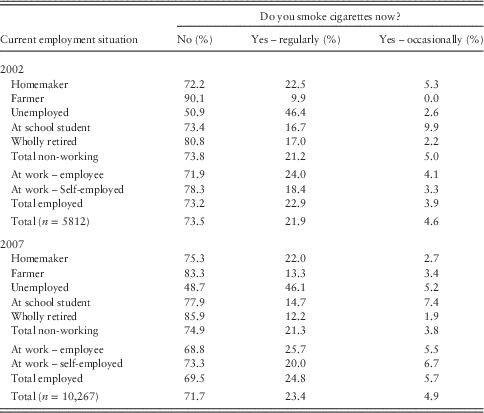
Table 1 shows the smoking prevalence among the different subgroups of the sample in the two waves of the data. The statistics indicate an interesting pattern that does not suggest a reduction in smoking prevalence among the employed from 2002 to 2007. Smoking among employees and self-employed increases from 2002 to 2007, whereas there are different patterns of smoking prevalence among the other groups. Taking the average among the potential control groups, we can see a slight increase in the amount of non-smokers, driven mainly by a decrease in the amount of occasional smokers. Overall prevalence of regular smokers in the entire population increases slightly from 21.9% to 23.4%.
Percentage of smokers by employment status

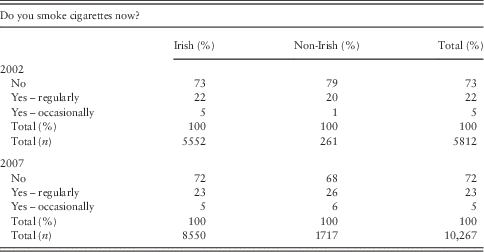
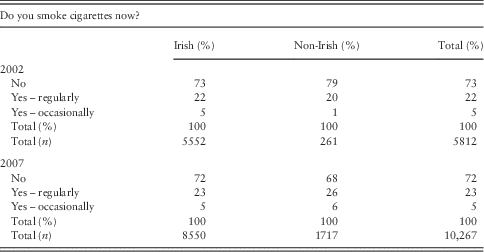
This pattern may partially be explained by the 2004 EU enlargement. Table 2 compares smoking rates among Irish and non-Irish respondents in both years of analysis. In 2002, the proportion of non-smokers among non-Irish respondents was five percentage points higher than among Irish respondents. By 2007, this pattern was reversed, when the proportion of non-smokers among non-Irish respondents was four percentage points lower than the Irish respondents. The change was driven mainly by changes in smoking patterns of the non-Irish respondents. Despite smoking rates among Irish respondents remaining quite similar in 2002 and 2007, the proportion of non-Irish respondents smoking either regularly or occasionally increased by 10 percentage points over the same time period. This reflects the change in the composition of non-Irish citizens in Ireland after 2004.Footnote 11 Smoking prevalence in the control (non-working) or, more likely, the treatment (employed) groups in the analysis may be affected by the changed composition of non-Irish respondents in the Slán 2007 survey. Without controlling for the EU enlargement, we would risk diagnosing an increase in smoking rates among either the treatment or control group as a result of the smoking ban, when it would actually be the result of the EU enlargement.
Percentage of smokers by nationality
6. Results
6.1 Estimation of the DiD coefficient
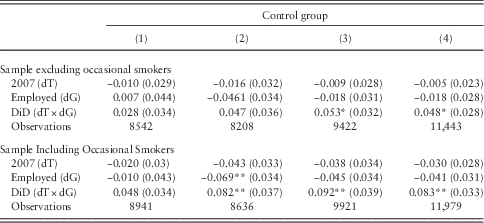
When we include only regular smokers and non-smokers in the dependent variable, the DiD coefficient is positive in all four cases. Only two out of the four, however, are significant at the 10% significance level. In addition, the time-period dummy variable, 2007, is insignificant across all four control groups.
Effect of the workplace smoking ban on smoking rates
Notes: standard errors in parentheses.
***p<0.01, **p<0.05, *p<0.1
All control variables included but not shown here.
Control groups: (1) Retired (2) Homemakers (3) Homemakers, Students, Farmers, Unemployed (4) All Inactive.
These initial results suggest that there is no evidence that smoking prevalence among the employed decreased by more than it did for other groups following the introduction of the workplace smoking ban. In addition, the results indicate that the ban itself had little or no effect on the proportion of regular smokers among the general population in Ireland.
Most interestingly, when we group occasional smokers with regular smokers in the analysis, three out of four DiD coefficients are positive and significant at the 5% significance level. This suggests that employed smokers did not reduce their smoking by more than non-working smokers following the introduction of the smoking ban. In fact, the evidence suggests a significantly larger decrease in smoking prevalence among the non-workers relative to the employed. As discussed earlier, the positive DiD coefficient could be due to an increase in smoking among the employed, or larger decrease in smoking among the non-workers than among the employed.
Out of the control variables, age, education, marital status and the presence of private health insurance are most significant. Both EU enlargement control variables are non-significant, indicating that once factors such as age, income, education and marital status are taken into Footnote account, there is no fundamental difference in smoking behaviour between the Irish respondents and those respondents who immigrated to Ireland soon after the EU enlargement.Footnote 12
The significant negative coefficient on the private health insurance variable indicates that those with private health insurance are less likely to smoke. This suggests the presence of self-selection and reflects the findings in Layte and Whelan (Reference Layte and Whelan2009) that ‘measures of disadvantage and deprivation’ are positively correlated with smoking. As private health insurance is positively correlated with income and education, in this case it is acting as a measure of advantage, and so is negatively correlated with smoking status.
The results of the regression analysis suggest that the workplace smoking ban did not induce a greater reduction in smoking prevalence among the employed population compared to any of the control groups used. We conducted a number of robustness checks to test the results. Dropping the self-employed from the analysis, we found that the DiD coefficient remained positive, and in certain cases became more significant. Similarly, when we removed those individuals who were not working in 2007 but were employed since the introduction of the smoking ban in 2004, the DiD coefficient remained significant. By using the 1998 and 2002 waves of the Slán data, we ran the same regressions in a placebo time period and found statistically insignificant DiD coefficients, rejecting the concept of a general time trend producing the above results.
6.2 Discussion
So why did the 2004 workplace smoking ban not induce a greater reduction in smoking rates among employed individuals? Here we briefly discuss two possible explanations for the behaviour identified in Section 6.1.
6.2.1 Price
The price of tobacco did not move in line with other prices and wages over the 2002 to 2007 period. While consumer prices rose by over 18%Footnote 13 and wages grew by over 29%,Footnote 14 Brugha et al. (Reference Brugha, Tully, Dicker, Shelley, Ward and McGee2009) report that in Ireland, the price of tobacco products increased by <10% in annual budgets between 1999 and 2009. They argue that it is highly likely that the stalling in the reduction of smoking prevalence rates in Ireland despite the introduction of the smoking ban is attributable, at least to some extent, to a failure to sufficiently raise cigarette taxes and prices.
Not only could this point explain the lack of a general reduction in smoking prevalence over the given time period, it may also explain why smoking prevalence among the employed did not decrease by more than among the non-working control groups. Although average wages increased dramatically over the 2002 to 2007 period, those individuals in the non-working control groups may not have seen such an increase in their income. This is particularly true of the homemakers and students, although unemployed and retired individuals may actually have had a larger growth in income from 2002 to 2007 due to increases in transfer payment rates. This may explain why we estimate an insignificant DiD term when using the retired control group.Footnote 15 Therefore, while the real price of cigarettes dropped considerably for the employed, there may not have been such a reduction in price for the control groups. Basic microeconomic theory asserts that we should observe a greater increase in consumption of cigarettes among the group who faced the larger reduction in price. This may partly explain the results of the regression analysis.
6.2.2 Risk aversion in a boom
Another possible explanation for the change in smoking patterns from 2002 to 2007 could be that risk aversion decreased among the employed over that time period, resulting in increased smoking rates in that group. Malmendier and Nagel (Reference Malmendier and Nagel2011) find that attitudes to risk can depend on macroeconomic circumstances. The second wave of the Slán data in 2007 was collected near the peak of an economic boom in Ireland. Those who accrued the greatest benefits from the boom, those in employment, would be most likely to lower their risk aversion; a consequence of this may be to increase their smoking rates.
Using the same framework as before, we estimated DiD coefficients with a binary dependent variable indicating whether an individual wore a bicycle helmet when they cycle their bike as a measure of risk aversion. Although the signs on the DiD coefficients support a reduction in risk aversion among the employed, the coefficients are not statistically significant.
7. Conclusion
With the NTCO reporting a 95% compliance rate among employers with the workplace smoking ban, the primary aim of reducing the risk of passive smoking in the workplace was achieved. However, in terms of smoking prevalence, the analysis presented in this paper suggests that the workplace smoking ban had heterogeneous impacts on different subgroups of the population. Among the employed population, the results of the paper suggest that the workplace smoking ban did not induce a greater reduction in smoking prevalence compared with any of the control groups in the analysis. In fact, the evidence suggests a significantly larger decrease in smoking prevalence among the non-workers relative to the employed. This pattern was found to be particularly strong for occasional smokers.
A number of robustness checks were carried out on the sample of observations on which we did our analysis. Dropping the self-employed from the treatment group and the recently employed from the control groups only served to increase the size and significance of the positive DiD coefficients. The pattern of increased smoking rates among the employed was not replicated in an earlier time period.
Possible explanations for the relative change in smoking behaviour between the employed and non-employed from 2002 to 2007 were examined. A fall in the real price of cigarettes from 2002 to 2007 seems to be the most likely explanation for the patterns in smoking prevalence identified in this paper. A change in risk aversion among the employed may also explain some of the pattern observed, although this is an area that requires further study.
Because of data constraints, we were unable to examine changes in the amount of cigarettes smoked before and after the introduction of the workplace smoking ban, a subject, which may provide further evidence on the impact of the ban. However, the findings on smoking prevalence suggest that the Irish workplace smoking ban had little or no effect in reducing smoking prevalence among the employed population. Indeed, smoking prevalence among non-workers decreased by a greater degree following the introduction of the workplace smoking ban.
Acknowledgements
The author thanks David Madden, Liam Delaney, Richard Layte, Tim Callan, Seán Lyons, Philip O’Connell, Claire Keane, Frances Ruane, Anne Nolan, two anonymous referees, and participants at the NUIG Applied Microeconometrics and Public Policy Conference for comments and suggestions. The author also thanks the Irish Social Science Data Archive (ISSDA) for providing access to the Slán data.