INTRODUCTION
Low-stature tree species growing on white sands in areas of the upper Rio Negro inhabit and thrive in areas near the Equator, with a typical tropical humid climate and soils with very low nutritional status (Bongers et al. Reference BONGERS, ENGELEN and KLINGE1985, Herrera et al. Reference HERRERA, JORDAN, KLINGE and MEDINA1978). These species exhibit a range of sclerophylly index values between 3.4 and 7.4 g crude fibre g−1 protein, which is related to their high C/N ratio, as a consequence of the limitation of N and P required for growth (Sobrado Reference SOBRADO2008, Reference SOBRADO2009; Sobrado & Medina Reference SOBRADO and MEDINA1980). Thus, leaf blades are very expensive to construct and maintain, both on dry-mass and leaf-area bases (Sobrado Reference SOBRADO2009). The significance of sclerophyllous leaves in species thriving in humid tropical environments with aseasonal rainfall seems to be longevity enhancement rather than drought tolerance (Turner Reference TURNER1994). The short- and long-term leaf water use efficiency for carbon assimilation is relatively low in these species (Sobrado Reference SOBRADO2008, Reference SOBRADO2009). However, stomata are fully open only in the early morning, and they close from late morning onwards (Medina et al. Reference MEDINA, GARCIA and CUEVAS1990, Sobrado Reference SOBRADO1977). Adjustment in stomatal aperture as air humidity decreases has been attributed to hydraulic constraints and is a mechanism to regulate water status (Meinzer et al. Reference MEINZER, GOLDSTEIN, FRANCO, BUSTAMANTE, IGLER, JACKSON, CZALDAS and RUNDEL1999, Reference MEINZER, WOOODRUFF, DOMEC, GOLDSTEIN, CAMPANELLO, GATTI and VILLALOBOS-VEGA2008; Sperry et al. Reference SPERRY, TYREE and DONNELLY1988a, Reference SPERRY, HACKE, OREN and COMSTOCK2002). If the xylem leaf water potential is very low, this can lead to runaway embolisms which would decrease long-term water supply to leaves (Tyree & Sperry Reference TYREE and SPERRY1988). Thus, the maintenance of a maximally efficient hydraulic system would require that stomata close in order to regulate water loss in an appropriate fashion as the evaporative demand increases, so as to prevent xylem embolisms (Bond & Kavanagh Reference BOND and KAVANAGH1999, Jones & Sutherland Reference JONES and SUTHERLAND1991, Saliendra et al. Reference SALIENDRA, SPERRY and COMSTOCK1995, Sperry et al. Reference SPERRY, HACKE, OREN and COMSTOCK2002).
The ecological trend in vessel characteristics suggests that in warm and moist tropical habitats the xylem tissue consists of wider conduits (Baas Reference BAAS and Givnish1986, Carlquist Reference CARLQUIST1988). Long-distance water transport is much more efficient in wide vessels, which are also more vulnerable to embolisms. In fact, vessel cavitation has been related to interconduit pit diameters, which may increase linearly with vessel diameter (Hacke et al. Reference HACKE, SPERRY, WHEELER and CASTRO2006). Therefore, a xylem tension causing 50% loss of hydraulic conductivity is positively related to vessel diameter within the same species (Tyree et al. Reference TYREE, DAVIES and COCHARD1994). Across species, pit membrane characteristics may vary independently of vessel size resulting in lack of relationship between vessel diameter and cavitation resistance (Choat et al. Reference CHOAT, COBB and JANSEN2008). Vessel diameter tends to decrease in terminal branches, which represents a substantial hydraulic constraint in trees (Tyree & Ewers Reference TYREE and EWERS1991, Zimmermann Reference ZIMMERMANN1983). Thus, leaves should be able to develop an increasing water potential gradient to draw water as the water transport becomes insufficient. Nevertheless, this may lead to reduced leaf turgor and photosynthesis, and can cause xylem dysfunction (Tyree & Sperry Reference TYREE and SPERRY1988). Reduction in the leaf water potential for turgor loss by lowering osmotic potential, as well as changes in elasticity, would allow the development of a large leaf-soil gradient for water uptake. Leaf pressure-volume analysis provides important parameters of leaf water relations; namely, relative water potential, osmotic potential and turgor pressure as a function of relative water content, as well as bulk elastic modulus (Richter Reference RICHTER1997, Turner Reference TURNER1981, Tyree & Hammel Reference Tyree and HAMMEL1982). This approach has been widely used to characterize plants thriving in contrasting environments as well as to assess the effect of stressing environmental conditions on adjustments to leaf water relations.
Leaf tissue characteristics reflect species adaptation to the dynamic changes in water status occurring under field conditions, and may be related to stem hydraulic sufficiency as well. However, the associations between leaf water-relation characteristics and xylem water transport have been less studied, particularly in tropical environments (Choat et al. Reference CHOAT, SACK and HOLBROOK2007). The objective of this study was to explore the leaf tissue water relations in terminal branches, as well as the relations between xylem structure and function of five species coexisting on white sand areas at the upper Rio Negro. In these species, which possess costly leaves and thrive in an extremely poor habitat, the preservation of leaf survival would be of comparable importance to the preservation of xylem vessels.
METHODS
Study site
Within upper Rio Negro basin (North Amazon), distinctive forest ecosystems have been associated to differential soil characteristics and topographical conditions (Breimer Reference BREIMER, Breimer, van Kekem and van Reuler1985, Herrera Reference HERRERA and Brünig1977, Herrera et al. Reference HERRERA, JORDAN, KLINGE and MEDINA1978). The tallest, most diverse and complex ‘tierra firme’ forests thrive on well-structured oxisols on slightly more elevated areas. The valleys with sandy spodozols are occupied by the ‘Amazon caatinga’ complex. Within these sandy areas, slightly more elevated domes have very low nutrient availability and a fluctuating water table. This zone represents an extreme stressful environment and the vegetation is known locally as ‘bana’ (Bongers et al. Reference BONGERS, ENGELEN and KLINGE1985). The tops of the domes, know as open bana, are covered by 18 woody species 2–5 m tall, sparsely distributed. The open bana is the specific vegetation on white sands where this research was conducted. A more detailed description of this type of vegetation can be found elsewhere (Bongers et al. Reference BONGERS, ENGELEN and KLINGE1985, Sobrado Reference SOBRADO2009). The studied bana is located 11 km from San Carlos de Rio Negro (Amazonas, Venezuela; 1° 54′N; 67° 03′W) within the upper Rio Negro basin. The climate in this area is very wet, with an annual rainfall of 3500 mm, with no month having less than 100 mm precipitation, and mean temperature of 26.2 °C. Several ecophysiological studies have been performed previously in this open bana (Bongers et al. Reference BONGERS, ENGELEN and KLINGE1985, Medina et al. Reference MEDINA, SOBRADO and HERRERA1978, Sobrado Reference SOBRADO1977, Reference SOBRADO2008, Reference SOBRADO2009; Sobrado & Medina Reference SOBRADO and MEDINA1980).
Study species
The species selected were: Catostemma sancarlosianum Steyerm. (Malvaceae), Heteropterys sp. (Malpighiaceae), Pachira sordida (R. E. Schult.) W. S. Alverson (syn. Rodognaphalopsis discolor A. Robyns) (Malvaceae), Retiniphyllum concolor (Spruce ex Benth.) Müll. Arg. (Rubiaceae) and Remijia morilloi Steyerm. (Rubiaceae). These species coexist at the site, and their importance value index (IVI; Müller-Dombois & Ellenberg Reference MÜLLER-DOMBOIS and ELLENBERG1974) is highest for the dominant species P. sordida (IVI = 17%), intermediate for the co-dominant species R. morilloi (IVI = 12%) and C. sancarlosianum (IVI = 10%), and lowest in Heteropterys (IVI = 8%) and R. concolor (IVI = 5%). All these species possess thick leaf blades of comparable density, as well as a low N and P concentration (Sobrado Reference SOBRADO2008, Reference SOBRADO2009; Sobrado & Medina Reference SOBRADO and MEDINA1980). Sclerophylly index (crude fibre/crude protein) is about 7.2 ± 0.8 in C. sancarlosianum and P. sordida, and 3.9 ± 0.3 in the other three species (Sobrado Reference SOBRADO2009). A total of three trees per species were tagged for all measurements. Given the small size of these trees, the amount of harvested tissue was kept to a minimum so as to preserve the trees.
Leaf water relations
Minimum tree water status was characterized by measuring midday leaf water potential (Ψ, MPa) under contrasting conditions, after 8 rainless days (November 2007) and during rainy days (January 2008). The Ψ was measured with a pressure chamber (PMS, Model 1400) in one or two twig samples per tree per species. Previous measurements of Ψ in these species were made in 1976–1977 (Sobrado Reference SOBRADO1977). Pressure-volume (P-V) curves were determined on randomly selected twigs from the tagged trees bearing 4–6 leaves. On the afternoon of the day prior to measurements, the selected twigs were bagged to allow maximal rehydration during night-time. This procedure avoids the problems associated with the rehydration of cut branches (Kubiske & Abrams Reference KUBISKE and ABRAMS1990). The following day, bagged twigs were cut and transported indoors for measurements. Four to six twigs per species were allowed to dehydrate naturally on the laboratory bench and P-V curves were constructed. The dehydration of the twigs proceeded very slowly given the thick leaf cuticles and the strong stomatal control in the detached leaves. Thus, it took up to 50 h to complete each P-V curve. During dehydration, weight loss was determined on an analytical balance and water potential (Ψ) measured immediately by using the pressure chamber. The water content at full turgidity was estimated for each sample according to Ladiges (Reference LADIGES1975). Then, the reciprocal of Ψ (1/Ψ) as a function of relative water content (RWC) was plotted. These plots were used to calculate osmotic potential at full (Ψ(100)) and zero (Ψ(0)) turgor, RWC at zero turgor (RWC0) as well as apoplastic (A) water content (Turner Reference TURNER1981, Tyree & Hammel Reference Tyree and HAMMEL1982). The volumetric elastic modulus (ɛ) was calculated as the slope of the relationship of turgor pressure (Ψp) above zero as a function of RWC.
Wood characteristics
Two branches between 1.0–1.2 m in length were sampled from the upper crown of each tagged tree early in the morning and wrapped in wet plastic bags in the field for subsequent indoor measurements. Segments of terminal twigs were subsampled from each branch. The first subsample consisted of three segments of 8–12 cm in length from each branch and was used to determine wood properties. Thus, six samples from each tagged tree were obtained. The segments were debarked, their fresh mass (Wf) was determined and their fresh volume (Vf) was obtained as the mass of displaced water. Afterwards, the segments were oven-dried at 90–95 °C until constant mass to obtain the dry mass of each segment (Wd). Stem water content (Wc) was determined as the difference between Wf and Wd for each segment, and wood density (ρw) was determined as Wd per unit of Vf (Siau Reference SIAU1984). Wood is made of water, solids and gas, with volumetric fractions of each of them termed Vw, Vs and Vg, respectively. These fractions were calculated following the relationships: Vw = ((Wf – Wd)/(ρwater Vf)) × 100, Vs = (Wd/(ρsVf)) × 100 and Vg = 100 – Vw – Vs, where ρwater and ρs are the density of water and solids, respectively (Siau Reference SIAU1971, Whitehead & Jarvis Reference WHITEHEAD, JARVIS and Kozlowski1981). The ρs was assumed to be constant at 1.53 g cm−3 (Siau Reference SIAU1971).
Hydraulic parameters
The second subsample was composed of three segments from each branch, 20–25 cm in length, and was used for all the hydraulic measurements. Length, diameter (without bark) and leaf area for each stem-sample was recorded, as required for further calculations. After, stem segments were kept wrapped in wet tissue paper and stored in plastic bags until measurements were completed, on the same day of collection. Hydraulic conductivity measurements were made by using an apparatus described elsewhere (Sperry et al. Reference SPERRY, DONNELLY and TYREE1988b). In order to prevent microbial growth, the permeating liquid employed was a solution of 10 mmol KCl in pre-filtered (0.2 μm) water, as recommended by Sperry & Saliendra (Reference SPERRY and SALIENDRA1994). Hydraulic measurements were determined gravimetrically, the height of the water source was recorded for each measurement to determine the water gradient pressure and the ambient temperature was measured to determine water viscosity. The water flowing through each stem segment was collected in three pre-weighed vials that were subsequently re-weighed to estimate the water flow in 2–4 min. The mass of water that passes per unit of time (kg s−1) divided by the gradient pressure (MPa m−1) was expressed per stem xylem cross-sectional area to obtain specific conductivity (Kx, kg m−1 s−1 MPa−1) or per distal leaf area to obtain leaf specific conductivity (Kl, kg m−1 s−1 MPa−1). Once the hydraulic measurement was completed, a section of 3 cm (the third subsample) was excised from each segment and fixed in a mixture of alcohol 50%, formaldehyde and acetic acid (FAA: 18:1:1), to be used for xylem anatomy.
Xylem anatomy
Xylem anatomy was studied in transverse sections of stem segments sliced by hand, stained with toluidine blue (0.5%) and mounted permanently in glycerol. Photographs were taken by means of a camera (Model MC80, Zeiss, Germany) attached to a microscope (Model Axioskop, Zeiss, Germany). Quantitative analysis was performed on the photographic material. The area of the stem cross-section occupied by xylem tissue was determined for each sample. Huber values (Hv, m m−2) were calculated as the stem cross-sectional area of xylem tissue (m2) per leaf area (m2). Vessel frequency and diameter of each vessel were measured for each stem. The diameter of each vessel (anatomical ratio; da) was calculated as the equivalent circle diameter. The variables used to characterize the twig xylem anatomy were: vessel density (number of vessels mm−2), mean conduit diameter, predicted hydraulic conductance and estimated mean hydraulic diameter. The sum of all vessel diameters to the fourth power (Σda4) was used as the predicted hydraulic conductance according to the Hagen–Poisieulle Law (Choat et al. Reference CHOAT, BALL, LULY and HOLTUM2005, Sperry & Saliendra Reference SPERRY and SALIENDRA1994). The frequency distribution by da class was determined for each plant group. Similarly, the contribution to water conductance of each diameter class was expressed as a percentage of the total Σda4. The hydraulic diameter (dh) was calculated by weighing each conduit to its contribution to Σda4 by using the relationship (Σda5/Σda4; Choat et al. Reference CHOAT, BALL, LULY and HOLTUM2005, Sperry & Saliendra Reference SPERRY and SALIENDRA1994, Sperry & Sullivan Reference SPERRY and SULLIVAN1992).
Statistical analysis
Measurements were carried out with independent replicates taken randomly. For each parameter, the normal distribution and homogeneity of the data were determined and subsequently one-way ANOVA was used. Afterwards, statistical differences among means were determined with a posteriori LSD or Duncan test when variances were homogeneous or non-homogeneous, respectively. Significance level was set at P ≤ 0.05. Statistical analysis was performed using SPSS (SPSS 10.0 for Microsoft Windows, SPSS Inc., Chicago, USA).
RESULTS
Leaf water relations
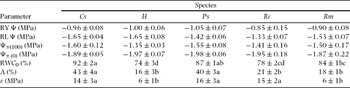
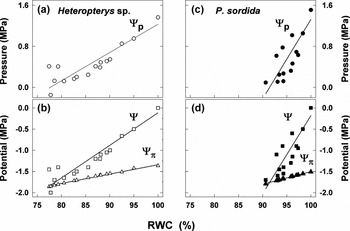
Minimum leaf water potential (Ψ) measured under two contrasting conditions showed that during rainy days Ψ (near 1.0 MPa) was considerably higher than during rainless days (−1.33 to −1.65 MPa; Table 1). Additionally, Ψ was remarkably similar across the five species. Leaf P-V analysis showed that osmotic potential at full (Ψπ(100)) and zero turgor (Ψπ(0)) was comparable among species as well. Turgor loss (Ψπ(0)) occurred in all species at lower Ψ than the minimum values recorded in the field (Table 1). Examples of the Höfler diagrams derived from P-V curves characterized the responses of water relation parameters to RWC for two contrasting species: Heteropterys sp. and P. sordida (Figure 1). Variation in relative water content at zero turgor (RWCo), apoplastic water (A) and volumetric elastic modulus (ɛ) accounted for major differences in leaf tissue water relations across species (Table 1, Figure 1). Thus, Heteropterys sp. and R. concolor lost turgor at lowest RWCo, and had the lowest A content and more elastic cells (<ɛ). By contrast, C. sancarlosianum and P. sordida, with less elastic cell walls (>ɛ), had relatively high RWCo and a shifting of symplastic water volume to the apoplast, whereas, R. morilloi had an intermediate behaviour with inelastic cell walls like C. sancarlosianum and P. sordida, but with A content comparable to Heteropterys sp. and R. concolor, resulting in an intermediated RWCo. Thus, increasing tissue elasticity can be regarded as a mechanism of turgor maintenance in response to leaf dehydration. This suggested that Heteropterys sp. and R. concolor might have a greater potential for acclimation to leaf dehydration and maintenance of high water potentials. Leaves of C. sancarlosianum, P. sordida and R. morilloi with rigid cell walls could undergo a lower water potential for small changes of water volume.
Midday (minimum) leaf water potential (Ψ) during rainy (RY) and rainless (RL) days, as well as pressure-volume parameters: osmotic potential at full (Ψ) and zero turgor (Ψ), relative water content at zero turgor (RWCo), apoplastic water content (A) and elastic modulus (ɛ), measured in Catostemma sancarlosianum (Cs), Heteropterys sp. (H), Pachira sordida (Ps), Remijia morilloi (Rm) and Retiniphyllum concolor (Rc). Each value is the mean ± SE of measurements taken in three trees per species. For each parameter, means followed by the different letter were statistically different at P < 0.05.

Höfler diagrams showing water potential (Ψ) and components: osmotic potential (Ψπ) and turgor pressure (Ψp) as a function of relative water content (RWC) in two species with contrasting leaf tissue water relations: Heteropterys sp. (a, b) and Pachira sordida (c, d). Plots were derived from four P-V curves for each species. Linear regressions are shown and equations are: Ψp = 0.055 RWC − 4.27 (r = 0.93; P < 0.0001), Ψπ = 0.021 RWC − 3.54 (r = 0.99; P < 0.0001), Ψ = 0.076 RWC − 7.79 (r = 0.96; P < 0.0001) for Heteropterys sp. and Ψp = 0.154 RWC − 14.14 (r = 0.87; P < 0.0001), Ψπ = 0.029 RWC − 4.47 (r = 0.90; P < 0.0001), Ψ = 0.184 RWC − 18.61 (r = 0.90; P < 0.0001) for Pachira sordida.

Wood characteristics
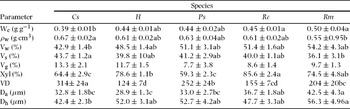
Wood and xylem characteristics of terminal branches are shown in Table 2. The species showed some significant differences in their wood water content (Wc) as well as in density (ρw); C. sancarlosianum had the lowest Wc and the highest ρw and the reverse trend was found in R morilloi. Thus, wood water content and density were negatively associated (r = 0.96; P < 0.005). As expected, the volumetric fraction of water (Vw) and the solids (Vs) followed the same trend as Wc and ρs, respectively. The gas fraction (Vg) was comparable across species and ranged between 8–13%, differences between species not being statistically significant (Table 2).
Water content (Wc), wood density (ρw), wood volumetric fraction of water (Vw), solids (Vs)and gas (Vg), per cent of transverse section occupied by xylem tissue (Xyl), vessel density (VD, no. mm−2) and anatomical (Da) and hydraulic ratios (Dh) measured in Catostemma sancarlosianum (Cs), Heteropterys sp. (H), Pachira sordida (Ps), Remijia morilloi (Rm) and Retiniphyllum concolor (Rc). Each value is the mean ± SE of measurements taken in three trees per species. For each parameter, means followed by the different letter were statistically different at P < 0.05.

Xylem characteristics
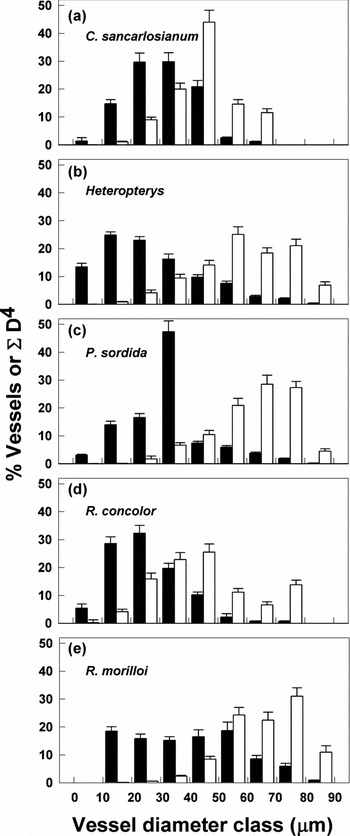
There were significant differences among species in both the fraction of the transverse section occupied by the xylem and in vessel density (Table 2). Vessel anatomical diameter (da) varied across species, and R. morilloi (widest vessels) had vessels 47% wider than those in Heropterys sp. (narrowest vessels; Table 2). Hydraulic diameter (dh) varied across species as well, but the maximum difference across species declined to 33% (R. morilloi vs C. sancarlosianun; Table 2). Vessel density and shift in the diameter frequency were accounted for by interspecific differences in xylem anatomy (Table 2, Figure 2). In C. sancarlosianum and R. concolor, vessels larger than 70 and 80 μm, respectively, were absent. A balanced distribution of vessel diameter between 10–50 μm was found in R. morilloi. However, the predicted hydraulic conductivity (Σ da4) per diameter class also shifted towards wide vessels in all species (Figure 2). This means that all species depended on fewer wide vessels for water transport.
Vessel diameter class in the stems of Catostemma sancarlosianun (a), Heteropterys sp. (b), Pachira sordida (c), Retiniphyllum concolor (d) and Remijia morilloi (e). Black bars represent percentages based on total vessel number and white bars are the conductance percentage based on the sum of all vessel diameters to the fourth power (Σda4). This reflects the relative hydraulic importance of each diameter class as estimated by the Hagen–Poiseuille Law. The bars are the means of measurements taken in three trees per species and SE.

Hydraulic characteristics
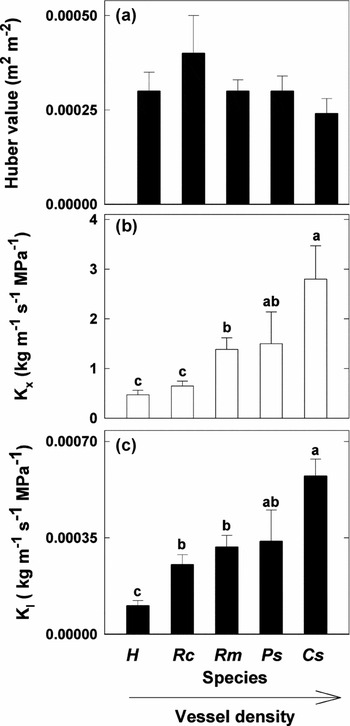
Stem hydraulic properties varied according to changes in the xylem structure. Thus, Huber value was slightly higher in R. concolor, but differences among species were not statistically significant (Figure 3a). Both hydraulic conductivity per xylem area (Kx) and per leaf area (Kl) tended to increase with vessel density (Figure 3b, c). Thus, positive and statistically significant relationships between Kx and vessel density (r = 0.97; P < 0.006), and between Kl and vessel density (r = 0.95; P < 0.011) were found. Catostemma sancarlosianum had the highest Kx and Kl with the highest leaf density as well (Table 2). Thus, Kl of R. concolor, R. morilloi and P. sordida were comparable, and the lowest value was found in Heropterys sp.
Huber value, xylem specific conductivity (Kx) and leaf specific conductivity (Kl) in the stems of Catostemma sancarlosianun (Cs), Heteropterys sp. (H), Pachira sordida (Ps), Remijia morilloi (Rm) and Retiniphyllum concolor (Rc). Species are arranged as vessel density increases. The bars are means of measurements taken in three trees per species and SE. Different letters indicate significant differences (P < 0.05).

DISCUSSION
In this study, the first comparison of xylem structure, hydraulic characteristics and leaf tissue water relations of sclerophyllous species coexisting in the bana vegetation is presented. Minimum Ψ was observed on rainless days, which averaged −1.53 ± 0.61 MPa, a value significantly lower than that of −0.94 ± 0.10 MPa found during rainy days. These averaged Ψ values and their trend agreed entirely with previous studies where frequency of drought spells was assessed monthly in conjunction with measurements of leaf Ψ and stomatal conductance in these species during 1976–1977 (Sobrado Reference SOBRADO1977). Drought periods can last from 3–8 d in this area at any time of the year, and between one to four times per year they last 15–20 d, particularly during February–March and October–November (Medina et al. Reference MEDINA, SOBRADO and HERRERA1978, Sobrado & Medina Reference SOBRADO and MEDINA1980). Sandy soils occupied by this sclerophyllous vegetation have low water-retention capability and the water table can drop below the main root zone during drought spells, or become waterlogged for a few hours after rain (Bongers et al. Reference BONGERS, ENGELEN and KLINGE1985). The average Ψπ between full and zero turgor was −1.48 ± 0.05 and −1.92 ± 0.05 MPa, respectively, across species. This means that, on average, if the leaf Ψ falls below −1.92 ± 0.05 MPa, the leaf turgor is lost. Lower Ψπ can enhance the plant-soil water potential gradient, thereby favouring water uptake above water loss. However, the species maintained the minimum Ψ within a safety range above the critical value for turgor loss, of about 0.97 ± 0.11 and 0.41 ± 0.12 MPa during rainy and rainless days, respectively. This safety range may be important for xylem integrity. Previously, we have occasionally recorded Ψ of about −1.8 MPa (Sobrado Reference SOBRADO1977). Thus, we cannot preclude that in unusually long dry spells, these species can reach low Ψ and perhaps lethal levels of embolisms in terminal branches. Occasionally, damaged leaves had been observed in the field. The range of Ψπ values in these species was much higher than those found in sclerophyllous species from tropical seasonal dry forests with several rainless months (< 3.0 MPA; Olivares & Medina Reference OLIVARES and MEDINA1992, Sobrado Reference SOBRADO1986). However, our Ψπ values compare well to those found in Mediterranean sclerophyllous leaves which are not particularly drought resistant (Kyriakopoulus & Richter Reference KYRIAKOPOULUS and RICHTER1991, Salleo & Lo Gullo Reference SALLEO and LO GULLO1990, Salleo et al. Reference SALLEO, NARDINI and LO GULLO1997). The anatomical structure typical of sclerophyllous leaves seems to appear first in humid areas and later migrate to more arid zones (Salleo et al. Reference SALLEO, NARDINI and LO GULLO1997). The species differed in their leaf elasticity: 5.8 ± 0.5 MPa in Heteropterys sp. and R. concolor, compared with 14.1 ± 1.2 MPa in C. sancarlosianum, P. sordida and R. morilloi. Leaf blades with lower elasticity are composed of smaller cells with thicker cell walls (Cutler et al. Reference CUTLER, RAINS and LOOMIS1977). An increase in ɛ as a consequence of changes in leaf structure has been considered the most significant leaf-level adaptation to water limitations on a global scale, considering that intracellular solute concentration is limited (Niinemets Reference NIINEMETS2001). The dominant species C. sancarlosianum, P. sordida and R. morilloi had the least elastic (>ɛ) leaf tissue. Low ɛ allows leaf dehydration to reach lower levels, while still maintaining their Ψ within the range of positive turgor, which may be beneficial during drought as well. Thus, both high and low ɛ have beneficial effects for drought tolerance (Abrams Reference ABRAMS1990, Bowman & Roberts Reference BOWMAN and ROBERTS1985, Roberts et al. Reference ROBERTS, STRAIN and KNÖRR1980). Summarizing, the five species experience comparable midday water potential, similar Ψ for turgor loss, maintenance of a safety range of Ψ above turgor loss and capability to develop leaf-to-soil water potential differences for water uptake.
Wood consisted mostly of water, which averaged 0.47± 0.01 g g−1 and 49.6% ± 1.1% for Wc and Vw, respectively. Vg was the lowest fraction and averaged 10.2% ± 0.8% among species. Tropical woods contain lower amounts of gas compared with temperate softwoods and hardwoods (Gartner et al. Reference GARTNER, MOORE and GARDINER2004, Poorter Reference POORTER2008). Increase in Vg results in higher biomechanical stability, which would be advantageous for tall trees receiving large wind force loads which increase surface stress (Gartner et al. Reference GARTNER, MOORE and GARDINER2004). The ρw and Vs have been regarded as measures of mechanical support and higher values correspond to species with slower growth (Lawton Reference LAWTON1984).
Comparison of xylem density across Amazonian habitats has shown a very wide range from 0.24 up to 1.13 g cm−3 reflecting the contrasting climatic conditions found in the whole basin (Patiño et al. Reference PATIÑO, LLOYD, PAIVA, QUESADA, BAKER, SANTOS, MERCADO, MALHI, PHILLIPS, AGUILAR, ALVAREZ, ARROYO, BONAI, COSTA, CZIMCZIK, GALLO, HERRERA, HIGUCHI, HORNA, HOYOS, JIMÉNEZ, KILLEEN, LEAL, LUIZAO, MEIR, MONTEAGUDIO, NEILL, NUÑEZ-VARGAS, PALOMINI, PEACOCK, PEÑA-CRUZ, PEÑUELA, PITMAN, PRIANTE, PRIETO, PANFIL, RUDAS, SALOMÃO, SILVA, SILVEIRA, SOARES De ALMEIDA, TORRES-LEZAMA, TURRIAGO, VAZQUEZ-MARTINEZ, SCHWARZ, SOTA, SCHMERIER, VIEIRA, VILLANUEVA and VITZTHUM2008). In this study, ρw and Vs averaged among species 0.61 ± 0.02 g cm−3 and 40.2% ± 0.7%, respectively. Across tropical species, wood with low ρw is cheap to construct and allows fast growth, whereas high ρw results in persistent wood and increases survival (Poorter Reference POORTER2008, Poorter & Bongers Reference POORTER and BONGERS2006). Furthermore, ρw and leaf mass per unit leaf area have been closely correlated suggesting that both parameters are related with growth capability and life span (Poorter & Bongers Reference POORTER and BONGERS2006). Studied species have leaves with a high leaf mass to leaf area ratio, which would require stems with enough biomechanical strength to resist bending stress with minimum deflection. In addition, a clear relationship between ρw of tropical species and the amplitude of daily changes in leaf Ψ has been established (Meinzer Reference MEINZER2003). In concordance with this relationship, the studied species would undergo diurnal changes in Ψ near to 1.1 MPa, which is consistent with the recorded range (Sobrado Reference SOBRADO1977). In temperate plant species, ρw has been positively correlated with the threshold xylem water potential for 50% loss of hydraulic conductivity as well (Hacke & Sperry Reference HACKE and SPERRY2001). However, it remains to be established if such a relation holds for tropical species.
The average da of 34.7 ± 1.2 μm in our twigs samples was low compared with values from 65–250 μm found in main stem wood from another Amazonian sandy-soil forest (Woodcock et al. Reference WOODCOCK, DOS SANTOS and REYNEL2000). However, vessel density was higher in this study (120–320 vessels mm−2) than was reported in that study (4–80 vessels mm−2). Anatomical differences in xylem tissue would result in different hydraulic capacities and transpiration rates (Schultz & Matthews Reference SCHULTZ and MATTHEWS1993, Tyree & Ewers Reference TYREE and EWERS1991, Tyree & Zimmermann Reference TYREE and ZIMMERMANN2002). Vessels with large diameter and pore size in inter-vessel pit membranes are evolutionarily favoured for efficient water conduction (Tyree et al. Reference TYREE, DAVIES and COCHARD1994). Thus, the dh average was 49.9 ±1.7 μm across species and between 16% and 90% of the water transport would occur in vessels wider than 50 μm, but the amount of vessels in this range was only between 4% and 33%. This indicated that more frequent narrow vessels would not compensate for less frequent larger vessels in terms of potential for water flow. The fact that these species depend on the small number of large vessels for most of their water transport capability suggested that their xylem is highly vulnerable to cavitation. Thus, the large vessels allow low investment in xylem structure in order to obtain high permeability. Water conductance efficiency, provided by wider vessels, would be advantageous for this species because leaves were unable to develop very negative water potentials in order to maintain water loss. However, high transpiration rates seem to be restricted to a few hours daily (Sobrado Reference SOBRADO1977), so as to prevent xylem cavitation. Despite the fact that more numerous smaller vessels could act as an auxiliary transport network to maintain some water flow if the larger vessels became embolised, preservation of those fewer and wider elements may have paramount importance to maintain a high leaf water supply. Xylem anatomy and hydraulic parameters indicated that both traits are structurally and functionally coordinated in this study. Thus, species with low vessel density had the lowest Kx and Kl as well, which suggested that larger pressure gradients would be required to maintain high transpiration rates. Across species, lack of correlation of Kx and Kl with vessel diameter might suggest that vessel diameter might not correlate well with cavitation resistance across species (Choat et al. Reference CHOAT, COBB and JANSEN2008). The Kx is a measure of transport efficiency per unit of xylem area (Zotz et al. Reference ZOTZ, TYREE, PATIÑO and CARLTON1998), whereas leaf specific conductivity (Kl) is a useful measurement of hydraulic sufficiency of stems in supplying water to the leaves (Tyree et al. Reference TYREE, DAVIES and COCHARD1994). Therefore, water transport through xylem was less efficient in Heteropterys sp. and R. concolor. Specifically, it shows that species with lower capability for xylem water transport have leaves with more elastic leaf tissue. Thus, these species can undergo larger dehydration of leaf cells and still maintain turgor and turgor-related processes. Across species Kx and Kl averaged 1.4 ± 0.22 and 0.00033 ± 0.000045 kg m−1 s−1 MPa−1, respectively. These values were of a similar order of magnitude as reported for other tropical species (Sperry Reference SPERRY2003, Tyree & Zimmermann Reference TYREE and ZIMMERMANN2002, Zotz et al. Reference ZOTZ, TYREE, PATIÑO and CARLTON1998).
CONCLUSIONS
Despite the fact that the leaves of the bana species are stiff, strong and tough, they are unable to sustain large water-potential drops (< −1.9 MPa). All species depend on relatively less abundant larger vessels for water transport, and leaf water supply is favoured in species with higher vessel density, which have a larger number of wider vessels as well. Midday regulation of water loss by stomatal closure may be an effective mechanism to preserve xylem integrity of these species. Thus, the minimum Ψ was conservative and well below the critical value for leaf turgor loss. When transpiration is severely reduced at midday, vertically oriented leaves help prevent overheating damage (Medina et al. Reference MEDINA, SOBRADO and HERRERA1978, Sobrado Reference SOBRADO1977). Despite this, at midday leaf blades absorb more photons than can be used in carbon assimilation, and photosynthetic apparatus undergoes down-regulation due to non-chronic photo-inhibition (Sobrado Reference SOBRADO2008). Consequently, these species should maximize production in the short-term with high water transport and very low water-use efficiency, and become highly conservative at times of maximal irradiance. This would result in very high costs due to high leaf blade construction and maintenance costs with reduced photosynthetic capacity (Sobrado Reference SOBRADO2009). A reduced daily carbon gain and productivity would further limit these species as effective competitors.
ACKNOWLEDGEMENTS
Financial support was provided by DID-USB (Fondo de trabajo 2007–2008). Logistic support to work in this remote area was provided by Pedro and Olga Maquirino and Euclides and Mirla DaSilva. I am pleased to thank Dr Elena Raimundez for allowing the use of the microscopic unit and Ms Norbelys Garcés (UCV, Facultad de Agronomía) for preparing the anatomical material. I acknowledge Professor Sandra Patiño and anonymous referees whose advice and suggestions were very helpful in improving this paper.