





Plain language summary
This study starts from the proposition that if the same in-game events are arrayed in different sequences, players may find some sequences to be more attractive, compelling, enjoyable, pleasurable, satisfying, exciting, engaging, or intriguing than others. To give an example, a game that offers no challenge, where the player consistently dominates, typically fails to sustain engagement. But one can imagine an exciting game where players succeed at the beginning, face some tough challenges in the middle, which makes them develop and refine their playing approaches, and beat the game in the end!
How can such experiences be conceptually explained and understood? Huizinga (Reference Huizinga1955) claims that play is a central characteristic of being human. Therefore, it could be expected that there exists a wealth of experience in how to manage, moderate, curate, and structure play in specific (e.g., engaging) ways. People should have an abundance of first-hand experience both as players and as facilitators of games, and multiple models should exist.
The article collects and discusses relevant conceptual models for the strategic ordering of game play events from various discourses integral or adjacent to game design research. The study scrutinizes the discourses of game design, design patterns, Dynamic Difficulty Adjustment (DDA), tabletop roleplay, literary drama, Flow theory, and Operant Conditioning theory and identifies exemplary, relevant concepts for the strategic ordering of game play events. The study summarizes popular theories and approaches to designing experiences in each area.
It is found that surprisingly few models exist. The predominant model appears to be repeated variations of rather simple experiential sequences of tension and relaxation on an overall increasing level, similar to the dramatic arc. The study’s main contribution to the narratology discourse is to show how the dramatic arc as a conceptual model can inform the understanding of the strategic ordering of game play events.
Introduction
This study starts from the proposition that if the same in-game events are arrayed in different sequences (or orders, schedules, phases, patterns, and structures), players may find some sequences to be more attractive, compelling, enjoyable, pleasurable, satisfying, exciting, engaging, or intriguing than others.Footnote 1 Sequences can be constituted, for instance, by events of increasing difficulty, a mix of positive and negative events, or phases of intense action broken up by pauses. As an example, one can imagine an exciting game where players succeed at the beginning, face some tough challenges in the middle, which makes them develop and refine their playing approaches, and beat the game in the end!
How can such experiences be conceptually explained and understood? If play is a central tenet of being human, and the “fun-element [
$\ldots $
 ] of play [
$\ldots $
 ] an absolutely primary category of life” (Huizinga Reference Huizinga1955, 3), it can be expected that there exists a wealth of experience in how to manage, moderate, curate, and structure play in specific (e.g., engaging) ways. People should have an abundance of first-hand experience both as players and as facilitators of games, and multiple models should exist. However, the authors are unaware of such conceptual models.
While literary theory has long proposed structural models like the dramatic arc to explain narrative engagement, recent work in computational narratology has begun to test these theories empirically. For example, Moreira et al. (Reference Moreira, Bizzoni, Nielbo, Lassen, Thomsen, Akoury, Clark, Iyyer, Chaturvedi, Brahman and Chandu2023) successfully modeled reader appreciation of novels by analyzing their “sentiment arcs” – the emotional trajectory of the text over time. Complementary research by Öhman et al. (Reference Öhman, Bizzoni, Moreira and Nielbo2024) on 9,000 literary texts further systematizes these arcs, distinguishing trajectories, such as “Rags to Riches” or “Man in a Hole.” Their findings show that the contours of a story’s sentiment are a significant predictor of how it will be rated by readers. This provides a compelling precedent for this investigation, which seeks to identify analogous structural models – specifically the dramatic arc – that explain the ordering of events not in static text, but in interactive game systems.
Consequently, this study is guided by two primary research questions:
-
1. RQ1: Which conceptual models from adjacent domains (narratology, psychology, and design) are relevant for the strategic ordering of game play events?
-
2. RQ2: How do these models align with or differ from the “dramatic arc” prevalent in traditional media?
To address these questions, this article collects and discusses relevant conceptual models for the strategic ordering of game play events from various discourses integral or adjacent to game design research. It is found that surprisingly few models exist. The predominant model appears to be repeated variations of rather simple experiential sequences of tension and relaxation on an overall increasing level, similar to the dramatic arc. The study’s main contribution to the narratology discourse is to show how the dramatic arc as a conceptual model can inform the understanding of the strategic ordering of game play events.
Methods
The study gathers conceptual models by examining domains connected to game design research, including design patterns, Dynamic Difficulty Adjustment (DDA), tabletop roleplay, literary drama, Flow theory, and Operant Conditioning theory. The text summarizes popular theories for or approaches to designing (e.g., structuring, sequencing, ordering, and curating) experiences in each area.
The domains scrutinized are regularly connected to and popularly referenced in the game design discourse, according to the authors’ awareness and experience. The study aims for the exemplary sampling of relevant concepts; it is not a comprehensive or exhaustive account. The text briefly introduces each domain and presents typical approaches and advice that may inform on the question at hand.
Results
The study scrutinizes the discourses of game design, design patterns, DDA, tabletop roleplay, literary drama, Flow theory, and Operant Conditioning theory and identifies exemplary, relevant concepts for the strategic ordering of game play events.
Game design
The notion of game design as it is “typically used in the [digital games] industry [
$\ldots $
 ] refer[s] only to the design of the gameplay aspect” (Zubek Reference Zubek2020, xv), not to, for instance, the design of graphical or audio assets. Game design controls “how the game should work: how it will behave, what the player will [or, rather, has the opportunity to] do, [
$\ldots $
 ] [and] how [the game’s characters] act when the player interacts with them” (ibid., emph. removed).
Game design resources (such as books, courses, and workshops) frequently adopt a “hybrid and iterative approach” (Zubek Reference Zubek2020, 7), working top-down from the designer’s vision for a game toward a realization, and bottom-up from the practices and activities afforded by the available spaces, mechanics, and systems (ibid.) to “continually test [
$\ldots $
 ] what kinds of gameplay and experiences are produced” (ibid.). Advice is often based more on personal experience and intuition than on general and agreed-upon rules. In his popular book on game feel, Swink (Reference Swink2009, Reference Charles, Mcneill, McAlister, Black, Moore, Stringer, Kücklich and Kerr20) poses the question, “what should the game designer’s desired feel be?”, and notes that “[t]his is up to the designer [
$\ldots $
 ] but I find this question often answers itself through experimentation.” He goes on to assert that the number of iteration cycles of “playtesting and modification” correlates with the quality of the game (ibid., 83). Usually, it is assumed or explicitly explained, that advice needs to be adjusted to the concrete situation when applied. For instance, Pugh (Reference Pugh2018) emphasizes that his tips on level design “should be interpreted in a way that is relevant to [the reader’s] level designs. Every game is different so every game requires a different approach.”
Rhythm and pacing
Game playing experiences are marked by their rhythms (e.g., Grace Reference Grace2011, 4f.). Rhythms can range from trivial to sophisticated, from regular to chaotic, and from strict to variable. Different games and game genres (such as strategy board games, first-person shooters, and party games) also have their preferred tempi (or meters, ibid., 5). Rhythms in games in can vary between parts; for instance, in Caesar III (Sierra, 1998), the game’s rhythm emerges between the “dynamic game economy” and “scripted events” (Adams and Dormans Reference Adams and Dormans2012, 206). Zubek (Reference Zubek2020, 174) proposes the design goal to interleave “high-intensity challenges” in games with “downtime,”Footnote 2 but provides no concrete model or ratio (“How exactly this is implemented varies greatly between genres and game types.”; ibid.). “Intensity” is not simply difficulty, but can include factors from the wider perspective on moment-to-moment experiences. A sequence can feel intense through temporal urgency, sensory stimulation, emotional engagement, or even cognitive demands of planning, attention, and interpretation.
The pacing of games (“how the game’s intensity varies over time,” ibid.) ranges from fixed to dynamic, and occasionally this is also interleaved in different parts or aspects of the game. Games with fixed pacing give much control of the experience to the designer and allow for quite an elaborate design, that may facilitate a powerful thrust to pull players into the game. An example is classic 2D space shooters with automatic scrolling such as R-Type (Irem, 1987). This kind of design is also rather robust. Whatever the player does, the pacing of the game remains largely intact. However, using a fixed design for the game pacing is rigid, and might not appeal to all players in the same way.
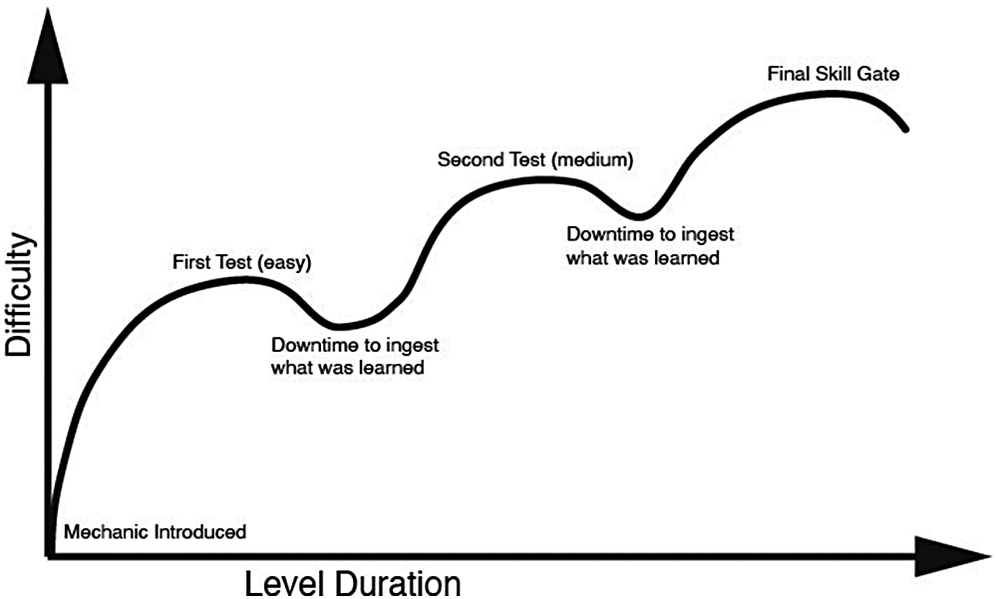
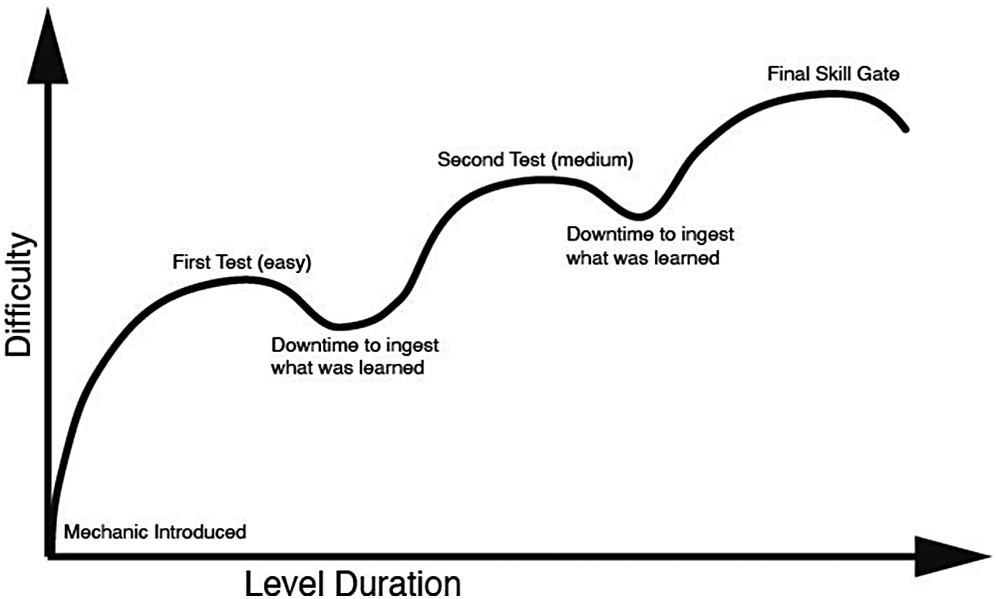
An alternative is dynamic pacing. Dynamic pacing affords players much agency in playing the game, but risks feeling loose, with players leaving the path(s) the designer has prepared and getting lost in-between in-game events. A typical example of dynamic pacing are open-world games such as Red Dead Redemption (Rockstar Games, 2010), in which players have much agency to decide what to do and how to play. Dynamic pacing is discussed by Ryan (Reference Ryan1999a) as a means for level design to accommodate various ways of playing the game, to let the players choose for themselves the most appropriate and fun way of playing, because “[s]ome players play conservatively, while others like to play it risky.” Taylor (Reference Taylor2013b) similarly advises for level design to not only to provide a “basic path” through levels or missions which “properly paced for a player of moderate ability,” but also to include “areas off the main path that present a clear opportunity for the skilled player (or an easier option for those less adept).” To enable players to make decisions about picking a path through a level in an informed manner, “both the risk, and resultant reward should be clearly called out using the level’s language” (ibid.). Pugh proposes a model to pace the learning of new in-game mechanics by the player (Figure 1).
Pacing the learning of new in-game mechanics by the player (Pugh Reference Pugh2018, redrawn by the authors).
Based on Hoffstetter (Reference Hoffstetter2013), level designer Kullman (Reference Kullman2022)Footnote
3
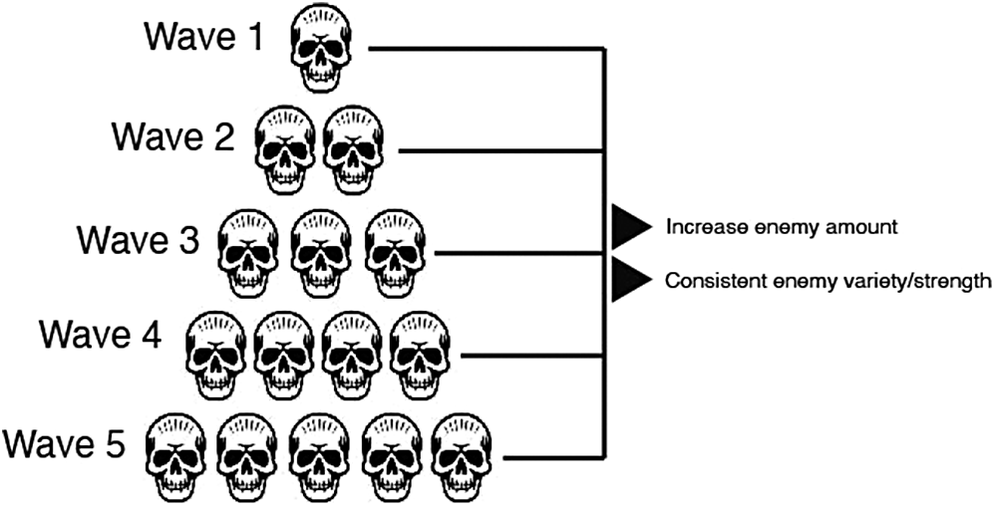
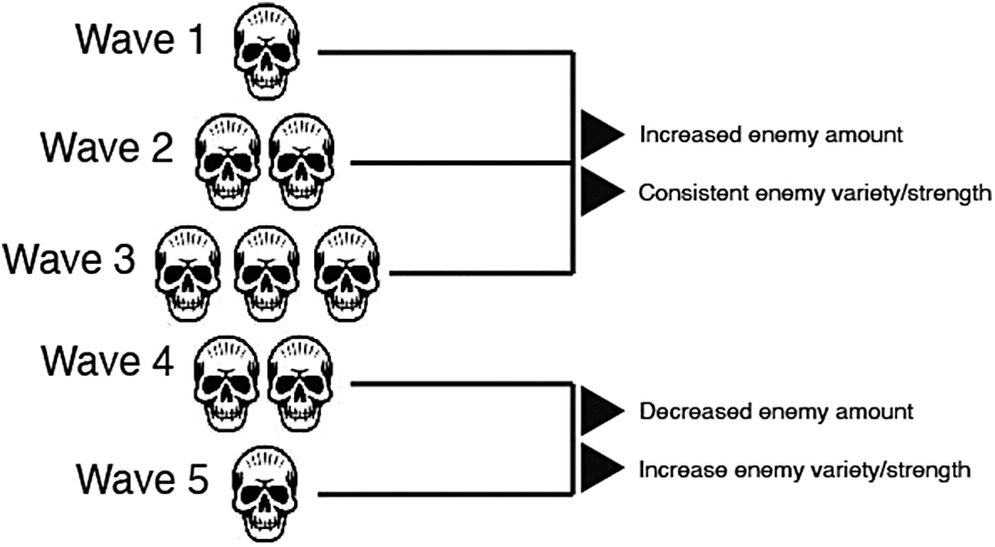
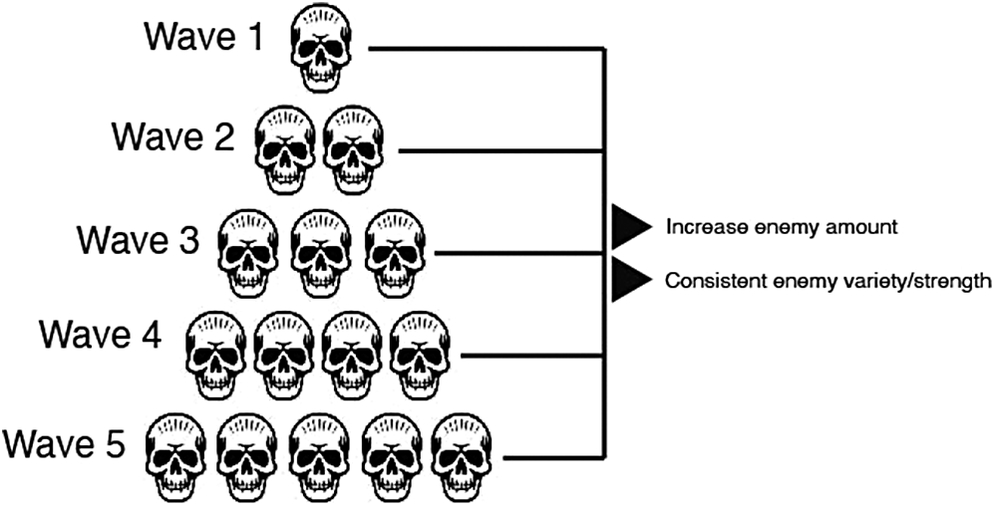
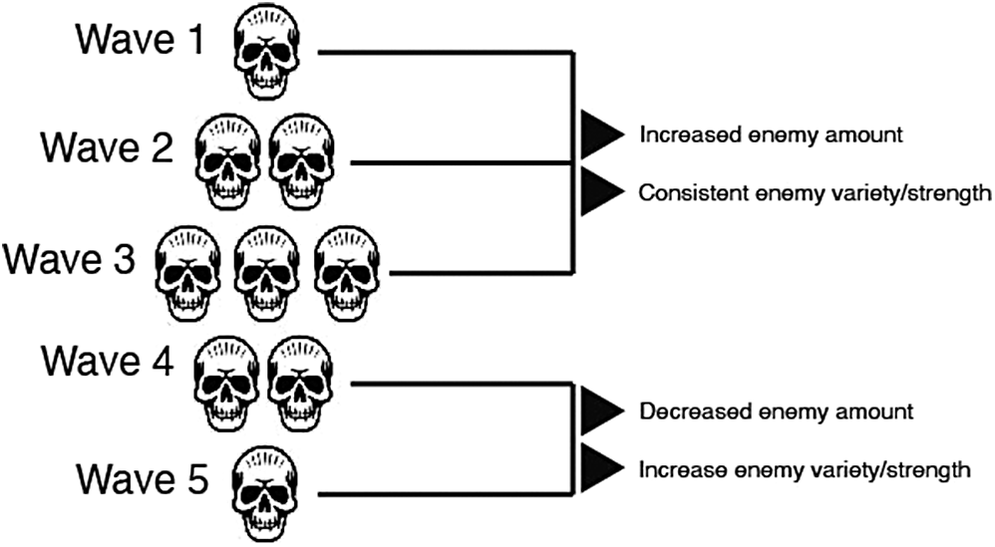
advises to pace hostile encounters in games by, for instance, “[b]reaking [them] up into waves (each one consisting of one or more enemy).” He describes “[t]wo ways to change the intensity of a fight”; one is the “triangle” and the other the “diamond pattern” (ibid.). The former “keeps the [enemy] types consistent, it just increases the amount of enemies” (ibid.; Figure 2). The latter “changes the types/strength [of enemies] but to keep the difficulty in check also reduces the enemy amount” (ibid.; Figure 3). Kullman (Reference Kullman2022) adds that “a consistent[,] gradual increase in difficulty” as facilitated by the triangle and diamond patterns “isn’t always ideal.” Such an increase may “[n]ot only [
$\ldots $
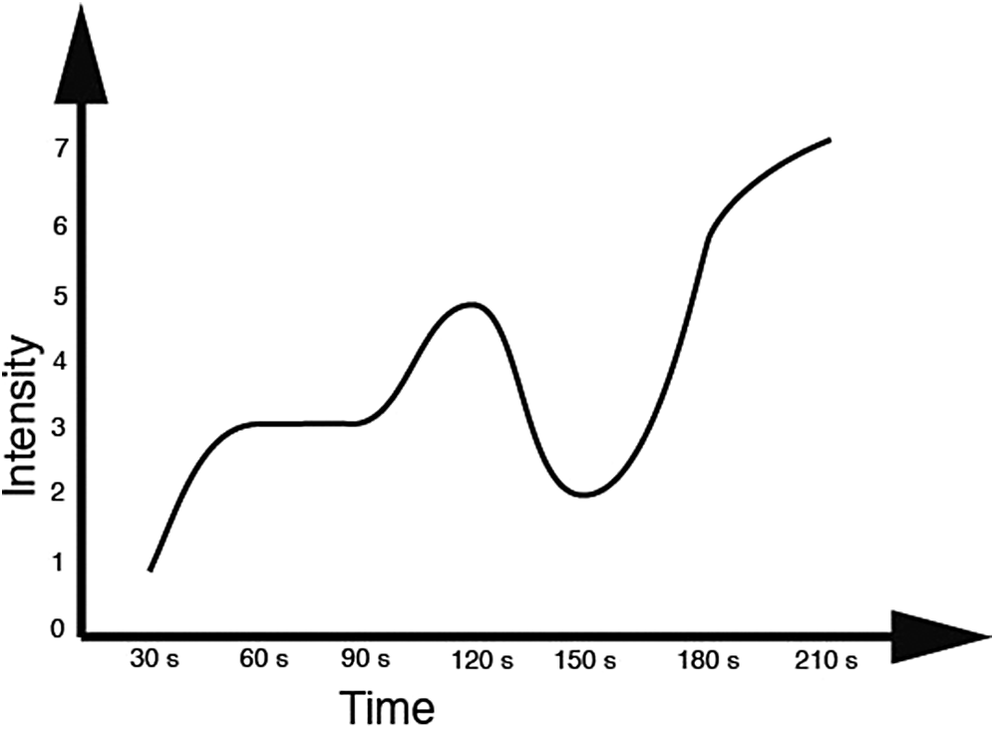
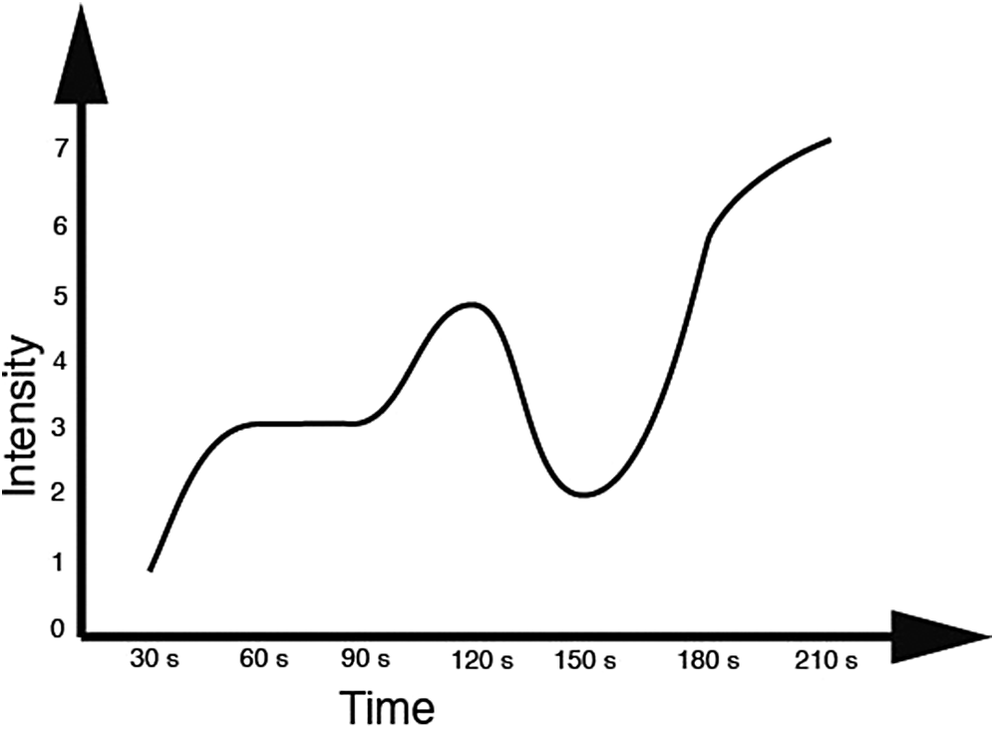
 ] limit what [the designer] can do,” but it “can also make encounters too predictable” (ibid.). He advises that “[w]hile it’s a good idea to have peaks and valleys along with increased intensity, it’s up to [the designer] to decide how to arrange them, as well as how long to hold on certain peaks and valleys” (ibid.; Figure 4).
Triangle patterned enemy wave (Kullman Reference Kullman2022 based on Hoffstetter Reference Hoffstetter2013, redrawn by the authors).
Diamond patterned enemy wave (Kullman Reference Kullman2022 based on Hoffstetter Reference Hoffstetter2013, redrawn by the authors).
Intensity and time curve in a game (Kullman Reference Kullman2022 based on Hoffstetter Reference Hoffstetter2013, redrawn by the authors).
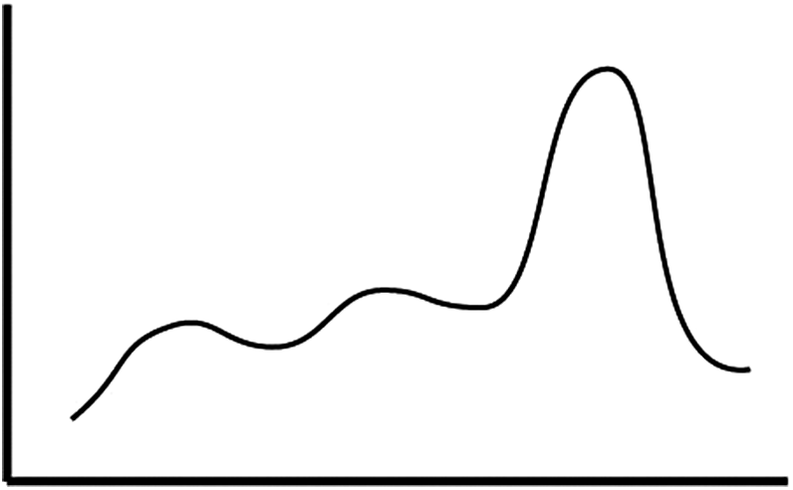
Kullman (Reference Kullman2022) describes a specific experience curve to structure a game’s pacing (Figure 5). He notes that this curve is probably the “most common form of pacing structure” (ibid.). The curve “contains peaks and valleys and a constant escalation until it reaches the climax” (ibid.). He believes that it is “typically a pretty safe structure to follow if you’re unsure of what to do or want to play it safe” (ibid.). However, he advises that it is “good to change things up (at least every now and then) so your game doesn’t become too predictable,” and to “have extended peaks/valleys, start with a high intensity beat, etc.” (ibid.).
Probably the most common form of pacing structure (Kullman Reference Kullman2022 apparently based on Maio Reference Maio2019 or Gallon Reference Gallon2021, 19, redrawn by the authors).
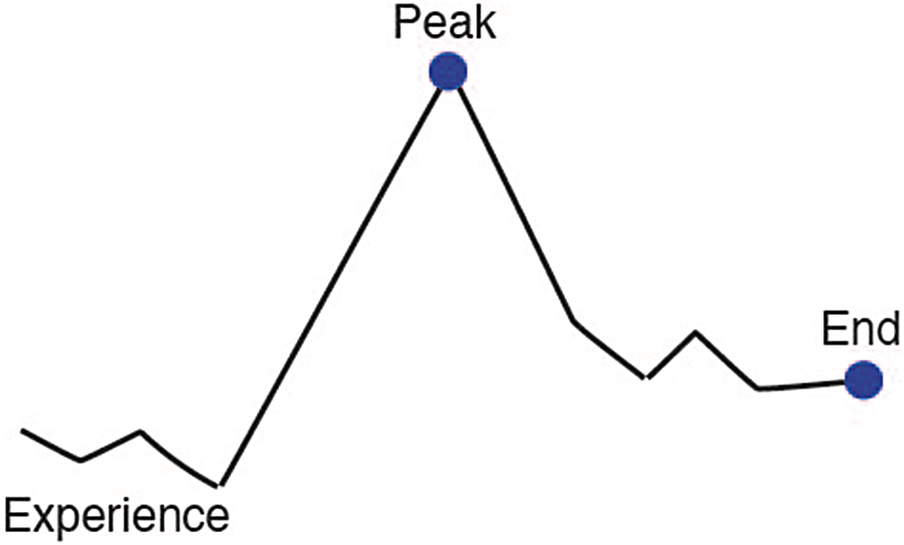
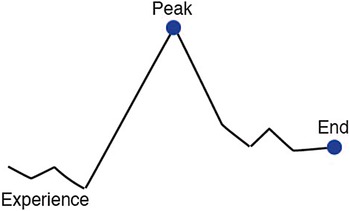
In addition, he explains that humans tend to remember experiences at “the peak and [at the] end” of their engagement “best” (ibid.). He refers to this phenomenon as the “Peak-End rule” (Figure 6). Applied to the design of games, he advises that “it could be okay to have a little more uneventful and ‘dull’ level if the peak and the end is memorable and satisfying to the player” (ibid.).
Peak-end rule (Kullman Reference Kullman2022 apparently based on Daniels Reference Daniels2018, redrawn by the authors).
Timing
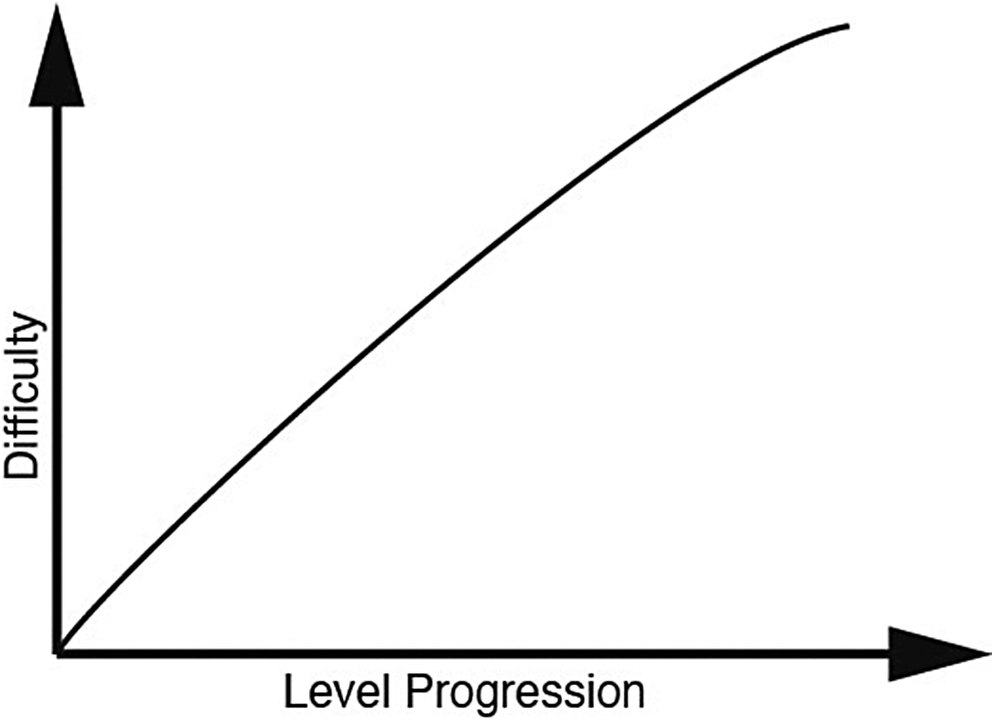
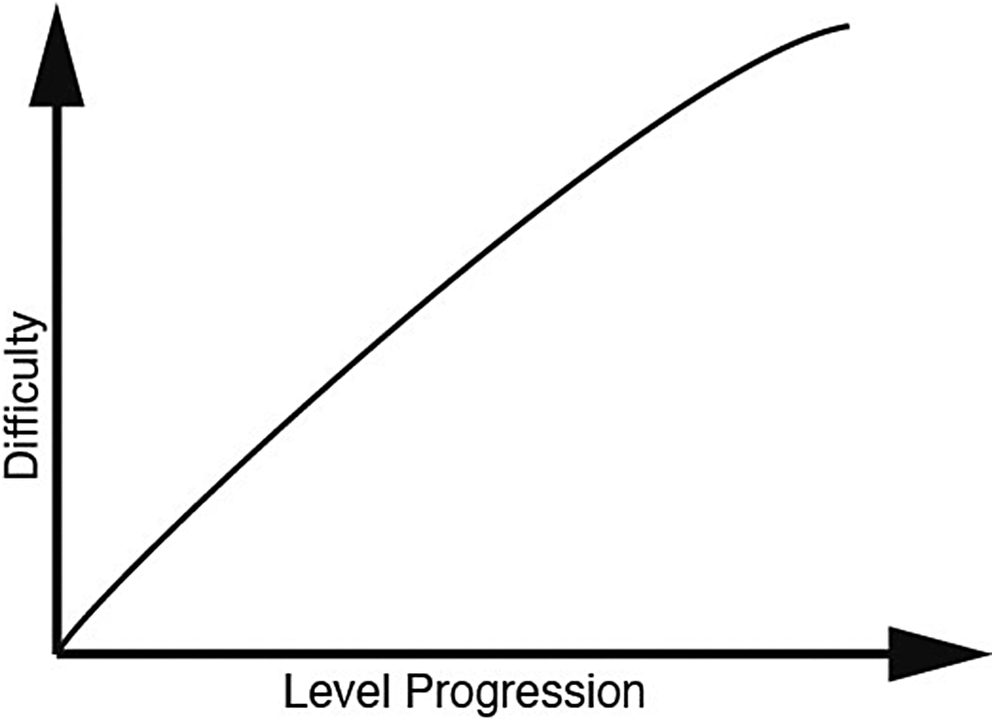
The timing of in-game events can be critical for the game playing experience. Most often, game design resources connect the timing with the difficulty of in-game challenges. For instance, Ryan (Reference Ryan1999a) describes a linear progression from simple challenges in early levels of a game to difficult challenges in the final levels of a game. The difficulty of levels should correspond to their positions in the game timeline or “level progression.” He reminds designers that “the first few levels [
$\ldots $
 ] should be a little forgiving,” while “[l]evels at the end should be the most difficult to coincide with the increased skill and player resources” (Figure 7).
A typical difficulty curve of a game (Ryan Reference Ryan1999a, redrawn by the authors).
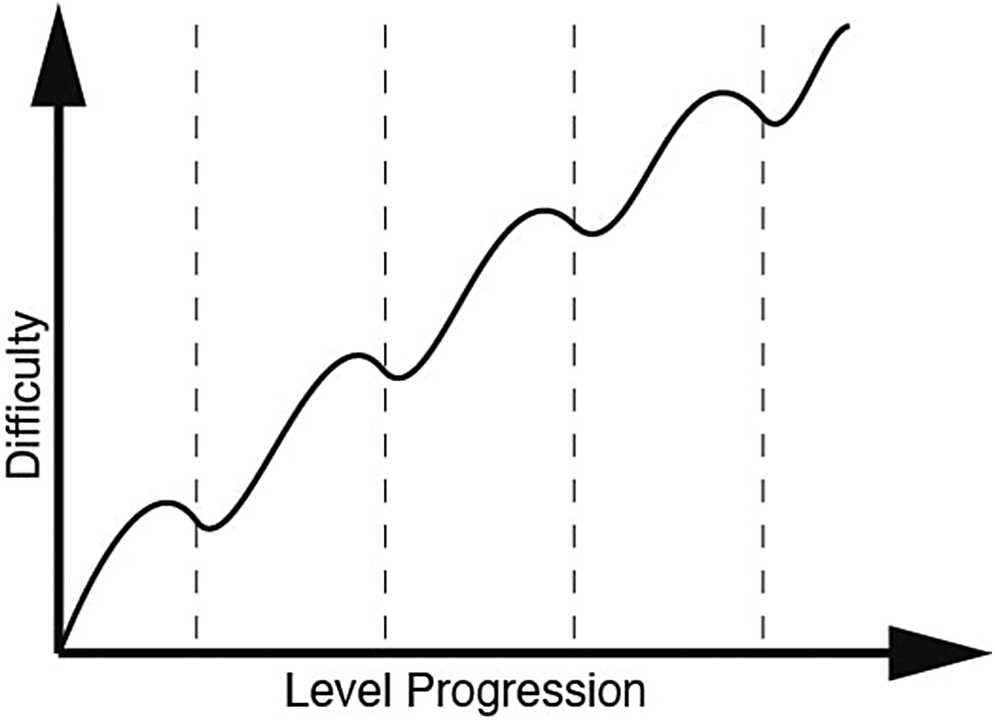
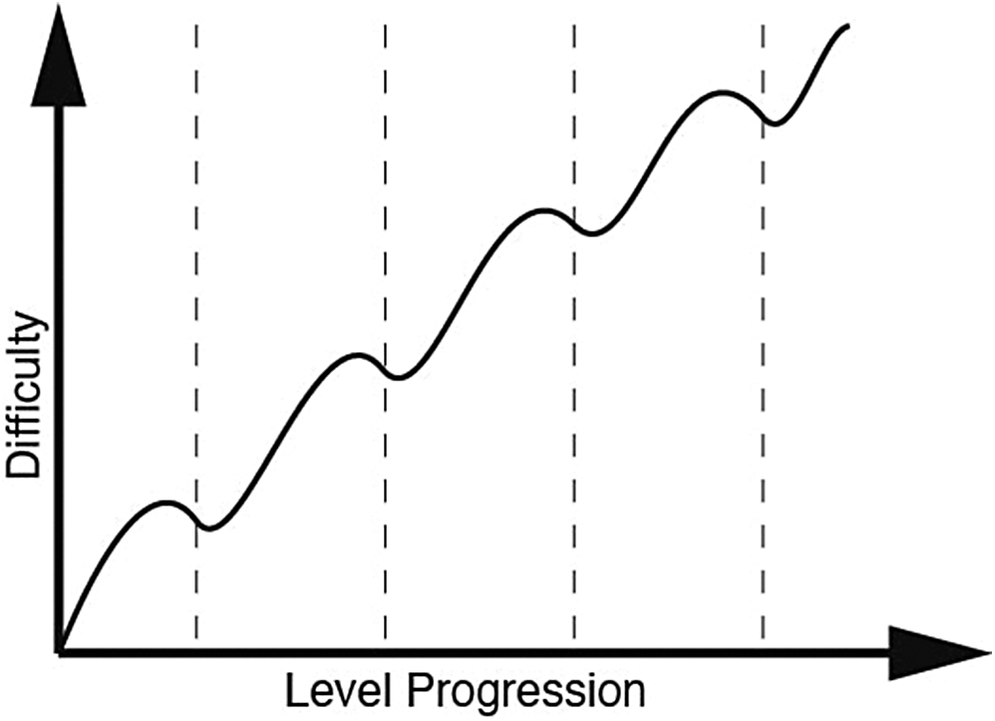
He adds that in mission-based games the difficulty is often not constantly increasing, but varies between missions while generally following an upward curve (Figure 8). Groups or “modules” of levels “like missions within an operation, floors in a dungeon, or regions on a planet” can have their own local increase in difficulty, and “the last level within a module may be more difficult than the first level in the next module” (ibid.). He explains that this allows players “to catch their breath” in a “natural pause and release of tension” (ibid.). An example of this flow of difficulty are platform game levels, in which a player first encounters some weak enemies, then some more powerful and dangerous enemies, and finally faces a level boss.
A difficulty curve of a game with missions (Ryan Reference Ryan1999a, redrawn by the authors).
Practitioners’ perspectives
To complement the brief literature review above, the authors invited three game design professionals from different local game studiosFootnote 4 to report and reflect on their own practices, and to respond in writing to the questionFootnote 5 :
Are there formal rules or informal guidelines (such as rules of thumb) for the design of the game playing experience you follow in your daily practice at [your game studio]? Such rules could describe, for instance, the order and variation of player experiences over time, such as in-game successes or game difficulty.
The game studio (X.) specializes in mobile, hypercasual games. (A.) has worked five years as a level and game designer and project manager at (X.) He explains that at (X.), the game design does not follow any formal rules, but respects a loose set of “guidelines” (pers. comm., 2022). The games made by (X.) usually aim for a linear and incremental increase of difficulty over time and game progress. (A.) continues to describe that for them, “[t]he most important [guideline]” is for games to provide a “solid onboarding” experience of novice players (ibid.). Concretely, this means that “[their] games start out very easy and become gradually harder as the player is ready for the increased challenge” (ibid.). This is realized by careful (static) design of “theme and aesthetic[s] with clear affordances” (ibid.). With regard to dynamic adjustment of the games’ difficulty, he comments that “[they] would rather make it fun to lose than artificially help players win more often” (ibid.). (A.) adds that even informal game design guidelines are transient and that “[s]ometimes,” for a specific game, “many of the guidelines need to be thrown out the window” (ibid.).
(Y.) is a game studio that develops AAA games, for instance, for a well-known game franchise. (B.) has worked at (Y.) as a level designer for over eight years on multiple games from this franchise and has now moved into a leading position. He notes that at and outside of their studio, “[t]here’s a lot of commonly accepted wisdom” about the order and variation of in-game experiences, but that the studio does not have any written rules that they follow (pers. comm., 2022). He explains that their design practice is based on “reasoning, personal experience, and trying things out” (ibid.). He adds that “bits of the ‘commonly accepted wisdom”’ from developer-oriented articles (such as Pugh Reference Pugh2018; Ryan Reference Ryan1999b; Taylor Reference Taylor2013a; Wilson Reference Wilson2018) are shared between the studio’s designers (ibid.).
Game designer (C.) works at game studio (Z.) which he co-founded about five years ago. (Z.) focuses on adventure games for consoles and mobile platforms. (C.) reports that for designing “player experience and game flow [they] rely heavily on testing and internal discussion,” rather than on specific formal rules or informal guidelines (pers. comm., 2022). For one recent game title, they had a bullet point list of in-game events that players should encounter for an ideal experience in the first 30 minutes of game play (ibid.). By play testing they incrementally optimized the level design to guide or “nudge the player” toward these events (ibid.). However, generally, (C.) refrains from prescribing a particular order or valence of in-game experiences, but “putting [players] in the driver’s seat of pacing” (ibid.), similar to the first strategy outlined by Ryan (1999; see above). For instance, their latest game release “can be enjoyed as both a hectic treasure hunt [
$\ldots $
 ], or as a relaxing exploration game” (ibid.).
Design patterns
In the 1970s, Christopher Alexander popularized the use of design patterns for the domain of architecture (Alexander Reference Alexander1979; Alexander et al. Reference Alexander, Silverstein, Angel, Ishikawa and Abrams1975, Reference Alexander, Ishikawa, Silverstein, Jacobson, Fiksdahl-King and Angel1977). Design patterns are semi-formalized guidelines; the description of every pattern contains “a specific situation, a problem and a proposed solution” (Cermak-Sassenrath Reference Cermak-Sassenrath2013). The idea of design patterns is rooted in the observation that while there are myriads of variants, and there is constant flux in all domains, they retain a certain kind of invariant “character, a ‘thing,’ a ‘structure,’ which remains the same” (Alexander Reference Alexander1979, 357). For instance, a particular architectural pattern can describe the construction of a traditional Californian barn. Patterns are embedded “in a certain structure, called a language, which informs and orders their application” (Cermak-Sassenrath Reference Cermak-Sassenrath2013).
The concept of Alexandrian design patterns has been applied to a range of different domains. An area in which design patterns are rather popular is programming (Aroraa and Chilberto Reference Aroraa and Chilberto2019; Cardoso Reference Cardoso2021; Fowler Reference Fowler2002; Freeman and Robson Reference Freeman and Robson2021; Gamma et al. Reference Gamma, Helm, Johnson and Vlissides1995; Lakshmanan, Robinson, and Munn Reference Lakshmanan, Robinson and Munn2020; Marcotte and Zebdi Reference Marcotte and Zebdi2022; Phillips Reference Phillips2018; Salcescu Reference Salcescu2019; Sarcar Reference Sarcar2020; Shalloway and Trott Reference Shalloway and Trott2005), also game programming (Gosselin Reference Gosselin2019; Nystrom Reference Nystrom2014). Recently, there appears to be a renewed interest in design patterns from a technical perspective, for instance, in Procedural Content Generation (PCG) in digital games (Smith Reference Smith2015).Footnote 6 Patterns also have already been applied to interaction design (Borchers Reference Borchers2001); design patterns have been identified in games, and formulated for and applied to game design (Berg and Högye Reference Berg and Högye2017; Björk and Holopainen Reference Björk and Holopainen2004; Björk, Lundgren, and Holopainen Reference Björk, Lundgren and Holopainen2003; Cermak-Sassenrath Reference Cermak-Sassenrath2013; Church Reference Church1999; Kreimeier Reference Kreimeier2002; Kreimeier Reference Kreimeier2003; Lemay Reference Lemay2007; Simpson Reference Simpson1999).
Starting from the (extensive) material collected for Björk and Holopainen’s well-known book (Björk and Holopainen Reference Björk and Holopainen2004), an online repository (http://virt10.itu.chalmers.se/index.php/Category:Patterns) is currently used to update and revise the collection of game design patterns. But no patterns with rules or guidelines on the concrete ordering or sequencing of player experiences are (yet) included. A “Balancing Effects” pattern (gdp3 2022) merely advises that “designers of [
$\ldots $
 ] games” can employ Balancing Effects, that is, “giving those [players] that have an advantageous position disadvantages and vice versa,” to “hinder losing players from having to endure uninspiring gameplay” or to prevent them from “stopping to play.”
One of the authors and his students have created a pattern language for the domain of action games based on classic game titles for 8- and 16-bit home computers, specifically for jump n’ run (e.g., Mario and Sonic), shoot’em up (Xenon 2) and maze games (Gauntlet; summary in Cermak-Sassenrath Reference Cermak-Sassenrath2013. In the language, only a single pattern outlines a model for the explicit design of the player’s experience. The GAME GETS HARDER pattern (written by Anonymized) notes that “[v]irtually all action [
$\ldots $
 ] games get harder in different ways as they progress” and recommends a constant increase of difficulty over game progress: “As a player gains familiarity with the game and dexterity with the controls, the game needs to present either new challenges or alter existing ones by stepping up the level of difficulty.” Concrete ways to achieve this change of difficulty are listed (for instance, game speed, enemy strength or number or ability, or traps), but details on intensity, order or dynamics are absent.
Dynamic Difficulty Adjustment
DDA is a technique intended to avoid players feeling that a game is too easy or too hard and thereby staves off boredom. DDA is often implemented by the system assessing the players’ performance,Footnote 7 then game parameters are tweaked to make the game easier or harder for the player. This is usually done by adjusting the number and types of in-game enemies, or the avatar properties, such as speed or armor; the player’s stats such as energy can also be boosted or diminished. In addition, the number and type of collectable bonus items to support players such as health packs, weapons, and ammunition can be modified. Rarely, DDA adjusts level layouts, such as placement of platforms or walls. Changes for DDA often happen in real-time or for subsequent levels or stages. The adjustments usually happen covertly, presumably so the players do not feel “cheated” or “helped.”
Commercial game titles employ forms of DDA in various ways. As examples of games that “adjust [
$\ldots $
 ] the[ir] challenge on the fly, to suit the player’s competence” and in which “the enemies become more powerful (and treasure more valuable) based on the player’s experience,” Taylor (Reference Taylor2013b) points to Fallout and Skyrim. Further examples are Crash Bandicoot 3: Warped (SCEA, 1998), in which a special in-game item is provided to the player “if [he/she] repeatedly fails at the same point in the game,” Mario Kart 64 (Nintendo, 1996) “where ‘rubber banding’ is used to help weaker players,” and Max Payne (Take 2 Interactive, 2001; Charles et al. Reference Charles, Mcneill, McAlister, Black, Moore, Stringer, Kücklich and Kerr2005, 4; see Wikipedia 2022). The game Left4Dead 2 (Valve, 2019) features a “director module” that automatically varies the intensity for the player over time (Zubek Reference Zubek2020, 174).
Many publications in the field of DDA appear to focus on the question of how to realize a reactive model of game behavior. Exemplary topics are player modeling and the challenge to balance the ratio of positive and negative in-game events so that players are prevented from losing too often and to keep the game going. Regularly, DDA projects also make use of existing models of ideal player experience, such as Flow theory (e.g., Jenova Chen Reference Jenova Chen2006, see below).
Tabletop roleplay
Tabletop roleplaying games (TTRPGs) offer players a high degree of agency in navigating imaginary environments, encompassing various formats, including live action roleplaying games (larps) and massively-multiplayer online role-playing games (MMORPGs) (Lortz Reference Lortz1979; White et al. Reference White, Arjoranta, Hitchens, Peterson, Torner, Walton, Zagal and Deterding2018). The game master (GM) plays a pivotal role in shaping the gaming experience, acting as a moderator and storyteller, tasked with designing the story elements, managing events, and improvizing dialogues and resolutions (Peinado and Gervás Reference Peinado, Gervás, Stefan, Ulrike, Anja, Ido, Oliver, Johanna and Axel2004; Strugnell et al. Reference Strugnell, Berry, Zambetta, Greuter, Rouse, Koenitz and Haahr2018). The GM needs to adeptly balance player agency with narrative structure, often improvizing to adapt to unforeseen actions of the players (Acharya, Mateas, and Wardrip-Fruin Reference Acharya, Mateas and Wardrip-Fruin2021).
GMs face the challenge of structuring long campaigns that span several sessions and accommodating players who may deviate from the anticipated path. This requires a flexible approach to narrative development, using tools like micro building blocks to create player-initiated events and adjusting in-game events in real time (Four Reference Four2022a; Quiogue Reference Quiogue2022). A rigid approach, where game play strictly follows a predetermined plot, is discouraged as it can conflict with player desires (Four Reference Four2022b). To maintain engagement, some GMs employ techniques like creating tension spikes and “micro-cliffhangers” during game play (Acharya, Mateas, and Wardrip-Fruin Reference Acharya, Mateas and Wardrip-Fruin2021). Structuring campaigns with defined stopping points, akin to book chapters, can help achieve narrative closure in each session (Delaney Reference Delaney2022).
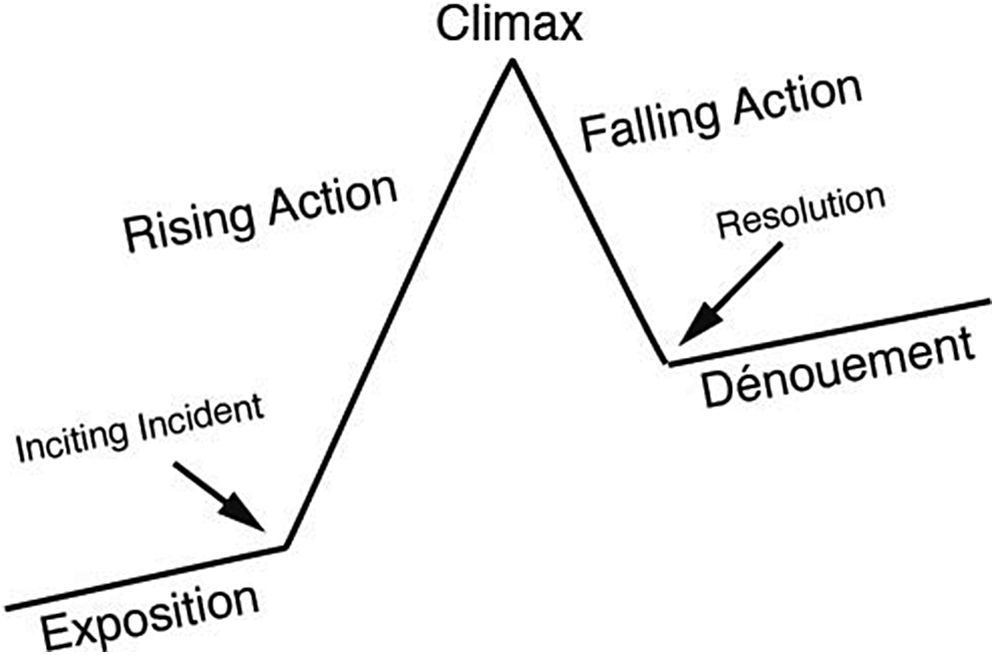
Simple dramatic arc (gilligaj 2014, redrawn by the authors).
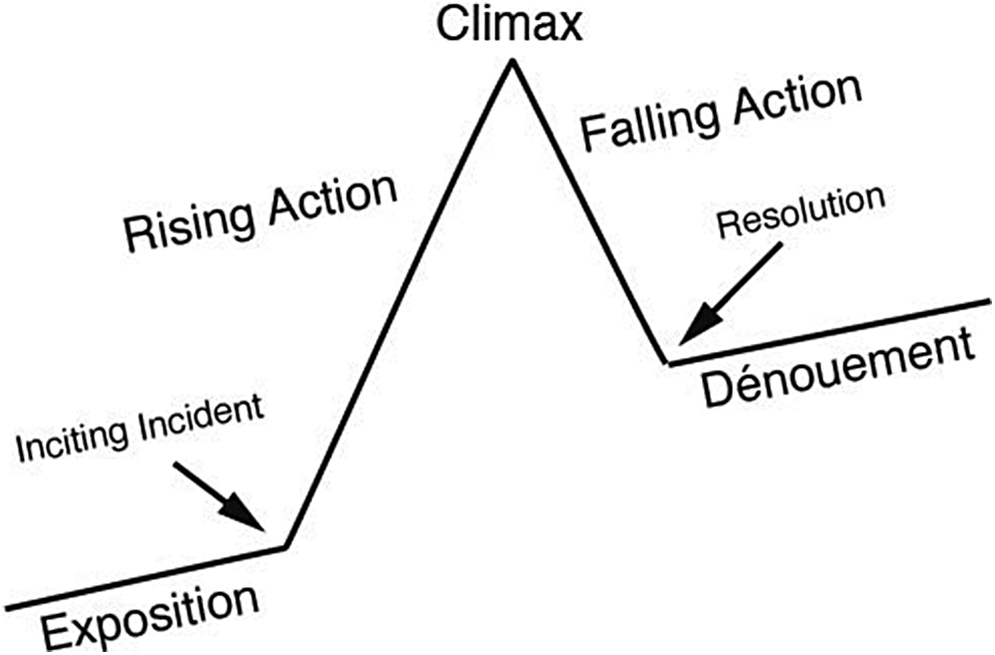
Despite the emphasis on flexibility, some level of narrative structure is beneficial to maintain player interest and provide a cohesive gaming experience. GMs are encouraged to explore the unique dynamics of GMing, allowing a significant degree of co-creation with players, while also drawing inspiration from other mediums like TV and movies (Four Reference Four2022a, Reference Four2023).
Current roleplaying resources, such as the D&D v5 Dungeon Master’s Guide and Starter Kit, offer limited guidance on story improvization during play, focusing more on a clear, planned narrative structure. This approach may not fully support GMs, especially novices, in handling disruptions of the story by players (Acharya, Mateas, and Wardrip-Fruin Reference Acharya, Mateas and Wardrip-Fruin2021). Thus, GMs are generally advised to adapt to player actions with spontaneity and flexibility, without adhering to a fixed structure or sequence of events.
Literary drama
The notion of drama is here used in an inclusive sense; for the purpose of this study, discussions of nuanced distinctions within drama (such as plays and novels) as well as of adjacent forms (such as poems, songs, and oration) are omitted. The investigation focuses on narrative templates for how sequences can be arranged to produce rises and falls in tension over time. The best-known narrative structural models from classic literary drama might be the simple Aristotelian dramatic arc or three-act model (Figure 9; e.g., Fullerton Reference Fullerton2014, 116f. and Zubek Reference Zubek2020, 159f.), and the Hero’s Journey (Campbell Reference Campbell1949, and e.g., Yin Reference Yin2015, 34ff.).Footnote 8 Other popular models are, for instance, the nine-act structure, which is often used in TV movies, caters to commercial breaks (Hornsby Reference Hornsby2020; O’Brien Reference O’Brien2022), and is “similar [in structure] to the classic Hero’s Journey” (Dane Reference Dane2007); Michael Hague’s Six Stage Plot Structure (the “Hollywood Blockbuster Formula” (Four Reference Four2022a)), which is targeted at and popular for commercial, mainstream movies, also “uses a three-act structure,” and is “a variation on the Hero’s Journey” (Hardy Reference Hardy2019, see Allen Reference Allen2022); and Syd Field’s three-act structure for screenplays (Field Reference Field2005), which is also similar to the dramatic arc with the three phases of setup, confrontation, and resolution. A structure originating in China (John Reference Johnn.d.), and informing traditional Chinese, Korean, Japanese, and Vietnamese narratives (Wikipedia 2025), is the four-act structure Kishōtenketsu. Structurally it is similar to the dramatic arc, as well.Footnote 9
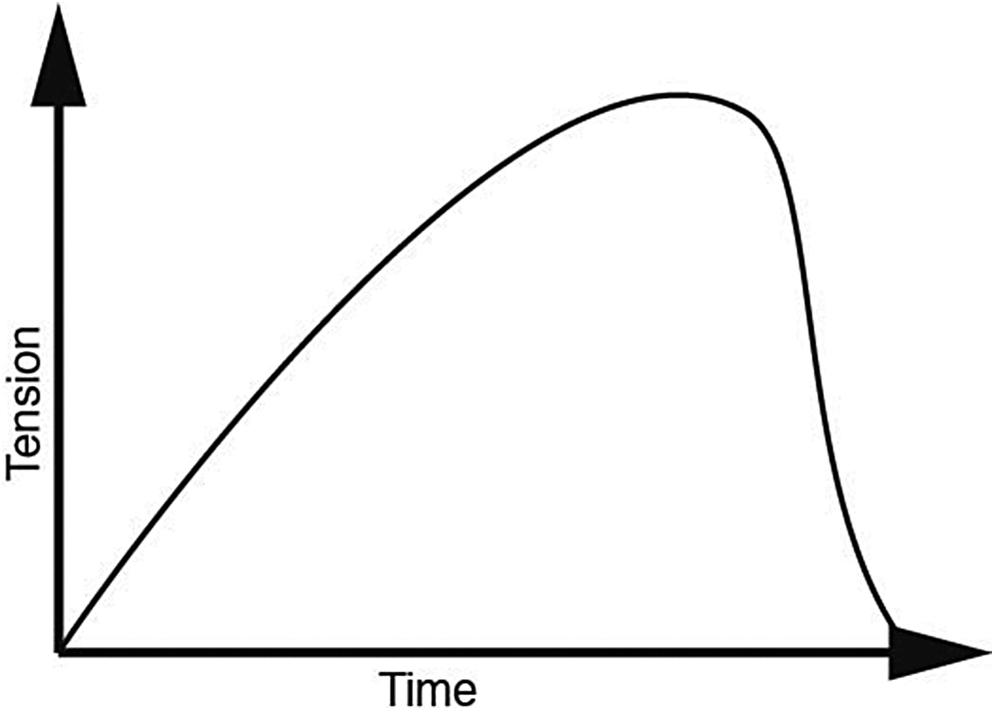
Ryan (Reference Ryan1999a) describes the application of the Aristotelian dramatic arc to game level design. Based on the “Thesis-Antithesis-Synthesis model that we know from stories and films,” he explains that in games the “tension builds as the player (the thesis) interacts with the antithesis, and it crescendos right before the synthesis, where the reader, watcher or player breathes a sigh of relief” (Figure 10).Footnote 10 Wesolowski (Reference Wesolowski2009) notes that cinematic pacing’s “clear rhythm” helps players “to anticipate challenges and get ready right on time,” provides “relief in regular intervals [which] prevents players from getting tired too quickly,” and supplies them with “adrenaline rushes” through “[s]udden surges of intensity” (ibid.).
A typical pacing curve in a level (Ryan Reference Ryan1999a, redrawn by the authors).
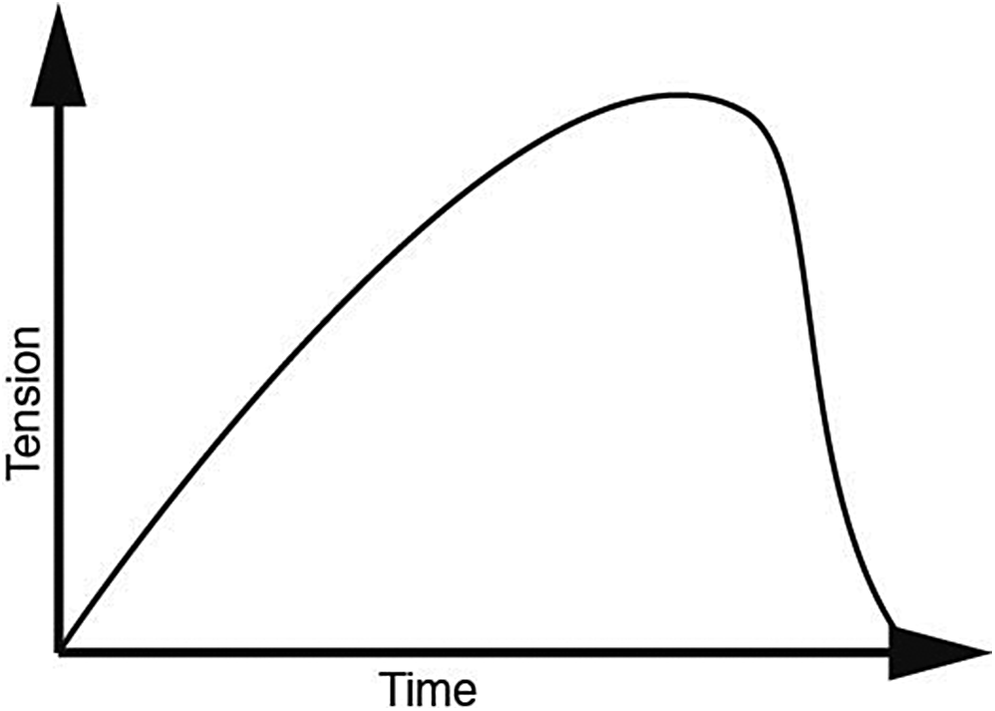
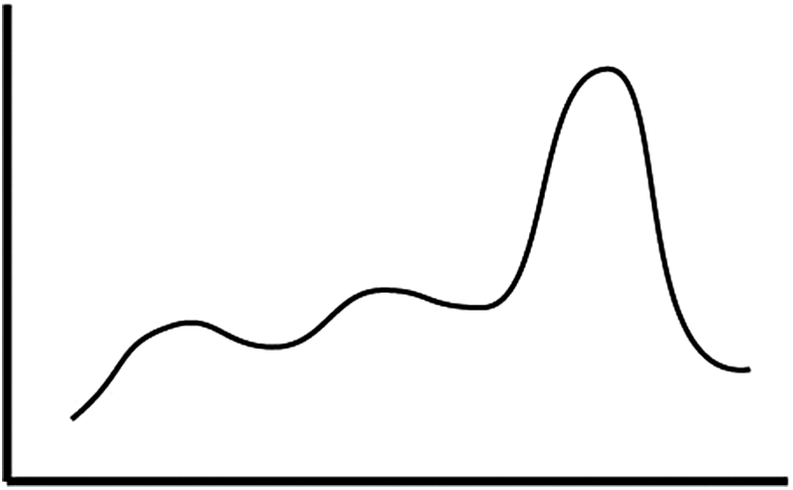
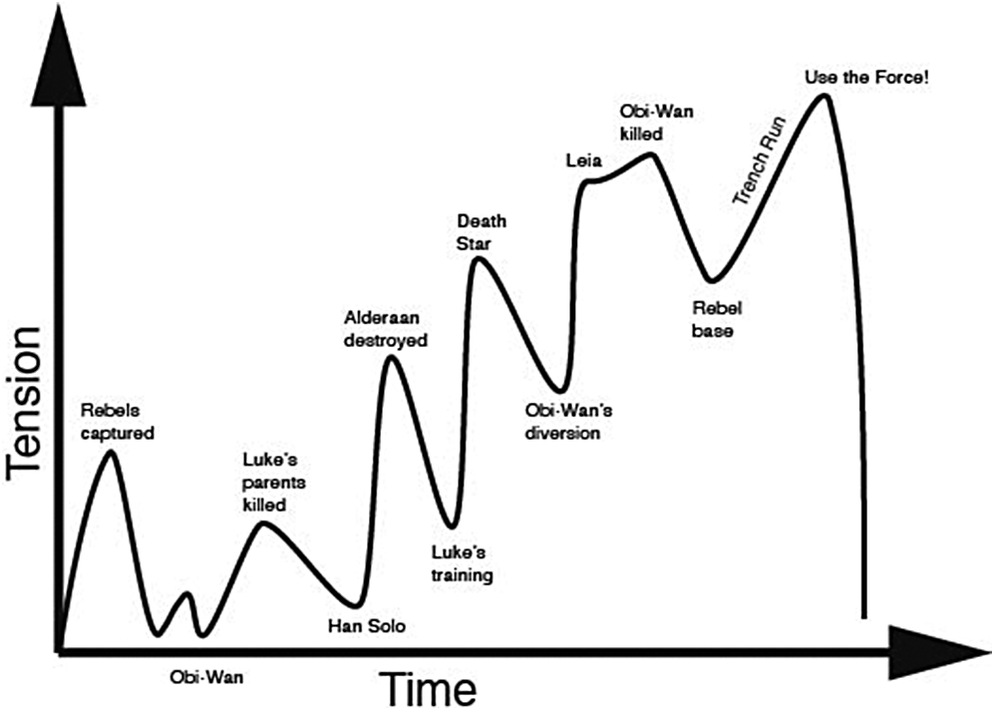
However, Ryan (Reference Ryan1999a) notes that “[b]ecause games are interactive, forcing a certain pace into the level can be difficult” (ibid.). Wesolowski (Reference Wesolowski2009) similarly cautions against the undiscerning application of narrative models such as the Hero’s Journey to structure experience to games. He observes that “[a]ll of its key concepts translate easily into an interactive setting,” with the player being the hero, the “combat loop” corresponding to the “confrontation sequences,” “[m]issions and levels correspond[ing] to trials on the Hero’s path,” etc. (ibid.). But he questions the assumption that the arrangement of in-game “events in an ‘increasing wave’ of intensity” (Figure 11) will lead to “the cinematic effect of mounting tension,” and would leave players “shaken and wanting more” (ibid.). Taylor similarly warns that while the “standard ‘roller-coaster’ curve of high vs. low intensity, exploration vs. combat, rest vs. action, etc.” may “serve [
$\ldots $
 ] as a good base-line for level design” when it “maintains player engagement, its constant repetition can quickly become” boring (Taylor Reference Taylor2013a, see also Taylor Reference Taylor2013b).
Pacing in the Star Wars movie (Wesolowski Reference Wesolowski2009, redrawn by the authors).
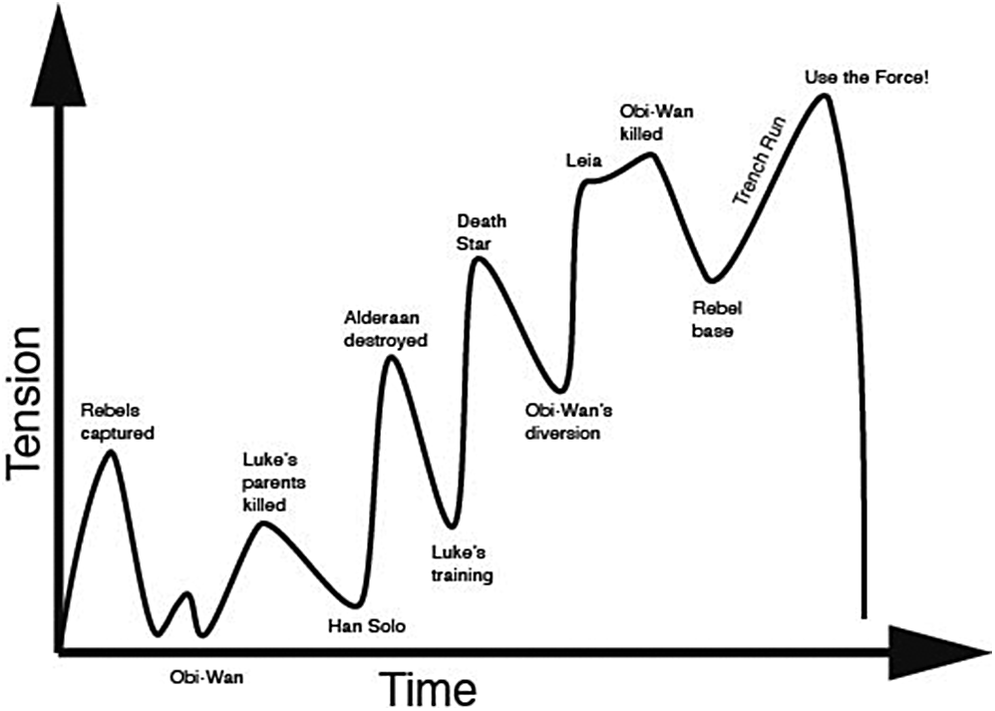
Wesolowski (Reference Wesolowski2009) identifies at least three aspects that limit the application of “[s]imple pacing structures, such as ‘increasing wave”’ in games (ibid.): (1) They “are very predictable when they have too many iterations” (ibid.). (2) Digital games are typically “between three and twenty times as long as films, which means intensity progression is much slower, and thus harder to notice. A designer doesn’t have much choice: each new obstacle is not more menacing, just different” (ibid.). For instance, the “[a]verage intensity [in Freelancer] doesn’t start to increase significantly until near the end of the game” (ibid.). (3) In a game, “[t]here are [
$\ldots $
 ] more individual action sequences than in a film,” which is repetitive, and diminishes the potential meaning of each individual sequence (ibid.).
Recently, narrative drama managers attempt to recreate structures informed by classic drama in (digital) games (and even productivity applications, Laurel Reference Laurel1986) and to design players’ (or users’) experiences accordingly (Laurel Reference Laurel2013; Mateas Reference Mateas2002; Mateas and Sengers Reference Mateas and Sengers2003; Mateas and Stern Reference Mateas and Stern2002, Reference Mateas and Stern2005; Mitchell and McGee Reference Mitchell and McGee2011; Murray Reference Murray2017, Sharma et al. Reference Sharma, Ontañón, Mehta and Ram2010, 185ff., Yin Reference Yin2015, 7f.). Commercial games which employ some form of interactive narrative management are, for instance, Mass Effect (BioWare, 2007), Fallout 3 (Bethesda Game Studios, 2008), and Spore (Electronic Arts, 2008; Sharma et al. Reference Sharma, Ontañón, Mehta and Ram2010, 184).
Flow theory
Csikszentmihalyi first defined Flow “as a holistic sensation that people have when they act with total involvement” (Csikszentmihalyi Reference Csikszentmihalyi1975 in Beard Reference Beard2015, 353). Flow is usually described as an “optimal experiences in daily activities” (Csikszentmihalyi, Montijo, and Mouton Reference Csikszentmihalyi, Montijo, Mouton, Pfeiffer, Shaunessy-Dedrick and Foley-Nicpon2018, 215); it happens in the “dynamic interplay between individual abilities and environmental opportunities” (ibid.). Flow understands the experience of an activity as the confluence of multiple, identifiable components. Three such components, which can facilitate Flow, are “an ongoing balance of challenge and skill, immediate feedback, and clear and proximate goals” (Csikszentmihalyi, Montijo, and Mouton Reference Csikszentmihalyi, Montijo, Mouton, Pfeiffer, Shaunessy-Dedrick and Foley-Nicpon2018, 215). Nine such components are: The “challenge-skill balance, action-awareness merging, clear goals, unambiguous feedback, concentration on the task at hand, sense of control, loss of self-consciousness, transformation of time, and an autotelic experience” (Beard Reference Beard2015, 353; see Csikszentmihalyi Reference Csikszentmihalyi1991, Reference Csikszentmihalyi1996). Regardless of many components there are,Footnote 11 they should be maximized in the design of an activity to create opportunities for Flow to emerge (Csikszentmihalyi, Montijo, and Mouton Reference Csikszentmihalyi, Montijo, Mouton, Pfeiffer, Shaunessy-Dedrick and Foley-Nicpon2018, 215).
Flow has been applied to (digital) game design “quite often” (Salisbury and Tomlinson Reference Salisbury and Tomlinson2016, 55, see ibid., 57 and Cowley et al. Reference Cowley, Charles, Black and Hickey2008, 13ff.). Naturally, much of the discourse on Flow and (digital) games appears to focus on how “to operationalize the flow construct in a game context” (ibid., 189; see Cowley et al. Reference Cowley, Charles, Black and Hickey2008, 1), that is, the integration of all or some of the components of Flow in game designs (Salisbury and Tomlinson Reference Salisbury and Tomlinson2016, 57). A play experience that (hopefully) exhibits Flow, emerges then implicitly, when “[t]he combination of these elements causes a sense of deep enjoyment” (Kiili Reference Kiili2006, 190).
Although there exist multiple components, Flow is often reduced to the balance between “the challenges associated with a situation and [a person’s] ability to meet the demands of the challenge” (Beard Reference Beard2015, 353). This component is also “[t]he original model of flow” (Csikszentmihalyi qtd. in Beard Reference Beard2015, 357). The focus is ubiquitously visible in the area of game design. For instance, Charles et al. (Reference Charles, Mcneill, McAlister, Black, Moore, Stringer, Kücklich and Kerr2005, Reference Allen6) formulate: “[F]low is the experience of hitting the ‘sweet spot’ between the annoyance of a task that is perceived [by players] as trivial and the frustration of a task that is perceived as too difficult” (similarly, Swink Reference Swink2009, 23, Fullerton Reference Fullerton2014, 98f., and Salisbury and Tomlinson Reference Salisbury and Tomlinson2016, 59).
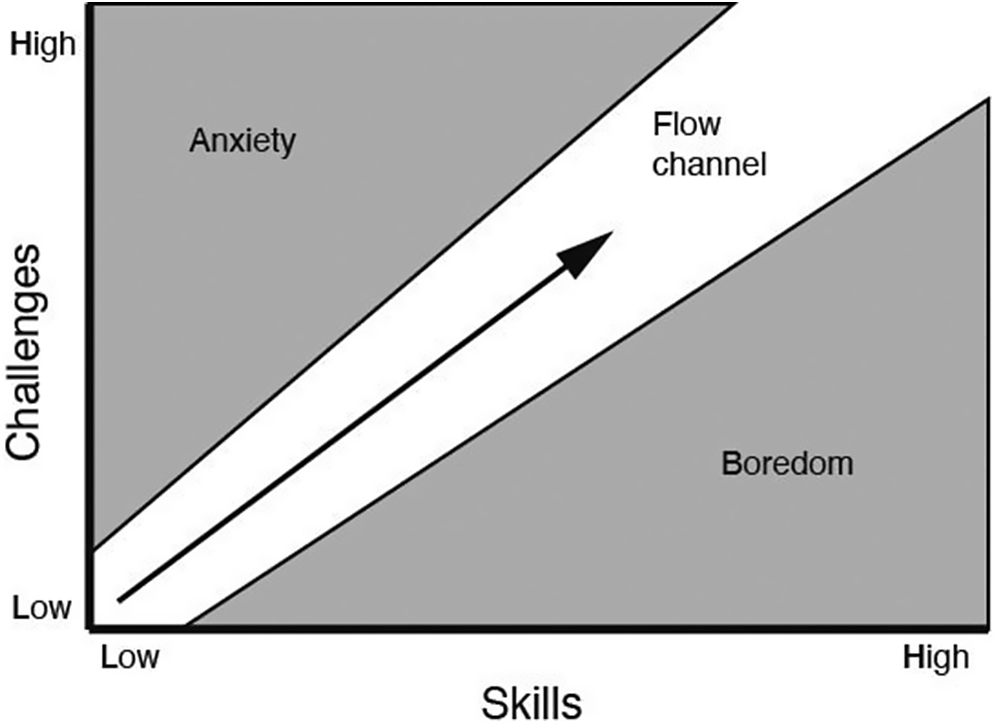
Useful for the identification of desirable experience patterns might be critical perspectives on a straight application of this component which aims to “[k]eep the user’s experience within the user’s Flow Zone” (Chen Reference Chen2007, 34), to facilitate a smoothly curved experience without sudden level changes, and which sees any divergence from such a curve as a fault (ibid., 33). Csikszentmihalyi (qtd. in Beard Reference Beard2015, 357) comments that in the “diagonal between challenges and skills” (Figure 12), “the flow doesn’t occur at the lower end of that diagonal, only further up, roughly above the average challenge and average skill for that person” (ibid., 357f.). The bottom-left part of the diagonal, “the tail end” of it, “is best described as apathy” (ibid., 358).
Flow channel between boredom and anxiety (Chou Reference Chou2018, redrawn by the authors).
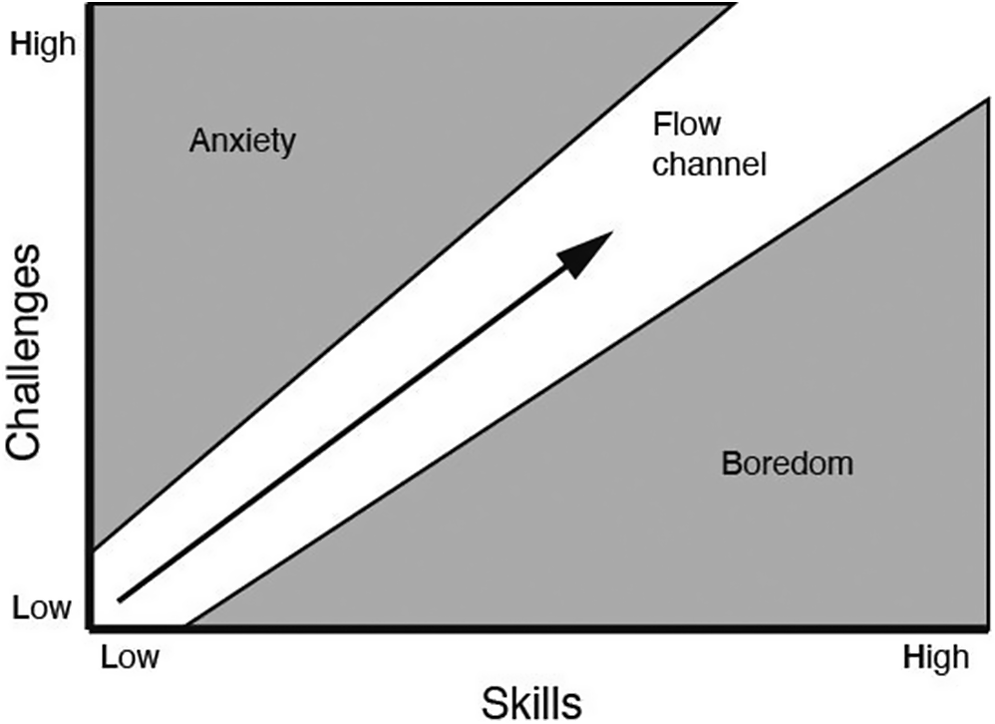
The design of experiences that center around the Flow curve, but also planfully dip into and traverse the areas above (too hard) and below it (too easy) has apparently not yet received much attention in the discourse. Kiili (Reference Kiili2006, 191) asserts that “the states of anxiousness and frustration should be understood more as the triggers or driving forces that motivate a user to strive for the flow state rather than as a plague that should be eliminated entirely.” Baumann, Lürig, and Engeser (Reference Baumann, Lürig and Engeser2016, 507) question the popular assumption that “flow is achieved best if the demands of a task are in balance with the skills of a person.” While several experiments with the “skill-demand ratio in computer games [
$\ldots $
 ] confirm that flow is higher under experimentally induced balance (
$skill = demands$
 ) compared to strong overload (
$skills < demands$
 ) and strong boredom (
$skills> demands$
 ),” Baumann et al. “do not expect that constant balance throughout a game is optimal” (ibid., 508). They “expect a slight overload in combination with a fluctuating balance” that “expose[s] the player to phases of high demands and rest” to be more conducive to flow than perfect balance (ibid.). As a specific pattern, they propose “dynamic conditions [
$\ldots $
 ] in which long phases of slight overload alternate with short phases of rest” (ibid.). They base their proposition on two key observations: First, the empirical finding that “people prefer challenge over balance in a game context,” and multiple studies that “support the assumption that slight overload is conducive to flow” (ibid.). Second, the insight in game design that “[d]emands should [
$\ldots $
 ] fluctuate over time” in a “cycle of tension and release” (ibid.).
Csikszentmihalyi notes that activities “may provide a reward structure” that facilitates Flow (Csikszentmihalyi Reference Csikszentmihalyi1975, 18 and Csikszentmihalyi Reference Csikszentmihalyi1994, 5 qtd. in Schüll Reference Schüll2012, 167). However, in many cases, the notion of reward structure appears to be used in the discourse to refer to the presence of extrinsic incentives (in contrast to intrinsic motivation); more concrete information on the strategic ordering or modulation of rewards has not been found.
Operant Conditioning theory
Operant Conditioning as understood and endorsed by Skinner, effectively starts from the proposition that people exhibit learned behaviors that are “little different from what had previously been termed ‘instrumental learning’ and what most people would call habit” (Staddon and Cerutti Reference Staddon and Cerutti2006). His “truly new” perspective is that the learning of such behaviors can be initiated and maintained by “automated training with intermittent reinforcement” (ibid.). The structure of the training is governed by reinforcement schedules (ibid.) which is “any procedure that delivers a reinforcer to an organism according to some well-defined rule.” Often, experiments use animals, such as rats or pigeons, which receive food. In the experiments, “the usual schedule [
$\ldots $
 ] delivers the reinforcer for a switch closure caused by a peck or lever press.” The experimental results generally also extend to humans (ibid., but compare, e.g., Csikszentmihalyi in Beard Reference Beard2015, 354f.).
The two most popular kinds of reinforcement schedules are “time-based schedules such as fixed and variable interval, in which the reinforcer is delivered after a fixed or variable time period” and ratio-based schedules which “require a fixed or variable number of responses before a reinforcer is delivered” (Staddon and Cerutti Reference Staddon and Cerutti2006, 1f.). The rate of elicited responses of the respondent is generally thought to be indicative of the response strength (ibid., 2). The effectual existence of Operant Conditioning is rarely questioned, but the interpretation of it is regularly “the focus of intense theoretical debate” (Kirsch et al. Reference Kirsch, Lynn, Vigorito and Miller2004, 370).
Conditioning theory has been applied to games, specifically, to gambling. Skinner (Reference Skinner1953, Reference Wesolowski104) underlines that “[t]he schedule is the important characteristic of behavioral conditioning” (Schüll Reference Schüll2012, 344, footnote 5). He explains that reinforcement schedules can be purposefully manipulated (“stretched”) to prolong engagement (ibid., 108): “The stretching may be accidental (an early run of good luck which grows subtly worse may create a dedicated gambler), or the ratio may be deliberately stretched by someone who controls the odds.” (Skinner Reference Skinner2002, 35 qtd. in Schüll Reference Schüll2012, 108, added emph. removed) Burger (Reference Burger1986, Reference Laurel66) notes that “[s]ystematic distortions of perceived cause and effect relationships have been found to permeate [people’s] efforts to make sense out of the events in the world.”
Studies indicate that “individuals modify their cognitions [about gambling] in response to the sequence of [manipulated] outcomes and schedules of reinforcement” (Herman Reference Herman2001, 16). For example, an early win is “thought to induce an illusion of control” for individuals (ibid.; notion of “illusion of control” introduced by Langer Reference Langer1975). In Langer and Roth’s experiment on predicting coin-tosses, they find evidence that the sequence of outcomes consistently influences individuals’ assessments of their ability to control the task (Reference Langer and Roth1975, 951). Langer and Roth explain that by somewhat consistently experiencing successes, people attribute skill to a task (ibid., 952); they note that in a task with a random outcome, even in one “as blatantly chance determined as coin flipping,” “the sequence of outcomes may serve as a cue signaling whether or not a task is controllable and whether or not one has that control” (ibid., 952).
Burger (Reference Burger1986) repeats Langer’s and Roth’s coin-toss experiment and confirms their findings (ibid., 66). He observes that “high desire for control subjects” attribute skill to the task “when they experience” successful outcomes “at the beginning of the sequence” to a higher degree than “subjects who experienced failure at the beginning of the sequence” (ibid., 66). Frank and Smith repeat the experiment with children (Reference Frank and Smith1989, 132), with similar results (ibid., 133f.). They find that children might even be “more optimistic about future performance than adults in similar situations” (ibid., 133, cf. p. 134). Frank and Smith assert that when people “in chance situations” are “successful at early trials, it is likely that an attribution to personal causation [is] made” (ibid., 130); they believe “[t]his attribution of control over chance situations” to be “key to understanding the persistence of gambling behavior” (ibid., 130). Specifically, they note that experiencing a “‘big win’ as a result of early gambling experience” might be “a common phenomenon of compulsive gamblers [
$\ldots $
 ] and is very likely critical in maintaining and forming the behavior” (ibid., 131, see Burger and Smith Reference Burger and Smith1985).
Schüll (Reference Schüll2012) describes multiple mechanics and features designed to make players spend money on (machine) gambling. She asserts that gambling machines are designed to follow not specific patterns, but certain schedules (i.e., numerical chances) of payouts that “dispense [
$\ldots $
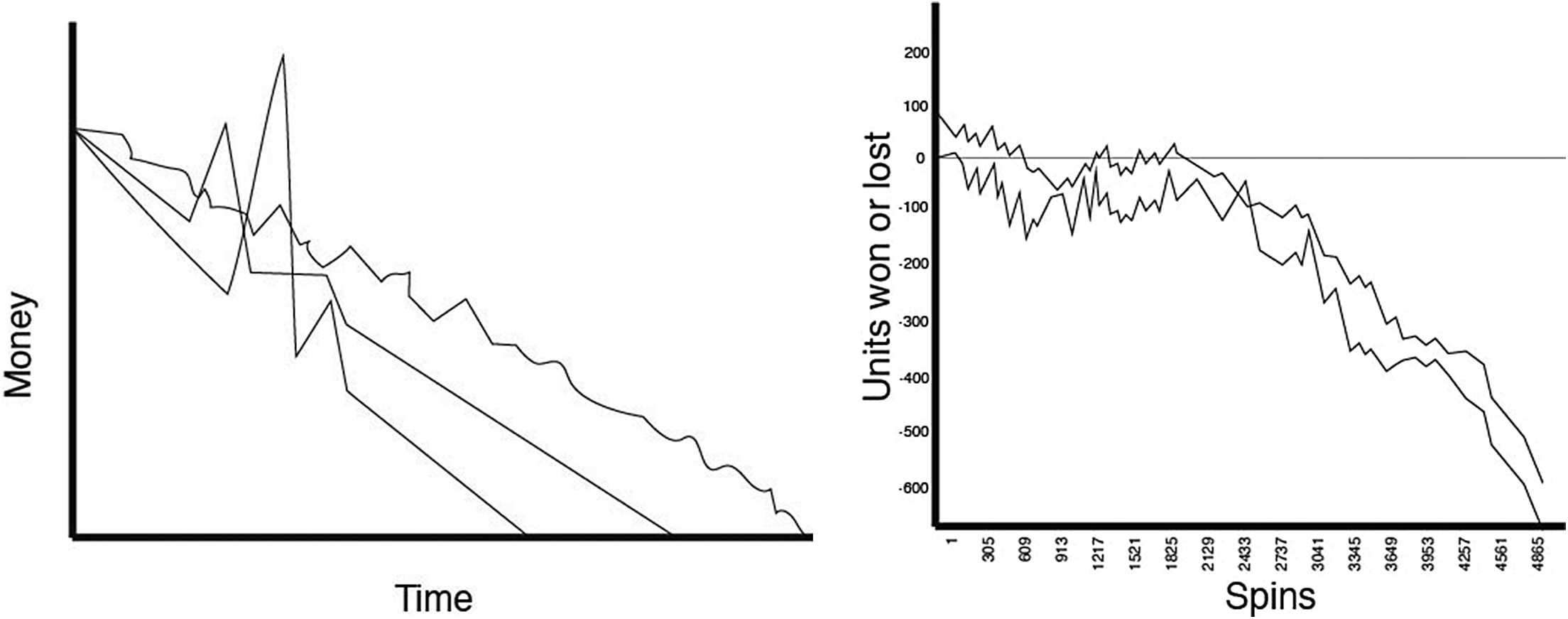
 ] rewards frequently enough to keep gamblers playing, yet not so frequently that a device will lose money” (ibid., 108). Gambling machine manufacturers simulate and test the efficiency of various payout schedules for groups of players (ibid., 109), to match “player types with schedule types” (Marcus Prater of Bally qtd. in ibid.). Prater goes on to state that different types of players are attracted by (“manifest themselves through”) different mathematical “formulae of chance” (qtd. in ibid.). Schüll (ibid.) describes two main and opposite payout schedules players appear to gravitate toward, “with several gradations in between” (John Vallejo of Anchor Gaming qtd. in ibid.): Winning infrequently, but large sums of money; and winning frequently but small sums of money (Figure 13).
Various projected (left) and simulated (right) payout curves over time in gambling devices (Schüll Reference Schüll2012, 112, redrawn by the authors).
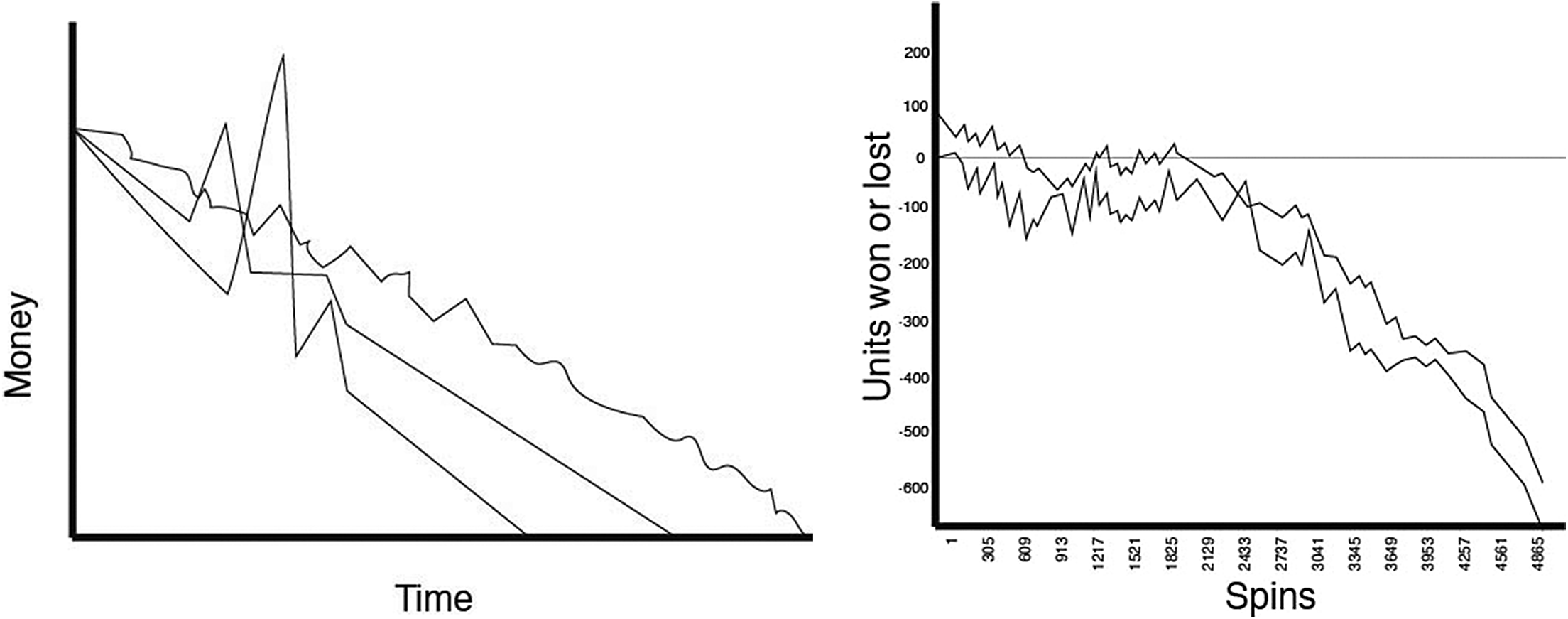
Schüll does not formally or informally identify specific patterns of experiences that keep gamblers engaged,Footnote 12 beyond observing that experience curves with only minor dynamic variation over events and time, so-called high hit frequency games, are increasingly preferred by gamblers (ibid., 128) and also by device manufacturers because “such games yield greater revenue” (ibid., 111).Footnote 13
Discussion
In the results presented above, three aspects appear quite surprising or at least unexpected: The heavy focus on experiential testing which is promoted both in the academic discourse and by game design practitioners; the almost complete lack of formal guidelines; and the ready applicability of the dramatic arc as a conceptual model to analytically understand the strategic ordering of game play events. These aspects are discussed here. In addition, several open conceptual and methodological questions are outlined. Limitations of the study are acknowledged.
Intuition, experience, and testing
Intuition, often based on a wealth of practical individual and collective experience, is, usually in combination with iterative development and testing, a common approach in game design, as regularly formulated in the discourse and emphasized by practitioners: Clearly, the most prevalent advice on the design of playing experiences is to try it out and playtest. The testing can be done during the design process, or, it can be left to the players, that is, a game offers various experiences (for instance, of different difficulties), and the players are to identify and select the one they prefer.
Similar observations are made in tabletop roleplaying, where GMs sometimes explicitly oppose and reject rigid structures, such as narrative arcs, because they can clash with the emergent dynamic of the players’ momentary intentions and actions of co-creation. Some GMs use chunks of premeditated material, such as little story snippets, non-player characters, situational challenges, large narrative blocks, stopping points, or whole (story) chapters, to support their spontaneous improvization.
Absent rules and guidelines
In the scrutinized discourses, often, only desirable experiential aims or outcomes are specified, but no rules or guidelines are formulated, such as in design patterns, where, for example, an action game design pattern proposes an increase in difficulty, but does not offer a specific model, and in roleplaying, where a satisfying shape of the playing experience is described, in which players have full agency, and sessions are clearly and accessibly structured, again without concrete information on conceptual models. The discourse on DDA appears to be oriented toward a reactive perspective that aims to momentarily avoid or fix undesirable playing situations, but does not incorporate a conceptual model for a holistic playing experience. Similarly, while reward structures are discussed in the discourse on Flow, no guidelines on the strategic modulation of the experience are formulated.
The same observation, it appears, can be made with regard to Operant Conditioning theory. Interestingly, while studies point out that tuning the chances and outcomes of events has an impact on, for instance, gambling behavior, no specific models are described. Already Skinner has, tantalizingly, outlined the idea that reinforcement schedules can be manipulated to facilitate certain experiences, such as, to extend the interaction time. This idea has occasionally been taken up, tangentially, in the discourse, over the years, but apart from an early win or predominantly positive results in the first part of an experience (Herman Reference Herman2001, 17), concrete insights still need to be formulated.
Experiential arcs and curves
Across the various areas, and as models to structure or pattern experiences, the study finds arcs or curves, such as the classic narrative three-act model and the simple dramatic arc, which originate in literary drama. There are more and less complex arcs proposed in the discourse, but they share the motif of multiple, oscillating phases of tension and relaxation, or aporia and epiphany, usually with an overall rising (and finally falling) valence.
Such arcs are regularly referenced in game design, for various aspects, such as pacing. Zubek (Reference Zubek2020, 174), for instance, characterizes the rhythm of games as “high-intensity challenges” and “downtime” (but supplies no specific information on the structure or order of such rhythms). Arcs proposed in game design rise either linearly (within and between levels) or in larger segments or chunks (within and between groups of levels, enemies). Arcs are also applied by GMs in tabletop roleplaying, to some degree, as long as the players do not stray too far from a source narrative.
Effectively, Flow, when reduced to the popular dichotomy between the components of boredom and anxiety, facilitates a linear increase in game difficulty similar to curves proposed in game design. Rarely, it is proposed for the game experience to leave the Flow channel; but no particular rhythms or patterns on how to structure or pace such excursions into the areas below and above the channel are specified.
Arcs are often spikey, with pronounced valleys and hills; and occasionally smooth, as in the famous Flow channel between boredom and anxiety, and in gambling, where gamblers as well as casinos or the manufacturers of gambling machinery prefer undramatic in-game events (such as small wins and losses) over dramatic ones.
Open questions
This study aims to identify conceptual models to inform the strategic ordering of game play events in various discourses, and only finds intensity or tension arcs. When considering the wide variety of play contexts and technologies that support play activities, there are surprisingly few (original or adapted) models for game designers to use when structuring events put forward in the literature. The predominant model appears to be repeated variations of rather simple experiential sequences of tension and relaxation on an overall increasing level, that is, the dramatic arc.
It is an open question if the blank spot, the study identifies, can be meaningfully filled; on this, the authors are not taking a position. Here, they only speculate on the reasons for the apparent lack of models or patterns. A reason might be technical, that is, the facilitation of specific in-game experiences for players is a complex endeavor, with regard to identifying players’ experiences (i.e., which experiences are typically or regularly facilitated by playing games), assessing what a particular player experiences at a given point in a game, or deciding what constitutes (discrete) in-game events, and what they mean for players, as well as facilitating specific desired experiences for players (i.e., how to match events in a game with certain reactions in players, and to bring about such events in a way that does not disrupt the game). Also, players are diverse; and games and game genres are different, as are the situations in which games are played (such as a quick casual game during a bus ride), thus the formulation of a universal model might be elusive from a practical point of view.
An alternative or additional reason might be conceptual or philosophical. A romantic perspective on play maintains that play is pure and open-ended, and cannot be influenced, shaped, or rigged from the outside without perverting, ruining, and ultimately stopping it. Players may well prefer chaotic, unplanned, arbitrary arrangements of experiences (which are raw and genuine) over well-shaped ones (which are artificially curated). To attempt to modulate players’ in-game experiences, might thus be a futile endeavor. When players take over and start playing a game, they “do not know what experience” was “intended for them” (Zubek Reference Zubek2020, 8), and their “experience playing the game can vary wildly” (ibid.). Players “have their own agency and ideas about what they want to do” (ibid.) as opposed to the designer’s agency what they should be doing (ibid., 8f.). Players “have full freedom to take the game in whatever direction they want” (ibid., 9); Zimmerman (Reference Zimmerman and Fullerton2014, xiii, emph. added) describes that the playing of a game “is to realize and [to] reconfigure” the connections between things in games. Players have shown a considerable propensity for the appropriation of games (Cermak-Sassenrath Reference Cermak-Sassenrath2018). It is also likely that player populations adapt rather quickly to new trends in games, and develop, for instance, regularly new expectations with regard to desired playing experiences (practitioner (A.) of game studio (X.), pers. comm., 2021); the design of experiences is then a moving target and invariant models could not be formulated.
Limitations
There are several aspects the authors acknowledge that may compromise the findings of this study. (1) The study adopts a wide and inclusive definition of gamesFootnote 14 and does not focus on specific types of experiences (desirable or otherwise). The research question or the employed notions may thus seem to be weakly defined. However, for an initial study, this wide view is helpful in elucidating high level models across domains. (2) Powerful abstract models are often simple, and they regularly need to be adjusted when applied to concrete situations. It is possible that simple curves are thus well suited and sufficient to describe general techniques for shaping playing experiences, but more detailed implementations and adjustments could be expected for specific contexts of game play. (3) The field of game design might be too complex, large, and diverse, for even high-level models to adequately describe how to modulate playing experiences. It might be naive to assume such models existed or could be found, which extend to and cover various games, game genres, players, playing situations, playing experiences, etc. While it might seem futile to try to identify universal models across various domains, the collection of examples identified similarities that warrant an investigation into the literature and suggest future directions for research (see below).
Conclusion and future work
The study reviewed several discourses to identify exemplary conceptual models for the strategic ordering of game play events. Models can describe, for instance, a pattern of increasing difficulty, a mix of positive and negative events, or phases of intense action broken up by pauses. Given that play is a central tenet of being human (Huizinga Reference Huizinga1955, 3), and people have a wealth of first-hand experience both as players and as facilitators of games, one could expect that there is an abundance of advice on the design of desirable play.
As the results of the study appear to indicate, there is a surprising paucity of formal and even informal rules and guidelines on this aspect of game design. Relatively few models are proposed in various discourses, and even these are occasionally severely criticized (e.g., by Taylor Reference Taylor2013b). If models are proposed or discussed at all, the predominant model applicable for the design of ideal playing experiences in games appears to be variations of rather simple curves that promote sequences of tension and relaxation, challenge and resolution, or risk and gain, which are repeated throughout the game; possibly with a gradually increasing level of difficulty or intensity. This motif is largely consistent across the various discourses or areas that have been scrutinized in this study.
As its central contribution to the narratology discourse, the study thus shows how the dramatic arc as a conceptual model can inform the understanding of the strategic ordering of game play events. Drama theory offers a powerful model to analytically describe sequences of dynamic experiences, even and specifically outside of the domain of literary drama. Curiously, such models are absent from other domains where they could be expected to be developed, to be naturally used and to proliferate, such as in game design, design patterns, or roleplay.
Building on this study’s findings, future work could: (1) Go beyond identifying models in an exemplary fashion, and provide systematic or comprehensive reviews of the same or of other discourses. (2) Conduct empirical work to confirm the effectiveness of particular models for or their impact on, for instance, specific groups of players, games, or game genres. (3) Discuss the reasons for the scarcity of models this study has identified, for instance, practical/technical and/or conceptual/philosophical reasons. (4) Complement the conceptual models identified in this study with empirical research with players engaged in game experiences to identify a set of formal rules, that substantiate, extend, or dismiss the findings.
Data availability statement
No data are available.
Author contributions
Conceptualization: D.C.-S. and T.M.; Formal analysis: D.C.-S. and T.M.; Investigation: D.C.-S. and T.M.; Methodology: D.C.-S. and T.M.; Writing – original draft: D.C.-S. and T.M.; Writing – review and editing: D.C.-S. and T.M. Both authors contributed equally to this work.
Funding statement
This research was supported in part by the Innovation Fund Denmark in the Innobooster project, “PlayXperience.”
Competing interests
The authors declare no competing interests.


 Open access


Rapid Responses
No Rapid Responses have been published for this article.