The quality of representation the citizenry receives from its political leaders is central to evaluating the character of any democratic institution. Moreover, the number of elected members that comprise an institution can be vital in determining whether citizens have access to and can influence the decisions of their representatives (Dahl and Tufte 1973). The United States House of Representatives has been frozen at 435 members for almost a century. This durability of this alignment is astonishing; in its first century of existence, the U.S. House experienced a virtually uninterrupted string of decennial increases in its membership. Despite the magnitude of the effects of this stasis on representation, political scientists have not extensively examined this subject (Squire and Hamm 2005).1
The work of Neubauer and Zeitlin (2003) is one exception. Their research looks at how variation in the size of the U.S. House would have brought about alternative outcomes in the Electoral College for the closely contested 2000 U.S. presidential election.
On one side of the debate are the proponents of an enlargement in the membership of the House as a means to improve the quality of representation citizens receive (Glassman 1990; Jacoby 2005; Kromkowski and Kromkowski 1991, 1992; Lijphart 2000; Lucas and McDonald 2000; Yates 1992). Primarily, these advocates claim that failure to adjust the size of the House consistent with U.S. population growth has created congressional districts that are too heavily populated for House members to ade-quately represent their constituents in the areas of policy and service responsiveness. They also contend that boosting the membership of the House would provide additional opportunities to elect women and minorities to the body. Furthermore, they suggest that taking this step would prevent states growing at a rate less than the national average from losing seats in subsequent rounds of reapportionment. Shifting migration patterns have cost many states in the Northeast and Midwest representation in the House over the course of the last half century. While one essay lists a total of 25 reasons to increase the size of the U.S. House (Kromkowski and Kromkowski 1991), the preceding justifications are emphasized as particularly important by advocates of this cause.
On any question of institutional design there is an imperative to balance the need to provide representation against operational efficiency (Buchanan and Tullock 1962; Polsby 1968; Shepsle 1988; Willoughby 1934). Any legislative body must be responsive to multiple interests in society, but it must also operate in an efficient manner so it can carry out its policy making responsibilities. Opponents argue that while enlarging the House might have benefits for representation, doing so would disrupt legislative operations in the chamber. This more unwieldy legislative environment would undermine communication and deliberation among members and make building coalitions in the House a more onerous task (Evans and Oleszek 2000; Overby 1992). Detractors also cite other concerns, including increased costs and lack of existing infrastructure needed to accommodate an addition of members and staff.
There has been recent legislative action to adjust the size of the House in the 110th Congress. On April 19, 2007, members of the House approved a two-seat increase in the size of the institution to provide a voting member for the residents of the District of Columbia. This proposal marked the first time since Alaska and Hawaii entered the Union that Congress has seriously debated an upward adjustment in the size of the nation's lower legislative body. However, on September 18, 2007, the bill died at the hands of a Senate filibuster (Sheridan 2007).
Despite the potential consequences for representation when a national legislative body remains constant in size during a period of extended population expansion, there has been little consideration of public opinion on this issue. Do U.S. citizens approve of the current size of the House, even if it means a diminished capacity for representation? Public attitudes toward numerous aspects of American political institutions are limited in scope, although some issues, such as term limits for members of Congress, have been polled extensively. Institutional size is a domain that has received scant attention from survey researchers. Moreover, there has been a complete absence of survey data probing attitudes about the size of the U.S. House and the average number of constituents per congressional district. This article fills this void by presenting the responses to questions on these topics from a national survey administered by Knowledge Networks of 1,020 Americans.
Questions Utilized for This Study
In undertaking an effort to empirically investigate attitudes toward the size of the U.S. House and the growth in the mean congressional district population size, there are no benchmark survey questions from which to take guidance. The Knowledge Networks' survey questions deal with the tradeoff between representation and legislative efficiency, loss of representation for certain states due to migration, and descriptive representation for minorities and women in the House. From September 13 to September 19, 2006, Knowledge Networks administered the survey to 1,425 of its members. The results presented in this study are based on responses from the 1,020 panel members who completed the survey, representing a 71.6% response rate.2
Post-stratification weighting was employed to control for minor variations in the sample compared to the general population.
Prior to a delineation of the rationale for the choice of questions, a brief explanation of the survey methodology employed by Knowledge Networks is apt. Knowledge Networks creates a panel employing probability-sampling techniques. Recruited by random-digit dialing over the telephone, the Knowledge Networks panel is the only online consumer panel that represents those individuals who do and those that do not have Internet access. Knowledge Networks supplies Internet technology to the roughly 30% of panel members who do not have Internet access at home. Previous studies have shown that panel data from Knowledge Networks is in some cases more reliable than findings from other, more traditional, research companies (Krosnick and Chang 2001). Survey results gathered by Knowledge Networks have been used in a number of political science studies in recent years.3
Several studies using Knowledge Networks have appeared in a number of well-respected political science journals (e.g. Clinton 2006; Hillygus and Shields 2005; Lawless 2004a).
Partial funding for the survey was provided by the Graduate School at Northern Illinois University.
An overarching theme throughout this debate revolves around the tradeoff between a small legislative chamber and a larger constituency size and large legislative chamber and a smaller constituency size. A small chamber may facilitate a more efficient legislative process, while a larger chamber is more representative in character (Willoughby 1934). This tradeoff forms the basis for the first survey question. Because of the rudimentary knowledge many U.S. citizens display toward U.S. institutions (Delli Carpini and Keeter 1996), the question is prefaced with a brief explanation of the changes in the size of the U.S. House and the average population of congressional districts. In doing so, each side of the tradeoff debate is included. The text of the question follows:
When the U.S. House of Representatives was first constituted it consisted of 65 members with each congressional district having approximately 30,000 people. As you may know, the House of Representatives has grown to 435 members with each member representing approximately 640,000 people. Some have argued that the number of representatives should be increased so that each member would represent fewer people, would be closer to the people and provide better representation. Others have argued that a House of Representatives with greater than 435 members would be more costly and make the legislative process less efficient. In your opinion, should the size of the House be: (1) increased, (2) kept at its current size, (3) decreased.
Providing a detailed question that offers each of the major arguments on both sides of the debate allows for a nuanced understanding of public attitudes. Those citizens inclined toward wanting a greater emphasis on additional representation through institutional reforms should support an increase, while those concerned with gridlock and the cost of government should voice preference for maintenance of the status quo or even reduction. Though most of the debate centers on an increase beyond 435 members, some Americans may find reduction an appealing option. Indeed, a few commentators have urged consideration of cutting back the size of the U.S. House (Proxmire 1989; Silverman 1991).
The remaining survey items investigate two of the other representational issues that have arisen from a cap on the size of the U.S. House. One of the most conspicuous consequences of the 435-seat limit pertains to geographic representation. Several states have lost seats in the House over the past century. Preventing this practice from continuing has been one of the most prominent arguments advanced by promoters of House enlargement (Kromkowski and Kromkowski 1991; Yates 1992). There has been a visible decline in the number of House seats for the states in the Midwestern and Northeastern regions, despite the fact the population of these states has continued to rise, albeit at a slower rate than the national average. For instance, after the 1910 reapportionment New York sent 43 elected members to the U.S. House; following the 2000 census that number dropped to 29 seats. At one point in the late Nineteenth and early Twentieth centuries, Congress routinely passed apportionment bills to prevent any state from losing seats in the House (Kromkowski and Kromkowski 1991). Would Americans favor a return to an apportionment process that no longer allows states to suffer a reduction in the number of seats allocated to the U.S. House?
The question gauging support for this proposition reads: “After the U.S. census is taken every ten years some states lose seats in the U.S. House of Representatives because their population growth is slower than the national rate. Would you support increasing the size of the House to prevent states from losing any seats?” This question serves as a straightforward way to assess to what extent Americans are concerned that many states are losing representation in the House due to the 435-seat limit. One plausible expectation is that residents from the Northeast and Midwest may be more inclined to support an increase due to the loss of seats many states in these regions have experienced over the past few decades than would citizens in other parts of the country where population growth has been more robust.
One of the major claims advanced by advocates of an upward adjustment in size of the House is that it would increase representation for women and minorities (Glassman 1990; Kromkowski and Kromkowski 1991; Rule 1991; Yates 1992). The logic behind this argument is that most members are elected to the House not by defeating a sitting incumbent, but rather when a seat becomes open either by retirement, resignation, or death. Women have traditionally made noticeable gains in the first election following reapportionment when there are more open-seat contests (Burrell 1994). After each census the number of new seats apportioned would rise, creating additional opportunities for women and minorities to run. It is easier to create majority-minority districts likely to elect African Americans and Latinos in less-populated congressional districts.5
Some analysts have offered up contrary assessments questioning the potential electoral benefits to women and minorities from enlarging the House (Overby 1992; Rush 2000).
While the concept of descriptive representation is frowned upon by many normative political theorists, Mansbridge (1999) observes that it may allow for unarticulated interests to be heard in the deliberative process and may give chances for members of groups systematically excluded from full participation in politics to demonstrate their ability to participate effectively in the governing process. Furthermore, when racial congruity is present, citizens are more likely to express approval of their representatives, all else equal (Box-Steffensmeier, Kimball, Meinke, and Tate 2003; Gay 2002; Tate 2003). The same relationship exists for women represented by a female member of Congress (Lawless 2004b). Thus, enlarging the size of the House may increase the level of political efficacy underrepresented citizens feel toward the political system. The third survey question discerned whether there is support for increasing the size of the House on the basis of descriptive representation: “Some argue that increasing the numerical size of the U.S. House of Representatives would create more opportunities for members of underrepresented groups such as women and racial minorities to get elected. Would you be very supportive, somewhat supportive, somewhat opposed or very opposed to increasing the size of the House for this purpose?”6
This question uses a set of ordered four-point response categories rather than a set of discrete choices to account for the greater intensity that may be engendered by issues involving race and gender.
Results
As a Legislative Tradeoff
The first set of results gauges public support for an increase in the size of the U.S. House in the context of the legislative tradeoff between efficiency and representation. Table 1 reveals that Americans are solidly behind keeping the House at its present size. Overall, 61.9% of those surveyed selected that option, while only 18.9% favored an increase, and just 19.3% supported a reduction in the membership of the body. There is some degree of variation across the subgroups listed in Table 1. Conservatives, Republicans, and older citizens are less likely to favor an increase.7
Though many conservatives in the general population oppose this idea, a few conservative pundits have lent their support for an increase in the size of the House (Jacoby 2005; Novak 2000; Will 2001).
For instance, a CBS/New York Times survey conducted from September 15–19, 2006, a similar interval of time when the survey for this study was taken, showed that approval of Congress was a paltry 25% (Nagourney and Elder 2006).
Support for an Increase in the Size of the U.S. House to Improve Representation

To Prevent State Seat Loss
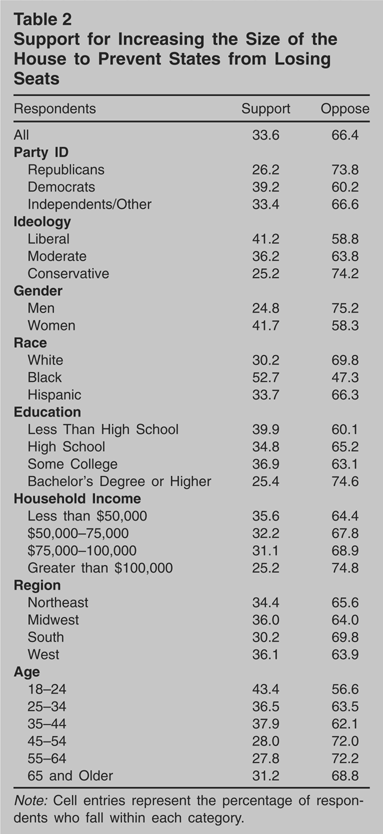
The loss of seats by states in the Northeast and Midwest has been one of the centerpieces of the case advanced by advocates of increasing the size of the U.S. House. According to the data contained in Table 2, Americans do not perceive this development as a compelling rationale to alter the size of the institution. Altogether, 66.4% are against the idea on these grounds. This view is consistent among a broad cross-section of groups. Only African Americans give majority support for an increase to preserve representation for the states. A sizable racial gap is present in public opinion on the question, with Whites 22.5 points less supportive than African Americans. Considering that the question does not touch on the subject of race, this divide among African Americans and Whites is quite startling. The results suggest that racial differences on issues of representation reach beyond topics directly pertaining to race.
Support for Increasing the Size of the House to Prevent States from Losing Seats

While both liberals and conservatives are against the idea, there is a 15-point difference in the level of opposition, with conservatives more uniformly against it. Most women are also opposed, but there is a substantial gender gap with female respondents approximately 17 points more supportive than men. As with the first question, younger people are more sympathetic to the cause of maintaining representation for states that would lose seats to reapportionment in the House. The results depicted in Table 2 also indicate negligible regional variation. Southerners are slightly more opposed than individuals living in other regions of the country, however, residents of the Midwest and Northeast stand solidly in opposition.
To Enhance Descriptive Representation
Thus far the evidence presented in this study indicates that there is minimal public enthusiasm for increasing the size of the House to improve the quality of representation its members provide or to end the practice of subtracting from the apportionment of seats from states with lagging population growth. This final analysis explores whether Americans are receptive to enlarging the numerical composition of the House to enhance the prospects for women and minorities to gain additional opportunities to serve in the body. As shown in Table 3, there is almost a split decision on this question: 15.5% of respondents are very supportive of the idea; 33.1% are somewhat supportive. Collapsing the response categories produces a figure of 48.6% in support. Though a slight majority remains opposed to an increase, the cause of descriptive representation generates the largest reservoir of support from the U.S. public on behalf of taking this policy action. Giving members of underrepresented groups more opportunities to serve in the House finds a receptive audience among some Americans not persuaded about the need for an increase for other reasons. Approximately 17% of all respondents backed an increase for the purpose of enhancing descriptive representation, but did not voice support when answering either of the first two questions.9
Only about 12% of respondents supported an increase across all three questions.
Support for an Increase in the Size of the House to Increase the Chances of Women and Minorities Getting Elected

Compared to the previous two questions utilized for this study, there are greater systematic differences in public opinion among various segments of the population. These results confirm the ideological realignment in the electorate over the past generation (Abramowitz and Saunders 1998). Conservatives and Republicans are the least supportive of a House size increase to improve descriptive representation, while most liberals and Democrats take a diametrically opposed position. Approximately two-thirds of Republicans and conservatives are against an increase on this basis; 60% of Democrats and liberals express some form of support. The partisan and ideological polarization on this issue suggests that a legislative proposal for an increase for purposes of descriptive representation would not garner a bipartisan consensus. These data lend credence to the notion that racial issues are still an important cleavage dividing party followers in the electorate (Carmines and Stimson 1989), contrary to the conclusions of some scholars who contend that these issues have faded in importance (Abramowitz 1994).
A further inspection of these data shows that a gender gap exists on this question, just as it does on other policy issues (Sapiro 2002). More women (55.8%) are behind the idea than men (40.8%). This gap is substantial, but it pales in comparison to the racial gap on this question. House enlargement to enhance descriptive representation is supported by over three quarters of African Americans and slightly greater than 55% of Hispanics. In contrast, only about 42% of Whites offer some degree of support. This cavernous divide, particularly between Blacks and Whites, is highly illustrative of the different conceptions concerning matters of race and representation still present in U.S. society. African Americans still feel that there are strides that need to be made in opening up the political process, while most White Americans do not see the same need to alter institutional arrangements to help the electoral prospects of women and minorities. This question is another area where racial division is present in public opinion, just as it is on a variety of other issues (Kinder and Sanders 1996).
Conclusion
The absence of available survey data gauging public attitudes toward increasing the size of the U.S. House necessitated gathering a systematic estimate of where Americans stand on this crucial issue. Simply because national lawmakers have taken it off the decision agenda does not mean it is unworthy of attention for survey researchers. The permanence of the 435-seat threshold and public and attitudes toward it are deserving of empirical investigation. The evidence supplied in this study has gone a long way toward expanding knowledge of public opinion on this subject. Serious political observers who have weighed in on this debate have not had the benefit of public opinion data to shape their arguments. The results presented in this article show that many of the individual reasons for an increase articulated by advocates of House enlargement do not reflect the will of the people, even if those supporters seek to improve the representative quality of the institution. A larger House may be more representative, but it represents a policy option that much of the public holds in disfavor. However, even though in each instance a majority of respondents opposed an increase, taken together about 55% of the individuals surveyed backed an increase based on one of the justifications provided. Nevertheless, if members of Congress were to enact a sizable increase in the size of the U.S. House, unless the case for this action was framed in a way that emphasized a multiplicity of reasons, it might provoke a backlash and further undermine the level of trust in the national government.10
Other arguments that might help persuade the public include emphasizing that it was once a common practice in the first 120 years of the nation's history to increase the size of the U.S. House every 10 years and that the size of the nation's lower house is smaller than the lower chambers of many other national legislatures in democratic countries (Kromkowski and Kromkowski 1991).
When the question providing each side of the legislative tradeoff argument was posed, the vast majority of citizens selected the status quo. Less than 20% want an increase in the size of the House membership even if it would help counter the growth in the average size of congressional districts and improve the quality of representation. In the minds of respondents, the financial costs and possible damage to the legislative operations of the U.S. House of Representatives outweighed the possible benefits that would accrue for representation. The U.S. public sees no pressing need for an expansion of the House beyond the 435-seat limit. Americans are highly concerned with legislative stalemate in Washington (Hibbing and Theiss-Morse 1995), and this idea seems likely to intensify the problem in most people's eyes. It must also be noted in this discussion that there is also no clamor among American citizens for a decrease in the size of the House. Most of the U.S. public is not reflexively anti-politician nor do they seek to make radical changes to the institutions of the U.S. political system based on their dissatisfaction with the behavior and motivations of members of Congress.
There is no widespread support for an increase to remedy the recurring phenomenon of House seats being transferred from the Midwest and Northeast to the South and West. Most Americans see this outcome as a legitimate result of shifting migration patterns in the country and harbor no desire to reverse it. Even residents in the slowest growing regions of the country or in states that have had their House delegations slashed due to reapportionment are not motivated to support House enlargement. It is a plausible argument that the issue is not particularly salient to most Americans, and that were political leaders in these states to mount a concerted campaign to change the existing policy, opinion would shift in favor of an increase. That may be a reasonable assumption regarding the citizens in states where population growth trails the national average, but not necessarily in the rest of the country. The more likely outcome is that most citizens in all states will continue voicing opposition on these grounds, if they contemplate the issue at all. Geographic representation in the context of increasing legislative size is poised to galvanize neither wide nor deep support in the U.S. population.
Without question, the reason for increasing the size of the House that gathered the highest level of support in this study was the prospect that it would potentially enhance descriptive representation for women and minorities. Though a slim majority was against an increase on these grounds, the results revealed that this argument has resonance for many members of society. Women and minority groups displayed the highest level of support for expansion for this reason. These results are an indication that these groups feel underrepresented in the nation's political institutions and sense that an increase in the size of the U.S. House of Representatives would increase the possibility that they would be represented by someone of their own social group. Beyond a more ample level of support for this rationale, what distinguished the responses to this question was the polarization it generated. Republicans and conservatives overwhelmingly reject this proposition, while Democrats and liberals openly embrace it. A similar divide is felt along racial and gender lines. Hence, the justification for increasing the size of the House that has the most support also stokes highly partisan reactions. House enlargement advocates will find little to gain from including descriptive representation as a part of their argument as long as Republicans and conservatives control key positions within the national political system. The Democratic takeover of Congress following the 2006 elections does, however, offer these backers a more receptive audience among national policymakers.
Author Bio
Brian Frederick is an assistant professor of political science at Bridgewater State College in Massachusetts. His research focuses on the U.S. Congress, women and politics, and judicial elections. He can be reached at: brian.frederick@bridgew.edu.