Introduction
Food quality and safety is a leading consumer concern. Therefore, new rules and standards have been designed by the public and private sectors, and they are widely adopted as well as brands and labels. Consumer attitudes to meat are influenced by some factors, such as price and availability. The significant differences, in the volume and type of meat consumed between countries, are thought to be primarily due to differences in culture and eating habits. Even though some studies have reported signs of people in industrialised countries eating less meat than before (Troy, Reference TROY2011), globally the trend is opposite. For instance, Fiala (Reference FIALA2008) reported that the consumption of meat worldwide is predicted to rise by 72% between 2000 and 2030. Steinfield et al. (Reference STEINFIELD, GERBER, WASSERNAAR, CASTEL, ROSALES and DE HAAN2006) projected the global production of meat to more than double between 2000 and 2050 due to an increasing world population, rising incomes and urbanisation.
While recent academic research has focussed on local food, this paper addresses the adoption of local food and specifically chicken in a developing country (Morris and Buller, Reference MORRIS and BULLER2003; Pearce et al., Reference PEARCE, HISCOCK, BLAKELY and WITTEN2008; Brown, Reference BROWN2003; Ghirardini et al., Reference GHIRARDINI, CARLI, DEL VECCHIO, ROVATI, COVA, VALIGI, AGNETTI, MACCONI, ADAMO, TRAINA, LAUDINI, MARCHESELLI, CARUSO, GEDDA, DONATI, MARZADRO, RUSSI, SPAGGIARI, BIANCO, BINDA, BARATTIERI, TOGNACCI, GIRARDO, VASCHETTI, CAPRINO, SESTI, ANDREOZZI, COLETTO, BELZER and PIERONI2007). Similarly, research on millennials (those born at the end of the 20th century) has focused on developed countries (Fedusiv, 2016; Becker, Reference BECKER2012; Holliday, 2004).
The goal of this paper was to gain knowledge about millennials’ perceptions of locally sourced and produced fresh poultry in developing countries, and to understand the influenced factors in the locally food market development. A significant aspect of the research was to gain a better understanding the importance of poultry origin in the purchasing process. This paper gives the latest account of millennials’ attitudes to locally sourced and produced fresh poultry in Slovenia.
Consumer knowledge in product recognition and positioning on the point of sale
Knowledge management refers to the top management as well as the management of knowledge of every individual and across the organisation. Enterprise knowledge management usually means the systematic management and rational use of knowledge. This is a great technical and organisational challenge which requires the development of appropriate human relations, as well as effective integration with a wide range of new technological opportunities. Knowledge management is a key factor for successful and efficient business development because of globalisation and the need for a quick response by the company to changes in the market. Knowledge management is required due to provide customers with the products and services they demand. The adoption of modern knowledge is critical because of the rapid development of technology and competition between companies. The business world has fully adopted the belief that knowledge has become one of the most strategic resources of the organisation, especially as a major factor in the competitiveness and performance of the company.
Brand positioning allows a company to change knowledge and perception of consumers, convince them their products meet their needs and become the best in the field. However, all this is not possible without employees and their knowledge, skills and motivation to carry out their work, which can be obtained in variety of ways. We must be aware of the importance of management skills needed in brand positioning, as companies and employees strive to continually study competition and requirements of consumers and gain the trust of consumers regarding the quality of products.
Consumers are often overwhelmed by information about products, services and brands. Their position is seen as a complex set of perceptions, impressions and sensations which arise whenever they make a comparison among different brands. The position of a brand depends on the way the consumers perceive its quality, advantages and disadvantages, price, value and image (Dibb and Simkin, Reference DIBB and SIMKIN1993). Due to increasing competition and consumers' demands in the food market, a proper and exact positioning of a brand in brand management is getting more important. This is especially true in developing countries where brands have historically been less important. Companies put effort into making their products more appealing to consumers and, with the help of branding, establishing a relationship that meets the consumers' expectations.
Poultry: a European perspective
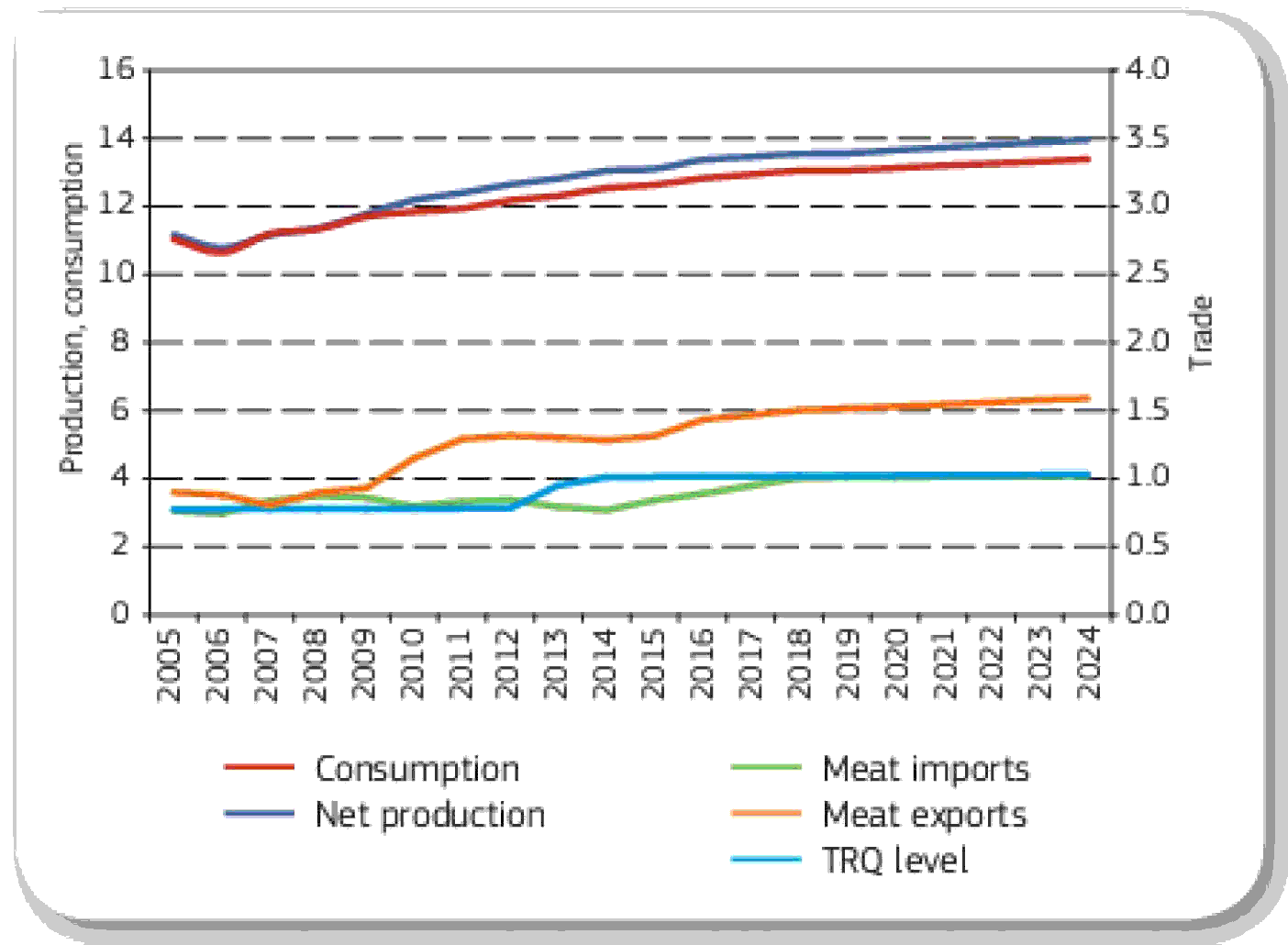
The causes for change in meat consumption have been a much-debated issue in the agricultural economics literature (Vukasovič, Reference VUKASOVIČ2013; Aral et al., Reference ARAL, AYDIN, DEMIR, AKIN, CEVGER, KAYA KUYULULU and ARIKAN2013; Calvo-Porral et al., Reference CALVO-PORRAL, STANTON and LÉVY-MANGIN2016; Vukasovič and Stanton, Reference VUKASOVIČ and STANTON2016). Poultry is the only meat in which production and consumption are expected to expand significantly in future, e.g. by 7% each between 2014 and 2024. Supported by sustained global demand, the EU is expected to maintain its market share with exports accounting for 10% of global trade. The production of poultry is expected to continue to grow steadily, but the rate of growth is likely to slow to 0.7% per year, having averaged 1.7% over the past ten years. The strongest increase in production (at 1% per year) is expected to be seen in the EU-N13, due largely to sustained productivity gains in Hungary, Poland and Romania. Other high production is expected from countries in the EU-15 Member States (e.g. Germany and the Netherlands), where production is expected to grow by 0.5% per year (European Commission, 2014).
Consumption chicken is still rising. Thanks to its relative inexpensiveness and healthy image, poultry is expected to continue to be the fastest growing part of the meat market in terms of consumption (out of the four main types of meat), with increases both in volumes consumed (by 0.6% per year, to reach 22.8 kg per capita by 2024), and in market share (rising to 32% by 2024). After a slowdown in the short term, reflecting lower input costs, prices for EU poultry are expected to recover steadily over the period to 2018, following world prices, and to continue rising beyond past levels to reach around €2030/t. Depending on the developments in the macroeconomic environment and in yields, poultry prices could vary between the 10th percentile (€1680/t) and the 90th percentile (€2510/t) (European Commission, 2014).
Total meat consumption in EU-N13 is slowly catching up with that of the EU-15. While prospects of improved economic growth should leave EU consumers with more disposable income and provide incentives for higher meat consumption, this is not reflected in projections. In line with trends seen over the last decade, consumption of meat products is not expected to rise over the coming years, due to the growing importance of social concerns (animal welfare and carbon footprints), health concerns and an ageing European population, who typically eat less meat per capita. Some of these factors serve to favour poultry over other meats, adding to increasing poultry consumption as a proportion of total meat consumption. In 2012 and 2013, lower availability, higher meat prices, the ongoing economic downturn and resulting high unemployment rates, especially in southern European countries, caused overall meat consumption to contract (by 1.5% over the two years), reaching the lowest level seen over the past 11 years (64.4 kg per capita) in 2013, as consumers turned to cheaper meats and cuts. Meat consumption is expected to recover up to the time of writing, as more meat comes onto the market and the economic situation improves, but this trend will be short-lived, with levels starting to fall once again. By the end of the outlook period, per capita consumption is expected to have fallen to 64.9 kg (in retail weight), a level similar to that seen in 2012 ( Figure 1 ) (European Commission, 2014).
Additionally, locally produced food is becoming a more important attribute globally. There are hundreds of research articles examining various aspect of local food, but few have addressed these issues in developing eastern European countries. Stanton et al. (Reference STANTON, LANG and YINGDAO2014) has an extensive review of this current environment.

Survey methods and sampling
In order to gain knowledge about millennials’ perceptions of locally sourced and produced fresh poultry, to understand the influenced factors in the locally food market development and to determine the importance of fresh poultry origin in the decision-making process, a quantitative research study was carried out. A sample of millennials (n=120) was carried out in Slovenia. Data were collected using a structured questionnaire administered in a field survey with the use of closed and open questions. The sampled population was a convenience sample where the place of residence (region), gender and age was recorded. Consumers were asked to respond from various locations in Slovenia, Ljubljana, Maribor, Ptuj, Murska sobota, Celje and Koper. The sample consisted of 88 women and 32 men. Most respondent were in the group between 25 and 35 years of age. About 45% lived in a two-person family, 38% had three in the household and 17% were single. In total, 85% of respondents currently living in cities. The sample represents a reasonable representation of urban Slovenia. Respondents all were aware of local foods as well as food sourced from other countries.
Questionnaire
The questionnaire was divided into the following research thematic areas:
-
1. habits of locally sourced and produced fresh poultry
-
2. motives for purchasing locally sourced and produced fresh poultry
-
3. consumption of locally sourced and produced fresh poultry
-
4. perception of locally sourced and produced fresh poultry
-
5. Socio-demographic data
A significant segment of the research focussed on determining the importance of fresh poultry origin in the consumer decision-making process. Several attributes of locally sourced and produced fresh poultry were measured by means of the five-point Likert scale anchors of 1 = low or bad degree of the characteristic, and 5 = high or good degree of the characteristic. The survey was pretested tested on a smaller sample (n=10) and changes were made accordingly. There was no missing data in the analysis, as only completed questionnaires were used. Since data was collected as a field intercept survey, respondents who did not complete the survey were never included.
The survey concept is based on prior literature. Magnusson et al. (Reference MAGNUSSON, ARVOLA, KOIVISTO HURSTI, ABERG and SJODEN2001) showed that the most significant purchase criteria for food are taste, health, long shelf-life and quality aspects of the product. A survey conducted in European Community (EC) countries (Lennernas et al., Reference LENNERNAS, FJELLSTROM, BECKER, GIACHETTI, SCHMITT, REMAUT DE WINTER and KEARNEY1997) has shown that quality/freshness, taste, healthy diet, price, family preferences and habits are the most significant food-choice factors. Wandel and Bugge's (1997) showed that taste, freshness, appearance and nutritional value are significant in a choice of fruits and vegetables. Verbeke (Reference VERBEKE2005) demonstrated that the top five significant attributes for fresh meat in Belgium are freshness, quality, taste, healthiness, and free of hormones. Vukasovič (Reference VUKASOVIČ2014) demonstrated that important attributes for fresh poultry in European Countries are taste, healthiness, consistent quality, nutritional value and safety.
Data analyses
Analysis of quantitative data in this study was done via the Statistical Package for Social Sciences (SPSS). The data obtained from the survey were analysed with univariate analysis in order to check distributions of frequencies and to detect possible errors occurring during the research and/or data entering. Chi-square, ANOVA and correlation analysis were performed to examine the relationships and differences in buying behaviour and attitudes among respondents. The level of comparison was set at α=0.05. The data collected from the surveys was put through a validity assessment (KMO = 0.847; Bartlett's Test sign = 0.000). The reliability of a measurement tool refers primarily to the accuracy of its results. Reliability refers to the accuracy, trust, stability or repeatability of test results (Momeni and Ghayomi, Reference MOMENI and GHAYOMI2012; Vukasovič, Reference VUKASOVIČ2014). In this study, Cronbach's alpha coefficient of reliability has been used. Analysis yielded a Cronbach's Alpha value of 0.89 and a significance level of 0.000 which represents that the reliability of the questionnaire is acceptable.
Research hypotheses
The survey examined five research hypotheses, based on previous research results and trends in European poultry market. These are:
H1: Chicken meat is the most popular type of meat among millennials.
H2: Millennials primarily consumed locally sourced and produced fresh poultry prepared at home.
H3: Millennials primarily consumed locally sourced and produced fresh poultry prepared in cooked dishes, as well as, grilled and roasted meat.
H4: Women consider locally sourced and produced fresh poultry more healthy and tastier than did men.
H5: There is a significant tendency towards purchasing locally sourced and produced fresh poultry because of domestic origin.
Results and discussion
buying habits of locally sourced and produced fresh poultry
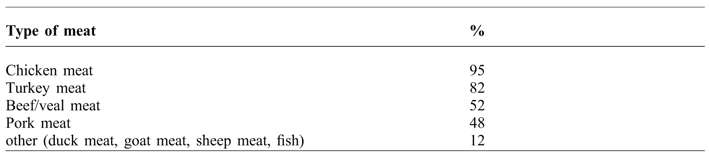
Results of the survey, presented in Table 1 , showed that 100% of millennials consumed meat. The data indicated that most consume poultry (chicken and turkey), pork, beef/veal and lamb. Millennials consume mainly chicken (95%) and turkey (82%), beef/veal (52%) and pork meat (48%). Based on the results Hypothesis 1 was confirmed, that chicken is the most popular meat among millennials. These results agree with the studies for Greek consumers by Sismanoglou and Tzimitra-Kalogianni (Reference SISMANOGLOU and TZIMITRA-KALOGIANNI2011) and Turkish consumers by Aral et al. (Reference ARAL, AYDIN, DEMIR, AKIN, CEVGER, KAYA KUYULULU and ARIKAN2013).
Meat consumption (%).

It was assessed whether gender variable had any effect on the buying habits of locally sourced and fresh poultry. A T-test and Levene's test results indicated equal variances between both male and female groups (F=0.981; p=0.321). No significant differences could be detected at the α=0.05.
The definition of locally sourced and produced fresh poultry was clearly recognised and understood by millennials. The data showed that knowledge and recognition is important for locally sourced and produced fresh poultry. More than 85% of respondents recognised locally sourced and produced fresh poultry. Millennials in this study defined this as meat that was locally produced and marked with the label ‘locally produced’). They define locally sourced and fresh poultry as home produced, as meat exclusively produced and consumed in the country and as meat that financially supports the local economy.
The results, i.e. answers to the question ˝Do you like to eat locally sourced and produced fresh poultry, were as follows: 58.89% of the millennials answered, with ‘I like it very much’, 29.25% answered ‘I like it’. A small percentage chose the answer ‘It's good’, 11.86% answered ‘I don't like it’ and ‘I don't like it at all’ was not chosen at all. A T-test was performed and Levene's test results indicated equal variances between both male and female respondents (F=0.997; p=0.231). No significant differences could be detected at the α=0.05
Consumption of locally sourced and produced fresh poultry
Results related to the place where local and fresh poultry was prepared, which was confirmed by ANOVA analysis, showed that 52% of millennials primarily consumed locally sourced and fresh poultry prepared at home. Consumption of locally sourced and fresh poultry prepared in ‘home cooked’ (43%) and other restaurants were equally represented (5%), but to a lesser extent than home prepared locally sourced and produced fresh poultry. Based on the results Hypothesis 2 was confirmed. Bowen et al. (Reference BOWEN, BAIRD, SYRETTE, NOAKES and BAGHURST2012) noted that most meat and poultry consumption occurs in the home environment. This is a significant result from both surveys. The primary consumption of locally sourced fresh poultry was in the form of grilled (43%), roasted (37%), fried (9%), stewed (6%) and in cooked dishes e.g. soup, sauce (5%). Based on this, Hypothesis 3 was confirmed.
Perception of locally sourced and produced fresh poultry
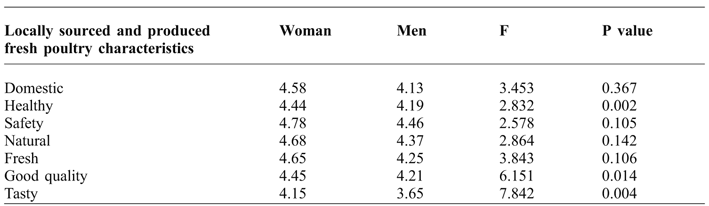
Respondents evaluated the characteristics that refer to locally sourced fresh poultry. Several attributes of locally sourced fresh poultry were measured using the five-point Likert scale anchors of 1 = low or bad degree of the characteristic, and 5 = high or good degree of the characteristic. Millennials perceived locally sourced fresh poultry as healthy, safe, natural, fresh, good quality and tasty. They perceived locally sourced fresh poultry as locally produced meat, produced and consumed in the country and as supportive for the local economy. Most perceptions were positive. Some socio-demographic characteristics and buying behaviours of millennials influenced their perception of locally sourced fresh poultry. ANOVA showed that women considered it healthier (woman 4.44, men 4.19, F=2.832, P=0.002*) and tastier (woman 4.15, men 3.65, F=7.842, P=0.004*) than did men ( Table 2 ). Hence, Hypothesis 4 was confirmed.
Characteristics of locally sourced and produced fresh poultry perception.

Note: Scale = low or bad degree; 5 = high or good degree significantly different
The at theThe attitude towards the origin of poultry
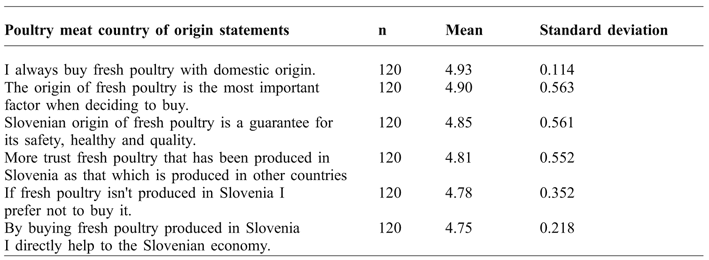
A significant segment of this research was to determine the importance of fresh meat origin in the decision-making process during purchasing. The results showed that the 95% bought meat available from domestic sources. The millennials interviewed indicated that domestic origin is a significant factor in the decision to purchase fresh poultry and Slovenian origin represents a guarantee for its safety, healthy and quality ( Table 3 ). There was a significant tendency towards purchasing fresh poultry of domestic origin, confirming Hypothesis 5.
A particular challenge for the food processing industry is to assure advantages in global trade, food safety and quality, which, in the future, can be expected to be the three main indicators of international competitiveness. It is important that food providers and consumers provide clear information on the advantages of producing and processing quality meat locally for the domestic market to ensure competitiveness and to develop consumer awareness.
The attitude towards the origin of fresh poultry.

Conclusions
This survey provided interesting insights into future developments of the Slovenian poultry market. A positive perception and image of locally sourced and produced fresh poultry was found. Survey data provided valuable information with respect to product positioning and marketing communications for consumers. These results are particularly useful for marketing and future development in the locally sourced and produced poultry sector, as they provide an indication as how companies can better reach and satisfy millennial consumers. This study showed significant opportunities, challenges and potentials in the development of the locally sourced and produced food market.