Acute aortic dissection is a true surgical emergency with a high mortality rate. Aortic regurgitation is frequently an accompanying complication seen in majority of the cases. Although the most common cause of regurgitation in the face of acute aortic dissection is deformation and dilatation of the aortic root, in rare cases the prolapse of an intimal flap into the left ventricular outflow tract was the causative factor.Reference Movsowitz, Levine, Hilgenberg and Isselbacher 1 , Reference Rosenzweig, Goldstein, Sherrid and Kronzon 2 The massive aortic regurgitation associated with this rare clinical situation may result in a serious hemodynamic instability. To date, all reported cases with this type of dissection were admitted under emergency conditions.Reference Nohara, Shida, Mukohara, Nakagiri, Matsumori and Ogawa 3 , Reference Cirillo, Conti, Tasca and Troise 4 The unique feature of this case study is that our patient presented to the cardiology outpatient clinic under elective conditions, in the face of an ultimate diagnosis of acute type A aortic dissection with a localised, circumferential dissection flap, prolapsing into the left ventricular outflow tract and causing massive aortic regurgitation.
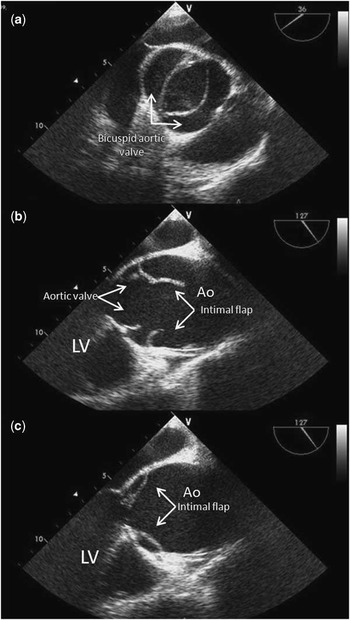
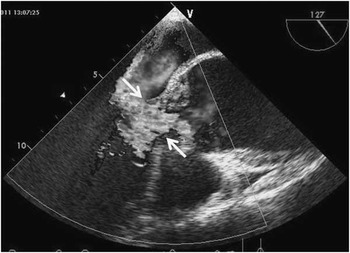
The 34-year-old previously healthy man was referred to our cardiology outpatient clinic when he complained of a sharp chest pain that began 12 hours ago and persisted for 2 hours, at a high intensity, before gradually dying out. He denied any pain during physical examination but described minor discomfort in his chest. The physical examination was remarkable for a heart rate of 85 beats/minute, a blood pressure of 110/70 mmHg, and a grade 2/6 decrescendo diastolic murmur at the left sternal edge. Peripheral pulses were palpable and equal in all four extremities. The 12-lead ECG revealed normal sinus rhythm with no signs of ischaemia. A transthoracic echocardiogram revealed a congenitally bicuspid aortic valve associated with a dilated aortic root and an aortic dissection with an intimal flap prolapsing into the left ventricular outflow tract through the aortic valve during diastole. A transoesophageal echocardiogram confirmed the bicuspid valve (Fig 1a) and demonstrated the circumferential extent of the intimal tear located at the sinotubular junction of the ascending aorta. The diameter of the ascending aorta and that of the sinotubular junction were 38 and 29 mm, respectively. A short, cylindrical intimal flap prolapsed into the left ventricular outflow tract during diastole, covering the aortic leaflets (Fig 1b and c) and causing massive aortic regurgitation (Fig 2). The patient was urgently transferred to the operating room where a Bentall procedure – aortic valve replacement with ascending aorta graft implantation – was performed, using a mechanical valved composite graft, utilising deep hypothermia and circulatory arrest with retrograde venous cerebral perfusion. A valve-sparing operation was not considered owing to the circumferential nature of the dissection. The postoperative course was uneventful. Histological examination revealed myxoid degeneration of the aortic valve cusps and of the ascending aorta.
The bicuspid aortic valve ( a ). Systolic ( b ) and diastolic ( c ) movement of the dissection flap. The intimal flap prolapses into the left ventricular outflow tract during diastole and is ejected back into the ascending aorta during the systole. Note that the aortic valve is always open. Ao=aorta; LV=left ventricle.

The prolapse of the intimal flap into the left ventriclular outflow tract precluded coaptation of the aortic valve cusps and causes massive aortic regurgitation (white arrows).

Displacement of the dehiscing intimal flap, which prolapses into the left ventricular outflow tract during diastole, is a rarely seen mechanism of aortic regurgitation in type A aortic dissection. However, when it does occur, it causes massive aortic regurgitation that can significantly compromise hemodynamics.Reference Rosenzweig, Goldstein, Sherrid and Kronzon 2 , Reference Nohara, Shida, Mukohara, Nakagiri, Matsumori and Ogawa 3 Most patients with this type of pathology are critically ill and require emergency surgery; though, some patients were reported to undergo operation without a preoperatively confirmed diagnosis, and the diagnosis was confirmed by transoesophageal echocardiography intraoperatively.Reference Cirillo, Conti, Tasca and Troise 4 , Reference Yamabi, Imanaka, Sato and Matsuoka 5 The unique feature of this case was that the patient was hemodynamically stable and presented electively without any signs or symptoms of severe aortic regurgitation. His young age, relative good health, and lack of comorbid conditions probably accounted for his relative stability and elective presentation. Although his relative stability could have been explained by antihypertensives or other medication that could have prevented a compensatory hypertensive, tachycardic response, he was on no medication. The particular pattern of dissection observed in this patient may also have contributed to his hemodynamic stability. Nevertheless, it is important to be aware of the urgency of this rare cardiac anomaly as it may prove to be lethal any time during the course of the disease.
Conflicts of Interest
None.