INTRODUCTION
Falls are a significant concern in patients who are frail, of advanced age, or have severe underlying medical conditions. They are defined as unexpected events where a person comes to rest on the ground, the floor, or a lower level either in a sitting, lying, or kneeling position. They are viewed by most as a tangible reminder of serious physical decline. According to the Centers for Disease Control and Prevention (CDC), one in every three adults aged 65 or older falls in the United States every year (Centers for Disease Control and Prevention, 2012). About two thirds will experience a second episode within the same year. Approximately 1 of 10 falls results in serious injury, including hip or some other fracture, subdural hematoma, other serious soft tissue injury, or head trauma (Tinetti et al., Reference Tinetti, Doucette. and Claus1995). In addition, although most falls do not result in serious injury, they are still a significant cause of morbidity, disability, social isolation, and reduced quality of life in this frail population (Tinetti et al., Reference Tinetti2003; Nevitt et al., Reference Nevitt, Cummings and Hudes1991; Sattin,Reference Sattin1992).
Unfortunately, falls are not solely the consequence of ageing and are not limited to older patients. In fact, there is a growing body of evidence that patients with cancer are at increased risk of falling (Stone et al., Reference Stone, Lawlor and Savva2012). Hospitalized cancer patients have higher fall frequencies and injury rates than patients without cancer (Pearse et al., Reference Pearse, Nicholson and Bennett2004; Overcash et al., Reference Overcash2007). Similar risk factors as those seen in the geriatric literature have been reported in this population (Stone et al., Reference Stone, Lawlor and Kenny2011a; Reference Stone, Lawlor and Nolan2011b). In addition to general fall risk factors, cancer-specific fall risk factors, including neurological and nutritional deficits as a result of cancer treatments, polypharmacy, and deconditioning from cancer-related fatigue, were found to increase the risk of falling in this population. The incidence of falls among hospice patients with cancer is four times higher than that in nursing homes, and the factors associated with falls included cognitive impairment, low blood pressure, visual impairment, and older age (Pearse et al., Reference Pearse, Nicholson and Bennett2004).
The purpose of our retrospective study was to determine the frequency and factors associated with falls in advanced cancer patients referred to a palliative care outpatient center in order to better understand and characterize falls in this population, which could allow for improved patient care as well as aid future research on prevention and treatment.
METHOD
We included 384 consecutive patients who were seen for the first time at the Supportive Care Clinic at MD Anderson Cancer Center between January 1 and December 31, 2009. The study was approved by the institutional review board of the center. The demographic information collected included scores on the Cut Down, Annoy, Guilt, Eye-Opener (CAGE) questionnaire, the Edmonton Symptom Assessment Scale (ESAS), the Memorial Delirium Assessment Scale (MDAS), and the Eastern Cooperative Oncology Group (ECOG) Scale. Information about history of falls within the last 30 days as well as the use of any assist devices for ambulation and mobility were taken on a routine basis on first clinical encounter in the supportive care center, so this information was collected for all patients.
We routinely assess for symptoms, delirium, and history of alcohol and drug abuse using validated tools such as the ESAS, the MDAS, and the CAGE questionnaire. The ESAS is a validated assessment tool measuring the 10 symptoms common in cancer patients during the previous 24-hour period. These symptoms include pain, fatigue, nausea, depression, anxiety, drowsiness, shortness of breath, appetite loss, sleep difficulty, and decreased feeling of well-being. Symptoms are rated from 0 to 10 on a numerical scale, with 0 corresponding to none present and 10 being the worst possible severity (Bruera et al., Reference Bruera, Kuehn and Miller1991). The MDAS is a 10-item, 4-point clinician-rated scale (possible range, 0–30) designed to quantify the severity of delirium in medically ill patients. A cutoff score ≥7 of 30 is used for a diagnosis of delirium. Its items include assessments for disturbances in arousal and level of consciousness, various areas of cognitive functioning, and psychomotor activity (Breitbart et al., Reference Breitbart, Rosenfeld and Roth1997). The CAGE questionnaire is a simple four-item screening survey employed to assess alcoholism. Two positive answers (CAGE-positive) yield a sensitivity of approximately 90% and specificity of greater than 95% (Ewing et al., Reference Ewing1984).
Administration of opioids (morphine equivalent daily dose, [MEDD]), nonopioid analgesia, sedatives, neuroleptics, antidepressants, antiemetics, antihypertensives, diuretics, chemotherapy, hormonal therapy, immunotherapy, target therapy, steroids, a bowel regimen, and stimulants was also recorded and analyzed.
Bivariate associations between each of the baseline covariates and patient group (with or without falls) were assessed using a chi-square test for categorical variables and Student's t test or the Mann-Whitney U test for continuous variables. Univariate logistic regression models were utilized to identify factors predictive of falls. Using only those variables that were significant or marginally significant in the univariate analysis, backwards model selection methods were employed to identify factors jointly and significantly associated with incidence of falls.
RESULTS
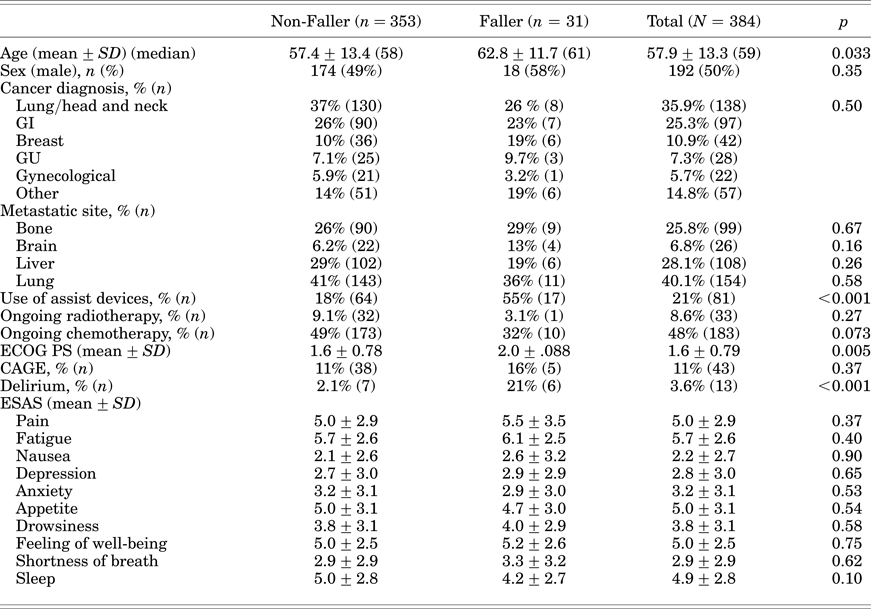
Patient demographic characteristics are summarized in Table 1. Among the 384 patients included in the study, 192 (50%) were male, and 31 (8%) reported fall episodes within the past month. Of those who fell, 17 (55%) reported use of assistive devices, while some had more than one assist device available at home.
Demographic characteristics of 384 patients with and without falls

Abbreviations: SD, standard deviation; ECOG PS, Eastern Cooperative Oncology Group performance status; CAGE, Cut Down, Annoy, Guilt, Eye-Opener questionnaire; ESAS, Edmonton Symptom Assessment Scale.
The variables site of cancer metastases, whether receiving ongoing anticancer therapy, CAGE status, ESAS score, number of opioids taken, and MEDD did not show statistical differences between fallers and non-fallers. Our results showed that older age (p = 0.033), use of assist devices (p = <0.001), poorer ECOG performance (p = 0.005), and presence of delirium (p = <0.001) were associated with fall episodes.
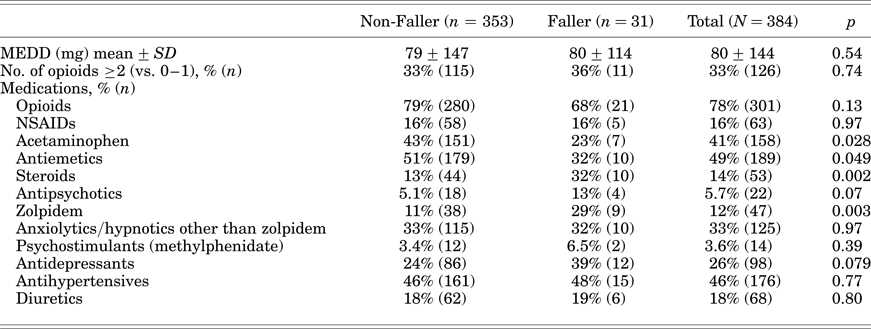
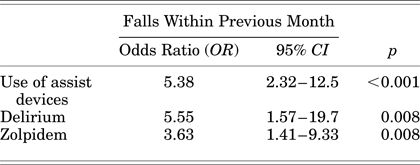
Table 2 presents the relationship between medications and fall episodes. A univariate logistic regression model determined that the use of dexamethasone and zolpidem were associated with a higher chance of falling. Multivariate analysis for each of the variables indicated that use of assist devices, presence of delirium, and use of zolpidem remained strongly significant (odds ratio (OR) 5.38, p < 0.001; 5.55, p = 0.008; 3.63, p = 0.008, respectively). Table 3 provides details on the independent risk factors for falling.
Relationship between medications and fall episodes: univariate analysis
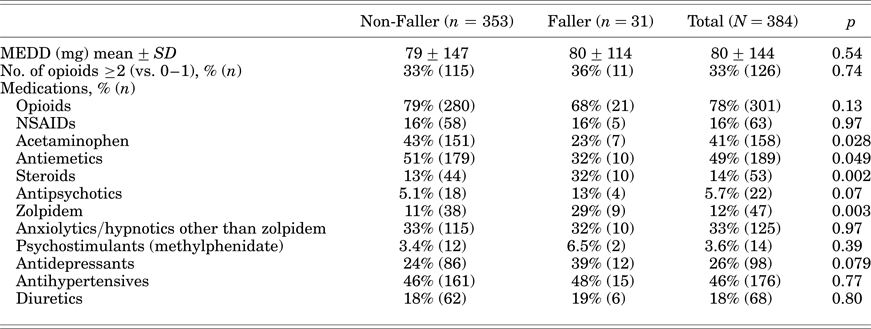
Abbreviations: MEDD, Morphine equivalent daily dosage; NSAIDs, nonsteroidal anti-inflammatory drugs.
Independent risk factors for falls
Note. Multivariate backward regression analyses were employed.
DISCUSSION
Eight percent of advanced cancer patients seen at our outpatient supportive care center experienced a fall episode within the last 30 days before their first clinic visit. The average frequency was 31 falls in 4 weeks for 384 patients, 0.02 falls per patient per week, or 1.05 falls per patient per year.
Studies done with community-dwelling elderly adults with newly diagnosed cancer reported a 19% frequency, comparable to that of the general community-dwelling geriatric population (Puts et al., Reference Puts, Monette and Girre2012). Stone and colleagues (Reference Stone, Lawlor and Nolan2011b) reported that about half of the patients admitted to a palliative care service followed prospectively for 6 months had experienced a fall. The patients in their study were ambulatory and had fairly good performance status.
We found that the use of assist devices and delirium were associated with a higher risk of falling. The presence of delirium and cognitive impairment has also been shown to increase the risk of falls in vulnerable patients. We found that patients with delirium were more than five times more likely to fall than patients without it. Previous studies in geriatric patients have demonstrated an association between incidence of falls and cognitive impairment (dementia and delirium) in various clinical settings (Rubenstein & Josephson, Reference Rubenstein and Josephson2002; Rubenstein, Reference Rubenstein2006). Pautex and colleagues reported that hospitalized advanced cancer patients with a diagnosis of delirium were at increased risk of falling, similar to results found for elderly patients admitted to a hospital (Pautex et al., Reference Pautex, Herrmann and Zulian2008). Patients with cognitive impairment and delirium have impaired judgment and therefore may overestimate their capabilities and be unable to make fully rational decisions.
Patients who use assist devices for ambulation may have a false sense of security,, so that they may be more likely to push themselves to be more active, resulting in a higher risk of falling. In general, assist devices optimize an individual's function and independence. It is also possible that assist devices may simply be a marker of patients with neuromuscular or skeletal problems that make them more prone to falling. In some patients, the use of assist devices may be simply the result of previous falls. However, patients with these devices should receive particular education regarding fall prevention and undergo a home safety evaluation.
Previous studies have shown that patients who are on sedative medications (including psychotropic medications, opioids, and anxiolytics) have an increased risk of falling (Ganz et al., Reference Ganz, Bao and Shekelle2007). A number of falls assessment tools include the presence of such medications in estimating risk of falling in different care settings. However, our data did not show any association with the use of opioids and MEDD and other psychotropic drugs aside from zolpidem. Therefore, further studies are needed in palliative care patients on the association between the use of assist devices and medications (including opioids, steroids, and anxiolytics) and the risk of falling.
The frequency of patient-reported falls found in the supportive care outpatient center was smaller than that reported by other investigators. However, it was still substantial at 8% and much higher in patients with risk factors. The factors associated with falling are consistent with those reported in the literature and include age, use of assist devices, delirium, and zolpidem use. Further studies are needed to examine other factors that may be associated with falling. The retrospective design of our study may likely have resulted in a lower frequency of falls than those reported by other studies. Additionally, recall bias is a limitation that may underestimate the data. Our findings suggest that palliative care patients and their caregivers should receive increased education on precautions to prevent falling, especially if they are older, receiving hypnotics, employ assist devices, or present with delirium.
ACKNOWLEDGMENTS
This study was presented in part at the Multinational Association of Supportive Care in Cancer/ISOO International Symposium at Athens, Greece, in June 2011. Preparation of the manuscript was supported in part by MD Anderson Cancer Center Support Grant CA016672, and by American Cancer Society (RSG-11-170-01-PCSM) [SY] and National Institutes of Health grants R01NR010162-01A1, R01CA1222292.01, and R01CA124481-01 [EB].