Introduction
The genus Riedelia Oliv. has some 75 species distributed in the Moluccas, New Guinea and the Solomon Islands. The only revision of the whole genus forms part of Schumann's revision of the Zingiberaceae in Engler's Das Pflanzenreich (Schumann, Reference Schumann and Engler1904). Six species were treated there but many more were described about a decade later by Valeton (Reference Valeton1913, Reference Valeton1914) and Ridley (Reference Ridley1916), since which time a further handful of species has been added, notably several high-altitude species by P. van Royen (Reference van Royen1979). A revision of the genus is urgently required.
Riedelia is in the tribe Riedelieae W.J.Kress, subfamily Alpinioideae Link of the Zingiberaceae (Kress et al., Reference Kress, Prince and Williams2002). The tribe is characterised by extrafloral nectaries on the leaf blades and elongate, dehiscent fruits. Riedelia is distinguished from the other three genera in the tribe (Burbidgea Hook.f., Pleuranthodium (K.Schum.) R.M.Sm. and Siamanthus K.Larsen & Mood) by its entirely caducous calyx.
Valeton (Reference Valeton1914) established the current classification of the species of Riedelia into two subgenera, of which Riedelia subgenus Schefferia Valeton has four sections, and Riedelia subgenus Schefferia section Cornuta Valeton has three subsections. This classification has not yet been tested using molecular systematic techniques.
Species Description
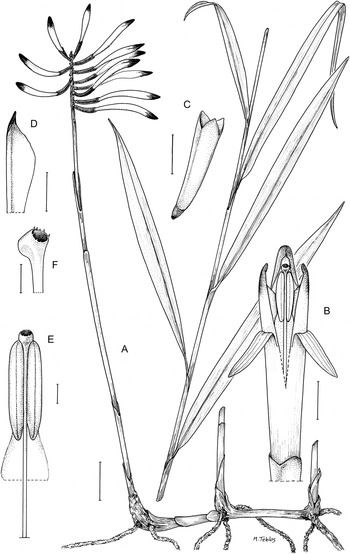
Riedelia charontis M.F.Newman, sp. nov. Subgenus Schefferia section Macrantha Valeton. Fig. 1.
Species habitu repenti et floribus magnis cum Riedelia tenuifolia Valeton optime congruens, sed foliis linearibus non oblongo-lanceolatis, floribus in caule discreto aphyllo et corollae lobo dorsali calcari apicali carenti differt. – Type: Indonesia, Papua, Mount Jaya, Mimika Regency, PT-Freeport Indonesia Concession Area, Aimua River, along track from Mile Post 50, 4°16′52″S, 137°1′21″E, 522 m, 10 iii 1999, T.M.A. Utteridge 93 (holo K, K000171742, incl. spirit collection; iso BO, MAN, Freeport Concession herbarium).
Riedelia charontis M.F.Newman. A, habit; B, upper part of flower; C, ovary and calyx; D, half of labellum; E, stamen, upper part of style and stigma; F, stigma. Drawn from T.M.A. Utteridge 93. Scale bars: A = 20 mm; B–D = 5 mm; E, F = 1 mm.

Creeping, semi-epiphytic herb on roots of trees, few-stemmed, 5–6 cm between stems, rhizomes bearing orange-yellow sheaths. Leafy shoots to c.65 cm high, slender, leaves 7 per shoot; basal sheaths papery, tending to crumble when dry, leaf blades in upper third to half of shoot, linear, 15–17 × 1–1.3 cm, glabrous, green; petiole 5–10 mm long; ligule rounded, 1–2 mm long, reddish green. Inflorescence on a separate, leafless shoot arising terminally on rhizome; peduncle erect, 25 cm long, covered with bladeless sheaths; rhachis 4 cm long, very dark grey, bearing c.15 flowers on pedicels 1 mm long; flowers held at an acute angle to rhachis, downward pointing on the specimen seen. Open flower 47 mm long, measured from base of corolla tube, ovary near anthesis 3–4 × 1.8–2 mm, ovoid, calyx tubular, blackish purple, similar in colour to the rhachis, 13.5–15 × 3 mm, somewhat flattened dorsally, with 3 acute teeth 2 mm long, corolla tube 32 mm long, dark pink at the base, becoming lighter towards apex, which is dark grey-purple as the calyx, a gradually widening cone, slightly curved abaxially, cleft by 13 mm abaxially, corolla lobes 3, point of insertion 6 mm distant from proximal point of cleft, lateral lobes triangular, 7 × 4 mm, fused at base to labellum, dorsal lobe hooded, 8 mm long, without spur, labellum deeply bilobed, the lobes 8 × 4 mm and fused to filament for c.6 mm, lobes held at right angles to opening of flower, irregularly triangular, lateral staminodes absent, filament with free section 5 mm long, flattened, 2 mm wide at base, narrowing gradually, anther versatile, attached dorsally, c.1/3 from base, without crest, 5.5 mm long, stigma held between apex of thecae, ostiole a lateral oval, rim ciliate, especially adaxially.
Note: Measurements of vegetative parts are taken from the herbarium specimen while those of the floral parts are taken from spirit material.
Distribution. Indonesia, Papua. Known only from the type.
Habitat and ecology. Riedelia charontis occurs in lowland tropical rain forest on a terrace adjacent to the River Aimua and along the river bank where it is semi-epiphytic on the roots of trees overhanging the river. Fallen flowers were seen on the forest floor, indicating that it was locally common.
Etymology. Charon's Riedelia, in allusion to the sombre colours of the flowers and the riverine habitat. Charon was the ferryman in Ancient Greek myth who carried the souls of the newly deceased across the River Acheron to Hades.
Proposed IUCN conservation status. Data Deficient (DD), on the grounds that Riedelia charontis is known only from the type specimen which is from a poorly known area.
Riedelia charontis does not fit easily in the existing classification of Riedelia. It keys directly to Riedelia subgenus Schefferia section Geocharides Valeton because the flowers are borne on a separate, leafless shoot but the overall resemblance of the plant is to R. tenuifolia in Riedelia subgenus Schefferia section Macrantha where the inflorescences are terminal on leafy shoots. This underlines the need for a revision of the genus.
Acknowledgements
I am grateful to the Keeper of the Herbarium of the Royal Botanic Gardens, Kew for permission to consult the collections there and to Tim Utteridge for giving background information about his collection. I thank Margaret Tebbs for her line drawing and Philip Oswald for correcting my Latin.