Beethoven's String Quintet in C major, Op. 29, was born in controversy. He wrote it on commission from Count Moritz von Fries and later sold the publication rights to Breitkopf und Härtel in Leipzig. At about the same time, the Viennese publisher Artaria secured a manuscript copy of the parts – perhaps from Count Fries – and brought out the work, ostensibly without Beethoven's permission. Furious, Beethoven attacked the accuracy of Artaria's edition in the Wiener Zeitung, setting in motion a protracted dispute with the publisher that had to be resolved in court.Footnote 1 In the introduction to her recent critical edition of the quintet, Sabine Kurth hypothesized that ‘Beethoven's published warning against the Artaria print may help to explain why this work, unlike the roughly contemporary string quartets Opp. 18 and 59, has led a wallflower existence otherwise inexplicable in view of its great significance and musical poetry’.Footnote 2 The Quintet might also have encountered practical obstacles. In the nineteenth century, adding a second violist to a string quartet was not always easy to do. When one could be found, there would be the temptation to play one of Mozart's popular quintets. But whatever the reasons, Op. 29 did become a wallflower – a work that, without enough suitors, remained on the sidelines.Footnote 3
But there were a few important figures in the history of the string quartet who did not treat it so. Perhaps foremost among them was Joseph Joachim. This was true even in the early years of Joachim's career as a quartet leader, as his letter to Johannes Brahms from Hanover of 20 April 1856 attests: ‘Our two quartet [programmes] went over well. In the first: Haydn, Op. 130 by Beethoven, G-minor Quintet by Mozart; in the second, last night: Quartet by Mendelssohn in E flat, Schumann's A minor, Quintet in C by Beethoven.’Footnote 4 Later on, as leader of the celebrated Joachim Quartet, he programmed the Beethoven Quintet regularly on that ensemble's important concert series at the Berlin Singakademie.Footnote 5 The frequency of Joachim's performances of the Quintet in England is especially noteworthy. In an unpublished paper presented at the international conference ‘Joseph Joachim at 185’, Therese Ellsworth discussed Joachim's participation in the Monday Popular Concerts in London.Footnote 6 These concerts were given in St James Hall, built in 1858, which seated 2,000 people. Beginning in 1859, the Monday Popular Concerts, with their inexpensive ticket prices, made classical chamber music available to people of ordinary means. During Joachim's many appearances in the series, the three works by Beethoven that he programmed most frequently were: The Kreutzer Sonata, Op. 47, the Septet, Op. 20, and the String Quintet, Op. 29.Footnote 7 The popular appeal of the first two works is understandable; the Kreutzer Sonata was Beethoven's best-known work for violin and piano, combining dramatic musical ideas with thrilling virtuosity; the Septet had long been known for its pleasing, serenade-like qualities. But why the Op. 29 Quintet?
Joachim's programming of the Quintet in Bonn provides some clues about how he regarded the work. In his authorized biography of the violinist (which Robert Eshbach aptly calls Joachim's ‘veiled autobiography’), Andreas Moser emphasized events of great personal significance to Joachim, including his extensive involvement in raising an endowment for a museum at the Beethoven-Haus in Bonn.Footnote 8 The fundraising plan envisioned a series of chamber music festivals that would include the Joachim Quartet. Joachim opened the first festival, in May of 1890, an event of great personal importance to him, with Beethoven's Quintet, Op. 29.Footnote 9 Joachim had wanted Brahms and Clara Schumann to participate in the inaugural Bonn festival. Writing to invite Brahms in a letter of 19 December [1889], Joachim noted that the festival would consist of ‘about five evenings, always illustrating the three epochs, [with] sonatas, trios, quartets, quintet, septet. Probably the manuscripts will be available for most of the things’.Footnote 10 While neither Brahms nor Clara Schumann wound up attending the festival, Brahms sent two Beethoven manuscripts from his personal library to be included in the exhibits. The festival catalogue indicates that Beethoven's manuscript of Op. 29 also was exhibited, and that it was supplied by Joachim himself.Footnote 11 This raises the possibility that Joachim gave Op. 29 pride of place at the opening of the 1890 festival partly because he had arranged to have its manuscript exhibited there. But his prominent featuring of the Quintet in this way would have been impossible if he had not regarded it musically as a masterwork, fully representative of Beethoven at his best.
Joachim's reference to ‘three epochs’ reflects the influence of Wilhelm von Lenz, who advocated for a tripartite division of Beethoven's works and provided the first thoroughgoing analytical survey of all of Beethoven's principal compositions.Footnote 12 Reflecting the three-period schema, many of Joachim's Bonn concerts were organized chronologically; for example, the second concert of the first festival comprised the String Quartet in C Minor, Op. 18, No. 4, the ‘Eroica’ Variations, Op. 35, the ‘Ghost’ Trio, Op. 70, No. 1, and the String Quartet in C-sharp Minor, Op. 131.Footnote 13 Since Joachim placed Op. 29 at the beginning of the opening concert, he may have regarded it as an exceptionally important ‘first-period’ work, replete with progressive tendencies. (The Quintet fell early in Lenz's Second Period, which encompassed Op. 21 through Op. 100.) Joachim also arranged each of the five-day Bonn festivals according to a coherent aesthetic plan. Rainer Cadenbach has observed that Joachim placed the weightiest concert of each festival on the fourth evening.Footnote 14 On the fifth and final concert of each festival, which always took place as a matinée on Himmelfahrtstag (Ascension Day), the chronological ordering of style periods was usually reversed. For example, the final concert of the 1890 festival consisted of Beethoven's Hammerklavier Sonata, Op. 106, An die ferne Geliebte, Op. 98, the Cello Sonata in A major, Op. 69, two Scottish Lieder, and the Septet, Op. 20. Apparently, Joachim intended to close each festival with a work for a large chamber ensemble that featured an exuberant conclusion. So it is significant that he placed the Op. 29 Quintet at the end of the last programme of the fourth Bonn festival, held 7–11 May 1899. Evidently he believed the Quintet, with its exciting finale, would conclude the festival in an exuberant and brilliant fashion. This treatment would be consistent with his programming of the Quintet only at the ends of concerts at the Berlin Singakademie (see note 5 for details). Lenz noted the great importance of the first violin part in the finale of Op. 29, comparing the virtuosity required to that of Beethoven's Violin Concerto, Op. 61, and remarking on impressive performances of the movement that he had heard from Henri Vieuxtemps.Footnote 15 So it is also possible that Joachim programmed Op. 29 prominently in part because of the wide scope it provided him individually as a performer. Doubtless, Joachim also loved the lyricism of the first movement's quiet and dignified opening theme, which Bathia Churgin suggests foreshadows that of Beethoven's Violin Concerto, and perhaps, especially in England, Joachim wanted to build an audience for a work that he felt was unjustly neglected.Footnote 16 But the evidence from the Bonn festivals suggests that the attractive musical qualities of the Quintet, and especially those of its virtuosic, exhilarating finale, played an important role in Joachim's persistent advocacy for the work.
Exactly when Brahms came to know Beethoven's Op. 29 is not clear. Given Joachim's enthusiasm for the Quintet, Brahms probably got familiar with it simply owing to the closeness of their relationship. In the mid-1850s, the itinerant Brahms divided his time predominantly between Düsseldorf, where Clara Schumann lived, his home town of Hamburg, and Joseph Joachim's residence in Hanover.Footnote 17 It is most likely at one of the informal chamber music gatherings that Joachim hosted in his home on Sundays that Brahms might have heard the Beethoven quintet played. That these gatherings focused on string chamber music is indicated by Joachim's letter to Robert Schumann of 17 November 1854, in which he referred to their personnel as ‘my colleagues from the Sunday quartet’.Footnote 18 According to Georg Fischer, Joachim continued to host such informal gatherings in his home, ‘where all the musical eminences that Hanover touched upon were to be found’, even after he had established a regular series of string quartet concerts in public venues.Footnote 19
It is therefore reasonable to believe that Brahms had heard Beethoven's Op. 29 quintet by 1860, when he was at work on his first String Sextet, Op. 18 in B-flat major. Several commentators have noted how few works in the sextet genre Brahms might have known at this time. Sextets had been written by Luigi Boccherini, Ignaz Pleyel, Bernhard Romberg and Louis Spohr, among others. Ferdinand David, Joachim's teacher at the Leipzig Conservatory, was working on a sextet for three violins, viola and two cellos at about the same time Brahms was writing Op. 18.Footnote 20 But none of the great masters had produced a string sextet. Marie Sumner Lott has suggested that Brahms might have looked to the string quintet literature when contemplating writing a sextet.Footnote 21 She situates Brahms's Op. 18 in a tradition of quintet writing that includes works by George Onslow and Louis Spohr. These quintets ‘privileged long, lyrical themes that are frequently repeated in their entirety several times in the work’, and sometimes opened with textural treatments similar to the beginning of Brahms's sextet.Footnote 22 However, the close relationship between the opening bars of Beethoven's Op. 29 Quintet and those of Brahms's Op. 18 suggests that it was Beethoven's work in particular that had caught Brahms's ear.Footnote 23
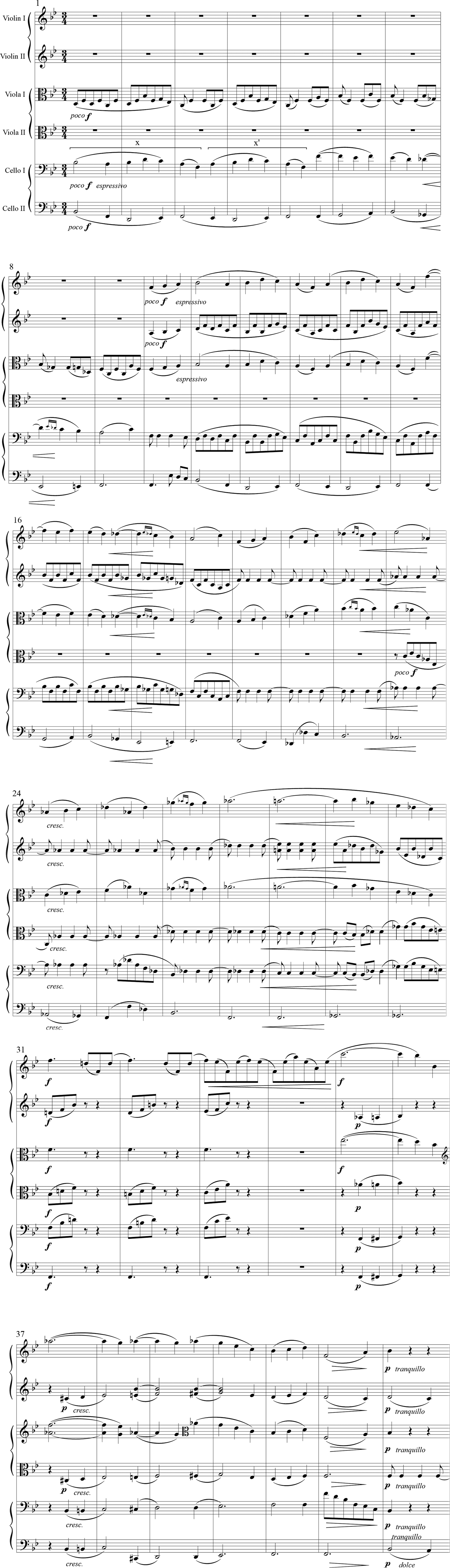
Beethoven's Quintet begins in trio texture. Its restrained initial motive, shown as ‘x’ in Example 1, starts on the down-beat with a long tone (dotted minim) on the tonic, followed by simple, legato crotchets that feature a persistent neighbour-tone motion around the tonic. Beethoven's sophisticated sentential construction combines the second presentation of the head-motive (‘x′’ in Example 1) with the initiation of a sequence that drives to the elided PAC at bar 9. In effect, we hear the neighbour-dominated x and x′’ motives circle around the tonic twice before the melody moves upward toward scale degree 5. The cello's line mirrors the melody in contrary motion, so that one can hardly speak of a rhythmically differentiated bass. Between these voices lie undulating quavers in the first viola. All three instruments lie in dark registers – the first violin on the G string, the viola on the C string, the cello as low as the integrity of its line will permit.Footnote 24 The second phrase (bars 9–17) reiterates the first one in an expanded texture, with the undulating quavers now doubled in octaves and the melody lying an octave higher in the second violin. Initially the first violin is withheld, but it joins the texture with a fourth real part in bar 11.
Beethoven, Quintet in C Major, Op. 29, mvt I, bars 1–17

Rudolf Stephan regards Beethoven's exploration of sound and texture at the beginning of the Op. 29 Quintet as an important distinguishing feature of the work, contrasting it with the motive-based openings of the Op. 18 quartets. He notes especially the restrained quality of the opening idea, ‘entirely without characterizing rhythmic profiling’, and the contrary motion between melody and bass, so that ‘the melody accompanies itself’.Footnote 25 In Stephan's view, in its fuller, rounder, more peaceful opening, the Quintet anticipates Schubert.Footnote 26 In a similar vein, Ludwig Finscher stresses that Beethoven's emphasis on sheer sound at the opening of Op. 29 distinguishes it from the more contrapuntally conceived quintets of Mozart.Footnote 27 The long tradition of comparing Beethoven's Op. 29 to Mozart's quintets began with Wilhelm von Lenz, who believed that the work was related to Mozart's ‘Kassationstyl’, or serenade style. He based this unusual argument on an observation in Otto Jahn's widely read Mozart biography, first published in 1856, in which Jahn imputed a light, serenade-like quality to Mozart's early quintets.Footnote 28 Lenz heard such qualities in the concertante writing in the last movement of Op. 29, with its emphasis on a virtuosic first violin part, and on the looseness of the form in that movement, with the two interpolated Andante con moto e scherzoso sections.Footnote 29 While modern critics tend to lay aside Lenz's comments about Op. 29, in the 1860s his emphasis on the serenade-like qualities of its finale would have contributed to a view of the work that was consistent with the way Joachim used it in concerts, for, despite its restrained, Schubertian opening, it provided a rousing, brilliant conclusion.
Like Beethoven's Op. 29, Brahms's Op. 18 sextet begins in a dark-hued trio texture. The first cello's initial motive, shown as ‘x’ in Example 2, starts with a long tonic note (a minim) on the downbeat that continues in simple, legato crotchets. As in Beethoven's Op. 29, the motive begins with a prominent lower-neighbour motion around the tonic, and the second presentation of the motive (‘x′’ in example 2) partially echoes the same neighbour motion, but with the initiating long tone removed, at the same time shifting the motive's beginning from downbeat to upbeat. Taken together, motives x and x′ circle around the tonic twice before springing up to scale degree 5. Because of their subtle rhythmic organization, x and x′ in both cases combine to yield an initial unit of five rather than four bars, causing the first phrase-level cadence to fall on bar 9 rather than bar 8. The middle of the texture is filled out by gently undulating quavers in the first viola. At bar 11, Brahms presents the same material again in an expanded texture, with the melody now an octave higher in the first violin, doubled an octave lower by the first viola. The bass is still supplied by the second cello, while the undulating quaver middle is now doubled in octaves between second violin and first cello. The second viola is initially withheld from this expanded texture, leaving the second phrase essentially scored for string quintet. After an exploration of the flatted mediant key (D-flat major) in bars 20–30, during which the second viola joins in, Brahms closes this lengthy first subject with a PAC at bar 43.
Brahms, Sextet, Op. 18, mvt I, bars 1–43

The many commonalities of melodic idea, pitch register, accompaniment figuration and texture between these two passages leave the strong impression that the opening of Brahms's sextet was written under the sway of Beethoven's Op. 29. The double presentation of the opening phrase in a dark trio texture and then in a warm, expanded scoring is especially persuasive to the ear. But the relatedness of the two passages is more complex than it appears to be, for in an earlier version Brahms's sextet did not begin in trio texture. In his biography of the composer, Max Kalbeck reported: ‘Originally the sextet began with the eleventh bar; the first violin took the theme. Joachim was of the opinion that the beautiful melody would come into play even more if it was first assigned to the cello and then was repeated by the violin.’Footnote 30 Donald Francis Tovey, who knew Joachim well late in the violinist's life, reported this information somewhat differently:
Joachim, to whom Brahms at this time sent all his compositions to be criticized movement by movement, found that the opening theme moved in its twelfth bar too abruptly to the rather remote key of D flat, and suggested to Brahms that instead of beginning at once with all six instruments it would be better to announce the first nine bars … in the violoncellos and viola, letting the violins sail in with the connecting tenth bar so as to take up the theme in their own octave by way of repetition; after which the modulation to D flat would sound as welcome as it is rich.Footnote 31
The manuscript of the sextet, now in the Library of Congress, confirms that the opening was revised. In James Webster's words:
the title page and first three pages of music are written on different paper from most of the remainder, and the blank space at the end of this bifolium, the third page of music, implies that Brahms must have rewritten the opening of the movement after the fourth page of music and the following pages already existed (otherwise there would have been no reason not to fill p. 3 to the end) … .This is compatible with the fact that the autograph [page] number 3 appears on the fourth page of music, which implies that originally only two pages preceded [it].Footnote 32
Writing in 1983, Webster lamented that he had found nothing in the Brahms–Joachim correspondence related to this revision.Footnote 33 But we now know that Kalbeck received his information directly from Joachim in the form of a written answer to one of several questions Kalbeck posed to him while working on Brahms's biography. Joachim wrote simply: ‘The first eight bars of the B-flat major sextet were added at my request.’Footnote 34 There is, then, a significant difference between what Joachim wrote to Kalbeck and what Kalbeck reported in his biography; Joachim revealed nothing to Kalbeck about why he had recommended the revision. Unless Kalbeck received further information from him on this point, the notion that Joachim wanted more exposure for the first theme at the beginning of the sextet must be imputed to Kalbeck, not to Joachim himself. Tovey's assertion, probably based on a conversation with Joachim, that the revision sprang from harmonic considerations also contradicts Kalbeck's account. Left hanging in the air is the question of whether, in suggesting a revision to the opening of Brahms's sextet, Joachim may have drawn, either deliberately or intuitively, on his own intimate knowledge of Beethoven's Quintet, with its double statement of an opening theme at first in trio texture and then in an expanded scoring – a theme that was already strikingly similar in gesture and expression to Brahms's first subject. Whatever the case may be, Brahms's allusion to Beethoven's Op. 29 at the beginning of his first sextet surely owes part of its force and effect to Joachim's suggestion.
Joachim famously despised virtuosic display in performance, but that does not mean he was not a dazzling executant.Footnote 35 J.A. Fuller-Maitland recalled ‘a kind of ethereal quality to his execution of rapid passages, such as the semiquavers at the beginning of the finale of Beethoven's String Quintet in C, Op. 29’.Footnote 36 Clearly Joachim's performance of this remarkable finale made a strong impression on Fuller-Maitland, and it may also have made a strong impression on Brahms, considering the broad similarities between the finale of Beethoven's Op. 29 and that of Brahms's Second Sextet, Op. 36.Footnote 37
The last movement of Op. 29 is one of the most distinctive finales Beethoven wrote before the Eroica Symphony. The six-eight presto sonata form opens with the passage Fuller-Maitland described, in which the first violin dashes up and down the scale in short, frantic bursts, supported by tremolo in the lower strings, as shown in Example 3.Footnote 38 The following transition and second subject in flowing quavers sound almost calm by comparison. They have been described by Walter Riezler as a ‘pastoral middle passage’ contrasting sharply with a demonic first subject.Footnote 39 Writing in 1912, Paul Bekker, who may have heard Joachim play Op. 29, described the first theme as a thunderstorm, with the first violin's octaves in bars 7–8 as flashes of lightning, and the second group as a contrasting ‘undulating quaver theme’.Footnote 40 This unhurried second group (bar 55), soon gives way to the tremolo motive again, especially in the retransition to the repeat of the exposition (bars 96–104). As shown in the overview of the form in Table 1, the shape of the exposition as a whole is that of a lively pastoral or gigue-like centre framed by intense tremolo passages.
Beethoven, Quintet, Op. 29, mvt iv, bars 1–34

Form and Idea in Beethoven's Op. 29, mvt iv and Brahms's Op. 36 mvt iv

Tremolo-based sections are given in bold type.
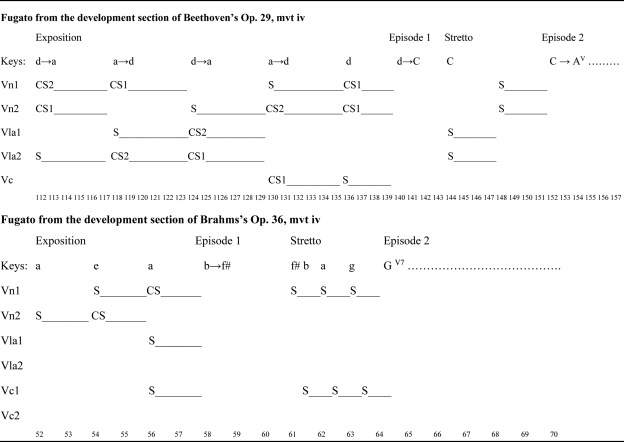
The development section is very distinctive. After a short, post-cadential transition to D minor using the tremolo-based first subject, Beethoven lets loose a fugato in that key, the first substantial development-section fugato in his output.Footnote 41 As outlined in Table 2, it is comprised of a complete exposition in all five parts (bars 112–140), a short modulatory episode, a pair of stretto-like entries in C major (bars 144–151), and an episodic transition leading to a dominant preparation of A major (bars 158–177).Footnote 42 This dominant preparation ushers in the remarkable interpolation of a little minuet, marked Andante con moto e scherzoso, in the by-then-antiquated early classical style (bars 177–195). It is an almost comical moment of courtly decorum separating the intense, preceding fugato from the storm of tremolo semiquavers that ensues with the recapitulation (bar 202).Footnote 43 This reprise is unremarkable, but in the coda the interpolated minuet reappears in the tonic key before the movement closes by returning to its dazzling first-subject material. The form as a whole leaves the impression of a continuous swinging back and forth between intense, tremolo-based passages and more refined ideas in a ‘pastoral’ mood, with an impressive fugato dominating the central development section.
Fugato of the development sections of Beethoven, Op. 29, mvt iv and Brahms, Op. 36, mvt iv

Table 1 also outlines the form of the last movement of Brahms's Op. 36 sextet, a movement that has been parsed in a remarkable variety of ways. Among recent analysts, Malcolm MacDonald regards its form as ‘a species of sonata design with a single (but bi-partite) subject’, with the first subject consisting of two parts, the first beginning in bar 1 and the second in bar 7.Footnote 44 Wolfgang Ruf posits that the form is ‘a subtly shaped mixture of sonata form and rondo. This results from the framing of both themes with a ritornello that is subjected to its own developmental processes.’Footnote 45 For Ruf, then, the tranquillo theme beginning in bar 7 is the first subject of the sonata form, with the second theme beginning in bar 34. The semiquaver tremolo material in bars 1–5 and 29–33 has a framing function analogous to the tutti sections in a baroque concerto. In Arno Mitschka's similar analysis, the semiquaver material in bars 1–5 is designated as a motto theme – according to Mitschka the earliest use of such a device in Brahms's works.Footnote 46 Hanns-Werner Heister contributes yet another perspective: ‘Within the meaning of sonata-like contrasts of the themes, corresponding to that of refrain and couplet, Brahms combined and confronted the first theme, almost hectic because of its continuous semiquaver motion, including many repeated notes, with a steady second [theme] emphasizing a tranquillo quality’.Footnote 47 All these analyses, and Heister's in particular, respond to the strong contrast of motivic surface between the tremolo-based ideas and the tranquillo material. As shown in Table 1, these contrasts suggest a broad connection between Brahms's finale and that of Beethoven's Op. 29.
The function of the first five bars, shown in Example 4, is at issue in all the analyses cited above. Their continuous tremolo and flashes of rushing scale passages are somewhat reminiscent of the opening of Beethoven's Op. 29 finale, despite their somewhat slower tempo and more contrapuntal texture. But how does this unusual music function in the form? Friedhelm Krummacher maintains that these bars are ‘no mere introduction’, but that subsequently their tremolo motive ‘comes back with many variants in all parts of the form and functions just as much as a germ-motive of the themes as their adversary’.Footnote 48 Besides raising the possibility of an introductory function for the opening bars, Krummacher points out that their head-motive appears without tremolo in bars 15–18.Footnote 49 This ‘plain’ statement of the motive is critical to my own analysis, which differs from Krummacher's primarily in that I regard the plain statement as the germ from which the semiquaver version was derived, and not the other way around.Footnote 50 Accordingly, my analysis begins with a consideration not of the opening bars, but of the material that begins at bar 7.
Brahms, Sextet, Op. 36, mvt iv, bars 1–7

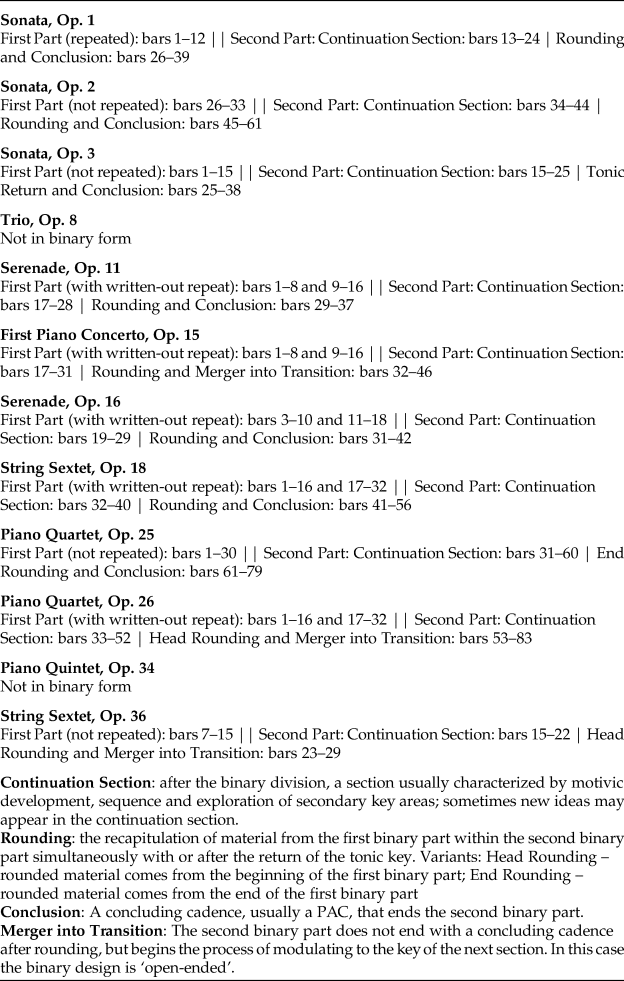
Brahms's tendency in many previous works was to cast the first themes of final movements in various kinds of binary form. Table 3 describes Brahms's treatment of these binary themes up to and including Op. 36. In his Op. 1, the first binary part was literally repeated, making the theme's binary design explicit. He later began to write out the repeat of the first part in order to rescore it, as in Opp. 11, 15, 16, 18 and 26. Most of the 12 binary themes listed in Table 3 conclude in the tonic key, often emphatically, but beginning with the First Piano Concerto, Op. 15, Brahms started cultivating a more efficient practice: slipping into the transition area of the sonata or sonata-rondo expositions shortly after the point of rounding in the first theme's second binary part. This procedure, coupled with the non-repetition of the first part, disguises the binary-form underpinnings of the theme beginning at bar 7 in the finale of Op. 36. The theme's binary design emerges clearly, however, in a hypothetical reconstruction that shows it to resemble a keyboard suite movement in the style of a pastorale, shown in Example 5. The mordents that appear here and there favour this impression, as does the aperiodicity of the melodic writing, the tonal plan and especially the launching of the second binary part with material derived from the opening motive. In a Bach keyboard suite, this derivation might typically involve melodic inversion, change of texture or embellishment.
Brahms, Sextet, Op. 36, mvt iv, bars 1–25: first subject realized as a keyboard suite movement

Binary-Form First Themes in Brahms's Early Finales

Here a more Brahmsian process involves motivic transformation, or developing variation, traced by the bracketed material labeled y0, y1, y2 and y3 in Example 5. Y0, the opening motive of the first theme, presents an ascending scale from scale degree 1 to scale degree 4, followed by stepwise descent to scale degree 3. In its first stage of transformation, y1, the rhythm of the motive is held constant, but the motive is transposed upward so that its opening scale moves from scale degree 5 up to scale degree 1; simultaneously, in a critical reshaping of the motive, the descending step from y0 is widened to a descending leap of a fourth. Y2 holds fast to all the pitch elements of y1, but now the motive begins to undergo a process of rhythmic contraction, with its last two notes expressed as a crotchet and quaver rather than as two dotted crotchets, as in y1. This process of rhythmic contraction is intensified in y3, where the ascending scale that begins the motive is removed, leaving only the ascending fourth from scale degree 5 up to scale degree 1 (now in the key of the dominant); at the same time, the rhythm of the descending fourth at the end of y3 is intensified through syncopation. During the overall transformation process, the motive has been reduced from five notes, spread out over three beats, to three notes, spread out over two beats. Most particularly, the introduction of syncopated rhythm in y3 allows the second binary part to commence with a fresh rhythmic impulse. Since, by this time, the opening motive had been worn down to a single interval melodically, it had to be replenished with new pitch material in order to launch the second binary part. Characteristically, Brahms chose to extend the newest element, the rhythmic syncopation, in that process.Footnote 51 Since much of the material in the third movement of the G major sextet can be traced to Brahms's study of Bach suite movements in 1855, it is tempting to connect this theme with the same preoccupation.Footnote 52
Because of its key and its binary structure, it is clear that the pastorale beginning at bar 7 constitutes the first theme of the sonata form, but, unlike Krummacher, I view bars 1–7 as primarily introductory, not as a prototype for further development. Their motivic material is derived from Motive y3, which, because of its important location at the beginning of the second part of the binary form, likely constitutes the prime form of all related motives in the movement. Example 6 presents y3 with three different continuations, or ‘suffixes’. The quaver suffix in parallel thirds at bar 16, forming y3a, conforms to the rhythmic profile of the pastorale and, through a process of semi-inversion, provides the basis for the canonic episode that begins in bar 19. Y3b, found at bar 29, is intensified with tremolo and appends a new suffix, a scalewise descent in semiquavers followed by an ascending leap of a sixth in quavers. The use of a closely related variant of y3b at bar 1, including its distinctive imitation at the subdominant, suggests that the material in the introduction was drawn from the transitional episode in bars 29–32, and not the other way around. The conversion of the quaver leaps in the y3b suffix (bars 30–32) into a semiquaver tremolo version (bar 2) in particular indicates the transformation of a simpler form of an idea into a more complex one. The introductory function of the first five bars and the transitional function of bars 29–33 is consistent with the fact that none of this material appears anywhere in the recapitulation, where an introduction would no longer be necessary and the omission of the modulating element of the transition would be a common occurrence.Footnote 53
Brahms, Sextet in G major, Op. 36, mvt iv: motivic transformations of y3

It is possible that Brahms composed the introduction for harmonic reasons. It serves as a modulatory bridge from the end of the previous movement in E major to the beginning of the last movement's sonata form proper in G major (E: I → iv = G: ii → V → I). If movement IV were to begin with the octave Ds in bar 5, their tritone relationship to the third of the previous movement's final E major chord would have been jarring, and perhaps unacceptable to Brahms. This reading of the form implies that the introduction was added after the movement as a whole was at least partially composed, since it would have been motivically dependent on the preexistence of y3 in bar 15. It also raises the question of why introductory material is included within the repeat of the exposition. In fact, the unusual, cadentially open ending of the exposition was originally designed to lead directly into the development. Brahms's autograph manuscript of the score (Paul Sacher Stiftung) and the copyist's manuscript of the parts (Brahms-Institut an der Musikhochschule Lübeck) both show that the repeat of the exposition was added by Brahms at a very late stage of composition, and unquestionably after the introduction was already in place.Footnote 54 So it was not Brahms's original intention that bars 1–5 should be repeated at all. In this scenario their introductory function would have been perfectly clear.
Beginning in bar 52, the tremolo form of y3 is extended into the subject of a fugato by means of yet another suffix, dominated by a turning figure in semiquavers, yielding y3c. This form is found again where the fugato reappears in the coda, beginning in bar 135. In both cases y3c is treated strictly as a fugue subject would be in the tradition of Bach's Well-Tempered Clavier, with tonal answers in the dominant key and third entries recurring in the tonic. By comparison, the looser treatment of the imitation at bars 1–4 (real imitation at the fifth below) is designed to support modulation, and the real imitation at the subdominant in bars 29–32 supports a transitional harmonic process. Neither of these imitation clusters can be regarded as fugal.
So there are two distinct tremolo versions of y3, distinguished both by their suffixes and by their imitative treatments. While y3c is reserved for strict fugal writing, the scalewise descending semiquavers of y3b subsequently reappear beginning at bar 38, creating spritely runs that dominate the second subject, especially in the first-violin part. Here the music takes on a level of virtuosic brilliance similar to that found in the finale of Beethoven's Op. 29, which is replete with turning motives and scalewise passages in semiquavers in the first violin. These figures eventually extend into long, downward-plunging scales. In both works these plunging scales lead toward cadences near the ends of formal units – the first subject in Beethoven and the second group in Brahms. In both cases the scales rush downward twice and arrive at a first-inversion ii chord of the original tonic key, revealing an unexpected degree of connectedness between the two movements in terms of gesture and idea.
The central developmental feature of both movements is fugato. Table 2 indicates several similarities of overall design between the two fugatos. Each exposition is followed by a modulatory episode that leads to contrapuntally intensified statements built from the first part of the fugue subject. Each of these statements extends into a second episode that leads out of the fugato toward a dominant preparation.
Some aspects of the two fugatos differ significantly. Beethoven employed a five-voice exposition with two countersubjects. Johann Georg Albrechtsberger, who gave Beethoven extensive lessons in counterpoint not long after Beethoven arrived in Vienna, referred to this procedure as ‘triple invertible counterpoint at the octave’ (dreifacher Contrapunkt in der Octave), the contrapuntal basis of ‘triple fugue’ (dreifache Fuge). This procedure constituted the culmination of Beethoven's studies in fugue with Albrechtsberger.Footnote 55 Beethoven employed a triple-fugue exposition for the first time in any of his published compositions in the Op. 29 fugato – a remarkable display of erudition in the midst of a high-spirited finale. By contrast, Brahms's three-voice exposition employed one countersubject, a common procedure in simple fugues in J.S. Bach's Well-Tempered Clavier. The contrapuntally intensified statements in the two fugatos also differ in detail. In Beethoven's fugato, a four-bar segment (bars 144–147) presents, with modifications, the three elements of the exposition's triple-invertible counterpoint, but now with a fourth part added. In the next four bars (bars 148–151) these four parts recur in a different contrapuntal combination, yielding quadruple-invertible counterpoint. The music also has a stretto-like effect because the headmotive of the subject is imitated at a distance of four bars rather than six, as in the exposition. Brahms's contrapuntally intensified statement is a true stretto that presents the first half of the subject in close canon between the upper voice and the bass (bars 61–4).
However, the two fugatos also present significant design similarities. Both use minor-key subjects and remain resolutely in the minor mode until, with the arrival of the quadruple counterpoint in Beethoven and the final episode in Brahms, the tonic key of each movement returns. In both cases the contrapuntally intensified statements use only the first part of the fugato subject. Both fugatos begin in the minor key a step higher than the original tonic, so that Beethoven's fugato proceeds from D minor to C major, while Brahms's fugato proceeds from A minor to G major. There is also irony of a sort: Beethoven's subject is a rhythmic simplification of his principal theme, with the semiquaver element removed, whereas Brahms based his subject on a portion of his principal theme (Motive y3), intensified and transformed by the addition of semiquaver tremolo. Brahms's fugato appears again, thoroughly reworked and in the tonic key, in the animato coda (bars 135–53), corresponding roughly to Beethoven's tonic-key presentation of the interpolated minuet. So a major feature of the development reappears tonally ‘resolved’ in the coda of both works – for Beethoven the minuet, for Brahms the fugato. Altogether, the developmental fugatos add significantly to the impression that the two finales are broadly connected.Footnote 56 While the motivic ideas in the movements are only occasionally related, the fixation on tremolo textures, contrasting pastoral ideas and developmental fugatos in both movements produces so many similarities of overall shape and content that it is hard to avoid the impression that Brahms was responding to Beethoven's finale when composing his own.
The points of contact between Beethoven's Op. 29 quintet and Brahms's two string sextets are intrinsically interesting, but they also have something to say about Brahms's chamber music in broader outline. It is often observed that Brahms tended to write chamber works in pairs. The Piano Quartets, Op. 25 and 26, the two string quartets in Op. 51, and the two clarinet sonatas in Op. 120 come immediately to mind. Like the examples mentioned above, the two string sextets exemplify the pairing of opposites. Certainly both works reflect Schubertian breadth in their first movements, although, as James Webster points out, the first movement of Op. 36 already bends back toward a more restrained formal organization, with its second group hewing resolutely to the dominant key.Footnote 57 The oppositional relationship between the two sextets is more apparent in their inner movements. The genial scherzo and trio in Op. 18 could easily have appeared in one of Brahms's Serenades, Op. 11 or 16. Its clever, Haydnesque features include the transfer of the scherzo's opening motive into the bass of the trio and the old-fashioned subdominant rounding of the trio's binary form (bar 73). Above all, its uncomplicated homophony stands in stark contrast to the contrapuntal complexity of the scherzo in Op. 36, in which a complete, three-voice gigue exposition appears in the dominant-key area of the first binary part, with an inversion of the opening theme serving as a countersubject to the gigue motive. The opening theme of this movement, as Robert Pascal has pointed out, was developed from a keyboard gavotte in baroque style that Brahms penned in the 1850s, so the scherzo might be considered a compilation of two proto-baroque dances.
The classical manner of the variations in Op. 18's Passamezzo-inspired slow movement is apparent from their progression of surface rhythms through semiquavers, triplet semiquavers, and demisemiquavers, followed by a variation in crotchet and quaver rhythms. Only the ingenious musette-like fifth variation separates this overall plan from that of the variation movement in Beethoven's String Quartet, Op. 18, No. 5. By contrast, the theme of the Adagio variations in Op. 36 is built up from a four-bar fragment that Brahms had sent to Clara Schumann in a letter of 7 February 1855.Footnote 58 It is possible that this fragment also existed in canonic form in the 1850s.Footnote 59 Should this be true, then both of the interior movements of Op. 36 were developed from proto-baroque composition exercises that Brahms first sketched a decade before writing the sextet. The ensuing variations achieve extraordinary levels of contrapuntal complexity. In particular, large stretches of the imitative, gigue-like third and fourth variations are written in six independent parts. In the manner of the gigues in Bach's keyboard suites, the leading motives of these two variations are freely related by inversion.
However, it is in their finales that the oppositional relationship between Op. 18 and Op. 36 is most sharply drawn. The sprawling theme of Op. 18's closing rondo has the phrase form: aa′aa′baa″, with each phrase eight bars in length and the paired aa′ phrase groups forming periods. It is a melodic statement that exudes regularity, presenting its headmotive no less than six times. Reflecting Schubertian practice, Brahms presents a generously proportioned B theme twice, with the first statement leading to a local-tonic close and the second one modulating back to the original tonic for the return of A (bars 78–102 and 102–137). The central developmental section (based on the b phrase of the opening theme) likewise is organized into two large parts, related broadly by sequence after the manner of Schubert (bars 180–207 and 207–277). The extensive harmonic digression in the third appearance of A to the key B major (enharmonically the Neapolitan) and its subdominant is likewise Schubertian.Footnote 60 Except for brief imitative forays in the development section, homophonic writing dominates the movement.
The contrast with the finale of Op. 36 could hardly be more striking. The play of imitation in its modulatory introduction announces from the outset that contrapuntal procedures will feature prominently in the movement. The indebtedness of the sonata form's first subject to baroque dance music has already been discussed here. The irregularity of the first subject's phrase structure places it far indeed from Op. 18's square-rigged rondo theme. Its second binary part begins with two canons following close on one another (bars 15–18 and 19–20), the first at the octave and the second at the tenth. The second subject offers relief from the writhing counterpoint, but its terseness, utter lack of closed cadences, and tenacious, though somewhat ambiguous, adherence to the dominant key make it the antithesis of a Schubertian second group. Brahms's brilliant ploy of letting the end of the exposition linger on a ii6 chord in G major makes the formally disruptive repeat of bars 1–5 sound plausibly like part of a ‘first ending’ and emphasizes the second-group's complete lack of cadential closure. (Compare the similar effect made by the return of tremolo-based material in the ‘real’ first ending of Beethoven's Op. 29.) In fact, except for the somewhat irregular authentic cadence at bar 6, there is not a single PAC in the tonic key in the entire movement until bar 169, six bars from the end. This astonishing withholding of tonic closure might help account for the feeling of high energy and restlessness that pervades this movement.
Looking at the long view of Brahms's chamber music output, if the Op. 18 sextet marks the point at which he turned toward Schubert as a source for organizational and expressive strategies, the Op. 36 sextet is the work in which he turned decisively in a new direction. Except for the first movement, which, as Webster points out, indeed possesses many Schubertian characteristics, the rest of the work emphatically embraces baroque-inspired counterpoint, terseness of form, and a more reticent harmonic palate as a path forward. The ramifications of this approach extend to the first cello sonata, Op. 38, in which the fugue-like finale is related to Contrapunctus 13 in J.S. Bach's Art of Fugue; to the First String Quintet, Op. 88, with its appropriation of a sarabande and gavotte written in the 1850s in the second movement and its fugue-laced finale; or to the tightly woven outer movements of the First String Quartet, replete with imitation, invertible counterpoint, and restless PAC avoidance.
In this context, it is remarkable that Brahms's two sextets, so opposed in compositional technique and expressive trajectory, should be connected by their interactions with Beethoven's ‘wallflower’ masterpiece, the Quintet, Op. 29. But perhaps this unlikely scenario is explained by the remarkable qualities of Beethoven's work, which in many ways was unlike anything he had written before. In Op. 18, Brahms's indebtedness to the opening of Op. 29 lay in the realms of motive, texture and idea. Here Rudolf Stephan's observations about the Schubertian character of Op. 29's opening, with an understated melody not far in character from that of, for example, the Sonata in B flat, D. 960, are trenchant. Moreover, Brahms certainly would have observed the remarkable tonal plan of the quintet's exposition (C Major–A major–A minor), Beethoven's first foray into the Schubertian three-key designs Brahms favoured during his first maturity. So both the opening theme of Op. 29 and its first-movement structure were Beethovenian harbingers of the very Schubertian characteristics that were so attractive to Brahms when he undertook his First Sextet.
Of the many points of contact between the finales of Brahms's Op. 36 and Beethoven's Quintet, perhaps the most important is the idea of presenting impressive fugatos in their central development sections. In Op. 29 we find not the genial, almost pro forma fugal writing of, say, the opening of the slow movement in Beethoven's First Symphony, but fugue that is dense, challenging, intellectually rigorous – a triple-fugue exposition that represented the point of highest attainment in his studies with Albrechtsberger. The central fugato of Brahms's finale in Op. 36 is forged from dense, almost frantic counterpoint, with its close strettos demonstrating an especially impressive command of the terse subject. Combined with the related fugato in the coda, in which the material is further developed, Brahms presents in this movement for the first time a thoroughgoing commitment to fugue as a decisive force in a large form.Footnote 61 It is interesting that he wrote the finale at an eight-month remove from the rest of the sextet.Footnote 62 One might conjecture that after writing the two middle movements, so strongly influenced by baroque traditions, he paused, sensing that a more conventional finale would not follow them well. It was at just this point, where Brahms was ready to try a new path in his chamber music, that Beethoven's astonishingly original Op. 29 Quintet had something more to offer him.