They entered the gorge, and immediately its terrors began to strike upon them. They first observed the character of the poison-making trees. They looked something like laburnum, but their exuberant blossoms were a deep blood-red, and the effect was as if the trees were extending over them long, skinny arms with trailing fingers dripping with blood. As they pushed forward the heavy horrible blossoms brushed them and caused an involuntary shudder. They pressed on, and horror upon horror revealed itself. Trailing creepers entangled the feet of the animals and rose about the legs of their riders; and on dead or decaying trees filthy, fleshy-looking orchids grew and fed, some of them showing blooms that looked like horrid, painted, grinning, pantomime masks, with long, thin stamens like serpents’ tongues. And still as they went on they perceived how fatal the Throat of Death had been to former travellers; for they began to stumble among things that could be nothing but skeletons of beasts and men. Through fallen blood-red blossoms that bestrewed the ground stuck rags of clothing, and the ever-present orchids showed their disgusting growths in sockets where once had shone human eyes, and between grinning teeth whence had once issued human speech. The total effect was enough to cause a madness of horror in the sanest minds.
James Maclaren Cobban, The Tyrants of Kool-Sim (1896)Footnote 1So reads the description of “the Throat of Death,” a deadly gorge in the midst of the desolate African wilderness through which travelers must pass if they are to reach the eponymous lost city of James Cobban's The Tyrants of Kool-Sim, published in 1896. The novel relates the tale of two British boys, Will and Walter, who accompany the heroic adventurer Captain Betterton on a mission to rescue Will's uncle, Tom Malleson, from darkest Africa. To reach Kool-Sim, described as “the accursed land of djinns and sorcerers” (88), the group must pass through the Throat of Death, a valley lined with tangled creepers and crimson orchids that breathe out poison. It is, as Cobban's narrator points out, a place of “horror upon horror,” whose terrors manifest in the specter of the monstrous vegetal. These trees exist at the uncanny intersection between the familiar and the unknown. They resemble laburnum, but their blossoms are blood-red; moreover, they are described as “exuberant,” with an unsettling vitality and capacity for movement affirmed by the likening of their branches to grasping, blood-tipped fingers. Their pendulous blooms are attributed an uncanny agency, grinning like pantomime masks in an eerie juxtaposition of the comic and the carnivorous. Perhaps most sinister, however, is the way in which these plants have colonized the bodies of those who succumbed to their poison. The presence of these red blossoms among the bleached bones of the dead emphasizes the fragility of the human form, the plants grotesquely impersonating the lifeblood of those whose lives they have brought to an abrupt halt. Human speech and human bodies are ephemeral; by contrast, the serpent-tongue stamens that protrude from these skulls are eternal and horrifyingly abundant. They are a reminder that, as Dawn Keetley points out, “each of us becomes the landscape from which we spend our lives trying to distinguish ourselves.”Footnote 2
It is no surprise that such an experience “was enough to cause a madness of horror in the sanest minds” (126), for the late nineteenth century had witnessed an explosion of interest—both scientific and literary—in the horrifying potential of carnivorous plants. As early as 1783, Dutch surgeon J. N. Foersch had published in the London Magazine an account of the Javanese upas tree, whose poisonous secretions were apparently “so virulent, that they not only kill by contact, but poison the air for several miles around, so that the greater number of those who approach the vegetable monster are killed.”Footnote 3 William Whitman noted that the term “upas” had “become a figure of speech” by the end of the century, and we find it used by writers including Thomas Carlyle, Charlotte Brontë, and Charles Dickens to signal a poisonous atmosphere.Footnote 4 This occurred in spite of the fact that an 1839 article in Chamber's Edinburgh Magazine debunked the deadly tree as a myth, speculating instead that the toxic nature of a certain “Valley of Poison” in central Java was due to carbonic acid gas escaping through fissures in the ground.Footnote 5 This scientific, rational explanation did not discourage writers such as Cobban, whose novel sees the nebulously dangerous upas reimagined as an active predator, its carnivorous arsenal supplementing noxious fumes with uncannily active, grasping tendrils. As Cheryl Blake Price points out, the fin de siècle introduced “much more actively sinister plants” to the cultural imagination, partly owing to the interest generated by Darwin's Insectivorous Plants (1875).Footnote 6 Similarly, Kelly Hurley argues that “Darwinism opened up a space wherein hitherto unthinkable morphic structures could emerge: the fin de siècle Gothic occupied that space and pried it open further, attempting to give shape to the unthinkable.”Footnote 7 This “shape” was often vegetal. Indeed, journalist Edward Step noted in 1896 that “now and again the readers of a certain class of journals are treated to startling accounts of a remarkable tree. [. . .] Probably some highly imaginative journalist has been reading Mr Darwin's work on Carnivorous Plants, and gave full rein to his fancy.”Footnote 8 Examples include Arthur Conan Doyle's “An American's Tale” (1879), Phil Robinson's “The Man-Eating Tree” (1881), and Fred M. White's “The Purple Terror” (1899), among others. The appearance of plant monsters was frequently characterized by high levels of pseudobotanical detail and tended to fall into two categories: supposedly “real-life” travelogues in newspapers and periodicals that detailed encounters with endemic plant species in their native lands, and fictional accounts that derived their horror from the fluidity of biogeography, with “foreign” plant species finding their way into Britain and performing a form of reverse colonization upon the helpless bodies of its inhabitants. Price argues that the monstrous vegetal in Victorian fiction highlighted “the threat of an unconquered and highly evolved natural world,” focusing fears about foreign environments.Footnote 9 Literary depictions of such flora were thus not new, but during the late nineteenth century they were transported, significantly, into a very specific “foreign environment”: the lost world.
Fin de siècle lost world novels can be classified as a significant subgenre of “imperial romance”: adventure narratives featuring the daring exploits of male protagonists in colonial locations, often darkest Africa. They were frequently marketed to boy readers, with Rider Haggard's hugely successful King Solomon's Mines (1885) perhaps the defining example of the genre. Bradley Deane has noted that the period between 1871 and 1914 saw a greater concentration of lost world novels published (over two hundred) than in all the preceding years. We can ascribe this trend to both the market conditions that allowed such texts to flourish—burgeoning opportunities for publication in literary journals and serials, for example—and the specifically New Imperialist ideology they explored and inscribed. As Elaine Showalter points out, “boys’ fiction was the primer of empire. Little boys who read will become big boys who rule, and adventure fiction is thus important training.”Footnote 10 Such texts, Deane argues, “dream of a pre-historical mandate for empire articulated in the blood and sinews of the male body,” expressing “those dreams far more freely and more intimately than do the discourses of politics or science.”Footnote 11 Existing beyond the known world and the boundaries of the map, the lost world was a fictional space in which authors could reflect upon masculinity and heroism in an age of imperial, technological, and geographical expansion. As Joseph Kestner succinctly argues, “the primary if narrow agenda of many adventure texts [is] to model masculinity and interrogate it.”Footnote 12 These “interrogations” frequently took the form of encounters with Natives, which enabled the hero of New Imperialism to “recognize the barbarous Other in himself and exalt his own untrammeled instinct as a tool of empire and the core of his manhood.”Footnote 13 What has yet to be explored in depth, however, is the significance of encounters between the male heroes of lost world fiction and the barbarous “other” in the form of the monstrous vegetal. This “other” violently resists the hero's attempts to incorporate it and threatens, rather than strengthens, the very essence of his manhood. If “the late Victorian and Edwardian popular imagination embraced as never before the image of an imperial hero draped in the garments of alterity,” how are we to read the imperial hero ensnared by carnivorous vines or caressed by poisonous blossoms?Footnote 14
Patrick Brantlinger has identified what he terms “imperial Gothic” in many of the adventure romances of the fin de siècle, characterized by the combination of a “seemingly scientific, progressive, often Darwinian ideology of imperialism with an antithetical interest in the occult.”Footnote 15 He identifies the three principal themes of imperial Gothic as individual regression or going native; an invasion of civilization by the forces of barbarism or demonism; and the diminution of opportunities for adventure and heroism in the modern world.Footnote 16 This article will argue that these characteristics are given vivid, often horrifying form in the spectacle of interactions between “freakish flora” and the male body, connecting the otherness of the lost world landscape with pervasive anxieties attending Victorian conceptualizations of imperial masculinity. As Elizabeth Chang argues, “in addition to the primary critical paradigms shaping our reading of fin de siècle literature—of the imperial gothic, of degeneration, of professionalism, of catastrophe—we can add the fictional accommodation of varieties of non-native biological, and particularly botanical, life.”Footnote 17 Furthermore, examining the space where what modern ecocriticism terms “plant horror” and Victorian imperial romance intersect enables us to nuance both genres in productive ways, revealing a deep-seated fear of stasis and inadequacy that is often occluded by the spectacle of dynamic violence and conquest. Deane argues that “masculine norms were themselves in flux” during the nineteenth century, and we must acknowledge that “any hegemonic masculinity stands uneasily at a moment between the configuration it has displaced and that which will replace it.”Footnote 18 Charged fictive interactions between plant life and the male body emphasize the fluidity and fragility of hegemonic masculinities and link this fragility to more disturbing questions about the ways in which plant life might entangle, manipulate, and complicate the dynamics of conquest and control that often irrigated imperialist ideology. I will explore four examples of the “lost world” imperial romance from the final two decades of the nineteenth century: Cobban's Tyrants of Kool-Sim, R. D. Chetwode's The Marble City (1895), Rider Haggard's She (1886), and Frank Aubrey's The Devil-Tree of El-Dorado (1897).
We can trace a literary genealogy of the lost world through these texts in the comments of contemporary reviewers, whose remarks frequently point to Haggard as a pioneering figure of the genre. Aubrey's Devil-Tree was described as “threaten[ing] Mr. Rider Haggard's position,” “worthy of Rider Haggard at his best,” and “surpass[ing] in imagination the romances of Mr. Rider Haggard himself.” On at least two occasions, it was said that the novel “out-Haggards Haggard.”Footnote 19 A review in the Spectator also suggested that Chetwode's The Marble City, first serialized in the Boy's Illustrated Magazine, would appeal to “boys who have been taught in the schools of M. Jules Verne or Mr. Rider Haggard,” identifying the importance of an assumed boy reader in shaping the genre.Footnote 20 This group of texts also highlights the somewhat repetitive and derivative nature of the form, with Aubrey, Haggard, and Cobban all producing multiple lost world novels during the late nineteenth and early twentieth centuries—in Aubrey's case, under several different pseudonyms—many of which were first serialized in boys’ magazines. These particular four novels all feature what Carter Hanson identifies as a “lost race” narrative: “a discovery of racial congruence between a marginal lost ‘other’ and the centered English ‘self’” that works to “assert the historical continuity and permanence of the British Empire.”Footnote 21 Yet, as I will demonstrate, these texts also figure an unsettling “congruence”—metaphorical and physical—between the masculine self and vegetal “others.” Exploring this congruence can help nuance both the ecophobia that often characterized Victorian fascination with carnivorous plants and with colonial environments, and the ideologies of continuity that underpinned the imperial romance genre.Footnote 22
Often overlooked in discussions of uncanny Victorian flora is the specific way in which their devastating effects are mapped upon the male body. This omission is particularly curious considering the close critical connection between fin de siècle literature and the spectacle of the adventurous, imperiled, or degenerate male form. Deane argues that the “emphasis on a naturally competitive manliness” characteristic of new imperialism “underwrote a sense of history in which struggle was constant and never-ending” and in which “the barbaric hero finds his fulfilment suddenly, fitfully, in moments of stress.”Footnote 23 Imperial romance is frequently analyzed as representing the violent penetration of colonial territory by male explorers, but encounters with plant life in these lost world texts problematize this discursive focus. Instead, struggles between man and plant in these novels are remarkable for their ultimate emphasis on stasis and torpor, depriving male heroes of opportunities for dynamic struggle and heroic “stress” and instead representing a much more unsettling contest: a fight for basic stabilities of physical form, registered vividly upon the enervated male body. These demonic plants are bound up with anxieties about diminishing opportunities for adventure but also, even more frighteningly, about the relevance of hegemonic masculinities in unknown climates where stasis and adaptability, rather than vigorous violence, seemed to result in biological dominance. Such a reading challenges both our conceptions of plant horror and of imperial masculinities, both of which tend to center around motion: what Hurley identifies as the “ruination” of the human subject, “figured in the most violent, absolute, and often repulsive terms.”Footnote 24 Price contends that “the bodies of the monstrous plants and animals which inhabit gothic environments confound scientific categories and mimic cultural conceptions of the ‘freakish body,’” which become “magnets to which culture secures its anxieties, questions, and needs at any given moment.”Footnote 25 We witness in these texts, in fact, the securing of anxiety to two “freakish bodies.” The male body is manipulated or mutilated by the uncannily active and predatory plant body, and the result—presented as horrifying yet fascinating spectacle—registers deep concerns about the threat posed by foreign environments to masculine integrity, particularly the fear of stasis in a world where perceived opportunities for adventure were declining.
1. The Stupor of Despair: Exuberant Tendrils and Enervated Bodies
In 1897 science fiction writer Frank Aubrey published The Devil-Tree of El Dorado, a tale of two British explorers, Jack Templemore and Leonard Elwood, who set out to find the lost city of El Dorado—called Manoa in the novel—and in the process become embroiled in conflict with an evil group of priests, the Dark Brotherhood. The brotherhood's secret weapon is a carnivorous “Devil-Tree.” Most unsettling about this specimen—other than the fact that it attacks and consumes humans—is its uncanny mingling of plant, animal, and human features. It is “a sombre violet-blue, tinged in places with a ruddy hue,” evoking a blushing human face. Its branches move of their own accord, running “restlessly along the ground like lithe snakes.”Footnote 26 The tree is likened to “a sort of gigantic vegetable octopus” and a “devil-fish” (224). A reviewer in 1897 described the eponymous terror of Aubrey's novel as “so far as we know [. . .] an absolutely new monster,” claiming that the book was “strikingly original in its central idea.”Footnote 27 However, the same phrasing had been used by an American farmers’ magazine in 1892 to describe a flesh-eating tree found in Nicaragua, “a kind of vegetable octopus or devil-fish [. . .] able to draw blood of any living thing which comes within its clutches.”Footnote 28 This illustrates how man-eating trees tended to inspire the same semantic groupings during this period. Aubrey's monster was far from original, indicating recurring anxieties that irrigated fin de siècle lost world fiction and frequently materialized in the specter of the violent vegetal. Like many carnivorous trees described in the periodical literature of the late nineteenth century, the Devil-Tree bleeds a noxious red substance when cut. Furthermore, it has a “mouth,” a hollow at the top of the trunk around which the branches form a huge knot. This animal resemblance shifts toward the language of human domesticity in the description of a macabre device, “the Devil-Tree's ladle,” a wooden plank on wheels to which victims are strapped and pushed toward the monstrous tree during public executions (276). Reports of man-eating plants during the period responded to anxieties about monstrous evolutionary progress by categorizing such entities as disturbing animal/plant hybrids. In 1876 biologist Thomas Henry Huxley had published an essay in which he argued that “there is a border territory between the [animal and plant] kingdoms, a sort of no-man's-land,”Footnote 29 while a scientist writing in the New York Times claimed that “we are all wrong” in distinguishing between plants and animals, “for the differences when sifted are only those of a greater and lesser degree.”Footnote 30 Hurley points out that “monstrosities which disturb the taxonomies of natural history are, paradoxically, legitimated by the Darwinian version of natural history,” a “narrative within which any combination of morphic traits, any transfiguration of bodily form, was possible: species integrity was undone and remade according to the immediate, situational logic of adaptation to the environment.”Footnote 31 Consequently, such monstrosities in the fictional realm tended to rely on hybridity for their horrifying effects. Aubrey's Devil-Tree resembles a fish or octopus, but its branches are also likened to the head of the Medusa and something out of Dante's Inferno (251). It is part myth and part biological reality, and its naked branches apparently blur the boundaries between life and death, too, possessing a color “half funereal, half of a deep blood-tint almost unknown amongst botanical productions.”Footnote 32
This “gruesome wonder of the vegetable world [. . .] instinctively aroused aversion,” remarks Aubrey's protagonist, Jack.Footnote 33 It is the ontological instability of the tree that renders it truly horrifying, perhaps even more so than its monstrous actions. As Keetley points out, “plants already lurk perilously close to the very definition of the monstrous—which [. . .] centers precisely on its refusal of known categories.”Footnote 34 Similarly, Randy Laist has posited that “the most interesting thing about plants is ontological, rather than semantic. More interesting than the question of what plants mean is the question of what they are.”Footnote 35 In fact, understanding gothicized representations of plant life in these lost world novels requires a sense of both ontology and semantics. What these plants are—uncanny admixtures of animal, vegetal, monstrous, and human—is at the heart of their function in these texts, reflecting the hybrid nature of the lost world itself. Indeed, the very “lostness” and impenetrability of Manoa in Aubrey's Devil-Tree is signaled by describing it as an “unknown plant zone” (ix). The lost world was a space that combined mythology with an air of historical and scientific plausibility; lost cities in darkest Africa could be traced to the Phoenicians, as in Rider Haggard's She, and a land of dinosaurs survived into modernity, protected by high cliffs and impenetrable forests, as in Arthur Conan Doyle's later example of the genre, The Lost World (1912). Understanding the flora of these novels allows for better insight into the operations of the genre itself, and particularly its representations of masculinities. Just as the lost world tends to be linked genealogically or biologically to the known world of the imperial adventurer, the plant life within also evinces an uncanny combination of strangeness and familiarity, resembling—sometimes variously, sometimes simultaneously—a violent combatant, an alluring lover, and a wild animal. Yet, ultimately, the alternative forms of life it evokes challenge the male imperial adventurer, raising the specter of his inadequacy and impotence within environments that nourish—even prioritize—alternate, hybrid forms of life.
Read within a paradigm of Victorian masculinity that coalesced around heroic individualism, the ability of the vegetal to render all bodies alike and to nullify distinctions of class and constitution through a generalized enervation emphasizes the deep concerns about agency and opportunity that haunted these texts. Moreover, it underscores the problematic questions of ontology that lurk at the heart of imperial expansion, as men are forced to confront and reconsider their own integrity and potency in the face of other, unexpected beings. Cobban's Throat of Death—which surely recalls Bunyan's allegorical Valley of the Shadow of Death—is, like many other perilous journeys in imperial romance, posited as a test of fortitude. However, it also dramatizes the terrifying prospect of the male adventurer losing both these attributes and the opportunity to display them. Having made it through the terrible gorge, local guide Abdallah addresses Captain Betterton—whose very name hints at a superior masculinity—as he has been wont to do thus far, with the epithet “Master of Adventure.” Betterton, however, rejects the title: “Call me no more ‘master of adventure’” (137). Although known for his daring exploits in Afghanistan and Tibet, Betterton's encounter with a vegetal foe renders him powerless and stupefied, dependent upon Abdallah's aid to save his life. The root of the problem is clear in the intimation that Betterton's horror at the sickening plants was “made stronger [. . .] by the facts that there was nothing to fight: all must be endured: and that they could utter no sound to each other because their mouths were so muffled” (127). The last detail is telling: prior to entering the valley, the group wrap their mouths in handkerchiefs to block out some of the poisoned air. Yet this muffling also metaphorically represents the stifling of their ability to combat their foes “man to man” or “face to face.” At one point, Abdallah tears the handkerchief from his face, crying, “I will wear this rag no longer, and be choked in my throat!” (130), before taking decisive action and carrying his companions out of the gorge. Although the poisonous blossoms cause acute physical discomfort and death, even more threatening is their ability to incapacitate a man by depriving him of traditional ways in which to prove himself. Betterton cannot fight this foe; at one point he fires at a group of hopeful vultures with his revolver, emphasizing the futility of such weapons against the true enemy. If, as Stephen Arata points out, “the celebrations of empire found in the male romance are edgy, defensive,” then these incidents—in which men cannot defend themselves from uncanny vegetal foes—reveal significant anxieties about the permanence and stability of both the empire and its supposed protectors.Footnote 36 It also hints, problematically, that dominant imperial ideologies might be misreading or misunderstanding the true site of colonial struggle: not a war for territory or dominance, but simply a stark question of “survival of the fittest,” in biological rather than political or ideological terms.
Readiness to take risks was intimately bound up with the male condition in late Victorian discourse. Antigambling advocate Alfred Norris defined the effeminate man as being “inapt to do, unready to dare,” while Rudyard Kipling's famous poem “If,” written in 1895, linked manhood with the ability to navigate every conceivable testing situation that life could offer.Footnote 37 It is significant that one of the main threats posed by the unnatural flora in these lost world novels is its soporific effect. A focus on the lethargy instilled by noxious plant substances reveals anxieties about the declining possibility for masculine action in imperial environments, and the uncertain question of male identity in a world without such risks, or, indeed, human identity at all in environments where well-adapted plant life seemed to reign supreme. Lost world texts were acutely concerned with the disappearance of “blank spaces” on the map, owing to advances in cartography and geography, and therefore a loss of unknown, perilous locales in which men could prove their mettle. The genre is often linked, as John Tosh has argued, with a “flight from the domestic,” a desire to escape the stifling confines of the home and seek invigorating adventure in foreign lands.Footnote 38 Arata points out that “the romance genre, like late-Victorian imperialist ideology generally, is centrally concerned with the possibility of renewal,” specifically the renewal of enervated masculinities through transposition to far-flung locations where, in the words of David Trotter, “a more vigorous identity can be created.”Footnote 39 Yet these lost world novels offer a disturbing counternarrative to this oft-discussed trope: the “renewal” of male bodies through their implied absorption by plants and transmogrification into a new kind of life. They urge us to question our understanding of imperial romance as an attempt to compensate for “perceived losses” such as the emasculation of the middle-class male in Victorian society, instead foregrounding the destabilization of hegemonic masculinity and the reduction of the male subject to a state commonly associated with (nonmonstrous) plant life: static, enervated, rooted.Footnote 40 These texts are almost masochistically invested in dwelling, at length, on that which they ostensibly fear the most, “convulsed by nostalgia for the ‘fully human’ subject whose undoing [they] accomplish so resolutely.”Footnote 41
The blossoms in the Throat of Death cause “a lassitude and a desire for sleep” to “pervade all the person” (132). Yet they are not the only plants in these texts to cause lethargy. Prior to their execution by Aubrey's Devil-Tree, victims are kept in “the Devil-Tree's larder.” This is a cell, below the deadly plant, where the prisoner is afflicted by the “foetid odours given off by the foul tree” but, even worse, driven slowly mad by the possibility that any minute the door could open and the branches could snake inside and devour him (271). When he is trapped in this prison, Aubrey's Leonard is overcome by “a sort of brooding lethargy,” “the stupor of despair,” and “a state of torpor” (277). The tree is able to suck, metaphorically, the life out of its victims even before it drains their blood. Such was the apparent morbid fascination of plant-induced torpor that it even appeared in supposedly true tales recounted by explorers during the period: “The Man-Eating Plant,” published in an American botanical magazine in 1896, recounts the tale of a German trader who found himself nearly ensnared by the “sense-lulling, stupefying perfume” of a carnivorous tree.Footnote 42 It is significant that the key crisis of R. D. Chetwode's The Marble City, a story of three teenage brothers shipwrecked en route to Sydney who end up discovering the lost city of “Alsico,” occurs not when the boys are nearly burned alive by cannibal savages but instead revolves around the stupefaction of the youngest brother, Harry, by a plant. He is abducted by the dictatorial high priest of Alsico and forcibly intoxicated with a drug made from the mysterious “Hetel” herb, rendering him pliantly obedient. This drug, depending on the dose, can cause memory loss, a profound sleep that mimics death, or death itself. It is used to subdue troublesome members of the population and to keep servants to the high priest in a state of blissfully unaware subjugation. It is described as a “deadly drug,” but the loss of one's memory, causing a man to exist in an automaton-like state of servitude, is posited by the novel as a fate worse than death.Footnote 43 In other words, the true horror at the heart of these texts is that of men becoming more like plants. Brantlinger has remarked upon the dreamlike quality of Haggard's lost world landscapes, and it is true that Horace Holly, the protagonist of She, observes at the end of his adventures that he has “that wild look with which a startled person wakes from deep sleep.”Footnote 44 However, this fixation with sleep also hints at an overriding specter haunting these fictions: that of the British Empire—following its Roman predecessor—disintegrating in a frenzy of languid decadence, lacking the adaptability and flexibility possessed by plant life.
Almost as threatening as the possibility of masculine torpor in lost world texts is the spectacle of the unnaturally preserved, immobilized body. This appears in both Haggard's She and Chetwode's Marble City, where it indicates both a fascination with, and a deep-rooted fear of, masculine stasis. Such preservation does not correspond with the renewal that imperial adventure supposedly promised; instead, it denies it. The bodies of the citizens of Kôr are embalmed using a preservative manufactured from the leaves of a small bush. Their resemblance to living bodies is unsettling, scaring Holly's servant Job nearly out of his wits, but more remarkable is the way in which the current citizens of Kôr use these bodies: as torches to light their celebrations, “the material with which they were preserved having rendered them so inflammable that the flames would literally spout out of the ears and mouth in tongues of fire a foot or more in length” (210). Haggard emphasizes the helplessness of these bodies: Holly was “half expecting to see the spirits those flaming forms had once enclosed come creeping from the shadows to work vengeance on their desecrators” (211), but no such event occurs. The corpses remain at the mercy of pyromaniac partygoers, immobilized human forms whose unnaturally extended repose ends only through their total obliteration. Embalmed bodies in The Marble City are particularly horrible in their eternal stasis, occupying a liminal space between life and death: their eyes “were glassy, fixed, and rigid, gazing ever before them in one dull, unmeaning stare” (169). Similarly, Holly muses that “there was something very terrible, and yet very fascinating, about the employment of the remote dead to illumine the orgies of the living; in itself the thing was a satire, both on the living and the dead” (210). The “awful and hideous grandeur of the spectacle” is apparently most hideous for what it suggests about the disposability of the human form:
Those old citizens of Kôr burnt as, to judge from their sculptures and inscriptions, they had lived, very fast, and with the utmost liberality. What is more, there were plenty of them. As soon as ever a mummy had burnt down to the ankles, which it did in about twenty minutes, the feet were kicked away, and another one put in its place. (211)
Ayesha, queen of Kôr, affirms his sentiment: “What thinkest thou those long-forgotten nobles and ladies would have felt had they known that they should one day flare to light the dance or boil the pot of savages?” (211). More unsettling than the spectacle of the flaming corpses is what it apparently reveals about the abilities of plant substances to dispense with distinctions of class, gender, or life and death. Haggard's imperial romance—and She in particular—is frequently discussed as representing a fantasized dissolution of feminine power, authority, and sexuality, but examining how plants function in the novel suggests there is more at stake than a battle of the sexes.Footnote 45 Ayesha's literal and metaphorical dissolution—her “unveiling,” as Rebecca Stott describes it—within the Fire of Life is often read as a triumph for masculinity and a dismissal of the feminine, yet I would argue that it should be read in light of this earlier episode featuring bodies disintegrating in the grip of flame.Footnote 46 Here, the human form is uncannily “renewed,” made afresh by stripping it of everything it hitherto used to distinguish itself from primitive nature. More threatening than Ayesha's domination of Holly and Leo—frequently depicted as an intense sexual and emotional struggle on the part of both men—is the prospect of such struggle as redundant, since all human forms ultimately disintegrate into mere fuel. It is not only the female body that was disposable—and destructible—within the economies of imperialism. We are presented with “the spectacle of a body metamorphic and undifferentiated; in place of the possibility of human transcendence, the prospect of an existence circumscribed within the realities of gross corporality.”Footnote 47 Similarly, in Aubrey's Devil-Tree, it is not just the way in which the tree devours its victims that instills horror into Jack and Leonard. When it has digested all it can, the tree opens its “mouth” and expels the remains of its meal, passing it almost playfully from branch to branch “as a cat might with a mouse” (250). What remains is “but the mutilated husk of what had once been a living, breathing, human being [. . .] now there was little left beyond a shapeless form” (250), what Hurley might characterize as the “abhuman,” “characterised by its morphic variability, continually in danger of becoming not-itself, becoming other.”Footnote 48 Such a sight almost causes Jack to faint, yet he remembers that “he was expected to master his emotions, however strong and painful they might be” (251). In this scene, manly explorers are confronted with a vivid reminder of the arbitrariness of their existence and their inevitable degeneration into amorphous forms. Jack is both reminded of the need to perform his required role by stifling his disquiet, but also confronted with the fact that his hard-earned masculine aptitude is ultimately futile, destined to dissolve into crude shapelessness in the face of more adaptable life-forms. Hurley argues that “as ‘the human’ loses its particularity, it also begins to be evacuated of its meaningfulness”; we could say the same here for hegemonic masculinities, which immediately begin to fragment upon contact with wildly alternative and divergent forms of life.Footnote 49
Horrifying plant attacks in fin de siècle discourse were thus characterized by a curious tension between stasis and frenzied activity, which runs counter to how we tend to imagine moments of plant horror: as hideously, viscerally dynamic. An 1889 explorers’ report published in America entitled “The Devil's Tree” described the “long, drooping whiplike limbs” of the tree in question, which “seemed possessed of a horrible life-like power of coiling and uncoiling. Occasionally the whole tree would seem a writhing, squirming mass.”Footnote 50 Agnes Scherer points out that in modern plant horror,
the uncanny is often introduced through an unusually accelerated plant growth, which is sometimes so fast that it becomes a visible movement. [. . .] The intensification of the monstrous [. . .] is often effected by means of an increase and agglomeration of movement as the plant becomes more and more mobile, and brings forth ever more tendrils whose bustling activity becomes incomprehensible.Footnote 51
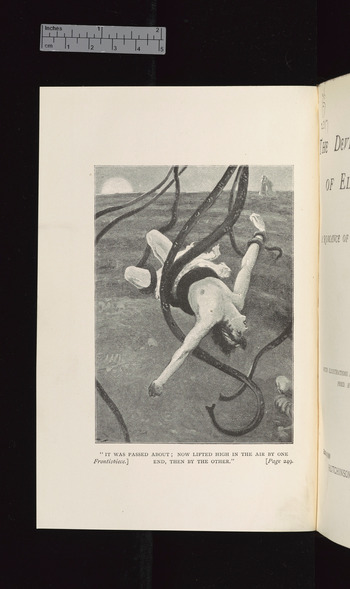
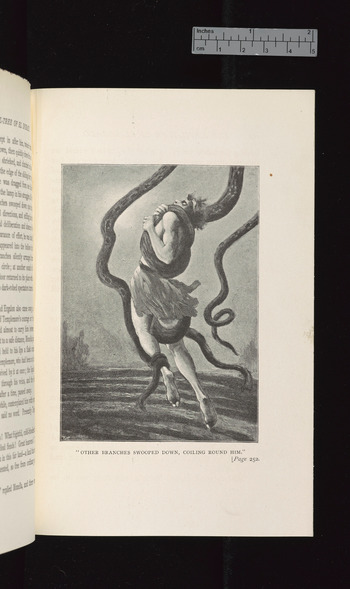
The motif has its (literal) roots in what she terms the “abstract squiggle” that represented wildness in European art history from Plato onward, signifying the disorderly, shapeless khora that preceded the emergence of the cosmos.Footnote 52 The tentacular plant monster thus evinces “the still unformed drive that is pure life instinct [. . .] life itself in its fundamentally excessive, superabundant nature as it bulges out of the tectonics of matter.”Footnote 53 Such irruptive, disorderly movement is characteristic of plant horror from the last few decades, as with the stinging tendrils of John Wyndham's triffids (1951) or the flesh-eating creepers of Scott Smith's The Ruins (2006), and is not restricted to the plant horror genre, with the sudden ensnaring of human limbs by writhing creepers a modern cinematic cliché. Such scenes of vigorous struggle against plant matter derive their horror from the grotesque speed and dynamism with which a body is consumed; in the recent film version of The Ruins (2008), the vines creep down a character's throat and suffocate him while the rest of his group argue amongst themselves.Footnote 54 The monstrous vegetal of these nineteenth-century texts seems to fall into the same category: the tentacular branches of Aubrey's Devil-Tree snare their victims almost “immediately” (224). It is significant that the first edition of the text features two almost identical illustrations (see figures 1 and 2) of the Devil Tree's hapless victims, both of which emphasize the swiftness of deadly, snaking tendrils around the pliant male form. Indeed, the caption of the first illustration underscores this aspect of the text: “It was passed about; now lifted high in the air by one end, then by the other,” the use of “it” instead of “he” serving to stress the agency of the tendril as juxtaposed with the static, objectified male it engulfs. Furthermore, the seminakedness of the victims, clad only around the waist, serves to emphasize the horrifying contrast between the slick black tendril, “coiling round him” (253), and vulnerable human flesh. The “bustling activity” of these attacks belies the fact that what is truly at stake in such encounters is a struggle between the dynamic vigor of hegemonic imperial masculinity and alternative forms of life characterized by adaptability, entanglement, and stasis. The “renewal” of the male imperial hero is enacted not through physical combat and conquest but through his implied absorption into these hybrid life-forms.
From Frank Aubrey, The Devil-Tree of El Dorado (New York: Amsterdam Book Co., 1897), frontispiece. Illustration by Leigh Ellis and Fred Hyland. By permission of the Syndics of Cambridge University Library.

From Frank Aubrey, The Devil-Tree of El Dorado (New York: Amsterdam Book Co., 1897), 252. Illustration by Leigh Ellis and Fred Hyland. By permission of the Syndics of Cambridge University Library.

These attacks can be read, in line with Keetley's observations, as “events,” signaling “absolute rupture not only of normality [. . .] but of the entirety of the known world and its fundamental structuring rules.”Footnote 55 They illustrate how plant life “troubles taken-for-granted assumptions about (human) agency.”Footnote 56 Although there is immediate horror in the graphic entanglement of the human form by vegetal limbs, what is more horrifying is the stark contrast between the “characteristic uncontrolled growth” of the tendril, which “never seems to be a ‘finished’ figure but is always engaged in further sprawling,” and the speed with which this perpetually extending tentacle reduces the vital human form to shapeless, lifeless matter.Footnote 57 These lost world texts suggest an alternate way of interpreting the horror at the heart of plant attacks, by focusing less on the accelerated moment of entanglement and struggle than what it ultimately betokens: “the attenuation of those things we think of as ‘human’ (reason, will, agency, autonomy, mastery, control) as they succumb to the immanent vestiges of the vegetal.”Footnote 58 These energetic plant encounters reveal, somewhat paradoxically, the terror of enforced stasis in a world that associates identity and individualism—particularly among men, and particularly men in service of the empire—with the capacity for action and reaction. If one of the “absolute difference[s]” between humans and plants is the latter's “profound unfreedom, signalled in plants’ rootedness to a spot,” then the spectacle of the monstrous plant in fin de siècle lost world fiction presents a role reversal of sorts.Footnote 59 It is the same troubling shift that occurs in Algernon Blackwood's influential “The Willows,” as the mysterious trees evince “personal agency” and “aggressive hostility” that “terrified [the narrator] into a sort of rigidity”;Footnote 60 or, as Chang summarizes, “plants are made mobile and humans fixed in place.”Footnote 61 The humans of these lost world texts are forced to grasp the “constitutive vegetal otherness” in themselves: their potential for profound unfreedom, enforced stasis, and inevitable obliteration.Footnote 62 Ultimately, they are confronted with the realization that, in the words of Charles Bernheimer, “my self has no distinctive identity: I am merely an instrument of nature's luxuriant productivity and impersonal violence.”Footnote 63
The grasp of the Devil-Tree is frequently referred to as an “embrace,” a simile also deployed to characterize the monstrous vegetal in other narratives from the period: explorer John H. Betterman wrote in 1889 of a tree he found in Mexico, describing how it drew a bird into its “fearful embrace,”Footnote 64 while author Phil Robinson in 1881 recalled his father's encounter with a man-eating tree who “sucks the carcass of man himself, til his matter becomes as vague as his mind, and all his animate capabilities cannot escape him from the terrible embrace.”Footnote 65 Such language hints at other ways of reading the rapacious, irruptive tentacle of plant horror narratives: as a penetrating phallic force that renders its victims emasculated vessels, their contents probed and devoured until only a senseless husk remains. Natania Meeker and Antonia Szabari have noted, in relation to plant horror films, that “the extinction of human desire within the otherworldly need of the plant holds its own visceral and spectacular appeal. [. . .] Plants that devour humans allow us to imagine the demise of humanity itself as not just terrible but pleasurable.”Footnote 66 Aubrey's unsettlingly hybrid Devil-Tree produces an equally hybrid reaction in its beholders, an intermingling of terror and attraction: Jack notes that “the tree was a hideous monstrosity that had yet a certain terrible fascination which attracted and retained the sight while it revolted and repelled the mind” (247). We can also identify in the “visceral and spectacular appeal” of these plant attacks connections to other unnervingly hybrid forms of pleasure. Keetley has noted that “plants dramatically breach confining categories of sex and gender, reveling in a wild ‘both/and’ sexual power: they are terrifying and alluring—utterly alien to normative gender and sex and therefore able [. . .] to figure ‘perverse,’ queer sexual possibilities.”Footnote 67 The writhing, coiling tentacles of lost world plant monsters are undeniably masculine, yet there is also a fluidity to these forms that evokes the feminine: the blushing of Aubrey's Devil-Tree; the skinny arms and blood-red blossoms of Cobban's orchids; the alluring “embrace” that leaves a man stupefied. They sit within an established literary tradition of carnivorous, poisonous, or otherwise monstrous plants linked to decadent “fantasies of nature's female fecundity” that in turn “generate dilemmas of male identity”: Nathaniel Hawthorne's “Rappaccini's Daughter” (1844), thought to be based on an ancient Indian tale; Ėmile Zola's La Faute de l'Abbé Mouret (1875); Joris-Karl Huysmans's À Rebours (1884).Footnote 68 Unlike some of these earlier texts, however, the plants in these lost world novels are not analogically or dramatically linked to attractive female characters but come to replace such characters altogether, troubling the gender dynamics often identified in imperial romance. Anne McClintock argues that “as European men crossed the dangerous thresholds of their known worlds, they ritualistically feminized borders and boundaries. Female figures were planted like fetishes at the ambiguous points of contact, at the borders and orifices of the contact zone.”Footnote 69 Here, however, female figures are not planted, but rather plants are partially feminized in order to relocate the contested “borders and orifices” of imperial expansion to the vulnerable male body itself, reframing a struggle for territory as a basic struggle for fundamental bodily and biological integrity.
These plants might appear to have much in common with the hypnotic femmes fatales that appear in lost world fiction (and indeed fin de siècle fiction more widely), who use their feminine wiles to subdue and, in some cases, predate upon men rendered powerless by their enthralling sexuality: Stoker's female vampires; Machen's Helen Vaughan; Haggard's Ayesha, also known as “She-who-must-be-obeyed.” The latter is described, like Aubrey's tree, as “terrible but most fascinating” (142). Holly is “drawn to her by some magnetic force which I could not resist” (153). He is “a victim to this modern Circe” yet takes a peculiar pleasure in his “stupor” (156), as does Leo, who is both horrified by Ayesha's heartless violence and drawn to her “more strongly than [by] iron bonds” (221). Importantly, as Hurley points out, the ambivalence of the carnivorous plant—an “it” with both male and female characteristics—“by no means denotes the cancellation or neutralization of sexuality. The condition of It-ness instead signals a proliferation and confusion of sexual identities and behaviours. [. . .] The desiring economies found within the fin de siècle Gothic are highly unstable ones, throwing into confusion such essentialist constructs as ‘normal masculinity’ and ‘normal femininity.’”Footnote 70 Hurley argues that in gothic fiction, “when the male subject is confronted with the fact of his own liminality, his own abhumanness, his own bodily fluctuability, he will attempt to keep this fact at bay by insisting that only the female body is chaotic and abominable, never his own.”Footnote 71 Yet by figuring the carnivorous vegetal as only partially coded female, and then depicting its violent irruption or penetration of the male form, these texts trouble the ideological and gendered separations often identified in imperial romance. Showalter argues convincingly that male writers of the fin de siècle frequently imagined “fantastic plots involving alternative forms of male reproduction or self-replication,” repressing the role of the woman in procreation and creation, yet these lost world novels imagine something more complex altogether.Footnote 72 They depict an unsettling blurring of the boundaries between human and plant life, with reproduction and replication taken into the “hands”—or tendrils—of plants that return male bodies to the earth in a symbolic “rebirth” that is simultaneously a burial, devouring, and decomposition.
The fluidity of plant forms in these texts also complicates the notion that, as Judith Sensibar argues, colonists (real and fictional) “may have sought the wilderness as a place where they could more successfully mask homosexual panic.”Footnote 73 The monstrous vegetation of these novels figures all of the ambiguities of threatened masculinity in ways that cannot simply be ascribed to “male dread of women's sexual, creative, and reproductive power.”Footnote 74 Its grasping tentacles and stupefying powers manifest the unnerving vulnerability more generally of the male body in alien locales: penetrable, futile, and impotent. It is not the threatening female that becomes an object of fear in such narratives, but the general vulnerability of the male form even amongst other men, particularly men whose morality and character have become harmfully entangled with the powerful plants they appropriate. The intoxication and manipulation of young Harry by a brotherhood of priests in Chetwode's Marble City hints at the possible physical exploitation that might accompany such mental control, emphasizing the prone susceptibility of the male body even within ostensibly homosocial communities. This is also the case in Aubrey's novel, with the villains who subject their victims to torment and death at the branches of the Devil-Tree termed, significantly, a “brotherhood.” Just as the plant's creeping limbs penetrate the (male) bodies of its victims, these texts hint at fears regarding the penetration of queer, contradictory, inexplicable sexual forces—plant forces—into the homosocial colonial community, and the ultimate fragility of masculine identities, bodies, and bonds.
2. Swallowing the World: Plants, Consumption, and Control
Brantlinger argues that “the basic regression fantasy of imperial Gothic involves a reverse cannibalism: the nightmare of being swallowed by the world's dark places has as its obverse side the solipsistic fantasy of swallowing the world.”Footnote 75 Complementing the fascination with carnivorous plants in these texts is a fascination with the reverse: human consumption of plant substances, and their effects upon the male body. The solipsistic fantasy of swallowing the world becomes a solipsistic gamble between heroic masculinity and effeminate torpor, arbitrated by unpredictable plant substances. “Kool-Sim,” we are told, translates as “eat poison” in Arabic, because the people developed poisoned blood by consuming produce from the sulfurous soil, to the extent that the tyrant king actually uses his own blood to poison darts that kill his enemies in seconds (150). As with the Dark Brotherhood of Aubrey's novel, misappropriation of preternatural botanicals is used to signal a lapse into barbarism (one might also consider the horrifying scene from Arthur Conan Doyle's The Lost World, in which the vicious ape-men appropriate a grove of giant bamboo as a torture and execution device).Footnote 76 The connection between masculine constitution and use of plant substances is also evident in Aubrey's Devil-Tree. The bittersweet juice of the “Plant of Life,” a mysterious blue succulent, grants the Manoans unnaturally long lives. Their king, who looks to be in his midfifties, is in fact 340. This plant is intimately bound up with questions of masculine endurance. We are told that recipes for preparing it are passed down from father to son, rather than—as we might expect with domestic wisdom—from mother to daughter. Furthermore, its consumption throws into sharp relief two opposed visions of the male body in a foreign environment: as vigorous and strong-willed, and as apathetic and static. More significant even than this, though, is the fact that it also throws into sharp relief the fine line between these two possibilities. Brantlinger points out that “in imperial Gothic white men do not always rise to the top—just as often they sink into savagedom, cowardice, or exotic torpor, as in Tennyson's ‘Lotos Eaters.’”Footnote 77 Encounters with the Plant of Life reveal the unsettling possibility—whose literary analogues could be traced back as far as the Bible or Homer's Odyssey—that a man had an equal chance of rising to greatness and descending into lethargy upon finding himself in a foreign (florid) environment.
We are told that some men live longer than others, despite taking the same dose of the plant liquor:
Some constitutions are naturally stronger than others, and these endure longer, just as is the case in the world outside where the plant is not known. [. . .] If a man who has inherited a constitution that is absolutely sound, from ancestors who have possessed the same through many generations, and if he has, in addition, a strong will, powerful beyond the average, he may live longer—if he is so minded. (232)
The Plant of Life is a means by which men may secure unnaturally long lives, but more importantly, it forms a litmus test for their constitutions. For the right kind of man, the Plant of Life can enable him to become an almost God-like paragon of manhood, as is the case with the idealized hero Mellenda in Aubrey's novel. However, opposed to this vision is the specter of a man haunted by Manoa's only incurable disease: the “falloa,” or “don't care sickness,” a “form of melancholia, of weariness with the world” (156). This disease is particularly interesting because it is the one ailment that cannot be cured by the Plant of Life. Its name, reminiscent of “fallow” and therefore continuing Aubrey's interest in the effects of the vegetal upon the male body, evokes dormancy and stasis. Like the torpor induced by the Devil-Tree, Cobban's orchids or Chetwode's Hetel plant, this incurable disease manifests fears about the stifling of masculine energies in an increasingly less adventurous world.
Furthermore, it raises the uncomfortable idea that colonial conquest and dominance might not be the result of dedicated masculine endeavor alone, but that unknown plant substances—and the arcane knowledge of them possessed by Native peoples—might have a significant role to play, once again intimating the redundancy of hegemonic imperial masculinity. Despite their uncanny, monstrous propensities, the plants of these novels are also subsumed within the colonialist fantasy of “swallowing the world,” given a somewhat more mundane role as commodities within capitalist, imperial, and political economies. The Plant of Life is intimated to be at least partly responsible for the past success of the Manoan Empire: “The secret of such a plant—the rapid increase of population when there were so few deaths in proportion—would of course give them a long pull over other nations” (197–98). Furthermore, as Price argues, Aubrey's novel strongly suggests that the Manoans imported and planted the Devil-Tree during a period of colonial conquest and expansion. She argues that its foreign origins “evoke fears about importation and dangerous colonial exchanges,” but we can also read this as evoking a slightly different, but related, anxiety: a fear not only of the direct danger of colonial exchange but also of losing the battle for dominant tactical control of imported substances of failing to capitalize upon biogeographical potential.Footnote 78 Chetwode's Hetel plant is at the heart of political machinations within Alsico: it is used to control the population, and the struggle for dominance between the priest Iburini and his rival Oriope is ultimately decided by which one knows more about the plants. The dramatic showdown between the evil Coryon and the returning king Mellenda in Aubrey's Devil-Tree takes place under the branches of the tree, Coryon's sadistic execution device, and Coryon is ultimately fed to it as a sign that the political situation has been overturned. In She, the citizens of Kôr are embalmed using a preservative manufactured from a local tree; we are told that the best mixture came from the roots, and that no one under a certain rank was to be embalmed using such a product. The sale of its leaves and roots was a government monopoly, from which the kings of Kôr derived much of their private revenue. As Simon Estok has observed,
among the many paradigmatic shifts and lurches occasioned by the Industrial Revolution was the redefinition of nature from participative subject and organism in an organic community to the status of pure object, a machine that ideally could be intimately and infinitely controlled and forced to spit out products in the service of an increasingly utilitarian capitalist economy.Footnote 79
We can, of course, read these vegetal monsters in lost world fiction as part of an ecophobic narrative whereby nature becomes “the hateful object in need of our control, the loathed and feared thing that can only result in tragedy if left in control.”Footnote 80 However, examining them through the spectacle of the helpless male body also raises another possibility, of nature not as the phobic object but as metaphor for a sublimated, very specific sociocultural anxiety. These plants are a vibrant reminder that adventurous male bodies were ultimately disposable, controllable, and replaceable within the economies of imperialism, and that other forms of life—gender-fluid, static—might ultimately be more important in the grand struggle for colonial domination.
At the end of The Tyrants of Kool-Sim, Cobban's protagonist explains his decision not to donate relics of his adventures to the British Museum, since “nobody now believes in things that come from Africa” (306). So saturated had the continent become with explorers, geographers, and civil servants that there seemed to be no space left for originality or individuality. Holly concludes She with a very brief précis of the remainder of his tale, claiming that “it is of no public interest, resembling as it does the experience of more than one Central African traveller” (299). The peculiar fascination of lost world texts with male doublings—Leo and Kallikrates in She, Monella and Mellenda in Aubrey's Devil-Tree—also casts aspersions on the possibility of heroic individualism in a world where so many men were shaped, through educational and cultural institutions, according to the same mold, conditioned to strive for the same virtues in alien environments, and were ultimately replaceable should the worst happen. Like nature in an industrial age, they are objects in the service of empire, their fragility as fuel for the imperial endeavor made manifest in the specter of the man-eating tree or the flaming embalmed body. Keetley argues that in our “disavowal of the ‘constitutive vegetal otherness in ourselves,’ we have certainly engaged in a systematic repression of plants, thus guaranteeing the truth of Wood's dictum that the repressed will re-emerge as ‘an object of horror.’ Since humans have also long oppressed plants, they ‘doubly threaten to stage a vengeful return, forming a potent force of both the repressed and the oppressed.’”Footnote 81 This double vengeance is writ large in the lost world: the plant escapes its containment and rises up to control the human form, and in so doing emphasizes an uncomfortable truth haunting Victorian paradigms of imperial masculinity: that men are no more individual, no less disposable, and no less “unfree” than plants themselves. The struggle for global colonial domination might require masculinities that were more flexible, more adaptable; in fact, more like plants themselves.
We experience two sides of the vegetal spectrum in the lost world novels of the fin de siècle: plants that prolong the life and health of their consumers, and plants that bring it to a swift, bloody end. Yet although these texts ostensibly present as their main terror grasping trees with gaping, carnivorous mouths, or fleshy orchids who poison and entangle their victims, what is truly at stake in such novels is the vulnerability of manhood within the imperial project and the vulnerability of the ideological foundations upon which imperial masculinity precariously perched. These curious plant specimens turn a man with terrifying speed from a strong-willed hero, a “master of adventure,” to a quivering, lethargic wreck, a shapeless form like the partially digested corpses vomited up by the Devil-Tree. Furthermore, they embody queer sexual possibilities, revealing the penetrability of the masculine form and its ultimate vulnerability to hostile foreign environments, even within supposedly safe homosocial communities. The hybrid forms of these vegetable monsters also figure the hybrid response aroused by the blank spaces of the imperial map, a tantalizing admixture of fear, desire, violence, and submission. These fine lines—between heroism and atavism, bravery and barbarism—are frequently remarked upon as a defining characteristic of the imperial gothic. What remains to be explored in greater depth are the ways in which lost world novels dramatize the fragility of such distinctions, refiguring the nature of imperial struggle through what Aubrey aptly termed “the gruesome wonders of the vegetable world” (247).