Implications
This study was conducted to explore effects of early pullet rearing conditions on adaptation to furnished cages (FC) during the laying period, which may be a key issue for hen welfare. Physiological, haematological and immunological variables relevant to stress and welfare were measured in birds with intact beaks housed in cages or on the litter floor during rearing, and subsequently in conventional cages or FC during the laying period. Rearing conditions affected variables relevant for hen adaptation. However, it was not evident if the effects were associated with pathogenic load or stress and environmental conditions.
Introduction
Currently, the improvement of laying hen welfare is of great concern to the European Commission and EU egg industry (Council Directive, 1999; EFSA, 2005; Blokhuis et al., Reference Blokhuis, van Niekerk, Bessei, Elson, Guemene, Kjaer, Levrino, Nicol, Tauson, Weeks and van de Weerd2007). In recent times, there have been concerted research efforts focusing on modifying cage designs and improving hen welfare (Appleby et al., Reference Appleby, Walker, Nicol, Lindberg, Freire, Hughes and Elson2002; Blokhuis et al., Reference Blokhuis, van Niekerk, Bessei, Elson, Guemene, Kjaer, Levrino, Nicol, Tauson, Weeks and van de Weerd2007). A furnished cage system (FC) attempts to provide an enriched environment to meet the behavioural needs of hens while maintaining a small group size to minimize stress (Tauson, Reference Tauson1998). In contrast to the conventional cages (CC), FC are equipped with nesting areas, perches and litter areas to increase opportunities for the hens to exhibit natural behaviours and thereby improve their welfare (Appleby et al., Reference Appleby, Walker, Nicol, Lindberg, Freire, Hughes and Elson2002). However, discrepancies in the outcome assessment regarding mortality, plumage conditions and production parameters have been reported for new housing systems (EFSA, 2005; Blokhuis et al., Reference Blokhuis, van Niekerk, Bessei, Elson, Guemene, Kjaer, Levrino, Nicol, Tauson, Weeks and van de Weerd2007), although several factors could have been responsible for the inconsistent results, including differences in cage designs, group sizes, stocking densities, application of beak trimming and the genotype of birds used (EFSA, 2005).
Access to litter at an early age stimulates ground pecking and dustbathing, and influences the propensity for injurious feather pecking in laying hens during the laying period (van de Weerd and Elson, Reference van de Weerd and Elson2006). Therefore, the early rearing environment has been presented as one of the most important factors affecting the ability of hens to adapt to the housing environment during the laying period. Early rearing conditions may be of particular importance for hens with intact beaks in order to adapt to future housing systems involving large group sizes. It has been shown that rearing pullets with intact beaks on deep litter floor resulted in a positive long-term impact on plumage conditions regardless of housing conditions (i.e. FC or CC) during the laying period (Hetland et al., Reference Hetland, Moe, Tauson, Lervik and Svihus2004). Hens for this study had been recruited from that large-scale experiment in order to explore measures relevant to stress and adaptation that have been presented as an important approach for addressing hen welfare (Blokhuis et al., Reference Blokhuis, van Niekerk, Bessei, Elson, Guemene, Kjaer, Levrino, Nicol, Tauson, Weeks and van de Weerd2007).
The activation of the hypothalamo–pituitary–adrenal (HPA) pathways by environmental stressors plays an important role in the coordination of the physiological response to stress, including the immune response in laying hens (Siegel, Reference Siegel1985; Dohms and Metz, Reference Dohms and Metz1991). Therefore, physiological, haematological and immunological variables relevant to long-term stress may be recorded in order to understand how early rearing management practices including housing conditions influence the adaptation process of laying hens.
One approach to detect long-term stress has been using an adrenocorticotropin (ACTH) stimulation test (Thorn et al., Reference Thorn, Jenkins, Laidlaw, Goetz, Dingman, Arons, Streeten and McRacken1953) to assess corticotropic axis functionality and to determine the adrenal glands capacity to respond to ACTH. This approach has previously been used to assess chronic stress in relation to housing conditions in birds (Mormède et al., Reference Mormède, Andanson, Aupérin, Beerda, Guémené, Malmkvist, Manteca, Manteuffel, Prunet, van Reenen, Richard and Veissier2007).
Studies of immune responses are another approach to assess long-term stress in birds. The T-cell dependent antibody response, using a modified ELISA with either sheep red blood cells (SRBC) or keyhole limpet haemocyanin (KLH) as antigen, has been a common protocol for pre-clinical immunotoxicity evaluations in different species (Gore, Reference Gore2006). Accordingly, it has been shown that poultry exposed to various stressful environments or procedures have lower antibody production in response to a variety of antigens including SRBC (Siegel, Reference Siegel1985). Similarly, exposure to continuous infusions of ACTH (Mumma et al., Reference Mumma, Thaxton, Vizzier-Thaxton and Dodson2006) or dietary corticosterone (Post et al., Reference Post, Rebel and ter Huurne2003), in order to mimic chronic stress, suppressed antibody responses to immunization with experimental antigens such as SRBC (Mumma et al., Reference Mumma, Thaxton, Vizzier-Thaxton and Dodson2006) and vaccines used commercially, for example, infectious bronchitis virus vaccine (Shini et al., Reference Shini, Kaiser, Shini and Bryden2008). On the other hand, reducing stress during the laying period (Zulkifli et al., Reference Zulkifli, Gilbert, Liew and Ginsos2002) and enriching the cage environment (El-Lethey et al., Reference El-Lethey, Aerni, Jungi and Wechsler2000) led to increased anti-SRBC antibody titres. Under practical farm conditions, higher antibody titres in response to vaccines are reported in laying hens placed in floor pens as compared with FC (Shini, Reference Shini2003). Furthermore, heterophil to lymphocyte (H/L) ratio has been widely used as a sensitive indicator of long-term stress related to immune function in laying hens (Gross and Siegel, Reference Gross and Siegel1983; Maxwell and Robertson, Reference Maxwell and Robertson1998), and has been employed as an index of hen welfare (Nicol et al., Reference Nicol, Caplen, Edgar and Browne2009). However, little is known about the long-term effects of early rearing environment on immune responses in hens housed in FC during the laying period.
In studies on hen welfare in FC, most attention has concentrated on mortality, health and production parameters (Tauson, Reference Tauson1998; Rodenburg et al., Reference Rodenburg, Tuyttens, Sonck, De Reu, Herman and Zoons2009) and few have focused on the effects of FC on hen’s physiological and haematological measures, while employing beak-trimmed hens (Shini, Reference Shini2003; Pohle and Cheng, Reference Pohle and Cheng2009; Tactacan et al., Reference Tactacan, Guenter, Lewis, Rodriguez-Lecompte and House2009). Nevertheless, these investigators did not examine the effects of early rearing conditions on measures of long-term stress during the laying period. Studies of stress involving rearing conditions and effects in subsequent housing systems are of particular importance to assess welfare in hens that are not beak trimmed.
In this study, the effects of early rearing conditions in cages (CR) or floor pens (FR) and housing systems during the laying period (CC or FC) on long-term stress measures (i.e. adrenal reactivity, humoral immune response and H/L ratios) were investigated in laying hens with intact beaks. In addition, a possible interaction between the variables during rearing and laying conditions was examined.
Material and methods
Birds and housing
White Lohmann Selected Leghorn chicks were hatched at the Research Station of the Norwegian Poultry Association, Norway. The day after hatch, 1600 chicks were transferred to an adjacent building and kept on a deep litter floor (FR) or in conventional wire mesh rearing cages (CR) throughout the rearing period from 0 to 16 weeks of age. For FR, 800 pullets were divided into eight pens at a stocking density of 13 birds/m2. For CR, 800 pullets were housed in conventional wire mesh rearing cages (Big Dutchman) with 12 pullets per cage at a stocking density of 448 cm2/bird. None of the rearing alternatives included a perch. Chicks were vaccinated against Marek’s disease (TAD – Marek – vac vet., LAH Cuxhaven, Lohmann Animal Health GmbH & Co. KG, Cuxhaven, Germany), coccidiosis (Paracox vet., Schering – Plough, Intervet/Schering-Plough Animal Health, Boxmeer, The Netherlands) and avian encephalomyelitis (TAD – AE – VAC vet., LAH Cuxhaven) on days 1 and 7, and week 12 after hatch, respectively.
At 16 weeks of age, pullets were transferred to an adjacent building and housed in 36 CC, housing three hens/cage, at a density of 730 cm2/hen; or in 12 Victorsson FC, housing eight hens/cage, with a minimum space allowance of 750 cm2/hen including a litter bath and nest box and perch with 12 cm allowance per bird. This experimental design allowed for four rearing and housing combinations: CR/CC; CR/FC; FR/CC; and FR/FC. This study was part of another large-scale study (Hetland et al., Reference Hetland, Moe, Tauson, Lervik and Svihus2004), and the results reported here are from a total of 160 individuals randomly selected from these rearing and housing alternatives, that is, 80 birds (20 per rearing and housing alternative) for the ACTH and immunization challenge, and a further 80 birds (20 per rearing and housing alternative) for the H/L trial. Individual hens were not marked according to rearing pen or cage number when they were transferred to layers cage systems, and it was therefore not possible to include pen or rearing cage number as a factor. The cages were placed in the same room and hens were kept there during the entire laying period, that is, from 16 to 76 weeks of age. Birds were not beak trimmed.
Measurements
Indicators of hen physiology (i.e. adrenal responsiveness to a challenge with ACTH), haematology (i.e. differential white blood cell counts including H/L ratio) and immune function (i.e. humoral immune response to immunization with SRBC and KLH) were used to assess the long-term effects of rearing and housing. In short, 20 hens per rearing alternative (CR or FR) and cage model (CC or FC) (i.e. a total of 80 hens) were randomly selected and individually marked with coloured foot rings and then used for the adrenal responsiveness (50 weeks of age) and immune function assessment beginning at 62 weeks of age, with weekly blood sampling for 6 weeks. Another 80 birds (20 hens per cage model and rearing alternative) were used for the H/L ratio assessment at 70 weeks of age.
ACTH stimulation
Initial corticosterone concentrations and maximum reactivity of the adrenal glands using a challenge with 1 to 24 ACTH were assessed at 50 weeks of age. Each bird was injected i.m. in the pectoralis major muscle with 10 μg/kg BW 1 to 24 ACTH (Immediate Synacthen 0.25 mg, Novartis, Oslo, Norway). This dose has previously been used to induce maximal HPA axis response in laying hens (Kjaer and Guémené, Reference Kjaer and Guémené2009). Blood samples (1 ml) were drawn from the right wing vein immediately before, and then from the left wing vein 15 min after injection. Blood was then immediately transferred to a Lithium–Heparin-coated centrifuge tube. Hens were placed in individual boxes immediately after the zero-blood sample and ACTH injection, removed after 15 min, a blood sample taken and then returned to their home cage. Blood was stored on ice and centrifuged within 6 h; plasma was separated and stored at −20°C for corticosterone assay. Plasma corticosterone concentrations were measured in duplicate using a specific radioimmunoassay (Etches, Reference Etches1976).
Antibody titres
The same hens were used for adrenal and immune challenges. At 62 weeks of age, blood samples (1 ml) were obtained from the right wing vein to determine pre-immunization antibody titres. Subsequently, 1 ml of a 2% (v/v) of SRBC (SIGMA) in phosphate buffer saline (PBS) and 1 ml of a 250 μg/ml KLH (No H7017, Sigma-Aldrich Inc., St. Louis, MO, USA) diluted in PBS (31 mM PBS containing 0.46 M NaCl and 41 mM sucrose) were injected i.m. in the right and left front parts of the pectoralis major muscle, respectively. Blood samples were collected at 7, 14, 21, 28, 35 and 42 days post-immunization. Serum from blood was stored frozen until analysed for the presence of anti-KLH IgG-specific antibodies and antibodies to SRBC. Antibodies against KLH were measured by an enzyme-linked immunosorbent assay (ELISA), as described by Korver et al. (Reference Korver, Zeijlemaker, Schellekens and Vossen1984), and slightly modified in that we used skim milk powder (Merck, Germany) in PBS-Tween 20 as blocking solution, and by the 2-fold dilution of serum samples. The lowest dilution tested was 1 : 100. The serum antibody titre was measured by using a horseradish peroxidase linked goat anti chicken IgG-Po (Fc) (AA129P, Serotec, Oxford, UK) and the enzyme substrate, ABTS (2,2′-azinobis (3-ethylbenzthiazolinesulphonic acid)) (Sigma-Aldrich Inc.). The enzyme reaction was stopped by adding sodium azide (NaN3, 1 mg/ml) and measured immediately with a Titertek Multiskan®Plus ELISA reader (Labsystems, Titertek Multiskan, Eflab. Oy, Helsinki, Finland; wavelength 405 nm). The antibody titre values were log2 – transformed (log10 of the titre divided with log10 2) to normalize the distribution. The final titre was defined as the reciprocal (log2) of the highest dilution of serum showing positive reaction, that is, at least 0.1 OD405, which exceeded by more than a factor of two of the average OD405 of the mean normal control samples in the same test plate.
Anti-SRBC titres were quantified using a haemagglutination assay (Ling and Catty, Reference Ling and Catty1988). In short, whole blood (heparinized) from sheep was mixed 1 : 2 with Alsevers solution and kept overnight at 4°C. The SRBC was washed three times in PBS and a 0.5% (v/v) SRBC suspension was made for the assay. Serum (25 μl) was diluted with PBS (25 μl) in titration plates. The lowest serum dilution tested was 1 : 2. To all wells 50 μl 0.5% SRBC was added and the suspension was gently mixed. The plates were kept for 2 h at room temperature before the anti-SRBC antibody endpoint titre of each animal was estimated as the reciprocal (log2) of the highest dilution of serum showing haemagglutination.
Leucocyte counts
At 70 weeks of age, a total of 80 other birds (two hens randomly selected per cage) were individually gently removed from their cage. Immediately after the capture, a drop of blood was taken from a small puncture of the wing vein. The blood was immediately smeared onto a glass slide and dried. Later, the smears were fixed and stained using May–Grünewald–Giemsa stain according to standard procedures, and one hundred leucocytes were counted once on each slide using a light microscope and 1000× magnification. The H/L ratios were determined by dividing the number of heterophils by the number of lymphocytes.
Statistical analysis
After establishing the database in Excel® (2003) for Windows, the data were transferred to the statistical programs JMP (8.0 for Windows, SAS Institute Inc.) for further analysis. The data were examined using graphical and tabular methods before a full model was established using the GLM platform. Initial corticosterone concentrations were described using median and range, as the data were not normally distributed. The increase in corticosterone was however normally distributed, allowing a linear regression model to be constructed. The linear regression model was built using the outcomes of increases of plasma corticosterone concentrations, leucocyte differential counts and immune response, and housing and rearing as fixed explanatory factors. Models with and without interactions between housing and rearing were tested. Model fit was assessed using standard procedures including check for normality of residuals using quantile normal plots. For the immune response, the model was established in Stata (10/SE for Windows, StataCorp, College Station, TX, USA) with the hen as a random factor in the GLM regression model. Models were built and assessed as in JMP. Owing to the skewed distribution of data for differential counts and the H/L ratio, the data were presented as median and range using the Wilcoxon rank sum test for group comparison.
Results
ACTH stimulation
Median initial base concentrations of plasma corticosterone were 0.88 ng/l (range 0.11 to 6.7), while the response concentrations were 16.9 ng/l (range 1.5 to 38.0) after ACTH challenge. The median increase was 16.03 ng/l (range 0.96 to 36.6) and clearly significant (F = 150.3, df = 1, P < 0.0001). No effect of rearing (F = 0.44, df = 1, P = 0.51) or housing (F = 0.52, df = 1, P = 0.47) was found.
Antibody titres
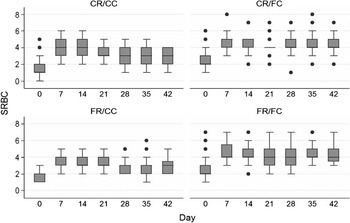
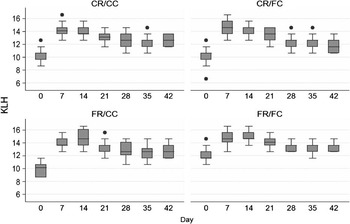
Hens responded to immunizations with a clear increase in antibody titres to SRBC and anti-KLH IgG, respectively, as illustrated in Figure 1 (SRBC) and Figure 2 (KLH). Anti-SRBC titre was significantly affected by rearing conditions (F = 68.1, df = 1, P < 0.0001) where highest titre was found for FR hens. No effects of housing conditions were found. However, interactions between layer housing and rearing were found for KLH titre (F = 29.5, df = 1, P < 0.001), where the highest titre was found in FR hens that had been housed in FC.
Anti-SRBC titre (log 2) in laying hens before (0) and after (days 7 to 42) immunization with Sheep Red Blood Cells (SRBC). Results are presented as the reciprocal (log2) of the highest dilution of serum showing haemagglutination. Hens had been exposed to four rearing and housing combinations: CR/CC, CR/FC, FR/CC or FR/FC (CR: Cage rearing, FR: Floor rearing, CC: Conventional cages and FC: Furnished cages). Results are presented as a box plot, where the box (including a median line) represents the 25 to 75 percentile, the range line represents upper adjacent values based on inter-quartal range and dots represent outside values.

Anti-keyhole limpet haemocyanin (KLH) IgG titre (log 2) in laying hens before (day 0) and after (days 7 to 42) immunization with KLH. Results are presented as the reciprocal (log2) of the highest dilution of serum showing positive reaction. Hens had been exposed to four rearing and housing combinations: CR/CC, CR/FC, FR/CC or FR/FC (CR: Cage rearing, FR: Floor rearing, CC: Conventional cages and FC: Furnished cages). Results are presented as a box plot, where the box (including a median line) represents the 25 to 75 percentile, the range line represents upper adjacent values based on inter-quartal range and dots represent outside values.

Leucocyte counts
Data on differential leucocyte counts and H/L ratio are presented in Table 1. Layer housing conditions significantly affected H/L ratios (F = 7.9, df = 1, P < 0.01). Hens housed in FC showed the highest values of H/L compared with hens housed in CC. When adjusted for a housing effect, rearing conditions tended to affect H/L ratio (F = 3.45, df = 1, P = 0.07), where FR resulted in the highest H/L ratio.
Effects of early rearing conditions and housing conditions during the laying period on differential leucocyte counts in laying hens with intact beaks. Four rearing and housing combinations were investigated: CR/CC: Cage rearing, housed in conventional cages; FR/CC: Floor rearing, housed in conventional cages; CR/FC: Cage rearing, housed in furnished cages; FR/FC: Floor rearing, housed in furnished cages. Results are presented as median (range)

Discussion
Initial plasma corticosterone concentrations were low, indicating that hens were not hypersensitive, resulting from chronic stressful housing conditions (Guémené et al., Reference Guémené, Guy, Noirault, Destombes and Faure2006). Furthermore, 1 to 24 ACTH injection led to significant increases of corticosterone concentrations in all groups. Thus, no exhaustion of the adrenal glands was found, indicating that hens had not experienced severe chronic stress related to any of the present experimental rearing or housing conditions. On the other hand, it has to be emphasized that high doses of ACTH stimulation can only detect maximum reactivity of the adrenal glands. Therefore, it cannot be ruled out that minor differences in stress levels could have been detected by exploring adrenal sensitivity using lower doses of ACTH (Guémené et al., Reference Guémené, Guy, Noirault, Destombes and Faure2006). Our present finding is thus not in contradiction with those of other investigators (e.g. Hester et al., Reference Hester, Muir, Craig and Albright1996) who have shown an improvement in the bird’s capacity to adapt to stress when exposed to similar social conditions during the rearing and laying period.
Housing conditions did not influence immune response to immunization, which suggests that hens are capable of building the same level of immune protection in different housing conditions during the laying period. However, layer housing affected H/L ratio. Larger group size in FC (eight hens) compared with CC (three hens) showed increased H/L ratios presumably caused by social ranking and social stress (Gross and Siegel, Reference Gross and Siegel1980; Craig and Muir, Reference Craig and Muir1996; Hester et al., Reference Hester, Muir, Craig and Albright1996). Our results are supported by Barnett et al. (Reference Barnett, Tauson, Downing, Janardhana, Lowenthal, Butler and Cronin2009) who found that group size in FC was probably more influential on hen welfare than the type of housing facilities provided. Our results contrast with findings by Shini (Reference Shini2003) who found higher H/L ratio in hens housed in CC when compared with modified cages and free-range conditions. It should be noted that birds used in that study were beak trimmed. However, Scholz et al. (Reference Scholz, Rönchen, Hamann, Pendl and Distl2008) also reported lower H/L ratios in hens with intact beaks kept in groups of 40 layers in compartments with perches (Eurovent). It appears that beak trimming alone may not explain the discrepancy in results. There are many other factors that influence the H/L ratio in hens, including age, infectious agents and hen–human relationships (Gross and Siegel, Reference Gross and Siegel1983). In this study, all birds were non-beak trimmed and the bird management was similar. Therefore, we suggest that housing condition (group size and access to litter in FC) may have induced stress and influenced H/L ratios in hens.
Rearing conditions tended to affect H/L ratio (P = 0.07). A small sample size and large variation in the results can explain why these differences did not reach significance. In agreement with Wall and Tauson (Reference Wall and Tauson2005), FR and later housing in FC resulted in the highest H/L ratio, and accordingly represented the most stressful rearing and layer housing combination. In contrast, CR hens that were housed in CC had the lowest H/L ratio, indicating less stress. Faure (Reference Faure1991) showed that chicks reared on large floor pens worked intensively in order to gain access to more space in an operant conditioning cage during the laying period. Therefore, the movement of birds from the spacious rearing system (floor) to a space-restricted environment in a laying system (FC) may have been stressful, whereas moving hens from a rearing cage environment to a layer cage environment may have been less stressful. This supports the suggestion that rearing birds in a system that closely resembles their future housing environment helps facilitate the transition to production housing (van Emous, Reference van Emous2003; Colson et al., Reference Colson, Arnould and Michel2008).
Rearing conditions significantly affected the antibody responses to SRBC. Our results are in agreement with Shini (Reference Shini2003) who showed that hens kept on floor pens had higher antibody responses when compared with FC. Furthermore, we indicate that the effects on humoral immunity are long-lasting regardless of later housing conditions. An interaction between rearing and housing and KLH titre was found in FR hens that had the highest titre when they were subsequently housed in FC. This may indicate lack of stress and improved immunity as a result of early adaptation in floor-reared hens.
In summary, the results on H/L did not support the assumption that hens in FR may experience less stress. In contrast, the H/L ratio was highest in FC. This inconsistency suggests that other factors may have been involved in the humoral and cellular immune response to SRBC and H/L ratio in FR hens, respectively. Litter floor and enrichment of FC (i.e. nest, perches and litter) present a more complex environment than CC regarding hygiene and microbial contamination, which can influence heterophils and stress levels (Shini et al., Reference Shini, Kaiser, Shini and Bryden2008). Indeed, heterophilia and lymphopenia are natural defence mechanisms against bacterial infection in avians (Maxwell and Robertson, Reference Maxwell and Robertson1998). FR and subsequent housing in FC with access to litter (in a litter box) represent the highest opportunity for earlier and/or long-lasting exposure to environmental antigens, that is, pathogens. This could be the explanation for altered H/L ratio and SRBC titre found in the FR/FC hens. Similarly, the alteration of H/L ratio in FC could be the result of a higher pathogenic contamination present in this system rather than stress response to cage housing, or a combination of both factors. It is therefore likely that effects of early rearing environment on immune response may not unambiguously reflect stress and hen welfare, but rather early and/or long-lasting exposure to environmental pathogens. It has to be emphasized that depriving hens of litter leads to stress and an increased H/L ratio too (El-Lethey et al., Reference El-Lethey, Huber-Eicher and Jungi2003), and that further experiments are needed to draw firmer conclusions. Recently, Shini et al. (Reference Shini, Kaiser, Shini and Bryden2008) showed that corticosterone treatment and bacterial exposure both increase H/L ratios, but alter the ultrastructure of heterophils and lymphocytes differently. The possibility to use other cellular and molecular parameters of stress and immune response, that is, heterophil ultrastructure evaluation (Shini et al., Reference Shini, Kaiser, Shini and Bryden2008), measurement of acute phase proteins (Rath et al., Reference Rath, Anthony, Kannan, Huff, Huff, Chapman, Erf and Wakenell2009) and cytokine and chemokine gene expression levels in heterophils and lymphocytes (Shini and Kaiser, Reference Shini and Kaiser2009; Shini et al., Reference Shini, Shini and Kaiser2010) could be explored to differentiate effects between non-infectious stress (induced by housing and social factors) and bacterial stress (induced by environmental pathogens). Further studies are needed to avoid potential misinterpretation involving the H/L ratio as an index of hen welfare (e.g. Nicol et al., Reference Nicol, Caplen, Edgar and Browne2009).
H/L ratios measured under all experimental conditions were lower than previously reported (e.g. El-Lethey et al., Reference El-Lethey, Aerni, Jungi and Wechsler2000; Wall et al., Reference Wall, Tauson and Elwinger2004; Shini et al., Reference Shini, Kaiser, Shini and Bryden2008). As suggested by Gross and Siegel (Reference Gross and Siegel1983), H/L ratios of about 0.20, 0.50 and 0.80 are characteristic of low, optimal and high degrees of stress. Our results indicated that hens in this study did not experience severe stress. Hens might probably have experienced acute stress when they were transferred to the layer house (Craig et al., Reference Craig, Okpokho and Milliken1988). However, this was not measured in this study and did not have any long-term effect at later stages of the laying period.
Conclusion
This study shows that early rearing environment affects stress and immunological response of hens in the subsequent laying period. The H/L ratio was increased in FR birds and in laying hens housed in FC during the laying period, indicating some degree of stress, but the immune response to SRBC was higher only in FR hens. These results suggest that the effects on immune response may reflect pathogenic load due to environmental complexity rather than stress due to housing system or rearing system per se. As a result, a degree of caution should be exercised when making interpretations based on these indicators of hen welfare. In order to further explore the impact of rearing and housing conditions on hen welfare, there is a need to investigate the role of pathogens v. stress on immune measurements that are commonly used as stress indicators before being able to draw firm conclusions.
Acknowledgements
This study was financially supported by grants from the Norwegian Research Council (NFR 144384/110). Financial support from the LayWel Research project (European FP6- No. 502315-STReP) to perform the corticosterone assay is also greatly acknowledged. The authors thank the staff of the Norwegian Poultry Association for the technical support, in particular B. Siliart and D. Soyer (Veterinary School of Nantes, France) for performing the differential leucocyte count, M. Couty (INRA, France) for expert technical assistance in assaying corticosterone, and M. Borg and G. M. Johansen (Norwegian School of Veterinary Science, Norway) for technical assistance with assays for the antibody response evaluation.