Implication
The black soldier fly (Hermetia illucens L.; HI) has been the subject of recent attention in poultry nutrition as an alternative ingredient. The lipid content of whole non-defatted black soldier fly larvae is notable (26% to 35%). The process of larva defatting results in two potential feed ingredients: fat and protein-concentrate meal. Recently, the fat derived from larvae of HI has been shown to be an acceptable lipid source for broiler chickens. This study demonstrated that fat from HI can totally and partly substitute for conventional lipid sources in finisher broiler diet without impairing performance, carcass characteristics, intestinal morphology or histological features.
Introduction
The majority of the lipid sources used in poultry diets consists mainly of rendered fat, coming from the part of the slaughtered animal which is not used for human consumption, and crude vegetable oils. Among vegetable oils, soybean oil is utilised as an ingredient in poultry diets due to its high energy value, digestibility and metabolizable energy content compared with other vegetable oils (Fascina et al., Reference Fascina, Carrijo, Souza, Garcia, Kiefer and Sartori2009). However, currently, the limited supply of soybeans and their high price has caused increasing interest in the search for new alternative lipid sources for poultry feed.
Insects represent an opportunity for partial or total replacement of the conventional lipid feed sources. Furthermore, insects have a potential as a feed ingredient due to their appropriate nutritional quality (Veldkamp and Bosch, Reference Veldkamp and Bosch2015) and greater acceptance by poultry (Leiber et al., Reference Leiber, Gelencsér, Stamer, Amsler, Wohlfahrt, Früh and Maurer2017). Indeed, insects (adult, larval and pupal form) are naturally consumed by wild birds and free-range poultry (Rumpold et al., Reference Rumpold, Klocke and Schlüter2016). In recent years, most of the attention on insects as a feed source has been focussed on their protein content (Belforti et al., Reference Belforti, Gai, Lussiana, Renna, Marfatto, Rotolo, De Marco, Dabbou, Schiavone, Zoccarato and Gasco2015; Gasco et al., Reference Gasco, Henry, Piccolo, Marono, Gai, Renna, Lussiana, Antonopoulou, Mola and Chatzifotis2016; Renna et al., Reference Renna, Schiavone, Gai, Dabbou, Lussiana, Malfatto, Prearo, Capucchio, Biasato, Biasibetti, De Marco, Brugiapaglia, Zoccarato and Gasco2017). Certain insect species have a high fat content with higher levels in larval stages than in adults (Ramos-Elorduy, Reference Ramos-Elorduy1997; Barroso et al., Reference Barroso, de Haro, Sánchez-Muros, Venegas, Martínez-Sánchez and Pérez-Bañón2014). In fact, lipids are also a main component of insects and are produced during protein isolation. Surendra et al. (Reference Surendra, Olivier, Tomberlin, Jha and Khanal2016) pointed out the importance of defatting insect meal and then using insect protein concentrate as an animal feed ingredient and the lipids for both animal nutrition and the production of biodiesel. Such authors showed that fat removal is necessary to improve the storability of the feed and to increase the protein digestibility of the insect-derived feed.
Black soldier fly (Hermetia illucens L.; HI) is a very promising species because of its amino acid profile, lipid content and calcium content (Cullere et al., Reference Cullere, Tasoniero, Giaccone, Miotti-Scapin, Claeys, De Smet and Dalle Zotte2016; Schiavone et al., Reference Schiavone, Cullere, De Marco, Meneguz, Biasato, Bergagna, Dezzutto, Gai, Dabbou, Gasco and Dalle Zotte2017b). The larva of the black soldier fly contains up to 45% of lipids (Li et al., Reference Li, Ji, Zhang, Tian, Zhou and Yu2016). In the fatty acid (FA) profile of HI larvae, linoleic acid content is greater than α-linolenic acid content, similar to many plant oils (such as soybean oil and sunflower oil). The FA profile is also rich in medium-chain fatty acids (MCFAs) such as lauric acid (C12:0) and its esters, which represent 21.4% to 49.3% of the total profile (Tran et al., Reference Tran, Heuzé and Makkar2015; Li et al., Reference Li, Ji, Zhang, Tian, Zhou and Yu2016; Ushakova et al., Reference Ushakova, Brodskii, Kovalenko, Bastrakov, Kozlova and Pavlov2016). The use of dietary fats rich in lauric acid and myristic acid (C14:0) in broilers could be advantageous in terms of gut health and growth performance. The underlying mechanism involves antimicrobial effects on gut bacteria and changes in gut morphology (Zeitz et al., Reference Zeitz, Fennhoff, Kluge, Stangl and Eder2015).
Chicken growth directly depends on the morphological and functional integrity of the digestive tract. Microscopic structure parameters such as villus height and crypt depth have been reported to be good indicators of intestinal development, health and functionality, influencing nutrient digestion and absorption (Wang and Peng, Reference Wang and Peng2008). Despite the relationship between dietary modifications and gut morphology being widely investigated in poultry, limited data about the utilization of feed fats are currently available (Ozdogan et al., Reference Ozdogan, Topal, Paksuz and Kirkan2014; Zeitz et al., Reference Zeitz, Fennhoff, Kluge, Stangl and Eder2015).
Currently, knowledge about the suitability of HI larvae fat as a poultry feed ingredient is still scarce, and to the best of our knowledge, no studies have yet been carried out to determine the effects of soybean oil replacement by HI larva fat on gut morphology and histological features. For this reason, the objective of the present work was to evaluate the effects of finisher diet HI larva fat on the growth performance, carcass traits, blood parameters, intestinal morphology and histological features of broiler chickens.
Material and methods
Ethical approval
The experimental protocol was designed according to the guidelines of the current European and Italian laws on the care and use of experimental animals (European directive 86/609/EEC, put into law in Italy with D.L.116/92) and approved by the Ethical Committee of the Department of Veterinary Sciences of the University of Turin (Italy).
Experimental design and feed preparation
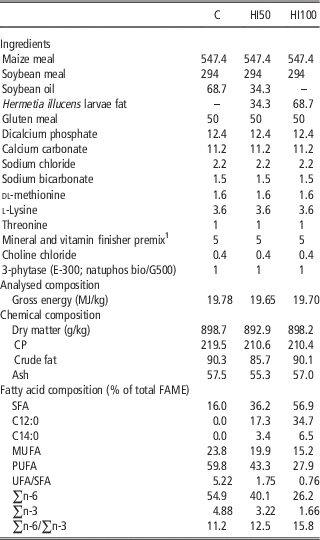
The study was carried out at the experimental poultry farm of the Department of Agricultural, Forest and Food Sciences (DISAFA) of the University of Turin, located in Carmagnola (TO), Italy. The poultry house was 7 m wide×50 m long×7 m high, equipped with waterproof floor and walls, covered completely by tiles and with an automatic ventilation system. The impact of partial or total replacement of soybean oil with HI larva fat in broiler chickens’ finisher diet (from 21 to 48 days of age) was evaluated by replacement in a basal control diet (C: 100% soybean oil; 68.7 g/kg as fed of soybean oil), either at 50% or 100% HI larva fat (HI50 and HI100 groups, respectively). All diets were formulated according to Aviagen (2014) broiler nutrition specifications (Table 1). Chickens had free access to water and feed throughout the trial.
Ingredients (g/kg as fed), chemical (g/kg DM) and fatty acid composition (% of total FAME) of the experimental diets

C=control; HI50=Hermetia illucens 50%; HI100=Hermetia illucens 100%, DM=dry matter; AME=apparent metabolizable energy; FAME=fatty acids methyl esters; FA=fatty acids; SFA=saturated fatty acids; MUFA=monounsaturated fatty acids; PUFA=polyunsaturated fatty acids; UFA=unsaturated fatty acids.
1 Mineral-vitamin finisher premix (Final B Prisma, IZA SRL, Forlì, Italy), given values are supplied per kg of diet: 2.500.000 IU of vitamin A; 1.000.000 IU of vitamin D3; 7.000 IU of vitamin E; 700 mg of vitamin K; 400 mg of vitamin B1; 800 mg of vitamin B2; 400 mg of vitamin B6; 4 mg of vitamin B12; 30 mg of biotin; 3.111 mg of Ca pantothenate acid; 100 mg of folic acid; 15.000 mg of vitamin C; 5.600 mg of vitamin B3; 10.500 mg of Zn, 10.920 mg of Fe; 9.960 mg of Mn; 3.850 mg of Cu; 137 mg of I; 70 mg of Se.
Birds and husbandry
Day-old male broiler chickens (Ross 308) were farmed in a floor pen until 21 days of age and fed a commercial broiler starter diet (217 g/kg of CP; 12.9 MJ/kg metabolizable energy). At hatching, all the birds were vaccinated against Newcastle disease, Marek disease, infectious bronchitis and coccidiosis. At day 21, after equalizing for mean initial BW, 120 birds were chosen and homogeneously distributed over three dietary treatments, each one consisting of five pens as replicates with eight chicks per pen. The animals were reared to the slaughter age set at 48 days. Each pen was 1.0 m wide×1.5 m long. Each pen was equipped with a feeder, an automatic drinker and rice hulls as litter. Up to 21 days of age infrared lamps were used to keep a suitable body temperature according to standard breeding practices (Aviagen, 2014). The lighting schedule was 18 h light : 6 h dark for the whole experimental period. Clinical signs of illness and mortality were monitored daily throughout the experimental period.
Chemical composition and fatty acid profile of the experimental diets
Chemical analyses were carried out on three replicates of each feed sample. Diet samples were ground through a 0.5-mm sieve and stored in airtight plastic containers. They were analysed for DM (#930.15), ash (#924.05), and CP (#984.13) according to the Association of Official Analytical Chemists (2005) methods. The gross energy content was determined using an adiabatic calorimetric bomb (IKA C7000; IKA, Staufen, Germany). The lipid extraction and FA profiling of the experimental diets were carried out at the laboratory of the Department of Animal Medicine, Production and Health, University of Padova, Legnaro, Italy. The lipid extraction was performed by Accelerated Solvent Extraction (M-ASE) using petroleum ether as a solvent. The FA profile was determined as described by Mattioli et al. (Reference Li, Ji, Zhang, Tian, Zhou and Yu2016) and Schiavone et al. (Reference Schiavone, Chiarini, Marzoni, Castillo, Tassone and Romboli2007). Samples were transmethylated using a methanolic solution of H2SO4 (4%) in order to determine fatty acid methyl esters (FAME). A biphasic separation was obtained by adding 0.5 ml of distilled water and 1.5 ml of N-heptane to each sample. Fatty acid methyl esters were quantified by gas chromatography (Shimadzu GC17A), equipped with an Omegawax 250 column (30 m×0.25 µm×0.25 µm) and flame ionization detector. Helium was used as the carrier gas at a constant flow of 0.8 ml/min. The injector and detector temperatures were 260 °C. Peaks were identified based on commercially available FAME mixtures (37-Component FAME Mix; Supelco Inc., Bellefonte, PA, USA). The results are expressed as % of total detected FAME. The proximate and FA composition of the feeds are reported in Table 1.
Growth performance
During the whole experimental period (21 to 48 days), the BW and feed consumption (FC) of all birds were measured weekly to calculate daily feed intake, daily weight gain (DWG) and the feed conversion ratio (FCR). Final BW (FBW) was recorded on day 48. All measurements were carried out on the pen basis using a high precision electronic scale (Sartorius – Signum®).
Slaughtering procedures
At day 48, 15 birds (three birds/pen) from each feeding group (chosen on the basis of pen average FBW) were individually identified with a shank ring and weighed. The chickens were electrically stunned and slaughtered at a commercial abattoir. The plucked and eviscerated carcasses were obtained, and the head, neck, feet and abdominal fat were removed to obtain the chilled carcass. Then, the weights of the liver, heart, spleen, bursa of fabricius, abdominal fat, and breast and thighs were immediately recorded. The breast and thigh weights were expressed as percentage of live weight.
Haematological and serum parameters
At slaughtering (day 48), blood samples were collected from three birds per pen. A total of 2.5 ml was placed in an ethylenediaminetetraacetic acid tube and 2.5 ml in a serum-separating tube. Then, a blood smear was prepared, using one glass slide for each bird, from a drop of blood without anticoagulant. The smears were stained using May-Grünwald and Giemsa stains (Salamano et al., Reference Salamano, Mellia, Tarantola, Gennero, Doglione and Schiavone2010). The total red (erythrocytes) and white (leucocytes) blood cell counts were determined in an improved Neubauer haemocytometer on blood samples previously treated with 1 : 200 Natt-Herrick solution. A total of 100 leukocytes, including granular (heterophils, eosinophils and basophils) and non-granular (lymphocytes and monocytes) leucocytes, were counted on the slide, and the H/L ratio was calculated. The tubes without anticoagulant were left to clot in a standing position at room temperature for ~2 h to obtain serum. The serum was separated by means of centrifugation at 700×g for 15 min and frozen at −80°C until analysis. The electrophoretic pattern of the serum was obtained using a semi-automated agarose gel electrophoresis system (Sebia Hydrasys®, Norcross, GA, USA). The aspartate-aminotransferase (AST), alanine-aminotransferase (ALT), triglycerides, cholesterol, phosphorus, magnesium, iron, uric acid and creatinine serum concentrations were measured by means of enzymatic methods in a clinical chemistry analyser (Screen Master Touch; Hospitex diagnostics Srl., Florence, Italy).
Histomorphological investigations
The slaughtered animals were submitted to anatomopathological investigations. Intestinal segment samples (~5 cm in length) of duodenum, jejunum and ileum were excised and flushed with 0.9% saline to remove all the contents. The collected segments of intestine were the loop of the duodenum, the tract before Meckel’s diverticulum (jejunum) and the tract before the ileocolic junction (ileum). Samples of liver, spleen, thymus, bursa of fabricius, kidney and heart were also collected. Gut segments were fixed in Carnoy’s solutions for morphometric analysis, while the other organ samples were fixed in 10% buffered formalin solution for histological examination. Tissues were routinely embedded in paraffin wax blocks, sectioned at 5 µm thickness, mounted on glass slides and stained with haematoxylin and eosin (HE). The evaluated morphometric indexes were the villus height (Vh, from the tip of the villus to the crypt), crypt depth (Cd, from the base of the villus to the submucosa) and the Vh/Cd ratio (Laudadio et al., Reference Laudadio, Passantino, Perillo, Lopresti, Passantino, Khan and Tufarelli2012). Morphometric analyses were performed on 10 well-oriented and intact villi and 10 crypts chosen from the three collected intestinal segments (Qaisrani et al., Reference Qaisrani, Moquet, van Krimpen, Kwakkel, Verstegen and Hendriks2014). Histopathological alterations were evaluated using a semi-quantitative scoring system as previously assessed by Biasato et al. (Reference Biasato, De Marco, Rotolo, Renna, Dabbou, Capucchio, Biasibetti, Tarantola, Costa, Gai, Pozzo, Dezzutto, Bergagna, Gasco and Schiavone2016): absent/minimal (score=0), mild (score=1) and severe (score=2).
Statistical analysis
The statistical analysis was performed using the SPSS software package (version 17 for Windows; SPSS Inc., Chicago, IL, USA). The experimental unit was the pen for growth performance, while it was the individual bird for all of the other parameters. Data were tested by one-way ANOVA, followed by Tukey’s post hoc test for growth performance, carcass traits and blood parameters. One-way ANOVA (Duncan’s multiple range test) or the Kruskal–Wallis test (post hoc test: Dunn’s Multiple Comparison test) was used to compare (1) the morphometric indexes among the dietary treatments within each intestinal segment and (2) the morphometric indexes among the intestinal segments within each dietary treatment. Histopathological scores were analysed by the Kruskal–Wallis test (post hoc test: Dunn’s Multiple Comparison test). Significance was declared at P<0.05. A statistical trend was considered for P<0.10. The results are expressed as the mean and pooled standard error of the mean (SEM).
Results
Diet composition and fatty acid profile
The ingredients and the chemical and FA composition of the three experimental diets are summarized in Table 1. The three diets were isonitrogenous and had similar gross energy, total lipid, protein and ash contents but differed greatly in their FA composition. In the experimental diets, C12:0 and C14:0 FA and total saturated fatty acids (SFAs) increased with increasing inclusion of HI larva fat. Total monounsaturated FAs (MUFAs), polyunsaturated FAs (PUFAs), total n-3 PUFAs and total n-6 PUFAs decreased in the experimental diets as the HI larva fat inclusion level increased, which determined an increase of the ∑n-6/∑n-3 ratio in the experimental diets (from 11.2% to 15.8% of total FAME for HI0 and HI100, respectively).
Growth performance and slaughtering traits
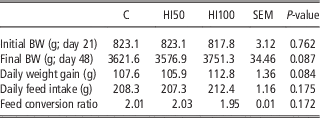
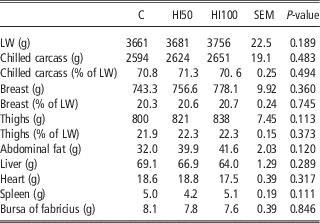
During the whole experimental period, the birds remained healthy, no signs of illness were observed, and the mortality rate was zero in all groups. The growth performance of the broiler chickens is reported in Table 2. The initial BW of chicks did not differ (P>0.05) among the three dietary treatments. Growth performance was not influenced by the partial or total replacement of soybean oil with HI larva fat (P>0.05). However, a positive numerical trend was observed in the HI100 group for FBW (P=0.087) and DWG (P=0.084). No statistical differences were observed for FCR; nevertheless, the HI100 group displayed the lowest numerical value. Dietary HI larva fat inclusion did not significantly affect (P>0.05) the slaughtering traits of the chickens (Table 3).
Effects of dietary Hermetia illucens larvae fat (HI) inclusion on the growth performance of broiler chickens (n=5 pens/treatment)

C=control; HI50=Hermetia illucens 50%; HI100=Hermetia illucens 100%.
Effects of dietary Hermetia illucens (HI) larvae fat inclusion on carcass traits and internal organs weight (n=15/treatment)

C=control; HI50=Hermetia illucens 50%; HI100=Hermetia illucens 100%; LW=live weight.
Haematological and serum parameters
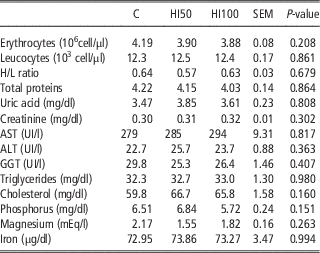
The dietary HI larva fat inclusion level did not significantly influence (P>0.05) the haematological or serum biochemical traits of the birds (Table 4).
Effects of dietary Hermetia illucens (HI) larvae fat inclusion on blood parameters of broiler chickens (n=15/treatment)

AST=aspartate-aminotransferase; ALT=alanine-aminotransferase; GGT=gamma-glutamyl transferase; C=control; HI50=Hermetia illucens 50%; HI100=Hermetia illucens 100%.
Histomorphological investigations
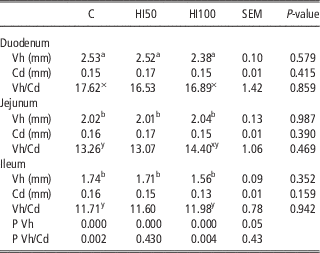
The intestinal morphology of the broiler chickens is summarized in Table 5. Dietary HI larva fat inclusion did not significantly affect (P>0.05) gut morphometric indexes. In all dietary treatments, the duodenum showed greater Vh (C=2.53 mm; HI50=2.52 mm; HI100=2.38 mm) (P<0.001) than the jejunum (C=2.02 mm; HI50=2.01 mm; HI100=2.04 mm) and ileum (C=1.74 mm; HI50=1.71 mm; HI100=1.56 mm). In the C group, the Vh/Cd ratio was higher (P<0.01) in the duodenum (17.62) compared with the jejunum (13.26) and ileum (11.71). In the HI100 dietary treatment, the Vh/Cd ratio was also higher (P<0.01) in the duodenum (16.89) than the ileum (11.98). In contrast, no significant differences (P>0.05) regarding Cd were observed within any intestinal segment in any of the groups.
Effects of dietary Hermetia illucens (HI) larvae fat inclusion on intestinal morphometric indexes of broiler chickens (n=15/treatment)

Vh=villus height; Cd=crypt depth; Vh/Cd=villus height to crypt depth ratio; C=control; HI50=Hermetia illucens 50%; HI100=Hermetia illucens 100%.
Different superscript letters in the same column mean significant differences (P<0.05) among the intestinal segments (duodenum, jejunum and ileum) for Vh (a, b) and Vh/Cd (x, y) within each dietary treatment. P-values of the significant differences are indicated as P Vh and P Vh/Cd.
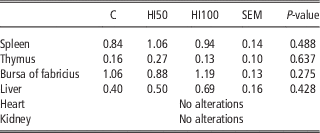
Histopathological alterations developed for spleen, thymus, bursa of fabricius and liver and were observed in all of the dietary treatments. The histopathological scores of the broiler chickens are shown in Table 6. Dietary HI larva fat inclusion did not significantly affect (P>0.05) the severity of the histopathological findings. Spleen showed mild (69% of the broilers in all the dietary treatments) to severe (C=6%; HI50=19%; HI100=13%) white pulp depletion or hyperplasia. Of the animals, 25% (C), 13% (HI50) and 19% (HI100) had a normal spleen. In the thymus, mild cortical depletion was found in all the groups (C=13% of the broilers; HI50=25%; HI100=13%). A normal thymus was observed in 88% (C), 75% (HI50) and 88% (HI100) of the animals. The bursa of fabricius showed mild (C=69% of the broilers; HI50=63%; HI100=81%) to severe (C=19%; HI50=13%; HI100=19%) follicular depletion. Of the animals, 13% (C), 25% (HI50) and 0% (HI100) had a normal bursa of fabricius. The liver showed mild (C=25% of the broilers; HI50=50%; HI100=44%) to severe (C=6%; HI50=0%; HI100=13%) perivascular lymphoid tissue activation. A normal liver was observed in 63% (C), 50% (HI50) and 44% (HI100) of the animals.
Effects of dietary Hermetia illucens (HI) larvae fat inclusion on histopathological scores of broiler chickens (n=15/treatment).

C=control; HI50=Hermetia illucens 50%; HI100=Hermetia illucens 100%.
Discussion
Growth performance and slaughtering traits
The inclusion of HI larva fat substituting 50 or 100% of the soybean oil in finisher broiler chickens’ diet did not lead to any adverse effects on growth performance or carcass traits. Feed intake was not affected by the partial or total replacement of soybean oil with HI larva fat, indicating that 50% and 100% HI inclusion were both acceptable to broiler chickens. This finding suggests that it is possible to replace up to 100% of the soybean oil with HI larva fat in diets for finisher chickens without any negative effects on feed utilization or productive performance. Comparing HI larva fat with other vegetable oils used in poultry diets, it seems to be similar to coconut oil rich in saturated oils (about 90%) with 60% of its total FA composition being MCFAs (Kappally et al., Reference Kappally, Shirwaikar and Shirwaikar2015). Furthermore, lauric acid content in coconut oil accounts for ~36.95 g/100 g FA (Wang et al., Reference Wang, Wang, Li, Chen, Yang and Zhang2015). A study on male broiler finisher chickens (days 22 to 42) found that dietary replacement (25%, 50%, 75% and 100%) of soybean oil with coconut oil did not affect growth performance (Wang et al., Reference Wang, Wang, Li, Chen, Yang and Zhang2015). The results of the present study agree with the findings of Schiavone et al. (Reference Schiavone, De Marco, Martínez, Dabbou, Renna, Madrid, Hernandez, Rotolo, Costa, Gai and Gasco2017a), which reported that the partial or total replacement of soybean oil with HI larva fat in growing broiler diets did not affect the growth performance, the feed choice or the carcass traits. In the same context, Cullere et al. (Reference Cullere, Tasoniero, Giaccone, Miotti-Scapin, Claeys, De Smet and Dalle Zotte2016) showed that defatted HI larva meal could be introduced into the diet for growing broiler quails at 10% and 15% inclusion levels, partially replacing conventional soybean meal and soybean oil, with no negative effects on productive performance, mortality or carcass traits. Regarding the use of HI larva fat in fish feed, Li et al. (Reference Li, Ji, Zhang, Tian, Zhou and Yu2016) did not report any significant effects on growth performance in juvenile Jian carp (Cyprinus carpio var. Jian) fed with diets where soybean oil was substituted with 25%, 50%, 75% or 100% HI larva fat.
Haematological and serum parameters
The physiological and biochemical status of animals can be expressed through haematology and blood chemistry. All the blood parameters obtained in the present trial suggested that HI larva fat did not affect the health status of the animals. The H/L ratio has recently been used for measurement of distress conditions in chickens in which an increased H/L ratio may indicate that the animals suffered from infections, inflammation or stress (Salamano et al., Reference Salamano, Mellia, Tarantola, Gennero, Doglione and Schiavone2010; De Marco et al., Reference De Marco, Martinez, Tarantola, Bergagna, Mellia, Gennero and Schiavone2013; Pozzo et al., Reference Pozzo, Salamano, Mellia, Gennero, Doglione, Cavallarin, Tarantola, Forneris and Schiavone2013). In the present study, the H/L ratio of chickens fed the experimental diets did not present any significant differences compared with the control group. Their leukocytes fell within the normal range, thus suggesting that the feeding treatments did not affect the immune system of the broiler chickens. It should be highlighted that the present study was performed in a standard environment without infections, stress or other factors that could have influenced the haematological parameters. The activities of serum AST and ALT are generally related to liver damage, acting as indicators of liver necrosis when they increase (Hyder et al., Reference Hyder, Hasan and Mohieldein2013). The identification of no influence on ALT or AST activity suggests that HI larva fat may not cause negative effects on the hepatopancreas or liver health. No significant differences (P>0.05) were found in the mean values of creatinine, thus implying that HI larva fat has similar effects on the kidney functionality of the birds. The results of the present research agree with those of Schiavone et al. (Reference Schiavone, De Marco, Martínez, Dabbou, Renna, Madrid, Hernandez, Rotolo, Costa, Gai and Gasco2017a) and Li et al. (Reference Li, Ji, Zhang, Tian, Zhou and Yu2016), who showed that the use of HI larva fat in substitution for soybean oil in broilers and juvenile Jian carp diets, respectively, had no negative effects on the blood traits of the animals and confirmed the nutritional adequacy of these diets.
Histomorphological investigations
An initial hypothesis was that lauric and myristic MCFA would exert a certain positive effect on chicken growth performance through two main mechanisms: an antimicrobial effect on gut pathogens that would improve gut health together with reducing the competition for nutrients, and modifications to the gut morphology, mainly increasing villi length and the villi : crypt ratio in the duodenum and jejunum, which could improve nutrient absorption (Zeitz et al., Reference Zeitz, Fennhoff, Kluge, Stangl and Eder2015). However, the intestinal morphology of broiler chickens was not affected by the dietary treatments of the present experiment in which important differences in the dietary contents of C12:0 and C14:0 FA were observed with increasing HI fat inclusion levels. Such finding could be due to the already optimal health status of the animals which was expressed by satisfactory productive performance and normal intestinal morphology. It is hypothesized that a sub-optimal farming condition and/or health status are necessary to test the real potential of dietary MCFA in exerting a possible positive effect on chicken gut health and growth performance. This confirmed the previous findings of Biasato et al. (Reference Biasato, De Marco, Rotolo, Renna, Dabbou, Capucchio, Biasibetti, Tarantola, Costa, Gai, Pozzo, Dezzutto, Bergagna, Gasco and Schiavone2016), who observed no differences related to insect meal utilization in free-range chickens. According to previous studies (de Verdal et al., Reference de Verdal, Mignon-Grasteau, Jeulin, Le Bihan-Duval, Leconte, Mallet, Martin and Narcy2010; Biasato et al., Reference Biasato, De Marco, Rotolo, Renna, Dabbou, Capucchio, Biasibetti, Tarantola, Costa, Gai, Pozzo, Dezzutto, Bergagna, Gasco and Schiavone2016), the duodenum shows greater morphometric indexes among the intestinal segments. This finding represents physiological gut development because the duodenum is the segment with the fastest cell renewal and is also the first one to be stimulated by the presence of diet in the lumen (de Verdal et al., Reference de Verdal, Mignon-Grasteau, Jeulin, Le Bihan-Duval, Leconte, Mallet, Martin and Narcy2010).
Furthermore, the severity of the histopathological alterations in the broilers was not affected regardless of diet. However, the lymphoid system activation represented an interesting finding. Some stressful situations, in particular overcrowding, can frequently occur in modern poultry rearing operations. Measures of immunity that have been reported to be affected under stress conditions in poultry are lymphoid organ weight (Heckert et al., Reference Heckert, Estevez, Russek-Cohen and Pettit-Riley2002), the H/L ratio (De Marco et al., Reference De Marco, Martinez, Tarantola, Bergagna, Mellia, Gennero and Schiavone2013) and lymphocyte blastogenesis (Cunnick et al., Reference Cunnick, Kojic and Hughes1994). Despite no histopathological studies being currently available in relation to stress evaluation in broilers, the lymphoid system activation detected in the present study may reflect this aspect. A potential role of HI in the development of these alterations seems unlikely as they were also found in the animals fed with the control diet, their severity was unaffected, and the percentage of their occurrence was heterogeneous and quite similar among the dietary treatments. The greater percentage of normal and moderately affected organs in all the groups may suggest the presence of tolerable stress levels. This hypothesis could also be supported by the identification of the overall positive health and welfare status of the broilers.
In conclusion, the important differences in the dietary contents of lauric and myristic FAs with increasing HI fat inclusion had no beneficial effect on chicken gut health. Despite this, the findings of this study suggest that HI larva fat could totally replace soybean oil in finisher chickens’ diet without any adverse effects on growth performance, haematological parameters, serum biochemical indices, intestinal morphology or histological features. These findings suggest that HI larva fat can be a suitable ingredient for poultry diets. Further research efforts are necessary to deeply investigate the impact of HI larva fat on the meat quality traits and FA profile of broiler chickens.
Acknowledgements
The research was supported by a University of Turin (ex 60%) grant (Es. fin. 2014 and 2015), by University of Padova funds (ex 60%, 2016 – DOR1603318) and by a University of Padova Senior Researcher Scholarship (Prot. n. 1098, 2015). The authors are grateful to Dr Paolo Montersino, Mr Dario Sola and Mr Mario Colombano for bird care and technical support.
Declaration of interest
The authors declare that they have no competing interests.
Ethics Statement
The experimental protocol was approved by the Ethical Committee of the Department of Veterinary Sciences of the University of Turin (Italy) (protocol number 1/2016).
Software and data repository resources
The datasets analyzed in the current study are available from the corresponding author on reasonable request.