

Introduction
The study of quit attempts has provided many insights into the process of smoking cessation (Etter, Prokhorov, & Perneger, Reference Etter and Sutton2002; Etter & Sutton, Reference Etter and Sutton2002; Farkas et al., Reference Farkas, Pierce, Zhu, Rosbrook, Gilpin, Berry and Kaplan1996; Garvey, Bliss, Hitchcock, Heinold, & Rosner, Reference Garvey, Bliss, Hitchcock, Heinold and Rosner1992; Gilpin, Pierce, & Farkas, Reference Gilpin, Pierce and Farkas1997; Hu & Lanese, Reference Hu and Lanese1998; Vangeli & West, Reference Vangeli and West2012). A well-established finding is the close relationship between attempting to quit smoking and succeeding (Vangeli, Stapleton, Smit, Borland, & West, Reference Vangeli, Stapleton, Smit, Borland and West2011). For example, a recent quit attempt is associated with the likelihood of a new attempt (Etter & Sutton, Reference Etter and Sutton2002), and having recently managed at least a week of abstinence or having ever managed more than a year are both predictive of later long-term success (Farkas et al., Reference Farkas, Pierce, Zhu, Rosbrook, Gilpin, Berry and Kaplan1996; Gilpin et al., Reference Gilpin, Pierce and Farkas1997). As a result of these relationships, together with the frequency of unsuccessful attempts, it is widely assumed that smokers rarely quit successfully without ‘attempting’ to do so. However, there is little direct evidence of the prevalence with which smokers report having stopped without reporting having made an attempt. It is possible that a substantial minority of smokers may quit smoking with relative ease and without considering that they tried, which could contribute to a neglect of unassisted quitting and an under-estimation of its effectiveness (Chapman & MacKenzie, Reference Chapman and MacKenzie2010).
On the other hand, prior research into the assessment of failed quit attempts suggests that there are reasons other than quitting with relative ease as to why successful quit attempts may be unreported (Berg et al., Reference Berg, An, Kirch, Guo, Thomas, Patten and West2010; Borland, Partos, Yong, Cummings, & Hyland, Reference Borland, Partos, Yong, Cummings and Hyland2012; Gilpin & Pierce, Reference Gilpin and Pierce1994). One possible reason is inconsistent reporting about the timing of quit attempts. For example, there is evidence that self-reported data about smoking tends to peak around standard cut-offs such as 1-month and 1-year. The finding appears to result from people telescoping older events into whichever particular target period is being assessed (Borland et al., Reference Borland, Partos, Yong, Cummings and Hyland2012). Inconsistency in this bias between questions about smoking status and quit attempts across the same period could lead to the appearance of having become an ex-smoker without having made a quit attempt. Another reason relates to the interpretation of questions used to assess attempts by a successful quitter. For example, regardless of instructions to the contrary, respondents may decide that their success should be not regarded as an ‘attempt’ because that implies failure. Similarly, individuals who report that they have stopped completely may not have judged themselves to have made an attempt to stop indefinitely. Instead, the ex-smokers may be either intending, or unable to rule out, a return to smoking in the future (Vangeli, Stapleton, & West, Reference Vangeli, Stapleton and West2010a, Reference Vangeli, Stapleton and West2010b; Vangeli & West, Reference Vangeli and West2012). Insofar that there are smokers who fail to report successful quit attempts for any of these reasons, characterising these smokers might help prevent certain groups being underrepresented in population-level assessments involving quit attempts.
This study addressed the following research questions:
-
1. What is the prevalence and characteristics of smokers who report having stopped smoking in the past year without reporting having made a quit attempt in a nationally representative sample?
-
2. What are the reasons for failing to report a successful quit attempt?
Material and methods
Study design
Data were collected as part of the ongoing Smoking Toolkit Study (www.smokinginengland.info), which each month involves a new sample of approximately 1800 adults aged 16 and over in England completing a face-to-face computer-assisted survey about their smoking. The full survey methods are described elsewhere and have been shown to yield a representative sample of the English population (Fidler et al., Reference Fidler, Shahab, West, Jarvis, McEwen, Stapleton and West2011).
Participants
We used data from respondents between November 2006 and June 2012 who reported having stopped smoking completely in the last year (recent ex-smokers). A total of 123,176 adults were surveyed; 1,892 were recent ex-smokers of whom 1,823 had complete data on all relevant variables. All the recent ex-smokers interviewed between January 2012 and June 2012 who failed to report a successful quit attempt were also asked an additional question about their reasons for failing to report an attempt and constituted a subgroup of 24.
Measures
The smoking status of all respondents was assessed by asking whether respondents had ‘stopped smoking completely in the last year’ with those responding ‘Yes’ being classified as recent ex-smokers.
The reporting of quit attempts by recent ex-smokers was assessed by asking ‘How many serious attempts to stop smoking have you made in the last 12 months? By serious attempt I mean you decided that you would try to make sure you never smoked again. Please include any attempt that you are currently making and please include any successful attempt made within the last year. Recent ex-smokers were classified as having ‘failed to report successful quit attempt’ (those answering ‘zero’) or ‘reported successful quit attempt’ (those answering one or more).
Additionally, recent ex-smokers were asked questions that assessed gender, age, social-grade, current dependence (Fidler, Shahab, & West, Reference Fidler, Shahab and West2010) and cigarettes smoked per day prior to quitting.
To assess possible reasons for failing to report a successful quit attempt, a subgroup were also asked: ‘You stopped smoking completely in the last year but also made no serious quit attempts in the past 12 months. Which of these best applies to you?’ The respondents were then presented with the following list of possible reasons, which was developed by the study authors on the basis of their experiences with smokers attempting to stop and studies of the process of quitting and relapsing in long-term ex-smokers (Vangeli et al., Reference Vangeli, Stapleton and West2010a, Reference Vangeli, Stapleton and West2010b; Vangeli & West, Reference Vangeli and West2012): ‘i) I actually stopped smoking completely more than a year ago; ii) Since I was successful in stopping smoking, I did not consider it to be an attempt but rather a success; iii) I have only stopped smoking temporarily and intend to return to smoking; iv) I have stopped smoking completely and intend to remain a non-smoker but am not ruling out the occasional puff; v) I stopped smoking completely without seriously attempting to do so; vi) Other; vii) Don't know’.
Analysis
We used rim-weighted data only to estimate the overall prevalence of recent ex-smokers who failed to report a corresponding attempt. The rim weighting involved an iterative sequence of weighting adjustments whereby separate nationally representative target profiles were set (for age, sex, and socioeconomic group) and the process repeated until all variables matched the specified targets (Fidler et al., Reference Fidler, Shahab, West, Jarvis, McEwen, Stapleton and West2011). To assess the smoking and socio-demographic characteristics associated with the failure to report successful quit attempts, we conducted simple and multiple logistic regressions on complete cases. To explore reasons for failing to report an attempt, we performed a descriptive analysis of the frequency with which different reasons were endorsed.
Results
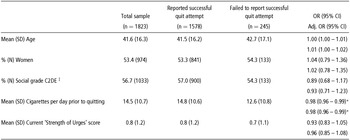
A total of 13.9% (95%CI = 12.4%-15.5%) of recent ex-smokers failed to report a corresponding quit attempt. Table 1 shows the smoking and socio-demographic characteristics of recent ex-smokers by their failure to report a successful quit attempt. The socio-demographic characteristics and dependence of recent ex-smokers were similar regardless of whether they failed to report a quit attempt except that those who did not report a corresponding attempt were likely to have smoked fewer cigarettes before stopping, which remained after adjusting for all other characteristics shown in Table 1.
Characteristics associated with the failure to report successful quit attempts

‡C2DE = skilled manual workers, semi-skilled and unskilled manual workers, and those on state benefit, unemployed and lowest grade workers.
*p < 0.05
Of the subgroup (n = 24) who were asked their reason for failing to report a quit attempt, the most common explanation was that they ‘actually stopped smoking completely more than a year ago’ (n = 9). Other endorsed reasons included: ‘since I was successful in stopping smoking, I did not consider it to be an attempt but rather a success’ (n = 4); ‘I have stopped smoking completely and intend to remain a non-smoker but am not ruling out the occasional puff’ (n = 6); and ‘I stopped smoking completely without seriously attempting to do so’ (n = 3). A minority ‘did not know’ the reason (n = 2), while no-one reported that ‘I have only stopped smoking temporarily and intend to return to smoking’ nor did any one provide any ‘other’ reasons.
Discussion
A substantial minority of ex-smokers who had stopped in the past year failed to report a corresponding quit attempt, however, only a small proportion of that minority believed they had quit without making a serious attempt to do so. Instead, the most common reason for the discrepancy was inconsistent reporting of the timing of the attempts. The characteristics of recent ex-smokers were similar regardless of their failure to report a quit attempt except that those who did not report a corresponding attempt were likely to have smoked fewer cigarettes before stopping.
The widespread assumption that smokers rarely quit without seriously attempting to do so is supported by the finding that only a small minority of those who failed to report a successful quit attempt explained the discrepancy by reporting quitting without considering that they had tried. The rarity of smokers quitting without trying undermines the idea that the cessation literature is unduly preoccupied with the difficulty of stopping (Chapman & MacKenzie, Reference Chapman and MacKenzie2010).
The substantial minority of smokers who quit successfully but failed to report a corresponding attempt is consistent with the bias associated with the recall of unsuccessful quit attempts (Berg et al., Reference Berg, An, Kirch, Guo, Thomas, Patten and West2010; Borland et al., Reference Borland, Partos, Yong, Cummings and Hyland2012; Gilpin & Pierce, Reference Gilpin and Pierce1994). The implication of biased recall is that population-level assessments relying on direct questions about quit attempts will underestimate the true number of attempts. By identifying the issue, it should be possible for future studies to make appropriate amendments to methods or analyses. For example, the number estimated from a direct assessment of attempts could be adjusted on the basis of additional questions to establish the rate and reasons that respondents quit successfully but fail to report a corresponding attempt.
The endorsement of a variety of other reasons for failing to report a successful quit attempt illustrates the complexity involved in the assessment of attempts. The explanation that recent ex-smokers actually quit more than a year ago resonates with the inaccuracies associated with retrospective data and how telescoping into particular target periods can change depending on how a question is phrased (Borland et al., Reference Borland, Partos, Yong, Cummings and Hyland2012). The fact that some respondents, despite a request to the contrary, decided that their success should be not regarded as an ‘attempt’ emphasises the limits of instructional caveats. The definition of ‘serious attempt’ as trying to make sure one never smoked again caused some recent ex-smokers to fail to report an attempt – as they felt either unable to rule out future lapses or had quit without seriously attempting to do so – and illustrates a trade-off in the assessment of quit attempts between excluding ‘true’ quit attempts and including ‘false alarms’.
The similarity of the socio-demographic characteristics and dependence of recent ex-smokers regardless of their failure to report a successful quit attempt is re-assuring in that the attempts of most groups will not have been systematically under-represented in population-level estimates. However, those who did not report a corresponding attempt were likely to have smoked fewer cigarettes prior to stopping smoking, which implies the quit attempts of ‘light’ smokers may be systematically under-estimated. As a consequence of lighter smokers seeking less treatment (Kotz, Fidler, & West, Reference Kotz, Fidler and West2009; Shiffman, Brockwell, Pillitteri, & Gitchell, Reference Shiffman, Brockwell, Pillitteri and Gitchell2008; Shiffman, Di Marino, & Sweeney, Reference Shiffman, Marino and Sweeney2005), this under-estimate of the quit attempts of lighter smokers could lead to an over-estimate of the effectiveness of smokers who try to quit without treatment.
One limitation of this study is that recent ex-smokers who failed to report a quit attempt were characterised by a relatively small number of factors. Future research should consider a wider variety of characteristics particularly related to the use of smoking cessation treatment. A second limitation is the measure of dependence used in the present study, which asks ex-smokers to rate their current strength of urges. The measure has the advantages of not being retrospective and stable within a cohort of smokers across a quit attempt (Ussher, Beard, Abikoye, Hajek, & West, Reference Ussher, Beard, Abikoye, Hajek and West2013). However, the measure does also relate to the time since stopping, which was not assessed in all respondents in the current study. This confound may have impeded power to detect a true difference in dependence, which was implied by the difference in cigarette consumption between the groups who did and did not report quit attempts. Future research should either assess time since quit attempt or include a retrospective assessment of consumptive dependence measures. A third limitation is that the extent of quitting without reporting an attempt may have been underestimated. The question about smoking status asked about the ‘last year’ and a small proportion of respondents may have interpreted that to mean the time since 1 January. As a result for those participants the target period for the assessment of smoking status was smaller than that for quit attempts, which asked specifically about the previous 12 months. A final limitation is that reasons for failing to report a successful attempt were assessed in a relatively small sample of recent ex-smokers – all those completing the survey in 2012 – and the incidence should be re-examined in a larger sample. Additionally, the list of reasons presented to respondents may not have been exhaustive. However, the list was developed, in part, on the basis of a qualitative study on the process of smoking cessation (Vangeli & West, Reference Vangeli and West2012) and the finding that no-one offered any ‘other’ reason than the ones provided suggested that the most important reasons were identified. Nonetheless, future qualitative research, specifically with those smokers who quit successfully but fail to report a corresponding attempt, may reveal additional possible reasons.
Conclusions
A substantial minority of ex-smokers who report having stopped in the past year may fail to report a corresponding attempt, which may cause under-estimation in population-level assessments of quit attempts particularly among lighter ex-smokers who are more likely to fail to report one. However, quitting smoking without considering that one has tried appears to be rare, as is quitting but reserving the option of having an occasional cigarette in the future. Instead, the most common reason for the discrepancy is inconsistent reporting of the timing of quit attempts.
Acknowledgements
The research team is part of the UK Centre for Tobacco Control Studies.
Financial Support
JB's post is currently funded by a fellowship from the Society of Study for Addiction. RW is funded by Cancer Research UK. We are grateful to Cancer Research UK, the Department of Health and Pfizer for funding this study. At the outset data collection for the Smoking Toolkit Study was also supported by GlaxoSmithKline and Johnson and Johnson.
Conflict of Interest
JB has received an unrestricted research grant from Pfizer. RW and TR undertake research and consultancy and receive fees for speaking from companies that develop and manufacture smoking cessation medications (Pfizer, J&J, McNeil, GSK, Nabi, Novartis, and Sanofi-Aventis). RW also has a share of a patent for a novel nicotine delivery device. EV & JAF have no conflicts.
Ethical Standards
The authors assert that all procedures contributing to this work comply with the ethical standards of the relevant national and institutional committees on human experimentation and with the Helsinki Declaration of 1975, as revised in 2008.