Indigenous groups in the Americas have historically faced extractive, non-responsive, or absent state institutions that have failed to provide them with needed public goods and services. Scholars have highlighted the promise of autonomy as a potential solution to these longstanding distributional challenges. Autonomy involves the creation of a territorial sphere of authority within the nation-state where “indigenous norms, authorities, and cultures are allowed to develop without interference from the state or nonindigenous actors” (Van Cott, Reference Van Cott2001, 388). By allowing indigenous groups to replace state institutions with longstanding political and economic practices, such as communal landholding, deliberative assemblies, councils of elders, and tribal chiefs, autonomy may encourage a distributive politics that is more responsive to local interests and thereby expand native groups' access to needed public goods and services (Miller, Reference Miller1968; Cramb and Wills, Reference Cramb and Wills1990; Díaz-Cayeros et al., Reference Díaz-Cayeros, Magaloni and Ruiz-Euler2014; Baldwin, Reference Baldwin2015). Yet, across several cases in the Americas, including Bolivia (Stauffer, Reference Stauffer2018), Panama (Fuentes Cordoba, Reference Fuentes Cordoba2019), and the United States (Frye and Parker, Reference Frye, Parker and Anderson2016), evidence suggests that greater autonomy can, in fact, worsen development outcomes for indigenous groups.
This article examines how contemporary autonomy arrangements shape public goods provision in historically marginalized native communities. Throughout the Americas, national governments have generally recognized only partial autonomy, in which indigenous groups are granted a circumscribed degree of political authority over local affairs. In certain regions of Mexico, Bolivia, Panama, and the United States, for example, tribal councils and traditional deliberative assemblies—rather than mayors and political parties—have assumed responsibility over local public goods provision. These autonomous governments may control the distribution of resources, but they remain financially dependent on the state and lack policymaking authority.
I argue that these existing forms of autonomy present a tradeoff for indigenous communities. On the one hand, autonomy guarantees local representation through indigenous institutions and coethnic officials, generating incentives for responsive governance. On the other, autonomy often fails to provide indigenous governments with the capacity to respond to coethnic demands for public goods. I define capacity as the ability of local governments to collect and deploy resources to intended recipients. Three main capacity challenges arise for autonomous governments: severe constraints with respect to own-source revenue, limited access to intergovernmental transfers, and lost bureaucratic capacity following the adoption of autonomy. Some of these challenges can be overcome in the long-term, but they require time, patience, and an investment of already scarce resources.
As an alternative to autonomy, indigenous groups may instead seek representation within local governments. I argue that this strategy provides greater bureaucratic capacity to meet indigenous demands. Furthermore, local government officials, due to established infrastructure and prior experience, have an advantage vis-à-vis autonomous governments in lobbying for finite discretionary transfers from higher tiers of government. Despite these advantages with respect to governing capacity, there is no guarantee that local governments will be responsive to indigenous community demands. However, coordination among indigenous communities to elect coethnic local representatives increases the likelihood that state institutions will provide native groups with needed public goods and services.
The above dynamics present an autonomy-representation dilemma for indigenous groups in the Americas. In working outside the framework of the state, indigenous groups who achieve autonomy can exercise more control over their local affairs, potentially generating a more efficient and effective provision of public goods. However, in distancing themselves from the state, new pressures emerge to develop endogenous capacity to obtain revenue and deploy it. Coethnic representation within existing local governments presents an alternative and potentially preferable strategy, but it may prove difficult or impossible to achieve.
I evaluate this argument in a series of steps using evidence from Peru and Bolivia, two unitary states with advanced levels of administrative decentralization but limited fiscal decentralization (Cibils and Ter-Minassian, Reference Cibils and Ter-Minassian2015, 16). As such, local governments in both countries depend on intergovernmental transfers to finance their extensive spending responsibilities. I first demonstrate the benefits of coethnic political representation using evidence from the Peruvian case. I draw on an original survey of indigenous community leaders and a regression-discontinuity design to show that when indigenous candidates are elected mayor in Peru, local governments appear to become more responsive to native communities' demands. I then evaluate the effects of autonomy, using data from the two municipalities in Bolivia that have adopted autonomous status: Chipaya and Charagua. Both municipalities now have indigenous governments. However, the experiences of each demonstrate different capacity-related issues that may emerge under autonomy. In Chipaya, the main challenge involves a reduction in revenue following the adoption of autonomy, while in Charagua, administrative issues have emerged that thwart the provision of needed public goods and services. I then investigate how the argument may be applied to evaluate the distributive effects of indigenous autonomy in Mexico, Panama, and the United States.
The theory and evidence presented in this paper make several theoretical contributions. First, the findings contribute to an emerging literature on the complementarity between state and indigenous institutions in the provision of public goods. Specifically, distributive outcomes may be more likely to improve when indigenous and traditional institutions are incorporated into the state rather than separated from it (Baldwin, Reference Baldwin2013; Koter, Reference Koter2013; Díaz-Cayeros et al., Reference Díaz-Cayeros, Magaloni and Ruiz-Euler2014; de Kadt and Larreguy, Reference de Kadt and Larreguy2018; Van der Windt et al., Reference Van der Windt, Humphreys, Medina, Timmons and Voors2018). Second, the evidence may explain, in part, the unexpected rejection of autonomy by indigenous groups in a number of historical and contemporary cases, including Bolivia, Canada, Ecuador, Peru, and the United States (Carter, Reference Carter2020). While autonomy may be desirable in the symbolic value it provides, it can be less effective in resolving persistent distributive inequalities, particularly when it is offered in a limited way that presents capacity challenges for autonomous governments.Footnote 1 Third, the paper provides support for a key claim in the literature on coethnic political representation, showing that, for indigenous groups, descriptive representation promotes substantive representation (Shotts, Reference Shotts2003; Chattopadhyay and Duflo, Reference Chattopadhyay and Duflo2004; Grossman et al., Reference Grossman, Gazal-Ayal, Pimentel and Weinstein2016). Finally, the theory builds on a broader literature around state-society relations to illustrate a key dilemma faced by many organized interest groups, which must weigh the benefits of autonomy against the challenges that accompany it. Trade unions in the Americas, for example, toed a difficult line in the twentieth century as they attempted to gain access to the state without ceding their organizational independence (Dahl, Reference Dahl1982, 29; Collier and Collier, Reference Collier and Collier2002, 48–50).
1. Theoretical framework
This section develops a theory around an autonomy-representation dilemma. While autonomy may increase incentives for local governments to respond to indigenous demands for public goods, it may fail to provide the capacity these governments need to respond effectively. Representation within existing local governments, on the other hand, avoids these capacity challenges but fails to generate incentives for consistent government responsiveness.
I begin with the assumption that two factors shape local public goods provision for indigenous communities. Governing officials must first have an incentive—electoral or otherwise—to provide public goods to indigenous communities. Coethnicity provides such an incentive. Compared with non-indigenous officials, indigenous political leaders are more likely to provide public goods to coethnic constituents.Footnote 2 This heightened responsiveness to indigenous constituents arises not only from in-group favoritism (Tajfel and Turner, Reference Tajfel, Turner, Hogg and Abrams2001; Chandra, Reference Chandra2006), but also from compliance with existing social norms and institutions. For example, native groups have long preserved reciprocity institutions, which make it more likely that winning indigenous candidates will reward coethnic supporters with post-election benefits.Footnote 3 Second, those in charge of resource allocation must have the capacity to provide public goods to native communities. Capacity constraints arise when resources cannot be easily or effectively deployed due to a lack of financial resources, technical expertise, or bureaucratic infrastructure.
Historically, governments have failed along both dimensions. They have possessed few incentives to provide distributive benefits to indigenous communities, which often lack economic, political, or demographic power. More nefariously, state officials may benefit from keeping native groups in a marginalized state, which facilitates the seizure of their land or unpaid labor for public works projects that benefit non-indigenous voters. Local governments have likewise lacked the capacity to deploy resources in native communities. For example, indigenous citizens may live in remote areas, which can make infrastructural investments by local governments prohibitively expensive.
In the wake of decentralization and democratization, however, new paths have emerged for indigenous groups to achieve a more equitable distribution of public goods. The first path involves seeking representation within existing state institutions by electing indigenous officials to positions of local power. The second path, autonomy, involves the replacement of state institutions with ones designed by indigenous communities themselves. Each of these paths generates tradeoffs with respect to the incentives and capacity that local governments—autonomous or state—have to provide public goods.
Representation supplies officials with more capacity to provide public goods, but state institutions often yield officials who have minimal incentives to respond to indigenous communities' demands. With respect to the former point, elected representatives operating within state institutions can seek the assistance of local bureaucrats and administrators, who have expertise in the allocation and distribution of government resources. These representatives may also have greater access to government transfers and infrastructure to collect own-source revenue, providing more financial resources to meet the demands of native communities.
Yet, there is no guarantee that state officials will respond to indigenous communities' demands for public goods and services. If native groups successfully coordinate during elections, they may elect coethnic officials, who have incentives to be responsive, as discussed above. In many cases, however, this cooperation is not possible due to the suppression of indigenous voters, the low demographic weight of native communities, or within-group conflict. As a result, non-indigenous officials are frequently elected who, as in previous periods, fail to respond to indigenous demands.
Autonomy has nearly opposite effects on each of these two dimensions of public goods provision: it generally increases the incentives of local governments to respond to native communities' demands but reduces the capacity of officials to meet these demands. With respect to incentives for responsiveness, autonomous status may legitimize and protect indigenous institutions, such as customary authorities. The ability to define the rules around political authority at the local level has resulted in the empowerment and legitimation of tribal chiefs, councils of elders, and community presidents. These institutional arrangements guarantee coethnic representation. Therefore, leaders of autonomous governments possess a clear incentive to respond to the demands of their coethnic constituents; failing to do so may result in social sanctioning and removal from office.Footnote 4
Yet, autonomy—at least in the form offered by contemporary states—often fails to provide the capacity that these indigenous authorities need to respond to coethnic demands. Specifically, national governments have not yet allowed full and robust autonomy in any country; as a result, autonomous governments remain dependent on higher tiers of government, especially for financial resources. In Bolivia, autonomous municipalities do not control subsoil rights and thus cannot use the resources on their land to fund local development (Postero and Tockman, Reference Postero and Tockman2020). In Mexico, despite a formal prohibition, national political parties continue to mediate indigenous communities' access to financial resources (Eisenstadt, Reference Eisenstadt2011; Benton, Reference Benton2017). In the United States, the federal government owns reservation land, which native communities cannot develop without permission from the Bureau of Indian Affairs and cannot sell.
As a result, autonomous governments often face severe constraints with respect to their ability to collect own-source revenue. Part of this challenge arises from the factors discussed above: indigenous governments lack control over land development and natural resource extraction. Other problems, however, arise from an inability to tax. Frequently, majority-indigenous areas are characterized by high levels of poverty, which constrains the available tax base for local governments. These problems are particularly acute for autonomous governments, which—to a greater extent than other local governments—are given “unfunded mandates,” in which they are responsible for the provision of goods and services but lack the resources to finance such activities.Footnote 5
Autonomous governments also face a second, revenue-related capacity challenge: limited experience lobbying for government resources. Lacking own-source revenue, autonomous governments must compete with local governments for scarce intergovernmental transfers. In this competitive environment, newly autonomous governments are disadvantaged, often lacking the networks, experience, and tools to lobby effectively for discretionary transfers.
A third and final capacity challenge involves the deployment of revenue. When governments become autonomous, they lose access to many pre-existing state institutions. These include not only political bodies but also key bureaucratic agencies, which possess technical expertise in municipal administration, budgeting, and planning. In the absence of an established local bureaucracy, new institutions must be created that can oversee and manage the creation and operation of needed goods and services. Autonomous institutions may be poorly equipped to deal with the sudden challenges of administering goods and services for an entire municipality, province, or reservation. Over time, these institutions may become more efficient through a process of learning; this, however, requires time, patience, and resources.
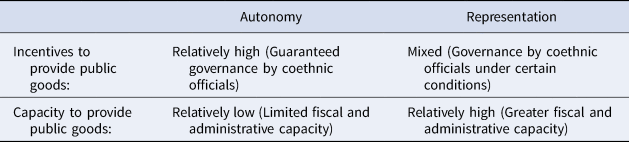
The above theory thus presents an autonomy-representation dilemma (Table 1). Through representation, indigenous groups may place into subnational office coethnic leaders who have incentives and the capacity to provide public goods. Yet, achieving this outcome depends on both indigenous groups' share of the electorate and their ability to coordinate during elections. Thus, local officials' incentives to provide public goods are generally mixed—depending on the success of native communities in electing coethnic representatives—but their capacity to provide is relatively high. Autonomy, on the other hand, functionally guarantees that indigenous groups will be governed by coethnic officials, who have incentives to respond to native groups' demands. However, autonomy may also create new capacity challenges, particularly in terms of revenue, which is no longer reliably provided, and bureaucratic institutions, which often must be developed endogenously. In the next section, I examine the unequal provision of public goods to native communities in the Americas and outline the institutional frameworks that have emerged to address this persistent inequality.
The autonomy-representation dilemma

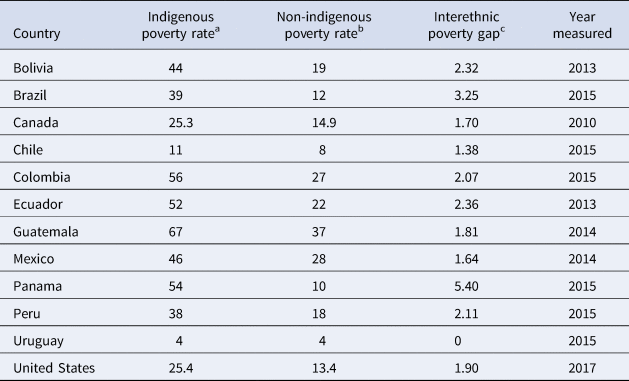
Indigenous and non-indigenous poverty gaps in the Americas

a Calculated as percentage of indigenous who make less than US$5.50 (2011 PPP, per day) in Latin America and federal poverty and low-income rates in the United States and Canada, respectively.
b Same as above; excludes Afro-descendant populations.
c Calculated using the ratio of Indigenous poverty to Non-indigenous poverty Source: LAC Equity Lab of SEDLAC (CEDLAS and World Bank), American Communities Survey, Statistics Canada.
2. Distributive Inequalities and Indigenous Autonomy in the Americas
Indigenous groups in the Americas face persistent and severe levels of economic marginalization. In many countries, with the notable exceptions of Chile and Uruguay, indigenous groups experience poverty rates that are roughly double that of non-indigenous populations (Table 2).Footnote 6 A number of factors account for the persistent poverty of native communities in the Americas. Demographic collapse following a colonial-era genocide (Grieshaber, Reference Grieshaber1980; Cook Reference Cook1998; Alchon, Reference Alchon2002, 132; Cameron et al., Reference Cameron, Kelton and Swedlund2015), exposure to near-constant resource extraction (Stern, Reference Stern1993; Dell Reference Dell2010; Mahoney, Reference Mahoney2010; Acemoglu and Robinson, Reference Acemoglu and Robinson2012; Engerman and Sokoloff, Reference Engerman and Sokoloff2012; Tockman and Cameron, Reference Tockman and Cameron2014; González, Reference González2015), the remoteness of indigenous communities and their historically limited access to education (World Bank Group, 2015), and expansive efforts to privatize indigenous communal land (Huenchulaf Cayuqueo, Reference Huenchulaf Cayuqueo, Alta, Iturralde and López-Bassols1998; Yashar, Reference Yashar1998, Reference Yashar2005; Van Cott, Reference Van Cott2001; Postero and Zamosc, Reference Postero and Zamosc2004; Jackson and Warren, Reference Jackson and Warren2005) have all played important roles.
Yet, contemporary factors also play an important role in explaining the perpetuation of this poverty; specifically, indigenous groups have often been excluded from political representation within the state, particularly from subnational offices in the post-decentralization era. Lacking representation within government, indigenous communities have lacked access to many locally provided public goods and services, including electricity, sewage, and piped water.Footnote 7 In no case in the Americas have indigenous groups achieved parity with non-indigenous groups in their access to local public goods and services.
In response to this persistent political and economic marginalization, indigenous groups in the Americas have lobbied for greater authority over their local affairs without interference from external actors, or “autonomy” (Van Cott, Reference Van Cott2001). Autonomy constitutes the central demand of both indigenous communities and the organizations that articulate these demands at the national level (Díaz-Polanco, Reference Díaz-Polanco, Alta, Iturralde and López Bassola1998; Stavenhagen, Reference Stavenhagen and y Mayor2000; Andolina, Reference Andolina2003; Jackson and Warren, Reference Jackson and Warren2005; Yashar, Reference Yashar2005).
Governments have sometimes responded to these demands, in some cases recognizing indigenous institutions as constitutive elements of the state's formal administrative structure. In Mexico, Bolivia, Ecuador, and Panama, some municipalities and provinces are now governed by traditional indigenous political institutions, such as chiefs and deliberative assemblies. In other cases, governments have extended autonomy to indigenous institutions that operate within territorial units that have little to no correspondence to existing subnational boundaries. For example, in Canada, Colombia, and the United States, governments have recognized political autonomy as operating within indigenous reserves and reservations, which exist outside of the state's formal administrative structure. In still other cases, such as Peru, governments have offered no political autonomy to indigenous groups, requiring indigenous communities to pursue different routes to improved public goods provision, including seeking representation within the state. The next section evaluates the effects of this latter strategy, specifically analyzing whether coethnic representation within existing local governments improves native communities' access to needed goods and services. Later in the paper, I evaluate the effects of contemporary autonomy arrangements.
3. Distributive benefits of political representation
A longstanding literature suggests that when candidates from a given ethnic group are elected to political office, their coethnics experience a public goods dividend (Alesina et al., Reference Alesina, Baqir and Easterly1999; Habyarimana et al., Reference Habyarimana, Humphreys, Posner and Weinstein2009).Footnote 8 In this section, I use survey evidence and a regression-discontinuity design to assess whether coethnic representation in local government increases public goods provision to indigenous communities.
To test this prediction, I analyze data from an original survey of over 320 current and former community presidents in Cusco, Peru. Indigenous communities in Peru are formally recognized institutions based around communal landholding.Footnote 9 There are over 6,000 communities, and they have been called the “oldest institution of [Peruvian] society” (Mendoza, Reference Mendoza2002, 8). Twenty percent of the Peruvian population lives in an indigenous community, and the communal lands held by indigenous communities account for 30% of the national territory (Instituto Nacional de Estadística e Informática, 2011, 2014; Dubertret and Alden Wily, Reference Dubertret and Alden Wily2015). However, this land tends to be poor quality and often disconnected from economic markets, resulting in persistent economic marginalization. Unlike similar communities in Mexico, Bolivia, and Ecuador, Peru's indigenous communities have not been offered formal political autonomy.
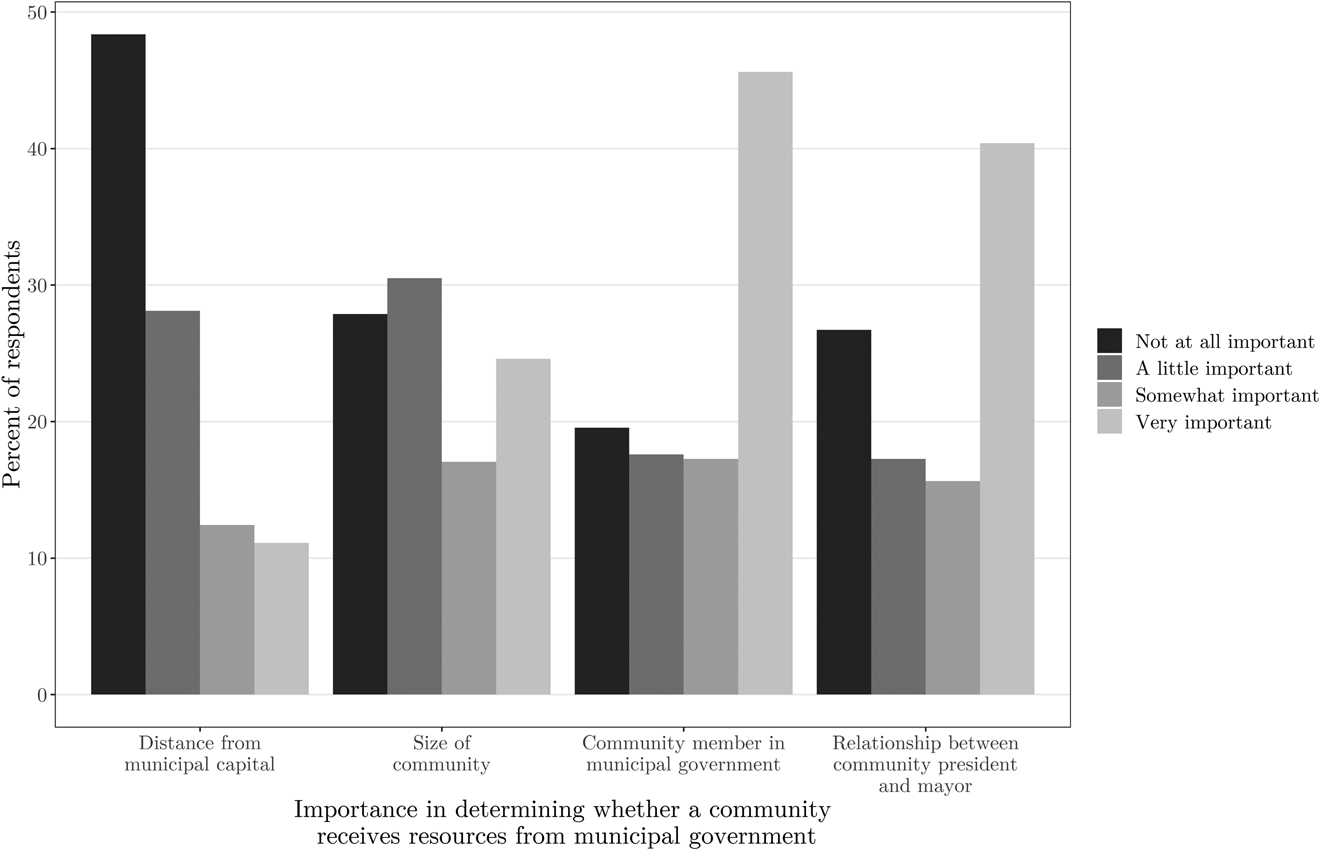
Instead, these communities often seek representation within existing local governments, a strategy that requires coordination among the multiple communal groups living within a single municipality. When coethnic community members are elected, access to distributive politics appears to improve. In the survey, community presidents were asked why some communities receive more municipal resources than others. The factor that presidents claimed to be most important was having a community member in an elective post in the municipal government (Figure 1). Just under half of community presidents labeled this as “very important.”Footnote 10 The size of the community and its distance from the municipal capital were generally viewed as less important.
Determinants of public goods provision, community president survey in Cusco (n = 320).

The evidence above demonstrates a preference for coethnic representation, but does the election of these representatives improve public goods provision in indigenous communities? I argue above that coethnic representatives should be more responsive to native groups' demands. To measure responsiveness, I examine variation in indigenous communities' access to water. Because water is an essential resource for health and economic production—and because access remains relatively limited in native communities—it is often their primary demand. It is also a key responsibility of municipal governments. In the survey referenced above, I asked community presidents to rank, in order of importance to their community, seven policies that fall under the jurisdiction of municipal governments: water, sanitation, electricity, roads, education, health, and employment.Footnote 11 Just under 60% (59.1%) of community presidents listed water as the number-one issue facing their community.Footnote 12
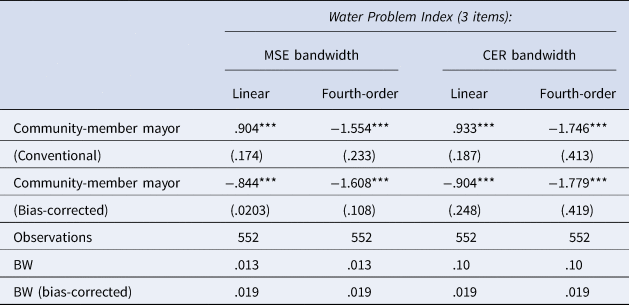
I now proceed to evaluate whether coethnic representation improves communities' access to water. Testing this prediction, however, requires confronting potential issues of confounding: the election of a community member to local office may be related to observed or unobserved causes of indigenous communities' water access. For example, municipalities where communities are more geographically dispersed may have less access to piped water networks and also be less capable of coordinating to elect coethnic representatives. To address these concerns, I employ a close-election regression-discontinuity design in which indigenous community members are narrowly elected or not elected to the mayorship of a municipality. The key identifying assumption requires that potential outcomes be continuous across the cutpoint dividing winners from losers. I then compare community-level outcomes based on whether a community member barely won the mayorship or barely lost it.Footnote 13 The outcome consists of a three-item index, which tabulates the number of reported water problems in the community according to a 2012 census of indigenous communities (Instituto Nacional de Estadística e Informática, 2014). The index items include problems with (1) payment or water rights, (2) water quality, and (3) water cut-offs. I provide additional details on the empirical strategy in Appendix 1.
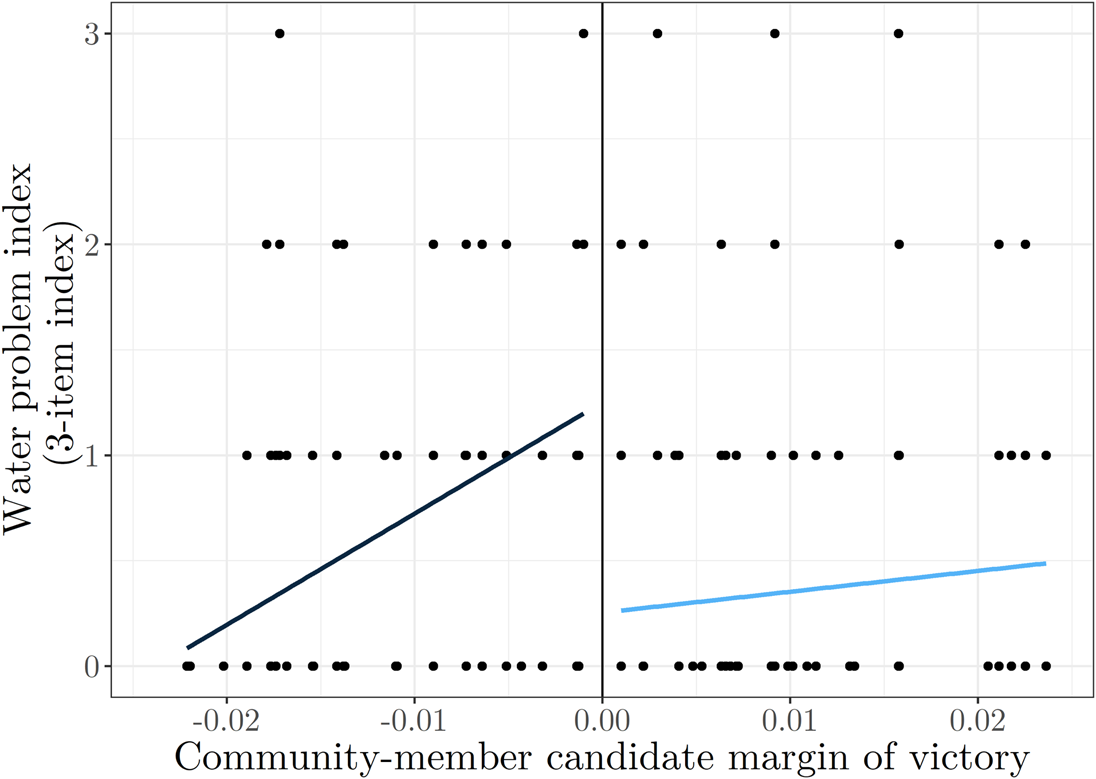
Figure 2 offers support for my theory. In municipalities where a community-member candidate won a close election, there is clear evidence of a decrease in the number of water-related issues reported by indigenous communities. Table 3 yields similar results across a number of specifications. Thus, coethnic political representation appears to increase indigenous groups' access to a needed public good. Do these distributive benefits obtained within the institutional framework of the state also emerge under autonomy? I explore this question in the next section.
Community-member municipal victory and reported incidence of water issues (3-item index).

Community-member municipal victory and community-level average of reported incidence of water issues (3-item index)

Note: SEs clustered at municipal level *p < .1; **p < .05; ***p < .01.
4. Capacity constraints of autonomy
I argue above that central states grant autonomy in ways that reduce indigenous leaders' capacity to collect and deploy revenue. This, in turn, makes it difficult for autonomous governments to respond to indigenous demands for public goods. In this section, I examine this claim. I investigate the recent adoption of autonomy in two Bolivian municipalities. Each of these cases illustrates a separate capacity constraint that emerges from indigenous autonomy. I begin with the case of Chipaya, a municipality in the department of Oruro that obtained autonomous status in 2018 and has subsequently experienced a decline in access to government revenue. I then turn to Charagua, a municipality in the department of Santa Cruz. Unlike Chipaya, Charagua has not experienced a decline in government revenue since obtaining autonomous status in 2017. However, it has faced bureaucratic issues in deploying this revenue to produce needed public goods.
4.1 Contemporary indigenous autonomy in Bolivia
In 2008, the government of indigenous president Evo Morales promulgated a new “plurinational” constitution that recognized indigenous political autonomy. For the first time, native territories and majority-indigenous municipalities were offered the chance to become an autonomía indígena originaria campesina (“indigenous originary peasant autonomy,” AIOC). In 2009, 180 of Bolivia's 337 municipalities were eligible for AIOC status; that is, a majority of their population identified as indigenous (Rousseau and Manrique, Reference Rousseau and Manrique2019, 10). That year, only twelve municipalities held referendums to adopt AIOC status. Ultimately, only three of the municipalities that held referenda in 2009 adopted an autonomy statute and obtained AIOC status: Charaguá, Chipaya, and Salinas de Garci Mendoza. Thus far, only Charaguá and Chipaya have put into place AIOC governments. The other municipalities that held referendums in 2009 have since rejected autonomy.
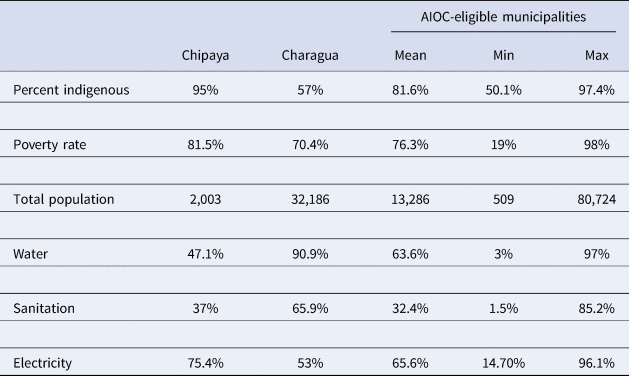
The subsection that follows analyzes the only two municipalities that have fully converted to AIOC status: Charagua and Chipaya. One potential concern with analyzing only these two cases is that they may be similar in ways that predict both AIOC adoption low baseline levels of state capacity. As such, Charagua and Chipaya may simply be so different from all other majority-indigenous municipalities that the conclusions drawn from these cases cannot be generalized to other AIOC-eligible municipalities. In fact, however, the two cases differ greatly from one another with respect to a number of pre-adoption traits, including their baseline population, levels of public goods provision, and poverty rates (Table 4). The municipalities are also located in very different regions of the country: Chipaya in the mountainous highlands of the relatively poor department of Oruro and Charagua in the lowlands of the wealthy Santa Cruz department. Despite these differences, the two cases ultimately converge in offering support for my theory: autonomy, albeit through different mechanisms, results in a reduction in local public goods provision in both AIOC municipalities.Footnote 14
Comparison of Chipaya and Charagua on baseline (pre-adoption) traits

4.2 Capacity constraints in Chipaya and Charagua
Chipaya voted to adopt AIOC status in 2017 and convened its first autonomous government in 2018. The central institution of the autonomous government is the deliberative communal assembly, or Chawkh Parla. A legislative body (Laymis Parla), made up of 8 officials, is charged with enacting the will of the people expressed in the Chawkh Parla. Finally, there exists a single Great Executive Authority (Lanqśñi paqh mä eph), elected to a four-year term; the position rotates among the four communities, or ayllus, that comprise the municipality (Mollinedo and Miguel, Reference Mollinedo and Miguel2017; Rojas Paz, Reference Rojas Paz2018).
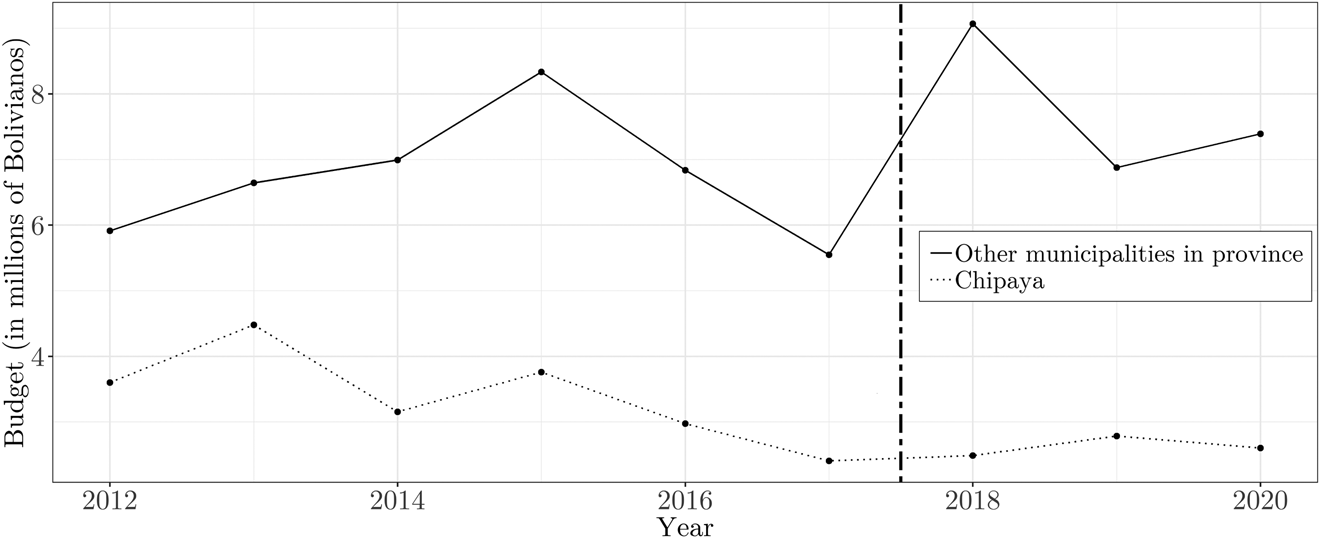
The institutional structure adopted in Chipaya provided the promise of more responsive local governance, but in the first years following the adoption of AIOC, indigenous authorities in the municipality have lacked sufficient revenue to provide needed public goods. While revenue shortages were an issue prior to the adoption of autonomy, they appear to have become even more severe following the conversion to AIOC status. Prior to 2018, Chipaya had a smaller budget than the average for other municipalities in its province, but it nonetheless followed the same general trend as these other municipalities in terms of peaks and dips in annual financial resources (Figure 3). For example, all municipalities in the province experienced a clear decline in revenue in 2017. Whereas the other municipalities rebounded somewhat in subsequent years, the recently autonomous Chipaya has stayed well below its pre-2018 average. In 2018, Zacarías Guarachi López, the Lanqśñi paqh mä eph, argued that the existing municipal budget was insufficient for producing needed public works, such as a road linking the municipality to the provincial capital; Guarachi asserted, “We are going to look for help from other agencies. Soon, I will travel to Oruro [the department capital] to coordinate these projects” (Aliaga, Reference Aliaga2018).
Municipal budget in Chipaya and other municipalities in Sabaya Province, Bolivia, 2012–2020.
Note: Dashed line indicates AIOC adoption. Line for “other municipalities” reflects an average budget for each of the other two municipalities in the province: Sabaya and Coipasa.
Source: Ministerio de Economía y Finanzas Públicas (2020).

Similar to Chipaya, Charagua's early experiment with political autonomy has been plagued by a number of challenges. Bolivia's largest municipality by area, Charagua obtained AIOC status in early 2017, the first Bolivian municipality to do so.
Charagua's sizeFootnote 15 and ethnolinguistic diversityFootnote 16 have given rise to a more decentralized governance structure than that observed in Chipaya. The executive branch of Charagua's AIOC consists of six chiefs who preside over subnational “zones” and an overarching coordinator (Tëtarembiokuai Reta Imborika, or TRI) (Augsburger and Haber, Reference Augsburger and Haber2018; Postero and Tockman, Reference Postero and Tockman2020). As in Chipaya, there also exists a legislative body and an overarching communal assembly.
Initially, indigenous populations viewed the autonomy process with optimism, seeing the promise of more responsive governance, not mediated by potentially corrupt political parties and state authorities (Postero, Reference Postero2017: 166). During the early debates around the adoption of autonomy, one young native leader in the municipality argued that conversion would “include all sectors of the Charagua community…[who] would benefit from development projects and more direct flow of funds to the town” (Postero, Reference Postero2017, 174). Since obtaining AIOC status, however, the autonomous government has struggled to maintain pre-existing levels of public goods provision even though—unlike Chipaya—the municipality has not witnessed a decline in access to state resources.Footnote 17
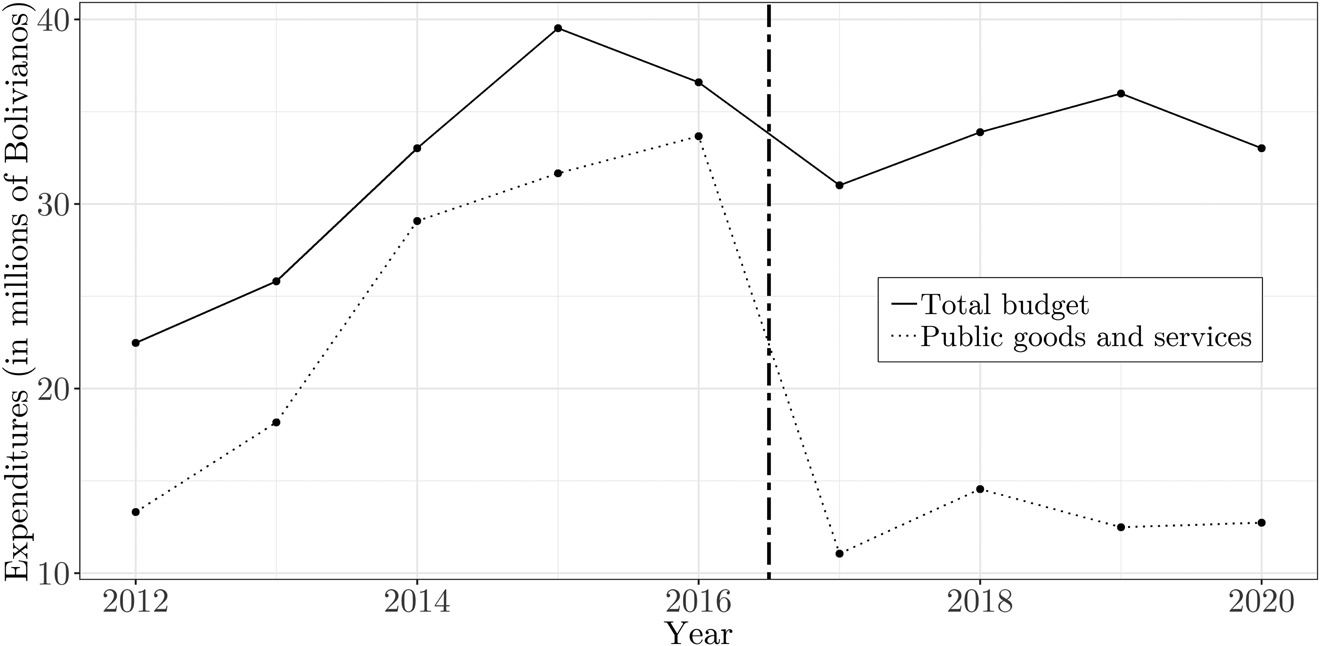
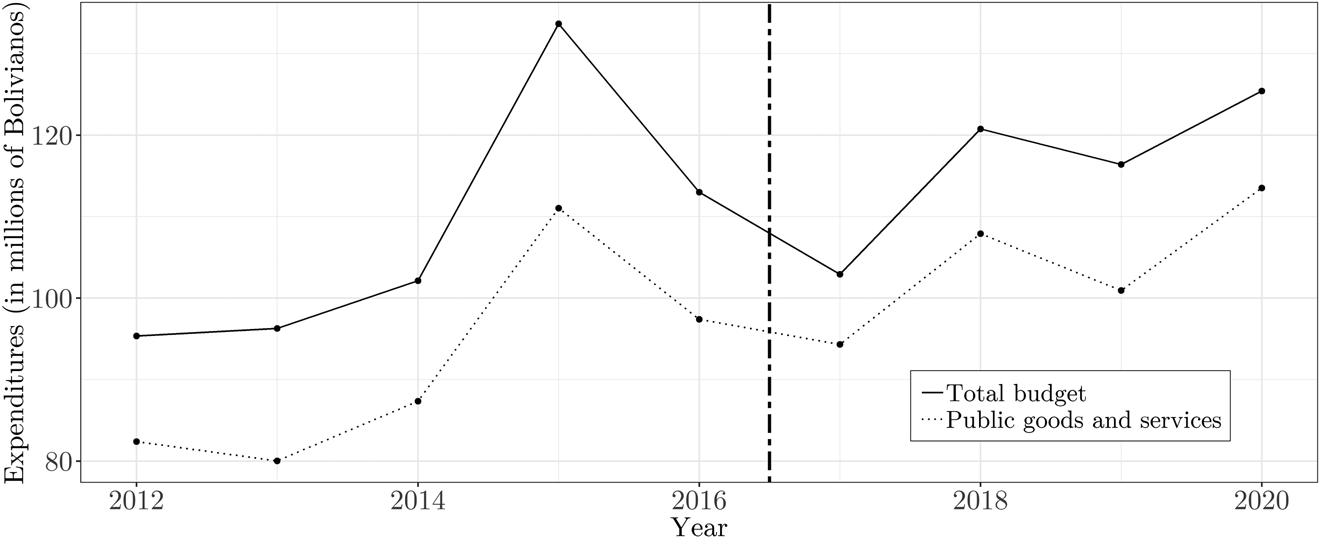
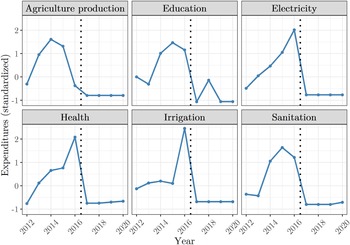
Instead, the challenge for Charagua has been a failure to adequately deploy revenues to needed public works projects. Figure 4 draws on municipal-level budget data from 2012 to 2020 to illustrate the dip in public expenditures in Charagua following its adoption of political autonomy. While the total budget increased, the amount spent on goods and services greatly decreased. A similar gap is not observed in the other municipalities in the province (Figure 5). Furthermore, expenditures on basic local public goods, such as education, health, sanitation, irrigation, and electricity experienced a clear decline after autonomy adoption in Charagua (Figure 6).
Ratio of goods and service expenditures to total budget: Charagua, 2012–2020.
Note: Dashed line indicates AIOC adoption in Charagua.
Source: Ministerio de Economía y Finanzas Públicas (2020).

Ratio of goods and service expenditures to total budget: Other municipalities in Cordillera Province, 2012–2020.
Note: Dashed line indicates AIOC adoption in Charagua. Data taken from combined budgets of Boyuibe, Cabezas, Camin Cuevo, Gutiérrez, and Lagunillas.
Source: Ministerio de Economía y Finanzas Públicas (2020).

Municipal expenditures in Charagua, 2012–2020.
Note: Dashed line indicates AIOC adoption.
Source: Ministerio de Economía y Finanzas Públicas (2020).

These challenges in effectively deploying revenue have emerged from three main sources. First, the decentralized structure of the AIOC has given rise to coordination problems. For example, the bureaucratic procedures to obtain and spend resources “now require the signature of seven people—the six zonal executives and the TRI—which will often take more time to obtain than when Charagua was a municipality with a single mayor” (Postero and Tockman, Reference Postero and Tockman2020, 9). Second, challenges have emerged, as nascent institutions clash, each attempting to establish itself as the most powerful (Postero and Tockman, Reference Postero and Tockman2020). Finally, new criteria and methods of leader selection have empowered individuals with no previous experience in municipal-level administration. The Bolivian state failed to anticipate or address this issue. While lawyers and bureaucrats from the national government played a heavy-handed role in the design of Charagua's autonomy statute (Tockman et al., Reference Tockman, Cameron and Plata2015; Tockman, Reference Tockman2017), there was little effort to train indigenous leaders in the procedural and logistical aspects of governing their municipalities.
Although each of these problems may be resolved with time, citizens of Charagua are becoming impatient with the AIOC government and its failure to provide basic public goods and services. Ramiro Lucas, a Guaraní leader, observed that money for school breakfasts had been reallocated to health centers since the municipality could not fund both; he asks, “Now we have land, but what good is that if we don't have resources” (Stauffer, Reference Stauffer2018). Another Charagua resident appeared ready to abandon autonomy altogether, exclaiming at a 2018 meeting in the municipal capital, “We are worse than before. I want a recall on this autonomy” (Stauffer, Reference Stauffer2018).
4.3 Extensions to other cases
In a number of other cases in the Americas, indigenous autonomy has failed to generate improved development outcomes for native communities, largely due to problems in how states have devolved authority. As a result, new capacity challenges have arisen that complicate autonomous governance. This section examines this claim in three different cases. In the United States, autonomy was extended to territorial units, i.e., reservations, that did not conform to existing administrative units. In Panama, autonomy was recognized at the level of the largest administrative sub-division: the province.Footnote 18 In Mexico, autonomy was allocated at the lowest administrative sub-division, the municipality. While the size of the autonomous units and their assigned responsibilities vary, across these three cases the predictions of my theory are largely confirmed. In the United States and Panama, a lack of revenue and bureaucratic capacity has generally limited the benefits of autonomy. In Mexico, however, autonomy has had more beneficial effects, precisely because many indigenous municipalities are aligned with a major party that has favored them in the distribution of intergovernmental transfers; thus, these municipalities have more successfully navigated the autonomy-representation tradeoff.
In the United States, the Indian Reorganization Act (IRA) of 1934 granted native reservations greater autonomy. However, the Bureau of Indian Affairs and Secretary of the Interior played an important role in limiting the powers of tribal governments. Individual tribes crafted constitutions, similar to the autonomy statutes drafted in contemporary Bolivia, but bureaucrats in the federal government ultimately had the opportunity to approve or reject these documents. This oversight continued after the adoption of the IRA. Tribal councils were required to seek approval from the BIA for many decisions over which municipal governments traditionally had authority (Clow, Reference Clow1987). This paternalism has been linked to negative development outcomes for indigenous reservations, as government intervention likely thwarted the capacity of tribal authorities to respond to local demands (Frye and Parker, Reference Frye, Parker and Anderson2016).
Autonomous indigenous governments in Panama have also faced capacity challenges that have inhibited responsive governance. The 1972 constitution granted three indigenous comarcas a measure of autonomy by recognizing the authority of their native political leaders. These comarcas are large subnational units, equivalent in size to a Panamanian province. While comarcas have a certain degree of decision-making autonomy, they remain dependent on the central state for revenue; the government must “guarantee necessary allocations for administration, investment, and integrated development of the Comarca in each year's annual national budget” (Vakis and Lindert, Reference Vakis and Lindert2000, 2). This system has generally worked to the detriment of indigenous comarcas, which receive fewer resources on a per capita basis than any of Panama's provinces.Footnote 19 Perhaps because of this lack of revenue, distributive inequalities persist between Panama's indigenous comarcas and non-indigenous provinces (OECD 2018; Fuentes Cordoba, Reference Fuentes Cordoba2019). In 2000, only about half of indigenous households had access to piped water compared with over 90% of non-native households (Vakis and Lindert, Reference Vakis and Lindert2000, 13). As of 2018, the human development index for comarcas is about half that of the rest of Panama; furthermore, indigenous comarcas continue to severely lag non-indigenous areas in access to locally provided basic services, such as water, electricity, and sewage (Puerta et al., Reference Puerta, Maciel, Soriano, García, Maqueda, Mortara and Soares2020, 2–3).
Mexico, on the other hand, provides a potential success case of indigenous autonomy. Scholars have observed that indigenous autonomy in the state of Oaxaca, Mexico—created by replacing political parties with traditional deliberative assemblies (i.e., usos y costumbres)—has improved public goods provision by encouraging a more engaged citizenry and collective decision making (Díaz-Cayeros et al., Reference Díaz-Cayeros, Magaloni and Ruiz-Euler2014; Magaloni et al., Reference Magaloni, Díaz-Cayeros and Ruiz Euler2019). As Faguet (Reference Faguet2011) observes, “Local government by non-party usos y costumbres achieves a more responsive, accountable government because of the processes that characterize usos itself: ongoing consultation with the citizenry, continuous monitoring, and sanctioning when citizens gather in public assemblies” (13). The success of usos y costumbres can also be attributed to “corporatist” ties between indigenous municipalities and the dominant Institutional Revolutionary Party (PRI), which governed Oaxaca until 2010. When the PRI's hold on power began to loosen in the 1990s, the party began to channel needed resources to usos y costumbres municipalities (Eisenstadt, Reference Eisenstadt2011, 112–113). Access to financial resources combined with more responsive governing institutions may account for the improved distributive outcomes observed in Oaxaca following the adoption of indigenous autonomy.Footnote 20
The experience of indigenous autonomy in Oaxaca sharply contrasts that of the Bolivian municipalities discussed in the previous section. Despite similarities in the responsibilities of indigenous governments in both countries, autonomy-seeking municipalities in Bolivia often had weak ties to governing parties, whereas those in Mexico had strong ties to governing parties. In fact, some evidence suggests that the governing PRI party in Oaxaca strategically assigned usos y costumbres to core areas of support (Benton, Reference Benton2017). Following the adoption of usos y costumbres, these linkages provided autonomous governments with access to needed financial resources and ties to state-level bureaucracies. Conversely, municipalities in Bolivia generally lack these ties, increasing the difficulty of collecting and deploying revenue.
The discussion above highlights the importance of capacity constraints in three different contexts. In Panama and the United States, autonomous governments often administer an enormous amount of territory, and in both cases, indigenous leaders negotiate directly with the national government for resources—as opposed to a higher subnational tier of government. In both cases, autonomous governments have struggled to provide needed goods and services, largely because of the capacity constraints they face. This mirrors a broader problem faced by local governments in the wake of decentralization: national governments are eager to offload spending responsibilities on local governments but are less willing to provide local governments with the financial resources to fulfill these new responsibilities (Falleti, Reference Falleti2005). The case of Mexico illustrates what would perhaps happen if such funding were granted to indigenous governments: autonomous governments provide more public goods and services. This illustrates a key scope condition on the autonomy-representation dilemma, which appears to exist only where autonomy ruptures ties between local leaders and officials at higher levels of governments.
5. Discussion and conclusions
Indigenous autonomy provides potentially significant benefits for native groups, and for this reason, it has often been the principal demand of national-level indigenous organizations. Replacing exclusionary and exploitative state institutions with indigenous ones can improve the quality of local governance. Yet, autonomy can also carry important costs. In operating outside the framework of the state, native groups become responsible for developing the capacity—fiscal and administrative—to respond to demands for public goods and services.Footnote 21 For this reason, where electing coethnic candidates to local office is possible, representation within the state may offer a preferable route to reducing distributive inequalities.
The capacity challenges of autonomy may explain the surprising decision of indigenous groups to resist autonomy in Peru in the 1920s; the United States in the 1930s; and Bolivia, Ecuador, and Canada during the contemporary period (Carter, Reference Carter2020). In the Bolivian municipality of San Pedro de Totora, for example, a powerful argument against AIOC status asserted, “If the No vote wins [in the referendum to adopt AIOC], there will be public works, and if the Yes vote wins, forget about works…because there will be no money” (Guarachi Huanca, Reference Guarachi Huanca2016). Ultimately, San Pedro de Totora rejected autonomy, with 70% voting against AIOC status.
Over time, indigenous groups can endogenously develop the tools to address the capacity challenges that arise from most contemporary autonomy arrangements. Through a combination of learning and investment in bureaucratic institutions, officials may accumulate the expertise and build the institutions that are needed to operate successful autonomous governments.Footnote 22 To date, however, many communities have been unwilling to incur this short-term cost, with some even opting out of autonomy after viewing the resultant capacity constraints.Footnote 23
In addition to the capacity challenges I outline in this paper, autonomy may carry other costs. For example, autonomy may result in greater within-group conflict and inequality. Governments often grant autonomy to geographic units that include multiple communities, tribal bands, and kinship groups, which are required to operate under a single institutional framework. More powerful groups, who have the political or demographic power to define the rules of autonomy, may exclude rivals, resulting in conflict and the continued exclusion of less powerful groups. In Mexico, for example, Eisenstadt (Reference Eisenstadt2007) demonstrates that usos y costumbres municipalities are more prone to post-electoral conflict than party-based municipalities. Similarly, in the United States, Taylor argues that “[t]he tribal governments established under the Indian Reorganization Act constituted a totally new and unfamiliar level of organization for many Indian Groups” (Taylor, Reference Taylor1980, 65). Scholars have linked these processes of forcing diverse indigenous communities together under a common tribal or reservation government to worsened welfare outcomes. Dippel (Reference Dippel and Anderson2016) finds that the grouping of multiple sub-tribal bands into a single reservation in the United States resulted in lower per capita income—compared with reservations that corresponded to a single sub-tribal band. As Taylor (Reference Taylor1980) observes, the granting of autonomy to reservation-level governments in 1935 served to “[arouse] tensions among communities which had hitherto coexisted in a state of autonomy” (65). Importantly, however, these challenges emerge not under any form of autonomy but rather under the institutional arrangements through which modern governments have recognized autonomy. If state officials allocated autonomy at lower levels that did not force disparate groups under a single autonomous government, some of these issues may be averted.
This paper has shown that autonomy may create new challenges for public goods provision—at least in the short term. Many of these challenges arise not from autonomy itself but rather from the limits that central states have placed on it. To address the capacity constraints that arise from contemporary autonomy arrangements, central states could pursue either of two approaches. First, they might combine offers of autonomy with greater political integration. This may involve, for example, offering individual indigenous communities autonomy over the allocation of resources, while entitling these communities to a particular proportion of municipal or provincial budgets. State officials might also invest in training newly empowered officials of autonomous governments; this would reduce the bureaucratic and technical gap that often disadvantages indigenous governments vis-à-vis those run by state institutions. Alternatively, state officials might undertake a second strategy of experimenting with more robust forms of autonomy, which would provide indigenous communities with greater control over local economic development. In most cases, autonomous governments cannot currently develop land or extract natural resources independently. Expanded control over these activities—and the revenues arising from them—may allow communities to overcome existing capacity challenges. Such robust forms of autonomy, which have heretofore been absent in the Americas, may finally deliver on the promise of improved local governance in traditionally marginalized indigenous communities.
Acknowledgments
I am grateful to my advisors—Thad Dunning, Andrew Little, Alison Post, and Ken Scheve—for thoughtful feedback and guidance throughout the project. For their very insightful comments, I also thank Todd Eisenstadt, Laura Evans, and participants at the 2020 APSA annual meeting, as well as the editors and two anonymous reviewers.
Supplementary material
The supplementary material for this article can be found at https://doi.org/10.1017/rep.2021.25.