Introduction
Ever since Marx (Reference Marx and Fernbach1894: 943) in the mid-nineteenth century, the impact of modern manufacturing on peasant handicrafts has been a controversial issue. In the case of China, it was long the orthodoxy that the growing availability of machine-made products, whether manufactured overseas or in China, undermined the market for handicraft textiles. As a result, the traditional self-sufficient economy was weakened and rural areas were increasingly integrated into the market economy. Meanwhile, the rural handicraft workers were bankrupted and transformed into a proletariat, forced into factory employment in the cities.Footnote 2 An opposing view has, however, been more recently put forward by a number of scholars, particularly but not only in the West, who have argued that some forms of handicraft cloth production were able to coexist with modern factory industry and in fact prospered well into the twentieth century.Footnote 3
This paper will argue that both these viewpoints are over-simplified and that any full analysis of this question must take into account spatial differentiation not only between but also within regions. It uses as a case study the radically different fates of handicraft cloth production in three major sub-regions of Jiangsu province. At the same time it will argue that the development of capitalist industry in the cities did not result in a linear process of commercialisation in rural areas, but that in fact commercialisation waxed and waned according to the specific characteristics of each sub-region.
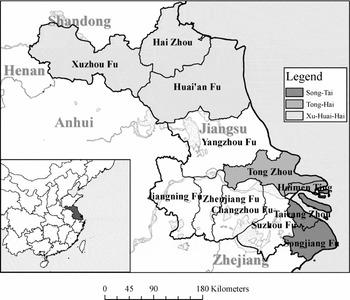
In pre-modern rural Jiangsu, several different sub-regional economic systems coexisted, three of which are analysed in this paper (for the scope of each sub-region, see Figure 1). First, in the Song-Tai sub-region, consisting of Songjiang Prefecture and Taicang Autonomous Department, in the south of the province, the production of handicraft cloth had become the dominant occupation, leaving agriculture basically as subsidiary.Footnote 4 In the Tong-Hai sub-region, consisting of Tongzhou Autonomous Department and Haimen Subprefecture, in central Jiangsu just north of the Yangzi, rural production followed the classic Chinese pattern of combining agriculture with handicraft manufacture—‘the man tills and the woman weaves’. Finally, in the Xu-Huai-Hai sub-region, spanning the prefectures of Xuzhou and Huaian (renamed ‘Huaiyin’ after 1913) as well as Haizhou Autonomous Department, in the far north of the province, the production of handicraft textiles had disappeared by late imperial times, and rural households relied solely on agriculture for their livelihood.
Jiangsu Province, with prefectural boundaries, 1820.
Source: ‘CHGIS, Version 4’ Cambridge: Harvard Yenching Institute, January 2007.

As modern industry developed from the late nineteenth century, its impact differed as between each of these three sub-regional economic systems. In Song-Tai, where the process of industrialisation started earliest, the rural population ceased to rely on handicraft weaving and became modern industrial workers. At the same time, the previous highly commercialised rural economy became more autarchic. In Tong-Hai, by contrast, handicraft weaving became the dominant occupation, and agriculture went into decline, becoming just a sideline. Both cotton textile production and commercialisation developed simultaneously. Finally, in Xu-Huai-Hai handicraft weaving gradually developed during the late nineteenth and early twentieth centuries with the increase in the import of machine-spun yarn into the region.
This paper will analyse the pre-modern economic system of each sub-region, the changes brought about after industrialisation and the effects of those changes. It will argue that the spatially differentiated transformation of the Jiangsu rural economy reflected a harmonious development of agriculture and modern industry through which a more rational deployment of human and natural resources was realised. This conclusion poses a challenge both to the traditional theories suggesting the bankruptcy of the natural economy and to recent Western theories about the development of the peasant economy in the region.Footnote 5
Song-Tai: From an Economy Dominated by Handicraft Production to One Dominated by Industrial Labour
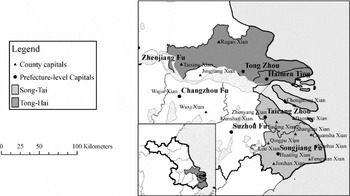
In the Ming (1368–1644) and Qing (1644–1911) dynasties, handicraft cloth production was highly developed in most areas of Song-Tai (for Song-Tai, see Figure 2), and achieved an empire-wide, indeed world-wide, reputation, as reflected in the common saying that ‘Songjiang clothes and quilts the whole world’. In addition to supplying domestic markets, handicraft cloth from Songjiang was exported to Japan as early as the Ming dynasty (Kobata Reference Kobata1942: 445). Most surprisingly of all, substantial amounts of Songjiang cloth (known as ‘Native Nankeen’ in Europe) were exported to England, even in the early nineteenth century when that country was the world's major producer of machine-woven cloth. Indeed, both the texture and colour of Songjiang cloth were superior to those of their British machine-woven counterpart (Chinese Repository 1834: 465). American merchants also shipped large amounts of Songjiang cloth to the United States, Central and South America and sometimes even to Western Europe.Footnote 6
Song-Tai and Tong-Hai sub-regions, with county capitals, 1820.
Source: ‘CHGIS, Version 4’ Cambridge: Harvard Yenching Institute, January 2007.

This shows that, by the eighteenth century, Song-Tai's handicraft-weaving industry had become highly commercialised, rather than just producing goods for household consumption as part of a natural economy. Ping-ti Ho (Reference Ho1959: 201) has argued that the growth of handicraft textile production meant that Songjiang became ‘the Lancashire of early modern China’. The development of handicraft cloth production influenced the entire economy and society, including agricultural production, labour allocation, household income and even the position of women.
In order to provide the raw material for the production of handicraft cloth, an increasing proportion of cultivated land in Song-Tai was devoted to growing cotton. In the 1890s cotton accounted for 70% of the cultivated acreage, as against only 30% for rice and other grains (Gao Reference Gao1775: 1b; Zhang Reference Zhang1878: 19:1b; Liang Reference Liang1882: 14: 1b; Wang Reference Wang1919: 3:22b; Qian Reference Qian1921: 6:1b; Yuan Reference Yuan1921: 3; Qian Reference Qian1924: 5:1a; Huang Reference Huang1930: 5:1a; Lü Reference Lü1948: 26; Huadong junzheng weiyuanhui 1952: 78). For example, the production of cotton (and thence handicraft cloth) almost completely replaced that of rice in Jiading County, and a Qing dynasty observer cited in the local history even wrote, ‘Jiading does not produce any rice’ (Zhang Reference Zhang1924: 524). Many other counties witnessed similar phenomena: in Baoshan, ‘farmers cultivate nothing but cotton . . . their livelihoods are totally reliant on cotton and cotton textiles’ (Liang Reference Liang1882: 3:3a).
This in turn had an effect on the allocation of labour. In the mid-eighteenth century, the editors of the Jiading County Gazetteer (Cheng Reference Cheng1742: 12:7a) wrote: ‘It is the universal pattern that men cultivate the land and grow grain, while women weave cloth. But in Jiading men grow cotton, while women produce cotton textiles. Households obtain their rice and cash by selling the cloth they produce’. By the eighteenth century, handicraft weaving had become the dominant occupation across the sub-region, leaving agriculture as the subsidiary.Footnote 7 A further indication of the sub-region's reliance on cotton and cloth production can be deduced from a simple and hypothetical calculation based on the estimates made by Xu Xinwu (Reference Xu1992: 211, 215). In all, about 30 million pieces of handicraft cloth were produced in Songjiang in 1860. At six labour days per piece, this would have required an annual input of 180 million labour days to process from raw cotton to the final product. The total population of the prefecture in 1860 was around three million. If one assumes five persons and two labourers per household, this suggests that cotton textile production accounted for about 300 days labour input per year per household, or (assuming a total of 300 days per year labour input per worker) about 50% of total labour input.
In the same way, handicraft cloth production became the main source of household income. A common perception, in the words of Yin Huiyi (n.d.: 3:13b), was that, ‘Suzhou and Songjiang prefectures are the most wealthy places in Jiangnan, with most poor people able to support their families through weaving handicraft cloth, rather than through sericulture’. The proportion of rural household earnings generated by handicraft weaving in Song-Tai increased over several centuries, while earnings from agriculture declined to an almost insignificant proportion of the total.
The dominance of textile production also had social effects, for example on the position of women. Much of the labour devoted to weaving cloth was female, and as a result women were very important contributors to family income. It was said (probably with some exaggeration) that in many families a single weaving woman could support eight family members (Wang Reference Wang1678: 2:239; Zhou Reference Zhou1992: 3:587). The importance of women's labour in cotton textile production can be gauged from the honours awarded to ‘chaste and filial women’. According to the Draft Gazetteer of Jiangsu Province (Miao Reference Miao2002: vol. 11, 544–552, 590–602), the authorities honoured 20 women in Taicang and 10 in Songjiang for supporting their families through producing cotton textiles. The proportion of women honoured for these reasons in Taicang and Songjiang made up in all about 15% of the total of women honoured, the highest proportion in the province.
Skills in spinning or weaving also strengthened the hand of women in the marriage market. Such women were in great demand as prospective brides (Xu Reference Xu1992: 241). Moreover, these skills put the bride's family in a stronger position and, rather than marrying their daughters out into other villages, the familes sometimes required their sons-in-law to move to their village in an uxorilocal marriage. Half the children of such marriages adopted the surname of their mother's family and half that of the father's (Lamson Reference Lamson1931b: 1058–1059).
However, weaving was by no means limited to female or child labour, nor was it an underpaid ancillary occupation. In fact, in Songjiang many men also engaged in handicraft cloth production (Xu, Reference Xu1992, 28). A Qing dynasty poem described a situation where ‘both men and women are expert’ in weaving cotton cloth (Tian Reference Tian1881: 8:8a). In Kunshan County, just over the border from Taicang, the weaving ability of some men was even superior to that of many women (Fang Reference Fang1963: 1:6b). In the 1960s, many rural cotton weavers around Shanghai recalled that before 1949 it was very common for men to spin and weave or for ‘men to spin and women to weave’ (Xu Reference Xu1992: 240, 243). Thus men, who provided the core agricultural labour force, were also frequently engaged in weaving handicraft cloth.
The production of cotton cloth in Songjiang declined from the late nineteenth century, precisely at the time when China's industrialisation started (Xu Reference Xu1992: 163–166, 239). Bao Shichen (Reference Bao1888: 2:34b) reported: ‘Villagers who previously supported their families through textile production now have no yarn for their looms. The cloth markets in Song-Tai have been reduced to under half their previous level’.
The conventional explanation for this decline is that handicraft cloth lost out in competition with cheaper and higher quality manufactured cloth (which in the earlier period was mostly imported). Bao's report (1888: 2:34b), cited above, is often used as evidence. He explained the decline as follows. ‘Foreign cloth has dominated the market recently, because its price is less than one third that of handicraft cloth’.
However, a closer examination suggests that this explanation is not correct. In fact, over a long period, the markets for foreign and handicraft cloth were at least partly separate. As Albert Feuerwerker (Reference Feuerwerker1970: 374) suggested, ‘Domestic mill cloth and imported goods were not perfect substitutes for the handicraft cloth’. Where they did compete, the competition between handicraft and foreign cloth was often not as fierce as that between different kinds of handicraft cloth. At the very time that Song-Tai's cloth production was declining, handicraft cloth woven in many counties of North China, such as Gaoyang (Grove Reference Grove2006), Baodi and Wei County, was increasing in production and sales.
Taking the dates of 1875, 1905, 1919 and 1931 as benchmarks, in these years handicraft cloth production accounted for 78.1%, 78.7%, 65.5% and 61.6% respectively of the total national market in terms of square yards (Reynolds Reference Reynolds, May and Fairbank1986: 135). This constrained the sales of machine-woven cloth, whether imported from abroad or produced within China. In fact, growth in sales of both handicraft and machine-woven cloth lay behind the decline in imports reported by the Maritime Customs of China (1934: vol. 1, 39) in 1934.
As recently as four years ago cotton goods, including yarn but not including raw cotton, headed the list of imports into China in order of value; in 1931 this class of merchandise had dropped to second place in the list; in 1932 it had dropped to third place; and in the year under review, it dropped to sixth place. The trend of trade in cotton goods is indicated even more distinctly by the comparative value figures for these four years: 233.4 million dollars in 1930; 188.6 million dollars in 1931; 139.8 million dollars in 1931; and 71.3 million dollars in 1933.
In the cloth market of Jiangsu, it was far from simply the case that machine-woven cloth outcompeted its handicraft counterpart. In fact, even in the late Qing, competition between foreign and handicraft cloth took place on relatively equal terms. The Zhenjiang Maritime Customs (IMC 1893: 181) recorded how foreign machine-woven cloth was losing out to handicraft cloth woven with imported cotton or cotton yarn:
While some formerly less important articles have grown, it will be found that certain current staples are losing ground. This is prominently the case with about all the Cotton and Woolen Piece Goods . . . Bad crops can be made responsible for short purchases of Foreign goods generally, but a more palpable reason may be quoted in connection with Cotton Goods, namely, that the demand for Foreign manufactures has been largely replaced by the importation of the raw material.
In fact, the real reason for the decline of handicraft cloth production in Song-Tai was on the supply side, that is the redistribution of labour resources away from weaving to more remunerative pursuits. In the early twentieth century, Song-Tai, especially Shanghai, which was formerly a county in Songjiang Prefecture, became the most industrialised region in the country. Factory wages were much higher than earnings from cloth production, and so the weavers moved in large numbers to the mills. Factory labour replaced weaving as the basis of the rural household economy. The local history of Shanghai (Wu Reference Wu1918: 1:10b) reported in 1918: ‘Shanghai has been industrialising so rapidly that it has become reasonable for farmers and weavers to abandon their original occupation in order to work in the factories’.
This change in the allocation of labour involved female as well as male labour. Many of the new factory workers were women, and industry became the largest source of work for female workers. Overall, there were about two million female workers in Jiangsu, that is 13% of the total female population in 1932 (Zhao Reference Zhao1935: vol. 1, 37). Since the majority of these workers were in Song-Tai, the proportion of female workers in that area would have been several times as high as in the province as a whole. For example, in the 1920s in Yangsi District (xiang), a rural area near Shanghai, just two factories employed 900 female workers, out of a total female population of about 8,000 (Yuan Reference Yuan1921: 3). Similarly, in 1930 the lace industry alone employed about one-third of the total female population of Chuansha County (21,450 out of 64,448) (Huang Reference Huang1936: 3:4a–b, 5:27b–29a).
The booming silk industry was one of the main sources of employment for women. In Baoshan, 10 silk filatures employed 5,800 mostly female workers (Qian Reference Qian1921: 6:3b, 15a–b). In 1932, 50 silk filatures in Wuxi employed 36,350 female workers, out of a total female population of 80,000 (Gao Reference Gao1987: 492; Tan Reference Tan1994: 180). In the 1930s Fei Xiaotong (1939: 232) reported of Wujiang that ‘the development of silk filature in the nearby cities in the last twenty years has been rapid. The urban industry attracts rural labour. This movement of population undoubtedly is a disruptive force in the traditional social structure of the rural community’.
These new employment opportunities divested handicraft weaving of most of its female labour force. Most female workers in Shanghai had previously been rural handicraft weavers. In Zhenru District, then a rural area to the north-west of Shanghai, ‘women workers were quite common. When the district grew cotton, most women spun and wove. However, after the boom in the Shanghai factories, the wages there were so high that the women were all happy to go there to work’ (Wang Reference Wang1935: 233). The situation was identical in Baoshan County. As the local gazetteer (Qian Reference Qian1924: 5:1b) reported, the rural households ‘used for a long period to live on cloth weaving. But recently, the majority of men and women have begun to work in factories’. Similarly, in Chuansha County, ‘the main industry used to be [handicraft] cloth weaving’, but, ‘because machine-produced yarn and cloth have recently become fashionable, most of the weavers have moved to Shanghai and work in cotton mills’ (Huang Reference Huang1936: 5:25a, 14:7a).
It was this loss of labour and not the competition from manufactured cloth that led to the decline of handicraft weaving. In Huayang Township (zhen) in Songjiang County there were 670 wage earners in 800 households, but only one handicraft weaver (MT 1940: 20, 165). Another survey of a village in Jiading showed that only six out of 89 households were still engaged in weaving cloth (MT 1942: Table 1).
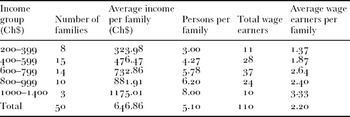
The Proportion of Wage Earners in Rural Households in Shanghai County, 1929

Source: Lamson Reference Lamson1931b: 1031.
This shift in the occupation of women workers is relevant to a number of theoretical questions. It verifies one of Kenneth Pomeranz's (Reference Pomeranz2000: 103) hypotheses, that a market in female labour did exist, and that women would leave home to work in a factory if income was higher there. On the other hand it does not support Chao Kang's (1975: 179) contention that handicraft weaving was only able to survive because handicrafts and modern industry employed two different kinds of labour and did not compete with each other for labour. Chao posited separate loci of labour allocation, with handicraft industries using members of rural households, while modern industry employed individual wage earners. In Song-Tai, however, handicrafts and modern industry competed for the same pool of labour, and industry had the overwhelming advantage in this regard. As an old villager in the countryside around Shanghai recalled,
When factories first opened in this vicinity the manager sent out men to get workers from the village. Some dropped their farming and went to work in factories. Later, the factories desiring women laborers secured some of them here, leaving us older ones to work in the fields to which we are accustomed. The village has been decreasing in size because of the migration to the city. (Lamson Reference Lamson1931b: 1059)
Thus, modern industry attracted labour out of villages and deprived handicraft weaving of its labour force. Over 20% of the population of some districts in Wuxi migrated to Suzhou and Shanghai (Tan Reference Tan1994: 178). A Japanese investigation of two districts near Wuxi around 1940 (MT 1941a: 99, 19–20) reported that 44 of a total of 80 households in Xiaoding District depended for their livelihood on the income from family members working in industry and commerce, while, in Rongxiang District, 225 people earned their living as industrial labourers outside the village, and only 191 worked in agriculture. In Rongxiang and Kaiyuan Districts, only 3.5% and 12.2%, respectively, of young people aged between 16 and 25 remained at home (MT 1941a: 88). Shanghai was very much the preferred destination of migrants. About 82.5% of emigrants from Wuxi went to that city and among them about 75% worked as employees of factories or stores (MT 1941a: 99–100). In all, there were 141,855 migrants from Jiangsu in the Shanghai International Concession in 1900, a figure that had increased to 500,576 by 1930 (Xu Reference Xu1985: 311). Other cities in Jiangsu, however, also attracted a substantial number of migrants from rural areas. While most migrants from Xiaoding and Rongxiang ended up in Shanghai, around 10% moved to Wuxi itself (MT 1941a: 19–20, 99).
As a corollary of this, wage earners became the major providers of income for most households. In rural households near Shanghai in 1929, there were, as shown in Table 1, 2.2 wage earners in the average household of 5.1 persons. In H. D. Lamson's (Reference Lamson1931b: 1064–1065) investigation of Shanghai mill workers, we read of one family that lived off the wages of the wife and sister of the head of the household; the head ‘spurned farming’ and rented out the 1.3 hectares of land owned by the family for Ch$54 per year. Another two families relied in one case on the wages of the daughter-in-law who was a factory worker, in the other on the Ch$432 annual salary of the household head who was employed by the Shanghai Power Company; again the families rented out the 0.25 hectares of land each owned for Ch$12 per year.
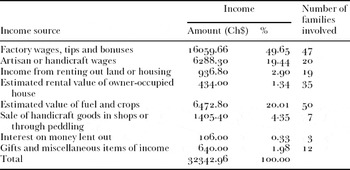
Table 2 likewise indicates that factory and other wages were the major source of income for rural households in Shanghai County in 1929. Income earned from modern industry was around two-and-a-half times as much as that from the sale of fuel and crops, and over 11 times that from the sale of handicraft products. There was a similar situation in Litai District in Taicang, where the opening of a cotton mill provided the main income for many households (Cao Reference Cao1996: 172).
Sources of Income of Rural Households in Shanghai County, 1929

Source: Lamson Reference Lamson1931b: 1037.
The availability of factory employment also had a profound impact on village society, encompassing the composition of the village population, the nature of agriculture and the position of women. It became a common phenomenon that villages became divested of adult males, as farmers in rural areas around Shanghai became industrial workers and moved out of the village to live closer to their work, leaving their parents to care for the houses and farmland (Li Reference Li1920: 9; Lamson Reference Lamson1931b: 1062). In many cases, rather than continuing to cultivate their farms, families rented out their land, as they did, for example, in villages near Shanghai's industrial Yangshupu area, ‘in order to have time free for urban occupations, either because farming is less attractive labour, or because it is felt that more income can be secured by industrial and other city work’ (Lamson Reference Lamson1931b: 1060). Labour leaving for the city was replaced by migrants from other areas, such as Chongming Island, who were attracted to areas close to Shanghai in order to find a better livelihood (Lamson Reference Lamson1931b: 1061).
This in turn had an impact on agriculture. Contrary to the common perception that there was a linear trend towards the commercialisation of agriculture in China's modern market economy up to 1937, in Song-Tai the decline of handicraft weaving was not accompanied by any great expansion of the market. On the contrary, a new system emerged whereby both agricultural crops and handicraft cloth came to be produced for direct consumption rather than for the market. By the 1930s, the late Imperial system of cultivation focusing mainly on cotton made way for a new pattern of subsistence grain production (Xu Reference Xu1992: 243). One investigation (Shanghaishi shehuiju 1930: 2) showed that by 1930 cotton had already declined to 34.8% of the total cultivated acreage in rural Shanghai, a much smaller proportion than that of grain, which accounted for more than 50% of the total.
At that time, the general model for the operation of rural households was one of the older people being the farmers and the younger ones the factory operatives (Lamson Reference Lamson1931b: 1066). Given that the largest part of household income came from the factory workers, the system was oriented to support those workers. As food costs made up over 55% of the total expenditures of urban households in Shanghai in the 1930s (Lamson Reference Lamson1931a: 451–452), a household with family members working in the city could make major savings on the outgoings of their urban residents if they could supply them with food from the family farm. As a result, those staying in the village cultivated crops such as rice, beans and vegetables that required less labour input than cotton, and that could be supplied to urban relatives for consumption.
Clothing was the second largest item in the expenditures of urban households, at 10% of the total. Thus, maintaining handicraft weaving in the villages could reduce the living costs of urban family members. In any case, woman workers in modern Shanghai, as well as in nearby counties such as Jiading and Baoshan, preferred clothes made from handicraft cloth (Yan Reference Yan1929: 18:13a; Ma Reference Ma2003: 337). It was because of these factors that handicraft weaving survived in the villages of Song-Tai (Qian Reference Qian1921: 6:13a; Yan Reference Yan1929: 18:13a; Huang Reference Huang1930: 5:9b; Wang Reference Wang1935: 233).
Finally, the fact that a large proportion of the factory workers were women—even an elderly woman could sometimes find a job in a cotton mill (Li Reference Li1920: 9)—had social as well as economic effects. The major contribution to household income made by the wages of women workers significantly enhanced the status of women in the family. One rural woman described the situation: ‘Nowadays girls are just as, if not even more, useful than boys. My two daughters do good work in the factory, while my son who has some education stays idle at home’ (Lamson Reference Lamson1931b: 1071). Similarly, a girl factory worker said, ‘If we can support ourselves why do we want to marry? We can be quite free by ourselves’ (Lamson Reference Lamson1931b: 1074). In one case, even when a girl had been ‘greatly disgraced’, her husband's family was still willing to accept her and ‘treat her as usual’ because of her earning capacity in a silk filature in the village (Fei Reference Fei1939: 235). The same factors even influenced women to prefer to adopt a girl rather than a boy (Lamson Reference Lamson1931b: 1074).
Thus, the fate of the handicraft weaving industry in Song-Tai was determined by the fact that higher wages were available from factory work, while the income from cloth remained static, or even declined. The decline of weaving did not, however, indicate a fall in rural household income, still less the bankruptcy of the peasant economy. On the contrary, it showed that there was an unprecedented transformation of rural society—a qualitative change, generated by industrialisation, from reliance on rural industry to rural–urban migration. In rural villages near Shanghai, the supply of labour fell short of demand because ‘more and more farmers were employed in Shanghai’ (Huang Reference Huang1930: 5:3a). The income available from wage labour in Shanghai mills was far greater than that earned from weaving handicraft cloth, whether in Song-Tai or in the newly developing weaving districts of North China.Footnote 8
How do we explain the fact that modern industry did not lead the peasant economy towards higher levels of commercialisation, but rather forced it to ‘retreat’ to a more autarchic pattern? Essentially it was the result of the fact that the labour power remaining in the villages was insufficient to engage in production for the market, while the ever-increasing cost of living for urban residents encouraged the production of subsistence goods to reduce costs.
Song-Tai had been an advanced region in pre-modern times, in that its population relied on handicrafts, while most rural residents elsewhere still relied on agriculture. After the rise of modern industry, Song-Tai continued to lead the way for the rest of rural China, in that industrial labour became the main source of income for rural households.
Tong-Hai: From an Autarchic Economy with ‘The Man Tilling and the Woman Weaving’ to a Commercialised Economy Dominated by Handicraft Weaving
In pre-modern times, handicraft cloth produced in Tong-Hai (for Tong-Hai, see Figure 2) was not sold outside the sub-region, but mostly used within the weaving households. As Kathy Walker (Reference Walker1999: 11–12) suggested,
In fact the northern delta [of the Yangzi River], its textile production increasingly overshadowed by the Songjiang-centered cotton cloth industry in the latter half of the Ming (dynasty), would see its primary role within the regional economy reduced to that of supplier of raw cotton during the Qing. In short, in the Yangzi delta integrating-infusionist economic processes were coupled with malintegration that peripheralised the north.
Up to the late nineteenth century, the cloth woven by the population north of the Yangzi, such as in rural Tong-Hai, tended to be very coarse (Wang Reference Wang1755: 16:3b, 18b); it was mostly produced for use within the family and was therefore called ‘homemade cloth’ (jia ji bu). Such coarse cloth could in no way compete with the fine cloth produced in Song-Tai, and the level of commercialisation of Tong-Hai handicraft cloth production was far lower than in Song-Tai (Wang Reference Wang1755: 16:8b). Even the high-quality cloth produced by weavers hired by wealthy families was not exclusively produced for the market, some being used by the wealthy families themselves (Lin Reference Lin1984: 152), though luxury cloth was mainly purchased from Song-Tai (Wang Reference Wang1755: 16:7a–b). Thus, cloth production for the market was limited to a very few districts, and only in the 1870s or 1880s did merchants from Suqian County in northern Jiangsu begin to come to buy handicraft cloth from markets in Nantong County (previously part of Tongzhou), such as Erjia or Jinyu Townships or Houyou Zha (Yu Reference Yu1984: 34–35).
The situation changed rapidly after 1884 with the beginning of imports of foreign yarn into the sub-region, and over the next 15 years production of handicraft cloth using machine-spun yarn grew rapidly (Lin Reference Lin1984: 145). In the 1890s, the value of such handicraft cloth was about Ch$1 million (Zhu Reference Zhu1897: 1a), and it began to be exported to other areas where it posed a challenge to foreign cloth. The 1893 Maritime Customs Report (IMC 1894: 191) for Zhenjiang, which was close to Tong-Hai, stated:
Grey Shirtings alone showing a diminution of 214,492 pieces, or over 21 per cent. T-Cloth receded quite 17,000 pieces. . . .The Cotton crop, especially in the districts around T'ung-chou, was excellent. This town, the principal seat of the Cotton industry in the province, largely exports purely Native Cotton textiles, which are sold at Ch$1.60 per piece of 5 chang [zhang], or are retailed at the rate of 30 cash per ch'ih [chi]. Here, too, a hybrid fabric—less durable, perhaps, in texture and less warm than the purely Native Nankeen, but, nevertheless, a good wearing article of superior appearance and well adapted to Native taste and requirements—is woven in great quantities from a mixture of Indian and Native Yarn, and sold at Ch$1.25 per piece of 5 chang. It is from this centre, where between 4,000 and 5,000 looms are at work, that the Hsü-chou [Xuzhou] district now largely draws its supplies.
A symbiotic relationship emerged between handicraft weavers in rural areas and the producers of machine-spun yarn. The growth of handicraft weaving created a market for thick yarn, fulfilled partly by Zhang Jian's Dasheng Cotton Mill in Nantong, opened in 1899. Both Chinese and Western scholars have agreed that the growth of supplies of machine-spun yarn was crucial to the expansion of handicraft cloth production and trade (Dasheng ziben jituan shi bianxiezu 1969: 50). Kathy Walker (Reference Walker1999: 120–121) has suggested that, ‘The yarn manufactured by Dasheng cotton mill gave [the cloth firms] significant new opportunities to expand cloth output’. In Nantong, the availability of machine-spun yarn facilitated a rapid increase in the weaving of the new and much higher quality handicraft cloth, which had its main market in Northeast China (Lin Reference Lin1984: 145).
By the 1920s and 1930s the value of cloth exported annually from Nantong was over Ch$26 million, though this declined to Ch$17 million after Northeast China was occupied by the Japanese in 1931 (Xu Reference Xu1992: 609). By this time, Tong-Hai had replaced Song-Tai as the main centre of handicraft weaving in the Lower Yangzi. Shanghai cloth merchants mainly traded in Tong-Hai cloth because ‘the handicraft cloth from Changshu and the counties around Shanghai was too narrow and short, and had fewer uses than Nantong handicraft cloth’ (Ji Reference Ji1939: 406–407). This shift in the location of the industry led Japanese investigators to use Nantong rather than Song-Tai as the typical handicraft-weaving area when they surveyed the industry in the late 1930s and early 1940s.
Zhang Jian, the leading local entrepreneur, was also concerned to develop local sources of supply of raw cotton and, after his Dasheng mill had begun to make profits, worked to promote cotton cultivation and improvement in Tong-Hai (Fan Reference Fan1921: 3:1b, 10b, 11b, 12). By the early Republican period (1912–1927), cotton had become the predominant crop in the sub-region. In 1915, the acreages of land sown with cotton in Nantong and Haimen Counties were over 113,000 and 72,000 hectares respectively, the highest in the province. Specifically these figures far exceeded the amount of land sown with cotton in any of the counties around Shanghai, which had earlier been the main centres for cotton cultivation (ZGDE 1991: table between 252 and 253).
The growth of the handicraft cloth industry led weaving to become the predominant occupation in Tong-Hai in the early twentieth century. Many peasants abandoned their traditional agricultural occupation. The Jiangsu Governor's office (JSSZGS 1919: 118) reported that,
The majority of rural households [in Haimen] possess looms for weaving cloth. They produce more than one million pieces of handicraft cloth annually, valued at about Ch$1.3 million. In addition to satisfying local consumption, most of the cloth is shipped for sale in Northeast China or Russia.
In Jingjiang County (on the flood plain north of the Yangzi, and geographically, though not administratively, part of Tongzhou), we read that, ‘Most workers are involved in weaving cloth and produce 500,000 to 600,000 pieces a year’ (JSSZGS 1919: 155–156). The Jiangsu Industry Monthly (Shen Reference Shen1919b: 28 and Reference Shen1919a: 24) reported that ‘every household [in Taixing] owns looms for weaving’, while in Rugao, ‘about 400 cloth stores sell more than 80,000 bolts of handicraft cloth each year’.
While the predominant form of organisation of production was based on rural households, small local factories also played a role, albeit a mainly indirect one. Factories such as Baoxing, Tonghua, Guohua and Lisheng in Haimen were short lived because they could not compete with handicraft production, but they nevertheless made an important contribution to the development of the local economy through training rural weavers, improving weaving equipment, researching dyestuffs and engaging in product innovation. Over 1,000 skilled weavers learned their trade in the factories before resigning to take up rural handicraft production. The famous Dasheng Cotton Mill also trained many rural weavers as a matter of policy (Lin Reference Lin1984: 246–247).
In the 1930s more than 600,000 people in Nantong and Haimen Counties earned a livelihood from handicraft weaving—on average two in each household (Gongshang banyue kan 1932: 4; ZGDE, 1991, 145). In Nantong about 38% of all households relied entirely, and 54% partially, on handicraft weaving; only 8% were not engaged in weaving. An investigation of 94 rural households in Touzong Village in Jinsha Township (Nantong County), showed that 46 households were directly engaged in weaving, 12 traded in yarn, two in handicraft cloth, one made weaving implements and finally seven households transported yarn and cloth (MT 1941b: 118–119). In this village, handicraft weaving clearly dominated the local economy.
Just as in Song-Tai, weaving became in part men's work in Tong-Hai. In Jingjiang County, the Governor's office (JSSZGS 1919: 156) reported that ‘the weaving households can be found everywhere; both men and women are engaged in weaving’. In the 1930s, Nantong was described as a typical district where men took part in weaving (Zhao Reference Zhao1935: vol 2, 143). Of the 90 handicraft weavers in Touzong Village, 47 were men and only 43 were women (MT 1941b: 120). Technological change both reflected and promoted the new gender division of labour: In rural Haimen, just as in Gaoyang in north China (Grove, Reference Grove2006: 82–83), a new type of loom called a ‘yangji’ (foreign machine) was created specifically for male weavers; it was operated by the feet rather than manually, and was much more efficient than an ordinary loom (Wang Reference Wang1936: 78).
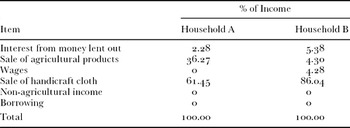
Income generated by handicraft weaving also became the mainstay of household incomes. Table 3 indicates that income from handicraft weaving made up over 60% and over 80% of the income of two rural households in Touzong Village. By the same token, cash payments for yarn to weave the cloth made up 67% and 94% respectively of the production costs of these two households (MT 1941b: 124–125).
Sources of Income for Two Households in Rural Nantong in the Late 1930 s and Early 1940 s

Source: MT 1941b: 124.
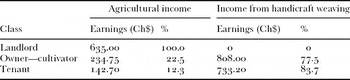
Thus, whereas in Song-Tai by the twentieth century handicraft weaving was regarded as poorly paid and low-prestige employment and was relegated to a subsidiary occupation, in Nantong at the same time it provided households with much higher incomes than were available from agriculture. A small farmer who was able to spend much of his time weaving cloth in fact enjoyed a higher income even than a landlord who owned much more land but had to spend more time on agricultural production. Table 4 shows that in the late 1930s and early 1940s while the landlord's income from land was 2.7 times as much as that of the owner–cultivator and 4.4 times that of the tenant, income from handicraft weaving meant that the total incomes of the latter two were in fact 64% and 38% higher than the landlord's.
Income Sources of Different Classes in Rural Nantong in the Late 1930 s and Early 1940 s

Note: The original terms in Japanese that we have translated as ‘owner–cultivator’ and ‘tenant’ are jisakunō and shō jisakunō.
Source: MT 1941b: 133.
Rural households now became heavily dependent on the market. As Kathy Walker (Reference Walker1999: 99) writes:
Weaving families could now sell the cotton they had previously reserved for hand-spinning, and indeed had to sell it to raise the cash for yarn. Although the merchants who supplied them with the new raw material did not directly control production, they did so indirectly. . . . In short, with the introduction of foreign yarn, merchants’ prerogatives and the commercialization of both agriculture and rural household industry developed further.
However, the expansion of the commodity market was not at all based on the bankruptcy of the rural handicraft cloth industry but rather on its development.
Handicraft weaving had earlier become dominant in rural Song-Tai because of the ‘endogenous’ development of the traditional Chinese economy. In Tong-Hai, by contrast, its rise was the result of the ‘exogenous’ factors centring on the growth of modern industry. This shows how both endogenous and exogenous factors could under different circumstances promote the development of the rural economy to a higher stage.
Xu-Huai-Hai: From a Highly Commercialised Economy Concentrating on Agriculture to an Autarchic Economy of ‘The Man Tilling and the Woman Weaving’
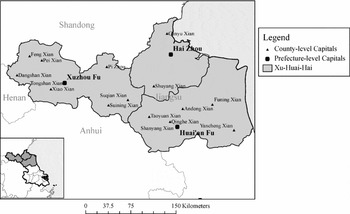
Before the 1880s, the rural economy of Xu-Huai-Hai (see Figure 3) did not conform at all to the standard pattern of a self-sufficient economy where ‘the man tills and the woman weaves’ (Xu and Wu Reference Xu and Wu2003: vol. 2, 265). Nor did the region conform to the pattern, identified by Sugihara Kaoru (Reference Sugihara, Mathias and Davis1997: 148–166), of a ‘miracle’ of development in China involving a high standard of living and advanced market system between the sixteenth and nineteenth centuries. While this latter pattern fits the historical reality of Song-Tai, and to some extent that of Tong-Hai, Xu-Huai-Hai lagged far behind.
Xu-Huai-Hai sub-region, with county capitals, 1820.
Source: ‘CHGIS, Version 4’ Cambridge: Harvard Yenching Institute, January 2007.

Before the Song dynasty (960–1279) the rural economy of Xu-Huai-Hai was highly developed. During the Tang dynasty (618–906) the region belonged to the macroregional ‘core’ both economically and politically, and had a flourishing textile industry.Footnote 9 Xu-Huai-Hai was the source of tribute goods including high-quality silk and silk cloth of various kinds (Ouyang Reference Ouyang2000: 38:645). Shi Nianhai (Reference Shi1978: 268) has shown that the Henan Dao, which included Xu-Huai-Hai, produced both first- and second-class silk. A famous poem by Bai Juyi (Reference Bai1992: 138) described a typical panorama of ‘the man tilling and the woman weaving’ in a village near Xuzhou. Much later, a poem from the Qing dynasty (Tang Reference Tang1811: 13:30a) recalled that, ‘I have heard that mulberry and hemp used to be planted all over this district [of Haizhou]’. Finally, according to Ming agricultural handbooks, textile machinery in and nearby Xu-Huai-Hai was much more advanced than in other areas up to the Song dynasty (Xu Reference Xu and 永瑢1639: 493, 495).
After the Song, however, handicraft textile production in Xu-Huai-Hai declined dramatically (Shi 1978: 267–268). A series of local gazetteers show that it was common for rural households to produce no handicraft textiles but to rely exclusively on agriculture. Jin Bingzuo, magistrate of Shanyang (Huaian) County in the mid Qing, reported the absence of weaving (Wu Reference Wu1884: 2:6a):
In 1742, I was appointed as magistrate of Shanyang County. Every time I go into the countryside to participate in disaster relief, I never see a loom or hear the sound of a spinning wheel in action. When they need yarn for sewing, the women there spin cotton into yarn not by using a spinning wheel but with their bare hands. Handicraft weaving has long since disappeared. All this is the reason why the people in this county are so poor.
Later, in Suining County a nineteenth-century observer (Yiwenlu, 16 August 1893: 369a) reported. ‘It is universal for both men and women to raise oxen to cultivate the land. There is no handicraft cloth industry at all. All the cloth used by the population is imported from other areas’. Similarly, there was no evidence for the coexistence of agriculture and handicraft weaving in Yancheng and Qinghe Counties in Huaian Prefecture before the very end of the nineteenth century (Liu Reference Liu1895: 2:25b, 29b–30a; Lu Reference Lu1919: 2:8b).
Even conscious attempts to introduce weaving into this area failed. In the mid-sixteenth century Ma Jing, a magistrate in Xuzhou Prefecture, attempted to train the local population in the skills necessary to spin and weave, but ‘there were still no spinners or weavers there’ (Zhuang Reference Zhuang1923: 24:17b, 20a). In the mid Qing, several magistrates attempted to promote weaving by setting up spinning and weaving schools and inviting experienced weavers from Song-Tai to train local girls. However, there was no response from the populace. One official (Wu Reference Wu1884: 2:5b–6a) wrote: ‘This effectively demonstrates that Huaian people are too lazy’. As a result, a nineteenth-century writer (Xue Reference Xue1882: 1:7b) reported that up to the 1870s,
In the whole area north of the Yangzi, only Tongzhou and Haimen people are acquainted with handicraft cloth. The people of Huaian and Yangzhou are ignorant of the benefits of sericulture and textile production; they rely exclusively on agriculture and so live a life of great poverty.
Nor was the cultivation of raw cotton common in Xu-Huai-Hai, even at a time when it was a dominant crop in Song-Tai. Cotton was not listed by the Gazetteer of Jiangnan (Huang Reference Huang and 永瑢1986: 428–431) as a local product or crop anywhere in the prefectures of either Xuzhou or Haizhou. Although it was listed in Huaian, the Gazetteer specifically noted that it was only grown south of the Huai River.
In the late Imperial period, Xu-Huai-Hai was relatively commercialised—more so than Song-Tai. This was because all clothing was purchased through the market, while in terms of crop production households grew fine grain for sale while purchasing lower-quality grain, leaving a cash surplus necessary to buy clothing and other goods (Liu Reference Liu1991: 231–232, 243–244).
The lack of handicraft weaving in the sub-region had a negative impact on the position of women. Although the income-generating opportunities offered by weaving greatly enhanced the status of women in Song-Tai, their absence in Xu-Huai-Hai led to low status. In Yancheng at the end of the nineteenth century one observer (Liu Reference Liu1895: 2:25b) wrote. ‘Women cannot support themselves because there is no handicraft weaving industry. They lack self-confidence and have no means to survive without menfolk to support them’. In many counties, such as Yancheng, Pi and Xinghua, they were frequently forced into prostitution (Zhou Reference Zhou1839: 8b–9a; Liu Reference Liu1895: 2:30a; Zhuang Reference Zhuang1923: 24:19b).
The biographies of virtuous women show a telling distinction between Xu-Huai-Hai and Song-Tai. While, as shown above, in Song-Tai many women were honoured for supporting their families through handicraft weaving, in Xu-Huai-Hai women were most commonly honoured for ‘cutting off their own flesh to feed their ill relatives’ (kuigu liaoqin). In Huaian, Xuzhou and Haizhou, 16 out of 45, 8 out of 28 and 13 out of 29 women were honoured for this reason, but not a single one for supporting their family through handicraft weaving (Miao Reference Miao2002: vol. 11, 570–574, 587–590, 602–605).
We have described above the changes brought about by industrialisation in the peasant economies of Song-Tai and Tong-Hai. In Xu-Huai-Hai likewise some of the most important changes centred around cotton and the cotton textile industry.
As foreign yarn started to be imported into China in the late nineteenth century, this enabled rural households in Xu-Huai-Hai to begin to produce handicraft cloth. While in the mid-nineteenth century there had been substantial imports of foreign cloth into the sub-region, yarn rapidly began to replace cloth as the main import. Several times the Customs reports stressed that the yarn imported through Zhenjiang was destined for handicraft weavers in Xu-Huai-Hai and adjacent regions.
The 1891 Customs Report for Zhenjiang (IMC 1892: 182), which was the most important port serving Xu-Huai-Hai, reported that,
There were, however, large decreases in the import of some of the principal goods, such as Grey Shirtings, of which 108,757 pieces less than in 1890 came to hand. . . . Indian yarn is making great strides, as the following figures will show: 1889, 947 piculs; 1890, 12,820 piculs; 1891, 26,150 piculs. It is used for making so-called Native Cloth, and will, there is no reasonable doubt, eventually supplant the Native article.
The next year yarn sales went even better, and the Report (IMC 1893: 181) said,
Indian Cotton Yarn being represented by the unprecedented figure of 85,000 piculs, against 27,000 piculs in 1891, the advance over the preceding year amounts to over 200 per cent. . . . The looms for the manufacture of handicraft cloth out of Indian Yarn are spread over a comparatively limited district adjoining the right bank of the Huang-ho (Huang He) and extending over the delta formed by the present and the old channel of that river, which fact will be found to be corroborated by an examination of our Inward Transit table.Footnote 10
Indian cotton yarn, valued at 4.5 million taels, contributed 30% of the foreign imports through Zhenjiang in 1902. According to the Customs Report (IMC, 1903, 336),
Most of it went into the interior, the districts of Hsü-chou (Kiangsu [Jiangsu]), Chi-ning [Jining] (Shantung [Shandong]), and Ch'en-chou [Chenzhou] (Honan [Henan]) being the principal consumers. Native Cloth woven from this Yarn is preferred by the Chinese to the Foreign-manufactured fabrics.
The Zhenjiang Customs Report for 1903 (IMC, 1904, 371) stated that,
Indian Cotton yarn, which in 1902 was under the previous year's figures, has during 1903 advanced 58,000 piculs over 1902. During the past 10 years the importation of this item has progressed steadily, and the figures for 1903 are four times as great as those for 1894.
Feuerwerker (Reference Feuerwerker1970: 343) has argued that, ‘Ironically, the very success of yarn imports in the last four decades of the Manchu Dynasty, which had a critical effect upon the structure of China's textile handicrafts, indirectly came to be the major obstacle to the equally rapid development of cloth imports’. This argument is supported by the reports of Zhenjiang Customs in the early twentieth century. For example, the Report for 1904 (IMC 1905: 409–410) stated,
The falling off is entirely under Foreign Cotton Goods, 1 million taels, and Indian Cotton Yarn, 100 per cent, valued at 2¾ million taels. All the principal Piece Goods, with the exception of Plain Cotton Italians, show diminished importations, the decrease in Grey Shirtings, American Drills, T-Cloths, and Plain Cotton Prints being especially noticeable. The restrictive influence of the high prices of Foreign Cotton Goods, which ruled during the year, coupled with the increasing tendency on the part of country people to weave their own cloth, ought to have fostered a corresponding increase in the Yarn trade, and no doubt it did.
From the 1920s, very little foreign cloth was imported to Xu-Huai-Hai through Zhenjiang.
Local evidence backs up the Customs reports and confirms that Xu-Huai-Hai did develop handicraft cloth production in the late nineteenth and early twentieth centuries. In Huaian Prefecture handicraft weaving, which, as shown above, was little practised earlier, developed rapidly in the late Qing. Just as in Tong-Hai, the pattern was one where rural weavers gained their skills in small modern weaving mills. They then left in order to take up handicraft weaving, providing competition that forced the modern mills to close. We can see this pattern with several small factories, for example in Funing (Pang Reference Pang1934: 13:1b), as well as in Qingjiang [Qinghe], Shuyang, Guanyun, Donghai [Guanyun and Donghai were earlier part of Haizhou] and other counties (Yu Reference Yu1920b: 33; Fan Reference Fan1922: 150, 155, 158, 160; Zhang Reference Zhang1926: 7:7b; Zhang Reference Zhang1933: 3:2a; Peng Reference Peng1957: vol. 2, 367).
Likewise, in Xuzhou Prefecture, although historically there had been almost no handicraft cloth production, by the 1890s weaving developed widely. A report from Suining County (Yiwenlu 16 August 1893: 369a) stated that, ‘Since foreign yarn began to pour in, almost every villager is happy to weave cloth. A piece of cloth woven by themselves can save them over 10 cash’. In the early Republican period, about 38,000 pieces of handicraft cloth were woven annually in Suining (Yu Reference Yu1920a: 10). Other observers (Yan Reference Yan1935: 2:10a) reported that, in neighbouring Suqian, ‘cloth was previously imported from Nantong, but now cotton is widely cultivated and handicraft weaving is very popular’, while in Tongshan, ‘handicraft weaving is very common in both rural and urban areas, and each household owns three to four looms’ (Tang Reference Tang1919a: 5). A similar development of handicraft weaving also took place in Feng, Pi, Pei and Xiao Counties to the west and the north of the prefecture (Tang Reference Tang1919b: 11, Reference Tang1919c: 20, Reference Tang1919d: 29).
In the 1930s, the urban centres of both Huaiyin and Xuzhou Prefectures functioned as marketing hubs for rural areas practicing handicraft weaving (Fangzhi shibao 1933: 2077). An investigation by the Ministry of Industry (Shiyebu 1933: 2:68–69) reported:
Since cotton mills were built in the treaty ports, many farmers have begun to buy machine-spun yarn in order to weave handicraft cloth . . . Even the people of Huaiyin [Qinghe], Lianshui [Andong] and Suqian Counties were easily able to engage in the business . . . Other counties such as Siyang [Taoyuan], Suining, Xiao, Pi and Dangshan relied on yarn purchased from Xuzhou for handicraft weaving.
Although Pomeranz (Reference Pomeranz1993: 107) has argued that village leaders in western Shandong feared losing both power and money if they helped to promote US cotton, in the different situation of Xu-Huai-Hai the elites saw the promotion of cotton cultivation and handicraft textiles as an important way to utilise local resources and expand their influence. Thus, many followed Zhang Jian's example by promoting cotton cultivation as well as handicraft weaving (Fan Reference Fan1922: 155–156). In fact Zhang himself had established a score of cotton cultivation companies in the early twentieth century, which greatly improved the conditions for handicraft textile production in Xu-Huai-Hai as well as in Tong-Hai (Pang Reference Pang1934: 12:1b).
The growth of cotton cultivation can be seen in the fact that the number of households in Xuzhou cultivating American cotton increased from 1,346 to 23,184 between 1934 and 1936, while the amount of land sown to the crop increased from 400 hectares to over 7,000 hectares (Yin Reference Yin1937: 570–572). By the 1930s, those parts of the Xu-Huai-Hai sub-region centring on the old watercourse of the Huang He, and including Funing, Huaiyin, Huaian, Lianshui, Feng, Tongshan, Xiao, Pei and Dangshan Counties, had become a key cotton-producing area. In 1937 a total of 120,000 hectares yielded 18,700 tons of cotton (Kahoku renrakubu 1941: 299–300).
In the early twentieth century, the development of modern industry transformed the Xu-Huai-Hai peasant economy into one where ‘the man tilled and woman wove’, that is, it turned a partially commercialised into a more autarchic economy. Although the rural population of Xu-Huai-Hai, like that of Tong-Hai, purchased machine-spun yarn on the market, the quality of the cloth they produced was much inferior to that of Tong-Hai (Wu Reference Wu1875: 5b), and most of it was used within the household, with little resold on the market. An investigation of 1942 (Kachū renrakubu 1942: 66–67) did not list handicraft cloth as an export product in any of the districts near the Salt Canal in Haizhou.
Any increase in purchases of yarn came at the expense of a decline in purchases of cloth, and did not result in a rise in the overall level of commercialisation. The Commissioner of the Zhenjiang Customs (IMC 1893: 181) stated,
I have not heard of any [handicraft cloth] consignments being made to Chinkiang or other markets. A glance at the Transit table shows that the very districts [Xuzhou and nearby counties] mentioned as purchasers of Yarn are distinguished by noteworthy deficits in the importation of other fabrics. The districts south of the Yangtze and close on the north bank can scarcely be said to share in this fluctuation.
At the same time the grain trade declined, because households who produced handicraft cloth no longer needed to purchase cloth on the market, and therefore had less need to generate cash by selling high-quality and purchasing low-quality grain. This further restricted the level of commercialisation.
Conclusion
The experience of Jiangsu shows that advanced areas could become a powerful mechanism to allow other less developed areas to grow and dynamically reallocate their economic resources.Footnote 11 As against Pomeranz's (Reference Pomeranz1993: ch. 3) argument that the outcome of development in one region could be underdevelopment in another, in Jiangsu we can observe both ‘growth’ and ‘development’ in the transformation of Jiangsu's peasant economy as the development of modern industry led, through the ‘invisible hand’, to the harmonious development of different regions.
This paper also shows that variations between ‘core’ and ‘periphery’ in Jiangsu fit the Skinnerian model quite well, but on the other hand it throws into question another of Skinner's contentions: that the economy of core areas was usually much more commercialised than that of the periphery. In fact the characteristics of the core as compared with the periphery were rather a more rational allocation of resources, a lower proportion of the population engaged in agriculture and a much higher standard of living.Footnote 12
Thus, in rural Song-Tai, where the commodity economy had been highly developed, industrialisation led to a change in the predominant occupation from handicraft cloth production to industrial labour, while the high level of commercialisation of the rural economy was actually reduced by an increase in production for household use. In this area, the decline of handicraft textiles was the result of a shift of labour from handicraft weaving to modern industrial employment, not of machine-woven products supplanting handicraft cloth. Nor did the decline presage an increase in commercialisation or the bankruptcy of the peasant economy. Since factory wages were much higher than the incomes earned through weaving, the standard of living of rural households greatly improved.
In Tong-Hai, which before the 1880s had been a typical area where agriculture was combined with handicraft textile production, modern industry did not destroy textile production at all, but rather enhanced it and enabled it to operate on a more commercialised basis. It was in this area, but only there, that the level of commercialisation was clearly increased by the emergence of modern industry.
In Xu-Huai-Hai, cotton textile production only became common in the late nineteenth and early twentieth centuries. Industrialisation transformed the peasant economy from one whose relatively high level of commercialisation was a function of its need to import cotton textiles from other areas into a more balanced economy combining agriculture with handicraft textile production. Though it is very doubtful that the level of commercialisation increased, there emerged a much more rational deployment of human and natural resources, which was able to make better use of female labour.
Glossary
Baodi County 宝坻县
Baoshan County 宝 山 县
Baoxing County 宝兴县
Changshu County 常熟县
Chenzhou (Ch'en-chou) 陈州
chi (ch'ih) 尺
Chongming Island 崇 明 岛
Chuansha County 川 沙 县
cun 村
Dangshan County 砀山县
Dasheng Cotton Mill 大生纱厂
Donghai County 东海县
Erjia Township 二甲镇
Feng County 丰县
Funing County 阜宁县
Gaoyang County 高阳县
Guanyun County 灌云县
Guohua 国华
Haimen Subprefecture 海门厅
Haizhou Autonomous Department 海州直隶州
Henan Dao 河南道
Houyou Zha 候油榨
Huaian Prefecture 淮安府
Huaiyin County 淮阴县
Huayang Township 华阳镇
Jiading County 嘉定县
jia ji bu 家机布
Jin Bingzuo 金秉祚
Jingjiang County 靖江县
Jining (Chi-ning) 济宁
Jinsha Township 金沙镇
Jinyu Township 金余镇
jisakunō 自作农
Kaiyuan District开源乡
kuigu liaoqin 刲股疗亲
Kunshan County 昆山县
Lianshui County 涟水县
Lisheng 利生
Litai District 利泰乡
Ma Jing 马京
mu 亩
Nanhui County 南汇县
Nantong County 南通县
nügong 女红
Pei County 沛县
Pi County 邳县
Qinghe County 清河县
Qingjiang County 清江县
Qingpu County 青浦县
Rongxiang District 荣巷乡
Rugao County 如皋县
Sanyuan County 三原县
sha bu 沙布
Shanyang County 山阳县
shō jisakunō 小自作农
Shuyang County 沭阳县
Siyang County 泗阳县
Songjiang Prefecture 松江府
Song-Tai 松太
Suining County 睢宁县
Suzhou Prefecture 苏州府
Taicang Autonomous Department 太仓直隶州
Taixing County 泰兴县
Tong-Hai 通海
Tonghua 同华
Tongshan County 铜山县
Tongzhou (T'ung-chou) Autonomous Department 通州直隶州
Touzong Village 头总村
Wei County 潍县
Wujiang County 吴江县
Wujin County 武进县
Wuxi County 无锡
Xiao County 萧县
Xiaoding District 小丁乡
Xinghua County 兴化县
Xu-Huai-Hai 徐淮海
Xuzhou (Hsü-chou) Prefecture 徐州府
Yancheng County 盐城县
yangji 洋机
Yangshupu 杨树浦
Yangsi District 杨思乡
Yangzhou Prefecture 扬州府
zhang (chang) 丈
Zhang Jian 张謇
Zhenjiang (Chinkiang) 镇江
Zhenru 真如