Implications
Results from this experiment indicated that manipulating geese maternal dietary fatty acid supplements can alter polyunsaturated fatty acid (PUFA) profiles in egg yolks and improve the health of their progeny. This could provide a foundation for further understanding n-3 PUFA effects on progeny lipid metabolism and immune functions.
Introduction
In poultry, maternal nutrition plays an important role in the performance and health of their progeny because the nutrients required by the developing offspring are transferred from the hens via the egg (Hamal et al., Reference Hamal, Burgess, Pevzner and Erf2006). Yolk fatty acid (FA) is the major source of energy and is known to influence the tissue lipid metabolism and FA composition of the developing chicks during embryogenesis (Cherian and Sim, Reference Cherian and Sim1991; Cherian and Sim, Reference Cherian and Sim1992; Ajuyah et al., Reference Ajuyah, Wang, Sunwoo, Cherian and Sim2003; Hall et al., Reference Hall, Jha, Skinner and Cherian2007). Convincing evidence has been published suggesting that the modulation of n-3 polyunsaturated fatty acid (PUFA) in egg yolks resulted in a greater n-3 PUFA deposition content, liver desaturase enzyme activity, immune response and antioxidant status in tissues of their offspring (Cherian and Sim, Reference Cherian and Sim1991 and Reference Cherian and Sim1992; Ajuyah et al., Reference Ajuyah, Wang, Sunwoo, Cherian and Sim2003; Pappas et al., Reference Pappas, Acamovic, Surai and McDeviitt2006; Hall et al., Reference Hall, Jha, Skinner and Cherian2007; Bautista-Ortega et al., Reference Bautista-Ortega, Goeger and Cherian2009). EPA (20:5n-3), DPA (22:5n-3) and DHA (22:6n-3) are the major n-3 PUFAs derived from α-linolenic acid (α-LNA, 18:3n-3). A evidence has indicated that enhancing the n-3 PUFA content of tissues during growth may lead to better health by reducing inflammatory disorders and metabolic disease-related pathologies (Ajuyah et al., Reference Ajuyah, Wang, Sunwoo, Cherian and Sim2003). However, increasing the n-3 PUFA content increases the susceptibility to peroxidation and deterioration of broiler chickens (Eritsland, Reference Eritsland2000; Rymer and Givens, Reference Rymer and Givens2005).
Among the different feed stuffs, flaxseed (Linum usitatissimum) is unique among oil seed crops and is a rich source of protein (>22%), oil (>38%) and α-LNA (50% of total lipid) for poultry (Leeson and Summers, Reference Leeson and Summers2005). However, data concerning the effects of maternal n-3 PUFA modulation by feeding flaxseed on the antioxidant status of hatching goslings are scarce in geese. We hypothesized that goslings hatched from eggs enriched in n-3 PUFA would incorporate higher levels of n-3 PUFA into tissues, affecting their antioxidant status. Therefore, the objective of the present study was to investigate the effects of supplementing maternal diet with flaxseed on yolk FA profiles of geese and the antioxidant status of their neonatal progeny.
Material and methods
Birds, housing and experimental design
A total of 288 female Huoyan geese (42-week old, BW=3.65±0.40 kg) were randomly allocated to a 56-day trial. The birds were fed a corn–soybean basal diet (same with control diet) for 2 weeks for adaptation and then subjected to four dietary treatments, containing flaxseed at 0% (control), 5%, 10% and 15%, respectively. There were nine replicate pens with 8 geese/replicate. An Institutional Animal Care and Use Committee of Henan Agricultural University (Zhenzhou, Henan, China) approved all experimental protocols.
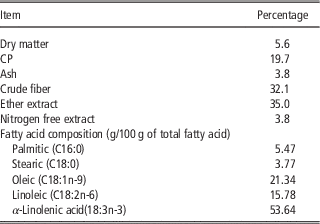
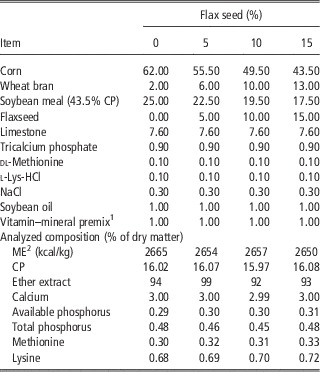
All geese were raised in house with stainless steel pens of identical size (3.00×2.55 m) with concrete floors covered with clean rice bran in an area that provided 16 h light and 8 h dark on a daily basis. Room temperature was maintained at 24°C to 26°C and the relative humidity was around 60% throughout the whole experimental period. Water and feed were provided ad libitum. The flaxseed were ground to 700–800 μm before mixing and its chemical composition was analyzed (Table 1). All diets were supplied in mash form and were formulated isoenergetic and isonitrogenous to meet or exceed the nutritional requirements of the goose (National Research Council, 1994, Table 2). Geese were artificially inseminated twice on three consecutive days with 0.08 ml of pooled semen from Huoyan geese kept at Henan Agricultural University (Zhenzhou, Henan, China).
Chemical composition of flaxseed used in this experiment (as-fed basis)

Nutrient composition of experimental diets (as-fed basis, %)

1 Provided per kg of diet: 9000 IU of vitamin A (retinyl acetate), 1400 IU of vitamin D3 (cholcalciferol), 15 mg of vitamin E (DL-α-tocopherol), 1.5 mg of vitamin K3, 2 mg of thiamin, 2 mg of riboflavin, 2 mg of vitamin B6, 12 μg of vitamin B12, 75 mg of niacin, 20.5 mg of folic acid, 0.1 mg of biotin, 1400 mg of choline chloride, 13.5 mg of pantothenic acid, 60 mg Zn (as ZnSO4·5H2O), 66 mg of Mn (MnSO4·5H2O), 96 mg of Fe (as FeSO4·7H2O), 5 mg of Cu (as CuSO4·5H2O), 0.42 mg of I (as KI) and 0.1 mg of Se (as Na2SeO3·5H2O).
2 The metabolizable energy (ME) of the diet was calculated according to National Research Council (1994).
Sampling and preparation
At the end of the 56-day breeder experiment, 432 normal (no shell defects, cracks or double yolk) eggs (4 eggs/replicate per day, 36 eggs/treatment per day) were collected during a period of 3 days and kept in a cooler at 18.3°C. In total, 27 eggs from each treatment (3 eggs/replicate) were collected randomly and the yolks were manually separated. Yolk samples from each replicate were pooled and homogenized with ice isotonic physiological saline (0.154 mol/l; pH=7.4) in the ratio of 1 : 9 for 5 min with a vortex mixer. The homogenate was then centrifuged at 1500×g and 4°C for 10 min. The resultant supernatants were subsequently stored at −20°C to determine cholesterol levels and FA profile.
The remaining 324 eggs were incubated at a dry bulb and wet bulb temperature of 37.5°C and 29.4°C, respectively. At day 31 of incubation, the eggs were candled and infertile eggs were removed and counted. The eggs were transferred to hatch baskets and the hatch was pulled at 32.5 days. In total, 27 (3 goslings/replicate) newly hatched goslings were randomly chosen from each treatment group and blood (5 ml/gosling) was collected from the jugular vein using sterilized syringe, and the goslings were sacrificed. The blood samples were incubated at 37°C for 2 h and were then centrifuged at 1500×g for 10 min. The resultant serum was stored in 1.5 ml Eppendorf tubes at −20°C. Gosling liver samples were quickly removed, snap-frozen with liquid nitrogen and stored at −80°C until analysis. Liver tissue and blood samples (n=3) from each replicate were pooled to obtain a sample size of nine per treatment for analytical purposes. About 0.5 g from each pooled sample was homogenized in five volumes of ice-cold phosphate-buffered saline for 30 s. After centrifugation at 10 000×g for 30 min at 4°C, the supernatant was collected and stored at −80°C until assay.
Determination of egg yolk FAs profile and cholesterol content
Total cholesterol and FAs profile of egg yolk, diets and flaxseed were determined in lipid separated via extraction from the egg yolk with a chloroform and methanol mixture (2 : 1 v/v). Total cholesterol in egg yolk was quantified using a commercial kit (Beijing Biological Technology Co., Beijing, China). The FAs of egg yolk were separated and were then identified by gas chromatography HP 6890 (Agilent, Waldbronn, Germany) equipped with a flame ionization detector and an HP 19091 (Agilent, Waldbronn, Germany) to 136 capillary column (60×0.25 mm internal diameter) with a film thickness (0.25 μm) of stationary phase. Calibration and identification of the peak for the diverse FAs were obtained by comparing the retention time with that of a standard whose composition was previously known. Helium (at 1.5 ml/min) was used as the carrier gas.
Blood characteristics analysis
The concentrations of total protein, glucose, albumin and globulin in the serum samples were analyzed with an Automatic Biochemical Analyzer (RA-1000, Bayer Corp., Tarrytown, NY, USA) using colorimetric methods. Serum total cholesterol and triglycerides (glycerol-3-oxidase-peroxidase-enzymatic-colorimetric) levels were analyzed by an automated Vitros 350 analyzer (Otho-Clinical Diagnostic, Johnson & Johnson, Rochester, NY, USA). The levels of enzyme activities including aspartate aminotransferase and alanine aminotransferase were analyzed using an Automated Clinical Chemistry Analyzer (Roche, Cobus-Mira-Plus, Roche Diagnostic System, Inc., NY, USA).
Assay of antioxidants status in liver
Liver sample of gosling was assayed for enzymatic activity of superoxide dismutase (SOD), catalase, glutathione peroxidase (GSH-Px), glutathione reductase and content of glutathione and malondialdehyde (MDA) using the same procedures as described by Zhang et al. (Reference Zhang, Zhu, Cai and Wu2008) with assay kits obtained from Nanjing Jiancheng Bioengineering Institute (Nanjing, Jiangsu, China). Triplicate analyses were performed and the mean was used for each sample.
Feed chemical analysis
Approximately 200 g of each diet was taken from each batch upon mixing, stored at −20°C and then composited to four samples (every two batches for the first four batches and last batch) for chemical analysis of CP (method 990.03; Association of Official Analytical Chemists (AOAC), 2000), calcium, phosphorus (method 985.01; AOAC, 2000) and amino acids (method 982.30; AOAC, 2000), and the diet composition values are presented in Table 1.The diet FA composition is determined using the same method with egg yolk and shown in Table 2.
Statistical analysis
All data were analyzed using the GLM procedures of SAS software (SAS Institute, Inc., Cary, NC, USA), with each replicate pen as the experiment unit. For FAs contents, log transforms were applied where data were not normally distributed. Differences among treatment means were determined using the Duncan’s multiple range test. Linear and quadratic regression contrasts were included in the analysis to determine the animal response to increasing dietary flaxseed levels. Values were considered significant at P⩽0.05.
Results
Egg yolk FA profile and cholesterol contents
The dietary chemical composition is shown in Tables 2 and 3. The concentrations of n-3 PUFA were greater in 5%, 10% and 15% flaxseed-containing treatments than in the control diet (24.19%, 29.17% and 32.88%, respectively, v. 6.02%). The total saturated and monounsaturated fatty acid contents were also less in the flaxseed-supplemented diets.
Fatty acid composition of diet (as-fed basis (g/kg diet))

1 SFA (saturated fatty acid)=14:0+15:0+16:0+18:0+20:0+22:0+24:0.
2 MUFA (monounsaturated fatty acid)=14:1+16:1n-7+18:1n-9+20:1n-9.
3 PUFA (polyunsaturated fatty acid)=18:2n-6+18:3n-3+20:4n-6+20:5n-3+22:5n-6+22:5n-3.
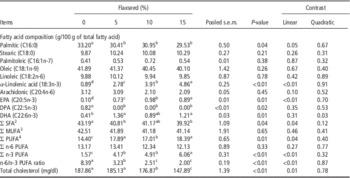
Geese fed increasing concentrations of flaxseed had decreasing (linear, P=0.01) total cholesterol levels in their egg yolks (Table 4). The concentration of palmitic acid (linear, P=0.05), DPA (P=0.02) and saturated fatty acid (linear, P=0.04) in egg yolks were lower, in the flaxseed-containing groups than in the control diet. Geese fed 15% flaxseed had greater concentrations of α-LNA (linear, P<0.01), EPA (P<0.01), DHA (quadratic, P=0.03), total PUFA (linear, P=0.04) and total n-3 PUFA (linear, P<0.01) compared with the control diet. The contents of α-LNA and EPA were highest at the 15% flaxseed supplementation level. No differences were observed in monounsaturated fatty acid and PUFA levels among treatments. The n-6/n-3 ratio was shown to linearly decrease (P<0.01) as the flaxseed levels increased.
Egg yolk fatty acid composition and cholesterol content of Huoyan geese fed with flaxseed for 56 daysFootnote 1

a,b,c Means in the same row not followed by the same superscript letter are significantly different at P<0.05.
1 n=9 replicate pens/treatments, 3 goslings/pen.
2 Σ SFA (saturated fatty acid)=14:0+15:0+16:0 +18:0+20:0+22:0+24:0.
3 Σ MUFA (monounsaturated fatty acid)=14:1+16:1n-7+18:1n-9+20:1n-9.
4 Σ PUFA (polyunsaturated fatty acid)=18:2n-6+18:3n-3+20:4n-6+20:5n-3+22:5n-6+22:5n-3.
Blood characteristics of neonatal goslings
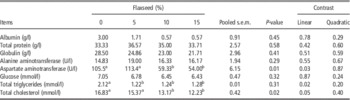
Neonatal goslings hatched from geese fed 10% and 15% flaxseed had decreased levels of aspartate aminotransferase (linear, P=0.03), total triglycerides (linear, P=0.02) and total cholesterol (linear, P=0.05) in their blood (Table 5). The serum levels of albumin, total protein, globulin, alanine aminotransferase and glucose in the goslings were not affected by the maternal dietary treatments.
Blood characteristics of 1-day-old goslings as affected by maternal dietary supplementation with flaxseedFootnote 1

a,b Means in the same row not followed by the same superscript letter are significantly different at P<0.05.
1 n=9 replicate pens/treatments, 3 goslings/pen.
Liver antioxidant status of neonatal goslings
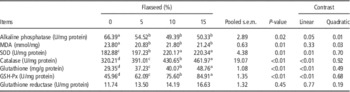
The alkaline phosphatase levels in livers were lower (linear, P=0.05) in goslings from geese fed flaxseed-containing diets (Table 6). The SOD (linear, P=0.01), GSH-Px (linear, P<0.01) and catalase (linear, P<0.01) enzyme activities and the glutathione (linear, P<0.01) concentration were linearly increased by increasing flaxseed levels. The MDA content decreased (quadratic, P=0.03) compared with the control as flaxseed supplementation levels increased; however, no differences were observed between different flaxseed levels. There was no difference in glutathione reductase activity among the dietary treatments.
Antioxidant enzyme activities, MDA and glutathione content in liver of 1-day-old goslings as affected by maternal dietary supplementation with flaxseedFootnote 1

a,b,c Means in the same row not followed by the same superscript letter are significantly different at P<0.05.
1 n=9 replicate pens/treatments, 3 goslings/pen. MDA=malondialdehyde; SOD=superoxide dismutase; GSH-Px=glutathione peroxidase.
Discussion
In the current study, we observed that the dietary addition of flaxseed resulted in greater α-LNA, EPA, DHA and n-3 PUFA levels in the egg yolks of geese in a dose-dependent manner, which resulted in a lower n-6/n-3 ratio. Moreover, the feed intake and egg number of geese, as well as the offspring growth rate were not affected in our study (data not shown). The modulation in the FA profiles present in the egg yolks as a result of n-3 PUFA supplementation is well documented (Cherian and Sim, Reference Cherian and Sim1991; Jiang et al., Reference Jiang, Ahn, Ladner and Sim1992; Bavelaar and Beynen, Reference Bavelaar and Beynen2004; Cherian, Reference Cherian2008). Bavelaar and Beynen (Reference Bavelaar and Beynen2004) also indicated that there was a linear relationship between dietary α-LNA and DHA, and their content in egg yolks. Flaxseed is a rich source of n-3 PUFA, and it contains ~20% α-LNA (dry matter basis). Including 10% to 20% flaxseed in laying hen rations can produce eggs with more n-3 PUFAs, such as α-LNA, EPA and DHA (Cherian and Sim, Reference Cherian and Sim2001; Bavelaar and Beynnen, Reference Bavelaar and Beynen2004; García-Rebollar et al., Reference García-Rebollar, Cachaldora, Alvarez, De Blas and Méndez2008; Hayat et al., Reference Hayat, Cherian, Pasha, Khattak and Jabbar2009; Oliveira et al., Reference Oliveira, Baio, Canado, Grimaldi, Souza, Lara and Lan2010). This may be because the α-LNA in flaxseed can be converted into EPA and DHA by the birds’ livers and the synthesized FAs are subsequently deposited in the egg yolks (Jiang et al., Reference Jiang, Ahn, Ladner and Sim1992). The enzyme Δ6-desaturase is the rate-limiting step in the synthesis of long-chain n-3 PUFA formulation from their 18-carbon precursors (Brenner, Reference Brenner1971; Cherian, Reference Cherian1993). There is a competition between n-6 and n-3 PUFAs in which n-3 PUFAs are used as the preferred substrate in the desaturation–elongation pathway, leading to a decreased n-6/n-3 FA ratio in the eggs from hens fed flaxseed.
Current research findings suggested that dietary flaxseed reduced total cholesterol levels in the egg yolks, which is in accordance with our previous study (Chen et al., Reference Chen, Jiang, Wang, Huang and Wang2014). However, Botsoglou et al. (Reference Botosoglou, Yannakopoulos, Fletouris, Tserveni-Goussi and Psomas1998) and Petrović et al. (Reference Petrović, Gačić, Karačić, Gottstein, Mazija and Medić2012) found that the inclusion of 5% and 10% flaxseed, or flaxseed oil, in laying hen diets did not influence the egg yolks’ cholesterol levels. The cholesterol-reducing effect of dietary n-3 PUFA has been well documented in the plasma of animals (Adkins and Kelley, Reference Adkins and Kelley2010); however, few studies have confirmed its reducing effects in egg cholesterol levels (Ayerza and Coates, Reference Ayerza and Coats1999 and Reference Ayerza and Coats2000). Other studies also confirmed that the yolk’s cholesterol content was not affected by various lipid sources but was affected by the hen’s age (Botsoglou et al., Reference Botosoglou, Yannakopoulos, Fletouris, Tserveni-Goussi and Psomas1998; Hayat et al., Reference Hayat, Cherian, Pasha, Khattak and Jabbar2009; Petrović et al., Reference Petrović, Gačić, Karačić, Gottstein, Mazija and Medić2012). Thus, the cholesterol-reducing effect may be different in different avian species and its mechanism needs to be elucidated.
The goslings’ total serum cholesterol decreased linearly with increasing levels of flaxseed in the maternal diets. The mechanism by which maternal dietary lipid influences the concentration of serum lipids in their progeny is not fully known. Yolk FA is the major source of energy and is a modifiable factor known to influence the lipid and FA composition of the developing chicks during embryogenesis (Cherian and Sim, Reference Cherian and Sim1991 and Reference Cherian and Sim2001; Pappas et al., Reference Pappas, Acamovic, Surai and McDeviitt2006; Hall et al., Reference Hall, Jha, Skinner and Cherian2007). It is clear that dietary PUFA, particularly C18:2n-6 and n-3 FAs, may reduce hepatic FA and triacylglycerol synthesis. However, it is not clear whether altering the n-6/n-3 PUFA ratio exerts any influence on the lipid metabolism of their progeny or not. Further experimentation is necessary to investigate the lipid metabolism of their progeny.
Our study revealed that feeding flaxseed moderately increased the antioxidant enzyme activities (catalase, GSH-Px, glutathione reductase and SOD) and decreased the MDA levels in a dose-dependent pattern in the livers of goslings. GSH-Px, SOD and catalase activities can be used as indicators of the tissue’s oxidative stability (Bautista-Ortega et al., Reference Bautista-Ortega, Goeger and Cherian2009). SOD is the first enzyme to respond against oxidative stress. Catalase has been implicated as an essential defense against the potential toxicity of hydroxyl radicals. Glutathione-dependent enzymes, such as glutathione S-transferase, GSH-Px and GR, were able to counteract the peroxidation damage. These results suggest a unique role of maternal (egg yolk) n-6 and n-3 PUFAs in modulating the antioxidant capacity in the progeny. The greater GSH-Px, SOD and catalase activities observed for the different treatments of extruded flaxseed may be owing to the greater n-3 PUFA content in the liver. That the supplementation of the maternal diet with n-3 PUFAs increases the concentration of long-chain n-3 PUFAs relative to total FA in the yolk and in the tissues (liver, brain, heart and plasma) of the hatched chicks has been well documented (Cherian and Sim, Reference Cherian and Sim1992; Pappas et al., Reference Pappas, Acamovic, Surai and McDeviitt2006). Previous studies also demonstrated that manipulating egg yolk n-6 and n-3 PUFA contents can alter liver desaturase enzyme activity, immune and inflammatory responses, and PUFA-derived eicosanoid synthesis up to 21 days post-hatching in progeny goslings (Cherian and Sim, Reference Cherian and Sim2001; Liu and Denbow, Reference Liu and Denbow2001; Ajuyah et al., Reference Ajuyah, Wang, Sunwoo, Cherian and Sim2003; Hall et al., Reference Hall, Jha, Skinner and Cherian2007). Moreover, during avian embryogenesis, DHA is preferentially taken up from yolk sac lipids and is incorporated into cell membrane phospholipids of the developing embryo. Additionally, the liver shows a greater percentage of DHA (Cherian and Sim, Reference Cherian and Sim1992; Cherian, Reference Cherian1993). It is evident that PUFA is susceptible to attack by free radicals and can be oxidized into lipid peroxides (Eritsland, Reference Eritsland2000; Rymer and Givens, Reference Rymer and Givens2005), consequently contributing to inflammation and oxidative stress (Kubo et al., Reference Kubo, Saito, Tadokoro and Maekawa1998; Kubo et al., Reference Kubo, Saito, Tadokoro and Maekawa2000). However, the increase in n-3 PUFA percentage relative to n-6 PUFA can benefit the antioxidant capacity and alleviate inflammation by avoiding n-6 PUFA synthesis in the liver. We found that goslings hatched from n-3 PUFA-enriched treatments (up to 15%) can linearly enhance the antioxidant capacity and lower lipid peroxidation in the liver. Similarly, other studies also reported that n-3 PUFA enhanced the activities of the hepatic antioxidant enzymes SOD, catalase and GSH-Px (Demoz et al., Reference Demoz, Willumsen and Berge1992; Nieto et al., Reference Nieto, Fernández, Torres, Ríos, Suárez and Gil1998; Bhattacharya et al., Reference Bhattacharya, Lawrence, Krishnan, Zaman, Sun and Fernandes2003). This phenomenon may be because the levels of lipid peroxide scavengers, such as glutathione and GSH-Px, were greater in the liver and because DHA was preferentially utilized for phosphatidylcholine synthesis (Kubo et al., Reference Kubo, Saito, Tadokoro and Maekawa1997; Kubo et al., Reference Kubo, Saito, Tadokoro and Maekawa1998). It is also important to mention that the four diets used in this particular trial were stabilized using α-tocopherol (15 mg/kg of diet) to prevent oxidative damage. Similarly, Bautista-Ortega et al. (Reference Bautista-Ortega, Goeger and Cherian2009) found that catalase activities in the heart of newly hatched goslings were enhanced by flaxseed addition to the hen’s diet. However, they failed to observe any difference in antioxidant enzyme activities (GSH-Px, glutathione reductase, catalase and SOD) in the other tissues (liver, brain and lung) of goslings from high n-3 PUFA eggs. These data indicated a better antioxidant status for the liver, which may lead to better protection from oxidative stress. In addition, the lipid peroxidation indicators, such as a lower MDA content in the liver, reflected this result. The serum aspartate aminotransferase and alkaline phosphatase concentrations in the liver are also indicators of liver damage and inflammation. We found that goslings hatched from geese fed flaxseed had lower concentrations of serum aspartate aminotransferase and alkaline phosphatase than those subjected to other treatments. This may also reflect less damage to the liver owing to its greater antioxidant capacity. Further investigations are necessary to confirm this result and elucidate the possible mechanism.
In summary, results from this experiment confirm previous research showing that maternal supplementation with flaxseed as an n-3 PUFA source altered the PUFA profiles in egg yolks. The supplementation of the maternal diet with up to 15% flaxseed improved (linearly and quadratic) the antioxidant status of the goslings. The optimal supplementation level of flaxseed in the maternal diet appears to be 5% based on the antioxidant status of their goslings, and the price and availability of this lipid source. Future research with geese is needed to clarify n-3 PUFAs’ effects on their progeny’s lipid metabolism and immune functions.
Acknowledgments
This work was funded by National Natural Science Foundation of China (1272434), Innovation Scientists and Technicians Troop Construction Projects of Zhengzhou City (121PCXTD516) and Zhengzhou City Feed and Nutritional Key Lab (111PYFZX153).