Introduction
There are medically important mosquitoes that transmit diseases to humans. Their capability for disease transmission determines the medical importance of mosquitoes. Most mosquitoes are vectors of infections caused by viruses, protists, and nematodes (Agudelo et al., Reference Agudelo, Alfonso-Parra and Avila2021). Aedes mosquitoes transmit dengue, chikungunya, yellow fever, and Zika viruses to humans. Currently, dengue is the most important vector-borne disease caused by the DEN virus. Depending on the geographic area, several Aedes species, Aedes aegypti, Aedes albopictus, Aedes polynesiensis, and other members of the Aedes scutellaris group act as vectors for dengue virus transmission (Gubler, Reference Gubler1998). Vitarana et al. (Reference Vitarana, Jayakuru and Withane1997) stated that, in Sri Lanka, Ae. aegypti serves as the primary vector while Ae. albopictus serves as the secondary vector.
Female Ae. aegypti is monogamous (Craig, Reference Craig1967; Spielman et al., Reference Spielman, Leahy and Skaff1967), and they accept the sperms from only one male, although they copulate with many males (Hausermann and Nijhout, Reference Hausermann and Nijhout1975). They start to copulate soon after the emergence from the pupae (Gwadz and Craig, Reference Gwadz and Craig1968). Even if they copulate soon after emergence, females may not be inseminated as they become receptive to insemination only after 48–72 h of emergence (Gwadz and Craig, Reference Gwadz and Craig1968). Furthermore, it takes about 15–24 h for the male genitalia to rotate 180°, which is necessary for successful insemination (Hartberg, Reference Hartberg1971). The time lag after emergence for females to become receptive to insemination and males to undergo rotation of genitalia to effect successful sperm transfer allows the newly emerged females to disperse from the site of emergence and mix with the population before being inseminated. Ultimately, this prevents inbreeding and facilitates evolution through genetic mixing (Hartberg, Reference Hartberg1971). Thus, it ensures that mating does not occur in the breeding sites.
The global incidence of dengue has increased from 8.3 million in 1990 to 58.4 million in 2013 (Stanaway et al., Reference Stanaway, Shepard, Undurraga, Halasa, Coffeng, Brady, Hay, Bedi, Bensenor, Castañeda-Orjuela and Chuang2016). Annually, 390 million new dengue cases are reported from 128 dengue-endemic countries (Bhatt et al., Reference Bhatt, Gething, Brady, Messina, Farlow, Moyes, Drake, Brownstein, Hoen, Sankoh and Myers2013). Dengue control measures used by most countries rely heavily on insecticides, but the trend towards an integrated approach is evident in many countries, including Sri Lanka. Thus, an understanding of the life history, habitats, and other aspects of the ecology of the vector is vital towards this end.
Since an operative vaccine or a drug has not yet been developed to treat dengue, vector control is the only effective way to regulate the dengue (De Valdez et al., Reference De Valdez, Nimmo, Betz, Gong, James, Alphey and Black2011). The conventional approaches used to control the vector embrace source reduction, spraying larvicides, fumigation, and the use of Bacillus thuringiensis israelensis bacteria. Chemical controlling methods are delimited as they are toxic to humans, affect non-targeted species, and progress insecticide resistance (Dorta et al., Reference Dorta, Vasuki and Rajavel1993; Denholm et al., Reference Denholm, Devine and Williamson2002; Teixeira et al., Reference Teixeira, Augusto and Morata2003).
Various pheromones act as mating disruptors; besides, they delay the mating or prevent the mating of insects (Vickers, Reference Vickers1992). The upshot of delayed mating diverges among different species of insects. However, the mating disruptors may distress the population dynamics and help control the insect population size. When a high concentration of synthetic female sex pheromone of Ephestia cautella (Lepidoptera: Pyralidae) is upheld in the background, the mating of the females is barred (Brady and Daley, Reference Brady and Daley1975). Furthermore, Barrer (Reference Barrer1976) stated that synthetic female sex pheromones limit the mating in E. cautella only when the population density is very low and at higher population densities, which only leads to a delay in mating.
It is anticipated that the techniques such as the mass scale release of sterile males into dengue-endemic areas will interrupt the mating process by averting or delaying it and suppress the vector population density (Ponlawat and Harrington, Reference Ponlawat and Harrington2009). Age at the mating of both females and males affects female reproductive performance, including fecundity and fertility (McCann et al., Reference McCann, Day, Allan and Lord2009; Ponlawat and Harrington, Reference Ponlawat and Harrington2009). The increase of age at mating changes the physiology of the insects. Jones and Wheeler (Reference Jones and Wheeler1965) have specified that the length of the testis and the number of spermatocytes produced in each testis decline with the increase of the age of Ae. aegypti. Consequently, the quantity and the quality of sperms transferred into the female will condense, thereby affecting the fecundity and fertility of the female.
Eventually, delayed mating may occur in mosquitoes due to mating disruptors and the release of sterile males. Consequently, in the current study, it was hypothesized that delayed mating might affect the reproductive performance, life-history parameters, and longevity of Ae. aegypti. Nevertheless, limited studies have been conducted to assess all these effects. Thus, the objective of the study was to determine the impact of delayed mating on fecundity, fertility, larval mortality, total larval duration, pupal duration, and longevity of female Ae. aegypti.
Methodology
Test insects and place of study
To determine the effect of delayed mating on reproductive performance and life-history parameters, Ae. aegypti mosquitoes were selected. The eggs of the Ae. aegypti were brought from the Faculty of Medicine, University of Colombo. Using these eggs, a pure colony of adult Ae. aegypti was maintained in the insectary at the University of Kelaniya (6°58′20.91″N; 79°54′52.83″E) throughout the study period under the temperature of 27 ± 2°C, relative humidity 75–80%, and photoperiod of 12L:12D. Three generations of the strain were maintained prior to the experiments.
Separation of male and female mosquito pupae
Pupae were sexed using a plastic dropper based on the size difference of the pupae (Papathanos et al., Reference Papathanos, Bossin, Benedict, Catteruccia, Malcolm, Alphey and Crisanti2009; Bellini et al., Reference Bellini, Puggioli, Balestrino, Carrieri and Urbanelli2018). Large-sized pupae (female) were added to one 500 ml beaker, and small-sized pupae (males) were added to another 500 ml beaker consisting of aged tap water. The beakers were kept in two separate mosquito cages until the adult males and females emerged.
Facilitating the mating of adult females
Five male mosquitoes were placed in a netted cubic mosquito rearing cage (30 cm × 30 cm × 30 cm), and two virgin females (freshly emerged) were presented into the cage at a time. Once the females formed mating copulas for at least 6 s, the female was removed to another cage using an aspirator (Helinski and Harrington, Reference Helinski and Harrington2011). Mating was confirmed through visual observation. Cotton wool soaked in a 10% sugar solution provided the required energy for flight and copulation.
Rearing of mosquitoes
A mosquito egg sheet was placed in a 2 litre plastic tray (23.0 cm × 18.0 cm × 5.0 cm). Two-thirds of the tray was filled with water boiled up to 100°C and cooled to room temperature (Zheng et al., Reference Zheng, Zhang, Damiens, Lees and Gilles2015). Water was boiled to enhance hatching by removing dissolved oxygen and some ions like chlorides. The tray was covered with a 0.5 mm mesh net to prevent oviposition by the other mosquitoes. After 24 h, 100 first instar larvae were transferred into a 2 litre plastic tray. A total of six trays were prepared with 100 larvae per tray. First, second, third, and fourth instar larvae were fed with 5, 6, 7, and 8 ml of the liquid diet, respectively, twice daily. A hundred grams of dried krill (Euphausiacea spp.) was finely ground into a powder using a grinder (Philips Mixer Grinder HL7699, 750 W), and the powdered krill were sieved using a sieve with a 0.5 mm mesh size. Then 6 g of krill powder were dissolved in 100 ml of distilled water to prepare the liquid diet. Water was carefully siphoned out from the trays daily and replaced with new aged tap water to maintain the water quality of the larval rearing medium. The male and female pupae were collected separately into two 500 ml beakers containing aerated tap water. Beakers were kept inside two separate mosquito rearing cages (30 cm × 30 cm × 30 cm) until adults emerged. The adults were regularly fed with a 10% sugar solution (Helinski and Harrington, Reference Helinski and Harrington2011; Zheng et al., Reference Zheng, Zhang, Damiens, Lees and Gilles2015). Females were blood-fed using the membrane feeding technique to promote egg development and prepare them for oviposition (Owens, Reference Owens1981). They were starved for 24 h before blood feeding.
Effect of delayed mating on fecundity, fertility, life-history parameters, and adult longevity of Ae. aegypti
Four experiments were carried out to assess the effect of delayed mating on (i) fecundity, (ii) fertility, (iii) life-history parameters, and (iv) adult longevity of female Ae. aegypti. For these experiments, 0 (day of emergence, less than 24 h), 2, 5, and 8-day-old mosquitoes were used. Twenty female mosquitoes from each age group were allowed to mate with males of the same age group. The males and females used in all the experiments were of similar sizes (medium), and the maximum age difference of mosquitoes in a single group would be 12 h. The females were blood-fed for 30 min, 24 h after mating. Fully engorged ten females from each age group were immediately collected and transferred to four separate mosquito rearing cages (30 cm × 30 cm × 30 cm) for oviposition. Black colour cylindrical plastic cups (200 ml) with a diameter of 7.0 cm and a depth of 6.0 cm were used to prepare the oviposition substrates inside the rearing cages. The cups were soaked in a water bath for 1 week to avoid the bad plastic odour. A filter paper stripe of length 22.0 cm and width of 5.0 cm was placed along the plastic cup's interior circumference, which acted as the substrate for egg-laying. One-third of the cup was filled with aged tap water.
Fecundity
The number of eggs laid after 120 h (5 days) of the blood meal was counted using a low-power stereo microscope at 15× magnification.
Fertility
After oviposition, on the 6th day, a piece of egg sheet with 100 eggs was taken and was placed on a 2 litre tray filled with water boiled up to 100°C and cooled to room temperature to facilitate hatching. Twenty-four hours later, the number of first instar larvae hatched out from the eggs was carefully counted under a light source and recorded.
Life-history parameters
After oviposition, the egg sheet was placed on a 2 litre tray filled with water boiled up to 100°C and cooled to room temperature. Twenty-four hours later, 50 first instar larvae were counted and transferred to another 2 litre plastic tray. Larval mortality, total larval duration, and pupal duration were recorded.
Longevity
After oviposition, the females were transferred to another mosquito rearing cage. They were regularly fed with a 10% sugar solution (Helinski and Harrington, Reference Helinski and Harrington2011; Zheng et al., Reference Zheng, Zhang, Damiens, Lees and Gilles2015). The number of days required for the adult population size to become zero was recorded.
Each experiment was repeated three times.
Data analysis
Data obtained during the experiments were analysed using Minitab 18 software. All the data were tested for the Anderson–Darling normality test. As the data followed a normal distribution, a one-way analysis of variance (ANOVA) was carried out to check whether there was a significant difference among the data obtained for the effect of delayed mating on the fecundity, fertility, and life-history parameters and longevity of female Ae. Aegypti with age at mating. Tukey's test was used to determine the differences among sample means for significance. Pearson's correlation and regression analysis were applied to determine the functional relationship between the fecundity of Ae. aegypti mosquitoes with age at mating and the fertility of the same with age at mating.
Results
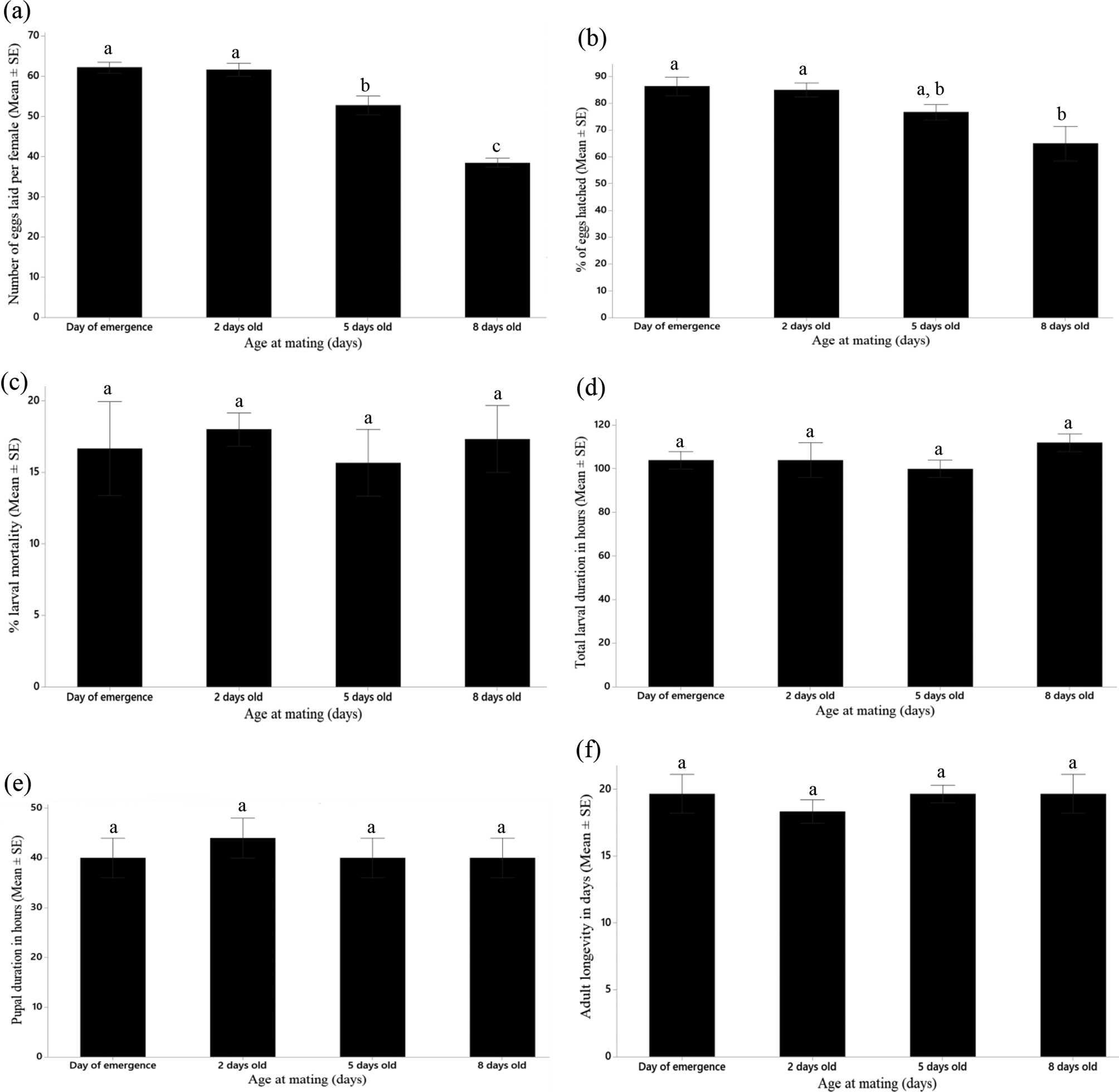
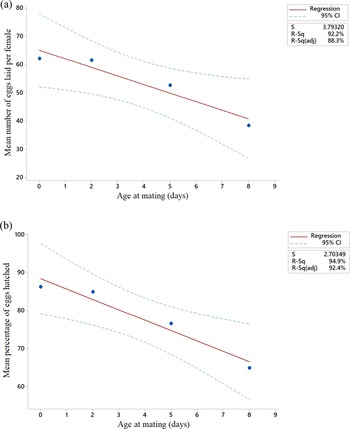
Fecundity was assessed by counting the mean number of eggs laid by a single female mosquito. It varied significantly with the age at mating of the mosquitoes (one-way ANOVA, F = 44.02, df = 3, P < 0.05). Tukey's test showed that the mean number of eggs laid by females mated at the age of 5 and 8 days was significantly different from the rest. The highest fecundity (62.20 ± 1.36) was observed once the females were mated at the age of 0–2 days, and once the females were mated at the age of 8 days, the lowest fecundity (38.47 ± 1.10) was observed (fig. 1a). The mean number of eggs laid was negatively correlated with the age at the mating of the females (Pearson's correlation, P < 0.05, R 2 = 0.922: fig. 2a).
(a) Fecundity, (b) fertility, (c) percentage larval mortality, (d) total larval duration, (e) pupal duration, and (f) adult longevity of female Ae. aegypti with age at mating of similar days old male and female: day of emergence, 2 days old, 5 days old, and 8 days old. Fecundity was assessed by counting the mean number of eggs (±SE) laid in the oviposition substrate by the mosquitoes (n = 10); fertility was assessed as the mean percentage of eggs hatched (±SE) 24 h after the eggs were immersed in the hatching media (n = 100); percentage larval mortality was assessed as the mean percentage of first, second, third, and fourth instar larvae dead (±SE) (n = 50); total larval duration was assessed as the mean larval duration (±SE) of first, second, third, and fourth instar larvae (n = 50); mean pupal duration was assessed in hours (±SE) (n = 50); mean adult longevity was assessed in days (±SE) (n = 10). Bars with different letters are significantly different from each other (P < 0.05). (ANOVA, Tukey–Kramer HSD test, P < 0.05). Statistical analysis was performed using Minitab 18.

(a) Relationship between the fecundity and (b) fertility of female Ae. aegypti with age at mating of similar days old male and female: day of emergence, 2 days old, 5 days old, and 8 days old. Fecundity was assessed by counting the mean number of eggs (±SE) laid in the oviposition substrate by the mosquitoes (n = 10); fertility was assessed as the mean percentage of eggs hatched (±SE) 24 h after the eggs were immersed in the hatching media (n = 100). Pearson's correlation, P < 0.05; R 2 = coefficient of determination. Statistical analysis was performed using Minitab 18.

The percentage egg hatch rate determined fertility. The mean percentage of eggs hatched also showed a significant difference with age at the mating of the mosquitoes (one-way ANOVA, F = 5.59, df = 3, P < 0.05). Tukey's test showed that the mean percentage hatch rate of the eggs laid by mosquitoes once they were mated at 8 days was significantly different from the rest. Accordingly, once the females were mated at the age of 0–2 days, the highest fertility (86.33 ± 3.48) was observed, and the lowest fertility (65.00 ± 6.43) was observed once the females were mated at the age of 8 days (fig. 1b). The mean percentage of eggs hatched was negatively correlated with the age at the mating of the females (Pearson's correlation, P < 0.05, R 2 = 0.949; fig. 2b).
Larval mortality was determined as the percentage of death of the tested larvae. The mean percentage of larval mortality was 16.92 ± 0.50 among the different batches of mosquitoes despite their age at mating. This did not show any significant difference among the different batches of mosquitoes mated at different ages (one-way ANOVA, F = 0.17, df = 3, P > 0.05; fig. 1c). The total larval duration was measured as the sum of the first, second, third, and fourth instar larval durations. The total larval duration did not show any significant difference with age at the mating of the adult female mosquitoes (one-way ANOVA, F = 0.90, df = 3, P > 0.05; fig. 1d). The mean total larval duration was 105.00 ± 2.52 h. The pupal duration did not show any significant difference when the female mosquitoes were mated at different ages (one-way ANOVA, F = 0.25, df = 3, P > 0.05; fig. 1e). The mean pupal duration was 41.00 ± 1.00 h. The female adult mosquitoes mated at different ages, did not show any significant difference in the longevity (one-way ANOVA, F = 0.33, df = 3, P > 0.05; fig. 1f). The mean adult longevity was 19.34 ± 0.33 days.
Discussion
The current study has shown an effect of delayed mating on fecundity and fertility but not on the life-history parameters such as total larval duration, pupal duration, larval mortality, and longevity of Ae. aegypti. Fecundity displayed a negative correlation with age at mating, indicating that the mean number of eggs laid by a female lessened once her age was increased from the day of emergence up to 8 days. It was observed that there was a 38% reduction in fecundity after 8 days of delay in mating. This indicates that the age of the male is a critical factor that determines the fecundity of the female (Ponlawat and Harrington, Reference Ponlawat and Harrington2009). Chevone and Richards (Reference Chevone and Richards1976) have shown that it takes about 24 h for the male terminalia to rotate 180° and gain the mating ability after the eclosion. Hausermann and Nijhout (Reference Hausermann and Nijhout1975) stated that female Ae. Aegypti becomes sexually mature 15–24 h after eclosion. In contrast, during the current study, it was observed that some males started to copulate even 24 h after eclosion. This may be because the mosquitoes mature faster due to the laboratory culture. A similar observation has been observed in Anopheles mosquitoes by Oliva et al. (Reference Oliva, Benedict, Lempérière and Gilles2011). Furthermore, Hausermann and Nijhout (Reference Hausermann and Nijhout1975) stated that a male could copulate at any time when it is inspired by the flight sound of a female mosquito. Nevertheless, females can produce a wing pitch beat to attract the males only after 2.5 h of their rise (Roth, Reference Roth1948). McCann et al. (Reference McCann, Day, Allan and Lord2009) stated that the temperature and the humidity alter the effect of age on fecundity. Additionally, fecundity varies with the female's body size (Briegel, Reference Briegel1990; Lyimo and Takken, Reference Lyimo and Takken1993; Blackmore and Lord, Reference Blackmore and Lord2000). McCann et al. (Reference McCann, Day, Allan and Lord2009) determined that falling fecundity with age is more advanced in large females than small females.
Mating success is described as the number of sperms transferred to the female during copulation (Ponlawat and Harrington, Reference Ponlawat and Harrington2009). Delisle (Reference Delisle1995) specified that the mating success of the male Choristoneura rosaceana (Lepidoptera: Tortricidae) is increased until it became 3 days old and then started to decline. This may be why the fecundity degenerated with the upsurge of age at the mating of Ae. aegypti. When mating was delayed by 6 days, the reproduction rate of Plutella xylostella (Lepidoptera: Plutellidae) was significantly abridged (Nemoto et al., Reference Nemoto, Yano and Kiritani1992), and when mating was delayed more than 4 days, both egg fertility and fecundity of Chilo partellus (Lepidoptera: Crambidae) were significantly reduced (Unnithan and Paye, Reference Unnithan and Paye1991). Huang and Subramanyam (Reference Huang and Subramanyam2003) found that when females of Plodia interpunctella (Lepidoptera: Pyralidae) were exposed to a delay in mating, the fecundity of the females significantly reduced. They also found that males gradually lost the ability to inseminate the females when the males were subjected to a delay in mating, resulting in low fertility of the females (Huang and Subramanyam, Reference Huang and Subramanyam2003).
According to the current study, the fertility of the female Ae. aegypti also declined by 24% when the mating was delayed by 8 days. This may be due to the increase of age at the mating of the male. Consequently, with the rise in age at mating, the number of sperms that are transferred into the female's spermatheca and fertilization of eggs might have abridged, leading to low fertility. The seminal fluid of Ae. aegypti males comprise many proteins, and during the copulation, they are transferred into the female's spermatheca (Sirot et al., Reference Sirot, Poulson, McKenna, Girnary, Wolfner and Harrington2008). These proteins influence the biology and behaviour of the female mosquito (Ponlawat and Harrington, Reference Ponlawat and Harrington2009). The functions of these proteins may also alter with the increase of age at the mating of the male. Mating influences the survival of the species such that mated females may live slightly longer than unmated females. The unmated females can lay eggs, yet the eggs will not be viable (Schoof, Reference Schoof1967).
Once the mating of E. cautella was delayed, both fecundity and fertility have lessened, indicating that physiological changes of the females are critically accountable for the drop in both fecundity and fertility (Barrer, Reference Barrer1976). It is supposed that delayed mating impacts the reproductive physiology of females. Waloff et al. (Reference Waloff, Norris, Richards and Broadhead1948) have stated that the decreased fecundity may be due to the reabsorption of egg rudiments for metabolism. According to Barrer (Reference Barrer1976), this may be possible when food reserves are occupied for the general metabolism instead of egg maturation.
The current study results did not show any significant variation in the life-history parameters of Ae. aegypti as a result of delayed mating. The larval mortality, total larval duration, total pupal duration, and adult longevity remained unchanged with delayed mating. Although there is no scientific information concerning delayed mating and mosquito longevity, several studies have been carried out on lepidopteran moths and dipteran flies on delayed mating and adult longevity. For example, Vickers (Reference Vickers1997) stated that the longevity of Cydia pomonella (Lepidoptera: Tortricidae) increased when mating was delayed. Similarly, Ellis and Steele (Reference Ellis and Steele1982) stated that the longevity of Spodoptera littoralis (Lepidoptera: Noctuidae) was increased when mating was delayed. Furthermore, the age of the male and female at mating influences the mortality and longevity of the progeny of the neriid fly Telostylinus angusticollis (Diptera: Neriidae) (Wylde et al., Reference Wylde, Spagopoulou, Hooper, Maklakov and Bonduriansky2019).
Sterile insect technique (SIT) will reduce the probability for the females to partake in successful insemination or may reduce the reproductive potential of the females (De Valdez et al., Reference De Valdez, Nimmo, Betz, Gong, James, Alphey and Black2011), thereby suppressing the vector population density. Also, SIT can force the mosquitoes towards delayed mating. Although the females encounter a sterile male at their first copulation, there is a chance for them to meet a fertile male after certain days, symbolizing delayed mating. Furthermore, mating disruption techniques that limit the availability of males will prevent mating in some females and delay mating in others, thereby influencing their population dynamics (Vickers, Reference Vickers1997). Since the current study showed that delayed mating could reduce fecundity and fertility, it can be postulated that SIT and mating disruption techniques anyhow accomplish their desired goal, suppressing vector population density either by prevention or delaying mating.
Additionally, the current study revealed that the highest fecundity and fertility of the mosquitoes could occur when the mosquitoes were mated within 2 days. Consequently, this information can be applied in the mass-rearing of mosquitoes in SIT. This is because the production of insects can be increased when the adults are mated at the most suitable age, which will increase their fitness. Moreover, if the scientists can find a proper synthetic chemical that can delay the mating of adult Ae. aegypti, this concept of delayed mating could be used in a feasible way to control the vector population density of Ae. aegypti.
Acknowledgments
The authors are thankful to Mr Sudesh Ruvinda, a lecturer of the Department of Zoology and Environmental Management, University of Kelaniya, for the support given for the statistical analysis, Mr D. Sunil Shantha, an Entomological Assistant, Faculty of Medicine, University of Colombo, for providing an egg sheet of Ae. aegypti and Prof. U. S. Amarasinghe for his valuable comments on the manuscript.
Author contributions
G. A. S. M. G. conceived and designed the experiments, R. A. K. M. G. conducted all field and laboratory work, performed data analysis, and was the principal writer of the manuscript. D. P. W. J. contributed to the data analysis and improvement of the manuscript. All authors read and approved the final manuscript.
Financial support
This research received no external funding.
Conflict of interest
The authors declare that they have no competing interests.