INTRODUCTION
Trawling is considered one of the most harmful fishing activities in tropical aquatic environments. Great quantities of fish, crustaceans, molluscs and other organisms are captured as by-catch and returned to the sea either dead or with few chances of survival. Yearly average discards, between 1992 and 2001, were evaluated around 7.3 million tonnes. Tropical shrimp fisheries have the highest discard rates and account for over 27% of this total estimate (Kelleher, Reference Kelleher2005).
With fin-fish stocks declining worldwide, crustacean fisheries are becoming increasingly important and now account for 7% of all fish and shellfish landings in weight and 28% in value (Smith & Addison, 2003). The swimming crabs of the genus Callinectes occur from New Scotia to Argentina, and are intensely exploited economically (Williams, Reference Williams1974). The blue crab Callinectes sapidus supports a highly productive fishery in Chesapeake Bay (USA) that currently supplies over one-third of all US commercial blue crab landings (Aguilar et al., Reference Aguilar, Hines, Wolcott, Wolcott, Kramer and Lipcius2005).
Callinectes danae Smith, 1869 and Callinectes ornatus Ordway, 1863 are very important species commercially and ecologically, along the Brazilian coast. They are opportunistic, omnivorous and play an important role in the regulation and distribution of their prey (Branco & Verani, Reference Branco and Verani1997; Mantelatto & Cristofoletti, Reference Mantelatto and Cristofoletti2001; Branco et al., Reference Branco, Lunardon-Branco, Verani, Schveitzer, Souto and Vale2002). In Guanabara Bay, these two species constitute a valuable resource for numerous artisanal fishermen. However, they have been heavily discarded by the pink-shrimp trawl fisheries (Farfantepenaeus paulensis and Farfantepenaeus brasiliensis) (Jablonski et al., Reference Jablonski, Azevedo and Moreira2006). Despite this being the most common fishing activity in the bay, quantitative data concerning the distribution and biology of the crustaceans is still scarce (Lavrado et al., Reference Lavrado, Falcão, Carvalho-Cunha and Silva2000).
Thus, the aim of the present work was to estimate the instantaneous mortality rates of C. danae and C. ornatus captured as pink-shrimp by-catch in Guanabara Bay and discuss possible effects of their migration activities on these rates.
MATERIALS AND METHODS
Study area
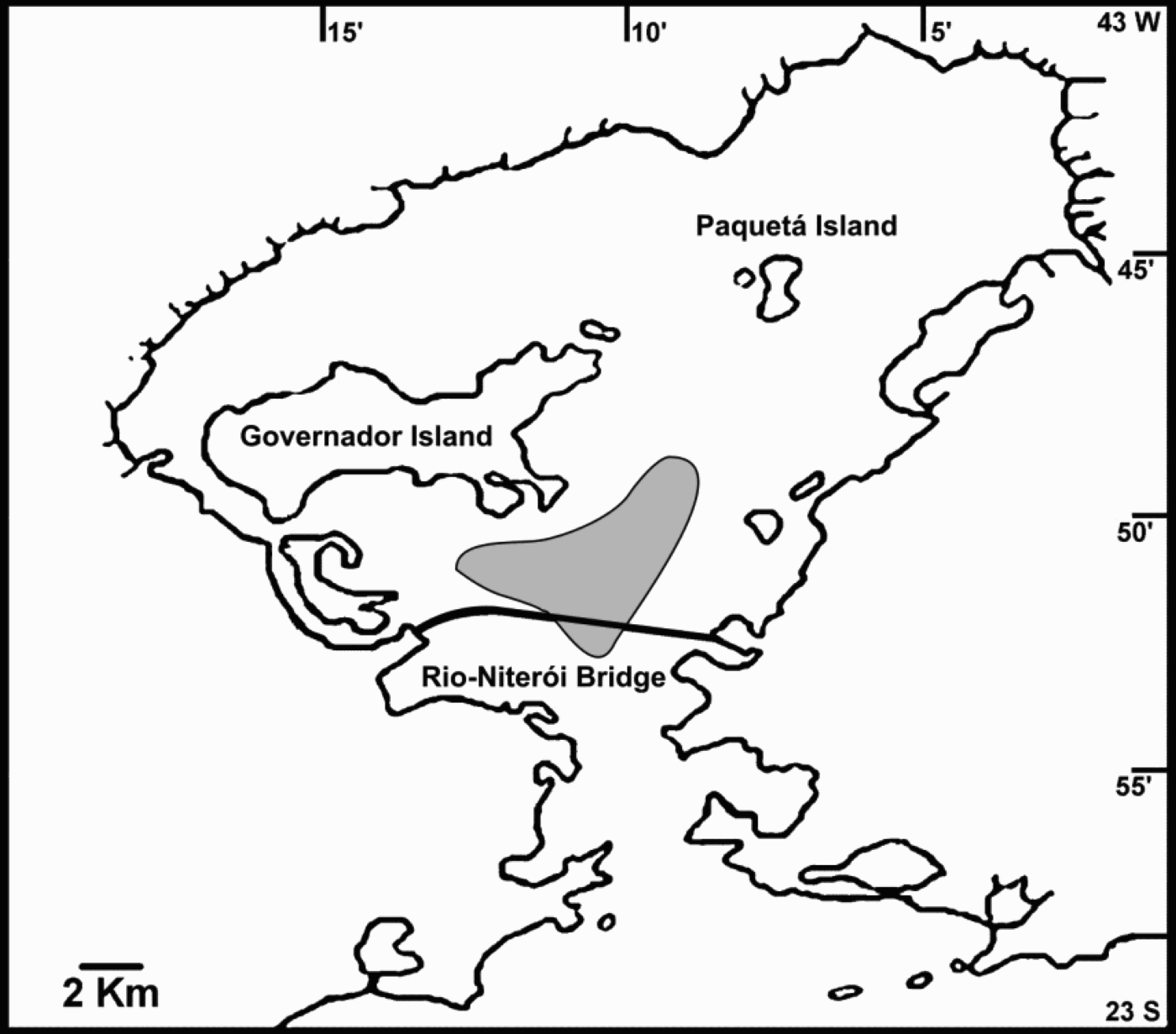
Guanabara Bay has a surface area of 381 km2 and is located in Rio de Janeiro State, Brazil (22°S 48°W) (Figure 1). In spite of its high pollution levels and intense environmental degradation, the bay still exhibits characteristics of a typical tropical estuary, such as high productivity and favourable conditions for growth and reproduction of estuarine species. Its resources sustain important fisheries and a large number of fishermen in activity (Jablonski et al., Reference Jablonski, Azevedo and Moreira2006).
Illustration of the fishing area within Guanabara Bay, Rio de Janeiro, Brazil.

Hydrological conditions are heterogeneous within the bay, depending on circulation patterns and pollution foci (Lavrado et al., Reference Lavrado, Falcão, Carvalho-Cunha and Silva2000). Salinity is usually lower in internal areas due to the inflow of fresh water from the drainage basin, especially during the rainy season (October to April) (JICA, 1994). The watershed, ~4000 km2, is formed by 35 primary rivers.
Biological samplings
Using a typical boat from the artisanal pink-shrimp fleet, samples were obtained bi-monthly, during 19 consecutive months (November 2003 to May 2005), composed of the total catch, with no selection or discard, of a 1-h haul with an otter trawl (18 mm from opposite knots mesh size on the cod end). Boat speed was maintained around 1.5 knots and trawling was always carried out at night. The collected specimens were frozen and taken to the laboratory where they were sorted by species, fixed (10% formaldehyde), preserved (70% ethanol), sexed, and measured. Carapace width (CW, distance of the carapace including lateral spines) was measured using a digital caliper (0.01 mm).
Total, natural and fishing mortality rates
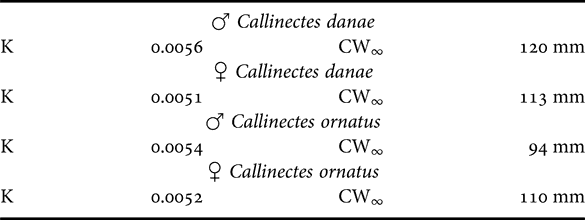
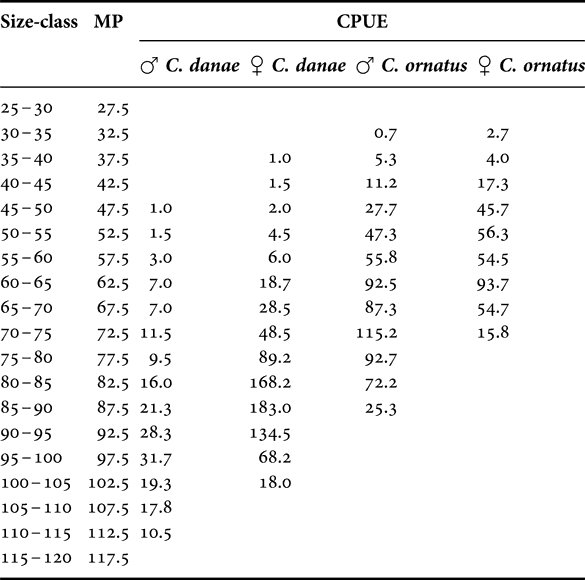
Age determination was performed indirectly by length-based methods. Parameters of the von Bertalanffy growth function, estimated for males and females (Keunecke et al., Reference Keunecke, D'Incao, Moreira, Silva and Verani2008), were used to convert length to age (t) (Table 1). Catch-per-unit-effort (CPUE) expressed in the number of individuals, by size-class, per hour of haul, was used as an estimate of Callinectes abundance (Table 2). Instantaneous rates of total mortality (Z) were estimated by length-converted catch curves (Pauly, Reference Pauly1990), ln (N/(dt) = a + bt', where the slope of regression (b) is the estimate of Z; N is the number of individuals in a given length class; dt is the time taken for the individuals growth through the length class; and t is the mean age of individuals in that class. The regression line was fitted excluding the initial ascending data points as well as the rightmost point. Catch curves were estimated for males and females and a Student t-test was used to compare Z values between sexes (Zar, Reference Zar1999).
Parameters of individual growth (von Bertalanffy growth function) estimated for males and females (Keunecke et al., Reference Keunecke, D'Incao, Moreira, Silva and Verani2008) to convert length to age (t). K (growth rate), CW∞ (asymptotic carapace width).

Length–frequency data used to construct length-converted catch curves. MP, Midpoint (mm); CPUE, catch-per-unit-effort (individuals/haul).

Natural mortality (M) was calculated by an approximated method based on life history analysis (Taylor, Reference Taylor1959, Reference Taylor1960), M = –ln[(1–0.95)/A0.95], where A0.95 is the age at which the individual reaches 95% of its asymptotic width and is defined by A0.95 = t0–(2.996/K), where K and t0 are parameters from the von Bertalanffy growth function. In this case, t0 = 0 since carapace width for both species is negligible at birth.
Fishing mortality (F) was calculated by the difference between total (Z) and natural (M) mortality: Z = M + F. The exploitation rate (E) was calculated by the quotient between fishing and total mortality: E = F/Z (Sparre & Venema, Reference Sparre and Venema1997).
RESULTS
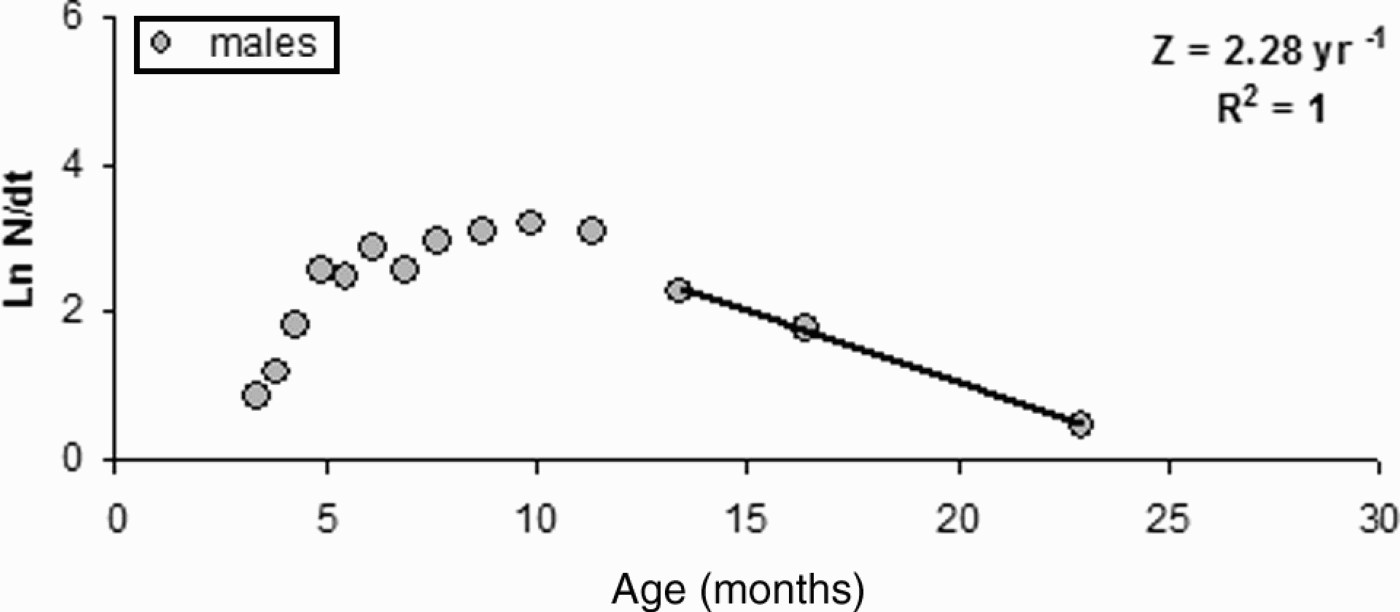
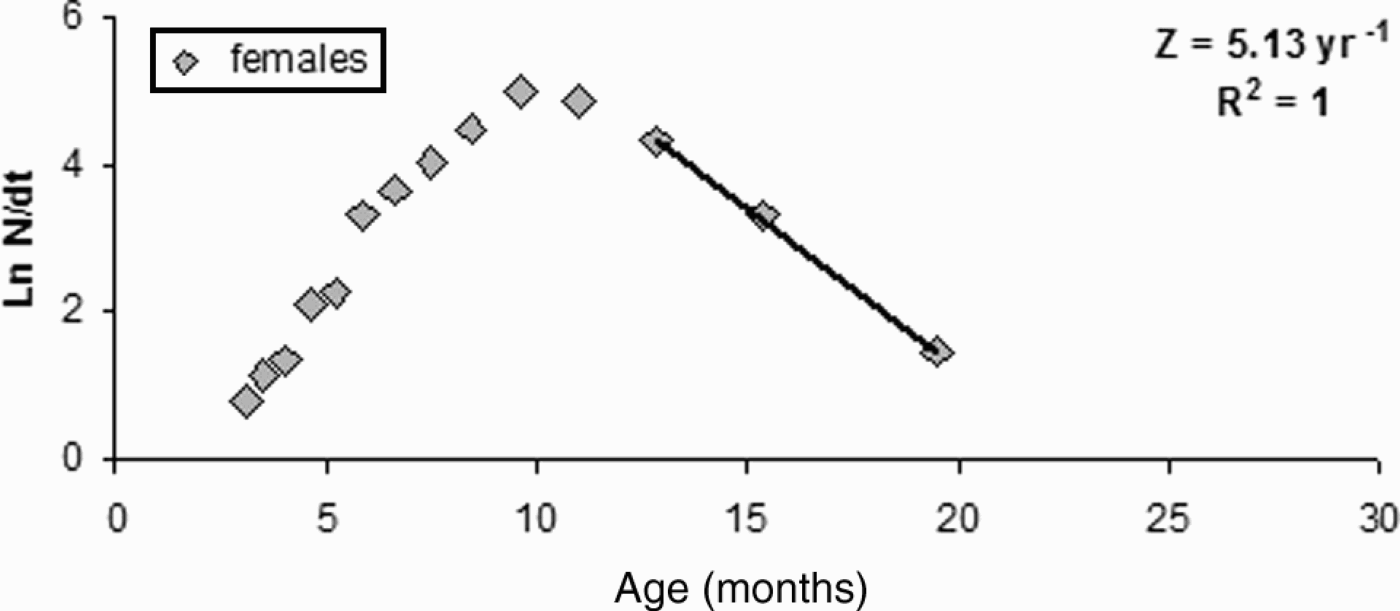
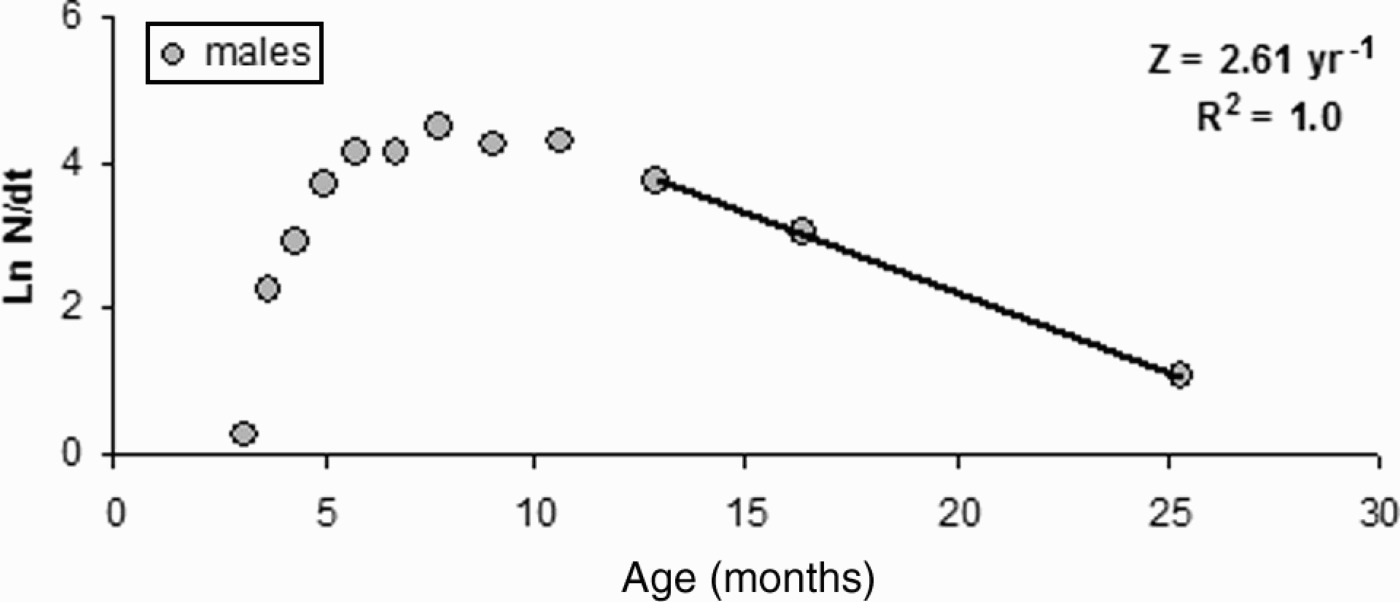
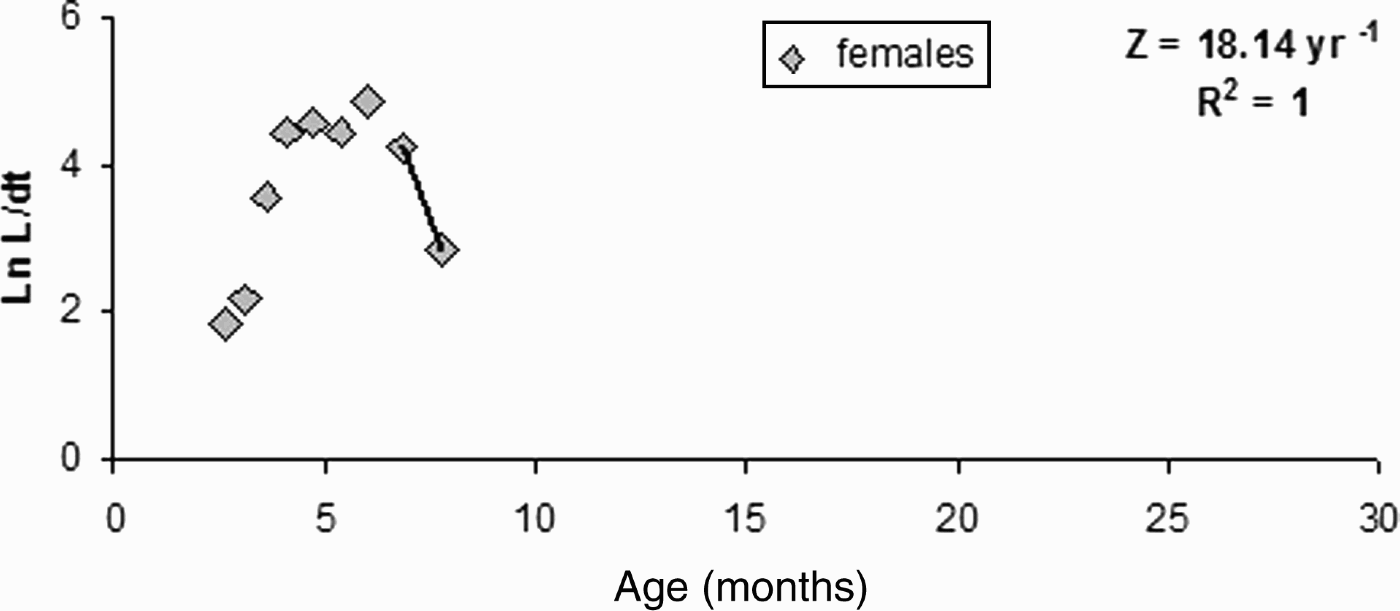
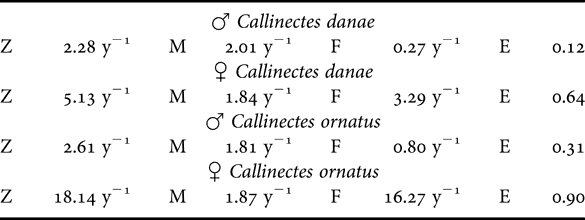
Males and females of Callinectes danae became vulnerable to the fishing gear at 11 months of age (Figures 2 & 3). Males of C. ornatus became vulnerable at ten months and females at six months (Figures 4 & 5). The instantaneous rate of total mortality (Z) was 2.28 y−1 and 5.13 y−1, for males and females of C. danae and 2.61 y−1 and 18.4 y−1 for males and females of C. ornatus, respectively. The Student t-test showed significant differences in estimates of Z between sexes for C. danae and for C. ornatus (*P < 0.01). Estimates of natural mortality (M) were similar for both species and both sexes, whereas fishing mortality (F) and exploitation rates (E) exhibited higher values for females, especially for C. ornatus (Table 3).
Length-converted catch curves for males of Callinectes danae. The rightmost point was excluded from the plot.

Length-converted catch curves for females of Callinectes danae. The rightmost point was excluded from the plot.

Length-converted catch curves for males of Callinectes ornatus. The rightmost point was excluded from the plot.

Length-converted catch curves for females of Callinectes ornatus. The rightmost point was excluded from the plot.

Instantaneous coefficient of total (Z), natural (M) and fishing mortality (F) and the exploitation rate (E).

DISCUSSION
In fishery biology, total mortality rates have been conventionally divided into natural and fishing mortality. Most of the natural mortality can be attributed to the predation factor that acts predominantly on young individuals (Laevastu & Favorite, Reference Laevastu and Favorite1988). The small variation in natural mortality (M) may be due to the homogeneous estimates of K (growth rate), ~0.005 d−1 (Keunecke et al., Reference Keunecke, D'Incao, Moreira, Silva and Verani2008), for males and females of Callinectes ornatus and C. danae. These species are sympatric and subjected to the same biotic and abiotic conditions in Guanabara Bay. The crab Hepatus pudibundus, captured as by-catch from shrimp trawls in the Ubatuba region of south-eastern Brazil, presented similar natural mortality rates: around 1.8 y−1 (Keunecke et al., Reference Keunecke, D'Incao and Fonseca2007). Many authors question the use of natural mortality rates due to their expression as a single value, despite intensity changes throughout the different phases of the life cycle. However, they still represent an important tool in fishery studies (Laevastu & Favorite, Reference Laevastu and Favorite1988; Vetter, Reference Vetter1988; Pascual & Iribane, Reference Pascual and Iribane1993; Caddy & Defeo, Reference Caddy and Defeo2003; Kahn & Helser, Reference Kahn and Helser2005).
The initial ascending points of the catch curve may result from the fishing gear selectivity, which would let the smallest individuals escape, or from the absence of individuals in that particular age class in the area (Ricker, Reference Ricker1975). Although C. ornatus occasionally inhabits freshwater environments (Williams, Reference Williams1974), it has a more significant association with high salinity and deeper waters (Negreiros-Fransozo & Fransozo, Reference Negreiros-Fransozo and Fransozo1995). This results in a migratory activity of six month-old specimens from Guanabara Bay to more saline coastal waters, where they complete their development and begin spawning. Callinectes danae also shows migratory activities, but not as intense. It is likely that ovigerous females of this species remain near the entrance of the bay (Lavrado et al., Reference Lavrado, Falcão, Carvalho-Cunha and Silva2000). In Ubatuba, C. danae appeared most frequently in low salinity shallow waters (Negreiros-Fransozo & Fransozo, Reference Negreiros-Fransozo and Fransozo1995).
Specialists agree that migrations are difficult to measure. Emigration sometimes appears as a seeming mortality, though it may be compensated by immigration (Laevastu & Favorite, Reference Laevastu and Favorite1988). In the present work, the high instantaneous rates of total mortality of C. ornatus and C. danae females represent a sum of the instantaneous rates of natural mortality, fishing mortality and probably emigration. Therefore this specific value may be overestimated and not represent the correct value of the instantaneous rate of fishing mortality. The significant differences in Z estimates between sexes, for both species, indicated that total mortality was greater in females. Unfortunately, it was not possible to distinguish the fishing mortality from the migration factor, since older females, especially C. ornatus, were scarce in the samples, probably occurring outside the fishing area.
Considering the mortality rates estimated in the present study, we strongly recommend further biological investigations, including the full range of size strata in the population, as well as studies concerning the possible migration patterns for females of C. danae and C. ornatus. Despite a greater urgency for data concerning females, males that have presented low exploitation rates (below the recommended value for explored stocks – 0.5; Sparre & Venema, Reference Sparre and Venema1997) should also be monitored.
A further study of the fishery is also necessary to avoid depletion of the blue crab stocks in Guanabara Bay. Changes in the fishing technique such as the implementation of by-catch reduction devices (BRDs) in trawl nets may be an effective measure to reduce the fishing mortality of Callinectes, maintaining a high production of the target species, as demonstrated by Vianna & D'Incao (Reference Vianna and D'Incao2006) in Patos Lagoon, southern Brazil. Management actions capable of finding solutions to complex problems such as by-catch must be formulated and implemented by joint actions incorporating government, scientists and the productive sector (Vianna & Almeida, Reference Vianna and Almeida2005).