Introduction
In many countries, there is increasing pressure to develop novel approaches to the management of invertebrate pests of crops. A primary focus target for the development of novel management techniques is the peach-potato aphid or green peach aphid, Myzus persicae (Sulzer) (Hemiptera: Aphididae). It has a worldwide distribution; even where the primary host plants (Prunus sp.) are absent, M. persicae can remain anholocyclic on secondary hosts if the climate is suitable. Over 40 different plant species can act as secondary hosts, many of which are crops of economic importance, including brassicas, sugar beet, sugar cane, tobacco, tomato and potato (van Emden et al., Reference van Emden, Eastop, Hughes and Way1969; Blackman & Eastop, Reference Blackman and Eastop2000). Myzus persicae is a very important aphid vector of plant viruses (Kennedy et al., Reference Kennedy, Day and Eastop1962) and can reproduce rapidly in favourable conditions. As a result of its cosmopolitan distribution both geographically and botanically, M. persicae has been persistently targeted with different insecticide applications, and this has resulted in the emergence of resistance to organophosphate, organochlorine, carbamate and pyrethroid insecticides (Foster et al., Reference Foster, Denholm and Devonshire2000). Insecticide-resistant aphids have been found throughout Europe and the UK (Foster et al., Reference Foster, Denholm, Harling, Moores and Devonshire1998; Fenton et al., Reference Fenton, Malloch, Woodford, Foster, Anstead, Denholm, King and Pickup2005) and have highlighted the need for alternative control measures.
The use of particle film technologies has recently been introduced as a novel approach to suppress arthropod pests of crops (Glenn et al., Reference Glenn, Puterka, Vanderzwet, Byers and Feldhake1999) and a specific formulation is available commercially as the crop protectant, Surround® WP (Engelhard Corporation, NJ, USA). Kaolin, the main component of these films, is a white, non-abrasive aluminosilicate mineral (Al4Si4010[OH]8), that is purified and finely-sized in these formulations (Glenn et al., Reference Glenn, Puterka, Vanderzwet, Byers and Feldhake1999; Puterka et al., Reference Puterka, Glenn, Sekutowski, Unruh and Jones2000). The material is sprayed onto the crop as an aqueous suspension that dries to leave a white particle film on the plant surface. The material is chemically inert over a wide pH range, and therefore has no direct toxicity to animals or plants (Glenn et al., Reference Glenn, Puterka, Vanderzwet, Byers and Feldhake1999; Puterka et al., Reference Puterka, Glenn, Sekutowski, Unruh and Jones2000).
The use of kaolin particle films has been investigated in a number of different crops (mainly fruit) against a range of different pests, such as Diptera, psyllids, Coleoptera and Lepidoptera (Glenn et al., Reference Glenn, Puterka, Vanderzwet, Byers and Feldhake1999; Lapointe, Reference Lapointe2000; Pasqualini et al., Reference Pasqualini, Civolani and Grappadelli2002; Showler, Reference Showler2002; Saour & Makee, Reference Saour and Makee2004; Barker et al., Reference Barker, Fulton, Evans and Powell2006). In addition, field studies suggest that kaolin formulations show potential in reducing aphid numbers in a range of crops, including rosy apple aphid, Dysaphis plantaginea (Passerini), in apple orchards (Wyss & Daniel, Reference Wyss and Daniel2004; Bürgel et al., Reference Bürgel, Daniel and Wyss2005), pea aphid, Acyrthosiphon pisum (Harris), in pea fields (Eigenbrode et al., Reference Eigenbrode, Ding, Neufeld and Duetting2006) and M. Persicae in peach orchards (Karagounis et al., Reference Karagounis, Kourdoumbalos, Margaritopoulos, Nanos and Tsitsipis2006). There have been very few laboratory studies to investigate the mechanisms of action of kaolin against sap-feeding insects. However, there are some indications that aphids and psyllids show decreased preference for kaolin particle film-treated areas of foliage, and decreased survival and reproduction when confined to such foliage (Cottrell et al., Reference Cottrell, Wood and Reilly2002; Puterka et al., Reference Puterka, Glenn and Pluta2005). The aim of this study was to explore effects of kaolin particle film on M. persicae by investigating aphid behaviour and performance in the laboratory.
Materials and methods
A clone of M. persicae (insecticide susceptible: Pickett et al., Reference Pickett, Dawson, Griffiths, Hassanali, Merritt, Mudd, Smith, Wadhams, Woodcock, Zhang, Greenhalgh and Roberts1987) was maintained on Brassica rapa var. pekinensis cv. Kiansi and Brassica oleracea var. capitata cv. Pixie in a controlled environment at 18±1°C in a 16:8 h light:dark cycle. Unless stated otherwise, experiments were also performed under these conditions. Aphids were transferred to new substrates using a fine, moistened paintbrush.
The kaolin-based particle film formulation used in this study was F-01-KV-6, an experimental hydrophilic formulation supplied by Engelhard Corporation (NJ, USA) with similar composition to their Surround® WP product (Barker et al., Reference Barker, Fulton, Evans and Powell2006). The material was applied as an aqueous suspension in accordance with the supplier's recommended rate (60 g l−1 water). Using a hand-held sprayer, two applications of the kaolin particle suspension were applied to the point of run-off to the plant material or other substrates used experimentally. Unless stated otherwise, the experimental plant material was calabrese, Brassica oleracea var. italica cv. Fiesta F1.
Application of kaolin directly onto adults
Adult apterous Myzus persicae were placed on filter paper in Petri dishes, ten per dish. Each dish was then sprayed, using a hand-held mister, with either water or the kaolin particle suspension. The paper in each dish was sprayed an equal number of times, which approximated that needed to spray plant material until run off. Excess liquid in the Petri dishes was allowed to drain off, and the aphids were left for 1 h. After this period of time, the number surviving was assessed. Random samples of the surviving aphids from each dish were then transferred individually using a paintbrush onto single calabrese plants, at the one-to-two true leaf stage. A perforated ‘bread’ bag was placed over each plant and secured around the base of the pot with an elastic band. Every subsequent 24 h, the bags were removed and the plants examined, until the adult aphid died. At each examination the number, if any, of nymphs produced was noted and these were removed.
Aphids that could still be located 24 h after initially being transferred onto the plants were classed as having settled. The survival time (post-spraying) of settlers, the total number of nymphs produced and the mean number of nymphs produced per aphid per day were compared between treatments using a general linear model procedure (The Lawes Agricultural Trust, 2002). There were five replicates of each treatment at the Petri dish stage and ∼30 at the individual survival stage.
Mean relative growth rate
First-instar Myzus persicae were weighed using a Sartorius 4303 micro-balance and then individually confined to whole calabrese plants that had previously been sprayed with kaolin on both surfaces, the upper surface only or neither surface. After seven days, the aphids were recovered and weighed again. Their mean relative growth rate (MRGR) was then calculated according to the formula (van Emden, Reference van Emden1969):

The experiment was repeated on a total of three occasions (blocks), each one allocating 7–9 aphids to each of the three experimental treatments. The MRGR was compared between treatments using a general linear model procedure (The Lawes Agricultural Trust, 2002) taking into account the effect of block. A chi-square goodness-of-fit analysis (ibid) was used to compare, between treatments, the numbers of aphids that could not be found compared to those which could.
Reproduction and survival
Adult M. persicae that had been removed from the culture ∼1 h previously were transferred to the apex or petiole of the leaves of calabrese plants (one-to-two true leaf stage) of each treatment type, one per plant: kaolin treated on both leaf surfaces, upper surface only and untreated. Each pot, containing an individual plant, was then covered with a ‘bread’ bag secured at the base round the pot with an elastic band. After 24 h the numbers of nymphs produced by the adults were counted, and the adult was removed from each plant. After a further 3 days, the plants were checked again; the number of remaining nymphs counted and their position on the stem, the abaxial or adaxial side of a leaf, noted.
The experiment was repeated on a total of three occasions (blocks), and the total number of aphids allocated to each treatment were 43 on untreated plants, 41 on kaolin treated (upper surface only) and 41 on kaolin treated (both surfaces). Statistical analyses of the numbers of adults surviving and the number of surviving adults that produced nymphs were carried out using Pearson chi-square tests (The Lawes Agricultural Trust, 2002). A general linear model procedure was used to analyse the mean number of nymphs produced (ibid) and a binominal logistic regression to analyse the proportion of surviving nymphs after 3 days (ibid). Predicted mean values are presented for both nymph production and survival as the effect of block was taken into account in both of these analyses (ibid).
Settling preference of nymphs
Thirty-five mm diameter leaf discs from calabrese plants (three-to-four true leaf stage) treated either with kaolin or water on both leaf surfaces were placed adaxial side up in 9 cm diameter Petri dishes (one of each treatment type per dish) with a single M. persicae second-instar nymph. The position of each aphid (either on the kaolin-treated disc, the water-treated disc or elsewhere) after 2 and 18 h was recorded. Statistical analysis of the effect of treatment was performed by Pearson chi-square goodness-of-fit analysis (The Lawes Agricultural Trust, 2002).
An additional experiment examined the effects of the kaolin particle film on the settling of second-instar nymphs over a shorter timeframe. Single nymphs were placed across the middle of the adaxial side of 35 mm leaf discs, half of which had been treated with two coats of the kaolin, applied with a soft sponge. The other half of the disc was left untreated, the boundary being defined by the midrib. Observations were then made every 100 s over the following 20 min; and each aphid's responses were subsequently classed into one of three categories, dependent on where they had spent the majority of their time: either on the treated leaf portion; the untreated leaf portion; or off the leaf. Statistical analysis of the effect of the location of the aphid was performed by Pearson chi-square goodness-of-fit analysis (ibid). Log-linear modelling was used to investigate these differences further (ibid).
Settling preference of adults
The behaviour of settling apterous adult aphids was investigated using the same methods as those for the nymphs over the 2 and 18 h periods. The settling preference experiments were all performed at 20±2°C.
Results
Application of kaolin directly onto adults
Of the initial 99 and 102 aphids that were sprayed with the kaolin and water, respectively, only one of the kaolin-sprayed aphids and two of the water-sprayed aphids were dead after 1 h. The survival time of the kaolin-sprayed adults was not significantly different from those sprayed with water (t=1.10, 50 df, P=0.275) (table 1). No significant difference was found in total number of nymphs produced (t=1.22, 50 df, P=0.227) or mean number of nymphs produced per aphid per day (t=1.57, 50 df, P=0.124) (table 1).
The longer-term effects of direct application of kaolin particle film onto apterous adult M. persicae.

Relative growth rate
After one week, 16 of the 21 aphids on untreated plants were still present. This compared to 20 of the 26 on the kaolin (upper surface only) treated plants and 14 of the 23 on the kaolin (both surfaces) treated plants. There were no significant differences in the proportions of aphids that were present between the treatments (χ2=1.87, 2 df, P=0.392).
The MRGR of M. persicae was not found to be significantly different between those aphids on the untreated plants and those with kaolin particle film on either the upper leaf surfaces only (t=0.09, 45 df, P=0.928) or both leaf surfaces (t=0.27, 42 df, P=0.785). The MRGR values (±SE) for aphids on untreated, kaolin particle film-upper surfaces only and kaolin particle film-both surfaces were 0.3052±0.0121, 0.3077±0.0115 and 0.311±0.0136, respectively.
Reproduction and survival
The number of adults that survived 24 h post-transfer onto plants did not differ significantly between treatments (χ2=0.73, 2 df, P=0.692; table 2). Similarly, the number of adults which produced nymphs did not differ significantly between treatments (χ2=1.76, 2 df, P=0.415; table 2). The mean number of nymphs resulting from both the total number of surviving adults and the nymph-producing adults only was found to be higher on the water only treatment compared to the kaolin treatments; however, treatment was not found to have a significant effect (F=1.40, 111 df, P=0.252; F=1.24, 88 df, P=0.294, respectively; table 2). After 3 days, the proportion of nymphs that had survived was high and not significantly different between treatments (deviance ratio=1.25, P=0.288; table 2).
The effects of kaolin particle film-treated plant material on M. persicae reproduction and survival. *Mean±SE.

The position of the M. persicae nymphs after 3 days was such that none were found on either the plant stem or leaf petioles, all being on either an abaxial or an adaxial leaf (including cotyledons) surface. There was no significant difference between treatments in the proportion of nymphs on the adaxial compared to the abaxial leaf surfaces (data not shown, χ2=0.99, 2 df, P=0.610).
Settling preference of M. persicae
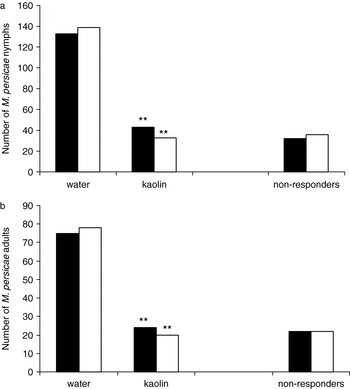
After both 2 and 18 h, there were significantly less nymphs (χ2=157.03, 2 df, P<0.001; χ2=183.99, 2 df, P<0.001, respectively) and adults (χ2=88.91, 2 df, P<0.001; χ2=100.49, 2 df, P<0.001, respectively) on the kaolin-treated discs compared to the water-treated discs (fig. 1a, b).
The leaf disc treatment type on which nymph (a), and adult (b), M. persicae were positioned after 2 (■) and 18 (□) hours in a choice situation. ** Significantly different from water-treated disc at P<0.01 level.

Of 200 second-instar nymphs observed for a 20 min period, 104 were observed for the majority of times on the untreated half of the leaf disc. This was significantly more than the 60 which were observed more frequently on the kaolin-treated half (χ2=99.71, 2 df, P<0.001). Thirty-five of the aphids spent the majority of the time points off the leaf disc and one was observed an equal number of times off the disc and on the treated half of the leaf disc.
Discussion
A direct coating of kaolin particle film does not appear to directly affect the survival of M. persicae as may have been the case if the residual coating (which was still visible on the kaolin-treated aphids throughout) had blocked feeding or respiration, or limited movement (Glenn et al., Reference Glenn, Puterka, Vanderzwet, Byers and Feldhake1999; Cottrell et al., Reference Cottrell, Wood and Reilly2002). Similar style direct application experiments with the pear psylla, Cacopsylla pyricola (Foerster) also indicated that the particle films had no immediate contact toxicity (Puterka et al., Reference Puterka, Glenn and Pluta2005). However, in contrast to the M. persicae data, increased mortality was reported after 72 h for C. pyricola adults and just 3 h for nymphs. The mechanisms for these effects are uncertain (Puterka et al., Reference Puterka, Glenn and Pluta2005).
In contrast to studies with the spirea aphid (Aphis spireacola Patch) where a nearly 50% reduction in numbers occurred within a 24 h period after insects were placed on treated apple leaves in no-choice experiments (Glenn et al., Reference Glenn, Puterka, Vanderzwet, Byers and Feldhake1999), survival of M. persicae was not affected by kaolin particle film treatment of plants. Production of progeny by adults was also not affected by the treatment, and this is congruent with studies of the black pecan aphid, Melanocallis caryaefoliae (Davis) (Cottrell et al., Reference Cottrell, Wood and Reilly2002). However, in contrast, nymph production by A. spiraecola adults was inhibited on kaolin-treated plant material (Glenn et al., Reference Glenn, Puterka, Vanderzwet, Byers and Feldhake1999).
These studies show that, under laboratory conditions, the kaolin particle film treatment does not appear to affect M. persicae in terms of growth rate, reproduction or survival. The lack of effect of the kaolin particle film on aphid performance contrasts with investigations of leaf-chewing pests such as Plutella xylostella (L.), Spodoptera exigua (Hüber) and Macrodactylus subspinosus (F.) (Knight et al., Reference Knight, Unruh, Christianson, Puterka and Glenn2000; Showler, Reference Showler2003; Isaacs et al., Reference Isaacs, Mercader and Wise2004; Sackett et al., Reference Sackett, Buddle and Vincent2005; Barker et al., Reference Barker, Fulton, Evans and Powell2006), and this may be a consequence of the feeding strategy of aphids. The needle-like stylets may be able to penetrate between the particles, so that any disruption by the kaolin particle film is minimal or negligible. However, previous laboratory studies, with other species of aphids and psyllids, indicate that kaolin applications may reduce the performance of other sap-feeding insects (Glenn et al., Reference Glenn, Puterka, Vanderzwet, Byers and Feldhake1999; Cottrell et al., Reference Cottrell, Wood and Reilly2002; Puterka et al., Reference Puterka, Glenn and Pluta2005). Myzus persicae survival may be unaffected by the kaolin particle film for a number of reasons: it could be due to the specific formulation of the film used in these studies, or a particular feature of this aphid.
The results reported here, therefore, provide no evidence that kaolin treatment affects M. persicae performance, but kaolin application to plants has been reported to reduce M. persicae infestations under field conditions (Karagounis et al., Reference Karagounis, Kourdoumbalos, Margaritopoulos, Nanos and Tsitsipis2006). It seems likely that effects on aphids in the field involve some degree of behavioural rejection of kaolin-treated plant surfaces. Congruent with investigations of other sap feeders, our studies of M. persicae show a highly significant decreased preference for the kaolin-treated leaf material. However, previous studies assessed insect preference over relatively long-term choice tests: the earliest assessments of insect numbers were made at 24 h (Puterka et al., Reference Puterka, Glenn and Pluta2005) and 72 h (Cottrell et al., Reference Cottrell, Wood and Reilly2002). Our small-scale leaf disc bioassay revealed that aphids show a clear avoidance of kaolin-treated leaf areas very rapidly, certainly within the first 20 min of plant contact. The early change in aphid behaviour may be related to altered visual or tactile cues from the plant material (Glenn et al., Reference Glenn, Puterka, Vanderzwet, Byers and Feldhake1999; Bürgel et al., Reference Bürgel, Daniel and Wyss2005), and further studies are necessary to elucidate behavioural effects of kaolin in detail.
Acknowledgements
This work was funded by the Department for Environment, Food and Rural Affairs (DEFRA, project no. HH3107). The authors thank Engelhard Corporation, NJ, USA, for supplying the F-01-KV-6 kaolin formulation and Dr Gary Puterka, USDA-Appalachian Fruit Research Station, for his advice. Thanks also to Dan Barker, Valerie Elliot, Diane Crawshay-Williams and Adrian Russell for technical support.