Introduction
Fetal overexposure to maternal endogenous or synthetic glucocorticoids (sGC) may play a key role in offspring neurodevelopmental programing (Seckl and Meaney, Reference Seckl and Meaney2004). Fetal cortisol levels are up to 10 times lower than maternal levels. This is ensured by the placental glucocorticoid barrier enzyme, 11 β hydroxysteroid dehydrogenase type 2 (11β HSD2), which converts 80–90% of active maternal cortisol to its inactive form (Seckl and Meaney, Reference Seckl and Meaney2004). While lower levels of active cortisol are necessary for normal brain development, fetal cortisol overexposure may harm several neurodevelopmental processes, and hence harm the developing brain with potential adverse sequelae on mental health (Damsted et al., Reference Damsted, Born, Paulson and Uldall2011).
The average prevalence of preterm delivery in developed regions in 2010 was 8.6% (Blencowe et al., Reference Blencowe, Cousens, Oestergaard, Chou, Moller, Narwal, Adler, Vera Garcia, Rohde, Say and Lawn2012), with 7–10% of women at risk of preterm delivery being administered sGCs, such as betamethasone or dexamethasone (Reynolds and Seckl, Reference Reynolds and Seckl2012). In high-resource settings the treatment carries substantial benefits for infants born before 34 weeks of gestation: incidence of respiratory distress syndrome has been shown to decrease by 34%, intraventricular hemorrhage by 46%, and neonatal mortality by 31% (March of Dimes, PMNCH and WHO, 2012). Also those born late preterm (births between 34 and 36 weeks of gestation) may gain similar respiratory benefits of antenatal sGCs (Gyamfi-Bannerman et al., Reference Gyamfi-Bannerman, Thom, Blackwell, Tita, Reddy, Saade, Rouse, McKenna, Clark, Thorp, Chien, Peaceman, Gibbs, Swamy, Norton, Casey, Caritis, Tolosa, Sorokin, VanDorsten and Jain2016). There is, thus, wide consensus that these benefits outweigh the potential longer-term harms sGCs may carry on individuals born preterm. Yet, prediction of preterm birth is uncertain, and many sGC-exposed infants end up being born at term. While some evidence suggests that also those born early-term (births between 37 and 39 weeks of gestation) after cesarean sections (Stutchfield, Reference Stutchfield2005) may benefit from antenatal sGC in short-term (Kamath-Rayne et al., Reference Kamath-Rayne, Rozance, Goldenberg and Jobe2016; Saccone and Berghella, Reference Saccone and Berghella2016; The American College of Obstetricians and Gynecologists, 2016; Sweet et al., Reference Sweet, Carnielli, Greisen, Hallman, Ozek, Plavka, Saugstad, Simeoni, Speer, Vento, Visser and Halliday2017), it still remains unclear whether the short-term benefits related to sGCs equally outweigh the potential longer-term harms on neurodevelopment and mental health in individuals born at term (Reynolds and Seckl, Reference Reynolds and Seckl2012).
Human evidence supporting this argument in individuals exposed to antenatal sGCs and who ended up being born at term is still scarce and study findings are mixed. In one randomized controlled trial (RCT), term-born children exposed prenatally to multiple (up to four) courses of sGC had a higher rate of, and more severe, neurosensory disabilities at 5 years compared to peers exposed to a single course of sGC (Asztalos et al., Reference Asztalos, Willan, Murphy, Matthews, Ohlsson, Saigal, Armson, Kelly, Delisle, Gafni, Lee, Sananes, Rovet, Guselle and Amankwah2014). Another RCT found no differences in behavior problems between 8 and 15-year-old term-born children exposed prenatally to a single course of betamethasone and those not exposed to sGCs, though schools did report more learning difficulties in those exposed (Stutchfield et al., Reference Stutchfield, Whitaker, Gliddon, Hobson, Kotecha and Doull2013). In addition, two observational studies reported no differences between exposed and non-exposed term-born children in the levels of affective problems at the age of 6–10 years (Davis et al., Reference Davis, Sandman, Buss, Wing and Head2013), or in intelligence at 6–11 years (Alexander et al., Reference Alexander, Rosenlöcher, Dettenborn, Stalder, Linke, Distler, Morgner, Miller, Kliegel and Kirschbaum2016). Finally, in one additional observational study those term-borns exposed to sGCs displayed higher salivary cortisol stress reactivity to a standardized psychosocial stress test than their non-exposed term-born peers at 6–11 (Alexander et al., Reference Alexander, Rosenlöcher, Stalder, Linke, Distler, Morgner and Kirschbaum2012) and at 14–18 (Ilg et al., Reference Ilg, Kirschbaum, Li, Rosenlöcher, Miller and Alexander2018) years of age.
The mixed findings may result from different study designs, differences in the number of sGC courses administered, and the use of varying measures of mental health and psychological development at ages that vary in developmental stage. Further, only one of these previous studies has examined the possible confounding of maternal obesity and common pre-pregnancy and pregnancy disorders (Alexander et al., Reference Alexander, Rosenlöcher, Dettenborn, Stalder, Linke, Distler, Morgner, Miller, Kliegel and Kirschbaum2016). These disorders often underpin the risk of preterm birth (Rosenberg et al., Reference Rosenberg, Garbers, Lipkind and Chiasson2005; Goldenberg et al., Reference Goldenberg, Culhane, Iams and Romero2008), and hence co-occur with antenatal sGC treatment.
In a well-characterized cohort of Finnish women and their children, we examined the association of antenatal betamethasone exposure with early childhood mental and behavioral disorders and mother-reported psychiatric problems and developmental milestones. We examined if these associations varied by whether the children were born preterm or at term. We also took into account maternal early pregnancy obesity, gestational and type-1 diabetes, gestational and chronic hypertension, and pre-eclampsia, and tested if the association of antenatal betamethasone exposure with early childhood mental and behavioral disorders and mother-reported psychiatric problems and developmental milestones varied by sex, as one of the previous studies in term-born children showed that the effects of sGC treatment on stress reactivity might show sex-specificity (Alexander et al., Reference Alexander, Rosenlöcher, Stalder, Linke, Distler, Morgner and Kirschbaum2012).
Method
Participants
The Prediction and Prevention of Pre-eclampsia and Intrauterine Growth Restriction (PREDO) study comprises 4777 mothers who gave birth to a singleton liveborn child in Finland 2006–2010 (Girchenko et al., Reference Girchenko, Hämäläinen, Kajantie, Pesonen, Villa, Laivuori, Räikkönen, Entringer, Buss, Wadhwa, Hämäläinen, Kajantie, Pesonen, Villa, Laivuori and Räikkönen2017). Recruitment took place at ten study hospitals in Southern/Eastern Finland at the first ultrasound screening between 12 + 0 and 13 + 6 weeks + days-of-gestation. The original study cohort comprises three subgroups: 969 pregnant women with known clinical risk factors for pre-eclampsia and intrauterine growth restriction (IUGR), 110 women with no known risk factors for these conditions, and 3698 women who were recruited whether or not they had risk factors for pre-eclampsia and IUGR (Girchenko et al., Reference Girchenko, Hämäläinen, Kajantie, Pesonen, Villa, Laivuori, Räikkönen, Entringer, Buss, Wadhwa, Hämäläinen, Kajantie, Pesonen, Villa, Laivuori and Räikkönen2017). From the latter group two women have since withdrawn consent.
Diagnoses on mental and behavioral disorders from child birth up to 31 December 2016 were available from 4752 children. Of them, 4708 also had information on antenatal betamethasone exposure and other important pregnancy and perinatal characteristics. At the end of the register follow-up the children were 6–10 years-of-age [mean = 7.7, standard deviation (s.d.) = 0.8].
Additional information on mother-reported child psychiatric problems and developmental milestones were available from a follow-up conducted in 2011–2012. Mother-reported data on child psychiatric problems and/or developmental milestones and data on antenatal betamethasone exposure and other important pregnancy and perinatal characteristics were available for 2640 children at 1.9–5.9 years-of-age (mean = 3.5, s.d. = 0.7). See online Supplementary Fig. S1 for the sample and attrition.
Compared to the initial sample from whom we missed child disorders or betamethasone/pregnancy/perinatal data (N = 67), the ones with these data available (N = 4708) were born to mothers who 8.7% less often smoked during pregnancy, 9.3% less often had chronic hypertension, and 5.8% more often had gestational hypertension; the children themselves were born 5.8% less often preterm (all p values < 0.04). Compared to the invited non-participants of the 2011–2012 follow-up (N = 1945), the 2011–2012 follow-up study participants (N = 2640) were born to mothers who were 0.7-years-older at delivery, 10.1% more often had a tertiary education, 2.1% less often were single, 5.7% more often primiparous, 1.4% less often had chronic hypertension, 5.2% less often smoked during pregnancy, had 0.5 kg/m2 lower early pregnancy body mass index (BMI) and were 3.3% less often obese (all p values < 0.01).
All participating women signed informed consent. The PREDO study protocol was approved by the Ethics Committees of the Hospital District of Helsinki and Uusimaa and by the participating hospitals.
Exposure to synthetic glucocorticoids
Information on betamethasone treatment (yes/no) was extracted from medical records and/or the Finnish Medical Birth Register (MBR). For a subset of women who were recruited based on their risk factor status for pre-eclampsia and IUGR, we had information on the number of courses (N = 43; mean = 1, s.d. = 0.4, range 0.5–2 courses of 2 × 12 mg per course) and the timing of the exposure (N = 45; mean = 3.5, s.d. = 3.9, range 0–13 weeks before delivery).
Child mental and behavioral disorders
We identified diagnoses of child mental and behavioral disorders from the Finnish Hospital Discharge Register (HDR) from the child's birth between 2006–2010 and 31 December 2016. The HDR includes primary and subsidiary diagnoses of all inpatient and outpatient visits (data on both visits available since the child's birth) coded using International Classification of Diseases-10 (ICD-10) during the study period and is a valid tool for research (Sund, Reference Sund2012). We analyzed those disorders which included children in the betamethasone-exposed and non-exposed groups born preterm and at term (online Supplementary Table S1); children with no disorders were used as the referent in all analyses (online Supplementary Table S1).
Mother-reported child psychiatric problems
The Child Behavior Checklist 1½–5 years (CBCL) comprises 99 problem items rated on a scale of 0 (not true) to 2 (very true or often true) (Achenbach and Rescorla, Reference Achenbach and Rescorla2000). The CBCL yields total, internalizing, and externalizing problems scores (Achenbach and Rescorla, Reference Achenbach and Rescorla2000). See online Supplementary text for internalizing and externalizing problem subscales.
Mother-reported child developmental milestones
The Ages and Stages Questionnaire-3 (ASQ) (Squires et al., Reference Squires, Bricker and Potter1997) measures age-appropriate developmental milestones in five domains (communication, fine motor, gross motor, problem solving ability, and personal-social functioning). Six questions in each domain indicate whether the child has mastered (‘yes’, 10 points), partly/inconsistently mastered (‘sometimes’, five points), or not yet mastered the milestone (‘not yet’, 0 points) (Squires et al., Reference Squires, Bricker and Potter1997). We defined mild developmental delay as scores between −1 and −2 s.d. below the age-appropriate mean, and failure to meet the development that is typical for the child's age as scores −2 s.d. or more below the age-appropriate mean for each domain (Squires et al., Reference Squires, Bricker and Potter1997). The ASQ is a reliable and valid screening tool for determining children in need of further developmental assessment (Kerstjens et al., Reference Kerstjens, Bos, ten Vergert, de Meer, Butcher and Reijneveld2009; Filgueiras et al., Reference Filgueiras, Pires, Maissonette and Landeira-Fernandez2013; Steenis et al., Reference Steenis, Verhoeven, Hessen and van Baar2015; Charkaluk et al., Reference Charkaluk, Rousseau, Calderon, Bernard, Forhan, Heude and Kaminski2017).
Covariates and moderators
These included maternal age at delivery (years), parity (primiparous/multiparous), delivery mode (vaginal/cesarean section), premature rupture of membranes (yes/no), smoking during pregnancy (no/quit or smoked throughout), maternal early pregnancy BMI (kg/m2), chronic and gestational hypertension, pre-eclampsia, gestational and type-1 diabetes (all categorized yes/no), weight, length and head circumference at birth standardized by sex and gestational age (Pihkala et al., Reference Pihkala, Hakala, Petri and Raivio1989) (s.d. units), gestational age [analyzed both as a continuous covariate and dichotomous (<37/⩾37 gestational weeks) moderator], and child's sex (analyzed both as a covariate and a moderator), which were extracted from the MBR, HDR, and/or from medical reports. Maternal alcohol use during pregnancy (yes/no), education (primary or secondary/tertiary), and maternal history of physician-diagnosed asthma (yes/no), as some in this group may be taking corticosteroid inhalers, were reported in early pregnancy, and child's age (months) was reported in the follow-up. For the analyses of child mental and behavioral disorders as the outcomes, we also made adjustments for maternal any mental disorder diagnosis based on HDR inpatient and outpatient visits (any/no DSM-III-R/ICD-10 diagnosis of mental/behavioral disorder; inpatient data were available between 1987 and 2016; outpatient data were available between 1998 and 2016; birth year of the mothers varied from 1959 to 1977). For the analyses of mother-reported child outcomes, we made adjustments for maternal depressive symptoms during pregnancy (trimester-weighted mean score of bi-weekly reports) measured using the Center for Epidemiological Studies Depression Scale (CES-D) (Radloff, Reference Radloff1977), and concurrently to rating the child using the Beck Depression Inventory-II (BDI-II) (Beck et al., Reference Beck, Steer and Brown1996).
Statistical analysis
Statistical analyses were conducted by using IBM SPSS Statistics software, version 24 and SAS, version 9.4.
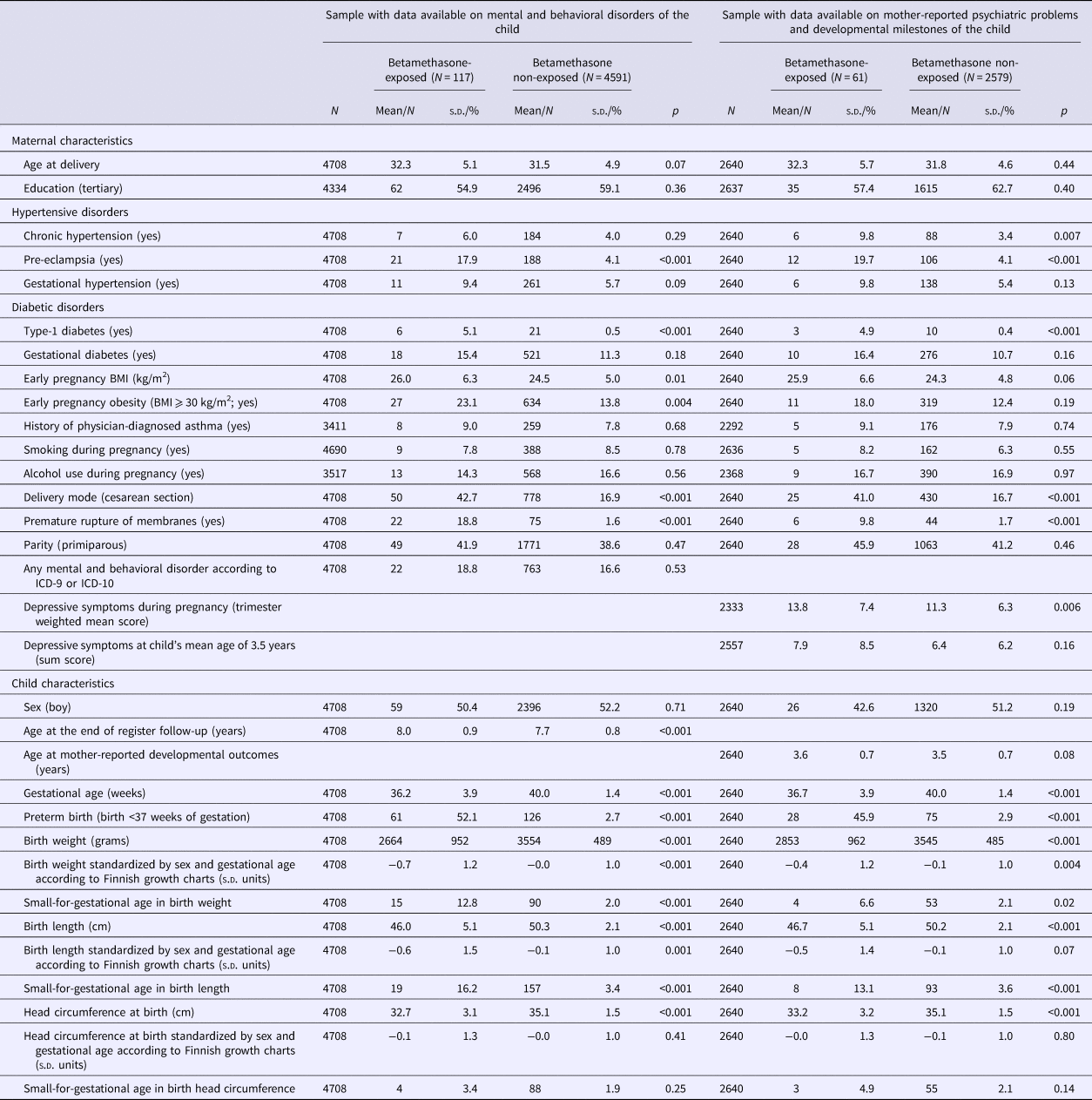
Since the PREDO study was not originally designed to study the effects of betamethasone treatment on child developmental outcomes, we used propensity score weighing (Austin, Reference Austin2011) to account for the differences in baseline characteristics associated with betamethasone treatment (Table 1). We determined the propensity score weights by logistic regression to estimate the probability of receiving betamethasone treatment conditional on the observed covariates. We then trimmed the highest propensity score weights downward with a 95th percentile cutpoint (Lee et al., Reference Lee, Lessler and Stuart2011). The resulting propensity score weights were used in all analyses. Because the sample size differed between the child disorders (N = 4708) and mother-reported child outcomes (N = 2640), we calculated the propensity score weights separately for these two samples.
Characteristics of the sample according to antenatal exposure to betamethasone

Characteristics are shown for the sample with data available on child's mental and behavioral disorder diagnoses from the child's birth in 2006–2010 to 31 December 2016 and for the sample with mother-reported child psychiatric problems and developmental milestones data available at the child age of 1.9 to 5.9 years.
The differences between the betamethasone-exposed and non-exposed groups are determined using t tests for continuous variables and χ2 test for categorized variables.
Using logistic regression analysis, we tested the associations between antenatal betamethasone exposure and child main category diagnoses of mental and behavioral disorders (online Supplementary Table S1), and multinomial logistic regression to test associations with having just one or two to four co-morbid mental and behavioral disorders compared to no disorders. If associations with the main category disorders were significant, we specified the associations by analyzing the disorders in the specific disorder category (online Supplementary Table S1).
We then tested the associations between antenatal betamethasone exposure and mother-reported child total, internalizing, and externalizing problems (converted into s.d. units) by using generalized linear models with Gaussian reference distribution. Associations between antenatal betamethasone exposure and mother-reported child developmental milestones (scores >−1 s.d. contrasted with scores between −1 s.d. and −2 s.d. and with scores ⩽−2 s.d.) were tested by using multinomial logistic regression analysis.
Analyses of child disorders as outcomes included the propensity score weights and child's sex and birth year as covariates, and mother-reported child outcomes propensity score weights and child's sex and age at follow-up as covariates (model 1). We then added all the other covariates into the models, except for maternal mental health (model 2). Further, maternal mental disorder derived from HDR was added into the models with child disorders as outcomes, and maternal depressive symptoms during pregnancy and at the time of rating the child outcomes were added into the models of mother-reported child outcomes (model 3). To study whether birth length or head circumference s.d. had an effect on the findings, we re-ran models 2–3 by replacing child's birth weight s.d. score with birth length and head circumference s.d. scores as covariates.
We entered an interaction term ‘betamethasone exposure/non-exposure × preterm/term birth’ into the equations to study if the betamethasone associations varied by preterm/term status, and an interaction term ‘betamethasone exposure/non-exposure × girl/boy’ into the equations to study if the betamethasone associations varied by child's sex.
Results
Table 1 shows that compared to non-exposed children, betamethasone-exposed children had lower gestational age, were more often born preterm, had lower weight, length and head circumference at birth, had lower birth weight and length s.d. scores, and were more often born small-for-gestational age in weight and length. They were also more often delivered by cesarean section and born from pregnancies complicated by pre-eclampsia, type-1 diabetes, obesity, and premature rupture of membranes (Table 1).
Betamethasone exposure and child mental and behavioral disorders
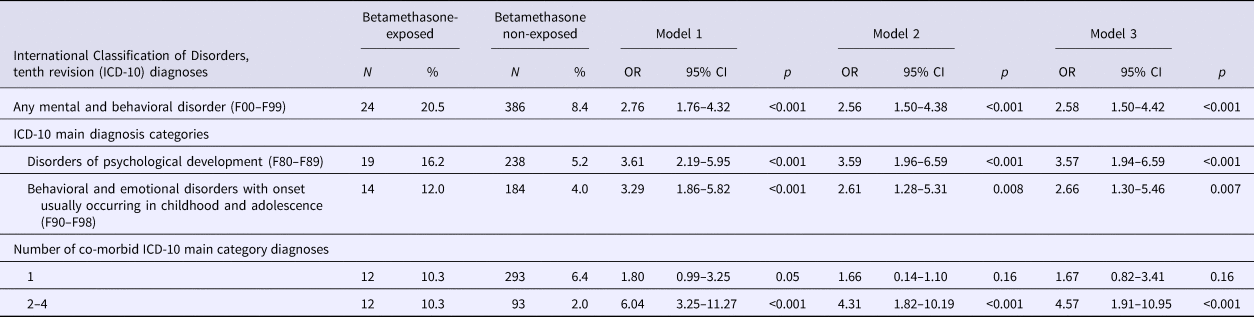
The prevalence of any mental and behavioral, psychological development, and behavioral and emotional disorders, and of two to four co-morbid disorders from the main diagnosis categories (Table 2) was significantly higher in the betamethasone-exposed than non-exposed children in models including the propensity score weights and all covariates (model 1 adjusted for child's sex and age; model 2 adjusted additionally for maternal BMI, hypertensive and diabetic pregnancy disorders, delivery mode, age, education, parity, smoking and alcohol use, asthma, premature rupture of membranes, and child's gestational age and birth weight s.d. score; and model 3 adjusted additionally for maternal mental disorders; Table 2).
The associations between antenatal betamethasone exposure and child main category diagnoses of mental and behavioral disorders according to the ICD-10

Only disorders which included children in the betamethasone-exposed and non-exposed groups born preterm and at term were included in the analyses. In the analyses with the number of co-morbid ICD-10 main category diagnoses, the group with no mental and behavioral disorders was used as referent.
All models include propensity score weights.
Model 1: adjusted for child sex and birth year.
Model 2: adjusted for model 1 + maternal early pregnancy BMI (kg/m2), hypertensive (gestational hypertension, pre-eclampsia, chronic hypertension) and diabetic (gestational diabetes, type-1 diabetes) pregnancy and pre-pregnancy disorders, delivery mode (vaginal/cesarean section), premature rupture of membranes (yes/no), mother's age (years), education (upper/lower tertiary/other), parity (primiparous/multiparous), maternal smoking during pregnancy (no/quit or smoked throughout), maternal alcohol use during pregnancy (yes/no), maternal history of physician-diagnosed asthma (yes/no), child's gestational age (weeks), birth weight standardized by sex and gestational age according to Finnish growth charts (21) (s.d. units).
Model 3: adjusted for model 2 + maternal mental and behavioral disorder (any diagnosis/no diagnosis).
Of the specific disorders of psychological development and behavioral and emotional disorders, the prevalence of speech and language [6.8% v. 2.9%, odds ratio (OR) 2.57, 95% confidence interval (CI) 1.25–5.30, p ⩽ 0.05 for models including propensity score weights and adjusting for all covariates] and other disorders of psychological development (4.3% v. 0.7%, OR 7.26, 95% CI 2.83–18.62, p < 0.001 for models including propensity score weights and adjusting for all covariates) and hyperkinetic disorders (6.0% v. 1.4%, OR 4.70, 95% CI 2.11–10.49, p < 0.02 for models including propensity score weights and adjusting for all covariates) were significantly higher in the betamethasone-exposed than non-exposed children.
None of these associations were altered when we replaced birth weight s.d. score with birth length and head circumference s.d. scores (p values ⩽ 0.05 for models including propensity score weights and all covariates; data not shown).
The interaction analyses ‘betamethasone-exposure/non-exposure × preterm/term birth’ (all p values > 0.27) or ‘betamethasone exposure/non-exposure × girl/boy’ did not reveal any significant interactions (all p values > 0.07; data not shown).
Betamethasone exposure and mother-reported child outcomes
Betamethasone-exposure was associated with higher scores on total, internalizing, and externalizing problems in models including the propensity score weights and all covariates (models 1–3 in Table 3). See online Supplementary Table S2 for associations with internalizing and externalizing problem subscales.
The associations between antenatal betamethasone exposure and mother-reported psychiatric problems of the child

All models include propensity score weights.
Model 1: adjusted for child sex (boy/girl) and age (months).
Model 2: model 1 + maternal early pregnancy BMI (kg/m2), hypertensive (gestational hypertension, pre-eclampsia, chronic hypertension) and gestational (gestational diabetes, type-1 diabetes) pregnancy and pre-pregnancy disorders, delivery mode (vaginal/cesarean section), mother's age (years), education (tertiary/other), parity (primiparous v. multiparous), premature rupture of membranes (yes/no), maternal smoking during pregnancy (no/quit or smoked throughout), maternal alcohol use during pregnancy (yes/no), maternal history of physician-diagnosed asthma (yes/no), child's gestational age (weeks), birth weight standardized by sex and gestational age according to Finnish growth charts (Pihkala et al., Reference Pihkala, Hakala, Petri and Raivio1989) (s.d. units).
Model 3: model 2 + trimester-weighted mean score of maternal depressive symptoms during pregnancy and maternal depressive symptoms at the time of rating the child behavior.
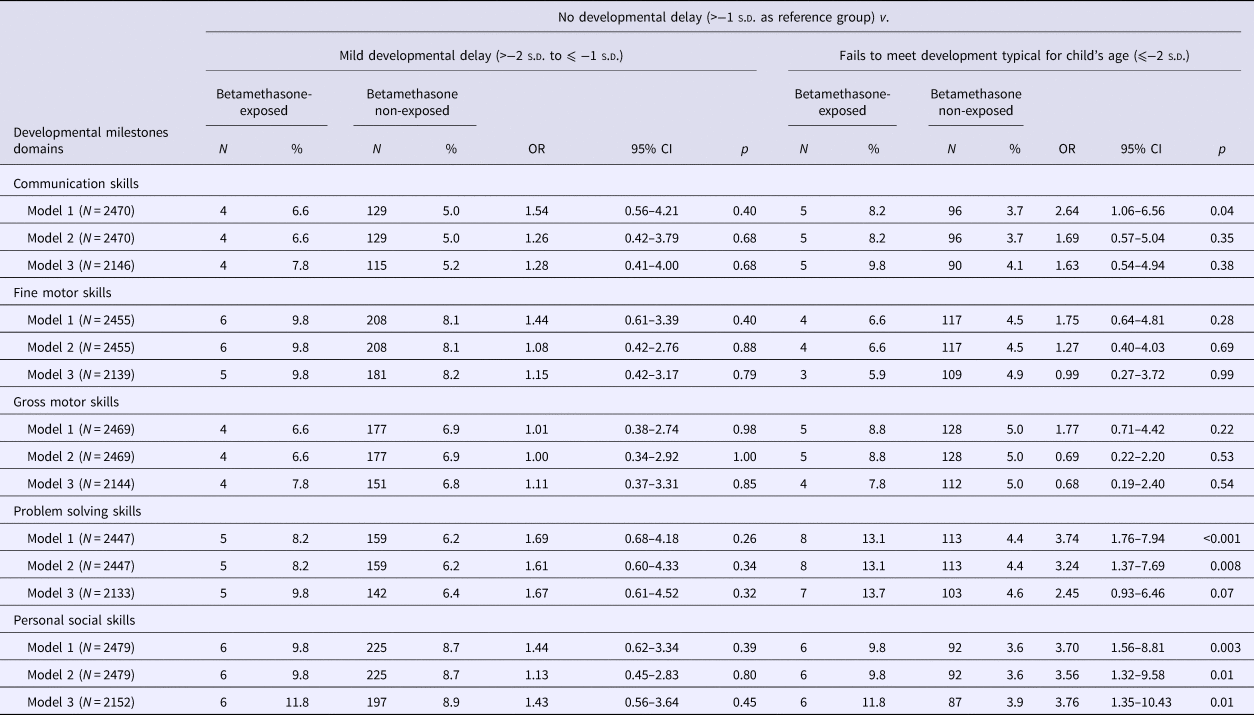
The prevalence of failing to meet the development that is typical for the child's age in communication, problem solving, and personal social skills was higher in betamethasone-exposed compared to non-exposed children in models including the propensity score weights and child's sex and age (model 1 in Table 4). The association with personal social skills survived when adjusted for all covariates, while the association with communication and problem solving did not (models 2–3 in Table 4). The associations with total, internalizing, and externalizing problems, and with the failure to meet the development that is typical for child's age in personal social skills remained unchanged when birth weight s.d. score was replaced with birth length and head circumference s.d. scores (p values ⩽ 0.03 in models including propensity score weights and all covariates; data not shown).
The associations between antenatal betamethasone exposure and mother-reported developmental milestones of the child

All models include propensity score weights.
Model 1: adjusted for child sex (boy/girl) and age (months).
Model 2: model 1 + maternal early pregnancy BMI (kg/m2), hypertensive (gestational hypertension, pre-eclampsia, chronic hypertension) and gestational (gestational diabetes, type-1 diabetes) pregnancy and pre-pregnancy disorders, delivery mode (vaginal/cesarean section), mother's age (years), education (tertiary/other), parity (primiparous v. multiparous), premature rupture of membranes (yes/no), maternal smoking during pregnancy (no/quit or smoked throughout), maternal alcohol use during pregnancy (yes/no), maternal history of physician-diagnosed asthma (yes/no), child's gestational age (weeks), birth weight standardized by sex and gestational age according to Finnish growth charts (Pihkala et al., Reference Pihkala, Hakala, Petri and Raivio1989) (s.d. units).
Model 3: model 2 + trimester-weighted mean score of maternal depressive symptoms during pregnancy and maternal depressive symptoms at the time of rating the child development.
The interaction analyses ‘betamethasone-exposure/non-exposure × preterm/term birth’ did not reveal any significant interactions (all p values > 0.12; data not shown). Further, we found one significant betamethasone exposure/non-exposure × girl/boy interaction on externalizing problems (p = 0.04). In boys, betamethasone-exposure was associated with higher externalizing problems scores (B = 0.66, 95% CI 0.28–1.04, p = 0.001) while in girls, it was not (p = 0.33).
Discussion
Our study shows that antenatal exposure to betamethasone may be associated with early childhood mental health problems. The prevalence of any mental and behavioral disorder, psychological development (specifically speech and language) and behavioral and emotional (specifically hyperkinetic) disorders in childhood was higher in the betamethasone-exposed than betamethasone non-exposed children. Compared to non-exposed children, the prevalence of co-morbid mental and behavioral disorders was also higher in the betamethasone-exposed children. Our study findings with mother-reported child outcomes are in alignment: compared to the non-exposed children, betamethasone-exposed children had higher scores on total, internalizing, and externalizing problems, and they had a higher prevalence of failing to meet the development that is typical for the child's age in personal social skills. Our findings are thus the first to show that exposure to sGCs is associated with child mental health problems that are robust and consistent across the sources of information; these harms not only relate to child mental and behavioral disorders but also to problems that are sub-threshold.
None of these associations varied significantly between those born preterm and at term. These associations, tested in the presence of propensity score weights and adjusted for a number of important covariates, including maternal pregnancy and pre-pregnancy conditions, smoking and alcohol use, education level, and premature rupture of membranes increasing the risk of preterm birth (Rosenberg et al., Reference Rosenberg, Garbers, Lipkind and Chiasson2005; Goldenberg et al., Reference Goldenberg, Culhane, Iams and Romero2008) and hence the risk of exposure to antenatal sGCs, as well as child's gestational age, birth weight, length, and head circumference s.d. score. Importantly, the associations were not either explained by maternal mental disorders derived from HDR up to the same date as the child's follow-up end-date or maternal depressive symptoms reported during or after pregnancy, which also increase the risk of preterm birth (Jarde et al., Reference Jarde, Morais, Kingston, Giallo, MacQueen, Giglia, Beyene, Wang and McDonald2016) and child mental and behavioral disorders (Lahti et al., Reference Lahti, Savolainen, Tuovinen, Pesonen, Lahti, Heinonen, Hämäläinen, Laivuori, Villa, Reynolds, Kajantie and Räikkönen2017; Tuovinen et al., Reference Tuovinen, Lahti-Pulkkinen, Girchenko, Lipsanen, Lahti, Heinonen, Reynolds, Hämäläinen, Kajantie, Laivuori, Pesonen, Villa and Räikkönen2018). Our findings, thus, additionally suggest that in term children, the potential benefits of antenatal sGCs may not outweigh the longer-term developmental harms. This observation is important as preterm birth is difficult to predict and a large number, in our study almost 50%, of the women administered antenatal sGCs, continue to deliver at term. This observation assumes further relevance as antenatal sGCs may be administered also in late-preterm deliveries and early term cesarean section deliveries as a result of observations of their short-term respiratory benefits (Stutchfield, Reference Stutchfield2005; Kamath-Rayne et al., Reference Kamath-Rayne, Rozance, Goldenberg and Jobe2016; Saccone and Berghella, Reference Saccone and Berghella2016; The American College of Obstetricians and Gynecologists, 2016; Sweet et al., Reference Sweet, Carnielli, Greisen, Hallman, Ozek, Plavka, Saugstad, Simeoni, Speer, Vento, Visser and Halliday2017). Further, even in preterm individuals, antenatal sGCs may have different effects on neurodevelopment depending on individual tissue-sensitivity to sGCs (van der Voorn et al., Reference van der Voorn, Wit, van der Pal, Rotteveel and Finken2015). Individual genetic variations in glucocorticoid sensitivity and exposure to antenatal sGCs have been associated with IQ and behavior in young adults born preterm (van der Voorn et al., Reference van der Voorn, Wit, van der Pal, Rotteveel and Finken2015). Future studies should further examine the possibility of more tailor-made approaches in sGC dosing.
Our study findings disagree with the previous observational studies showing null effects of sGCs on affective problems (Davis et al., Reference Davis, Sandman, Buss, Wing and Head2013) and intelligence (Alexander et al., Reference Alexander, Rosenlöcher, Dettenborn, Stalder, Linke, Distler, Morgner, Miller, Kliegel and Kirschbaum2016) in term-born children. Our findings also disagree with the RCTs which have reported null effects of sGCs on child behavior problems (Stutchfield et al., Reference Stutchfield, Whitaker, Gliddon, Hobson, Kotecha and Doull2013; Asztalos et al., Reference Asztalos, Willan, Murphy, Matthews, Ohlsson, Saigal, Armson, Kelly, Delisle, Gafni, Lee, Sananes, Rovet, Guselle and Amankwah2014) in term-born children. The RCTs have, however, shown harmful neurosensory effects in those exposed to multiple v. a single course of sGCs (Asztalos et al., Reference Asztalos, Willan, Murphy, Matthews, Ohlsson, Saigal, Armson, Kelly, Delisle, Gafni, Lee, Sananes, Rovet, Guselle and Amankwah2014), and harmful effects on learning in those exposed to a single course of sGCs v. no exposure (Stutchfield et al., Reference Stutchfield, Whitaker, Gliddon, Hobson, Kotecha and Doull2013). Our findings agree with a small observational study combining preterm and term children which found that those exposed to sGCs displayed more total psychiatric and inattention problems at age 8 years. These group differences were rendered non-significant at the age of 16 years (Khalife et al., Reference Khalife, Glover, Taanila, Ebeling, Järvelin and Rodriguez2013). This latter study did not examine if the effects varied by preterm/term birth. This precludes direct comparisons of our findings with findings of this study. Whether these harmful associations found in our study persist as the children age, is a subject of future studies.
As the placenta metabolizes sGCs poorly, they readily cross to the fetal side (Seckl and Meaney, Reference Seckl and Meaney2004) and easily pass the blood–brain barrier (Damsted et al., Reference Damsted, Born, Paulson and Uldall2011), carrying harmful effects on the fetal brain development. Glucocorticoids bind to glucocorticoid and mineralocorticoid receptors in the brain which are abundant especially in the hippocampus (Reul and De Kloet, Reference Reul and De Kloet1985) and in the human fetus they are expressed already at 24 weeks of gestation (Noorlander et al., Reference Noorlander, de Graan, Middeldorp, Van Beers and Visser2006). This corresponds with the typical timing of the administration of sGCs in clinical practice. Experimental animal studies have shown that sGC administration can lead to a decrease in neuronal proliferation, neuronal damage, and even neuronal death in the hippocampus (Noorlander et al., Reference Noorlander, Tijsseling, Hessel, de Vries, Derks, Visser and de Graan2014). Given the importance of the hippocampus in learning, memory, and spatial functioning (Burgess et al., Reference Burgess, Maguire and O'Keefe2002), as well as neuroendocrine function (Lupien et al., Reference Lupien, McEwen, Gunnar and Heim2009) and neurobehavioral problems (Geuze et al., Reference Geuze, Vermetten and Bremner2005), it is plausible that hippocampus is the key target of sGC-related harms. However in a small human study, no hippocampal changes associated with exposure to sGCs were found (Modi et al., Reference Modi, Lewis, Al-Naqeeb, Ajayi-Obe, Doré and Rutherford2001). Another key target may be the cerebellum which undergoes rapid growth after 24 weeks-of-gestation. The cerebellum is highly dense in glucocorticoid receptors (Pavlík et al., Reference Pavlík, Buresová and Burešová1984) and plays a role in emotion regulation and neurobehavioral development (O'Halloran et al., Reference O'Halloran, Kinsella and Storey2012). Studies have found that exposure to sGCs can affect cerebellar development, which subsequently, may affect cognitive development (Noguchi, Reference Noguchi2014) and mental health.
Animal models have also shown other adverse effects of antenatal sGC exposure on offspring brain development (Damsted et al., Reference Damsted, Born, Paulson and Uldall2011), suggesting that there may be other brain mechanisms through which sGCs affect neurobehavioral development as well. In human studies, exposure to sGCs has been associated with cortical thinning especially in the rostral anterior cingulate cortex (Davis et al., Reference Davis, Sandman, Buss, Wing and Head2013), which is also associated with internalizing problems (Boes et al., Reference Boes, McCormick, Coryell and Nopoulos2008). In addition, exposure to sGCs has been associated with decreased brain surface area and complexity of cortical folding in close to or term infants (Modi et al., Reference Modi, Lewis, Al-Naqeeb, Ajayi-Obe, Doré and Rutherford2001). Finally, a recent study found that antenatal sGC exposure is associated with reduced cord blood neurotrophin-3 (NT-3) in late preterm infants (Hodyl et al., Reference Hodyl, Crawford, McKerracher, Lawrence, Pitcher and Stark2016). NT-3 mediates neuronal growth, differentiation and synapse formation (Conover and Yancopoulos, Reference Conover and Yancopoulos1997), and thus may provide one mechanism through which sGC exposure affects brain development and subsequent mental health.
An additional novel finding of this study is that betamethasone appeared to exert sex-specific associations with mother-reported externalizing problems. This is of interest as boys in our and in other samples display higher scores on these problems, possibly resulting in a higher variance and statistical power to detect the associations in boys. Alternatively, this may suggest that boys may be more susceptible to the harmful effects of sGCs. However, a previous observational study showed that the association of betamethasone with higher salivary cortisol stress-reactivity was present in 6–11-year-old girls (Alexander et al., Reference Alexander, Rosenlöcher, Stalder, Linke, Distler, Morgner and Kirschbaum2012). In a later follow-up of this study, at age 14–18 years, the sex-specific effects in cortisol reactivity were no longer present (Ilg et al., Reference Ilg, Kirschbaum, Li, Rosenlöcher, Miller and Alexander2018). However, this may reflect the small sample size, since only 44 of the 209 original study participants participated in the follow-up (Ilg et al., Reference Ilg, Kirschbaum, Li, Rosenlöcher, Miller and Alexander2018). The sex-specific effects of sGC exposure have not been shown in other human studies, and findings from animal studies remain mixed (Kapoor et al., Reference Kapoor, Petropoulos and Matthews2008). The study by Alexander et al. comprised both pre-pubertal and pubertal children (Alexander et al., Reference Alexander, Rosenlöcher, Stalder, Linke, Distler, Morgner and Kirschbaum2012) while our sample was pre-pubertal. Hence, future studies are warranted to unravel if the sex-specificity of the antenatal sGC exposure differs according to the child's developmental stage.
The strengths of our study include a longitudinal study design and a well-characterized large cohort with detailed information on the maternal pregnancy and mother-child perinatal characteristics and child developmental outcome data from different sources. Further, follow-up attrition with information on mental and behavioral disorders was minimal. A further strength is that the findings were in alignment regardless of the source of information lending validity to our findings. A limitation of our study is that it was not originally designed to test the effects of antenatal betamethasone on child developmental outcomes. Yet, our study was designed to examine risk factors for pre-eclampsia and IUGR, which increase the risk for preterm birth (Goldenberg et al., Reference Goldenberg, Culhane, Iams and Romero2008) and, thus, exposure to antenatal sGC. This resulted in the prevalence of pre-eclampsia in the PREDO cohort being markedly higher (4.1% v. 0.8–1.9%) than in the Finnish general population (Girchenko et al., Reference Girchenko, Hämäläinen, Kajantie, Pesonen, Villa, Laivuori, Räikkönen, Entringer, Buss, Wadhwa, Hämäläinen, Kajantie, Pesonen, Villa, Laivuori and Räikkönen2017). In addition, compared to the Finnish general population, the PREDO mothers had a higher prevalence of early pregnancy obesity (14.0% v. 11.5%), gestational hypertension (4.2% v. 3.1%), and cesarean section deliveries (17.2% v. 15.8–16.2%), were older at delivery (31.5 v. 29.4–29.5 years), more often multiparous (61.3% v. 57.9–59.0%), and less often smoked throughout pregnancy (5.0% v. 11.1–11.4%) (Girchenko et al., Reference Girchenko, Hämäläinen, Kajantie, Pesonen, Villa, Laivuori, Räikkönen, Entringer, Buss, Wadhwa, Hämäläinen, Kajantie, Pesonen, Villa, Laivuori and Räikkönen2017). This may limit the generalizability of our findings. However, the gestational age and birth weight of the children in the cohort corresponded with the national average (Girchenko et al., Reference Girchenko, Hämäläinen, Kajantie, Pesonen, Villa, Laivuori, Räikkönen, Entringer, Buss, Wadhwa, Hämäläinen, Kajantie, Pesonen, Villa, Laivuori and Räikkönen2017). Further, while our sample size was large and the prevalence of pre-eclampsia high, the number of children exposed to betamethasone prenatally was still relatively small. The number of children with mental and behavioral disorders was also relatively small which precluded studying rarer specific disorders. Also, our observational study design precludes causal inferences. Randomized double-blinded controlled experimental clinical trials comparing the outcomes of antenatal betamethasone exposure on child outcomes in representative study samples are needed to make causal inferences. Finally, we had information on the dose and timing of the antenatal betamethasone treatment only for a small number of study participants, precluding tests of dose- or timing-dependent effects. However, repeated betamethasone courses were not recommended during the time our cohort was born (Uotila et al., Reference Uotila, Vuorela, Koistinen, Nupponen, Nuutila, Raudaskoski, Tammela and Varesmaa-Korhonen2011). In the subsample of our study whose dosage and timing information was available, only one mother had received two courses of betamethasone.
Our findings show that the term-born sGC-exposed children have similar problems in mental health than the sGC-exposed children who are born preterm. At the moment, children born preterm are followed up regardless of whether they were exposed to sGCs or not, but there is no systematic clinical follow-up of children exposed to sGCs who end up being born at term. These findings thus carry a public health message suggesting the need to extend clinical follow-up of child mental health beyond the preterm group to the group exposed to antenatal sGCs and born at term.
Supplementary material
The supplementary material for this article can be found at https://doi.org/10.1017/S0033291718004129.
Author ORCIDs
Elina Wolford, 0000-0003-4461-6256.
Financial support
The PREDO study is funded by the Academy of Finland; European Commission (Horizon 2020 Award SC1-2016-RTD-733280 RECAP); European Commission Dynamics of Inequality Across the Life-course: structures and processes (DIAL) No. 724363 for PremLife; EraNet Neuron; EVO (a special state subsidy for health science research); University of Helsinki Research Funds; the Signe and Ane Gyllenberg Foundation; the Emil Aaltonen Foundation; the Finnish Medical Foundation; the Jane and Aatos Erkko Foundation; the Novo Nordisk Foundation; the Päivikki and Sakari Sohlberg Foundation; the Sigrid Juselius Foundation; and the Sir Jules Thorn Charitable Trust.
Conflict of interest
None.
Ethical standards
The authors assert that all procedures contributing to this work comply with the ethical standards of the relevant national and institutional committees on human experimentation and with the Helsinki Declaration of 1975, as revised in 2008.