




No CrossRef data available.
Article contents
- Abstract
- THE EPICLASSIC AND POSTCLASSIC PERIODS IN THE TEOTIHUACAN VALLEY
- VAILLANT'S EXCAVATIONS AT LAS PALMAS
- LINNÉ'S EXCAVATIONS: XOLALPAN, LAS PALMAS, AND OZTOTLAN
- EXCAVATIONS IN TUNNELS EAST OF THE PYRAMID OF THE SUN
- MORTUARY PRACTICES IN THE CLASSIC PERIOD AT TEOTIHUACAN
- SUMMARY
- CONCLUSIONS
- RESUMEN
- ACKNOWLEDGMENTS
- References
BURIAL PRACTICES AT TEOTIHUACAN IN THE EARLY POSTCLASSIC PERIOD: The Vaillant and Linné Excavations (1931–1932)
Published online by Cambridge University Press: 28 March 2006
Article contents
- Abstract
- THE EPICLASSIC AND POSTCLASSIC PERIODS IN THE TEOTIHUACAN VALLEY
- VAILLANT'S EXCAVATIONS AT LAS PALMAS
- LINNÉ'S EXCAVATIONS: XOLALPAN, LAS PALMAS, AND OZTOTLAN
- EXCAVATIONS IN TUNNELS EAST OF THE PYRAMID OF THE SUN
- MORTUARY PRACTICES IN THE CLASSIC PERIOD AT TEOTIHUACAN
- SUMMARY
- CONCLUSIONS
- RESUMEN
- ACKNOWLEDGMENTS
- References
Abstract
In 1931 and 1932, George Vaillant and Sigvald Linné excavated 34 burials and 17 offerings dating to the Early Postclassic period (a.d. 900–1150). The features were located on the ruins of the Classic-period site of Teotihuacan and within the boundaries of a roughly 25–50 ha zone identified by the Teotihuacan Mapping Project as having a dense Early Postclassic-period occupation. The results of Vaillant's excavations have not been published. An examination of the Vaillant–Linné data sheds new light on Early Postclassic-period mortuary ritual and social organization. The identification of several types of burials shows that local people conducted primary and secondary mortuary rituals and indicates the presence of at least two social strata at the site. The content of the burials and offerings supports a division of the Early Postclassic period into two local phases, Mazapan (ca. a.d. 900–1000) and Atlatongo (ca. a.d. 1000–1100/1150), with these features dating to the earlier phase.
Information
- Type
- Research Article
- Information
- Copyright
- © 2005 Cambridge University Press
The archaeological site of Teotihuacan, in central Mexico, dominates the valley of the same name. Scholars of pre-Columbian culture have long known from ethnohistoric documents (compiled by Fray Bernardino de Sahagún and others) that by the time Aztec Tenochtitlan flourished, Teotihuacan existed as a ruined city. Yet at the turn of the twentieth century, the history of occupation of the city and the surrounding valley was far from clear. Archaeological investigations at the site of Teotihuacan began in earnest in the early twentieth century and focused primarily on excavating and restoring buildings in the urban core. In the 1920s, the emphasis shifted to identifying the internal chronology of the site and establishing its relationship with other regions of Mesoamerica (see a summary of early work at the site in Armillas 1950:41–43). In 1931 and 1932, George Vaillant conducted excavations within the boundaries of the Classic-period city as part of a larger project he executed from 1928–1936 designed to help clarify the cultural and chronological sequence of central Mexico. His initial excavations (in November 1931) were conducted at the 5' Mound Group (west of the Moon Pyramid), where he uncovered artifacts from Teotihuacan's major periods of occupation (now know to be approximately a.d. 1–650). A few months later, in January 1932, he initiated excavations in an area east of the Pyramid of the Sun called Las Palmas (Figure 1).

Map showing the approximate location of the Vaillant–Linné excavations and the extent of the “Las Palmas” site. The base map and grid is redrawn from Millon's 1973 map of Teotihuacan. The extent of the Las Palmas site is based on Cowgill (2003:xvii).
As Vaillant was nearing the completion of his work, Sigvald Linné, on expedition for the Royal Swedish Academy of Science, arrived and initiated his own research at Las Palmas. In addition, Linné chose to excavate a mound approximately 200 m north of Las Palmas in an area called Xolalpan. Finally, Linné excavated a tomb near an isolated house called Oztotlan, located some 200 m southeast of Xolalpan. In their excavations, Vaillant and Linné found yellow-buff to orange-brown paste pottery painted with red designs, which Vaillant called “Red-on-Yellow.” Stratigraphically, this pottery was located above ceramics dating to the city's major periods of occupation but below those contemporary with Aztec culture. Vaillant (1932; see also Armillas 1950:45–46) suggested that it belonged to the time period between the two cultures, which he called the “Mazapan” culture (after the modern community of San Francisco Mazapan). Today, the pottery Vaillant called “Red-on-Yellow” or “Mazapan” is called “Red-on-Buff” within the Mazapan ceramic complex. The designs are considered a hallmark of the Early Postclassic period (a.d. 900–1150) (Cowgill 2003; Millon 1981; Rattray 2001; Sanders 1986).
Decades after the Vaillant–Linné excavations, the Teotihuacan Mapping Project (Millon 1973; Millon et al. 1973) surveyed the urban core of ancient Teotihuacan to define the boundaries of the city. Within this area, project personnel identified a roughly 25–50 ha zone centered in the northwestern part of grid square N3E3 (and extending into the adjoining squares) as having a dense distribution of Mazapan ceramics (Cowgill 2003:xvii; see Millon et al. 1973; Figure 1). All three areas excavated by Vaillant and Linné—Las Palmas, Xolalpan, and Oztotlan—fall within this area. To distinguish this Early Postclassic occupation from the Classic-period city of Teotihuacan, we will call this 25–50 ha zone the site of Las Palmas.
Vaillant brought the majority of the artifacts and some of the human remains he uncovered to the American Museum of Natural History (AMNH) in New York but never published a detailed report of his work (see Vaillant 1932, 1935, 1938, 1941). He did not leave detailed field notes and took few photographs. He did leave several sketch maps of his excavations (two of these have been redrawn as Figures 3 and 4). Most important, he numbered every artifact and left a list detailing its provenience and the general relationship among artifacts in the same provenience—a term he used to designate a discrete group of objects. Information on objects recovered in each provenience is presented in Tables 1, 2, 3, and 4. Linné sent the majority of the artifacts he excavated to the National Museum of Ethnography in Stockholm and published a summary of his findings in English in a monograph and a short article (Linné 1934, 1938). His 1934 monograph describing the excavations at Las Palmas and Xolalpan has been republished with an introduction by George Cowgill (2003).
Offerings included in Burial X-XI. See figure 4 for the drawings of the vessels and their location in the burial.

Ceramic objects included in skull burials.

Human remains in the Las Palmas burials.

Ceramic objects included in offerings.

Since the Vaillant–Linné excavations lie within what is now known to be a center of Early Postclassic occupation in the Teotihuacan Valley, a comprehensive analysis of their data has the potential to shed new light on Early Postclassic society. In this paper, we begin by presenting current views on what the political, social, and economic organization of the Teotihuacan Valley was like after the fall of Teotihuacan circa a.d. 650. Then we describe in some detail the results of the Las Palmas work. We will briefly examine recent work by Linda Manzanilla and her colleagues (Manzanilla et al. 1996) who uncovered several Early Postclassic burials in caves east of the Pyramid of the Sun located within the Las Palmas zone. These data allow us to construct an outline of social organization and ritual practices at Las Palmas and to contribute to current discussions about the nature of Early Postclassic society in the Teotihuacan Valley.
THE EPICLASSIC AND POSTCLASSIC PERIODS IN THE TEOTIHUACAN VALLEY
At its apogee during the Early Classic period, Teotihuacan was the capital of a state. The city covered some 20 km2 and at its peak had a population estimated at 125,000. Teotihuacan has been described as a primate city that overwhelmingly dominated the local settlement hierarchy (Millon 1988:138; Sanders et al. 1979:128). Teotihuacan directly controlled or exerted indirect influence over many areas of Mesoamerica (see Millon 1988). Then, around a.d. 650, temples and elite residences in the city's ceremonial core were burned and destroyed (Millon 1988:149–150). These events were followed by population decline, a general abandonment of the ceremonial center, and a deterioration of the state's political power (Cowgill 1996; Millon 1988; Rattray 1996; Sanders 2003).
The nature of social, political, and economic organization in the immediately following Epiclassic period (a.d. 650–900) and in the Early Postclassic period (a.d. 900–1150) is not well understood. This is in part a result of the need for a more refined chronology for the post a.d. 650 time period for the Teotihuacan Valley (see Cowgill 1996; Nichols and Charlton 1996; Nichols et al. 2002; Parsons et al. 1996; Sanders 1986; Sanders et al. 1979). The current understanding of the Teotihuacan Valley for these time periods is based primarily on survey data collected by the Teotihuacan Valley Project, whose personnel also conducted controlled test excavations at several sites (Sanders [editor] 1986, 1987). Additional data are drawn from the Teotihuacan Mapping Project, whose personnel intensively surveyed the 20 km2 Classic-period site (Millon 1973; Millon et al. 1973).
Epiclassic-period occupation is marked by a ceramic complex called Coyotlatelco, which has distinctive Red-on-Buff designs (Acosta 1956–1957; Rattray 1966; Tolstoy 1958; Tozzer 1921; Vaillant 1938). Coyotlatelco ceramics do not occur in the contexts described in this paper. Within the area collected by the Teotihuacan Mapping Project, these ceramics occur in dispersed concentrations that may suggest ten discrete zones of settlement and a population totaling 20,000–40,000 people (Cowgill 1996; Crider 2002; Crider et al. 2003; Sanders and Murdy 1987). However, utilization of the Classic-period civic-ceremonial core ceased (Millon 1988:155). The rest of the valley was sparsely settled, with a population estimated at 10,000 (Sanders and Murdy 1987:524).
Several researchers suggest that Coyotlatelco ceramics first were produced in the region around Tula, Hidalgo (some 70 km northwest of Teotihuacan) and later produced in the Teotihuacan Valley, which may indicate migration into the valley by people with different cultural affiliations (Mastache et al. 2002:45–46; Rattray 1996). Other researchers agree that migration into the valley was a factor but doubt that it was at a scale sufficient to substantially alter the local population structure (Charlton and Nichols 1997; Diehl 1989; Sanders et al. 1979). It is likely that during the Epiclassic period, the Teotihuacan Valley existed as a politically independent polity (Charlton and Nichols 1997:193; Nichols et al. 2002:69; Parsons 1989:193; Sanders and Murdy 1987:524). An end date of approximately a.d. 850/900 has been suggested for the use of Coyotlatelco ceramics (Cowgill 2003:xvi; Sanders 1986:4).
During the Early Postclassic, the population settled on the ruins of Teotihuacan declined to an estimated 5,000–10,000 people (Sanders and Murdy 1987). Overall, population was more evenly dispersed throughout the valley and totaled that of the Coyotlatelco period. The Red-on-Buff wares typical of the ceramic complex can be subdivided into three types based on their decoration: Wavy Line Red-on-Buff, Toltec Red-on-Buff, and Wide Band Red-on-Buff (Sanders and Murdy 1987:521). These three wares originated in the Teotihuacan Valley and are found throughout the Early Postclassic period. Later in this period, two wares called Orange Slip and Cream Slip that are imports from Tula (or local imitations of Tula wares) also appear at some sites in the Teotihuacan valley (Sanders and Murdy 1987:521).
William Sanders and his colleagues (Sanders 1986:4; Sanders and Murdy 1987:521; Sanders et al. 1979:466) interpret the ceramic and settlement pattern data as suggesting that the Early Postclassic period can be divided into two local ceramic phases called Mazapan (ca. a.d. 900–1000), which is characterized by Red-on-Buff wares, and Atlatongo (ca. a.d. 1000–1100/1150), which is characterized by the presence of Orange and Cream slip wares. During the Mazapan phase, the Teotihuacan Valley remained independent, existing as a small, highly centralized state. In the Atlatongo phase, the Teotihuacan Valley was incorporated into Tula's sphere of influence, and three local administrative centers were established to disperse political authority centered at Teotihuacan (Sanders and Murdy 1987:524–526). However, without greater control over the chronology, an alternative model describing the valley as divided into four small competing polities during the Mazapan phase that were centralized at Teotihuacan during the Atlatongo phase cannot be discounted (Sanders and Murdy 1987:526).
A recently revised chronology for Tula proposes that the greatest expansion of the Tula state took place from a.d. 900–1150, or during what is called the Tollan phase (Mastache et al. 2002:42). During the Tollan phase, Tula Grande (already a center of occupation) grew to cover 11 km2 and had a population estimated at 30,000–40,000. Toltec Red-on-Buff and Wavy Line Red-on-Buff ceramics have been found at Tula in Tollan-phase deposits (Cobean and Mastache 1989:42–44; Diehl 1983:60). Thus, the data from Tula are consistent with the Teotihuacan Valley's falling under the control of Tula during the a.d. 900–1150 time period (Diehl 1983:136–137).
Tula rapidly declined after a.d. 1150, and many small, competing polities developed in the Basin of Mexico and Teotihuacan Valley (Charlton and Nichols 1997). Ethnohistoric documents state that in the 1400s there were several city-sates in the Teotihuacan Valley, each under the control of a local ruler (Hodge 1984, citing data in Guzman 1938; Munch 1976). Eventually, the valley fell firmly under the control of Texcoco. By the time of Spanish contact, about 10,000 people lived in the town (located at the present town of San Juan Teotihuacan), and the valley was quite densely populated, with upward of 100,000 people scattered throughout the region (Sanders et al. 1979:205). The ruins of the Classic-period city played an important role in Aztec mythology (Hodge 1984:117–132).
To summarize, a.d. 650–1150 is an interval of dramatic change in the Teotihuacan Valley, but little is known about local society. By a.d. 650, the great metropolis of Teotihuacan had declined in population and political power. However, throughout the Epiclassic Coyotlatelco period, 10,000–40,000 people still lived in the vicinity of the city's ruins (but may have been distributed among several communities), and the site probably functioned as the capital of a politically independent polity. Migration into, as well as out of, the valley may have been a factor contributing to the make-up of the local population.
The Epiclassic period ended circa a.d. 900/950 and was followed by the Early Postclassic period (a.d. 900/950–1150). In the Teotihuacan Valley, this period has been divided into two local phases, which Sanders called Mazapan and Atlatongo. During the Mazapan phase, the occupation in the ruins of Teotihuacan declined to between 5,000–10,000 people. However, the distribution of people more evenly through the valley, coupled with the possible presence of three additional political centers, may indicate the persistence of one or more separate polities in the Teotihuacan Valley at this time. During the Atlatongo phase, the valley likely was incorporated into Tula's sphere of influence (Sanders and Murdy 1987:524–526). As we will now describe in some detail, the Las Palmas contexts probably correspond with the Mazapan phase. The Las Palmas data document the emergence of ritual practices very distinct from those of the city's Classic-period inhabitants. In addition, the Las Palmas contexts provide enough data to sketch out the nature of the sociopolitical hierarchy that existed at the site during the early Postclassic Mazapan phase of occupation.
VAILLANT'S EXCAVATIONS AT LAS PALMAS
Description of the Contexts
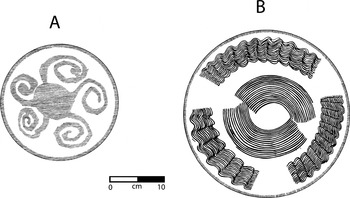
Excavated Early Postclassic cultural material is not widely published, so we will discuss each type of feature; describe in some detail the pottery, obsidian, miscellaneous objects, and skeletal material found in the features; and evaluate the contents in terms of chronological significance. In this paper (whenever possible), Red-on-Buff pottery is categorized as (1) Wavy Line Red-on-Buff; (2) Toltec Red-on-Buff; or (3) Wide Band Red-on-Buff, also called Macana Red-on-Brown. In these contexts, Wavy Line Red-on-Buff consists of vessels with repeating rows of wavy or straight parallel lines painted in red on the interior or exterior. The vessels can have a red band at the rim. They do not have supports (Figure 2b). Toltec Red-on-Buff consists of bowls with scroll designs painted in red on the interior (Figure 2a). While a small percentage of these types of vessels found in the Teotihuacan Valley have three hollow supports (Koehler 1986:21–22), the vessels described here do not. They do often have a red band at the rim. Wide Band Red-on-Buff consists of vessels with a wide red band painted in the interior of the vessel near the rim and three large, hollow supports with red paint.

Two decorative types of Red-on-Buff commonly found in Las Palmas mortuary contexts: (a) Toltec Red-on-Buff (30.1/3200); (b) Wavy Line Red-on-Buff (30.1/3136). See Tables 2 and 4 for details on these vessels.
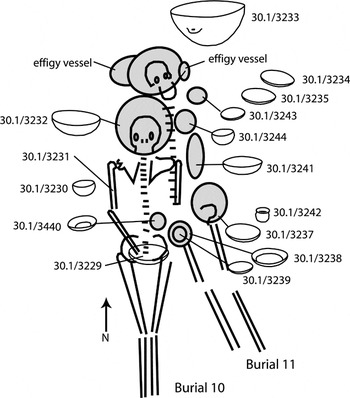
Vaillant excavated three types of proveniences or features: (1) one double burial; (2) eleven burials consisting of human skulls placed in ceramic vessels (called “skull burials”); and (3) 17 offerings with no human remains (Figure 3). The double burial, Burial X-XI, was located a few meters east of the concentration of offerings and skull burials (Figure 4; Table 1). The feature contained two adults placed side by side in an extended and face-up position. Seventeen vessels, including two effigy vessels depicting human heads, accompanied the individuals. One effigy vessel was retained by the Mexican government. The burial did not contain obsidian.

Plan of Vaillant's Las Palmas excavation based on a sketch in his field notes.

Plan of Burial X-XI based on a sketch in Vaillant's field notes. Vaillant sketched the skeletons and the location of the shaded vessels. The outlines of the vessels are drawn from those in the AMNH collections and placed at approximate scale to the vessels sketched in the plan.
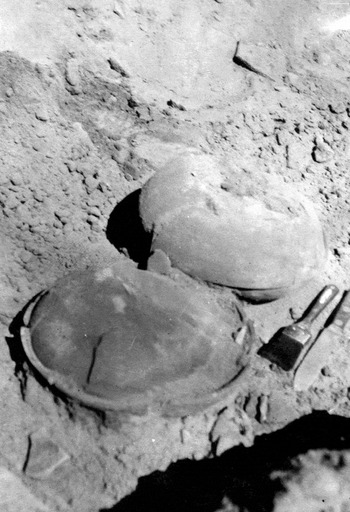
The skull burials and offerings co-occur within what Vaillant described as an earthen platform mound roughly 20 m2 (Figure 3; Table 3). Skull burials consist of skulls placed inside bowls that are covered by overturned bowls or, in some cases, by large sherds (Figure 5; Table 2). The skulls placed in the bowls do not face in any particular direction. Five of the skull burials (numbers 5–9) are grouped closely together and placed in a north–south alignment (see Figure 3). Figures 3 and 5 illustrate how the vessels holding skulls 6 and 7 were positioned so that they were almost touching. Skull Burial 13–14 was purchased from the owner of a nearby field. It is listed as a “double burial,” but the positions of artifacts in Skull Burial 13–14 were not recorded. One Red-on-Buff bowl from Skull Burial 1 and one unknown type of bowl from Skull Burial 6 were retained by the Mexican government. The rest of the objects were transported to the AMNH. The majority of the skull burials contain fewer than three objects, and only three of the 11 contexts contain obsidian. The crania from Skull Burials 2, 3, 4, 5, 6, 7, 8, 9, 13, and 14 were transported to the AMNH and are described in more detail later.

Field photograph of Skull Burials 6 and 7.
The third type of feature consists of discrete sets of artifacts (usually the vessels and other objects were nested inside one another or stacked atop one another), which Vaillant called offerings. The contents of each offering (labeled A, B, C, etc.; see Figure 3) are listed in Table 4. Offerings contain as few as one or as many as seven vessels, primarily bowls and jars. Thirteen of the 17 offerings had obsidian blades. Carbon and red ochre also were found in a few contexts (see later). There may be at least two groups of offerings: one made up of Offerings A, B, C, and possibly F, and the other made up of Offerings H, I, J, and possibly G. Both groups were placed in a line oriented in an east–west direction. Only the artifacts from Offering G are not in the AMNH collection.
Ceramic Vessels
The majority of the 109 vessels included in the three types of features take the shape of saucers, plates, or bowls. Eleven vessels have other forms.
Unknown vessel:
Possibly a hollow base of a larger vessel (or part of a figure this small unpainted object looks like a small stump with two claw-like projections. It is unfinished on the interior. It is the only component of Offering E, leaving open the possibility that it is not an intentional offering at all.
Jars with covers (Figure 6; see also Linné 1934:Figure 103):
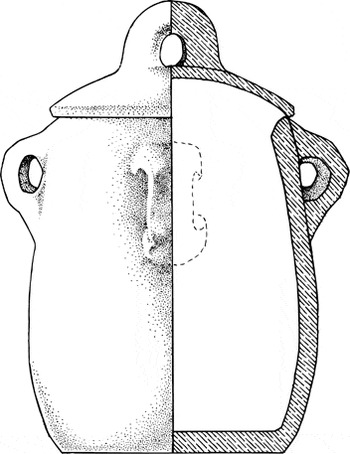
Five jars with covers were placed in three offerings (A, B, and C). These jars are 9–18 cm tall (with the covers) and have diameters of 5.5–7 cm. The jars are either spherical, such as the one pictured in Figure 6, or have straight and slightly in-leaning walls. Both the jar body and the cover are unpainted. The body has three or four small lug handles on the exterior, and the cover has a small lug handle on the top.

A jar with a lid (30.2/3169) from Offering B. See Table 4 for details on the vessel.
Jars (Figure 4):
A single small undecorated jar (catalogue no. 30.1/3242) was recovered from Burial X-XI. A body sherd from an undecorated jar (30.1/3208) was placed to cover Offering K.
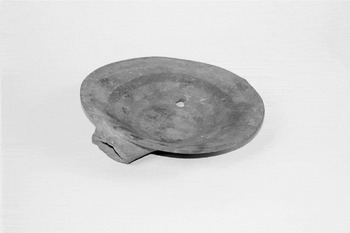
Incense burners (Figure 7; see also Linné 1934:Figure 104):
The bowl of one incense burner (the handle was not recovered) was found in Skull Burial 1. The vessel is unslipped, has four holes, and has red painted designs on the interior and exterior. The interior shows burned spots, suggesting the incense burner was used. Skull Burial 1 also contained a chunk of carbon, possibly from the bowl of the incense burner (but this is not specified in the field notes). Offering Q included a sherd from the base of what would have been a different kind of incense burner. The interior of the sherd is painted red and white and shows no evidence of burning.

A Red-on-Buff incense burner (30.1/3110) from Skull Burial 1. See Table 2 for details on the vessels.
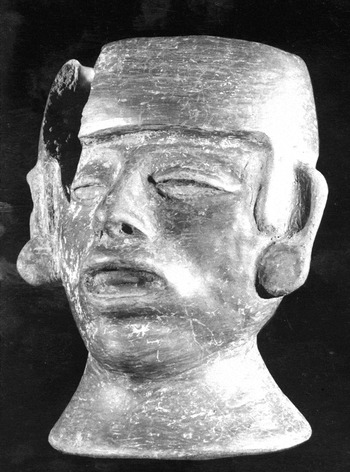
Human effigy vessels (Figure 8):
Two identical human effigy vessels were recovered from Burial X-XI. The one at the AMNH (on display in the Hall of Mexico and Central America) depicts a man with red-painted cheeks wearing headgear and earspools. The remainder of the vessel is light brown in color. It has an 8 cm elliptical opening at the top.

One of two identical effigy vessels (30.1/3263) found in Burial X-XI. See Table 1 for details on the vessel.
Saucers, plates, and bowls:
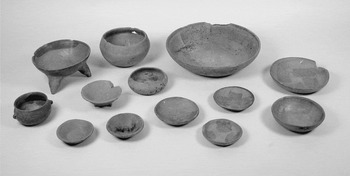
Two bowls, one (30.1/3166) from Offering B and one (30.1/3233) found inverted over the skull of Burial XI (see Figure 4) are large, undecorated bowls with smoothed interiors and roughened exteriors with two small lug handles (see Linné 1934:Figure 98 for an example of a bowl like 30.1/3233). One thin-walled bowl in Skull Burial 13–14 (30.1/3259) has a restricted neck, is painted a solid red-orange, and has two small handles attached to the exterior (Figure 9).

Vessels uncovered in Skull Burial 13–14. Catalogue numbers from left to right are: back row, 30.1/3260, 30.1/3249, 30.1/3258, 30.1/3251; middle row, 30.1/3259, 30.1/3257, 30.1/3261, 30.1/3263, 30.1/3262; front row, 30.1/3256, 30.1/3255, 30.1/3252, 30.1/3253. Not pictured is 30.1/3250 (not located) and 30.1/3254 (on display at AMNH). See Table 2 for details on the vessels.
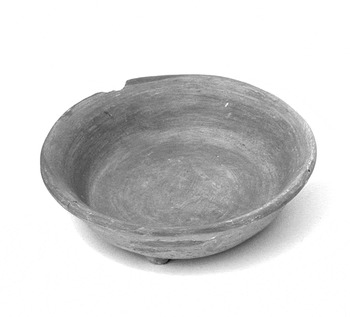
Offering H (30.1/3196, which is partially reconstructed) and Offering M (30.1/3212) both contain flat-bottomed out-leaned wall bowls, and the latter of these has three small supports (Figure 10). These are the only vessels that have an orange color finish. Vaillant (1938:544) called these types Orange Lacquer, which is equivalent to types called Jará Polished Orange or Tula Orange that at Tula date to the Tollan phase (Cobean 1990:335; Cobean and Mastache 1989:44; Parsons et al. 1996; Sanders 1986; Sanders et al. 1979:465–466; Tolstoy 1958:50–51). In Offering H and Offering M, these orange vessels co-occur with Wavy Line Red-on-Buff bowls.

An Orange Lacquer bowl (30.1/3212) from Offering M. See Table 4 for details on the vessel.
Skull Burial 13–14 contained an undecorated, conical tripod with three small supports (30.1/3257) and a tripod (30.2/3260) with three hollow, pointed feet and a thick band of glossy red paint on the interior and exterior rim (Figure 9). This last vessel is Wide-Band Red-on-Buff/Macana Red-on-Brown. At Tula, Macana Red-on-Brown is dated to the Terminal Corral (a.d. 850–900) and Tollan phases (Cobean 1990:289; Cobean and Mastache 1989:44; Mastache et al. 2002; Sanders et al. 1979:464–465).
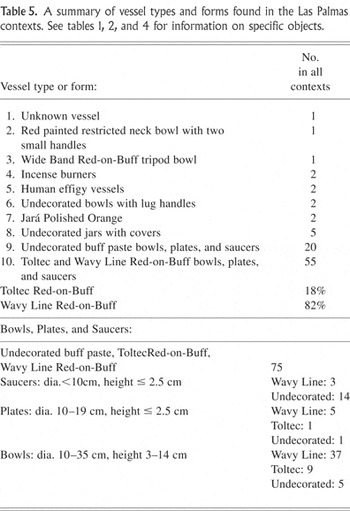
Another 75 bowls either are buff paste vessels with no decoration or Red-on-Buff vessels, which we analyzed for form and decoration (Table 5; the analysis does not include vessels we could not locate or sherds from Skull Burials 3, 5, 6, 7, 13–14, and Offerings C and P). Wavy Line Red-on-Buff accounts for 82% of the 75 vessels we analyzed. Only three examples are Wavy Line Red-on-Buff incurving bowls with decoration painted in red on the exterior (see Figure 9); the rest of the vessels are decorated on the interior. The remaining 18% are Toltec Red-on-Buff (see also Linné 1934:Figures 60–94). There is some variation in the quality and decoration of Red-on-Buff pottery that is difficult to quantify. Many vessels have a red band around the rim, but the color of the pottery ranges from a light yellow-buff with a very polished surface to a light orange-brown with an unpolished surface that can have firing clouds or an uneven tone. The painted designs on the vessels range from very neat and fine to poorly executed.
A summary of vessel types and forms found in the Las Palmas contexts. See tables 1, 2, and 4 for information on specific objects.

Vaillant and Linné called these vessels bowls, plates, dishes, or saucers. In general, we find that three categories may be relevant. Saucers have a diameter of 10 cm or less and are 2.5 cm or less in height. Only three saucers are Wavy Line Red-on-Buff; the other eighteen are undecorated. Seven vessels 2.5 cm or less in height with diameters between 10 cm and 19 cm could be termed plates, and most of these are Wavy Line Red-on-Buff. All but one of the bowls (the small incurving undecorated bowl 30.1/3261 in Skull Burial 13–14) have diameters between 10 cm and 35 cm and are 3–14 cm tall.
This analysis allows us to make several observations. First, undecorated buff, Wavy Line Red-on-Buff, Toltec Red-on-Buff, Macana Red-on-Brown, and Jará Polished Orange co-occur in these features. Undecorated buff and Wavy Line Red-on-Buff types predominate. Two contexts (Offering I and Skull Burial 9) contain only Toltec Red-on-Buff vessels. Macana Red-on-Brown and Jará Polished Orange are very infrequent (three examples total) and are found only in Skull Burial 13–14 and Offerings H and M.
Wavy Line Red-on-Buff and Toltec Red-on-Buff vessels co-occur, but the latter occurs less frequently and in a narrower range of shapes. Toltec Red-on-Buff bowls have diameters between 16.5 cm and 29.5 cm and are between 4.5 cm and 9 cm tall. Distinctly lacking are very tall, deep bowls and small, almost flat saucers. In short, the co-occurence of Wavy Line Red-on-Buff and Toltec Red-on-Buff in three contexts (Offerings D and F and Burial X-XI) suggests that they are contemporary, but the latter is less frequent and occurs in a narrower range of shapes.
There is some degree of similarity in vessel shape and design among Toltec Red-on-Buff and a type Vaillant (1938) identified as “Orange on White Lacquer” that today is called Joroba Orange on Cream and at Tula is dated to the Terminal Corral phase (a.d. 850–900) (Mastache et al. 2002:42). These are not the same wares. Joroba Orange on Cream has a white slip with scrolls painted on the sides (not base) of the vessels; however it has been suggested that the two types are contemporary and possibly part of the same ceramic tradition, so it is worth pointing out that this type is absent from these contexts.
Another type of pottery absent from these deposits is Tohil Plumbate, which has a wide distribution across Mesoamerican from a.d. 1000–1250 and is found at Tula in Tollan phase deposits (Cobean 1990:475–485). George Cowgill (personal communication 2004) has pointed out that Tohil Plumbate is exceedingly rare at Teotihuacan and that the Teotihuacan Mapping Project picked up only 18 sherds of this type out of 900,000 total sherds collected. Linné (1934:105) states that although Vaillant found Plumbate ware at Las Palmas, he found “none in the archaeological zone.” Linné in turn failed to find any in his excavations in Xolalpan and at Las Palmas, with the exception of the “necks of two vases.” These data are consistent with those of the Teotihuacan Mapping Project, and certainly we may say that Plumbate does not occur in the Las Palmas zone in primary contexts such as burials and offerings. It is not clear why Plumbate is virtually absent in surface collections not only here but also in the rest of the Teotihuacan Valley (see Evans 1986:307).
Obsidian
Thirty-five pieces of obsidian were listed in the field notes, but only 30 were catalogued (five pieces that were listed in the field notes as blades presumably did not leave Mexico; Table 6). Another five pieces (all catalogued at the AMNH as blades) were not located. Of the 25 pieces we found, seven are gray obsidian, and 18 are green obsidian. Gray obsidian could have been acquired from the nearby Otumba source (about 15 km away), while green obsidian most likely came from the Pachuca source, located about 50 km away. All but two of the 25 pieces are prismatic blades.
Obsidian included in offerings and burials.

Thirteen of the 17 offerings contained at least one blade, usually placed inside a bowl. Most of the blades have no visible edge damage. Offering A contained eleven (five gray and six green) very well-preserved blades that may have been placed unused in the offering. As we will see later, Linné found many unused blades in burials he excavated. While the offerings almost always contain at least one obsidian blade, only three of the nine skull burials contain blades. Skull Burial 6 did contain four pieces of obsidian (two broken blades and two flakes), but all four pieces have moderate or heavy edge damage. No obsidian was recorded in Burial X-XI.
Miscellaneous Artifacts
Other artifacts include one flat ceramic disc with a 3.5 cm diameter (Offering P), one small pottery figure possibly representing a bird (Skull Burial 6), one 6 cm × 3 cm chert scraper (Offering A), two chunks of carbon (Skull Burial 1 and Offering B), and a chunk of red ochre (Offering N).
A turtle shell (30.1/4313, measuring 50 cm in length) located near Offerings A and E and Skull Burial 4 was identified (by K. P. Schmidt) as Dermatemys (genus) mawii (species), commonly called a Central American River Turtle (Figure 2). The turtle's habitat includes northern Oaxaca, Veracruz, the Yucatan Peninsula, Belize, and the Atlantic coast of Guatemala and Honduras (EMYSystem 1999). It is likely that the turtle's shell was transported from one of these costal regions and incorporated as part of the rituals accompanying the burials and offerings.
Skeletal Remains
The crania from Skull Burials 2, 3, 4, 5, 6, 7, 8, 9, 13, and 14 were transported to the museum, as were the skeletons of two other individuals collected at Teotihuacan. The two skeletons come not from the contexts described in this paper but from probable Mazapan contexts that Vaillant excavated south of the Teotihuacan Museum (see Armillas 1950:46). However, because they have the same regional affiliation, we used this material to assist us in sexing the ten crania from Skull Burials 2–9 and 13–14. Basic information for the ten skulls is summarized in Table 3. A sample of bone collagen extracted from the mandible of Skull 9 was submitted for accelerator mass spectrometry (AMS) dating at Beta Analytic Labs (Beta-191778). The 2-sigma calibrated result (95% probability) was a.d. 690–890. The 1-sigma calibrated result (68% probability) was a.d. 720–740 and a.d. 760–870, and the intercept of the radiocarbon age with the calibration curve is a.d. 780.
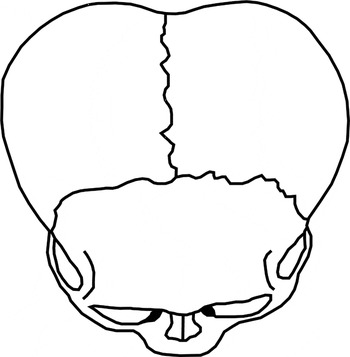
Six of the ten skulls show intentional cranial deformation (ICD) of the anteroposterior technique. This type of deformation, commonly called “tabular erect,” causes the forehead to recede posteriorly in an oblique manner and the posterior poles of the parietals to bulge outward, almost causing the head to look heart-shaped when viewed from above (Figure 11).

A schematic drawing showing the “tabular erect” type of intentional cranial deformation found on the Las Palmas skulls.
Sex was determined using three methods: (1) comparing the overall range of variability among the crania for size, shape, and robustness in the neurocrania and splanchnocrania portions of the skulls and overall size and shape of the mandible; (2) using the skeletal material and crania from one of the comparative skeletons which based on innominate dimensions we determined to be female; and (3) using measures of cranial dimensions, which were analyzed using FORDISC 2.0 (Ousley and Jantz 1996). While not the most reliable indicator of sex when comparing skulls with ICD to skulls without ICD, the results were identical to our assessments through gross examination. Age was determined by dental stages and the degree of occlusal wear. The data provided later are our best assessment as to an individual's age and gender.
Close examination of cranial squama and major joint surfaces turned up no evidence of blunt-force trauma or cut marks. It would appear that individual crania found in vessels were not ceremonially decapitated and that the skeletons were not defleshed by any means using implements that would have left marks on the bones. In at least one case, in Skull Burial 6, a phalange was recovered with the skull. We suggest that the best interpretation of these data is that the skulls represent secondary interments of male and female individuals over 30 years of age.
Summary
Several important points emerge from Vaillant's data. First, his excavations uncovered what we interpret to be both primary and secondary burials. The secondary burials consist almost exclusively of individual crania. Second, the skull burials and the offerings co-occur in a zone that lacks any substantial architecture except a possible earthen platform mound. Third, primary and secondary burials both contain common household items. Two human effigy vessels found in the double burial are unique. Incense burners (in these contexts, fragments of incense burners) and obsidian blades, some of which may never have been used, are objects with potential ritual significance.
Secondary burials co-occur with offerings, and we should consider how the two types of features are related. For example, the primary burial has an average of 8.5 vessels per person. Three secondary burials each contain six vessels, while eight secondary burials contain one to three vessels. We can suggest that burials contained six or more vessels, but when individuals were exhumed, they were reinterred with fewer goods, primarily bowls. In this scenario, offerings associated with secondary burials may represent offerings made to a group of reinterred individuals. These objects are either new items or grave goods exhumed from primary burial contexts. It would be tempting to see the inclusion of unused obsidian blades as part of the reinterment proceedings; however, because Linné found obsidian blades in many primary burials, it may be more likely that blades were transposed along with other primary burial goods into offering contexts. A second suggestion is that the skulls of adults over age 30 were selectively exhumed from primary burials and reinterred and that many adults chosen for reburial (6 out of 10) show cranial deformation. Most fortunately, by drawing on Linné's data we can flesh out our picture of burial practices a little further.
LINNÉ'S EXCAVATIONS: XOLALPAN, LAS PALMAS, AND OZTOTLAN
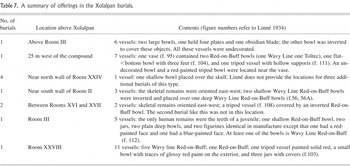
Xolalpan
The levels above the Classic-period house floors of the Xolalpan compound produced 16 Early Postclassic burials (Linné 1934: 75–86). Like Vaillant, Linné found no concrete floors or stone constructions associated with these features. Data from 11 of the 16 burials are presented in some detail in Linné's report and are summarized in Table 7. All of the burials were single individuals, either adults or juveniles. Because of poor preservation, Linné is not sure whether some burials contained complete skeletons. It is clear that four burials consisted of only skulls covered by an overturned bowl and that one of thee skulls belonged to a juvenile.
A summary of offerings in the Xolalpan burials.

Offerings consist primarily of Wavy Line Red-on-Buff pottery. Toltec Red-on-Buff vessels (1) occur only as shallow bowls; (2) are less well made; and (3) are found less frequently than Wavy Line Red-on-Buff. This information fits with our analysis of Vaillant's data, supporting our suggestion that Toltec Red-on-Buff occurs in a narrower range of vessel forms and is less frequent than, but contemporary with, Wavy Line Red-on-Buff.
Other decorated and undecorated vessels included as offerings are tripod bowls with hollow leg supports (four burials), jars with lids (two burials), and undecorated jars, bowls, and plates (five burials). Figurines appear in only one feature (associated with the burial of a child). Obsidian is not consistently described for these proveniences. In terms of the number of vessels per feature, one burial contains 11 vessels, three contain five to seven vessels, and three contain two or three vessels.
The four skull-only burials included only one vessel each. Linné (1934:83) pointed out that these burials differed from the contexts Vaillant excavated because here the skulls were covered by overturned vessels rather than placed inside of vessels and then covered by overturned vessels. Linné suggested that the skulls might be offerings associated with the Xipe Totec cult (see later), but admitted that it was not possible to make such an assertion without an examination of the skeletal remains (which had not been done). Based on an examination of the skeletal remains from Vaillant's skull burials, our interpretation is that these features probably are secondary burials.
In terms of the kinds of vessels placed as offerings, these features are similar to the contexts Vaillant excavated. It is possible that Xolalpan was the focal point of other types of rituals. In the northeastern section of the excavation, Linné (1934:84) uncovered fragments of a hollow Xipe Totec figure, a god associated with spring and planting rituals. The figure was smashed, and its fragments were spread over a 6 m2 area (after it was repaired, it stood 1.14 m). Sue Scott (1993) has provided a thorough description of the Xipe Totec figure.
Salvage Work at Xolalpan
In 1986, archaeologists at the Instituto Nacional de Antropología e Historia, Mexico City, conducted salvage work at Xolalpan (Jarquín and Martínez 1991:81–83). During the course of the excavations, they uncovered a flagstone floor and 22 Red-on-Buff vessels. All of the vessels (except for one tripod bowl) appear to be Wavy Line Red-on-Buff bowls. The excavators suggest that the open area may have served as a plaza. Most of the bowls occurred as sets: The bottom bowl, which held an unused gray obsidian blade, was covered by an overturned bowl. In several cases, the bottom bowl was ringed with small stones and united to the floor with mud. Ana María Jarquín and Enrique Martínez Vargas interpret this cache of vessels as offerings, possibly connected to fertility rites or to the Xipe Totec figure uncovered by Linné.
Las Palmas
At Las Palmas, Linné (1934:37) uncovered a series of large rectangular stones placed in rows (no dimensions given), which appear to have served as the foundation of a structure. He excavated inside the platform to a depth of 1.4 m and came across several large flagstones. Sitting atop the stones he encountered a figure carved of tufa and sherds of Red-on-Buff pottery (Linné 1934:Figure 267). The flagstones covered the entrance to a “roomy” cave holding two large storage jars (Linné 1934:37). The presence of storage vessels led Linné to suggest that he had uncovered the remains of a domestic structure. In another section of his report, Linné (1934:114) writes that next to a “primitive wall, or part of a house foundation”—very likely the structure just described—he found eight two-chambered candeleros placed in a row against the wall.
Linné excavated six burials in fairly close association to the structure. Each held one individual placed in an extended, face-up position but not oriented to any particular cardinal direction. Linné does not describe each burial in detail; rather, he presents several observations about the offerings. Each burial contained at least one bowl that was covered by one or more bowls. The bowl usually held a smaller bowl and an unused obsidian blade (Linné 1934:80). Several graves varied from this pattern or included additional objects: (1) in one burial, four sets of four stacked bowls(nested one inside another) were placed upright in a line behind the head of the individual; (2) two burials contained jars with small lug handles and lids (Linné 1934:Figure 103), and one of these graves had a vase (Linné 1934:Figure 102); (3) one burial contained a tripod vessel with spherical supports that was painted white and decorated with clay cones attached to the exterior (Linné 1934:Figure 97), while a large bowl with small lug handles had been placed (inverted) over the individual's head (Linné 1934:Figure 98) and a bowl containing an obsidian blade covered by an inverted dish sat at the individual's side; and (4) one burial included a rasping bone (Linné 1934:128).
Linné notes that general excavations in the zone uncovered domestic objects likely associated with the Early Postclassic occupation, including a vase of polished red ware (Linné 1934:Figure 137), comals (Linné 1934:Map 2), and figurines (see Scott 1993).
Oztotlan
Near an isolated house, Linné (1938) excavated a stone-lined burial feature or tomb measuring 180 cm long and 70 cm deep. The shorter north and south walls were solid slabs of stone, while the longer east and west walls were built of rectangular stone blocks 30–40 cm long and 10 cm tall. Five stone slabs formed the roof of the chamber. The tomb was oriented about 15° east of magnetic north. Inside, Linné uncovered the remains of two individuals. One of the individuals may have been placed in a seated position against the south wall.
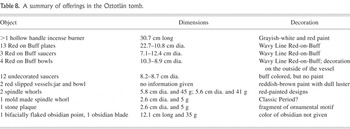
The tomb contained 34 vessels: 20 Wavy Line Red-on-Buff vessels, 12 undecorated saucers, and two red-slipped vessels. In addition, it held one complete incense burner (similar in shape to the one described for Offering A), three spindle whorls, a fragment of a stone sculpture, and several pieces of obsidian, including a blade and a 12.1 cm atlatl, or spear point (Table 8). The majority of these objects were positioned at the north end of the tomb. Some vessels were filled with ashes and charcoal. The floor of the tomb was covered by a layer of pulverized red volcanic rock.
A summary of offerings in the Oztotlán tomb.

EXCAVATIONS IN TUNNELS EAST OF THE PYRAMID OF THE SUN
A brief description of excavations in the Cueva de las Varillas located some 150 m directly east of the Pyramid of the Sun provides additional data on Early Postclassic burials and ritual (see Mazanilla et al. 1996). In this man-made cave, Linda Manzanilla and her colleagues found 13 Early Postclassic burials, along with storage features that contained amaranth, maize, and chenopodioum seeds. Five burials—three seated adults accompanied by two infants—were identified as one discrete feature. These individuals had been buried with intentionally smashed vessels, whole vessels, and obsidian. Vessel types included a Macana Red-on-Brown negative decorated miniature bowl with festooned rim; a Red-on-Brown tripod molcajete bowl; and a nearly complete Jará Orange tripod bowl with hemispherical supports. A complete Mazapan bowl (incurving with decoration on the exterior) was found with the infants. The project obtained two radiocarbon dates from this feature. One was calibrated a.d. 865–1229, with an intercept of a.d. 930, and the other was calibrated a.d. 670–970 with an intercept of a.d. 730 (Manzanilla et al. 1996:250). In another deposit in the central part of the chamber, the excavators found the skeletons of seven infants interred together, which they date to the seventh century a.d. They suggest that the infants were sacrificed in rituals to worship Tlaloc and that the cave itself was a focal point for the enactment of fertility ceremonies during the Epiclassic and Early Postclassic periods.
MORTUARY PRACTICES IN THE CLASSIC PERIOD AT TEOTIHUACAN
Comparative data on mortuary practices in Classic-period Teotihuacan is available in a study published by Martha Sempowski and Michael Spence (1994). The vast majority of the burials these researchers analyzed are primary burials, and they occur below the concrete floors of residential compounds. Most individuals were placed in simple pits. The only specially constructed stone-lined chambers are tombs found in the Oaxaca barrio, where a population of people affiliated with Zapotec culture resided, and one tomb at Xolalpan, which probably was built as part of the compound's initial construction (see also Linné 1934).
While burials of a single individual predominate, secondary burials did account for 24.8% of the burials examined (Sempowski 1994:136). Usually, secondary burials were multiple interments—such that one burial context might have both a primary and secondary internment—and when individuals were reburied, numerous skeletal bones (particularly crania and long bones) were place in the secondary burial context (Sempowski 1994:138). Only five burials contain only skulls, and one of these contexts is a mass interment of 35 skulls (and a few long bones) in a natural cave below the floor of a Classic-period apartment compound (Sempowski 1994:56–57; see Armillas 1950:59 citing data in Bastien 1946).
In the Classic period, both male and female remains show evidence of cranial deformation. Often, the state of preservation of cranial remains made it difficult to determine whether skulls were intentionally deformed (Sempowski 1994:127). However, in 37 cases (consisting of both males and females), the crania showed flattening of the frontal and occipital bones of the skull. There are three subtypes of this kind of cranial deformation that the researchers noted but could not describe in terms of relative frequencies: “tabular erect,” where pressure is applied high on the back of the skull and affects both parietals and the occipital bone; “tabular oblique,” where pressure is applied lower on the occipital bone, not encompassing the point of union with the parietal bones; and “mimetic,” which combines elements of each of the two other subtypes. As we have already noted, the first type, tabular erect, most closely describes the cranial deformation seen on the Early Postclassic skulls at Las Palmas.
SUMMARY
The Vaillant–Linné work provides us with temporal, spatial, and contextual information for 34 mortuary contexts that held a total of 37 individuals. Our analysis has extracted more detailed data for 11 primary burials and 14 secondary burials. In addition, 16 offerings (with no human remains) were examined. The Las Palmas data allow us to document that burials and offerings contain common household items including bowls, plates, jars, and obsidian. Unused obsidian blades were placed in offerings, and it appears that there was a preference for green blades over gray blades.
Presumably, Las Palmas is a dense zone of Early Postclassic-period occupation, although excavations uncovered only two substantial structures. Linné found no Early Postclassic structures atop the Classic-period Xolalpan ruins. Salvage work at Xolalpan uncovered what may be the flagstone floor of a plaza. Excavations at Las Palmas uncovered a stone house foundation with six primary burials in the general area. Vaillant cites only the presence of an earthen mound. We have noted the possibility that residential structures were built of perishable materials and were not detected, but also that excavators have not reported features such as middens or hearths commonly associated with even ephemeral residences. The evidence at hand suggests two possibilities to us regarding the Las Palmas site. In one scenario, these mortuary contexts are near to but not directly associated with domestic occupations, and the Las Palmas people buried their dead not below the floors of their homes but, rather, in a common cemetery. A different interpretation suggests that Las Palmas was primarily a ritual zone and not a residential area. Evidence from the Cueva de las Varillas and the presence of the Xipe Totec figure atop the Xolalpan mound indicate ongoing activities related to fertility rituals. Returning to the grounds of abandoned cities to conduct rituals is not uncommon in Mesoamerica in the Postclassic period and has been studied at sites such as Xochicalo, Morelos, and Monte Albán, Oaxaca (Caso 1969; Middleton et al. 1998; Smith 1992:259).
Data from Xolalpan and Las Palmas allow us to suggest the presence of secondary burials. Ten contexts (with 11 skulls) at Las Palmas and four graves at Xolalpan probably are secondary interments. The ten secondary burials at Las Palmas contain the skulls of male and female adults over age 30, and at least six of these show cranial deformation. Fundamentally, secondary burial rituals involved placing a skull under an overturned bowl. A few other vessels, almost always additional bowls, could be placed in the same feature. At Las Palmas, the secondary burials are closely associated with a cluster of offerings. Regarding the nature of secondary burial practices, we must admit that our lack of comparative skeletal data from primary burials and from Linné's probable secondary burials is frustrating and makes it difficult to draw firm conclusions about this practice. We can suggest that adults and possibly juveniles were treated in this manner and that at least some of these individuals had tabular erect cranial deformation. Secondary burial rituals involved almost exclusively a treatment of the skull in a manner involving its dislocation from one context (after enough time had passed for soft tissue to decay) and its reinterment in another with a limited number of objects, almost always just a bowl or two. Tentatively, we can propose that what these excavators found represents ongoing mortuary activities in which individuals are first buried in a cemetery context and then some individuals are disinterred, ritually processed, and reinterred as crania placed in bowls. The secondary burials are accompanied by offerings, possibly made up of vessels exhumed from primary burials. We do not know whether reburial events occurred on one or multiple occasions, but the positioning of Skulls 6 and 7 leads us to suggest that these rituals may have been conducted for several individuals at once.
These excavations did not uncover skeletons without crania; however, recent excavations at the Teotihuacan Valley site of San Marcos did uncover the burial of a female lacking a cranium. In its place was a Wavy Line Red-on-Buff bowl (see Charlton 1998). Future research may uncover similar contexts at the Las Palmas site. Of course, it is possible that subcranial material was exhumed and disposed of during the reburial process. It is not completely clear whether primary and secondary burials co-occur spatially. In the Xolalpan zone, they may well co-occur. In the Las Palmas zone, Vaillant uncovered one primary double burial located a few meters away from a concentration of secondary burials. Linné reports only primary burials from Las Palmas.
The Las Palmas data allow us to discern something about the social and economic structure of Mazapan society. Most individuals in primary burials are placed in an extended, face-up position, and while the remains have no overarching orientation, east–west is common. Two mortuary features are primary double burials—a stone lined tomb at Oztotlan and a simple pit at Las Palmas. The tomb stands out in terms of its construction quality and the number and variety of objects included as offerings (34 vessels, an incense burner, obsidian blades, an obsidian arrow or spear point, and three spindle whorls). At least one individual in this tomb, like the three adult burials in the Cueva de las Varillas, was placed in a seated position, while individuals in simple pits were placed in an extended face-up position.
There is very little data regarding the social structure of Early Postclassic-period society, but it is likely that the individuals buried in the Oztotlan tomb belonged to the noble social strata or elite class. Yet tombs are somewhat anomalous in central Mexico. The presence of a formal tomb with typical Early Postclassic objects indicates that the inhabitants of the Teotihuacan Valley had adopted elite burial practices distinct from those of the their Classic-period predecessors.
Elite burials may not be limited to tombs. The information at hand allows us to hypothesize only rudimentary patterns in burial treatment. For example, the double burial Vaillant excavated contained 17 vessels, including two elaborate effigy vessels. Additional contexts with ten or more vessels include Skull Burial 13–14, one burial of a single individual atop Xolalpan, and one burial of a single individual at Las Palmas. Most burials included only three or four vessels. Since we do not have skeletal data for these individuals, it is impossible to examine how the quantity or kinds of objects placed in burials correlate with age and sex. We can posit that if there is a general association between cranial deformation and elite status at Las Palmas, as there is in much of Mesoamerica, then the fact that at least six of 14 secondary burials show tabular cranial deformation may mean that elites were chosen more frequently than commoners for this process (which could skew the percentage of elite primary burials in excavation).
Our ceramic analysis and an AMS date from human remains allow us to discuss the chronology of these contexts. On the one hand, the calibrated 2-sigma radiocarbon date of a.d. 690–890 is relatively early. It may be that the skull was curated as a relic and therefore some length of time passed between the death of the individual and the reburial of the skull. On the other hand, a relatively early date fits well with the ceramic and obsidian data. Few of the contexts Vaillant and Linné excavated contain Jará Polished Orange or Macana Red-on-Brown vessels. Contexts that do contain those types also contain Wavy Line Red-on-Buff and Toltec Red-on-Buff. This pattern would fit with a scenario suggesting that Red-on-Buff types originated in the Teotihuacan Valley and were produced there for some time before appearing elsewhere.
None of these contexts contains Plumbate, a type found in central Mexico after a.d. 1000. We suggest that these contexts date to the Mazapan phase as defined by Sanders (1986). Mazapan-phase ceramics include undecorated buff pottery in the form of bowls, jars, and comals; Wavy Line Red-on-Buff pottery in the form of bowls, dishes, and saucers; and Toltec Red-on-Buff pottery, which occurs primarily as shallow bowls. Obsidian would not be infrequent in Mazapan contexts. As suggested by Sanders, Atlatongo-phase contexts include Red-on-Buff pottery as well as Joroba Orange on Cream and other ceramic types such as Jará Polished Orange and Macana Red-on-Brown. While exceedingly rare in the Teotihuacan Mapping Project surface collections, Tohil Plumbate could occur in Atlatongo deposits. The transition between the two phases is not abrupt, and distinguishing between Mazapan-phase and Atlatongo-phase contexts will require not only radiocarbon dates, but also analyses of the frequency of these types in controlled excavations.
CONCLUSIONS
This paper reviews excavations at Las Palmas, a site located on the grounds of the Classic-period city of Teotihuacan, as a way to evaluate aspects of Early Postclassic society in the Teotihuacan Valley. The information from the Vaillant–Linné excavations allows us to propose patterns in Early Postclassic burial and ritual practices at the Las Palmas site. Two practices show a clear break with Classic-period mortuary treatment: the presence of secondary burials and the placement of burials in cemeteries or ritual zones. The dating of these features lends support to a division of the Early Postclassic period in the Teotihuacan Valley into two phases, with these contexts dating to earlier the Mazapan phase.
Finally, this analysis draws primarily from a reevaluation of museum collections. We suggest that the ideas presented in this article could be refined and additional information could be gleaned about the Las Palmas site by (1) reexamining the Teotihuacan Mapping Project's surface collections for this zone; (2) reexamining Linné's collection in Stockholm; and (3) applying analytical techniques such as trace-element analysis and additional radiocarbon dating to the Las Palmas collections. Of course, new excavation projects focusing on the Early Postclassic also are needed to augment the work described here. Broad horizontal exposures that uncover the plans of domestic and ritual architecture and its associated features, such as middens and hearths, will provide critical data. Only then will we better understand the spatial relationship between living and deceased members of a community such as Las Palmas and refine current ideas about Early Postclassic culture.
RESUMEN
En los años 1931 y 1932, George Vaillant (Museo Americano de la Historia Natural) y Sigvald Linné (Museo Etnográfico de Estocolmo) excavaron en el sitio de Teotihuacan. Escogieron varios lugares generalmente ubicados a unos 200 metros al este de la pirámide del Sol. Vaillant excavó en un terreno llamado Las Palmas. También Linné excavó en Las Palmas y además excavó en Xolalpan y cerca de una casa aislada llamada Ozotolán. En los tres lugares, Vaillant y Linné encontraron cerámica de pasta café con diseños pintados en rojo. Dicha cerámica estaba ubicada encima de la ocupación clásica Teotihuacana pero abajo de la ocupación Azteca.
Hoy día, esta cerámica esta mejor conocida como Rojo sobre Café y se fecha a la época Postclásica temprana (900–1150 d.C.). Además, hoy día se sabe que estas zonas de excavación se encuentran dentro de una área identificada por el Proyecto de Mapeo de Teotihuacan por tener una densa ocupación postclásica temprana. Hemos llamado dicha zona el sito de Las Palmas para distinguirla de la ocupación clásica Teotihuacana.
El material excavado por Vaillant se encuentra en el Museo de New York. Una meta principal de este artículo es publicar los datos de la investigación de Vaillant y comparar sus datos con los datos publicados de Linné. Así podemos evaluar el carácter de la ocupación que existía en la zona de Las Palmas y brindar luz sobre los patrones mortuarios de los habitantes.
Vaillant encontró un entierro con dos individuos, once entierros de cráneos humanos, y diez y siete ofrendas. El entierro doble tenía diez y siete vasijas, incluyendo dos vasijas idénticas tomando la forma de la cabeza de un hombre con tocado y aretes. En los entierros de cráneos, cada cráneo estaba dentro de un cajete y por lo general estaba tapado con otro cajete volteado boca abajo. Los cráneos pertenecen a hombres y mujeres de más de treinta anos de edad y algunos demuestran deformación artificial. Hemos interpretado dichos contextos como entierros secundarios. Las ofrendas consisten principalmente de vasijas como cajetes y ollas con tapas y de navajas prismáticas de obsidiana, algunas de ellas sin huellas de uso.
Linné excavó doce entierros primarios en Xolalpan y cuatro entierros secundarios. En Las Palmas, excavó seis entierros primarios asociados con los cimientos de una casa. En Oztotlán, excavó una tumba de piedra con dos individuos acompañados de treinta y cuatro vasijas, malacates y obsidiana. La mayoría de las vasijas dentro de los contextos de Vaillant y Linné son del tipo Mazapa Rojo sobre Café y Tolteca Rojo sobre Café. William Sanders describe esta cerámica como típica de la fase Mazapan—una fase que el fecha cerca de 900–1000 d.C. en el Valle de Teotihuacan.
Usando los datos de Vaillant y Linné podemos sugerir que el patrón mortuario de los habitantes de Las Palmas difiere del de la población clásica de Teotihuacan. Los habitantes de Las Palmas no enterraban a los difuntos debajo de los pisos de las residencias pero en áreas comunales o panteones. Practicaban una forma de entierro secundario caracterizada por la exhumación únicamente del cráneo. El uso de una tumba formal de laja, probablemente para un individuo de alto estatus, es otro patron distinto y demuestra la presencia de por lo menos dos clases socio-económicas.
ACKNOWLEDGMENTS
This paper has greatly benefited from input by Thomas Charlton, George Cowgill, and Deborah Nichols. We also thank Sue Scott, Paul Tolstoy, and one anonymous reviewer who provided useful criticism during the review process. Juan Carlos Perez assisted us in analyzing the data, and funds to run the AMS date were generously provided by the Mexico and Central American Research Fund of the American Museum of Natural History.
References
REFERENCES
Acosta, Jorge
1956–1957
Interpretación de algunos de los datos obtenidos en Tula
relativos a la época Tolteca.
Revista Mexicana de Estudios Antropológicos
XIV(2):75–110.Google Scholar
Armillas, Pedro
1950
Teotihuacán, Tula, y Los Toltecas. Las culturas post-arcaicas
y pre-aztecas de centro de México. Excavaciones y estudios,
1922–1950.
RUNA
III:37–70.Google Scholar
Bastien, Remy
1946
Informe sobre las exploraciones hechas en el Pozo de las Calaveras,
Teotihuacán, 1946.
Manuscript on file,
Instituto Nacional de Antropología e Historia, Mexico
City.Google Scholar
Caso, Alfonso
1969
El tesoro de Monte Albán.
Instituto Nacional de Antropología e Historia,
Mexico City.Google Scholar
Charlton, Thomas H.
1998
Urban Influences at Rural Sites: Teotihuacán and Its Near
Hinterlands. Report submitted to the Foundation for the Advancement of
Mesoamerican Studies, Inc. (http://www.famsi.org).Google Scholar
Charlton, Thomas H., and
Deborah L. Nichols
1997
Diachronic Studies of City-States: Permutations on a
Theme—Central Mexico from 1700 b.c. to A.D. 1600. In
The Archaeology of City-States: Cross Cultural Approaches,
edited by
Deborah L. Nichols and
Thomas H. Charlton, pp.
169–208.
Smithsonian Institution Press,
Washington, DC.Google Scholar
Cobean, Robert H.
1990
La cerámica de Tula, Hidalgo.
Instituto Nacional de Antropología e Historia,
Mexico City.Google Scholar
Cobean, Robert H., and
Guadalupe Mastache
1989
The Late Classic and Early Postclassic Chronology of the Tula
Region. In
Tula of the Toltecs, edited by
Dan M. Healan, pp.
35–46.
University of Iowa Press,
Iowa City.Google Scholar
Cowgill, George L.
1996
A Reconsideration of the Postclassic Chronology of Central
Mexico.
Ancient Mesoamerica
7:325–331.CrossRefGoogle Scholar
Cowgill, George L.
2003
Introduction to the 2003 Edition: Xolalpan after Seventy
Years. In
Archaeological Researches at Teotihuacán, Mexico,
by Sigvald Linné, pp.
xiii–xxi.
University of Alabama Press,
Tuscaloosa.Google Scholar
Crider, Destiny
2002
Coyotlatelco Phase Community Structure at Teotihuacán.
Master's paper in anthropology,
Department of Anthropology, Arizona State University, Tempe.Google Scholar
Crider, Destiny,
Deborah L. Nichols,
Hector Neff, and
Michael D. Glascock
2003
Epiclassic Ceramic Production and Distribution in the
Teotihuacán Valley.
Paper presented at the68th meeting of the Society of American
Archaeology,
Milwaukee, WI.Google Scholar
Diehl, Richard A.
1983
Tula: The Toltec Capital of Ancient Mexico.
Thames and Hudson,
London.Google Scholar
Diehl, Richard A.
1989
A Shadow of Its Former Self: Teotihuacán during the
Coyotlatelco Period. In
Mesoamerica after the Decline of Teotihuacán, A.D.
700–900, edited by
Richard A. Diehl and
Janet C. Berlo, pp.
9–18.
Dumbarton Oaks Research Library and Collections,
Washington, DC.Google Scholar
EMYSystem
1999
Turtles of the World.
Terra Cognita Laboratory, Oregon State University,
Corvallis. Available at http://emys.geo.orst.edu/default.html.Google Scholar
Evans, Susan
1986
Analysis of the Surface Sample Ceramics. In
The Teotihuacán Valley Project, Final Report, Volume 4: The
Toltec Period Occupation, Part 1—Excavations and Ceramics,
edited by
William T. Sanders, pp.
283–366.
Occasional Papers in Anthropology No. 13.
Department of Anthropology, Pennsylvania State University,
University Park.Google Scholar
Guzmán, Eulalia
1938
Un manuscrito de la Colección Buturini que trata de los
antiguos señores de Teotihuacán.
Ethnos
3(4–5):
89–103.CrossRefGoogle Scholar
Hodge, Mary
1984
Aztec City States.
Memoirs of the Museum of Anthropology of the University of
Michigan No. 18.
Ann Arbor.CrossRefGoogle Scholar
Jarquín Pacheco, Ana
María, and
Enrique Martínez Vargas
1991
Sacrificio de niños.
Arquelogía, segunda época.
6:69–84.Google Scholar
Koehler, Thomas
1986
Excavations at Maquixco Bajo. In
The Tetihuacán Valley Project, Final Report, Volume 4: The
Toltec Period Occupation, Part 1—Excavations and Ceramics,
edited by
William T. Sanders, pp.
7–52.
Occasional Papers in Anthropology No. 13.
Department of Anthropology, Pennsylvania State University,
University Park.Google Scholar
Linné, Sigvald
1934
Archaeological Researches at Teotihuacán, Mexico.
Ethnographic Museum of Sweden.
New Series, Publication No. 1.
Stockholm.Google Scholar
Manzanilla, Linda,
Claudia López, and
AnnCorinne Freter
1996
Dating Results from Excavations in the Quarry Tunnels behind the
Pyramid of the Sun at Teotihuacán.
Ancient Mesoamerica
7:245–266.CrossRefGoogle Scholar
Mastache, Alba Guadalupe,
Robert H. Cobean, and
Dan M. Healan
2002
Ancient Tollan: Tula and the Toltec Heartland.
University Press of Colorado,
Boulder.Google Scholar
Middleton, William D.,
Gary M. Feinman, and
Guillermo Molina Villegas.
1998
Tomb Use and Reuse in Oaxaca, Mexico.
Ancient Mesoamerica
9(2):297–307.CrossRefGoogle Scholar
Millon, René
1973
Urbanization at Teotihuacán, Mexico, Volume 1: The
Teotihuacán Map, Part 2.
University of Texas Press,
Austin.Google Scholar
Millon, René
1981
Teotihuacán: City State and Civilization. In
Handbook of Middle American Indians, Supplement 1:
Archaeology, edited by
Victoria R. Bricker and
Jeremy A. Sabloff, pp.
198–243.
University of Texas Press,
Austin.Google Scholar
Millon, René
1988
The Last Years of Teotihuacán Dominance. In
The Collapse of Ancient States and Civilizations, edited by
Norman Yoffee and
George L. Cowgill, pp.
102–164.
University of Arizona Press,
Tucson.CrossRefGoogle Scholar
Millon, René,
R. Bruce Drewitt, and
George L. Cowgill.
1973
Urbanization at Teotihuacán, Mexico. In
The Teotihuacán Map Part 2: Maps.
University of Texas Press,
Austin.Google Scholar
Munch, G. Guido
1976
El Cacicazgo de San Juan Teotihuacán durante la Colonia,
1521–1821.
Colección Científica e Historica, 32.
Instituto Nacional de Antropología e Historia,
Mexico City.Google Scholar
Nichols, Deborah, and
Thomas Charlton
1996
The Postclassic Occupation at Teotihuacán: A Chronological
Assessment.
Ancient Mesoamerica
7:231–244.CrossRefGoogle Scholar
Nichols, Deborah,
Elizabeth Brumfiel,
Hector Neff,
Mary Hodge,
Thomas Charlton, and
Michael D. Glascock
2002
Neutrons, Markets, Cities and Empires: A 1,000-Year Perspective on
Ceramic Production and Distribution in the Postclassic Basin of
Mexico.
Journal of Anthropological Archaeology
21:25–82.CrossRefGoogle Scholar
Ousley, S.D., and
R.L. Jantz
1996
FORDISC 2.0 Personal Computer Forensic Discriminant
Functions.
Forensic Anthropology Center,
University of Tennessee, Knoxville.Google Scholar
Parsons, Jeffrey
1989
Arqueología regional en la Cuenca de México: Una
estratégia para la investigación futura.
Anales de Antropología
26:157–257.Google Scholar
Parsons, Jeffrey,
Elizabeth Brumfiel, and
Mary Hodge
1996
The Implication of Earlier Dates for Early Aztec in the Basin of
Mexico.
Ancient Mesoamerica
7:217–230.CrossRefGoogle Scholar
Rattray, Evelyn C.
1966
An Archaeological and Stylistic Study of Coyotlatelco
Pottery. In
Mesoamerican Notes 7–8, pp.
87–211.
University of the Americas,
Mexico City.Google Scholar
Rattray, Evelyn C.
1996
A Regional Perspective on the Epicalssic Period in Central
Mexico. In
Arqueología Mesoamericana: Homenaje and William T.
Sanders, edited by
Alba Guadalupe Mastache,
Jeffrey Parsons,
Robert S. Santley, and
Mari C. Serra Puche, pp.
213–231.
Instituto Nacional de Antropología e Historia,
Mexico City.Google Scholar
Rattray, Evelyn C.
2001
Teotihuacán Ceramics: Chronology and Cultural Trends.
Instituto Nacional de Antropología e
Historia–University of Pittsburgh,
Mexico City.Google Scholar
Sanders, William T.
1986
Ceramic Chronology. In
The Teotihuacán Valley Project, Final Report, Volume 4: The
Toltec Period Occupation, Part 1—Excavations and Ceramics,
edited by
William T. Sanders, pp.
367–373.
Occasional Papers in Anthropology No. 13.
Department of Anthropology, Pennsylvania State University,
University Park.Google Scholar
Sanders, William T.
2003
Collapse and Abandonment in Middle America. In
The Archaeology of Settlement Abandonment in Middle America,
edited by
Takeshi Inomata and
Ronald W. Webb, pp.
193–202.
University of Utah Press,
Salt Lake City.Google Scholar
Sanders, William T. (editor)
1986
The Teotihuacán Valley Project, Final Report, Volume 4: The
Toltec Period Occupation, Part 1—Excavations and Ceramics.
Occasional Papers in Anthropology No. 13,
Department of Anthropology, Pennsylvania State University,
University Park.Google Scholar
Sanders, William T. (editor)
1987
The Teotihuacán Valley Project, Final Report, Volume 4: The
Toltec Period Occupation, part 2—Surface Survey and Special
Studies.
Occasional Papers in Anthropology No. 15,
Department of Anthropology, Pennsylvania State University,
University Park.Google Scholar
Sanders, William T., and
Carson N. Murdy
1987
Mapping Toltec Period Settlement in the Teotihuacán Valley:
Commentary. In
The Teotihuacán Valley Project, Final Report, Volume 4: The
Toltec Period Occupation, Part 2—Surface Survey and Special
Studies, edited by
William T. Sanders, pp.
517–538.
Occasional Papers in Anthropology No. 15,
Department of Anthropology, Pennsylvania State University,
University Park.Google Scholar
Sanders, William T.,
Jeffrey Parsons, and
Robert S. Santley
1979
The Basin of Mexico: Ecological Process in the Evolution of a
Civilization.
Academic Press,
New York.Google Scholar
Scott, Sue
1993
Teotihuacán and Mazapan Figurines: A Link between the Basin
of Mexico and the Valley of Oaxaca.
Vanderbilt University Publications in Anthropology No.
44.
Nashville,
TN.Google Scholar
Sempowski, Martha L.
1994
Mortuary Practices at Teotihuacán. In
Mortuary Practices and Skeletal Remains at Teotihuacán,
by Martha L. Sempowski and
Michael W. Spence,
1–314.
University of Utah Press,
Salt Lake City.Google Scholar
Smith, Michael E.
1992
Archaeological Researches at Aztec Period Sites in Morels,
Mexico,
vol. 1.
University of Pittsburgh Memoirs in Latin American Archaeology No.
4.
Pittsburgh.Google Scholar
Tolstoy, Paul
1958
Surface Survey of the Northern Valley of Mexico: The Classic and
Postclassic Periods.
Transactions of the American Philosophical Society
48(5).CrossRefGoogle Scholar
Tozzer, Alfred
1921
Excavation of a Site at Santiago Ahuitzotla, D.F. Mexico.
Bureau of American Ethnology Bulletin 74,
Washington, DC.Google Scholar
Vaillant, George C.
1932
Stratigraphical Research in Central Mexico.
Proceedings of the National Academy of Sciences
18(7):487–490.CrossRefGoogle ScholarPubMed
Vaillant, George C.
1935
Early Cultures of the Valley of Mexico: Results of the
Stratigraphical Project of the American Museum of Natural History in the
Valley of Mexico, 1928–1933.
American Museum of Natural History Anthropological Papers
35:279–328.Google Scholar
Vaillant, George C.
1938
A Correlation of the Archaeological and Historical Sequences in the
Valley of Mexico.
American Anthropologist
40(4):
535–573.CrossRefGoogle Scholar
Two decorative types of Red-on-Buff commonly found in Las Palmas mortuary contexts: (a) Toltec Red-on-Buff (30.1/3200); (b) Wavy Line Red-on-Buff (30.1/3136). See Tables 2 and 4 for details on these vessels.

Plan of Vaillant's Las Palmas excavation based on a sketch in his field notes.
Plan of Burial X-XI based on a sketch in Vaillant's field notes. Vaillant sketched the skeletons and the location of the shaded vessels. The outlines of the vessels are drawn from those in the AMNH collections and placed at approximate scale to the vessels sketched in the plan.
Field photograph of Skull Burials 6 and 7.
A jar with a lid (30.2/3169) from Offering B. See Table 4 for details on the vessel.
A Red-on-Buff incense burner (30.1/3110) from Skull Burial 1. See Table 2 for details on the vessels.
One of two identical effigy vessels (30.1/3263) found in Burial X-XI. See Table 1 for details on the vessel.
Vessels uncovered in Skull Burial 13–14. Catalogue numbers from left to right are: back row, 30.1/3260, 30.1/3249, 30.1/3258, 30.1/3251; middle row, 30.1/3259, 30.1/3257, 30.1/3261, 30.1/3263, 30.1/3262; front row, 30.1/3256, 30.1/3255, 30.1/3252, 30.1/3253. Not pictured is 30.1/3250 (not located) and 30.1/3254 (on display at AMNH). See Table 2 for details on the vessels.
An Orange Lacquer bowl (30.1/3212) from Offering M. See Table 4 for details on the vessel.
A summary of vessel types and forms found in the Las Palmas contexts. See tables 1, 2, and 4 for information on specific objects.

Obsidian included in offerings and burials.
A schematic drawing showing the “tabular erect” type of intentional cranial deformation found on the Las Palmas skulls.
A summary of offerings in the Xolalpan burials.
A summary of offerings in the Oztotlán tomb.
 You have
Access