Introduction
There is an extended narrative in the academic and popular press providing support and critique of both ‘alternative’ and ‘industrial’ agricultural systems. Animal agriculture is discussed in a wide range of disciplines in relation to animal welfare issuesReference Siegford, Powers and Grimes-Casey1, environmental impactsReference Subak2, Reference McMichael, Powles, Butler and Uauy3, human health risksReference McMichael, Powles, Butler and Uauy3, Reference Leibler, Otte, Roland-Holst, Pfeiffer, Magalhaes, Rushton, Graham and Silbergeld4 and new methods of productionReference Oltjen and Beckett5, Reference Wilkins6, among others. There has also been an increase in studies on grass-finished beef production as well as the pasture-based production of broilers and laying hens. Many of the grass-finished beef production studies are surveys or analyses of current producer conditions and potential for market/production growthReference Martin and Rogers7–Reference Lozier, Rayburn and Shaw10. Studies regarding pasture-based poultry systems are few and limited in scope. Most focus on poultry feed consumption in pasture systemsReference Fanatico, Pillai, Hester, Falcone, Mench, Owens and Emmert11–Reference Anderson13. Multi-species pasture rotation systems (MSPR) have not been systematically researched.
In the past 20 years, there has been market growth for alternative agriculture production system products, such as organic and pasture-based proteinsReference Dimitri and Greene14–16. This consumer movement has spawned a body of literature and documentaries that scrutinize conventional agriculture practicesReference Nestle and McIntosh17. These books and documentaries also typically profile proposed alternatives, often without an equally detailed look at their sustainability and implications for a system-wide shift to these production strategies. Probably the two most influential popular books of the 21st century to date in this regard are Fast Food Nation Reference Schlosser18 and The Omnivore's Dilemma Reference Pollan19. It was Pollan's uneven treatment of various agricultural systems in The Omnivore's Dilemma that inspired our research. This study used Michigan as an examination site to geographically bind the study with a manageable scale of population (<10 million people, approximately 3% of the US population) and a relatively uniform climate. The question then was posed: how much acreage and how many farms would it take to produce enough beef, chicken and eggs locally for the state's population? While the pasture-based farm profiled by Pollan produces more products than beef, chicken and eggs (also turkey, pork and rabbit) we are not considering them in this analysis. The animals (cows and chickens) included in our present analysis share the most acreage and present a fairly complicated model as is. To complement this question, the acreage necessary to produce these same products from grain-based systems for Michigan was also calculated.
Pasture-based systems are often promoted because of their perceived benefits to society, environment, health and quality of life of farmersReference Martin and Rogers7, Reference Weber, Heinze and DeSoucey15, Reference Undersander, Albert, Cosgrove, Johnson and Peterson20, Reference Gwin21. The purpose of this paper, however, is not to argue for or against pasture-based production but to analyze this MSPR system (cattle and chickens) and identify what scale of change might be necessary if it became a large part of the meat production supply.
We are not aware of any research to date estimating the land and farms required to feed a population in relation to these types of production systems; however, numerous studies have attempted to estimate the land requirements relative to food consumption patterns. Most studies investigate the effect of different food consumption patterns on the agricultural land requirements. Conner et al.Reference Conner, Knudson, Hamm and Peterson22 incorporated an estimation of land into their economic analysis of the effects of developing more local fruit and vegetable production in Michigan. Various papers look at current consumption patterns or a range of other consumption patterns in relation to the acres required to produce this foodReference Peters, Bills, Lembo, Wilkins and Fick23–Reference Gerbens-Leenes and Nonhebel26. These papers contain no analysis of different production systems; rather the emphasis is on different dietary patterns with a generic production system. These papers are quite similar in concept to the following analysis; however, consumption levels were held constant and the potential production per acre of two different production systems was examined.
Methods
Multiple information sources were used to estimate the amount of land and number of farms required to produce enough beef, chicken and eggs for the population of Michigan. For this study, MSPR production levels similar to Polyface Farm (as outlined in Pollan's Omnivore's Dilemma and through personal communication) in northern Virginia were assumed for Michigan, an assumption verified by consulting USDA averages, industry specialists and a local farmer. A sequential analysis was conducted that included: annual Michigan per capita beef and poultry consumption levels, the animal nutrition/feed requirements in both pasture and grain-based systems to produce beef, chicken and eggs, and the acreage necessary for animal feed. The use of non-peer reviewed data was limited to the extent possible.
Consumption and meat requirements
Product disappearance data were used as a surrogate for annual consumption27 and beef average consumption was modified to reflect a Midwest regional difference28. Total consumption, used as the annual population demand, was then calculated using Michigan population data29. These consumption levels assume a year-round supply of beef for the consumer. It may be problematic for non-frozen beef to be available off-seasonReference Lozier, Rayburn and Shaw10 as there are difficulties finishing cattle throughout the year on grass.
The number of cattle needed was determined from the average slaughter liveweights and converted to average pounds of saleable meat per head of cattle. The average slaughter liveweight for the grass-finished system was taken from a survey of grass-finished beef producersReference Steinberg and Comerford30. Fifty-six percent of the slaughter liveweight, the industry average for grass-finished beef, was used to calculate the carcass weight (Dr A. Williams, personal communication, February 25, 2011). The carcass yield (edible meat) used was 75.5% of the carcass weight, the average of two studiesReference Bowling, Riggs, Smith, Carpenter, Reddish and Butler31, Reference Hendrick, Paterson, Matches, Thomas, Morrow, Stringer and Lipsey32.
The average slaughter liveweight for grain-based production was from the federally inspected category of the USDA Livestock Slaughter report for the time period of January–December 201033. Average carcass weight was 60.3% of the average slaughter liveweight based on average cattle carcass weight divided by the average federally inspected slaughter liveweight33. Seventy-three percent of the carcass weight is the saleable meat (bones excluded) assuming an average of Yield Grade 3Reference Ray34. The total annual per capita beef consumption was divided by the pounds of saleable meat per animal to determine the number of animals needed to meet Michigan's consumption.
The number of broilers needed was determined for both pasture-based and confinement systems using a process similar to that described for cattle. The average slaughter liveweight of pasture-based broilers (D. Salatin, personal communication, January 1, 2010) was determined and verified with a local producer (P. Henne, personal communication, July 7, 2010) and Extension Specialist (D. Karcher, personal communication, October 2009–January 2011). The average broiler slaughter liveweight for confinement operations was determined35. The broiler carcass weight is on average 70% of the slaughter liveweight (D. Karcher, personal communication, October 2009–January 2011) in each production system and was used as the saleable pounds per chicken. This figure was used to determine the total number of broilers needed to meet Michigan's demand. No allowance was made for lost/diseased birds.
The number of laying hens required for egg production was determined. The average number of eggs per chicken-day in the pasture-based system was identified (D. Salatin, personal communication, January 30, 2010) and verified (D. Karcher, personal communication, October 2009–January 2011) to ensure a reasonable range for Michigan. Average number of eggs per chicken-year was then calculated. Average egg production per bird in conventional systems was determinedReference Anderson12. The number of eggs consumed per year in Michigan was divided by the average annual production to determine the number of laying hens needed. No allowance was made for lost/diseased hens, egg breakage or seasonality.
Pasture and beef production
Across all species, using known feed efficiencies and animal requirements, necessary acreage allotments for pasture, hay and crops were calculated. We elected to view the production system merely for terminal production and did not incorporate any replacements or concurrent production systems including replacement production or reproductive males. For pasture-based production the land footprint of the directly grazed pasture as well as the land required to grow feed and hay was considered. The pasture acreage for the broilers and the laying hens was also determined. The land footprint of the buildings and feedlots were not included in the final calculations.
The number of cattle required each year to meet beef demand determines the number of cow–calf pairs required. General calf weaning age is assumed to be 205 daysReference Capper and Cady36 with average daily dry matter requirements per cow–calf pair of 36 lbsReference Meyer, Adams, Klopfenstein, Volesky, Stalker and Funston37. The daily dry matter requirement per dry cow of 23 lbsReference Capper and Cady36 was used for the remaining 160 days of the year. Both beef production systems were analyzed using the same cow–calf acreage and nutritional requirements. The total requirements for the dry cows were added to the pounds of cow–calf dry matter requirement to reach a total for the cow–calf portion of the production system.
The average dry matter production of Michigan's hayfields was calculated38 with a 13% reduction for dry matter conversion39. This was used to calculate total acres needed for the cow–calf and dry cow components of the system. No allowance was made for lost hay due to rain, drought or other factors. The acreage requirement for the grass-finished cattle production was based on weight gain per acre per year (D. Salatin, personal communication, January 30, 2010), with production per acre confirmed for Michigan and used to determine pounds of saleable meat per acre and total required acres. The yearly gain per acre used for the grass-finished production was 600 lbs (D. Salatin, personal communication, January 30, 2010; J. Rowntree, personal communication)Reference Steinberg and Comerford30. The overall pasture requirement for this system was then determined by adding the acreage needed for the cow–calf system to the grass-finished total.
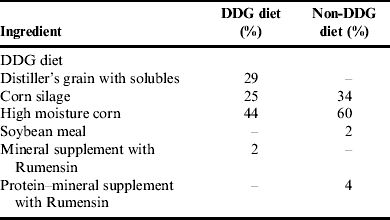
There are two commonly used diets in a feedlot finishing system (S. Rust, personal communication, June 16, 2011) (Table 1). One diet includes dried distillers grains (DDGs), a byproduct of corn ethanol production. It is estimated that 36% of beef producers in the upper Midwest use DDGs in their feedlot diets40. It was assumed that 36% of Michigan producers use DDGs in their feedlot diet and therefore 36% of the cattle were being fed a diet with DDG. This figure might be somewhat underestimated as feeding DDGs is more common in larger feedlots, thus the percentage of cattle might be higher39. Because the DDG-based diets require more acreage than the non-DDG diet this may underestimate total acreage needs in this system. However, the value of the ethanol produced is not accounted for in this study and it could be argued that the acreage required for the DDG diet should be discounted due to the fact that there are two uses coming from the same corn acreage. Confirmation that sufficient DDGs exist in Michigan to supply feedlot needs was determined from Michigan annual ethanol production dataReference Stroade, Martin and Conrad41. Nationally 42% of DDGs produced are used in feedlots40 and it was assumed consistent for Michigan. Forty-two percent of the Michigan DDG poundage is slightly greater than the total amount needed for the DDG feedlot diet.
Beef feedlot diets.
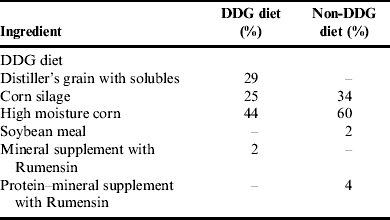
Source: Dr Steven Rust Michigan State University Extension, Beef Cattle Nutrition and Management.
The average number of days in the feedlot (227 days) was established by subtracting the average entry weight35 from the average slaughter weight33, divided by the average weight gain per day (3 lbs d−1). The pounds of feed consumed per feedlot animal was calculated and the lifetime feed consumption per animal was separated into pounds of ingredients based on diet formulations. The total tons of each feed ingredient were then calculated.
Feedlot feed consumed was divided by the average tons of Michigan production per acre to calculate total acreage requirements42. The overall total of the acreage needed for the feedlot finishing system was calculated by adding the cow–calf acreage requirements to the feedlot total.
Broiler and egg production
The feed consumption for the pasture-based broiler production system was calculated from the broiler feed conversion ratio (2.5)Reference Fanatico, Pillai, Hester, Falcone, Mench, Owens and Emmert11, Reference Chisholm, Trott, Zivnuska, Cox and Seipel43 multiplied by the slaughter liveweight of the broiler (D. Salatin, personal communication, January 30, 2010) to yield the pounds of feed required per bird. The tons of individual feed ingredients were then determined based on the pasture-based broiler dietReference Salatin44 and the diet confirmed by a local Michigan producer (P. Henne, personal communication, July 7, 2010).
The confinement broiler feed requirements were calculated using the same method. The average feed conversion ratio (1.9) and the average slaughter liveweight were determined35. Similar to the beef cattle feedlot diets, the ‘average’ diet for the confinement birds was determined (D. Karcher, personal communications, October 2009–January 2011). Total cropland acreage for broiler production feed was calculated analogously to that of the necessary beef feedlot diet crop production described aboveReference Stroade, Martin and Conrad41.
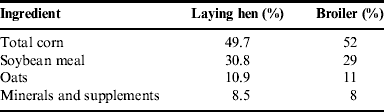
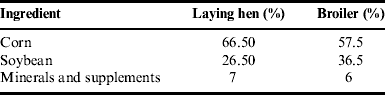
The pasture acreage requirements were determined using an average stocking rate of 1000 broilers per acre per year (D. Salatin, personal communication, January 30, 2010). The egg production calculation was based on feed conversion, in this case in pounds of feed per dozen eggs. The pasture-based feed conversion was calculated as the average weight of the egg (g) per total feed (g)Reference Anderson13. The feed allocation was 3.4 and 3.2 lbs of feed per dozen eggs in the pastured and confinement systems, respectivelyReference Anderson13. This was converted to pounds of feed per dozen eggs and then to total pounds of feed required per year. The pounds of ingredients were calculated from the total feed needed based on the pasture diet percentages (Table 2). The confinement production feed conversion per dozen eggs was determined using industry average diet formulations (Table 3) (Anonymous, personal communication, January 5, 2011). From the total tons of each ingredient the required acreage was calculated as above.
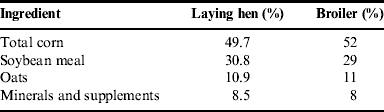
Confinement diets.
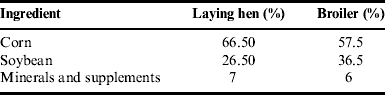
Source: Dr Darrin Karcher MSU Extension Poultry Specialist.
The pasture requirements for the pasture-based laying hens were based on the number of layers needed to produce the eggs following the Polyface Farm strategy (D. Salatin, personal communication, January 30, 2010).
In determining the overall land requirements for the MSPR system, similar to Polyface Farms, it was determined that the broiler/egg pasture production acreage requirements would fit within the beef production so no additional acreage is allocated for these animals. The MSPR system total acreage was calculated by adding the total pasture required for producing beef, and the cropland needed to produce the feed for the broilers and laying hens. The calculation of the acreage footprint for the confinement operations was defined as the total acreage requirements needed to produce feed for each system summed.
Results
US residents on average consume 79.6 lbs of chicken, 247.7 eggs, and 61.2 lbs of beef per year45 with upper Midwest beef as 109%28 of the national average or 66.7 lbs yr−1 per person. Michigan's population is estimated at 9,883,64029. Table 4 illustrates total estimated consumption and animals required to fulfill this demand. This was converted into animals required in the two systems as described in the methods (Table 4).
Consumption and production data.

1 Values for consumption of beef and chicken is boneless meat.
Broiler feed conversion:gain was 2.5 versus 1.9 lbs for the pasture-based42 and confinement systems, respectively.
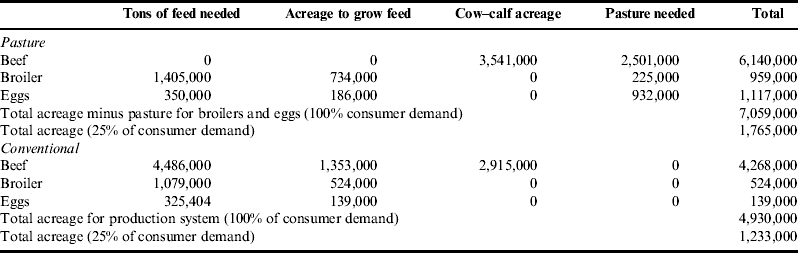
The acreage needed for each production system assuming either 100 or 25% of current consumer demand met is illustrated in Table 5. The acreage requirements for pasture or for growing feed were calculated based on the average cropland production (tons per acre) in Michigan: corn—3.35, soybean—1.16, silage corn—14.69 and oats—0.94Reference Meyer, Adams, Klopfenstein, Volesky, Stalker and Funston37, Reference Stroade, Martin and Conrad41.
Hence, the total acreage requirement for beef production at 100% demand was 4,930,000 acres for the confinement system and 7,059,000 acres for the MSPR system. At 25% of demand met the comparable acres are 1,233,000 and 1,765,000 for the confinement and MSPR systems, respectively.
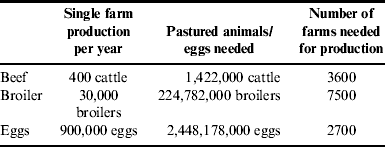
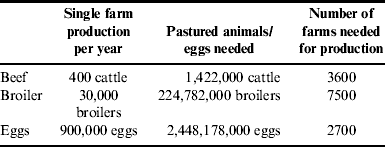
The calculated number of farms of the size of Polyface Farm (approximately 1000 acres) (Table 6) required was based on their annual production (D. Salatin, personal communication, January 30, 2010)—approximately 400 cattle, 30,000 chickens and produce 900,000 eggs per year. To produce beef in the manner utilized at Polyface Farm would require approximately 3600 similar farms in Michigan; 7500 farms would be required for the broiler requirements and 2700 farms for eggs.
Farms needed.
Discussion
The purpose of this study is to critically analyze a popularly held notion—that transforming our agrifood system to one based on a much different average scale and style of agriculture would be relatively simple and efficient given the current state of research and practice. It is not intended as an attempt to either criticize or praise either system. It has a backdrop of myriad challenges facing agriculture in the years ahead, including the cost and sources of energy, the availability of fresh water in current ‘production centers’ nationallyReference Hamm46, and the projected depletion of our mineral resources or their concentration in politically contested areas of the globeReference Cordell, Drangert and White47. It is intended to identify the magnitude of change that would be required to simultaneously maintain our current diets and transform the production system to one based on pasture and individual farm-scale alteration. We used Michigan, USA as our study site for several reasons: first, it has a scale and scope of agriculture that encompasses all the species discussed here as well as many others; secondly, with a population of nearly 10 million it is sufficiently large to extrapolate the issues to the remainder of the country; and thirdly, it provides good boundaries to examine changes that would need to emerge from other parts of the food system and agricultural landscape for such an expanded strategy to occur. Thus, the implications in relation to the number of acres and farms needed to provide Michigan with beef, chicken and eggs using an MSPR system, underscores some of the ramifications this switch would have on other segments of the agricultural landscape. These are outside the focus of this study and will only be discussed in passing. We used the MSPR system analysis supplying all the beef, chicken and eggs for 10 million people in an attempt to systematize the issues of scaling production to a large population. The confinement/grain-based production estimate is a way to comparatively benchmark.
The analysis outlined above takes the extreme position —100% of current consumption levels from the geographic area of Michigan, USA of beef, chicken and eggs would come from production within that same geographic area—while recognizing that this is practically impossible, ecologically improbable and politically untenable. We are not advocating for a diet localized to such an extreme extent nor are we suggesting that current levels of meat consumption are sustainable as world/national populations continue to grow. Finally, we picked as a reference point for the analysis the production strategy highlighted as ‘preferable’ in the best-selling food book of the 21st century to date. We have tried to be very clear that we are not criticizing the production strategy per se. We seek to illuminate issues that arise when a production system conducted at a few locations is conceived of as a general strategy for the nation's food supply.
To put these findings in context we will first compare them with current production figures in the geo-political boundary of focus—Michigan. We report needing 1,422,000 grass-finished cattle or 1,170,000 grain-finished cattle to meet 10 million people's current demand for beef. An eightfold increase in grass-finished cattle and a 6.6-fold increase for grain-finished cattle compared with current production providing 100% of consumer demand and twofold or 1.7-fold to meet 25% of demand (Table 7) would be necessary to feed the population.
Fold increase—Michigan production requirements to meet demand.

Broiler production would need to increase even more dramatically. A 56-fold increase in the number of pasture-raised broilers or a 46-fold increase in confinement-raised broilers would be required while a 14-fold and 11.5-fold increase for 25% of demand would be required. Laying hens would only require a 1.2-fold increase with pasture-based systems and 100% demand production while all other scenarios demonstrates sufficient in-state birds.
Beef production is the single largest driver of the acreage needs for both the grass and grain-finished production systems, with broiler and laying hen pasture needs easily fitting within the beef acreage requirements for the pasture-based system. Even with the broilers rotated for 3 years on the landscape, due to concerns of pathogens and nutrient concentration, there is a large excess of beef production pasture available.
In a place like Michigan, large changes in landscape use would need to occur for such systems to become widespread providers of meat and eggs. In 2007 there was 812,000 acres of pasture land in Michigan50—13.2% of the grazing acreage needed to provide 100% of the current beef consumed by 10 million people with the pasture-based system. In addition 1,160,000 acres are currently used for harvested forageReference Meyer, Adams, Klopfenstein, Volesky, Stalker and Funston37 and 213,000 acres are in the MI Conservation Reserve Program51. Most of this current pasture and forage land is likely used for dairy, sheep, goats and horses. If this total pastureland were available the additional total acreage needs for the MSPR production system is 3,955,000 acres—53.4% of the acres that are currently used to produce row crops52.
When the 920,000 acres needed for producing poultry feed grain are included, there are 2,717,000 cropland acres remaining for all other agricultural production. Overall, such a production system, while maintaining current consumption levels, would utilize 72.2% of the combined pasture, harvested forage and cropland acres in the state of Michigan. There is thus reason to question the potential of this system for producing beef, chicken and eggs for all markets beyond the current niche or recognizing that our consumption of these products (especially beef) is out-of-alignment with the land's carrying capacity.
The MSPR production system can be compared with 4,930,000 total acres required for the confinement/grain-finished system. The cow–calf portion of this production system requires 2,915,000 acres of pasture. The 2,015,000 acres needed for the production of feed for the animals would bring the usage for the confinement/grain-based system to 38% of the total cropland. If production acreage of corn for grain, corn silage and soybeans remained the same, the production of the feed would require 61, 32 and 28%, respectively of the current production acreage. Overall this system would use 50% of Michigan's combined pasture, harvested forage and cropland acres, about two-thirds that utilized in the pasture-based system.
Thus, to feed Michigan's population from internal production using either system explored herein would require a large shift in the current Michigan production profile and would monopolize all current pastureland and harvested forage land. This shift would be larger for the MSPR production system but both systems would greatly limit the capability of the state to produce other crops and raise other animal products such as pork, dairy and lamb. In some ways, then, this can be thought of as an argument against a fully localized food system within the context of current consumption patterns—neither highly intensive nor more extensive systems can feed the population without severely limiting opportunities in other areas of food production. It could, of course, also be used as an argument to modify consumption habits.
However, it could also be assumed that expanded research on MSPR systems would reduce the land use difference significantly, just as research on all commodity crops over the past several decades has dramatically increased yields and thus reduced the land requirements for a given level of productionReference Evenson and Gollin53. There may be gains to be had in ecosystem services in these MSPR systems that in future years may begin to make them more attractive for broader adoption as well—such things as energy useReference Pimentel and Pimentel54 and soil erosion ratesReference Montgomery55.
Many of these pasture-based systems, such as the one modeled here, are very complex with relatively little research to aid in their optimization. In this study, conservative estimates for production were used in order to avoid an error of optimism—allowing us to say that at most there would be a difference of just over 2 million acres between confinement/grain-finished and MSPR systems with a potential to shrink that difference with significant research funds geared at optimizing MSPR systems.
If we step back from a 100% localized system and examine some fraction thereof, the potential appears more feasible—for example, a 25% goal for Michigan's beef, chicken and eggs produced using MSPR systems (Table 5).
A primary goal of this study was to determine what type of shift would be required in the level of farming engaged in animal production, specifically pasture-based, for a fixed population over a specific geographic place. Given that the statistics on animal producers is somewhat general and incomplete, it is difficult to fix an extremely accurate baseline for projecting needed change—however, it is important to estimate the extent and type of a change in farmer population needed in order to gauge the implications of moving toward an MSPR-dominated production system. It is also important to recognize that most farms producing at a significant scale are specialized to a single species.
There are 7848 farms producing beef cattle in Michigan, but 95% have an inventory of less than 50 beef cattle, whereas only 21 farms have an inventory of 200 or more cattle51. Of these, 1481 are cattle feedlots56. While the overall number of farms producing beef in Michigan exceeds either of the calculated farm numbers, it is reasonable to assume that very few of these farms are the size that could be expected to expand production capacity to that modeled in this study. With almost all of the farms owning < 50 cattle in a given year, drastic on-farm changes would be required to achieve farm production levels modeled herein.
The key outcome from these data is the range of challenges for animal products produced in an MSPR system being broadly available in the marketplace—sufficient farms at appropriate scale and farmers, land transformation, financial considerations, supporting infrastructure and interest in adopting new production techniques. It is certain that at current consumption and known MSPR production levels, switching to this scale of production would monopolize most of the Michigan agricultural landscape.
The same issues arise with broiler and egg production. The number of farms currently producing broilers in Michigan (1088 farms with broilers in 200752) is well short of the 7500 farms needed for pasture-based production and is still less than the 3600 farms that would be required if the broilers raised per farm were increased.
In 2007 there were 5247 farms raising laying hens49 almost double the 2700 farms required for producing enough eggs. However, 83% of the farms were in the 1–49 hen category (and only 14 farms with hen inventories over 320049). Half of the existing farms would require an increase in production to just over 4000 laying hens per farm.
Data on the number of farms in Michigan that are producing pasture-based/grass finished animal products are very scarce—eatwild.com lists 22 grass-finished beef producers, 16 broiler producers and 12 farms producing eggs in Michigan. Some of the farms counted in this study produced two or three of these products and thus are counted twice. This is probably not an exhaustive list and does not profile the amount of production per farm, but it provides a sense of the scale of farms in the state attempting a similar production system.
Another indication of the number of people using grass to produce animal products shows that in 2007 there were 7151 farms that used rotational grazing57. This figure is fairly vague because rotational grazing can cover a wide range of management practices and probably includes a number of dairy farms using some form of grazing.
It is finally important to recognize that current consumption levels exceed the federal guidelines for protein consumption58. If the per capita consumption was reduced to federal nutrition guidelines, this would reduce consumption of beef, chicken and eggs by about 25%.
The cow–calf portion of the grain-finished system contributed more than half of the total acreage requirements for the confinement/grain-finished system. In the MSPR system, the production of beef was by far the largest contributor to acreage needs. There are promising signs that if the grazing systems are intensively managed there could be an increase in per acre production from the estimate used for beef cattle in this study. While not investigated thoroughly, anecdotal and preliminary data have shown the potential to reduce overall land use in these systems. For instance, high levels of applied nitrogen combined with irrigation can return 1000 lbs of gain per acreReference Nichols59. New management is ever-evolving that increases pasture utilization without nitrogen inputs as well. Management-intensive grazing combined with managing swards for 30% legumes has proved to be highly productiveReference Moore and Gerrish60. Rouquette and SmithReference Rouquette and Smith61, reported that legume biological N fixation can be as high as 180 lb N per acre. This advantage in pasture-based agriculture will be important given the current pressures on energy and feed.
The poultry systems are not as much of a concern, because overall they do not have large acreage requirements. Their impact is also tempered by their ability to be rotated onto land that is used for beef grass-finishing, which results in the pasture required for the broilers and laying hens not contributing to the overall acreage totals beyond feed.
These results also indicate that the template of Polyface farm would be a very large land footprint compared with an average size for beef, broiler and egg production in Michigan. Many of the small farms would need to greatly expand in scale (and probably scope of products). Another option would be to have farms that required smaller land footprints, but it is unclear how small these farms can be while still maintaining profitability, enhancing efficiency and producing adequate products for the region.
Conclusion
This study was intended to identify the scope of change required if pasture-based systems—specifically a MSPR production system—were to supply the current beef, chicken and egg demands for a population of nearly 10 million. Clearly, this would drastically alter the current agricultural landscape. This comparison illustrates the major reason that MSPR system requires more total land than the current production system. This research also suggests a need for extensive research into optimizing these systems.
We have attempted to develop the boundary conditions, in land and farms required, in order to have these MSPR products available to the general population on a daily basis. It fills a gap in the scientific knowledge where MSPR systems have not been fully examined. Using the extreme case, where this system produces all the beef, chicken and eggs for a large population, has exposed current system limitations as well as identifying a range of beneficial research areas.