INTRODUCTION
The use of rehabilitation to improve the quality of life (QoL) of cancer patients has attracted interest in recent years. However, much of the cancer rehabilitation research that has been conducted has consisted of relatively early recovery-of-function rehabilitation, and little research on maintenance or palliative rehabilitation has been performed. Hamaguchi and coworkers (Reference Hamaguchi, Okamura and Nakaya2008) conducted a fact-finding survey examining cancer rehabilitation at 1045 institutions in Japan and reported that physical function training accounted for a high proportion of cancer rehabilitation efforts, while little attention was directed toward spiritual or psychological suffering. While some research has certainly shown improvement in activities of daily living (ADL) in response to rehabilitation, decreases in function and reduced ADL are inevitable as cancer progresses. Moreover, the prevalence of depression appears to be especially elevated in patients with advanced cancer (Caplette-Gingras & Savard, Reference Caplette-Gingras and Savard2008). Thus, attending to the psychological aspects of cancer is an important task.
In light of this situation, the importance of rehabilitation approaches based on psychosocial aspects aimed at maintaining and improving cancer patients' QoL is now attracting attention (Ronson, Reference Ronson2002). One of these approaches, a life review, is a type of reminiscence method, which was developed by Butler (Reference Butler1963) as a psychological support technique. This activity has been shown to be effective in relation to a patient's degree of life satisfaction, psychological well-being, depressed mood, and self-esteem (Hanaoka & Okamura, Reference Hanaoka and Okamura2004). The reminiscence method has been shown to be a promising intervention method in cancer patients. However, there are relatively few studies concerning the reminiscence method for cancer patients. Wholihan (Reference Wholihan1992) demonstrated the effectiveness of utilizing a patient's photo albums or treasured objects. In Japan, Ando et al. (Reference Ando, Tsuda and Morita2007a,Reference Ando, Morita and O'Connorb) conducted several studies examining topics and programs for application of the reminiscence method in cancer patients. Out of consideration for the physical burden on patients, Ando et al. (Reference Ando, Morita and Okamoto2008) also developed a brief reminiscence method that can be completed in two interviews, and showed that the spiritual well-being, anxiety, and depression of terminal-stage cancer patients improved as a result of its application (Ando et al., Reference Ando, Morita and Akechi2010a,Reference Ando, Morita and Miyashitab). However, because the therapists produced the albums in this brief reminiscence method, no benefits were gained from enabling patients to leave behind a product that they themselves had created or from the experience of working through an actual activity. Regarding the benefits of having the subjects themselves participate in the activities, Chochinov et al. (Reference Chochinov, Hack and Hassard2002a,Reference Chochinov, Hack and McClementb; Reference Chochinov, Hack and Hassard2005; Reference Chochinov, Kristjanson and Breitbart2011) demonstrated the effect of dignity therapy on distress and quality of life in terminally ill patients. Dignity therapy involves two or three shorter sessions. Patients review their lives with the aid of routine questions, and the session is recorded, edited, and transcribed. Hall and colleagues (Reference Hall, Goddard and Speck2013) indicated that the most frequently perceived benefits of dignity therapy related to reminiscence, and that dignity therapy gave patients the opportunity to recall happy memories they could share with their families.
“Collage,” on the other hand, affords the experience of an activity that has been employed widely in occupational therapy. “Collage” is a French term that means “pasting.” It is produced by cutting existing images out of magazines, pamphlets, and the like, using scissors, rearranging the images on a posterboard, and then pasting the images onto the board. Collage came into being as an artistic technique in the early 1900s. It has the special characteristic of stimulating self-expression, and it is said to be capable of mitigating anxiety and conflicts experienced by patients, eliciting a positive mood and emotions (Aida et al., Reference Aida, Okamura and Takenouchi2010). In the area of cancer care, Williams (Reference Williams2002) mentioned the use of collage in end-of-life care, and Forzoni (Reference Forzoni2010) recently investigated and reported on the use of collage in cancer patients. Another study reported the use of a combination of collage and the reminiscence method in elderly subjects. However, that study did not focus on the effectiveness of the activity, but rather centered on the reminiscence method itself.
Life review usually consists mainly of “talks” generated by the review. The subjects may check albums and other works prepared by therapists, but they do not create works using their own hands and bodies, and their intentions are not reflected in their works. However, it has been pointed out that patients' “feelings” are often sublimated by expressing them in “things (works and activities).” Therefore, we thought we might be able to expect changes in the subjects by having them create works using a collage along with life review, which could increase one's sense of self-affirmation and is effective for spiritual pain, and creative activities, which are said to promote self-expression, thereby leading to affirmative feelings and emotions, and by preserving the works.
The aim of the present study was to examine the “narrative” of elderly cancer patients that emerged as a result of a life review involving the production of a collage and to assess the effectiveness of this activity in relation to the psychosocial and spiritual aspects of their lives, as well as its impact on their experiences.
MATERIALS AND METHODS
Our study was conducted with the approval of the ethics committee of the Graduate School of Health Sciences of Hiroshima University.
Participants
The subjects of our study included patients receiving home-visit nursing care, patients in the palliative care unit of a rehabilitation hospital who were receiving palliative care, and patients visiting a clinic who were receiving palliative care at home. All the subjects met the following eligibility criteria: (1) elderly cancer patient aged 65 years or over, (2) capable of understanding the nature of the study and the contents of the question sheets (no cognitive problems), and (3) consent of the attending physician allowing the patient's participation in the study.
Intervention Method
Ando and colleagues (Reference Ando, Morita and Okamoto2008) previously developed a brief reminiscence method that can be completed in two sessions and suggested that the method was effective for improving both the spiritual and psychosocial aspects of a patient's condition. The content of the interviews is mainly based on a structured life review but does not parallel developmental stages. Out of consideration for the physical burden that the intervention method would impose on the elderly subjects in our study, we configured the sessions based on the following brief reminiscence method. Before the intervention, we conducted an orientation in which we introduced ourselves, explained the nature of the study, and confirmed the patient's consent to participate in the study. We then conducted the first life review session as follows.
(Content of the Interview)
• What do you think is most important in life?
• What memory in life has left the greatest impression?
• What was the turning point in your life? If there was an event or person that influenced you. Would you mind telling me what or who that was?
• What sort of role do you feel you have played in life?
• Is there something in your life that you feel proud of?
• If you were to express life in a single word, what word would express it best?
• Were any words or advice ever said to you by a person who was important to you?
During the week after the first interview, the authors summarized the spoken content using a word-for-word record and divided it into paragraphs, and then collected images from magazines, the Internet, and the library that reflected the spoken content. During the second session, while matching photographs that the subject had to the images that had been collected, an independent collage activity was performed with the help of the therapist, and the selected images and photographs were arranged in a single booklet (see Figure 1).
(Color online) Example of a finished collage product.
(Upper left)
[Memories of my husband]
Many times I invited my husband for a trip although he did not like traveling, and I and my husband had many trips.
I was rather quiet.
But if I wanted to do something, I did it immediately.
I wanted to go and see places I had never been before.
I also had strong curiosity.
It was fun visiting Keelung, Taiwan, glaciers, New Zealand, etc.
I felt more lonely because of my husband's death. It was painful beyond description.
(Upper right)
[When I look back]
We experience various things in our lives.
But I have done what I wanted to do.
I am the happiest person.
And children, grandchildren, great grandchildren…
A family made by my husband and myself is expanding and expanding.
I have been really happy.
(Lower left)
I have boarded fishing boats since I was in my teens, and I have worked hard.
It was a matter of course to send money to my parents.
I did all the sewing and washing with my hands.
I prepared my things by myself.
The flow of time we had to choose.
I went south to New Zealand and north to the Bering Sea.
(Lower right)
My first job was toilet cleaning and cooking.
An era when there was no water and little electricity.
Rice was washed with seawater, and rice with a lot of debris was filtered with gauze and boiled.
The rice had no taste at all. Embattled by the weather.
And, finally, we got a pile of king crab.

Measures
Sociodemographic and Medical Variables
Age, sex, family makeup, current residence, disease site, performance status (PS), and whether or not the subject was experiencing pain were assessed as sociodemographic and medical information.
ADL: Barthel Index
The Barthel Index was created in 1965 by Mahoney and Barthel (Reference Mahoney and Barthel1965). Ratings are made based on 10 items (Ito & Kamakura, Reference Ito and Kamakura1994), and the maximum score is 100. A special feature of this index is that the scores for each item are weighted according to the time and amount of nursing care required.
QoL: Functional Assessment of Chronic Illness Therapy–Spiritual (FACIT–Sp)
The FACIT–Sp is part of a self-report that was developed by Cella and colleagues (Reference Cella, Tulsky and Gray1993). It consists of 12 items and is composed of 2 main factors: Meaning of Life/Peace and Faith. The Japanese-language version was developed by Shimotsuma (Reference Shimotsuma2002), and its reliability and validity have been confirmed (Noguchi et al., Reference Noguchi, Ohno and Morita2004).
Anxiety and Depression: Hospital Anxiety and Depression Scale (HADS)
The HADS is a self-rated scale developed by Zigmond and Snaith (Reference Zigmond and Snaith1983) to measure anxiety and depression. It consists of 14 items, and possible total scores for anxiety and depression each range from 0 to 21. The reliability and validity of the Japanese-language version (Kitamura, Reference Kitamura1993) were confirmed by Kugaya et al. (Reference Kugaya, Akechi and Okuyama1998).
Self-Efficacy: Self-Efficacy Scale for Terminal Cancer
The Self-Efficacy Scale for Terminal Cancer (SESTC) was devised by Hirai and coworkers (Reference Hirai, Suzuki and Tsuneto2002) and is composed of three subscales: “Affect Regulation Efficacy” (ARE), “Symptom Coping Efficacy” (SCE), and “ADL Efficacy” (ADE). There are 18 items in the full scale. Higher scores are considered to indicate greater self-efficacy.
Procedure
Physicians and nurses gave an oral explanation of the nature of the activity in advance to patients who were receiving palliative care between July 11 and December 28, 2011, and who met the eligibility criteria. The first author then visited the home or room of the patients who consented to participate and provided a written explanation of the purpose and methods of the study to each patient.
Scheduling of interviews was selected so as not to interfere with the conduct of patients' treatment or care, and the place selected was the bedside, day room, or rehabilitation room. If the patient had difficulty filling out the self-reported question sheets because of a physical problem, the author read the questions aloud to the subject and then the author and subject filled out the sheets together.
The evaluation forms were collected before the first session, and the first life review interview was then conducted. The content of the interview was recorded using an audio recorder. Whenever necessary, information was also collected from the patient's chart. The second session was held one week later. At the end of the second session, the subject was asked to fill out the evaluation sheets again, and the evaluations were again collected.
Analysis
Statistical Analysis
After confirming the normality of the data, the changes in FACIT–Sp, HADS, and SESTC scores before and after the collage activity were analyzed using a paired t test.
Summaries of Impressions
After completing the collage, the impressions of the subjects, families, and medical staff members regarding the intervention were obtained and summarized separately. The p values for all the tests were two-tailed, and a p value less than 0.05 was considered significant. The Statistical Package for Social Science (SPSS, version 17.0 J for Windows) was employed to perform all statistical analyses.
RESULTS
Subjects' Participation and Background of the Participants
Some 15 patients met the eligibility criteria during the study period, and consent was obtained from 13 patients. The reasons why consent was not obtained from the other two patients included “I'm not good at details,” “It's a lot of trouble,” “I feel reluctant to talk to a stranger,” and “I don't want to think about it.” The reasons given by one patient who initially consented but later refused prior to the actual performance of the intervention were “I don't want to talk about the terrible past” and “Doing this in the form of research would be too restricting for me.” During the collage activity, one patient read the life story that the therapist had summarized from the narrative and then reminisced extensively. Upon trying to give them the memories form, however, the patient looked at the album and gave up on the collage activity, saying, “I could never finish in just one day.” Thus, the intervention was ultimately completed in 11 subjects. The time allotted to conduct each session of the intervention in this study was about one hour. However, because in many cases it took much longer, the mean length of the first session was 84.5 ± 20.0 minutes, and the mean length of the second session was 93.6 ± 38.6 minutes. None of the subjects subsequently complained of not feeling well.
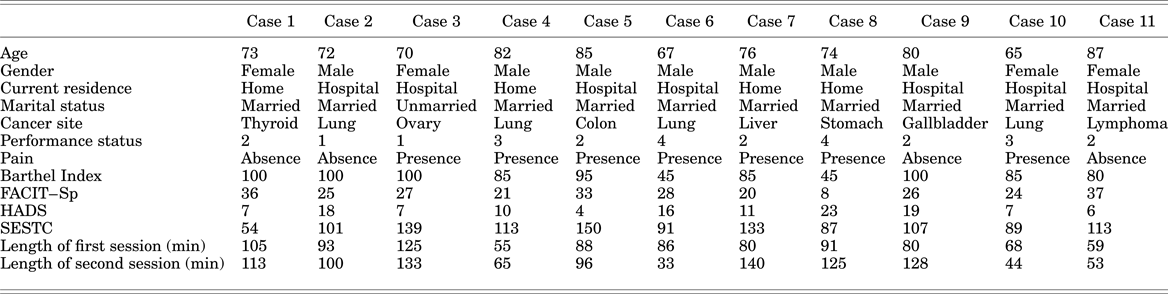
The background data on the 11 subjects who completed the intervention (7 males, 4 females; mean age 75.54 ± 7.2 years), their baseline FACIT–Sp, HADS, and SESTC scores, and the time required to complete sessions are presented in Table 1.
Background data for the 11 subjects who completed the intervention
FACIT–Sp: Functional Assessment of Chronic Illness Therapy–Spiritual; HADS: Hospital Anxiety and Depression Scale; SESTC: Self-Efficacy Scale for Terminal Cancer.
Changes in Evaluation Scale Scores
An examination of the changes in FACIT–Sp scores before and after the intervention showed that the mean score for Meaning of Life/Peace changed from 17.0 ± 5.3 to 22.8 ± 5.3 (p = 0.004), the mean score for Faith changed from 8.6 ± 3.2 to 12.0 ± 3.0 (p = 0.001), and the mean total score changed from 25.9 ± 8.1 to 34.9 ± 17.5 (p = 0.002).
An examination of the changes in HADS scores before and after the intervention showed that the mean score for anxiety changed from 5.6 ± 4.6 to 2.8 ± 2.0 (p = 0.034), the mean score for depression changed from 6.0 ± 2.4 to 3.6 ± 2.5 (p = 0.042), and the mean total score changed from 11.6 ± 6.3 to 6.4 ± 3.7 (p = 0.026).
An examination of the changes in SESTC scores before and after the intervention showed that, while the mean score for ARE increased significantly from 30.6 ± 16.0 to 39.0 ± 11.5 (p = 0.040), no significant differences in mean scores for SCE (p = 0.967) or ADE (p = 0.208) or total mean scores (p = 0.284) were observed.
Impressions of the Intervention
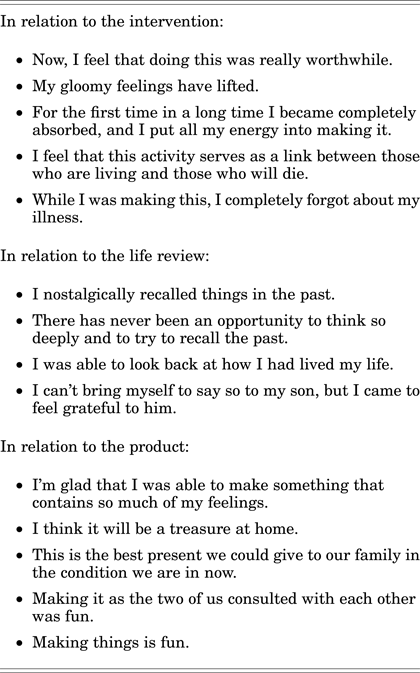
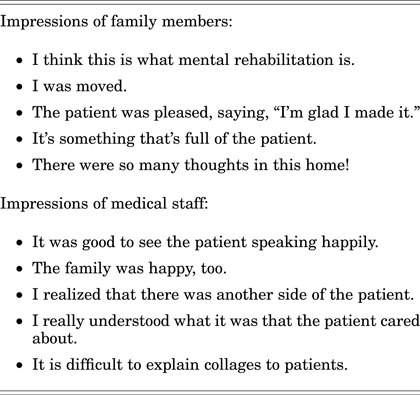
Some of the summations of the impressions of the subjects, families, and medical staff members after completion of the intervention are given in Tables 2 and 3, where one can see that generally favorable evaluations were heard from family members and medical staff as well as from subjects. However, several participants had not grasped the full picture before the start of the collage activity, and this limitation is also listed as an impression.
Impressions of subjects
Impressions of family members and medical staff
DISCUSSION
As a result of performing the collage activity based on a life review, the FACIT–Sp scores of the 11 subjects in this study increased significantly, while their HADS scores decreased significantly. These results suggest that the intervention can be effective in increasing the spiritual well-being of patients, similar to the findings of previous studies (Ando et al., Reference Ando, Tsuda and Morita2007a,Reference Ando, Morita and O'Connorb; Reference Ando, Morita and Okamoto2008; Reference Ando, Morita and Akechi2010a,Reference Ando, Morita and Miyashitab). Our results also suggest that the intervention may be simultaneously effective for mitigating anxiety and depression. Moreover, the score for the ARE subscale of the SESTC also increased significantly. Hirai and colleagues (Reference Hirai, Suzuki and Tsuneto2002) regarded improvements in the scores for this subscale to be a primary factor with direct effects on anxiety and depression. The level of self-efficacy has also been widely reported (Ewart, Reference Ewart and Maddux1995; Beckham et al., Reference Beckham, Burker and Lytle1997) to affect psychological adjustment, as corroborated by the results of our present study. Bandura (Reference Bandura1977) explained self-efficacy as a subjective determination that “I am capable of doing this,” and the “successful experience” of “even I can do that” was remarked upon among the impressions expressed after the intervention. It is suggested that this boost in confidence felt by subjects was linked to the increase in scores for this scale.
By contrast, no significant changes in feelings of efficacy in relation to physical symptoms or ADL were seen. This finding regarding feelings of efficacy as they relate to physical symptoms may have been attributable to the fact that none of the patients in this study complained of cancer pain severe enough to require the intervention to be stopped before completion, and symptom control in these patients was relatively good. Many participants had sufficient stamina to concentrate and spend time performing the life review and collage activity beyond the time that had been scheduled. The mean Barthel Index score before the intervention was 83.6 ± 20.5, and the fact that subjects' original ADL capacity was relatively high might have been related to the results for efficacy in relation to the ADL. In particular, after excluding the subjects with a PS of four, the ADL of the nine remaining subjects was high, and they were able to perform basic body movements and their own body care movements independently.
According to the impressions of the subjects after completion of the intervention, their memories and past experiences were recalled, and most of the subjects spoke animatedly, saying that the intervention created feelings of nostalgia. Moreover, while looking at the finished product, some subjects evaluated the product highly, saying that it was a “treasure” or their “best present,” and some said that by becoming engrossed in the collage activity they had forgotten about their illness, if only for a short time, and that they had been able to spend time in a meaningful way. These impressions were thought to have been affected by an improvement in the subjects' state of mind as a result of the self-affirmation and self-esteem created by the collage activity, during which the subjects enjoyed expressing themselves. Moreover, since the impression that “this activity serves as a link between those who are alive with those who will die” was also expressed, discussions of the continuity of relationships and one's own impermanence might have contributed to the spiritual care that is involved in relationships.
Among the impressions of the families who participated in the collage activity together with the subject, there were descriptions of the intervention as a “spiritual rehabilitation,” and the family members thought favorably of the intervention, saying that the subjects themselves had enjoyed the activity. In addition, subjects' family members stated that they discovered new aspects of the subjects through this activity and that this activity was an opportunity for them to renew their knowledge of the subjects' feelings. It is said that people do not often express their feelings to others in Japan as compared to the situation in other countries (Benedict, Reference Benedict2006). Therefore, this activity seems to be more deeply significant as a tool with which subjects and their families communicate each other's feelings. As an approach to the family, Tajiri and colleagues (Reference Tajiri, Ichikawa, Tsuji and Tsuji2006) pointed out that creating the product by working with and drawing closer to the patient is linked to a sense of achievement, and that in many cases the feeling of satisfaction of having been able to do something for the patient had an effect with regard to their psychological care. Thus, this activity may have also provided psychological care for the family as well. The results may be a possible avenue for future research. Furthermore, impressions were heard from the medical staff members that they had discovered new aspects of the subjects through the finished product, and that they had reconfirmed that it was something the subjects considered important. Moreover, the product was shown to not only link the subject and family as a means of communication, but also to have served as a topic for interaction between the staff and the subject.
This study has some limitations. The first is that, although only self-reported question sheets were used to evaluate the results of an intervention, whenever it was difficult for the subject to fill out the sheets because of physical problems the author read the questions aloud to the subject, and sometimes they read through the questions and filled out the sheets together. As a result, the evaluation methods sometimes varied according to the evaluator, and several biases may have occurred as a result. Second, because a control group was not included, the results may not be attributable to only the collage activity. The use of a control group and a controlled study design is needed for future studies. Third, no psychosocial changes over time were demonstrated after the product was completed. A detailed follow-up in addition to evaluations before and after performing the collage activity are needed. Finally, we configured the sessions based on the brief reminiscence method to avoid taxing patients. However, the possibility of adequately reviewing a life in such a short period of time is not clear. It should be better to have a greater number of smaller interviews where more adequate information could be gathered without overtaxing patients.
CONCLUSIONS
The possibility of objective and subjective effectiveness of a collage activity based on a life review was demonstrated in elderly cancer patients. Our results suggest that collage activity can be effective in improving spiritual well-being, mitigating anxiety and depression, and improving self-efficacy. In addition, in terms of the impact of the work activity on subjects and their family members, the product was shown to be useful as a tool for interacting with others, including family members, and that the activity was capable of providing psychological care to family members who performed the activity together with the subject. Future studies are needed where the activity is actually put into practice so that the link between a collage activity based on a previous life review and an improvement in the quality of life of patients and their families can be clarified as a useful psychosocial approach to treatment of elderly cancer patients.